
BuddhistCatholicContemplativeEvangelicalGeneral ChristianHinduJewishLatter-day SaintMuslimNew VisionsProgressive Christian
Beliefs
- Buddhist
- Catholic
- Contemplative
- Evangelical
- General Christian
- Hindu
- Jewish
- Latter-day Saint
- More Voices
- Muslim
- New Visions
- Pagan
- Progressive Christian
Topics
- Religion News
- Food and Religion
- Sports and Religion
- Religious Art
- Religious Music and Entertainment
- Religious Events
- History and Religion
- Style and Religion
- Politics and Religion
- Women in Religion
- Recreation Outdoors and Religion
- Business Finance and Religion
- Careers Workplace and Religion
- Education and Religion
- Family Parenting and Religion
- Health Fitness and Religion
- Home and Religion
- Relationships and Religion
- Technology and Religion
- Travel and Religion
Columnists
- Buddhist Columnists
- Business Finance and Religion Columnists
- Careers Workplace and Religion Columnists
- Catholic Columnists
- Contemplative Columnists
- Education and Religion Columnists
- Evangelists Columnists
- Family Parenting and Religion Columnists
- General Christian Columnists
- Health Fitness and Religion Columnists
- Hindu Columnists
- History and Religion Columnists
- Home and Religion Columnists
- Jewish Columnists
- More Voices Columnists
- Latter Day Columnists
- Muslim Columnists
- New Visions Columnists
- Nonreligious Columnists
- Pagan Columnists
- Politics and Religion Columnists
- Progressive Columnists
- Recreation Outdoors and Religion Columnists
- Relationships and Religion Columnists
- Religion News Columnists
- Religious Art Columnists
- Religious Events Columnists
- Religious Music and Entertainment Columnists
- Sports and Religion Columnists
- Style and Religion Columnists
- Technology and Religion Columnists
- Travel and Religion Columnists
- Women in Religion Columnists
Resource Library
- 2026 Calendar
- Library of World Religions
- The 100 Most Holy Places on Earth
- Patheos Answers
- Podcasts
- Videos
- Faith Leaders Database
- Anglican Episcopalian
- Bahai
- Baptist
- Buddhism
- Christianity
- Confucianism
- Eastern Orthodoxy
- Hinduism
- Holiness and Pentecostal
- ISKCON
- Islam
- Judaism
- Lutheran
- Methodist
- The Church of Jesus Christ of Latter-day Saints
- New Age
- Paganism
- Presbytarian and Reformed
- Protestantism
- Religion Behind the Scenes
- Roman Catholic
- Scientology
- Shia Islam
- Sikhism
- Sufism
- Sunni Islam
- Taoism
- Zen
- See all religions
Research Tools
 Ad-Free & Subscriber Log-In Subscription Support
Ad-Free & Subscriber Log-In Subscription Support
Follow Patheos 

- Trending:
- Forgiveness
- |
- Marriage
- |
- Consciousness
- |
- Death Penalty
- |
- Election
- |
- Halloween

-
About
-
Catholic Apologetics
-
Church History
-
Great Apologists
-
Christian Worldview
-
Protestantism & Misc.
- Home
- Catholic
- History and Religion
- Bp. Schneider Evokes Luther’s Disdain for Councils
Bp. Schneider Evokes Luther’s Disdain for Councils
Last updated on: June 6, 2026 at 12:42 am by Dave Armstrong
Bp. Schneider Evokes Luther’s Disdain for Councils 2026-06-06T00:42:44-04:00 Dave Armstrong
Patheos Explore the world's faith through different perspectives on religion and spirituality! Patheos has the views of the prevalent religions and spiritualities of the world.
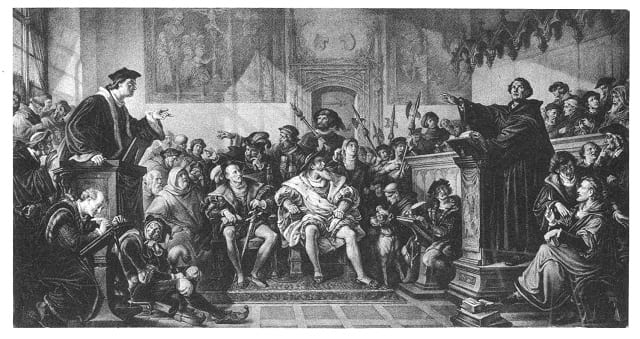
There are certain things I have constantly asserted with regard to radical Catholic reactionaries, in the 20+ years I have closely studied them and refuted their errors (including two books written about them, in 2002 and 2012). One of these is that their mentality or spirit of arbitrary “picking-and-choosing” what they will accept or reject of the Church’s teaching and authority is exactly like that of 1) theologically liberal / dissident / modernist Catholics (real or so-called) and 2) Protestants (particularly like Martin Luther).
Both the dissident and the Protestant, of course, reject the authority of ecumenical councils, or at least portions of the councils that they personally dislike (a false notion of private judgment and supposed “supremacy of conscience”). Likewise, radical Catholic reactionaries, whose target of loathing is, and has been for now 55 years, the Second Vatican Council. Here are a few of my past statements:
Obviously, then, according to reactionaries, the Church is in dire straits. As in the view of Martin Luther, the Church has descended into darkness, and brave prophets have now been raised to bring it back to life. Luther seemed to think of himself as some sort of prophet-figure, too. As reactionaries seem to follow his example in many other ways, why not this one, also? (2002)
Who determines what is “novel” anyway? The pope and the bishops, or reactionaries? How is reactionary dissent and selectivity of what they will follow different from what Luther maintained in 1517 and (especially) 1521? He wanted to stand there and say he knew better than the Church, and it was “self-evident,” etc. that the Church was wrong in this and that teaching. Reactionaries vainly think that they can determine what is a legitimate development, apart from the mind of the Church and the official pronouncements of the Magisterium? Curious . . . (2-27-02)
This is exactly what Luther did with Catholic tradition as a whole (admittedly to a much greater degree, but the principle of authority is very similar), when he defected and started up a new movement. I see little difference in principle at all. He claims that he was the “reformer”; bringing things back to the good old days; restoring the gospel that had supposedly been lost or at least deeply hidden, and getting rid of the crusty barnacles of mere traditions of men.
Reactionaries and some “traditionalists” think they are the bearers of the authentic tradition, and if popes and councils disagree with you, so much the worse for them; they’re wrong (just as Luther freely, breezily said that various councils were). That is Luther, through and through, . . . (2012)
In effect, they become their own popes: exercising private judgment in an unsavory fashion, much as (quite ironically) Catholic liberals do, and as Luther and Calvin did when they rebelled against the Church. They can’t live and let live. They must assume a condescending “superior-subordinate” orientation. (2012)
Key to Martin Luther’s initial dissent and eventual schism and heresy was his antipathy to ecumenical councils, and claim that they contradicted each other. Luther, early on, denied both papal and conciliar authority. He hadn’t yet done this in his 95 Theses of 1517. But he certainly by the time of the 18-day Leipzig Disputation of July 1519, with John Eck, where Luther was essentially pressed — a victim of his own faulty logic and ecclesiological understanding — into adopting something akin to sola Scriptura, and rejecting papal and conciliar infallibility.
Well-known Luther biographer Roland Bainton notes how Luther’s accusing the pope of committing serious errors in 1518 was “upping the ante” of the brewing theological controversy considerably:
[I]n the interim Luther had attacked not only the papal power to loose but also the power to bind through the ban. He had further declared the pope and councils to be capable of error. (Here I Stand, New York: Mentor, 1950, 78-79)
Bainton recounts the dramatic climax of the debate:
“Let me talk German,” demanded Luther. “I am being misunderstood by the people. I assert that a council has sometimes erred and may sometimes err. Nor has a council authority to establish new articles of faith. A council cannot make divine right out of that which by nature is not divine right. Councils have contradicted each other, for the recent Lateran Council has reversed the claim of the councils of Constance and Basel that a council is above a pope. A simple layman armed with Scripture is to be believed above a pope or a council without it. As for the pope’s decretal on indulgences I say that neither the Church nor the pope can establish articles of faith. These must come from Scripture. For the sake of Scripture we should reject pope and councils.”
“But this,” said Eck, “is the Bohemian virus, to attach more weight to one’s own interpretation of Scripture than to that of the popes and councils, the doctors and the universities. When Brother Luther says that this is the true meaning of the text, the pope and councils say, ‘No, the brother has not understood it correctly.’ Then I will take the council and let the brother go. Otherwise all the heresies will be renewed. They have all appealed to Scripture and have believed their interpretation to be correct, and have claimed that the popes and the councils were mistaken, as Luther now does. It is rancid to say that those gathered in a council, being men, are able to err. This is horrible, that the Reverend Father against the holy Council of Constance and the consensus of all Christians does not fear to call certain articles of Hus and Wyclif most Christian and evangelical. I tell you, Reverend Father, if you reject the Council of Constance, if you say a council, legitimately called, errs and has erred, be then to me as a Gentile and a publican.” (Ibid., 90)
And more generally, at the Diet of Worms in 1521, Luther famously stated:
Unless I am convinced by the testimony of the Scriptures or by clear reason (for I do not trust either in the pope or in councils alone, since it is well known that they have often erred and contradicted themselves), I am bound by the Scriptures I have quoted and my conscience is captive to the Word of God. I cannot and will not recant anything, since it is neither safe nor right to go against conscience.
Luther was spewing historical falsehood here. The Councils of Constance and Basel (rightly understood as being ratified by popes, as councils always were) did not teach that councils were above popes. I wrote three lengthy articles documenting this beyond all doubt, in 2004:
Was Medieval Ecclesiology “Fallibilist Conciliarism”?
Conciliarism: “Orthodox” Option in Medieval Catholicism?
Council of Constance (1414-18): Triumph or Death of Conciliarism?
Now, lo and behold, now comes reactionary Bishop Athanasius Schneider, using the identical flawed arguments of Luther, in his push to discredit Vatican II (by analogy). He argued (in a statement dated 6-24-20) that the Council of Constance was contradicted by both popes and later councils:
With a Bull in 1425, Martin V approved the decrees of the Council of Constance and even the decree ‘Frequens’ — from the 39th session of the Council (in 1417). This decree affirmed the error of conciliarism, i.e., the error that a Council is superior to a Pope. However, in 1446, his successor, Pope Eugene IV, declared that he accepted the decrees of the Ecumenical Council of Constance, except those (of sessions 3 – 5 and 39) which ‘prejudice the rights and primacy of the Apostolic See’ (absque tamen praeiudicio iuris, dignitatis et praeeminentiae Sedis Apostolicae). Vatican I’s dogma on papal primacy then definitively rejected the conciliarist error of the Ecumenical Council of Constance.
It so happens that this historical inaccuracy has been corrected by Cardinal Walter Brandmüller, president from 1998 to 2009 of the Pontifical Committee for Historical Sciences:
The Council of Constance (1415-1418) put an end to the schism that had divided the Church for forty years. In that context, it has often been stated – and recently repeated – that this council, with the decrees ‘Haec sancta’ and ‘Frequens’, defined conciliarism, the superiority of the council over the pope.
But this is not true at all. The assembly that issued those decrees was by no means an ecumenical council authorized to define the doctrine of the faith. It was instead an assembly of none but the followers of John XXIII (Baldassarre Cossa), one of the three ‘popes’ who were contending at that time over the leadership of the Church. That assembly had no authority.
The schism lasted until the assembly of Constance was joined by the other two parties as well, meaning the followers of Gregory XII (Angelo Correr) and the ‘natio hispanica’ of Benedict XIII (Pedro Martinez de Luna), which happened in the autumn of 1417. Only from that moment on did the ‘council’ of Constance become a true ecumenical council, albeit still without the pope who was eventually elected.
So all the proceedings of that first ‘incomplete’ phase of the council and its documents did not have the slightest canonical value, although they were effective at the political level in those circumstances. After the end of the council the new and only legitimate pope, Martin V, confirmed the documents issued by the ‘incomplete’ pre-conciliar assembly, except for ‘Haec sancta’, ‘Frequens’, and ‘Quilibet tyrannus’.
‘Frequens’, valid because it had been issued by the three former factions in concert, did not require confirmation. But it does not teach conciliarism at all, nor is it a doctrinal document, but simply regulates the frequency of the convening of councils.
Cardinal Walter Brandmüller also corrected a second falsehood that Bp. Schneider stated as regards the Council of Florence (1439-1445).
If Bishops Schneider and Vigano (who is calling for completely rejecting Vatican II) are arguing precisely as Luther did in the 16th century, and making this a centerpiece of their wrongheaded, scandalous, outrageous rebellion, does that bode well for its future? Does it suggest that their thinking is thoroughly Catholic, or that it already has at least the spirit of schism and heresy in it, or elements of same? Is this not a stark red flag and warning signal?
***
Photo credit: Leipzig Disputation between Martin Luther and John Eck (1519), painting (c. 1866) by Julius Hübner (1806-1882) [public domain / Wikimedia Commons]

***
Traditionalism vs. Radical Catholic Reactionaries
Archbishop Athanasius Schneider
Athanasius Schneider & Vatican II
indefectibility of the Catholic Church
Radical Catholic Reactionaries
Previous Post
July 16, 2020
Anti-Francis = Anti-Vatican II (You Heard it Here First)
Next Post
July 19, 2020 Luther & Killing Catholics: James Swan Butchers My Views
Browse Our Archives
Select a Category & Last Things About Me Anti-Catholicism Atheism & Agnosticism Baptism and Sacramentalism Bible and Tradition Blessed Virgin Mary Books by Dave Armstrong C. S. Lewis Calvinism & General Protestantism Catholic Apologetics Catholic Apologists Catholic conversion Catholic converts Christmas Church (Ecclesiology) Church History Conversion and Converts Development of Doctrine Eastern Orthodoxy Ecumenism & Christian Unity Eucharist & Liturgy Fathers of the Church French Translations G. K. Chesterton Hell Hell & Satan Hell & Satan & Last Things Heresies & Comparative Religion Holistic Health Inquisition & Crusades & Scandals James White Jews & Judaism & Old Testament John Calvin John Henry Newman Liberal / Modernist Theology Life Issues Literary Resume Lutheranism Mariology Martin Luther Music Orthodoxy Papacy & Infallibility Personal Page Philosophy & Science Political & Ethical & Moral Issues Protestant Persecution & Intolerance Protestantism Purgatory Purgatory & Penance Romantic & Imaginative Theology Saints & Purgatory & Penance Salvation Salvation & Justification Satan & Last Things Sexuality and Gender Issues Spanish Translations Traditionalism vs. Radical Catholic Reactionaries Traducciones al español / tradução para português Trinitarianism & Christology Uncategorized Videos
Select a Month October 2026 September 2026 August 2026 July 2026 June 2026 May 2026 April 2026 March 2026 February 2026 January 2026 December 2025 November 2025 October 2025 September 2025 August 2025 July 2025 June 2025 May 2025 April 2025 March 2025 February 2025 January 2025 December 2024 November 2024 October 2024 September 2024 August 2024 July 2024 June 2024 May 2024 April 2024 March 2024 February 2024 January 2024 December 2023 November 2023 October 2023 September 2023 August 2023 July 2023 June 2023 May 2023 April 2023 March 2023 February 2023 January 2023 December 2022 November 2022 October 2022 September 2022 August 2022 July 2022 June 2022 May 2022 April 2022 March 2022 February 2022 January 2022 December 2021 November 2021 October 2021 September 2021 August 2021 July 2021 June 2021 May 2021 April 2021 March 2021 February 2021 January 2021 December 2020 November 2020 October 2020 September 2020 August 2020 July 2020 June 2020 May 2020 April 2020 March 2020 February 2020 January 2020 December 2019 November 2019 October 2019 September 2019 August 2019 July 2019 June 2019 May 2019 April 2019 March 2019 February 2019 January 2019 December 2018 November 2018 October 2018 September 2018 August 2018 July 2018 June 2018 May 2018 April 2018 March 2018 February 2018 January 2018 December 2017 November 2017 October 2017 September 2017 August 2017 July 2017 June 2017 May 2017 April 2017 March 2017 February 2017 January 2017 December 2016 November 2016 October 2016 September 2016 August 2016 July 2016 June 2016 May 2016 April 2016 March 2016 February 2016 January 2016 December 2015 November 2015 October 2015 September 2015 August 2015 July 2015 June 2015 May 2015 April 2015 March 2015 February 2015 January 2015 December 2014 November 2014 October 2014 September 2014 August 2014 July 2014 June 2014 April 2014 March 2014 February 2014 January 2014 December 2013 November 2013 October 2013 September 2013 August 2013 July 2013 June 2013 April 2013 March 2013 February 2013 January 2013 December 2012 November 2012 October 2012 September 2012 August 2012 July 2012 June 2012 May 2012 April 2012 March 2012 February 2012 January 2012 December 2011 November 2011 October 2011 September 2011 August 2011 July 2011 June 2011 April 2011 March 2011 February 2011 October 2010 September 2010 August 2010 July 2010 April 2010 March 2010 December 2009 October 2009 August 2009 July 2009 June 2009 May 2009 March 2009 February 2009 October 2008 September 2008 April 2008 March 2008 February 2008 January 2008 December 2007 November 2007 October 2007 May 2007 March 2007 February 2007 January 2007 November 2006 October 2006 September 2006 August 2006 July 2006 June 2006 May 2006 April 2006 March 2006 February 2006 October 2005 June 2005 April 2005 February 2005 July 2004 May 2004 April 2004
Follow Us!
TAKE THE
Religious Wisdom Quiz
Who fell out of a window and was restored to life by Paul?
Select your answer to see how you score.
Silas Barnabas Eutychus Timothy
Books by This Author Books by Dave Armstrong
Related posts from Biblical Evidence for Catholicism

Jesus Founded the [Catholic] Church. If Not Him,...
Biblical Evidence for Catholicism

Jerusalem Council vs. James White & Sola Scriptura
Biblical Evidence for Catholicism

Apostolic Succession: 40 Biblical Arguments
Biblical Evidence for Catholicism

350 Bible Passages vs. Sola Scriptura
Biblical Evidence for Catholicism
TRENDING AT PATHEOS Catholic

In "Irreplaceable," our book on vocation and technology, Trevor Sutton and I...

I was strolling through the top floor of the brand new Parthenon...

What Does Gêvâh Mean For Kimberley Guifoyle &...
This week, a lot of the news is focused on Kimberly Guilfoyle....

INNER CIRCLE: Profound Mystery (Of Christ In All...
Ephesians 5:31-32 “For this reason, a man will leave his father and...

Do Not Rejoice When Your Enemy Falls: The...
Turning an execution into a public spectacle is a disturbing expression of...

'The Chosen' S6 Trailer: The Passion Gets Very...
Not many watching 'The Chosen' worry about spoilers, but just because they...
view all Catholic blogs
Ad-Free & Subscriber Log-In Subscription Support
- About Us
- 2026 Calendar
- Videos
- Podcasts
- Library of World Religions
- Faith In Media Tracker
- Advertise With Us
- Write for Us
- Privacy Policy
- Terms of Service
- Do Not Sell My Data
- Contact Us
- Radiant Digital
- Manage Newsletter Subscriptions
- Unsubscribe From Notifications
- Sitemap
Copyright 2008-2026, Patheos. All rights reserved.
Subscription Support Ad-Free & Subscriber Log-In
Follow Patheos