
BuddhistCatholicContemplativeEvangelicalGeneral ChristianHinduJewishLatter-day SaintMuslimNew VisionsProgressive Christian
Beliefs
- Buddhist
- Catholic
- Contemplative
- Evangelical
- General Christian
- Hindu
- Jewish
- Latter-day Saint
- More Voices
- Muslim
- New Visions
- Pagan
- Progressive Christian
Topics
- Religion News
- Food and Religion
- Sports and Religion
- Religious Art
- Religious Music and Entertainment
- Religious Events
- History and Religion
- Style and Religion
- Politics and Religion
- Women in Religion
- Recreation Outdoors and Religion
- Business Finance and Religion
- Careers Workplace and Religion
- Education and Religion
- Family Parenting and Religion
- Health Fitness and Religion
- Home and Religion
- Relationships and Religion
- Technology and Religion
- Travel and Religion
Columnists
- Buddhist Columnists
- Business Finance and Religion Columnists
- Careers Workplace and Religion Columnists
- Catholic Columnists
- Contemplative Columnists
- Education and Religion Columnists
- Evangelists Columnists
- Family Parenting and Religion Columnists
- General Christian Columnists
- Health Fitness and Religion Columnists
- Hindu Columnists
- History and Religion Columnists
- Home and Religion Columnists
- Jewish Columnists
- More Voices Columnists
- Latter Day Columnists
- Muslim Columnists
- New Visions Columnists
- Nonreligious Columnists
- Pagan Columnists
- Politics and Religion Columnists
- Progressive Columnists
- Recreation Outdoors and Religion Columnists
- Relationships and Religion Columnists
- Religion News Columnists
- Religious Art Columnists
- Religious Events Columnists
- Religious Music and Entertainment Columnists
- Sports and Religion Columnists
- Style and Religion Columnists
- Technology and Religion Columnists
- Travel and Religion Columnists
- Women in Religion Columnists
Resource Library
- 2026 Calendar
- Library of World Religions
- The 100 Most Holy Places on Earth
- Patheos Answers
- Podcasts
- Videos
- Faith Leaders Database
- Anglican Episcopalian
- Bahai
- Baptist
- Buddhism
- Christianity
- Confucianism
- Eastern Orthodoxy
- Hinduism
- Holiness and Pentecostal
- ISKCON
- Islam
- Judaism
- Lutheran
- Methodist
- The Church of Jesus Christ of Latter-day Saints
- New Age
- Paganism
- Presbytarian and Reformed
- Protestantism
- Religion Behind the Scenes
- Roman Catholic
- Scientology
- Shia Islam
- Sikhism
- Sufism
- Sunni Islam
- Taoism
- Zen
- See all religions
Research Tools
 Ad-Free & Subscriber Log-In Subscription Support
Ad-Free & Subscriber Log-In Subscription Support
Follow Patheos 

- Trending:
- Forgiveness
- |
- Marriage
- |
- Consciousness
- |
- Death Penalty
- |
- Election
- |
- Halloween

-
About
-
Catholic Apologetics
-
Church History
-
Great Apologists
-
Christian Worldview
-
Protestantism & Misc.
- Home
- Catholic
- History and Religion
- The Imitation of the Blessed Virgin Mary
The Imitation of the Blessed Virgin Mary
Last updated on: June 18, 2020 at 3:33 pm by Dave Armstrong
The Imitation of the Blessed Virgin Mary 2020-06-18T15:33:00-04:00 Dave Armstrong
Patheos Explore the world's faith through different perspectives on religion and spirituality! Patheos has the views of the prevalent religions and spiritualities of the world.
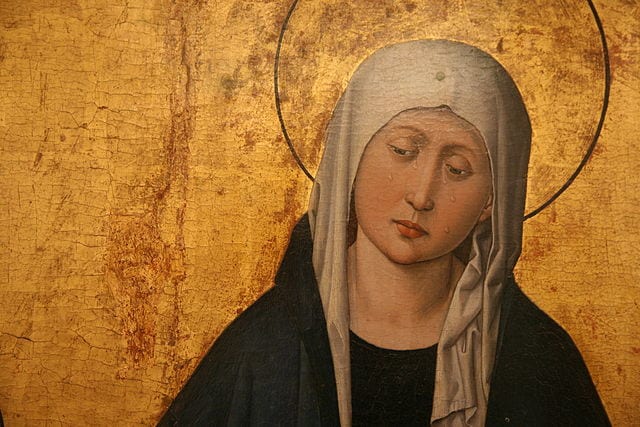
(written in 1997)
***
[This is one of my own very favorite papers]
* * *
A Catholic friend asked me:
Hey, I’ve got an apologetics question that I’ve been trying to answer for months (from my wife). She has trouble identifying with Mary because of Mary’s Immaculate Conception. In my wife’s mind, the special graces given to Mary through the perfect relationship she had (has) with God, make it impossible for the rest of us to emulate/imitate her. She keeps repeating the assertion that “it would have been more of a miracle if God chose a normal woman by which to enter the world.”
I am a convert from Evangelical Protestantism. She was raised in that environment and is now attending Mass, but not yet Catholic. The Marian doctrines seem to be her final stumbling stone (which I can fully understand, since they were mine also).
My answer:
Well, this is a good question. I’ll do my best to take a crack at it. All of us miserable sinners find ourselves in an awkward position when it comes to God and perfect people like the Blessed Virgin Mary. I would come at this from several different angles:
First, we need to distinguish between relating to Mary and emulating her. Since she was indeed without sin (both original and actual), in that sense it is of course difficult to “walk in her shoes,” so to speak. Yet, when it comes to imitation, it is a fact of life that in our better moments we all strive to emulate people who are “superior” to us, whom we admire and look up to — those who have succeeded in areas we still yearn for and dream about.
That’s what all the talk about “role models” is about. If we didn’t have a high goal to strive for, how could we improve and become the type of people we want to be? More on this later.
Second, what Catholics have most revered about Mary through the centuries (I think) is her humility and willingness to be mightily used by God as the Theotokos (God-bearer). In this sense she is like us: a mere human being who said yes to God, thus reversing the no of Eve (hence her designation as the Second Eve in the Fathers). This is the Mary of the Annunciation (Lk 1:38; cf 1:48).
Now, one might counter with the objection that she had to say yes, being sinless, yet Catholics would not hold to that assertion, since we also believe in free will. It is true of all of us that we must agree to accept and cooperate with the graces that always originate from God (e.g., 1 Cor 3:8-9; 15:10; 2 Cor 6:1). We are, in a sense, “co-laborers” with God. We do not adhere to fatalism or determinism (even Calvinists deny that they hold such a view).
If we take the logic that she “had to do it,” therefore it wasn’t meritorious, to its logical conclusion, we would also have to say that God’s voluntary good actions are not good, since He is unable — by the nature of things — to sin. So we assert that Mary did the right thing, and that she was a created human being like the rest of us, even though without sin, and that this is both her glory and her commonality with us.
Third, Mary is not intrinsically superior in essence to the rest of us. She received from God all of the grace which she possessed in abundance (Lk 1:28 — full of grace in some translations). She was merely given more of it at one time, and earlier, than us. All human beings who are to be saved for eternity in heaven will one day be without sin, unstained, immaculate, just as Mary was from conception, and just as all of us were meant to be, but for the Fall of Adam and Eve. That’s why Cardinal Newman said it was easier to believe in the Immaculate Conception than it was to accept the fact that all human beings are conceived in original sin, since it was one mere exception to the universal rule.
Fourth, while it is appealing in a sense to ponder a sinful Mary whom God could have used as well (which is indeed not an impossible hypothetical scenario — and one I used to argue also), God chose, rather, to make her sinless since this was appropriate for the ark of the new covenant who carried God incarnate and shared even her own blood with Him in utero. So God chose to act in a special way to preserve Mary from sin.
I don’t think it is unreasonable at all to believe that He would do that, given that He will eventually cleanse totally all saved persons so that they will be fit for heaven. If we must be clean to enter heaven and stand in God’s presence (Rev 21:27), then it seems only proper for the Mother of God to possess a commensurate righteousness for that unfathomable task, privilege, and honor. In fact, if I were her, I would much rather have been granted that special grace than to have to face that awesome situation as a sinner!
Fifth, there are plenty of other sinful, “weak” models in Scripture that we can relate to as like us in that sense: vacillating, overzealous Peter, perhaps proud, tempestuous Paul, stuttering Moses and his wimpy brother Aaron, blame-shifting Adam, murderous and adulterous David, doubting Thomas, deceptive Jacob, sexually weak Samson, drunken, incestuous Noah, etc. I don’t think it is implausible for God to spare one, lone human being (His earthly mother at that) from the onslaught of original sin. In fact, I wonder myself why He didn’t make more people sinless!
*
Finally, getting back to the first point, I think this objection fails in the final analysis because it is unscriptural, for the following reasons: we are commanded to imitate the Apostle Paul and other saints (1 Cor 4:16; Phil 3:17; 2 Thess 3:7-9; cf. Jas. 5:10-11; Heb 6:12 and ch. 11), which is difficult enough. Paul sinned as we do, but he also did extraordinary things that in all likelihood we will never accomplish. He was an Apostle! Yet we are called to “imitate” him. Christianity is filled with this sort of striving for what in fact is virtually unattainable in this lifetime.
This is one of the many paradoxes of our faith. We may not achieve a 100% grade, but we can shoot for a 90%, or 80% (speaking of sanctification, not the grounds of salvation), as God allows, and as we are faithful in allowing Him to do His work in us. The ideals are always there to shoot for.
Now, the rub is that Paul in turn, imitates Christ, and calls for us to do that as well (1 Cor 11:1; 1 Thess 1:6). Here we are in the same boat as with Mary, and much more so, since this is God Incarnate. Obviously we will not “imitate” Him perfectly, but we are called to do our best, and live by His example. And in our Lord Jesus we find the same humility (of course even more profound) that we find in Mary: He humbled Himself first by giving up divine prerogatives and becoming man (Phil 2:5-7) and then dying on the cross (Phil 2:8).
It is one of the glories of the Incarnation itself: the fact that God would so humble Himself out of love for us, as to become one of us — like His own creatures. C. S. Lewis compared that act to a person becoming an ant. We don’t say that we can’t relate to Christ because He is God, but that we can relate to Him since He is a man:
Hebrews 4:15 (NRSV) For we do not have a high priest who is unable to sympathize with our weaknesses, but we have one who in every respect has been tested as we are, yet without sin. (cf. 4:16; 5:7-8; 2:17-18; Is 53:3; 2 Cor 5:21; 1 Pet 2:19-21)
Therefore, since we are expressly informed in Scripture that Jesus our Lord and God, who did not and could not sin, can nevertheless relate to us, “sympathize with our weaknesses,” and has been tested like us “in every respect,” we can relate all the more so to Mary, who is a creature as we are, yet without sin. In other words, it is not sinlessness which is inherently opposed to human nature, as if sin and concupiscence were the “normal” state. Rather, it is sin which is “unhuman,” since it stands in the way of what God intended for the human race, and what will one day indeed be accomplished among the saved and the elect.
Thus, Mary is more “human” than all of us, and therefore can help us (by example and intercession) to be what we should be: more like Jesus, her beloved Son, and less in bondage to sin. She is the example of what all of us can be more and more in this life, and what we assuredly will essentially be in the next if we persevere in the faith.
Catholic Christianity recognizes and venerates the Blessed Virgin Mary, the Immaculate Mother of God, as the exemplar of what redeemed humanity will one day be: the forerunner, the quintessential Christian and symbol of the Church itself, our Spiritual Mother and Queen of Heaven, who was spared by God’s grace the curse of death and immediately received her glorious resurrected body after her earthly sojourn had come to an end. And that’s why we and others have fulfilled the prophecy that Mary gave concerning herself:
Luke 1:48b . . . from now on all generations will call me blessed.
And why is she blessed?:
Luke 1:49 for the Mighty One has done great things for me, and holy is his name.
Mary is always glorifying God the Father and Jesus, never herself, for this is her purpose and calling. All of the Marian doctrines are Christocentric. They were promulgated in the first place so that Jesus Christ would be glorified, not Mary. And this is why Catholics have venerated her above all creatures, and why any Christian can indeed “relate to” and “identify with” her, because she glorifies and imitates God, and that is what all serious Christians want to do (and are commanded to do) too.
***
Photo credit: Archetypal Gothic Lady of Sorrows from a triptych by the Master of the Stauffenberg Altarpiece, Alsace c. 1455 [Wikimedia Commons / Creative Commons Attribution 2.0 Generic license]

***
Previous Post
June 18, 2020
Cardinal Newman on the Bodily Assumption of Mary
Next Post
June 19, 2020 Dialogue: Mary’s “In Partu” Virginity (During Birth)
Browse Our Archives
Select a Category & Last Things About Me Anti-Catholicism Atheism & Agnosticism Baptism and Sacramentalism Bible and Tradition Blessed Virgin Mary Books by Dave Armstrong C. S. Lewis Calvinism & General Protestantism Catholic Apologetics Catholic Apologists Catholic conversion Catholic converts Christmas Church (Ecclesiology) Church History Conversion and Converts Development of Doctrine Eastern Orthodoxy Ecumenism & Christian Unity Eucharist & Liturgy Fathers of the Church French Translations G. K. Chesterton Hell Hell & Satan Hell & Satan & Last Things Heresies & Comparative Religion Holistic Health Inquisition & Crusades & Scandals James White Jews & Judaism & Old Testament John Calvin John Henry Newman Liberal / Modernist Theology Life Issues Literary Resume Lutheranism Mariology Martin Luther Music Orthodoxy Papacy & Infallibility Personal Page Philosophy & Science Political & Ethical & Moral Issues Protestant Persecution & Intolerance Protestantism Purgatory Purgatory & Penance Romantic & Imaginative Theology Saints & Purgatory & Penance Salvation Salvation & Justification Satan & Last Things Sexuality and Gender Issues Spanish Translations Traditionalism vs. Radical Catholic Reactionaries Traducciones al español / tradução para português Trinitarianism & Christology Uncategorized Videos
Select a Month October 2026 September 2026 August 2026 July 2026 June 2026 May 2026 April 2026 March 2026 February 2026 January 2026 December 2025 November 2025 October 2025 September 2025 August 2025 July 2025 June 2025 May 2025 April 2025 March 2025 February 2025 January 2025 December 2024 November 2024 October 2024 September 2024 August 2024 July 2024 June 2024 May 2024 April 2024 March 2024 February 2024 January 2024 December 2023 November 2023 October 2023 September 2023 August 2023 July 2023 June 2023 May 2023 April 2023 March 2023 February 2023 January 2023 December 2022 November 2022 October 2022 September 2022 August 2022 July 2022 June 2022 May 2022 April 2022 March 2022 February 2022 January 2022 December 2021 November 2021 October 2021 September 2021 August 2021 July 2021 June 2021 May 2021 April 2021 March 2021 February 2021 January 2021 December 2020 November 2020 October 2020 September 2020 August 2020 July 2020 June 2020 May 2020 April 2020 March 2020 February 2020 January 2020 December 2019 November 2019 October 2019 September 2019 August 2019 July 2019 June 2019 May 2019 April 2019 March 2019 February 2019 January 2019 December 2018 November 2018 October 2018 September 2018 August 2018 July 2018 June 2018 May 2018 April 2018 March 2018 February 2018 January 2018 December 2017 November 2017 October 2017 September 2017 August 2017 July 2017 June 2017 May 2017 April 2017 March 2017 February 2017 January 2017 December 2016 November 2016 October 2016 September 2016 August 2016 July 2016 June 2016 May 2016 April 2016 March 2016 February 2016 January 2016 December 2015 November 2015 October 2015 September 2015 August 2015 July 2015 June 2015 May 2015 April 2015 March 2015 February 2015 January 2015 December 2014 November 2014 October 2014 September 2014 August 2014 July 2014 June 2014 April 2014 March 2014 February 2014 January 2014 December 2013 November 2013 October 2013 September 2013 August 2013 July 2013 June 2013 April 2013 March 2013 February 2013 January 2013 December 2012 November 2012 October 2012 September 2012 August 2012 July 2012 June 2012 May 2012 April 2012 March 2012 February 2012 January 2012 December 2011 November 2011 October 2011 September 2011 August 2011 July 2011 June 2011 April 2011 March 2011 February 2011 October 2010 September 2010 August 2010 July 2010 April 2010 March 2010 December 2009 October 2009 August 2009 July 2009 June 2009 May 2009 March 2009 February 2009 October 2008 September 2008 April 2008 March 2008 February 2008 January 2008 December 2007 November 2007 October 2007 May 2007 March 2007 February 2007 January 2007 November 2006 October 2006 September 2006 August 2006 July 2006 June 2006 May 2006 April 2006 March 2006 February 2006 October 2005 June 2005 April 2005 February 2005 July 2004 May 2004 April 2004
Follow Us!
TAKE THE
Religious Wisdom Quiz
Where was Paul's hometown?
Select your answer to see how you score.
Damascus Tarsus Antioch Jerusalem
Books by This Author Books by Dave Armstrong
Related posts from Biblical Evidence for Catholicism

Holy Ground: Why Mary Had NO Other Children...
Biblical Evidence for Catholicism
Protestant Confessions & "Ever-Virgin" Mary
Biblical Evidence for Catholicism

Mary Wife of Clopas (Jn 19:25): Mary's Sister-in-Law?
Biblical Evidence for Catholicism

Jesus Had Four Brothers? The Bible Sez No!
Biblical Evidence for Catholicism
TRENDING AT PATHEOS Catholic

The Sermon on the Mount, Part I: Matthew...
The Sermon on the Mount, Part I (Matthew 4:12-5:12) St. Matthew moves...

What's up from Crossway: Reviewing some of their latest A few weeks...

Janie Learns the Way of the Cross: A...
Teaching children about Jesus' Passion can be challenging. Many parents and educators...

Looking For Good Catholic Writing - October 2026
He alone extends the heavens, and he walks upon the waves of...

In "Irreplaceable," our book on vocation and technology, Trevor Sutton and I...

I was strolling through the top floor of the brand new Parthenon...
view all Catholic blogs
Ad-Free & Subscriber Log-In Subscription Support
- About Us
- 2026 Calendar
- Videos
- Podcasts
- Library of World Religions
- Faith In Media Tracker
- Advertise With Us
- Write for Us
- Privacy Policy
- Terms of Service
- Do Not Sell My Data
- Contact Us
- Radiant Digital
- Manage Newsletter Subscriptions
- Unsubscribe From Notifications
- Sitemap
Copyright 2008-2026, Patheos. All rights reserved.
Subscription Support Ad-Free & Subscriber Log-In
Follow Patheos