
BuddhistCatholicContemplativeEvangelicalGeneral ChristianHinduJewishLatter-day SaintMuslimNew VisionsProgressive Christian
Beliefs
- Buddhist
- Catholic
- Contemplative
- Evangelical
- General Christian
- Hindu
- Jewish
- Latter-day Saint
- More Voices
- Muslim
- New Visions
- Pagan
- Progressive Christian
Topics
- Religion News
- Food and Religion
- Sports and Religion
- Religious Art
- Religious Music and Entertainment
- Religious Events
- History and Religion
- Style and Religion
- Politics and Religion
- Women in Religion
- Recreation Outdoors and Religion
- Business Finance and Religion
- Careers Workplace and Religion
- Education and Religion
- Family Parenting and Religion
- Health Fitness and Religion
- Home and Religion
- Relationships and Religion
- Technology and Religion
- Travel and Religion
Columnists
- Buddhist Columnists
- Business Finance and Religion Columnists
- Careers Workplace and Religion Columnists
- Catholic Columnists
- Contemplative Columnists
- Education and Religion Columnists
- Evangelists Columnists
- Family Parenting and Religion Columnists
- General Christian Columnists
- Health Fitness and Religion Columnists
- Hindu Columnists
- History and Religion Columnists
- Home and Religion Columnists
- Jewish Columnists
- More Voices Columnists
- Latter Day Columnists
- Muslim Columnists
- New Visions Columnists
- Nonreligious Columnists
- Pagan Columnists
- Politics and Religion Columnists
- Progressive Columnists
- Recreation Outdoors and Religion Columnists
- Relationships and Religion Columnists
- Religion News Columnists
- Religious Art Columnists
- Religious Events Columnists
- Religious Music and Entertainment Columnists
- Sports and Religion Columnists
- Style and Religion Columnists
- Technology and Religion Columnists
- Travel and Religion Columnists
- Women in Religion Columnists
Resource Library
- 2026 Calendar
- Library of World Religions
- The 100 Most Holy Places on Earth
- Patheos Answers
- Podcasts
- Videos
- Faith Leaders Database
- Anglican Episcopalian
- Bahai
- Baptist
- Buddhism
- Christianity
- Confucianism
- Eastern Orthodoxy
- Hinduism
- Holiness and Pentecostal
- ISKCON
- Islam
- Judaism
- Lutheran
- Methodist
- The Church of Jesus Christ of Latter-day Saints
- New Age
- Paganism
- Presbytarian and Reformed
- Protestantism
- Religion Behind the Scenes
- Roman Catholic
- Scientology
- Shia Islam
- Sikhism
- Sufism
- Sunni Islam
- Taoism
- Zen
- See all religions
Research Tools
 Ad-Free & Subscriber Log-In Subscription Support
Ad-Free & Subscriber Log-In Subscription Support
Follow Patheos 

- Trending:
- Forgiveness
- |
- Marriage
- |
- Consciousness
- |
- Death Penalty
- |
- Election
- |
- Halloween

-
About
-
Catholic Apologetics
-
Church History
-
Great Apologists
-
Christian Worldview
-
Protestantism & Misc.
- Home
- Catholic
- History and Religion
- Invocation of Saints: Jesus Allegedly “Calling on Elijah”
Invocation of Saints: Jesus Allegedly “Calling on Elijah”
Last updated on: July 6, 2020 at 6:09 pm by Dave Armstrong
Invocation of Saints: Jesus Allegedly “Calling on Elijah” 2020-07-06T18:09:10-04:00 Dave Armstrong
Patheos Explore the world's faith through different perspectives on religion and spirituality! Patheos has the views of the prevalent religions and spiritualities of the world.
Matthew 27:46-49 (RSV) And about the ninth hour Jesus cried with a loud voice, “Eli, Eli, la’ma sabach-tha’ni?” that is, “My God, my God, why hast thou forsaken me?” [47] And some of the bystanders hearing it said, “This man is calling Eli’jah.” [48] And one of them at once ran and took a sponge, filled it with vinegar, and put it on a reed, and gave it to him to drink. [49] But the others said, “Wait, let us see whether Eli’jah will come to save him.”
Mark 15:34-36 And at the ninth hour Jesus cried with a loud voice, “E’lo-i, E’lo-i, la’ma sabach-tha’ni?” which means, “My God, my God, why hast thou forsaken me?” [35] And some of the bystanders hearing it said, “Behold, he is calling Eli’jah.” [36] And one ran and, filling a sponge full of vinegar, put it on a reed and gave it to him to drink, saying, “Wait, let us see whether Eli’jah will come to take him down.”
Anti-Catholic Protestant apologist Jason Engwer, in his article, “Desperate To Justify Prayers To The Dead” (6-3-10), mocked usage of these passages as indications of the invocation of saints:
The practice of praying to the dead was brought up in a thread at Beggars All, and I linked to a post I wrote on the subject. Lvka responded:
Matthew 27:47 and Mark 15:35.
Some bystanders were attempting to explain what Jesus said, and they were mistaken. How does it follow that scripture is supporting prayer to the dead by recording what some mistaken bystanders said? Scripture also records accusations that Jesus was a sinner and was empowered by Satan.
The Bible covers thousands of years of history and a wide variety of contexts within that history. There are hundreds of passages on prayer. What should we think when people who believe in praying to the dead resort to passages like to try to justify the practice?
In my article, “4 Biblical Proofs for Prayers to Saints and for the Dead” (National Catholic Register, 11-1-19), I presented a brief version of this argument:
The “bystanders” at Jesus’ crucifixion provide another similar instance. They assumed that He could ask (pray to) the prophet Elijah to save Him from the agony of the cross (Mt 27:46-50). They’re presented as allies of Jesus (not enemies), since one of them gave Him a drink (Mt 27:48). Matthew 27:49 shows that this type of petition was commonly believed at the time.
Jason may think this is a “desperate” and utterly insignificant, inconsequential argument, but there is a lot more to it than first meets the eye. In fact, it was a well-known Old Testament tradition that the prophet Elijah would come back in some sense:
Malachi 4:5-6 “Behold, I will send you Eli’jah the prophet before the great and terrible day of the LORD comes. [6] And he will turn the hearts of fathers to their children and the hearts of children to their fathers, lest I come and smite the land with a curse.”
This tradition was reinforced in the deuterocanonical book of Sirach:
Sirach 48:10 you who are ready at the appointed time, it is written, to calm the wrath of God before it breaks out in fury, to turn the heart of the father to the son, (cf. 1 Macc 4:46; 14:41)
The New Bible Dictionary, (ed. J. D. Douglas, Grand Rapids, Michigan: Eerdmans, 1962) a Protestant work, comments that this theme “is a popular one in the Jewish Mishna (see Talmud and Midrash) and was a common topic of discussion during the ministry of Jesus (Mk 8:28)” (“Elijah,” p. 364).
Evidence of this existing tradition of Elijah’s return is found in the New Testament:
Matthew 16:13-14 Now when Jesus came into the district of Caesare’a Philip’pi, he asked his disciples, “Who do men say that the Son of man is?”[14] And they said, “Some say John the Baptist, others say Eli’jah, and others Jeremiah or one of the prophets.”
Mark 6:13-15 And they cast out many demons, and anointed with oil many that were sick and healed them. [14] King Herod heard of it; for Jesus’ name had become known. Some said, “John the baptizer has been raised from the dead; that is why these powers are at work in him.” [15] But others said, “It is Eli’jah.” And others said, “It is a prophet, like one of the prophets of old.”
Mark 8:27-28 And Jesus went on with his disciples, to the villages of Caesare’a Philip’pi; and on the way he asked his disciples, “Who do men say that I am?”[28] And they told him, “John the Baptist; and others say, Eli’jah; and others one of the prophets.”
Luke 9:7-8 Now Herod the tetrarch heard of all that was done, and he was perplexed, because it was said by some that John had been raised from the dead, [8] by some that Eli’jah had appeared, and by others that one of the old prophets had risen.
Luke 9:18-19 Now it happened that as he was praying alone the disciples were with him; and he asked them, “Who do the people say that I am?” [19] And they answered, “John the Baptist; but others say, Eli’jah; and others, that one of the old prophets has risen.”
Jesus taught that the Old Testament prediction of Elijah’s return was fulfilled in John the Baptist: of whom Elijah was a prototype (these being common in Scripture):
Matthew 11:7-14 As they went away, Jesus began to speak to the crowds concerning John: “What did you go out into the wilderness to behold? A reed shaken by the wind? [8] Why then did you go out? To see a man clothed in soft raiment? Behold, those who wear soft raiment are in kings’ houses. [9] Why then did you go out? To see a prophet? Yes, I tell you, and more than a prophet. [10] This is he of whom it is written, `Behold, I send my messenger before thy face, who shall prepare thy way before thee.’ [11] Truly, I say to you, among those born of women there has risen no one greater than John the Baptist; yet he who is least in the kingdom of heaven is greater than he. [12] From the days of John the Baptist until now the kingdom of heaven has suffered violence, and men of violence take it by force. [13] For all the prophets and the law prophesied until John; [14] and if you are willing to accept it, he is Eli’jah who is to come.
Mark 9:11-13 And they asked him, “Why do the scribes say that first Eli’jah must come?” [12] And he said to them, “Eli’jah does come first to restore all things; and how is it written of the Son of man, that he should suffer many things and be treated with contempt? [13] But I tell you that Eli’jah has come, and they did to him whatever they pleased, as it is written of him.” (cf. Mt 17:10-12)
The angel Gabriel told Zechariah the same thing:
Luke 1:13, 16-17 But the angel said to him, “Do not be afraid, Zechari’ah, for your prayer is heard, and your wife Elizabeth will bear you a son, and you shall call his name John. . . . [16] And he will turn many of the sons of Israel to the Lord their God, [17] and he will go before him in the spirit and power of Eli’jah, to turn the hearts of the fathers to the children, and the disobedient to the wisdom of the just, to make ready for the Lord a people prepared.”
Moreover, the idea of a pre-messianic appearance by Elijah on the earth is also reinforced by his actual appearance, along with Moses, at the Transfiguration of Jesus:
Matthew 17:2-3 And he was transfigured before them, and his face shone like the sun, and his garments became white as light. [3] And behold, there appeared to them Moses and Eli’jah, talking with him. (cf. Mk 9:4)
Luke 9:30-31 And behold, two men talked with him, Moses and Eli’jah, [31] who appeared in glory and spoke of his departure, which he was to accomplish at Jerusalem.
And some (perhaps many?) biblical commentators think that Elijah was one of the “Two Witnesses” of Revelation 11:3, who came back to earth.
Therefore, we observe an established tradition of Elijah returning to earth to prepare the world for the Messiah. It was plain to see in the Old Testament, in the canon and deuterocanon, was mentioned also in inter-testamental apocalyptic literature (1 Enoch), and made it into the Jewish Talmud, showing that it was a part of oral tradition as well. It’s mentioned several times in the New Testament, and is interpreted by both the angel Gabriel and Jesus as referring to John the Baptist, of whom Elijah was a prototype.
The bottom line for our argument regarding invocation of saints, then, is that it is perfectly understandable that the “bystanders” at the crucifixion misunderstood Jesus on the cross as calling out to Elijah, for this purpose. It would have been very difficult for Him to talk, and they may have been a ways away. Tradition holds that the Blessed Virgin Mary and St. John, whom we know were at the cross, were some distance away (30-40 feet). I stood on the spot when I visited Jerusalem in 2014. These other people heard Jesus say (in actuality) “Eli” or “Eloi” and mistook it for “Elijah” (“Eliyahu” or “Eliya” in Hebrew).
But there may be an even simpler explanation. Don Fernando on the Quora website, regarding this issue, wrote:
Eloi, Eloi, Lama sabakthani. These words are Aramaic, but remember the people hearing Jesus thought He was calling Elijah. If Jesus was calling Elijah He would have said, ‘Eli, Eli.’ Eli in Hebrew can mean either ‘My God’ or a form of Eliyahu, Hebrew for Elijah. However, the Aramaic Eloi can only mean ‘My God.’ Mark’s has Eloi, Eloi, Lama sabakthank. Matthew does record ‘Eli, Eli’.
We know they were mistaken, and that Jesus was in fact referring to God, not Elijah. But it doesn’t affect the present argument. What is relevant to note is the fact that they casually assumed that he could call on (in effect, “pray to”) a human being rather than God. That is the argument. It isn’t that they were simply dumbbells, as Jason would have it, and that this has no significance whatever. The known tradition held:
- that Elijah would return,
and also
- that there was such a thing as evoking dead saints.
These people probably hadn’t heard Jesus’ interpretation of John the Baptist as Messiah, so they thought that He (of Whom it was known by then that He claimed to be the Messiah) was invoking / calling upon Elijah, as a fulfillment of the prophecy tying Elijah to the Messiah. They were simply applying the Old Testament tradition of Elijah returning, reiterated several times in the New Testament. And in so doing they assumed the ability of human beings to invoke dead saints (as a tenet of existing Judaism).
And this is an argument for the Catholic and Orthodox notions of invocation of the saints. It’s not the best one, or anywhere near compelling in and of itself (I want to make it clear how much I claim for it), but it is a valid and interesting argument and one (in my humble opinion) more than worthy of serious consideration, rather than immediate dismissal, as Jason has done.
***
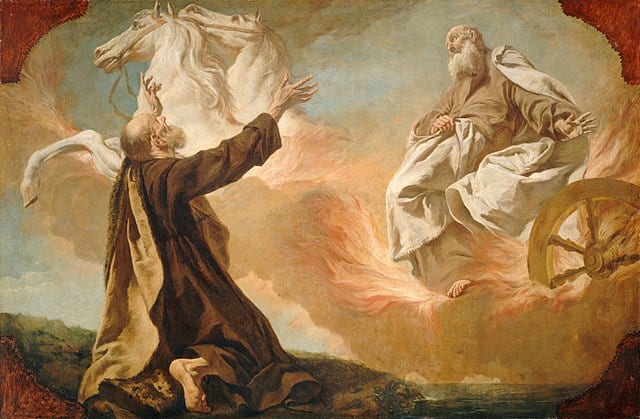
Photo credit: Elijah Taken Up in a Chariot of Fire, by Giuseppi Angeli (d. 1798) [public domain / Wikimedia Commons]

***
Previous Post

June 7, 2020
Dialogue: Principled Conservatism, George Floyd, & Racism
Next Post

June 10, 2020 James White's Obsession: Trashing Apologist Steve Ray
Browse Our Archives
Select a Category & Last Things About Me Anti-Catholicism Atheism & Agnosticism Baptism and Sacramentalism Bible and Tradition Blessed Virgin Mary Books by Dave Armstrong C. S. Lewis Calvinism & General Protestantism Catholic Apologetics Catholic Apologists Catholic conversion Catholic converts Christmas Church (Ecclesiology) Church History Conversion and Converts Development of Doctrine Eastern Orthodoxy Ecumenism & Christian Unity Eucharist & Liturgy Fathers of the Church French Translations G. K. Chesterton Hell Hell & Satan Hell & Satan & Last Things Heresies & Comparative Religion Holistic Health Inquisition & Crusades & Scandals James White Jews & Judaism & Old Testament John Calvin John Henry Newman Liberal / Modernist Theology Life Issues Literary Resume Lutheranism Mariology Martin Luther Music Orthodoxy Papacy & Infallibility Personal Page Philosophy & Science Political & Ethical & Moral Issues Protestant Persecution & Intolerance Protestantism Purgatory Purgatory & Penance Romantic & Imaginative Theology Saints & Purgatory & Penance Salvation Salvation & Justification Satan & Last Things Sexuality and Gender Issues Spanish Translations Traditionalism vs. Radical Catholic Reactionaries Traducciones al español / tradução para português Trinitarianism & Christology Uncategorized Videos
Select a Month October 2026 September 2026 August 2026 July 2026 June 2026 May 2026 April 2026 March 2026 February 2026 January 2026 December 2025 November 2025 October 2025 September 2025 August 2025 July 2025 June 2025 May 2025 April 2025 March 2025 February 2025 January 2025 December 2024 November 2024 October 2024 September 2024 August 2024 July 2024 June 2024 May 2024 April 2024 March 2024 February 2024 January 2024 December 2023 November 2023 October 2023 September 2023 August 2023 July 2023 June 2023 May 2023 April 2023 March 2023 February 2023 January 2023 December 2022 November 2022 October 2022 September 2022 August 2022 July 2022 June 2022 May 2022 April 2022 March 2022 February 2022 January 2022 December 2021 November 2021 October 2021 September 2021 August 2021 July 2021 June 2021 May 2021 April 2021 March 2021 February 2021 January 2021 December 2020 November 2020 October 2020 September 2020 August 2020 July 2020 June 2020 May 2020 April 2020 March 2020 February 2020 January 2020 December 2019 November 2019 October 2019 September 2019 August 2019 July 2019 June 2019 May 2019 April 2019 March 2019 February 2019 January 2019 December 2018 November 2018 October 2018 September 2018 August 2018 July 2018 June 2018 May 2018 April 2018 March 2018 February 2018 January 2018 December 2017 November 2017 October 2017 September 2017 August 2017 July 2017 June 2017 May 2017 April 2017 March 2017 February 2017 January 2017 December 2016 November 2016 October 2016 September 2016 August 2016 July 2016 June 2016 May 2016 April 2016 March 2016 February 2016 January 2016 December 2015 November 2015 October 2015 September 2015 August 2015 July 2015 June 2015 May 2015 April 2015 March 2015 February 2015 January 2015 December 2014 November 2014 October 2014 September 2014 August 2014 July 2014 June 2014 April 2014 March 2014 February 2014 January 2014 December 2013 November 2013 October 2013 September 2013 August 2013 July 2013 June 2013 April 2013 March 2013 February 2013 January 2013 December 2012 November 2012 October 2012 September 2012 August 2012 July 2012 June 2012 May 2012 April 2012 March 2012 February 2012 January 2012 December 2011 November 2011 October 2011 September 2011 August 2011 July 2011 June 2011 April 2011 March 2011 February 2011 October 2010 September 2010 August 2010 July 2010 April 2010 March 2010 December 2009 October 2009 August 2009 July 2009 June 2009 May 2009 March 2009 February 2009 October 2008 September 2008 April 2008 March 2008 February 2008 January 2008 December 2007 November 2007 October 2007 May 2007 March 2007 February 2007 January 2007 November 2006 October 2006 September 2006 August 2006 July 2006 June 2006 May 2006 April 2006 March 2006 February 2006 October 2005 June 2005 April 2005 February 2005 July 2004 May 2004 April 2004
Follow Us!
TAKE THE
Religious Wisdom Quiz
Where was Paul's hometown?
Select your answer to see how you score.
Damascus Tarsus Antioch Jerusalem
Books by This Author Books by Dave Armstrong
Related posts from Biblical Evidence for Catholicism

Three More Anti-Catholic Lies About Catholicism (#6-4)
Biblical Evidence for Catholicism

Bible & Catholicism on Mortal Sin (vs. John...
Biblical Evidence for Catholicism

Top Ten Anti-Catholic Lies (#10-7)
Biblical Evidence for Catholicism

Does Catholic Intercession of Saints Require Omniscience?
Biblical Evidence for Catholicism
TRENDING AT PATHEOS Catholic

The Sermon on the Mount, Part I: Matthew...
The Sermon on the Mount, Part I (Matthew 4:12-5:12) St. Matthew moves...

What's up from Crossway: Reviewing some of their latest A few weeks...

Janie Learns the Way of the Cross: A...
Teaching children about Jesus' Passion can be challenging. Many parents and educators...

Looking For Good Catholic Writing - October 2026
He alone extends the heavens, and he walks upon the waves of...

In "Irreplaceable," our book on vocation and technology, Trevor Sutton and I...

I was strolling through the top floor of the brand new Parthenon...
view all Catholic blogs
Ad-Free & Subscriber Log-In Subscription Support
- About Us
- 2026 Calendar
- Videos
- Podcasts
- Library of World Religions
- Faith In Media Tracker
- Advertise With Us
- Write for Us
- Privacy Policy
- Terms of Service
- Do Not Sell My Data
- Contact Us
- Radiant Digital
- Manage Newsletter Subscriptions
- Unsubscribe From Notifications
- Sitemap
Copyright 2008-2026, Patheos. All rights reserved.
Subscription Support Ad-Free & Subscriber Log-In
Follow Patheos