
BuddhistCatholicContemplativeEvangelicalGeneral ChristianHinduJewishLatter-day SaintMuslimNew VisionsProgressive Christian
Beliefs
- Buddhist
- Catholic
- Contemplative
- Evangelical
- General Christian
- Hindu
- Jewish
- Latter-day Saint
- More Voices
- Muslim
- New Visions
- Pagan
- Progressive Christian
Topics
- Religion News
- Food and Religion
- Sports and Religion
- Religious Art
- Religious Music and Entertainment
- Religious Events
- History and Religion
- Style and Religion
- Politics and Religion
- Women in Religion
- Recreation Outdoors and Religion
- Business Finance and Religion
- Careers Workplace and Religion
- Education and Religion
- Family Parenting and Religion
- Health Fitness and Religion
- Home and Religion
- Relationships and Religion
- Technology and Religion
- Travel and Religion
Columnists
- Buddhist Columnists
- Business Finance and Religion Columnists
- Careers Workplace and Religion Columnists
- Catholic Columnists
- Contemplative Columnists
- Education and Religion Columnists
- Evangelists Columnists
- Family Parenting and Religion Columnists
- General Christian Columnists
- Health Fitness and Religion Columnists
- Hindu Columnists
- History and Religion Columnists
- Home and Religion Columnists
- Jewish Columnists
- More Voices Columnists
- Latter Day Columnists
- Muslim Columnists
- New Visions Columnists
- Nonreligious Columnists
- Pagan Columnists
- Politics and Religion Columnists
- Progressive Columnists
- Recreation Outdoors and Religion Columnists
- Relationships and Religion Columnists
- Religion News Columnists
- Religious Art Columnists
- Religious Events Columnists
- Religious Music and Entertainment Columnists
- Sports and Religion Columnists
- Style and Religion Columnists
- Technology and Religion Columnists
- Travel and Religion Columnists
- Women in Religion Columnists
Resource Library
- 2026 Calendar
- Library of World Religions
- The 100 Most Holy Places on Earth
- Patheos Answers
- Podcasts
- Videos
- Faith Leaders Database
- Anglican Episcopalian
- Bahai
- Baptist
- Buddhism
- Christianity
- Confucianism
- Eastern Orthodoxy
- Hinduism
- Holiness and Pentecostal
- ISKCON
- Islam
- Judaism
- Lutheran
- Methodist
- The Church of Jesus Christ of Latter-day Saints
- New Age
- Paganism
- Presbytarian and Reformed
- Protestantism
- Religion Behind the Scenes
- Roman Catholic
- Scientology
- Shia Islam
- Sikhism
- Sufism
- Sunni Islam
- Taoism
- Zen
- See all religions
Research Tools
 Ad-Free & Subscriber Log-In Subscription Support
Ad-Free & Subscriber Log-In Subscription Support
Follow Patheos 

- Trending:
- Forgiveness
- |
- Marriage
- |
- Consciousness
- |
- Death Penalty
- |
- Election
- |
- Halloween

-
About
-
Catholic Apologetics
-
Church History
-
Great Apologists
-
Christian Worldview
-
Protestantism & Misc.
- Home
- Catholic
- History and Religion
- Dialogue: Mary’s “In Partu” Virginity (During Birth)
Dialogue: Mary’s “In Partu” Virginity (During Birth)
Last updated on: June 20, 2020 at 5:14 pm by Dave Armstrong
Dialogue: Mary’s “In Partu” Virginity (During Birth) 2020-06-20T17:14:25-04:00 Dave Armstrong
Patheos Explore the world's faith through different perspectives on religion and spirituality! Patheos has the views of the prevalent religions and spiritualities of the world.
with Ryan Grant
The following is from a Facebook discussion (3-9-17) about the paper, Mary’s Perpetual Virginity “In Partu” (a Miraculous, Non-Natural Childbirth) is a Binding Catholic Dogma [9-24-08; expanded on 9-21-15]. Words of Ryan Grant will be in blue; those of Phillip Campbell in green.
*****
What does it mean, then, to be a virgin “during” the birth? If the traditional language is “before, during, and after” I say that “during” makes no sense unless it is talking about physical virginity (i.e., an intact hymen). There would be no reason to say “during.” And we know that’s what the Church fathers meant by it.
I think the denial of this binding doctrine is a specimen of theological liberalism. If you read, for example, Servant of God Fr. John A. Hardon’s remarks in my paper, he explains what has been the traditional understanding.
I don’t claim absolute certainty on this, but that is my best understanding. Sometimes (distressingly) we see aspects of theological liberalism at pretty high levels in the Church. It all comes down to what “in partu” has been understood to mean.
My understanding is it was not dogma but sententia certa: one degree below dogma.
In partu is a tricky thing…believe it or not, the definition of virginity has actually changed throughout history.
We take virginity to mean “never had sex.” The medievals and ancients took it to mean the hymen was intact. In the ancient world, a woman who tripped and fell and broke her hymen was no longer a virgin. So the ancients knew Mary was perpetual Virgin, but for them that necessarily entailed that her hymen had to remain intact, it could not even be broken by natural means (such as childbirth). It was necessary to maintain her virginity.
To modern people who do not accept that definition of virginity, the teaching of Christ’s in partu birth makes little sense, at least in terms of being necessary to preserve Mary’s virginity.
It has always been held, until 1965 apparently or perhaps the date of this letter, that the Blessed Virgin suffered no pain in pariendo, and this is the sense that the Church Fathers understood, as well as all theologians and the Church’s constant teaching, precisely because it was not in the normal way a woman gives birth.
Among the Fathers it was certain. St. Jerome taught: “There was no midwife there, nor sedulous women attendants … she wrapped him up in swaddling clothes and laid Him in a manger.” (Nulla ibi obstetrix, nulla muliercularum sedulitas intercessit … Pannis, inquit involvit infantem et posuit in praesepio).
St. John of Damascus also affirms it: “No pleasure preceded this delivery, no birth-throes accompanied it.” (De Fide Orth. IV, 15, (Quam nativitatem nulla coluptas anteivit nec dolor quidem in partu secutus est.)
St. Bernard says: Christ’s conception was without reproach, and his birth without pain.” (Serm. de Virg. Nativitate, 4: “Conceptus fuit sine pudore, partus sine dolore.”)
St. Thomas Aquinas also confirms this: “Christ came forth from the closed womb of His Mother, and, thus there was no violence of opening the passage. Consequently there was no pain in that birth, as neither was there any corruption.” (Summa, III, qu. 35, art. 6, Christus egressus est ex clauso utero matris et sic nulla violentia apertionis meatuum ibi fuit, et proper hoc in illo partu nullus fuit dolor, sicut nec aliqua corruptio).
We can add to this the numerous testimonies of the Fathers, preeminently St. Ambrose, that prove Christ could exit the closed womb without causing any pain just in the manner that Christ entered the upper room after the resurrection, though the doors were locked. (De Instit. Virg., VIII, n. 52; Cf. St. Augustine, ep. 137 ad Volus.; Pope Hormisdas, ep. 79 ad Iustin.)
St. Ambrose makes it clear that Christ passed through the blessed Virgin,
The Prophet Ezechiel says that he saw the building of a city upon a very high mountain. The city had many gates. Of these one is described as shut. what is this gate but Mary? And shut because a virgin. Mary then, is the gate through which Christ came into this world, when he was shed forth by a virginal birth, without loosing the bars of virginity. The inclosure of purity remained unscathed, and the seals of integrity were kept inviolate, as he went forth from the virgin … A good gate is Mary, that was closed and was not opened. By her Christ passed, but he opened not.
Dr. Robert Fastiggi, a personal friend of mine, and professor of theology, is revising Ludwig Ott’s Fundamentals of Catholic Dogma. He has verified that Dr. Ott revised the section on in partu in the book (since the 1952 version had some liberalism in it), and he is the translator of the new text from German into English. I linked to all this above. He sent the revision of this portion to me, even before the revised book had been published (it’s still not). Dr. Fastiggi says it is de fide. See the revised portion:
Mary’s Virginity During Childbirth: Ott’s Revision & Latin Analysis [9-29-15]
On the other hand (in all fairness), Dr. Fastiggi has told me that Ott’s classifications of dogma are not absolutely unquestionable. So that would mean that folks can dissent about that (sigh!). . . I go by them, however, since I see nothing else that is as good of a schema of classifying doctrines, as his work.
Cardinal Franzelin, a peritus at Vatican I, makes it clear that this is not a birth as other births:
Nothing seems more fitting to me than if some properties, such as those of glorified bodies, just as they were in the body of the Word so they were also shared in the virginal body of the mother by the Son, and in that, I understand they were anticipated not habitually but transiently in the in the very birth and for this purpose. This method of understanding rests upon the explications of the holy Fathers. Just as St. Paul (1 Cor. 15:44) calls the glorified body ‘spiritual’ (soma pneumatikon) by reason of its qualities, among which is incorruption (en aphtharsia) so St. Leo the great (serm. 4 in nativ. c. 3) says the birth of Christ into the light was a ‘spiritual birth’ and the author of the Christmas homily cited by St. Cyril in the Council of Ephesus says: ‘Neither did God suffer any division (by begetting the word), for he begot divinely, nor did the Virgin suffer corruption in giving birth, for she gave birth ‘spiritually’ (oute ē parthenos phthoran upemeine tekousa, pneumatikos gar eteke) … in God, for it is not fitting to attend to natural things, but to believe in the omnipotence of the agent.’ Therefore, just as the body after the resurrection does not cease to be a true body, although it is made a partaker of certain supernatural qualities, on account of which it is called ‘spiritual’; so the birth of the infant Jesus from the Virgin mother was a true birth, but supernatural qualities were communicated to the virginal body of the mother, that the infant would come forth without any harm and corruption (ek dunamei en aphtharsia) to his virgin Mother; and on account of this supernatural mode the nativity can be called a ‘spiritual birth’, and the mother can be said to have given birth ‘spiritually’. (De Verbo Incarnato, pg. 120, my translation)
In all the works of theologians, where they categorize propositions as de fide, proxima fidei Catholicae, sententia certa, sententia communis; or condemn propositions as haeretica, erronea, temeraria, offensive piarum aurium, etc., these are only unquestionable if so characterized by the magisterium, or, if there is a unanimous witness of theologians using that classification (Pius IX, Tuas Libenter). For example, all theologians teach proposition x is de fide, but there is no formal magisterial decision, it cannot be denied without a note of erronea. If it is mixed, then the lowest classification is taken as what the average person would be held to, unless it is but an exception or two, then it would be called “communissima” (most common) while noting the exceptions. So, Baptism of Desire is held by some theologians to be de fide, others proxima fidei Catholicae, to most sententia certa, and a handful senentia communis; the sense is it is infallibly taught by theologians in a unanimous consensus that there is baptism of desire for explicit faith, but what consequence the teaching has to someone that denies it is in doubt. In all cases the person sins against faith, but how grievously is unclear. The meaning of these distinctions is discussed more at length in Ott.
That’s heavy, Ryan! So what is your understanding as to in partu (defined as an intact hymen) then?
Essentially that Christ was born by passing through the Virgin, just as he did at the Last Supper, as St. Ambrose notes, following St. Jerome who says it simply happened with no need for a midwife.
I meant in terms of dogmatic classification . . .
Based on what I have seen, it would be a certain theological conclusion (sententia certa). The reason is, following what St. Peter Canisius says as well as St. Robert Bellarmine, and a few others, it is intrinsically connected to that doctrine and is a necessary consequent, attested to by the fathers in a consensus (let alone the theologians). So based on the teaching of the above named, it could not be said to be de fide because it was not explicitly defined at Ephesus, but is rather a consequence of the definition that is certain. Practically it can be no more denied than if it were de fide, but at the same time de fide is the wrong classification.
Then why does Ott call it de fide? How could he be so mistaken (assuming you are correct)?
But you’re saying that the average Catholic ought to accept it, as just a notch under de fide?
Should I use the language of “binding”?
Yes. That would work. Some writers note a thing is de fide if it seems that there would be no other conclusion and so it must be what the Council meant when it spoke. This is why St. Robert Bellarmine, St. Alphonsus Liguori and a number of theologians call Baptism of Desire de fide after the Council of Trent (baptismo vel voto ejus) because it seemed the Council meant nothing else and it has no other sense. It is a diversity that the magisterium historically tolerated.
So individuals can believe something is de fide, but to be really really de fide, it has to be virtually universal consensus?
Yes, or at least, to hold others to it in that way. For my money it is de fide and I agree with Ott, but we can’t go beyond what the Church has historically said and, most theologians I can call to mind (Pohle-Preuss, Billot, Lennerz, etc.) call it sententia certa. I would modify the paper [and note] that it is a certain theological conclusion (sententia certa) with a discussion of what that means which you can find in Ott, and note that others (c.f. Ott) hold it as de fide.
It is actually good to flesh this out. That way you do not get blind-sided by someone pointing this out and arguing, like pro-choicers do, that one is not held to believe it if it is not de fide.
In fact, that distinction is apt. What the ordinary magisterium binds the Catholic faithful to, by its supreme office, though not a solemn judgment is still binding on the intellect and will, and may be infallible by the consistent teaching of that doctrine in the tradition, though it is not in all its aspects irreformable, unlike the solemn magisterium.
The judgments of theologians are of a similar vain. One is only allowed freedom in those propositions classed as “common opinion”, and there while observing respect for the opposing view. To all the rest, they are infallible if taught by all theologians, per what Pius IX teaches in Tuas Libenter, and consequently must be believed as true. Common opinion, by its nature, admits dissenting opinion and as such cannot be a true consensus, which is why it is never infallible unless elevated by magisterial teaching.
Thus, a teaching such as this in partu is so certain a conclusion that all Catholics are bound to believe it.
What do you call a position that holds that it was a natural birth just as any other, in terms of being natural: with the pain, labor, blood and everything else that women go through?
And how do you respond to the charge that in partu is “anti-sex” or even derived from Gnosticism, etc.?
In the past, it would have received the note of “erronea” since it is contrary to a consensus of the Fathers and the Theologians, and the sense intended by Ephesus.
I’m not sure what anti-sex would mean, in terms of relations or what is now called gender? If in partu is anti-sex, so is the Virgin Birth itself. Yet it is in scripture.
As far as gnosticism, is it gnostic to follow what all the Church Fathers taught? Or to create new ideas based on our private understanding? The latter sounds more gnostic to me.
But taking the question in its sense, if postulating a miraculous birth is gnostic, the charge assumes postulating a miracle without the body is gnostic; thus so is a miraculous rising from the dead, or passing through the door in the upper room, or how a creature is the mother of God; or how Christ’s body is present in the Eucharist equally gnostic, since all are equally miraculous.
Lastly, I never knew St. Cyril of Alexandria, St. Ambrose, St. Augustine, St. Jerome, St. Sophronius, St. Pope St. Leo the Great, St. Bernard, St. Thomas, St. Bonaventure, St. Peter Canisius and St. Robert Bellarmine, St. Alphonsus Liguori and all the theologians commissioned and approved by the Church that affirmed this doctrine were gnostics.
I think the notion that we hear Protestants expressing is that Catholics do all they can to dissociate from sexual things. So, rather than Mary having a natural birth like all other women (being like them in most respects), the Church comes along in its puritanism and says (as if the doctrine were just pulled out of a hat) that she didn’t go through any of that. Thus, women can’t relate to her.
In my vigorous discussions at Patheos, several women were highly offended by the whole discussion, especially the mention of hymens. I didn’t say it at the time, but I was thinking that circumcision would seem to me to be equally as “offensive”: dealing as it does, with private and sexual organs also. And that’s all over the Bible.
It’s “anti-sex” (so we are told) because it takes away some of the more physical and painful elements of the whole process. And of course celibacy is also railed against. To me it’s all irrelevant. It assumes beforehand that the Church is anti-sex, and promulgates these doctrines as a result.
But as you say, such a view would spill onto other doctrines, like the Virgin Birth and to some extent, the incarnation.
I’ve decided to retain the title of my article, because the doctrine remains a dogma and remains binding.
I really appreciate your insight on a rather subtle and complex discussion. Now I can offend a few less folks than before . . . LOL
Hah, don’t count on it ;-)
“Binding” is safer, while noting that some theologians call it de fide, c.f. Ott. I’m sure there are more I just can’t call them to mind. Look up, however, in Ott what a sententia certa is.
***
Facebook friend Nicholas El-Hajj brought up two excellent Bible texts in this regard:
Isaiah 7:14 (NASB) “Therefore the Lord Himself will give you a sign: Behold, a virgin will be with child and bear a son, and she will call His name Immanuel. [see many other translations that include “virgin” rather than “young woman”]
Isaiah 66:7-8 (RSV) “Before she was in labor she gave birth; before her pain came upon her she was delivered of a son. [8] Who has heard such a thing? Who has seen such things? . . .”
***
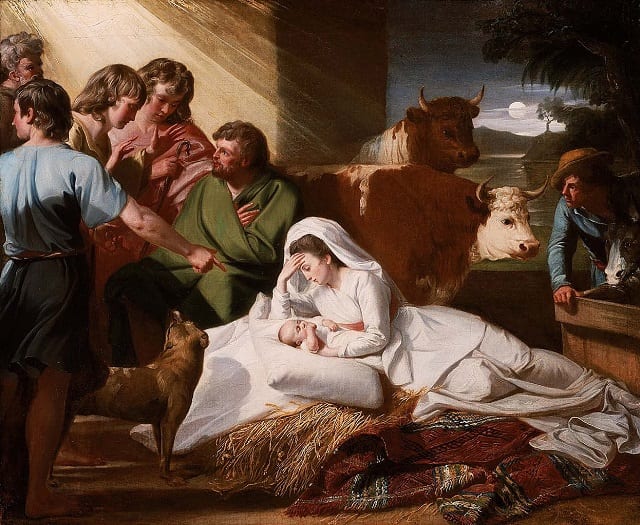
Photo credit: The Nativity (c. 1776), by John Singleton Copley (1738-1815) [public domain / Wikimedia Commons]

***
Previous Post
June 18, 2020
The Imitation of the Blessed Virgin Mary
Next Post

June 20, 2020 Gentleness
Browse Our Archives
Select a Category & Last Things About Me Anti-Catholicism Atheism & Agnosticism Baptism and Sacramentalism Bible and Tradition Blessed Virgin Mary Books by Dave Armstrong C. S. Lewis Calvinism & General Protestantism Catholic Apologetics Catholic Apologists Catholic conversion Catholic converts Christmas Church (Ecclesiology) Church History Conversion and Converts Development of Doctrine Eastern Orthodoxy Ecumenism & Christian Unity Eucharist & Liturgy Fathers of the Church French Translations G. K. Chesterton Hell Hell & Satan Hell & Satan & Last Things Heresies & Comparative Religion Holistic Health Inquisition & Crusades & Scandals James White Jews & Judaism & Old Testament John Calvin John Henry Newman Liberal / Modernist Theology Life Issues Literary Resume Lutheranism Mariology Martin Luther Music Orthodoxy Papacy & Infallibility Personal Page Philosophy & Science Political & Ethical & Moral Issues Protestant Persecution & Intolerance Protestantism Purgatory Purgatory & Penance Romantic & Imaginative Theology Saints & Purgatory & Penance Salvation Salvation & Justification Satan & Last Things Sexuality and Gender Issues Spanish Translations Traditionalism vs. Radical Catholic Reactionaries Traducciones al español / tradução para português Trinitarianism & Christology Uncategorized Videos
Select a Month October 2026 September 2026 August 2026 July 2026 June 2026 May 2026 April 2026 March 2026 February 2026 January 2026 December 2025 November 2025 October 2025 September 2025 August 2025 July 2025 June 2025 May 2025 April 2025 March 2025 February 2025 January 2025 December 2024 November 2024 October 2024 September 2024 August 2024 July 2024 June 2024 May 2024 April 2024 March 2024 February 2024 January 2024 December 2023 November 2023 October 2023 September 2023 August 2023 July 2023 June 2023 May 2023 April 2023 March 2023 February 2023 January 2023 December 2022 November 2022 October 2022 September 2022 August 2022 July 2022 June 2022 May 2022 April 2022 March 2022 February 2022 January 2022 December 2021 November 2021 October 2021 September 2021 August 2021 July 2021 June 2021 May 2021 April 2021 March 2021 February 2021 January 2021 December 2020 November 2020 October 2020 September 2020 August 2020 July 2020 June 2020 May 2020 April 2020 March 2020 February 2020 January 2020 December 2019 November 2019 October 2019 September 2019 August 2019 July 2019 June 2019 May 2019 April 2019 March 2019 February 2019 January 2019 December 2018 November 2018 October 2018 September 2018 August 2018 July 2018 June 2018 May 2018 April 2018 March 2018 February 2018 January 2018 December 2017 November 2017 October 2017 September 2017 August 2017 July 2017 June 2017 May 2017 April 2017 March 2017 February 2017 January 2017 December 2016 November 2016 October 2016 September 2016 August 2016 July 2016 June 2016 May 2016 April 2016 March 2016 February 2016 January 2016 December 2015 November 2015 October 2015 September 2015 August 2015 July 2015 June 2015 May 2015 April 2015 March 2015 February 2015 January 2015 December 2014 November 2014 October 2014 September 2014 August 2014 July 2014 June 2014 April 2014 March 2014 February 2014 January 2014 December 2013 November 2013 October 2013 September 2013 August 2013 July 2013 June 2013 April 2013 March 2013 February 2013 January 2013 December 2012 November 2012 October 2012 September 2012 August 2012 July 2012 June 2012 May 2012 April 2012 March 2012 February 2012 January 2012 December 2011 November 2011 October 2011 September 2011 August 2011 July 2011 June 2011 April 2011 March 2011 February 2011 October 2010 September 2010 August 2010 July 2010 April 2010 March 2010 December 2009 October 2009 August 2009 July 2009 June 2009 May 2009 March 2009 February 2009 October 2008 September 2008 April 2008 March 2008 February 2008 January 2008 December 2007 November 2007 October 2007 May 2007 March 2007 February 2007 January 2007 November 2006 October 2006 September 2006 August 2006 July 2006 June 2006 May 2006 April 2006 March 2006 February 2006 October 2005 June 2005 April 2005 February 2005 July 2004 May 2004 April 2004
Follow Us!
TAKE THE
Religious Wisdom Quiz
What does Hebrews say we have as an anchor for the soul?
Select your answer to see how you score.
Hope The word of God Love Faith
Books by This Author Books by Dave Armstrong
Related posts from Biblical Evidence for Catholicism

Holy Ground: Why Mary Had NO Other Children...
Biblical Evidence for Catholicism
Protestant Confessions & "Ever-Virgin" Mary
Biblical Evidence for Catholicism

Mary Wife of Clopas (Jn 19:25): Mary's Sister-in-Law?
Biblical Evidence for Catholicism

Jesus Had Four Brothers? The Bible Sez No!
Biblical Evidence for Catholicism
TRENDING AT PATHEOS Catholic

Swimfan: Forgotten Aughts Pleasures
This is a recovery effort. In 2002, My Big Fat Greek Wedding...

Top Three Anti-Catholic Lies About Catholicism
This is my initial transcript for the video, "THE 3 WORST...

Pope Leo Celebrates Mass for Nurses & Docs...
I don't have any idea how he did it, but Pope Leo...

The Sermon on the Mount, Part I: Matthew...
The Sermon on the Mount, Part I (Matthew 4:12-5:12) St. Matthew moves...

What's up from Crossway: Reviewing some of their latest A few weeks...

Janie Learns the Way of the Cross: A...
Teaching children about Jesus' Passion can be challenging. Many parents and educators...
view all Catholic blogs
Ad-Free & Subscriber Log-In Subscription Support
- About Us
- 2026 Calendar
- Videos
- Podcasts
- Library of World Religions
- Faith In Media Tracker
- Advertise With Us
- Write for Us
- Privacy Policy
- Terms of Service
- Do Not Sell My Data
- Contact Us
- Radiant Digital
- Manage Newsletter Subscriptions
- Unsubscribe From Notifications
- Sitemap
Copyright 2008-2026, Patheos. All rights reserved.
Subscription Support Ad-Free & Subscriber Log-In
Follow Patheos