
BuddhistCatholicContemplativeEvangelicalGeneral ChristianHinduJewishLatter-day SaintMuslimNew VisionsProgressive Christian
Beliefs
- Buddhist
- Catholic
- Contemplative
- Evangelical
- General Christian
- Hindu
- Jewish
- Latter-day Saint
- More Voices
- Muslim
- New Visions
- Pagan
- Progressive Christian
Topics
- Religion News
- Food and Religion
- Sports and Religion
- Religious Art
- Religious Music and Entertainment
- Religious Events
- History and Religion
- Style and Religion
- Politics and Religion
- Women in Religion
- Recreation Outdoors and Religion
- Business Finance and Religion
- Careers Workplace and Religion
- Education and Religion
- Family Parenting and Religion
- Health Fitness and Religion
- Home and Religion
- Relationships and Religion
- Technology and Religion
- Travel and Religion
Columnists
- Buddhist Columnists
- Business Finance and Religion Columnists
- Careers Workplace and Religion Columnists
- Catholic Columnists
- Contemplative Columnists
- Education and Religion Columnists
- Evangelists Columnists
- Family Parenting and Religion Columnists
- General Christian Columnists
- Health Fitness and Religion Columnists
- Hindu Columnists
- History and Religion Columnists
- Home and Religion Columnists
- Jewish Columnists
- More Voices Columnists
- Latter Day Columnists
- Muslim Columnists
- New Visions Columnists
- Nonreligious Columnists
- Pagan Columnists
- Politics and Religion Columnists
- Progressive Columnists
- Recreation Outdoors and Religion Columnists
- Relationships and Religion Columnists
- Religion News Columnists
- Religious Art Columnists
- Religious Events Columnists
- Religious Music and Entertainment Columnists
- Sports and Religion Columnists
- Style and Religion Columnists
- Technology and Religion Columnists
- Travel and Religion Columnists
- Women in Religion Columnists
Resource Library
- 2026 Calendar
- Library of World Religions
- The 100 Most Holy Places on Earth
- Patheos Answers
- Podcasts
- Videos
- Faith Leaders Database
- Anglican Episcopalian
- Bahai
- Baptist
- Buddhism
- Christianity
- Confucianism
- Eastern Orthodoxy
- Hinduism
- Holiness and Pentecostal
- ISKCON
- Islam
- Judaism
- Lutheran
- Methodist
- The Church of Jesus Christ of Latter-day Saints
- New Age
- Paganism
- Presbytarian and Reformed
- Protestantism
- Religion Behind the Scenes
- Roman Catholic
- Scientology
- Shia Islam
- Sikhism
- Sufism
- Sunni Islam
- Taoism
- Zen
- See all religions
Research Tools
 Ad-Free & Subscriber Log-In Subscription Support
Ad-Free & Subscriber Log-In Subscription Support
Follow Patheos 

- Trending:
- Forgiveness
- |
- Marriage
- |
- Consciousness
- |
- Death Penalty
- |
- Election
- |
- Halloween

-
About
-
Catholic Apologetics
-
Church History
-
Great Apologists
-
Christian Worldview
-
Protestantism & Misc.
- Home
- Catholic
- History and Religion
- 1 Esdras & the Canon of Hippo, Carthage, & Trent
1 Esdras & the Canon of Hippo, Carthage, & Trent
Last updated on: June 21, 2020 at 3:39 pm by Dave Armstrong
1 Esdras & the Canon of Hippo, Carthage, & Trent 2020-06-21T15:39:41-04:00 Dave Armstrong
Patheos Explore the world's faith through different perspectives on religion and spirituality! Patheos has the views of the prevalent religions and spiritualities of the world.
Protestant apologist Steve Christie (a nice guy, not an anti-Catholic, and worthy debate opponent) asked on my Facebook page (words in blue henceforth):
Just out of curiosity, which ecumenical council was infallible – The second ecumenical council of Nicaea In 787 that affirmed the Councils of Hippo and Carthage in the fourth century, which stated 1 Esdras was Scripture and part of the Old Testament, or the later ecumenical councils of Florence and Trent which stated it wasn’t? Which of these ecumenical councils that contradicted each other are you going to pick and choose to believe is infallible?
First, we must understand that 1 Esdras is simply a different Greek version of material from more than one biblical book that is already accepted as canonical by all parties. The great Protestant Bible scholar F. F. Bruce described it as “a variant Greek edition of the history from 2 Chron. 35:1 to Neh. 8:13” (The Canon of Scripture, InterVarsity Press, 1988, p. 47). It also included the book of Ezra. The Wikipedia article on the book states:
1 Esdras . . . is an ancient Greek version of the biblical Book of Ezra in use among the early church, and many modern Christians with varying degrees of canonicity. First Esdras is substantially derived from Masoretic Ezra–Nehemiah, with the passages specific to the career of Nehemiah removed or re-attributed to Ezra, and some additional material. . . .
‘1 Esdras’ is applied consistently in late medieval bibles to the book corresponding to the modern Book of Ezra; while the modern Book of Nehemiah corresponds to ‘2 Esdras’. 1 Esdras here, is in the Clementine Vulgate called 3 Esdras. The ‘Apocalypse of Ezra’, an additional work associated with the name Ezra, is denoted ‘4 Esdras’ in the Paris Bibles, the Clementine Vulgate and the Articles of Religion, but called ‘2 Esdras’ in the King James Version and in most modern English bibles, as here. . . .
Overwhelmingly, citations in early Christian writings claimed from the scriptural ‘Book of Ezra'(without any qualification) are taken from 1 Esdras, and never from the ‘Ezra’ sections of Ezra–Nehemiah (Septuagint ‘Esdras B’) . . .
First Esdras contains the whole of Ezra with the addition of one section; its verses are numbered differently. Just as Ezra begins with the last two verses of 2 Chronicles, 1 Esdras begins with the last two chapters; this suggests that Chronicles and Esdras may have been read as one book at sometime in the past.
Steve himself concurs with the above in his book, Why Protestant Bibles Are Smaller (2019). On page 49 he cites St. Cyril of Jerusalem’s listing of the canonical books of the Old Testament, and part of it reads, “the first and second of Esdras [Ezra-Nehemiah]”. In footnote 35 on the same page, he explains: “Brackets added by me for clarification.” He does the same again on pages 76-77: “I have put in brackets the modern names and spelling of some of these writings” (p. 76). Then in the list of the canonical books given at the Council of Rome in 382, we find: “Esdras two books [Ezra and Nehemiah]” (p. 77).
Wikipedia, “Synod of Hippo” informs us that this council in 393 included in its canon “Ezra ii books” (meaning, Ezra and Nehemiah, just as Steve clarified above). As for the Council of Carthage in 397, F. F. Bruce cited St. Augustine’s Old Testament canon (which included, of course, the Catholic deuterocanon), and included “the two of Esdras [i.e. Ezra and Nehemiah]” (ibid., p. 95; bracketed comment presumably Bruce’s). Then he noted that the council in Carthage was “along the lines approved by Augustine himself” (p. 97; Augustine being the bishop in that city).
The claimed affirmation of Carthage and Hippo by II Nicaea in 787 is a bit complicated and deductive, but I accept it, based on the reasoning elaborated upon in an article on the topic by Catholic apologist Mark Bonocore.
The Council of Florence in the 15th century listed among the (73) canonical books, “Esdras, Nehemiah” (referring to Ezra and Nehemiah). And the Council of Trent in the next century (Decree Concerning the Canonical Scriptures) uses the terminology, “the first book of Esdras, and the second which is entitled Nehemias.”
The Trent nomenclature is reflected in subsequent Catholic Bibles. The Douay version from 1610 (a revision of Jerome’s Latin Vulgate) uses “First Book of Esdras” for what modern Bibles list as Ezra, and “Book of Nehemias, which is called “The Second of Esdras” for Nehemiah. The Confraternity Bible (these particular books published in 1955), also a Vulgate revision, has exactly the same terminology, while Knox’s Revised Vulgate from the same year has “First Book of Esdras” and (curiously) “Second Book of Esdras or the Book of Nehemias.” It was only in 1970, with the New American Bible, translated from Hebrew and Greek, that the titles of Ezra and Nehemiah were used. Same books, different titles.
Bottom line: there is no difficulty here whatsoever for the Catholic canon or in terms of some alleged contradiction between the ecumenical councils of Nicaea II and Florence + Trent. It’s simply yet more failed Protestant polemics: untrue to history. A wonderfully in-depth thread in the Catholic Answer Forums, entitled, “Canon of Carthage different from the Canon of Trent?” (May 2007), elaborates on this fascinating and very confusing canonical issue. All that follows are quotations from this thread; I won’t bother to indent it. The material is from “itsjustdave1988” unless otherwise noted:
***
Did the Scripture canon at the 4th century synod of Carthage differ from the canon at the 16th Council of Trent?
Some Protestants claim yes, yet they are in the minority among Protestant scholars. Most Protestants claim otherwise.
Protestant historian Philip Schaff states:
“The council of Hippo in 393, and the third (according to another reckoning the sixth) council of Carthage in 397, under the influence of Augustine, who attended both, fixed the catholic canon of the Holy Scriptures, including the Apocrypha of the Old Testament… The New Testament canon is the same as ours. This decision of the transmarine church however, was subject to ratification; and the concurrence of the Roman see it received when Innocent I and Gelasius I a.d. 414) repeated the same index of biblical books. This canon remained undisturbed till the sixteenth century, and was sanctioned by the council of Trent at its fourth session.” (Schaff, Philip, History of the Christian Church, Vol. III, Ch 9)
From another scholarly Protestant source, The Oxford Dictionary of the Christian Church (2nd ed., edited by F.L. Cross & E.A. Livingstone, Oxford Univ. Press, 1983, p.232), refers to the earlier synod of Rome in AD 382:
“A council probably held at Rome in 382 under St. Damasus gave a complete list of the canonical books of both the Old Testament and the New Testament (also known as the ‘Gelasian Decree’ because it was reproduced by Gelasius in 495), which is identical with the list given at Trent.”
[these two citations were likely drawn from an old 2002 debate of mine]
[Protestant ] Kaycee’s theory is that the two books of Esdras canonized in the 4th century were what Catholics (and Jerome) call 1 and 3 Esdras.
Some nomenclature discussion is in order…
Esdras, two books” in the canons of the 4th century (Rome, Hippo, Carthage), as well as the list from the 15th cent. Florence and the 16th cent. Trent refer to what is now called Ezra and Nehemiah.
The Latin nomenclature of the various Esdras books are as follows:
1 Esdras = Ezra
2 Esdras = Nehemiah
The non-canonical texts are
3 Esdras = called 1 Esdras by Protestants
4 Esdras = called 2 Esdras by Protestants
It is quite clear, well before Trent, what the Catholic Church accepted. Anyone that has ever seen a Gutenberg Bible understands that the Canon, well before Trent understood the two books of Esdra to be “Ezra and Nehemiah.” This was clear at the the Council of Florence which confirmed the canon of the 4th century…
Florence Session 11—4 February 1442:
First, then, the holy Roman church, founded on the words of our Lord and Saviour, firmly believes, professes and preaches …that one and the same God is the author of the old and the new Testament — that is, the law and the prophets, and the gospel — since the saints of both testaments spoke under the inspiration of the same Spirit. It accepts and venerates their books, whose titles are as follows.
Five books of Moses, namely Genesis, Exodus, Leviticus, Numbers, Deuteronomy; Joshua, Judges, Ruth, four books of Kings, two of Paralipomenon, Esdras, Nehemiah, Tobit, Judith, Esther, Job, Psalms of David, Proverbs, Ecclesiastes, Song of Songs, Wisdom, Ecclesiasticus, Isaiah, Jeremiah, Baruch, Ezechiel, Daniel; the twelve minor prophets, namely Hosea, Joel, Amos, Obadiah, Jonah, Micah, Nahum, Habakkuk, Zephaniah, Haggai, Zechariah, Malachi; two books of the Maccabees; the four gospels of Matthew, Mark, Luke and John; fourteen letters of Paul, to the Romans, two to the Corinthians, to the Galatians, to the Ephesians, to the Philippians, two to the Thessalonians, to the Colossians, two to Timothy, to Titus, to Philemon, to the Hebrews; two letters of Peter, three of John, one of James, one of Jude; Acts of the Apostles; Apocalypse of John.
The bogus claim, championed by author William Webster while having no basis in fact is that “Hippo and Carthage state that 1 Esdras and 2 Esdras are canonical. They are referring here to the Septuagint version of 1 and 2 Esdras. In this version 1 Esdras is the Apocryphal additions to Ezra while 2 Esdras is the Jewish verion of Ezra-Nehemiah from the Jewish canon.” (William Webster, The Canon).
Webster provides no evidence of his claim. Neither Hippo nor Carthage were referring to LXX 1 Esdras (apocryphal) or LXX 2 Esdras (Ezra-Nehemiah). On the contrary, the thesis is rather untenable if one actually reads the contents of the apocryphal Esdras (Latin Esdras 3, LXX Esdras 1).
LXX 1 Esdras is not a “another” book of the Bible, but a different non-canonized recension of already canonized books. It consists of canonical Ezra, part of 2 Chronicles and part of Nehemiah, in addition to some additional verses not found in either of the canonical Chronicles-Ezra-Nehemiah.
Thus, 1 Esdras-LXX is a different recension of 2 Esdras-LXX. Why would both be canonized? We already have all of 2 Chronicles, all of Ezra, and all of Nehemiah in the canon of Scripture, so why add a different recension which duplicated them, adding some apocryphal verses to it? Why would anyone conclude that Hippo would have canonized Ezra-Nehemiah as one book of Ezra, then also canonize another recension of Chronicles-Ezra-Nehemiah? It makes no sense. Yet, despite the lack of evidence, this is Webster’s rather bizarre claim…a claim contrary to other Protestant sources which I cited above.
Furthermore, St. Augustine refers to these two books of Ezra, saying that the second is simply a continuation of the first.
St. Augustine, On Christian Doctrine, Bk II, chapt. 8…
…and the two of Ezra, which last look more like a sequel to the continuous regular history which terminates with the books of Kings and Chronicles.
Now, Latin 1 Esdras (Ezra) and Latin 2 Esdras (Nehemiah) fit Augustine’s own description perfectly. However, LXX-1 Esdra (part of Chronicles-most of Ezra-parts of Nehemiah) followed by LXX-2 Esdras (Ezra-Nehemiah) do not fit such a description, as LXX-1-Esdras is nothing more than an uninspired variant of already canonized books contained in LXX-2 Esdras.
It might help to understand what the apocryphal 3 Esdras (Latin)/LXX-1 Esdras consists of…
LXX 1 Esdras 1 = 2 Chron. 35:1 through 2 Chron 36:21
Duplication of material already found in 2 Chronicles.
LXX 1 Esdras 2:1-15 = Ezra1:1-11
LXX 1 Esdras 2:16-26 = Ezra 4:7-24
Now LXX 1 Esdras begins to substantially duplicate material found in Ezra, which is included in LXX-2 Esdras
LXX 1 Esdras 3:1 through 5:6 has no parallel in any part of the Old Testament. It is apocryphal.
LXX 1 Esdras 5:7-73 = Ezra 2 through 4:1-5
LXX 1 Esdras 6:1 through 7:15 = Ezra 5:1 through 6:22
LXX 1 Esdras 8:1-67 = Ezra 7:1 through 8:36
LXX 1 Esdras 8:68-90 = Ezra 9
LXX 1 Esdras 8:91 through 9:36 = Ezra 10
More duplication of Ezra, which is contained also in
LXX-2 Esdras. Thus, it makes no sense to canonize both.
LXX 1 Esdras 9:37-55 = Neh. 7:73 through 8:12
Now the variant recension begins to duplicate material found in ch. 7 and 8 of canonical Nehemiah, which is also found in LXX-2 Esdras. Yet, the historical events discussed in the apocryphal LXX 1 Esdras are parallel to those event in canonical Ezra, with the exception of chapter 1 which agrees with 2Ch. 35:1 through 36:21.
In what way could LXX 1 Esdras and LXX 2 Esdras be considered the supposed “two book of Esdras” canonized at Hippo, if according to Augustine of Hippo these two books “look more like a sequel to the continuous regular history which terminates with the books of Kings and Chronicles.” (On Christian Doctrine, Bk II, chapt. 8)?
LXX 1 Esdras is no sequal to LXX 2 Esdras. But Latin 1 Esdras (Ezra) and Latin 2 Esdas (Nehemiah) are “like a sequel.”
Esdras is what I was going to post about, but it looks like Dave has done a fine job of that!
Lazerlike42: William Webster’s false claim, a claim that James White also makes in his work, is based on false data. In their work, they claim that Jerome separated the LXX book of Esdras (containing what we call Ezra and Nehemiah) into two books, when in fact Jerome’s own introduction to Esdras makes it clear that he did not do this, but he in fact combined the books into one work for his edition, writing, “No one ought to be bothered by the fact that my edition consists of only one book…”
Their claim is that when Carthage (Or Damasus) canonized the books, they were counting them to be, as Dave said, 1 Esdras and 3 Esdras. This is based on the claim that the councils were using the LXX naming system, which has Ezra and Nehemiah in one combined book ( called 2 Esdras) and apocryphal Esdras in another (called 1 Esdras). However, if they had already done this, there would be no reason for Jerome to tell people not to be concerned about his combining Ezra-Nehemiah into one book, since that would be what had been canonized already. The only reason he would have to say this is that the councils listed two books of Esdras, whereas Jerome had them combined into one. It is clear that the councils were not using the LXX naming system, but an old Latin naming system which already had the books separated. The existence of a Latin system prior to the Vulgate is also something that Mr. Webster and Mr. White fail to mention.
***
With regard to Catholic historians and what they consider the facts:
The 1909 Catholic Encyclopedia states regarding Esdras III: “Although not belonging to the Canon of the Sacred Scriptures, this book is usually found, ne prorsus intereat, in an appendix to the editions of the Vulgate.”
According to another non-Catholic source, “The Books of Chronicles are placed after the Books of Kings, as being a later account of the matters narrated in Kings; and Ezra and Nehemiah follow Chronicles as being continuations of the narrative.” (The International Standard Bible Encyclopedia, “Chronicles, two books). That’s pretty much what Augustine affirmed.
From the same non-Catholic source above, “In the Septuagint, Ezra-Nehemiah is called Esdras B, while an apocryphal Book of Ezra is called Esdras A. In the catalogues of the Old Testament writings handed down to us by the Fathers (Origen, Cyril, Melito, Jerome and the Council of Laodicea) our Ezra is called 1 Ezra; Nehemiah, 2 Ezra; the apocryphal Greek Ezra, 3 Ezra;” (ibid. “Ezra-Nehemiah”).
Ezra-Nehemiah was found in some Greek manuscripts as separate books, which were called “1 & 2 Esdras”.
Moreover, St. Cyril of Jerusalem described 1 Esdra and 2 Esdra correctly, saying, “the first and second of Esdras are counted one.” (Catechetical Lectures, iv, 33). Thus, Ezra and Nehemiah, which are equivalent to “first and second of Esdras” are counted as one by the Hebrews. The Hebrews did not count LXX Esdras A “as one” with LXX Esdras B. Nor did Origen. Nor did Jerome who also studied in Jerusalem.
Contrary to Webster’s claim, the division of Ezra-Nehemiah into two separate books did not originate with St. Jerome’s Vulgate in the late 4th and early 5th centuries, but came much earlier among old Latin manuscripts and Greek manuscripts.
Now, the claim by Protestants is that the nomenclature of the books “Esdras, two books” made by Carthage was based upon a supposed understanding that these two books were actually 1) Ezra-Nehemiah and 2) another recension of Ezra which included duplication of 2 Chron-Ezra-Nehemiah.
Yet, this claim is unsupported by historical evidence, which is why serious Protestant scholars reject it. Why? Because serious Protestant scholars understand that even among the Greeks, for instance, Origen, the books known as “Esdras, two books” did indeed mean 1) Ezra and 2) Nehemiah. This is clear from the patristic evidence. Observe…
Origen contrasted the Hebrew and Christian reckoning of Scripture. He described the Christian usage of “first and second Kings” to among “them” (ie. the Hebrews) as “among them one, Samoel.” Likewise, our “third and fourth Kings” among the Hebrews “one, Wammelch David.” Of our first and second Chronicles, among the Hebrews, “one, Dabreiamein.”
What does he say regarding “our” two books of Esdras in contrast to their “one” book?
Origen: “Of our first and second Esdras, among the Hebrews “one, Ezra.” Hmmmmmm…but according to the above Protestant polemics, the Greek “Esdras, two books” could ONLY mean the LXX book “Ezra-Nehemiah” and the apocryphal duplicate recension of “2 Chron-Ezra-Nehemiah”. But this is not Origen’s claim. He claims the two books of Esdra are the SAME as the ONE book called by the Hebrews Ezra (which contains Ezra and Nehemiah in ONE BOOK).
Observe, from Origen (who preceded the synod of Carthage and Jerome’s Latin Vulgate)…
“The twenty-two books of the Hebrews are the following: That which is called by us Genesis, but by the Hebrews, from the beginning of the book, Breshith, which means ‘in the beginning’; … the first and second of Kings, among them one, Samoel, that is, ‘the called of God’; the third and fourth of Kings in one, Wammelch David, that is, ‘the kingdom of David’; of the Chronicles, the first and second in one, Dabreiamein, that is, ‘records of days’; Esdras, first and second in one, Ezra, that is, ‘an assistant’; the book of Psalms, Spharthelleim; the Proverbs of Solomon, Meloth; Ecclesiastes, Koelth; the Song of Songs (not, as some suppose, Songs of Songs), Sir Hassirim; Isaiah, Jessia; Jeremiah, with Lamentations and the Epistle(b) in one, Jeremia; Daniel, Daniel; Ezekiel, Jezekiel; Job, Job; Esther, Esther; And outside of these there are the Maccabees, which are entitled Sarbeth Sabanaiel.” (Origen quoted by Eusebius in his Ecclesiastical History, VI. 25)
Consequently, when Carthage speaks of Esdras, two books” it is speaking of what the Greek Father Origen long before understood as the division of Esdra, two books, that is: Ezra and Nehemiah.
Pope St. Damasus was the one who commissioned St. Jerome to prepare the Latin Vulgate. His decree of AD 38s did indeed decree the Esdras, two books (Ezra and Nehemiah) to be “Divine Scriptures.” There was no confusion on the matter as St. Jerome worked directly for Pope Damasus on the project. St. Jerome included Ezra and Nehemiah as the canonical books.
Here’s St. Jerome’s view of the Esdras books:
In Jerome’s own words, Ezra-Nehemiah was already “divided amongst Greeks and Latins into two books”. Observe…
“To the third class belong the Hagiographa, of which the first book begins with Job…the eighth, Ezra [note: one book by Hebrew reckoning] which itself is likewise divided amongst Greeks and Latins into two books; the ninth is Esther.” (St. Jerome, Preface to Samuel & Kings, NPNF, Series 2, Volume 6)
This view is congruent with the patristic evidence and view of the Greek Scripture scholar, Origen. Protestant polemical claims to the contrary, notwithstanding.
It is clear from the evidence that it was NOT Jerome that initiated the renaming of the Esdra books, but this nomenclature was known even in the time of Origen among the Greeks…
Moreover, Augustine’s diocese of Hippo used the Old Latin. There’s a distinct lack of argument from Augustine toward Jerome for supposedly boldly renaming the books. One would not expect silence on this issue if indeed Augustine intended 3 Esdra to be canonical at Hippo. Augustine and Jerome argued back and forth over JUST ONE WORD of the Book of Job. It is unreasonable to presume that Augustine didn’t mind that an ENTIRE BOOK of Esdras, which he supposedly canonized was demoted to “3 Esdras” by Jerome, while he had a heck of a lot of backlash to deal with over Jerome’s choice of ONE WORD that differed from the Old Latin of the Book of Job.
St. Innocent I (AD 405) affirmed the same canonical list as Rome, Hippo and Carthage [cf. Pope Innocent I letter to Excuperius, Bishop of Toulouse, (Feb. 20 AD 405), 6, 7, 13]
The decree of Damasus stated, unequivocally, “It is likewise decreed: Now, indeed, we must treat of the divine Scriptures: what the universal Catholic Church accepts and what she must shun.” Innocent I likes asserted (AD 405): “A short annotation shows what books are to be accepted as canonical. As you wished to be informed specifically…” (Ep. to Bp. Exsuperious). To suggest that this list by Innocent I did not include the same texts listed by Trent is absurd, and contrary to conclusion of serious Protestant historians cited above.
***
When I stated in my book I was using “modern names and spellings” to the books of 1 Esdras and 2 Esdras from the fouth fourth century councils of Hippo and Carthage, I was citing Catholic resources like Dr. Taylor Mitchell who listed them as Ezra and Nehemiah, respectfully, and as well as how Catholics would classify “1 Esdras” and “2 Esdras” today. This does not mean that is how these books were identified in the 4th century councils.
Rather, “1 Esdras” included the last two chapters of 2 Chronicles, most of the book of Ezra, 1/2 a chapter from Nehemiah AND 2 1/2 CHAPTERS NOT FOUND ANYWHERE IN THE CATHOLIC OT. So, it included writings not recognized by Florence and Trent, but affirmed by 2 Nicaea in 787. The fact there are Protestant scholars who believe 1 Esdras in the 4th century was the same as the book of Ezra only demonstrates even their assumption of this is based on their lack of historical knowledge of what this book was. 2 Esdras in the 4th century councils was the single book of Ezra-Nehemiah, which did not get “split” into 1 Esdras and 2 Esdras until the time of the Paris Bibles. The original 1 Esdras then became 3 Esdras. That is people think this designation was the same in the 4th century councils. It wasn’t.
My question to you is how do account for 1 Esdras including 2 1/2 chapters not found anywhere else in the Catholic OT, and not recognized as inspired or part of the OT at either Florence or Trent, but was recognized at 2 Nicaea in 787? Your article does not address that.
I would say off the top of my head that it’s the same sort of thing as the additions to Esther and Daniel, which you removed from the Bible and we retained (in the former case, you guys removed the only reference to God in the book!). So in this instance we removed that portion in due course. Goose and gander . . .
Also, as my friend Patti Sheffield pointed out, the canonical lists were not infallible in the highest sense until Trent, which is another reason that there is no alleged “contradiction” here. All you can come up with is these few chapters.
Also, when Jerome translated the Bible into the Vulgate, he broke these books down differently than the way Hippo, Carthage, & the Septuagint broke them down. The Vulgate broke “1 Esdras” & “2 Esdras” down as the books of Ezra & Nehemiah, respectfully, while the Septuagint, Hippo, & Carthage brought “1 Esdras” to include the additional 2 1/2 chapters not found in Catholic OTs, & “2 Esdras” as Ezra-Nehemiah. And that’s because Hippo & Carthage were following the Septuagint, while Rome & Jerome’s Vulgate were not. Gary Michuta conceded this in his 2004 debate with Dr. James White that “1 Esdras” & “2 Esdras” at Hippo & Carthage were NOT “Ezra” & “Nehemiah,” respectfully, and instead, they were the additional 2 1/2 chapters of Ezra, and Ezra-Nehemiah, respectfully.
And as far Origen is concerned, that was 200 years earlier. So, “1 Esdras” would have simply been the book of Ezra, and “2 Esdras” would have been Nehemiah. Designations, as well as what the early Catholic church considered “Scripture,” changed in 200 years.
I hope that response will suffice.
***
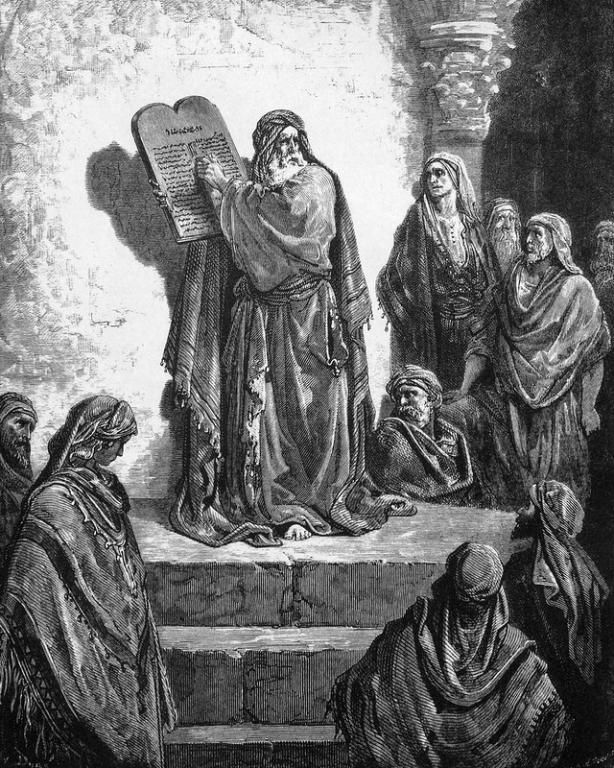
Photo credit: Ezra reading the Law in the hearing of the people (1867), by Gustave Doré (1832-1883) [Flickr / CC BY 2.0 license]
***
Previous Post
June 16, 2020
Ecumenical Councils: Catholic vs. Lutheran Perspective
Next Post

June 17, 2020 Is Harry Potter & Related Fantasy Literature Evil?
Browse Our Archives
Select a Category & Last Things About Me Anti-Catholicism Atheism & Agnosticism Baptism and Sacramentalism Bible and Tradition Blessed Virgin Mary Books by Dave Armstrong C. S. Lewis Calvinism & General Protestantism Catholic Apologetics Catholic Apologists Catholic conversion Catholic converts Christmas Church (Ecclesiology) Church History Conversion and Converts Development of Doctrine Eastern Orthodoxy Ecumenism & Christian Unity Eucharist & Liturgy Fathers of the Church French Translations G. K. Chesterton Hell Hell & Satan Hell & Satan & Last Things Heresies & Comparative Religion Holistic Health Inquisition & Crusades & Scandals James White Jews & Judaism & Old Testament John Calvin John Henry Newman Liberal / Modernist Theology Life Issues Literary Resume Lutheranism Mariology Martin Luther Music Orthodoxy Papacy & Infallibility Personal Page Philosophy & Science Political & Ethical & Moral Issues Protestant Persecution & Intolerance Protestantism Purgatory Purgatory & Penance Romantic & Imaginative Theology Saints & Purgatory & Penance Salvation Salvation & Justification Satan & Last Things Sexuality and Gender Issues Spanish Translations Traditionalism vs. Radical Catholic Reactionaries Traducciones al español / tradução para português Trinitarianism & Christology Uncategorized Videos
Select a Month October 2026 September 2026 August 2026 July 2026 June 2026 May 2026 April 2026 March 2026 February 2026 January 2026 December 2025 November 2025 October 2025 September 2025 August 2025 July 2025 June 2025 May 2025 April 2025 March 2025 February 2025 January 2025 December 2024 November 2024 October 2024 September 2024 August 2024 July 2024 June 2024 May 2024 April 2024 March 2024 February 2024 January 2024 December 2023 November 2023 October 2023 September 2023 August 2023 July 2023 June 2023 May 2023 April 2023 March 2023 February 2023 January 2023 December 2022 November 2022 October 2022 September 2022 August 2022 July 2022 June 2022 May 2022 April 2022 March 2022 February 2022 January 2022 December 2021 November 2021 October 2021 September 2021 August 2021 July 2021 June 2021 May 2021 April 2021 March 2021 February 2021 January 2021 December 2020 November 2020 October 2020 September 2020 August 2020 July 2020 June 2020 May 2020 April 2020 March 2020 February 2020 January 2020 December 2019 November 2019 October 2019 September 2019 August 2019 July 2019 June 2019 May 2019 April 2019 March 2019 February 2019 January 2019 December 2018 November 2018 October 2018 September 2018 August 2018 July 2018 June 2018 May 2018 April 2018 March 2018 February 2018 January 2018 December 2017 November 2017 October 2017 September 2017 August 2017 July 2017 June 2017 May 2017 April 2017 March 2017 February 2017 January 2017 December 2016 November 2016 October 2016 September 2016 August 2016 July 2016 June 2016 May 2016 April 2016 March 2016 February 2016 January 2016 December 2015 November 2015 October 2015 September 2015 August 2015 July 2015 June 2015 May 2015 April 2015 March 2015 February 2015 January 2015 December 2014 November 2014 October 2014 September 2014 August 2014 July 2014 June 2014 April 2014 March 2014 February 2014 January 2014 December 2013 November 2013 October 2013 September 2013 August 2013 July 2013 June 2013 April 2013 March 2013 February 2013 January 2013 December 2012 November 2012 October 2012 September 2012 August 2012 July 2012 June 2012 May 2012 April 2012 March 2012 February 2012 January 2012 December 2011 November 2011 October 2011 September 2011 August 2011 July 2011 June 2011 April 2011 March 2011 February 2011 October 2010 September 2010 August 2010 July 2010 April 2010 March 2010 December 2009 October 2009 August 2009 July 2009 June 2009 May 2009 March 2009 February 2009 October 2008 September 2008 April 2008 March 2008 February 2008 January 2008 December 2007 November 2007 October 2007 May 2007 March 2007 February 2007 January 2007 November 2006 October 2006 September 2006 August 2006 July 2006 June 2006 May 2006 April 2006 March 2006 February 2006 October 2005 June 2005 April 2005 February 2005 July 2004 May 2004 April 2004
Follow Us!
TAKE THE
Religious Wisdom Quiz
According to Paul, nothing in all creation can separate you from me—not death, not life, not angels or demons. What am I?
Select your answer to see how you score.
The love of God God's mercy Salvation God's grace
Books by This Author Books by Dave Armstrong
Related posts from Biblical Evidence for Catholicism

A Few "Worst" & "Best" Arguments vs. Protestantism
Biblical Evidence for Catholicism

Deuterocanon & Javier Perdomo's Straw Men
Biblical Evidence for Catholicism

St. Athanasius & the Deuterocanon (vs. Javier Perdomo)
Biblical Evidence for Catholicism

Jerusalem Council vs. James White & Sola Scriptura
Biblical Evidence for Catholicism
TRENDING AT PATHEOS Catholic

Emotion in Early Christianity by Andrew Crislip
Andrew Crislip’s Emotion in Early Christianity examines an often overlooked dimension of...

16 Spiritual Touchstones for a More Grounded Life
After decades of spiritual study, here are 16 principles I try...

Catholic Evangelization: Sharing Your Faith Every Day
Welcome back to the Graceful Awakening mini-series called, “From Faith to Mission.” ...

The Pillar of the Boatmen: the Ancient Monument...
The Pillar of the Boatmen is a Romano-Gaulish sculpture that dates from...

In one sense walking into Westminster Abbey is like walking down the...

'Super Scam Me' Exposes AI Jon Bon Jovi...
Leslie Pickett believed she was in a relationship with Jon Bon Jovi....
view all Catholic blogs
Ad-Free & Subscriber Log-In Subscription Support
- About Us
- 2026 Calendar
- Videos
- Podcasts
- Library of World Religions
- Faith In Media Tracker
- Advertise With Us
- Write for Us
- Privacy Policy
- Terms of Service
- Do Not Sell My Data
- Contact Us
- Radiant Digital
- Manage Newsletter Subscriptions
- Unsubscribe From Notifications
- Sitemap
Copyright 2008-2026, Patheos. All rights reserved.
Subscription Support Ad-Free & Subscriber Log-In
Follow Patheos