
BuddhistCatholicContemplativeEvangelicalGeneral ChristianHinduJewishLatter-day SaintMuslimNew VisionsProgressive Christian
Beliefs
- Buddhist
- Catholic
- Contemplative
- Evangelical
- General Christian
- Hindu
- Jewish
- Latter-day Saint
- More Voices
- Muslim
- New Visions
- Pagan
- Progressive Christian
Topics
- Religion News
- Food and Religion
- Sports and Religion
- Religious Art
- Religious Music and Entertainment
- Religious Events
- History and Religion
- Style and Religion
- Politics and Religion
- Women in Religion
- Recreation Outdoors and Religion
- Business Finance and Religion
- Careers Workplace and Religion
- Education and Religion
- Family Parenting and Religion
- Health Fitness and Religion
- Home and Religion
- Relationships and Religion
- Technology and Religion
- Travel and Religion
Columnists
- Buddhist Columnists
- Business Finance and Religion Columnists
- Careers Workplace and Religion Columnists
- Catholic Columnists
- Contemplative Columnists
- Education and Religion Columnists
- Evangelists Columnists
- Family Parenting and Religion Columnists
- General Christian Columnists
- Health Fitness and Religion Columnists
- Hindu Columnists
- History and Religion Columnists
- Home and Religion Columnists
- Jewish Columnists
- More Voices Columnists
- Latter Day Columnists
- Muslim Columnists
- New Visions Columnists
- Nonreligious Columnists
- Pagan Columnists
- Politics and Religion Columnists
- Progressive Columnists
- Recreation Outdoors and Religion Columnists
- Relationships and Religion Columnists
- Religion News Columnists
- Religious Art Columnists
- Religious Events Columnists
- Religious Music and Entertainment Columnists
- Sports and Religion Columnists
- Style and Religion Columnists
- Technology and Religion Columnists
- Travel and Religion Columnists
- Women in Religion Columnists
Resource Library
- 2026 Calendar
- Library of World Religions
- The 100 Most Holy Places on Earth
- Patheos Answers
- Podcasts
- Videos
- Faith Leaders Database
- Anglican Episcopalian
- Bahai
- Baptist
- Buddhism
- Christianity
- Confucianism
- Eastern Orthodoxy
- Hinduism
- Holiness and Pentecostal
- ISKCON
- Islam
- Judaism
- Lutheran
- Methodist
- The Church of Jesus Christ of Latter-day Saints
- New Age
- Paganism
- Presbytarian and Reformed
- Protestantism
- Religion Behind the Scenes
- Roman Catholic
- Scientology
- Shia Islam
- Sikhism
- Sufism
- Sunni Islam
- Taoism
- Zen
- See all religions
Research Tools
 Ad-Free & Subscriber Log-In Subscription Support
Ad-Free & Subscriber Log-In Subscription Support
Follow Patheos 

- Trending:
- Forgiveness
- |
- Marriage
- |
- Consciousness
- |
- Death Penalty
- |
- Election
- |
- Halloween

-
About
-
Catholic Apologetics
-
Church History
-
Great Apologists
-
Christian Worldview
-
Protestantism & Misc.
- Home
- Catholic
- History and Religion
- Ward’s Whoppers #11-12: Ten Commandments Issues
Ward’s Whoppers #11-12: Ten Commandments Issues
Last updated on: May 19, 2020 at 1:04 pm by Dave Armstrong
Ward’s Whoppers #11-12: Ten Commandments Issues 2020-05-19T13:04:44-04:00 Dave Armstrong
Patheos Explore the world's faith through different perspectives on religion and spirituality! Patheos has the views of the prevalent religions and spiritualities of the world.
Ward Ricker is an atheist who (as so often) was formerly a self-described “fundamentalist”. He likes to poke holes in the Bible and “prove” that it is a terrible and “evil” book, not inspired, hopelessly contradictory, etc. He put together a 222-page book called Unholy Bible (2019): available for free as a pdf file. It contains 421 couplets of passages that he considers literally contradictory, and 256 more couplets of not technically contradictory but “problem” passages (according to him). Ward wrote in his book: “I . . . am including here only what I consider to be the more firm examples of contradictions. . . . I do not want to include examples that are ‘weak’ and will be easily refuted. I have made my best judgment.” Ward also wrote to me:
[M]any Bible critics (“atheists” or otherwise) will use some pretty ridiculous arguments . . . I have screened out those bogus claims that some critics make and have published my own book . . . of contradictions that I and others have found in the Bible that are clearly contradictions. (letter to National Catholic Register about one of my articles there; reproduced in my first reply)
He issued a challenge for anyone to take on his alleged contradictions. After my first reply, he wrote a 5 1/2 page article suggesting in-depth dialogue. I responded, explaining in depth why I thought dialogue between us would be unfruitful, for many reasons. He then accused me (among other things in his two replies) of “hypocrisy” that “knows no bounds.” This is, of course, against my discussion rules, which forbids such rank insults, so he was promptly banned from my blog, and I replied: “I was exactly right in my judgment that no dialogue was possible. It never takes long for the fangs to come out if they are there.”
But I had already stated: “I may still take on several of your proposed contradictions, just so I can have opportunity to show how very wrong atheist contentions are (which is one thing Christian apologists do).” This series represents that effort. Mr. Ricker can respond on his page as he sees fit. He can still see my posts. His words will be in blue. To search any of this series on my blog, paste “Ward’s Whoppers #” in the search bar on the top right of my blog page. He uses the King James Version for his Bible verses. I will use RSV in my replies.
*****
46.
Exodus 20: 13 Thou shalt not kill.
Vs:
Exodus 32: 27 And he said unto them, Thus saith the LORD God of Israel, Put every man his sword by his side, and go in and out from gate to gate throughout the camp, and slay every man his brother, and every man his companion, and every man his neighbour.
Vs:
Deuteronomy 7: 1 When the LORD thy God shall bring thee into the land whither thou goest to possess it, and hath cast out many nations before thee, the Hittites, and the Girgashites, and the Amorites, and the Canaanites, and the Perizzites, and the Hivites, and the Jebusites, seven nations greater and mightier than thou; 2 and when the LORD thy God shall deliver them before thee; thou shalt smite them, and utterly destroy them
Q: Did god forbid killing?
***
This is my nomination for the most unfortunate Bible translation of one verse of all time: when the King James Version decided to translate the Hebrew ratsach (Strong’s word #7523) as “kill” rather than “murder” in Exodus 20:13. Thus, I give atheists and others a lot more slack with regard to this charge. Even the KJV in other places translates this word as “murderer” or “murder” 17 times out of its 47 appearances in the OT (36% of the time). When a word can have different meanings, it has to be determined by context which one is more accurate. Almost all modern Bible translations have “murder” in this passage (Young’s Literal Translation, ESV, NCV, NASB, NRSV, NKJV, NIV, etc.).
The killing described in the other passages is simply judgment, which is God’s prerogative to command and to do. It always seems to be poorly understood by atheists, but is perfectly sensible, compared to human analogies (ones that they themselves fully accept). Hence, I wrote in my first long response to Ward:
It’s not difficult to find many human analogies to judging and punishing: human judges passing sentences on criminals, the Allies “judging” and defeating the Nazis in World War II, our superiority over animals; parents’ chastising and punishing of children (an analogy to God that the Bible itself makes), police exercising lethal force as the situation warrants. Failing this understanding leads you to conclude that God is engaged in evil, wicked acts of “violence” when He is justly judging. It’s like saying we were “evil” and “ruthless” and “bloodthirsty” when we wiped out the Nazis.
See many more papers on God’s judgment on the Trinitarianism and Christology web page on my blog (word-search “God as Judge” for the section).
***
50.
Exodus 34: 1 And the LORD said unto Moses, Hew thee two tables of stone like unto the first: and I will write upon these tables the words that were in the first tables, which thou brakest.
Deuteronomy 10: 1 At that time the LORD said unto me, Hew thee two tables of stone like unto the first, and come up unto me into the mount, …. 4 And he wrote on the tables, according to the first writing, the ten commandments,
Vs:
Exodus 34: 27 And the LORD said unto Moses, Write thou these words: for after the tenor of these words I have made a covenant with thee and with Israel. 28 And he was there with the LORD forty days and forty nights; he did neither eat bread, nor drink water. And he wrote upon the tables the words of the covenant, the ten commandments.
Q: Who inscribed the tablets? (Does god lie?)
***
God wrote on both sets of tablets, according to the Bible: after the relevant considerations are taken into account. Apologist Eric Lyons (“Who Wrote on the Second Pair of Tablets?”, Apologetics Press, 2004), provides the solution:
The words that God instructed Moses to write were “these words,” which He spoke in the preceding verses (i.e., 34:10-26—the ceremonial and judicial injunctions, not the ten “words” of Exodus 20:2-17). The rewriting of the Ten Commandments on the newly prepared slabs was done by God’s own hand. God specifically stated in the first verse of Exodus 34 that He (not Moses) would write the same words that had been written on the first tablets of stone that Moses broke. In verse 28 of that chapter, we have it on record that God did what He said He would do in verse one (cf. Deuteronomy 10:2-4). The only thing verse 27 teaches is that Moses wrote the list of regulations given in verses 10-26.
It seems rather obvious that it is the portion before Exodus 34:27 (instructions from God) that God is referring to, in saying “Write these words; in accordance with these words I have made a covenant with you and with Israel.” He’s talking about the covenant, which involves a lot more than just the Ten Commandments. Hence, He started off in verse 10 saying, “Behold, I make a covenant.” Then after detailing many rules and laws, He ends by saying, “write these words” and mentioning the covenant: details of which He had just given.
The only remaining question, then, is who is referenced in the final clause of Exodus 34:28: “And he wrote upon the tables the words of the covenant, the ten commandments.” It does seem in context to refer to Moses, since the earlier part of the passage was about him. This is at least a plausible Bible difficulty (unlike most I have been examining in this series). But pronouns in the Bible (as in literature generally) sometimes refer to persons a bit earlier in the text:
He wrote, not Moses, but the Lord, as appears from Exodus 24:1, and from Deu[teronomy] 10, the relative pronoun being here referred to the remoter antecedent, of which there are many instances, as Genesis 10:12 1 Samuel 21:14 27:8 Psalm 99:6. (Matthew Poole’s Commentary; see an old Greek lexicon also making mention of this)
Here are two other examples of pronouns or nouns referencing a non-immediate antecedent in Scripture:
Acts 4:10-11 be it known to you all, and to all the people of Israel, that by the name of Jesus Christ of Nazareth, whom you crucified, whom God raised from the dead, by him this man is standing before you well. [11] This is the stone which was rejected by you builders, but which has become the head of the corner. [“This is the stone” refers to Christ, not the healed man who was mentioned right before it]
Acts 7:37-38 This is the Moses who said to the Israelites, `God will raise up for you a prophet from your brethren as he raised me up.’ [38] This is he who was in the congregation in the wilderness with the angel who spoke to him at Mount Sinai, and with our fathers; and he received living oracles to give to us. [“This is he” refers to Moses, not Christ, Who was alluded to right before it]
Doug Ward wrote a article about this very thing (“Watch Your Antecedents!”). He wrote:
Keeping track of possible antecedents of pronouns can shed new light on some puzzling passages from the book of Genesis.
Handbooks of English composition admonish aspiring writers to be very careful in using pronouns. In particular, a writer should make sure that there is no possibility of mistaking the identity of a pronoun’s intended antecedent. As an example of what to avoid, consider this sentence:
“He told his father he would soon get a letter.”
Here it is not clear which of the two-the son or the father-will be the recipient of a letter. The sentence should be rewritten to remove this ambiguity. . . .
Modern writers of English are not the only ones whose use of pronouns has resulted in questions and controversy. The ancient writers of the Hebrew scriptures have left us with a few ambiguities in the biblical text as well. When we encounter one of them, it is instructive to look at all the options and consider their possible interpretations in order to maximize our chances of grasping the intended meaning. In this article I will discuss three examples, all taken from the book of Genesis.
He proceeded to analyze Genesis 9:27; 35:4; and 37:28. That gives us nine total biblical passages in which reference to a remote antecedent occurs: precisely as I am claiming is the case with Exodus 34:28. By understanding that this sort of linguistic device is used in the Bible, we can understand some passages that are wrongly set forth as examples of contradictions. And our interpretation in this instance is bolstered by the clear cross-references of Exodus 34:1 and Deuteronomy 10:1.
***
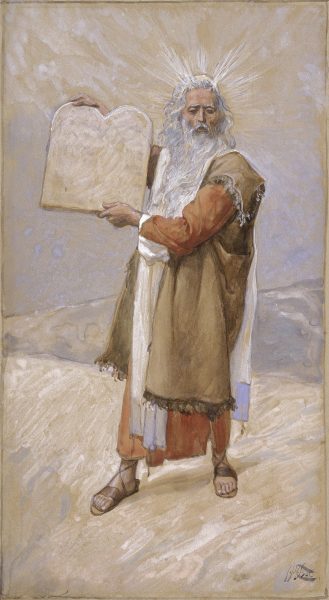
Photo credit: Moses and the Ten Commandments, by James Jacques Joseph Tissot (1836-1902) [public domain / Wikimedia Commons]

***
Jews & Judaism & Old Testament
Previous Post

May 18, 2020
Ward's Whoppers #9-10: Parting the Red Sea / "Foreigners"
Next Post
May 19, 2020 Ward's Whoppers #13: How Did David Kill Goliath?
Browse Our Archives
Select a Category & Last Things About Me Anti-Catholicism Atheism & Agnosticism Baptism and Sacramentalism Bible and Tradition Blessed Virgin Mary Books by Dave Armstrong C. S. Lewis Calvinism & General Protestantism Catholic Apologetics Catholic Apologists Catholic conversion Catholic converts Christmas Church (Ecclesiology) Church History Conversion and Converts Development of Doctrine Eastern Orthodoxy Ecumenism & Christian Unity Eucharist & Liturgy Fathers of the Church French Translations G. K. Chesterton Hell Hell & Satan Hell & Satan & Last Things Heresies & Comparative Religion Holistic Health Inquisition & Crusades & Scandals James White Jews & Judaism & Old Testament John Calvin John Henry Newman Liberal / Modernist Theology Life Issues Literary Resume Lutheranism Mariology Martin Luther Music Orthodoxy Papacy & Infallibility Personal Page Philosophy & Science Political & Ethical & Moral Issues Protestant Persecution & Intolerance Protestantism Purgatory Purgatory & Penance Romantic & Imaginative Theology Saints & Purgatory & Penance Salvation Salvation & Justification Satan & Last Things Sexuality and Gender Issues Spanish Translations Traditionalism vs. Radical Catholic Reactionaries Traducciones al español / tradução para português Trinitarianism & Christology Uncategorized Videos
Select a Month October 2026 September 2026 August 2026 July 2026 June 2026 May 2026 April 2026 March 2026 February 2026 January 2026 December 2025 November 2025 October 2025 September 2025 August 2025 July 2025 June 2025 May 2025 April 2025 March 2025 February 2025 January 2025 December 2024 November 2024 October 2024 September 2024 August 2024 July 2024 June 2024 May 2024 April 2024 March 2024 February 2024 January 2024 December 2023 November 2023 October 2023 September 2023 August 2023 July 2023 June 2023 May 2023 April 2023 March 2023 February 2023 January 2023 December 2022 November 2022 October 2022 September 2022 August 2022 July 2022 June 2022 May 2022 April 2022 March 2022 February 2022 January 2022 December 2021 November 2021 October 2021 September 2021 August 2021 July 2021 June 2021 May 2021 April 2021 March 2021 February 2021 January 2021 December 2020 November 2020 October 2020 September 2020 August 2020 July 2020 June 2020 May 2020 April 2020 March 2020 February 2020 January 2020 December 2019 November 2019 October 2019 September 2019 August 2019 July 2019 June 2019 May 2019 April 2019 March 2019 February 2019 January 2019 December 2018 November 2018 October 2018 September 2018 August 2018 July 2018 June 2018 May 2018 April 2018 March 2018 February 2018 January 2018 December 2017 November 2017 October 2017 September 2017 August 2017 July 2017 June 2017 May 2017 April 2017 March 2017 February 2017 January 2017 December 2016 November 2016 October 2016 September 2016 August 2016 July 2016 June 2016 May 2016 April 2016 March 2016 February 2016 January 2016 December 2015 November 2015 October 2015 September 2015 August 2015 July 2015 June 2015 May 2015 April 2015 March 2015 February 2015 January 2015 December 2014 November 2014 October 2014 September 2014 August 2014 July 2014 June 2014 April 2014 March 2014 February 2014 January 2014 December 2013 November 2013 October 2013 September 2013 August 2013 July 2013 June 2013 April 2013 March 2013 February 2013 January 2013 December 2012 November 2012 October 2012 September 2012 August 2012 July 2012 June 2012 May 2012 April 2012 March 2012 February 2012 January 2012 December 2011 November 2011 October 2011 September 2011 August 2011 July 2011 June 2011 April 2011 March 2011 February 2011 October 2010 September 2010 August 2010 July 2010 April 2010 March 2010 December 2009 October 2009 August 2009 July 2009 June 2009 May 2009 March 2009 February 2009 October 2008 September 2008 April 2008 March 2008 February 2008 January 2008 December 2007 November 2007 October 2007 May 2007 March 2007 February 2007 January 2007 November 2006 October 2006 September 2006 August 2006 July 2006 June 2006 May 2006 April 2006 March 2006 February 2006 October 2005 June 2005 April 2005 February 2005 July 2004 May 2004 April 2004
Follow Us!
TAKE THE
Religious Wisdom Quiz
Who was stoned to death for preaching about Jesus?
Select your answer to see how you score.
Peter Paul Stephen James
Books by This Author Books by Dave Armstrong
Related posts from Biblical Evidence for Catholicism

God, Modern Physics, & Dark Energy: An Analogy
Biblical Evidence for Catholicism

God's Presence, the Ark, the Eucharist, & Death
Biblical Evidence for Catholicism
Garden of Eden’s Location Verified by Science
Biblical Evidence for Catholicism
Unregenerate Good Works in the Old Testament
Biblical Evidence for Catholicism
TRENDING AT PATHEOS Catholic

Janie Learns the Way of the Cross: A...
Teaching children about Jesus' Passion can be challenging. Many parents and educators...

Looking For Good Catholic Writing - October 2026
He alone extends the heavens, and he walks upon the waves of...

In "Irreplaceable," our book on vocation and technology, Trevor Sutton and I...

I was strolling through the top floor of the brand new Parthenon...

What Does Gêvâh Mean For Kimberley Guifoyle &...
This week, a lot of the news is focused on Kimberly Guilfoyle....

INNER CIRCLE: Profound Mystery (Of Christ In All...
Ephesians 5:31-32 “For this reason, a man will leave his father and...
view all Catholic blogs
Ad-Free & Subscriber Log-In Subscription Support
- About Us
- 2026 Calendar
- Videos
- Podcasts
- Library of World Religions
- Faith In Media Tracker
- Advertise With Us
- Write for Us
- Privacy Policy
- Terms of Service
- Do Not Sell My Data
- Contact Us
- Radiant Digital
- Manage Newsletter Subscriptions
- Unsubscribe From Notifications
- Sitemap
Copyright 2008-2026, Patheos. All rights reserved.
Subscription Support Ad-Free & Subscriber Log-In
Follow Patheos