
BuddhistCatholicContemplativeEvangelicalGeneral ChristianHinduJewishLatter-day SaintMuslimNew VisionsProgressive Christian
Beliefs
- Buddhist
- Catholic
- Contemplative
- Evangelical
- General Christian
- Hindu
- Jewish
- Latter-day Saint
- More Voices
- Muslim
- New Visions
- Pagan
- Progressive Christian
Topics
- Religion News
- Food and Religion
- Sports and Religion
- Religious Art
- Religious Music and Entertainment
- Religious Events
- History and Religion
- Style and Religion
- Politics and Religion
- Women in Religion
- Recreation Outdoors and Religion
- Business Finance and Religion
- Careers Workplace and Religion
- Education and Religion
- Family Parenting and Religion
- Health Fitness and Religion
- Home and Religion
- Relationships and Religion
- Technology and Religion
- Travel and Religion
Columnists
- Buddhist Columnists
- Business Finance and Religion Columnists
- Careers Workplace and Religion Columnists
- Catholic Columnists
- Contemplative Columnists
- Education and Religion Columnists
- Evangelists Columnists
- Family Parenting and Religion Columnists
- General Christian Columnists
- Health Fitness and Religion Columnists
- Hindu Columnists
- History and Religion Columnists
- Home and Religion Columnists
- Jewish Columnists
- More Voices Columnists
- Latter Day Columnists
- Muslim Columnists
- New Visions Columnists
- Nonreligious Columnists
- Pagan Columnists
- Politics and Religion Columnists
- Progressive Columnists
- Recreation Outdoors and Religion Columnists
- Relationships and Religion Columnists
- Religion News Columnists
- Religious Art Columnists
- Religious Events Columnists
- Religious Music and Entertainment Columnists
- Sports and Religion Columnists
- Style and Religion Columnists
- Technology and Religion Columnists
- Travel and Religion Columnists
- Women in Religion Columnists
Resource Library
- 2026 Calendar
- Library of World Religions
- The 100 Most Holy Places on Earth
- Patheos Answers
- Podcasts
- Videos
- Faith Leaders Database
- Anglican Episcopalian
- Bahai
- Baptist
- Buddhism
- Christianity
- Confucianism
- Eastern Orthodoxy
- Hinduism
- Holiness and Pentecostal
- ISKCON
- Islam
- Judaism
- Lutheran
- Methodist
- The Church of Jesus Christ of Latter-day Saints
- New Age
- Paganism
- Presbytarian and Reformed
- Protestantism
- Religion Behind the Scenes
- Roman Catholic
- Scientology
- Shia Islam
- Sikhism
- Sufism
- Sunni Islam
- Taoism
- Zen
- See all religions
Research Tools
 Ad-Free & Subscriber Log-In Subscription Support
Ad-Free & Subscriber Log-In Subscription Support
Follow Patheos 

- Trending:
- Forgiveness
- |
- Marriage
- |
- Consciousness
- |
- Death Penalty
- |
- Election
- |
- Halloween

-
About
-
Catholic Apologetics
-
Church History
-
Great Apologists
-
Christian Worldview
-
Protestantism & Misc.
- Home
- Catholic
- History and Religion
- Trent Doesn’t Utterly Exclude Imputation (Kenneth Howell)
Trent Doesn’t Utterly Exclude Imputation (Kenneth Howell)
Last updated on: May 1, 2020 at 10:32 am by Dave Armstrong
Trent Doesn’t Utterly Exclude Imputation (Kenneth Howell) 2020-05-01T10:32:32-04:00 Dave Armstrong
Patheos Explore the world's faith through different perspectives on religion and spirituality! Patheos has the views of the prevalent religions and spiritualities of the world.
The following comes from some e-mail in my files from Dr. Kenneth Howell (July 1996). He was a Presbyterian minister from 1978 to 1996, and converted to the Catholic Church in June 1996. Dr. Howell holds a Master of Divinity degree from Westminster Seminary, and Ph.D’s in General Linguistics (Indiana) and History (Lancaster Univ., U.K.). He was Associate Professor of Biblical Languages and Literature at Reformed Theological Seminary in Jackson, Mississippi for seven years. Dr. Howell is currently a Senior Fellow of the St. Paul Center for Biblical Theology, and Director of the John Henry Cardinal Newman Institute of Catholic Thought, and Adjunct Associate Professor of Religious Studies at the University of Illinois.
* * * * *
Trent does not exclude the notion of imputation. It only denies that justification consists solely in imputation. The relevant canons are numbers 9,10,11. Canon 9 does not even deny sola fide completely but only a very minimal interpretation of that notion. I translate literally:
“If anyone says that the impious are justified by faith alone so that he understands [by this] that nothing else is required in which [quo] he cooperates in working out the grace of justification and that it is not necessary at all that he be prepared and disposed by the movement of his will, let him be anathema.”
Canon 9 then only anathematizes such a reduced form of faith that no outworking of that faith is necessary. This canon in no way says that imputation is not true but only that it is heretical to hold that justification consists solely in imputation.
I am puzzled why anyone would say that extrinsic righteousness might be excluded by Trent. The only righteousness that justifies is Christ’s. But Catholic theology teaches that what is Christ’s becomes ours by grace. In fact Canon 10 anathematizes anyone who denies that we can be justified without Christ’s righteousness or anyone who says that we are formally justified by that righteousness alone. Here’s the words:
“If anyone says that men are justified without Christ’s righteousness which he merited for us or that they are formally justified by it itself [i.e. righteousness] [‘per eam ipsam‘], let him be anathema.”
Canon 10 says that Christ’s righteousness is both necessary and not limited to imputation i.e. formally. So, imputation is not excluded but only said to be not sufficient.
With regard to imputation, if Trent indeed excludes it, I am ready to reject it. But the wording of the decrees does not seem to me to require this.
How could I become a Catholic if I still thought imputation was acceptable? Because I came to see that the rigid distinction between justification and sanctification so prominent in Reformation theologies was an artificial distinction that Scripture did not support. When one takes into account the whole of Scripture, especially James’ and Jesus’ teaching on the necessity of perfection for salvation (e.g. Matt 5;8), I realized that man cannot be “simul justus et peccator.” Transformational righteousness is absolutely essential for final salvation. Once one realizes this, the entire Catholic system of sacraments, purgatory etc. fits into a coherent pattern.
But does this mean that “imputation … is totally foreign to Catholic thought?” I am not sure it does. I find it even harder to believe that Christ’s righteousness declaring us forgiven is “totally antithetical to transformational righteousness.”
Perhaps it is very important to clarify definitions at this point . . . One is the Reformed/Lutheran idea of an account with God that has no direct bearing on our real state in life. Let’s call this the strong imputation thesis. I have no doubt that this was rejected by Trent. But a softer form — call it the weak imputation thesis — is that imputation is a declaration of forgiveness of the kind implied in Jesus’s words to the thief on the cross, “Today you will be with me in paradise.” Other examples are our Lord’s words to Zaccheus, “Today, salvation has arrived at this house because he himself is a son of Abraham.” Or to the woman caught in adultery, “Neither do I condemn you.” This declaration is what we receive when, having confessed our sins sincerely to our priests, we may be confident of the forgiveness of Christ. The words of the human priest are Christ’s words of forgiveness. We have been declared forgiven.
* * *
There can be no doubt that Trent stressed transformational righteousness as that which Christ infuses into our souls. The frequent references to baptism clearly speak of a real justice that results from Christ’s meritorious work. Furthermore, it’s evident that the idea of being thought of as righteous by God, without really being so, is unacceptable. This is particuarly emphasized in chapter 7 when speaking about the formal cause of justification. As with Aristotle’s use of this category “formal cause”, Trent meant that which shapes us (i.e. gives us form) into righteous people, not simply being thought of as righteous (“non modo reputamur sed vere justi nominamur et sumus“). To put the matter in another manner, God thinks of us as righteous only when we are in fact righteous. There is no legal fiction.
Having said that, it seems to me that there is also a place in Trent for a declaration which not only recognizes but also confers that righteousness of Christ which is the ground of our justification. In chapter 14 “On Lapses and their Restoration” Trent insists on the necessity of sacramental confession as the means of restoration and it explicitly says that sacramental absolution is the only means of remitting eternal punishment and guilt. The Latin here is somewhat convoluted and the standard English translation (Deferrari) is so literal that it is difficult to follow. So, I’ll retranslate the relevant section in a less literal but hopefully more comprehensible form:
A man’s repentance after falling … contains not only a cessation from sins by hating them (or a contrite and humble heart). It also requires a sacramental confession of those same sins, made at least in desire and at a proper time. This involves sacramental absolution as well as satisfaction by means of fasting, almsgiving, prayers and other pious exercises of the spiritual life. These pious acts do not pay for eternal punishment because that along with guilt can only be remitted by the sacrament or the desire for the sacrament. They pay for temporal punishment which is not always fully remitted (as is the case in baptism) for those who have grieved the Holy Spirit by their ingratitude for the grace of God they once received.
Here the Council Fathers go out of their way to stress that our standing before God in this life without guilt and eternal punishment comes from the declaration and conferring of forgiveness found in sacramental absolution. I am reminded of something I heard about Mother Teresa. She supposedly said when we come out of confession, we are without sin just for a little while. Belief in the objective nature of the sacraments requires us to say that the priest’s declaration confers what it signifies. And what does it signify? That Christ our High Priest is granting us pardon on the basis of his own merits.
How does this bear on imputation? The Protestant doctrine, it seems to me, has at least two sides. Imputation is the declaration of forgiveness on God’s part because of Christ’s work but it is also a legal fiction that has nothing immediately to do with real (subjective) state of the penitent. Now I think the declaration side of imputation is acceptable to Trent but not the legal fiction side. The difference between the Tridentine and the Reformation views, in addition to many other aspects, is that in the latter view God only sees us as righteous while in the former, Christ confers righteousness upon (and in) us.
There is another reason why I think imputation is not totally excluded but is acceptable in a modified form. Canon 9 rejects sola fide but, as we know, Trent does not reject faith as essential to justification. It only rejects the reductionism implied in the sola. So also, canon 11 rejects “sola imputatione justitiae Christi and sola peccatorum remissione.” Surely Trent includes remission of sins in justification. Why would we not say then that it also includes imputation of Christ’s righteousness? If faith (canon 9) and remission of sins (canon 11) are essential to justification, then should we not also say that imputation of Christ’s righteousness is also necessary? Indeed, it seems to me that this is precisely what is being emphasized in requirement for sacramental absolution in chapter 14.
What is wrong with the Reformation view then? It is the sola part. Faith is essential but not sola fide. Remission of sins is essential but not sola remissione. Imputation via absolution is essential but not sola imputatione. I remember well how this hit me one day in my journey. So much of Protestantism represents a reductionism of the Catholic faith. The Protestants added their qualifiers (sola) and thereby threw out the fullness of faith.
There is no doubt that the Protestant theory of legal fiction is just that, a fiction. That must be rejected. But the declarative side of justification does not need to be thrown out completely.
***
Related Reading
St. Paul on Justification, Sanctification, & Salvation [1996]
Romans 2-4 & “Works of the Law”: Patristic Interpretation [2-16-01]
Justification in James: Dialogue [5-8-02]
Council of Trent: Canons on Justification (with a handy summary of Tridentine soteriology) [12-29-03]
Initial Justification & “Faith Alone”: Harmonious? [5-3-04]
Faith & Works: Oil & Water or Two Sides of a Coin? [2004]
Catholics’ Underemphasis on Justification by Faith [3-30-06]
Dialogue w Three Lutherans on Justification & Salvation [2-1-07]
Catholic Bible Verses on Sanctification and Merit [12-20-07]
Catholic-Protestant Common Ground (Esp. Re Good Works) [4-8-08]
Martin Luther: Good Works Prove Authentic Faith [4-16-08]
St. Paul on Grace, Faith, & Works (50 Passages) [8-6-08]
John Calvin: Good Works Manifest True Saving Faith [9-4-08]
Grace, Faith, Works, & Judgment: A Scriptural Exposition [12-16-09; reformulated & abridged on 3-15-17]
Bible on Participation in Our Own Salvation (Always Enabled by God’s Grace) [1-3-10]
Monergism in Initial Justification is Catholic Doctrine [1-7-10]
Martin Luther: Faith Alone is Not Lawless Antinomianism [2-28-10]
Biblical “Power”: Proof of Infused (Catholic) Justification [3-14-11]
Justification: Not by Faith Alone, & Ongoing (Romans 4, James 2, and Abraham’s Multiple Justifications) [10-15-11]
St. Paul’s Use of the Term “Gift” & Infused Justification [2013]
Salvation: By Grace Alone, Not Faith Alone or Works [2013]
Scripture on Being Co-Workers with God for Salvation [2013]
“Catholic Justification” in James & Romans [11-18-15]
Philippians 2:12 & “Work[ing] Out” One’s Salvation [1-26-16]
***
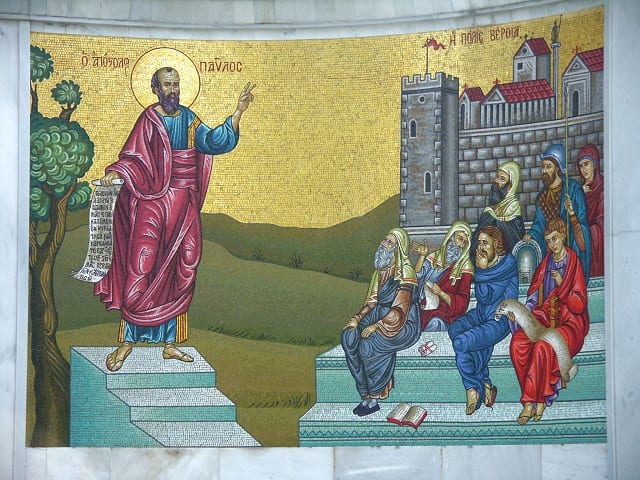
Photo credit: AJ Alfieri-Crispin (10-28-06), Saint Paul Preaching, Pauline shrine in Veria, Greece [Flickr / CC BY-SA 2.0 license]
***
Previous Post

April 30, 2020
Opposition to Extreme Anti-Francis Bias: Elliot Bougis
Next Post
May 1, 2020 Tackling the Objection that my Articles are "Too Long"
Browse Our Archives
Select a Category & Last Things About Me Anti-Catholicism Atheism & Agnosticism Baptism and Sacramentalism Bible and Tradition Blessed Virgin Mary Books by Dave Armstrong C. S. Lewis Calvinism & General Protestantism Catholic Apologetics Catholic Apologists Catholic conversion Catholic converts Christmas Church (Ecclesiology) Church History Conversion and Converts Development of Doctrine Eastern Orthodoxy Ecumenism & Christian Unity Eucharist & Liturgy Fathers of the Church French Translations G. K. Chesterton Hell Hell & Satan Hell & Satan & Last Things Heresies & Comparative Religion Holistic Health Inquisition & Crusades & Scandals James White Jews & Judaism & Old Testament John Calvin John Henry Newman Liberal / Modernist Theology Life Issues Literary Resume Lutheranism Mariology Martin Luther Music Orthodoxy Papacy & Infallibility Personal Page Philosophy & Science Political & Ethical & Moral Issues Protestant Persecution & Intolerance Protestantism Purgatory Purgatory & Penance Romantic & Imaginative Theology Saints & Purgatory & Penance Salvation Salvation & Justification Satan & Last Things Sexuality and Gender Issues Spanish Translations Traditionalism vs. Radical Catholic Reactionaries Traducciones al español / tradução para português Trinitarianism & Christology Uncategorized Videos
Select a Month October 2026 September 2026 August 2026 July 2026 June 2026 May 2026 April 2026 March 2026 February 2026 January 2026 December 2025 November 2025 October 2025 September 2025 August 2025 July 2025 June 2025 May 2025 April 2025 March 2025 February 2025 January 2025 December 2024 November 2024 October 2024 September 2024 August 2024 July 2024 June 2024 May 2024 April 2024 March 2024 February 2024 January 2024 December 2023 November 2023 October 2023 September 2023 August 2023 July 2023 June 2023 May 2023 April 2023 March 2023 February 2023 January 2023 December 2022 November 2022 October 2022 September 2022 August 2022 July 2022 June 2022 May 2022 April 2022 March 2022 February 2022 January 2022 December 2021 November 2021 October 2021 September 2021 August 2021 July 2021 June 2021 May 2021 April 2021 March 2021 February 2021 January 2021 December 2020 November 2020 October 2020 September 2020 August 2020 July 2020 June 2020 May 2020 April 2020 March 2020 February 2020 January 2020 December 2019 November 2019 October 2019 September 2019 August 2019 July 2019 June 2019 May 2019 April 2019 March 2019 February 2019 January 2019 December 2018 November 2018 October 2018 September 2018 August 2018 July 2018 June 2018 May 2018 April 2018 March 2018 February 2018 January 2018 December 2017 November 2017 October 2017 September 2017 August 2017 July 2017 June 2017 May 2017 April 2017 March 2017 February 2017 January 2017 December 2016 November 2016 October 2016 September 2016 August 2016 July 2016 June 2016 May 2016 April 2016 March 2016 February 2016 January 2016 December 2015 November 2015 October 2015 September 2015 August 2015 July 2015 June 2015 May 2015 April 2015 March 2015 February 2015 January 2015 December 2014 November 2014 October 2014 September 2014 August 2014 July 2014 June 2014 April 2014 March 2014 February 2014 January 2014 December 2013 November 2013 October 2013 September 2013 August 2013 July 2013 June 2013 April 2013 March 2013 February 2013 January 2013 December 2012 November 2012 October 2012 September 2012 August 2012 July 2012 June 2012 May 2012 April 2012 March 2012 February 2012 January 2012 December 2011 November 2011 October 2011 September 2011 August 2011 July 2011 June 2011 April 2011 March 2011 February 2011 October 2010 September 2010 August 2010 July 2010 April 2010 March 2010 December 2009 October 2009 August 2009 July 2009 June 2009 May 2009 March 2009 February 2009 October 2008 September 2008 April 2008 March 2008 February 2008 January 2008 December 2007 November 2007 October 2007 May 2007 March 2007 February 2007 January 2007 November 2006 October 2006 September 2006 August 2006 July 2006 June 2006 May 2006 April 2006 March 2006 February 2006 October 2005 June 2005 April 2005 February 2005 July 2004 May 2004 April 2004
Follow Us!
TAKE THE
Religious Wisdom Quiz
What famous cathedral is in Paris, known for its flying buttresses and rose windows?
Select your answer to see how you score.
Notre Dame St. Paul's St. Peter's Canterbury
Books by This Author Books by Dave Armstrong
Related posts from Biblical Evidence for Catholicism

Bible & Catholicism on Mortal Sin (vs. John...
Biblical Evidence for Catholicism

Dialogue on Eternal Security / Absolute Assurance
Biblical Evidence for Catholicism

"Faith Alone" Dialogue with a Calvinist
Biblical Evidence for Catholicism

Exegesis of 75 NT Faith [Alone?] & Works...
Biblical Evidence for Catholicism
TRENDING AT PATHEOS Catholic

In "Irreplaceable," our book on vocation and technology, Trevor Sutton and I...

I was strolling through the top floor of the brand new Parthenon...

What Does Gêvâh Mean For Kimberley Guifoyle &...
This week, a lot of the news is focused on Kimberly Guilfoyle....

INNER CIRCLE: Profound Mystery (Of Christ In All...
Ephesians 5:31-32 “For this reason, a man will leave his father and...

Do Not Rejoice When Your Enemy Falls: The...
Turning an execution into a public spectacle is a disturbing expression of...

'The Chosen' S6 Trailer: The Passion Gets Very...
Not many watching 'The Chosen' worry about spoilers, but just because they...
view all Catholic blogs
Ad-Free & Subscriber Log-In Subscription Support
- About Us
- 2026 Calendar
- Videos
- Podcasts
- Library of World Religions
- Faith In Media Tracker
- Advertise With Us
- Write for Us
- Privacy Policy
- Terms of Service
- Do Not Sell My Data
- Contact Us
- Radiant Digital
- Manage Newsletter Subscriptions
- Unsubscribe From Notifications
- Sitemap
Copyright 2008-2026, Patheos. All rights reserved.
Subscription Support Ad-Free & Subscriber Log-In
Follow Patheos