
BuddhistCatholicContemplativeEvangelicalGeneral ChristianHinduJewishLatter-day SaintMuslimNew VisionsProgressive Christian
Beliefs
- Buddhist
- Catholic
- Contemplative
- Evangelical
- General Christian
- Hindu
- Jewish
- Latter-day Saint
- More Voices
- Muslim
- New Visions
- Pagan
- Progressive Christian
Topics
- Religion News
- Food and Religion
- Sports and Religion
- Religious Art
- Religious Music and Entertainment
- Religious Events
- History and Religion
- Style and Religion
- Politics and Religion
- Women in Religion
- Recreation Outdoors and Religion
- Business Finance and Religion
- Careers Workplace and Religion
- Education and Religion
- Family Parenting and Religion
- Health Fitness and Religion
- Home and Religion
- Relationships and Religion
- Technology and Religion
- Travel and Religion
Columnists
- Buddhist Columnists
- Business Finance and Religion Columnists
- Careers Workplace and Religion Columnists
- Catholic Columnists
- Contemplative Columnists
- Education and Religion Columnists
- Evangelists Columnists
- Family Parenting and Religion Columnists
- General Christian Columnists
- Health Fitness and Religion Columnists
- Hindu Columnists
- History and Religion Columnists
- Home and Religion Columnists
- Jewish Columnists
- More Voices Columnists
- Latter Day Columnists
- Muslim Columnists
- New Visions Columnists
- Nonreligious Columnists
- Pagan Columnists
- Politics and Religion Columnists
- Progressive Columnists
- Recreation Outdoors and Religion Columnists
- Relationships and Religion Columnists
- Religion News Columnists
- Religious Art Columnists
- Religious Events Columnists
- Religious Music and Entertainment Columnists
- Sports and Religion Columnists
- Style and Religion Columnists
- Technology and Religion Columnists
- Travel and Religion Columnists
- Women in Religion Columnists
Resource Library
- 2026 Calendar
- Library of World Religions
- The 100 Most Holy Places on Earth
- Patheos Answers
- Podcasts
- Videos
- Faith Leaders Database
- Anglican Episcopalian
- Bahai
- Baptist
- Buddhism
- Christianity
- Confucianism
- Eastern Orthodoxy
- Hinduism
- Holiness and Pentecostal
- ISKCON
- Islam
- Judaism
- Lutheran
- Methodist
- The Church of Jesus Christ of Latter-day Saints
- New Age
- Paganism
- Presbytarian and Reformed
- Protestantism
- Religion Behind the Scenes
- Roman Catholic
- Scientology
- Shia Islam
- Sikhism
- Sufism
- Sunni Islam
- Taoism
- Zen
- See all religions
Research Tools
 Ad-Free & Subscriber Log-In Subscription Support
Ad-Free & Subscriber Log-In Subscription Support
Follow Patheos 

- Trending:
- Forgiveness
- |
- Marriage
- |
- Consciousness
- |
- Death Penalty
- |
- Election
- |
- Halloween

-
About
-
Catholic Apologetics
-
Church History
-
Great Apologists
-
Christian Worldview
-
Protestantism & Misc.
- Home
- Catholic
- History and Religion
- On the Title “Mother of God” / Theotokos (vs. Steve Hays)
On the Title “Mother of God” / Theotokos (vs. Steve Hays)
Last updated on: May 14, 2020 at 11:57 am by Dave Armstrong
On the Title “Mother of God” / Theotokos (vs. Steve Hays) 2020-05-14T11:57:48-04:00 Dave Armstrong
Patheos Explore the world's faith through different perspectives on religion and spirituality! Patheos has the views of the prevalent religions and spiritualities of the world.
Steve Hays of Tribalblogue is an anti-Catholic polemicist and sophist. I’ll be responding to the relevant portions of Steve’s article, “Theotokos” (12-19-17, Tribalblogue). His words will be in blue.
*****
Because “mother of God” is equivocal, Catholics use that as a wedge issue. They try to get evangelicals to agree on an orthodox sense of the title, swap that out and swap in a different meaning, then use their bait-n-switch to promote their legendary Marian dogmas.
. . . we should reject equivocal usage, where the evangelical side means one thing, the Catholic side means something else, and the Catholic side substitutes their meaning for our meaning, as if we made a substantive concession.
This also goes to the tactical blunder of letting your opponent define the terms of debate. That rigs the outcome in his favor.
*
Nonsense. Rather, the situation is that many Protestants absurdly misunderstand what we mean by “Mother of God” or Theotokos (literally, “God-bearer”): even though much of historical Protestantism (e.g., Luther, Calvin, Lutheranism, Anglicanism) fully accepted the term (or if not the very term — as with Calvin — , the exact notion that it conveys) in the same sense that we do. But the ones who are ignorant of both historical theology and especially historical Marian theology then project their own confusion back onto our use of the term.
Thus, it is not our supposed equivocation that is the problem; it is their blissful ignorance and lack of comprehension of what may be somewhat subtle, but is not, alas, rocket science.
The confessional Lutheran Book of Concord (Epitome of the Formula of Concord), states:
10] 6. Hence we believe, teach, and confess that God is man and man is God, which could not be if the divine and human natures had in deed and truth absolutely no communion with one another.
11] For how could the man, the son of Mary, in truth be called or be God, or the Son of God the Most High, if His humanity were not personally united with the Son of God, and He thus had realiter, that is, in deed and truth, nothing in common with Him except only the name of God?
12] 7. Hence we believe, teach, and confess that Mary conceived and bore not a mere man and no more, but the true Son of God; therefore she also is rightly called and truly is the mother of God. (section VIII: “The Person of Christ”, from the year 1577)
As for Anglicans, consider the view of Lancelot Andrewes (1555-1626). The Wikipedia article on him describes his importance within Anglicanism:
an English bishop and scholar, who held high positions in the Church of England during the reigns of Elizabeth I and James I. During the latter’s reign, Andrewes served successively as Bishop of Chichester, of Ely, and of Winchester and oversaw the translation of the King James Version of the Bible (or Authorized Version). . . .
As a churchman he was typically Anglican, equally removed from the Puritan and the Roman positions. . . .
Andrewes was considered, next to Ussher, to be the most learned churchman of his day, and enjoyed a great reputation as an eloquent and impassioned preacher . . .
Andrewes wrote about Mother of God:
Neither are we unmindful to bless Thee, for the most holy, pure,
highly blessed, the Mother of God, Mary the eternal Virgin, with all the Saints:Recommending ourselves and our whole life to Thee,
O Lord, our Christ and God:
For to Thee belongeth glory, honour, and worship. Amen.
For more on classical Anglicanism and Mother of God, see “Blessed Virgin: Mary and the Anglican Tradition,” by Dr Colin Podmore (2014). See also: “Evangelicals and the Mother of God” (First Things, February 2007), by Baptist Timothy George.
*
Martin Luther, the founder of Protestantism, understood the correct historical (and continuing Catholic) meaning:
She became the Mother of God, in which work so many and such great good things are bestowed on her as pass man’s understanding. For on this there follows all honor, all blessedness, and her unique place in the whole of mankind, among which she has no equal, namely, that she had a child by the Father in heaven, and such a Child . . . Hence men have crowded all her glory into a single word, calling her the Mother of God . . . None can say of her nor announce to her greater things, even though he had as many tongues as the earth possesses flowers and blades of grass: the sky, stars; and the sea, grains of sand. It needs to be pondered in the heart what it means to be the Mother of God. (Commentary on the Magnificat, 1521; Luther’s Works [LW], Vol. XXI, 326)
A guy of Steve’s anti-Catholic mentality and many other Protestants might say, “but that was early Luther, when he had barely extricated himself from the clutches of Holy Mother Rome.” Very well, then, here are four more quotations from 1539: just seven years before he died:
[S]he is rightly called not only the mother of the man, but also the Mother of God. . . . it is certain that Mary is the Mother of the real and true God. (Sermon on John 14:16, 1539, LW, Vol. XXIV, 107)
We, too, know very well that Christ did not derive his deity from Mary; but it does not follow that it must, therefore, be false to say, “God was born of Mary” and “God is Mary’s Son” and “Mary is God’s mother.” (On the Councils and the Church, 1539; Works of Martin Luther [PE], edited and translated by C. M. Jacobs and A. T. W. Steinhaeuser et al; Philadelphia: A.J. Holman Co. and the Castle Press, 1930, six volumes; also reprinted by Baker Book House, Grand Rapids, Michigan, 1982; Vol. V, 218)
He [Nestorius] admits that Christ is God and man in one Person; but since His deity does not come from His mother, Mary, she ought not to be called the mother of God. This was rightly condemned in the council, and ought to be condemned. (Ibid., PE, Vol. V, 219)
Mary is the true, natural mother of the child called Jesus Christ, and the true mother and bearer of God . . . Mary suckled God, rocked God, made broth and soup for God. For God and man are one Person, one Christ, one Son, one Jesus, not two persons . . . just as your son is not two sons . . . even though he has two natures, body and soul, — body from you, soul from God alone. (Ibid., PE, Vol. V, 220)
John Calvin concurred:
She [Elizabeth] calls Mary the mother of her Lord. This denotes a unity of person in the two natures of Christ; as if she had said, that he who was begotten a mortal man in the womb of Mary is, at the same time, the eternal God. (Harmony of the Synoptic Gospels, comment under Luke 1:43; Calvini Opera, ibid., vol. 45, 35)
In his standard biography, Zwingli (Cambridge University Press, 1976, p. ), G. R. Potter observed about this important early Protestant leader (p. 89, footnote 5): “he insisted upon the certainty of the perpetual virginity of the mother of God.”
Early Protestant “reformer” Heinrich Bullinger was also of like mind:
The Virgin Mary . . . completely sanctified by the grace and blood of her only Son and abundantly endowed by the gift of the Holy Spirit and preferred to all . . . now lives happily with Christ in heaven and is called and remains ever-Virgin and Mother of God. (from: Hilda Graef, Mary: A History of Doctrine and Devotion, combined edition of volumes 1 and 2, London: Sheed & Ward, 1965, vol. 2: 14-15)
All of these men understand the term (or concept in Calvin’s case, since he avoided the title itself) in exactly the same sense as Catholics do.
ii) The Theotokos is a half-truth. As such, it can be misleading, and Catholic apologists exploit that. There’s nothing wrong with avoiding formulations that are half-truths.
*
Theotokos, while having a grain of truth, is far from strictly accurate. For one thing, the Trinity is God, but Mary isn’t the birth-mother of the Trinity.
*
No one (who knows anything about historical orthodox Christian theology and specifically Mariology and Christology at all) is saying that Mary is the “birth-mother of the Trinity”: which is as asinine and blasphemous as it is ignorant. The very term Theotokos means literally “God-bearer” (i.e., one who gives birth to God”). Only one person of the Trinity was born of a human being: Jesus Christ the God-Man / God incarnate. No eminent Catholic or Orthodox in the history of the Church (in agreement with the majority of Protestant founders and thinkers) ever said otherwise.
*
Likewise, what Mary actually bore was the body of Jesus, which is in union his rational soul, while his body and soul are in union with the Son. But that’s two steps removing from giving birth to God.
*
To be theologically orthodox requires precision thought and precision formulations, not equivocations and half-truths.
*
This is precisely the Nestorian heresy of Christotokos which was condemned by the Council of Ephesus in 431. Yet here is Steve Hays spouting it in the year 2017, and being so ignorant that he’s not even aware of how heretical and blasphemous this is. This is so stupid it’s almost as if he is deliberately engaging in parody or engaging in a ruse, just to see if he can get away with it, for fun.
Holy Scripture teaches that:
Jesus is God (many many biblical proofs).
Mary is His true mother (Is 7:14; Matt 1:16, 18; 2:11, 13, 20; 12:46; Lk 1:31, 35, 43; Jn 1:15; 2:1; Gal 4:4).
Ergo, “Mary is the Mother of God” [the Son].
James Cardinal Gibbons explains the doctrine of Theotokos very well (roundly refuting Hays’ outrageous claim above):
We affirm that the Second Person of the Blessed Trinity, the Word of God, who in His divine nature is from all eternity begotten of the Father, consubstantial with Him, was in the fullness of time again begotten, by being born of the Virgin, thus taking to Himself, from her maternal womb, a human nature of the same substance with hers.
But it may be said the Blessed Virgin is not the Mother of the Divinity. She had not, and she could not have, any part in the generation of the Word of God, for that generation is eternal; her maternity is temporal. He is her Creator; she is His creature. Style her, if you will, the Mother of the man Jesus or even of the human nature of the Son of God, but not the Mother of God.
I shall answer this objection by putting a question. Did the mother who bore us have any part in the production of our soul? Was not this nobler part of our being the work of God alone? And yet who would for a moment dream of saying “the mother of my body,” and not “my mother?” . . . . .
In like manner, . . . the Blessed Virgin, under the overshadowing of the Holy Ghost, by communicating to the Second Person of the Adorable Trinity, as mothers do, a true human nature of the same substance with her own, is thereby really and truly His Mother.
It is in this sense that the title Mother of God, denied by Nestorius, was vindicated to her by the General Council of Ephesus, in 431; in this sense, and in no other, has the Church called her by that title.
Hence, by immediate and necessary consequence, follow her surpassing dignity and excellence. (The Faith of Our Fathers, New York: P. J. Kenedy & Sons, revised edition, 1917, 137-138)
iii) Likewise, a formulation that’s innocent in one context may be imprudent in another. There are perfectly innocent, acceptable theological formulations of the Incarnation or Trinity use with Christians in a popular context that I wouldn’t use in philosophical theology or that I wouldn’t use when debating a unitarian.
The Christian Church throughout history has always devised orthodox formulae and exacting expressions of true theological doctrines. This is one of them, from an ecumenical council. There is nothing “imprudent” about it at all. Steve is simply descending to his usual sophistry and obscurantism: missing the forest for the trees, as he almost always does.
iv) There’s no obligation to use invented Marian titles. Sure, we can and should use extrabiblical terminology for various things, but I reserve the right to choose which extrabiblical terms I use. That can’t be foisted on me by someone with their own agenda.
He’s free to reject classical theological formulations, accepted by Catholics, Orthodox, Lutherans, many Anglicans and other Protestants, Martin Luther, Zwingli, Bullinger, etc. But if he wants to do so, he needs to be intellectually honest about being in a tiny heterodox minority among the various portions of historic Christianity.
v) you’re allowing Catholics to frame the debate. And it gets off track, because it becomes a debate over Mary rather than Jesus. A strategic shift in focus. We don’t need to start with Mary to expound NT Christology: we can go straight to what-all the NT has to say about Jesus, which is abundant. Any discussion of Mary can and should be secondary to the direct, primary NT evidence regarding the nature of the Incarnation.
Not really. This was the decree and understanding of the early, united universal Christian Church: some 600 years before Catholicism and Orthodoxy split and 1100 or so before the tragic schism of the so-called “Reformation.” That’s why even Luther, Zwingli, Bullinger, many early Anglicans, the Lutheran confessions, and [in concept] even John Calvin agreed with it. Theotokos is primarily about Jesus Christ. It was declared precisely to safeguard the incarnation and belief that Jesus was God in the flesh (hence, Mary as His mother is the mother of God [the Son]). The Nestorianism that it was intended to counter was a Christological heresy, not a Marian heresy.
We don’t need to go through Mariology to arrive at Christology. The NT has little to say about Mary but tons to say about Jesus, unsurprisingly.
Exactly! That’s why we always observe that he relatively little Mariology in the NT was directly about Jesus Christ. That was God’s intention. As a result (for the very same reason), most of the Marian doctrines developed far more after the period of the writing of Scripture (first century). That follows from what Steve just asserted (with which we agree), yet he wants to have it both ways: have his cake and eat it, too.
After asserting that the NT is overwhelmingly focused on Christ our Lord, he would no doubt complain that the Marian doctrines were late to develop, and make out that this is somehow indicative of their falsity: even though trinitarian doctrine also developed through history up till at least the 7th century, when major, influential Christological heresies like monophysitism and monothelitism (after the earlier heresies of Arianism and Sabellianism were pretty much vanquished) were still being fought and refuted by orthodox churchmen.
It’s double standards and historical blindness all the way with this sort of anti-Catholic nonsense.
***
Related Reading
Mary Mother of God: Dialogue w Evangelical Protestant [1-21-02]
*
Mary “Mother of God”: Greater than God the Father? [8-31-06]
*
“Mother of God”: Quick, Effective Biblical Proof [12-11-08]
*
John Calvin’s Objection to the Term, “Mother of God” [5-9-13]
*
Mary, “Spouse of the Holy Spirit”: Blasphemy? [9-10-15]
*
Mary the Mother of God: Idolatry or Plainly Biblical? [10-8-15]
*
Martin Luther vs. Nestorius Regarding “Mother of God” [3-28-18]
*
***
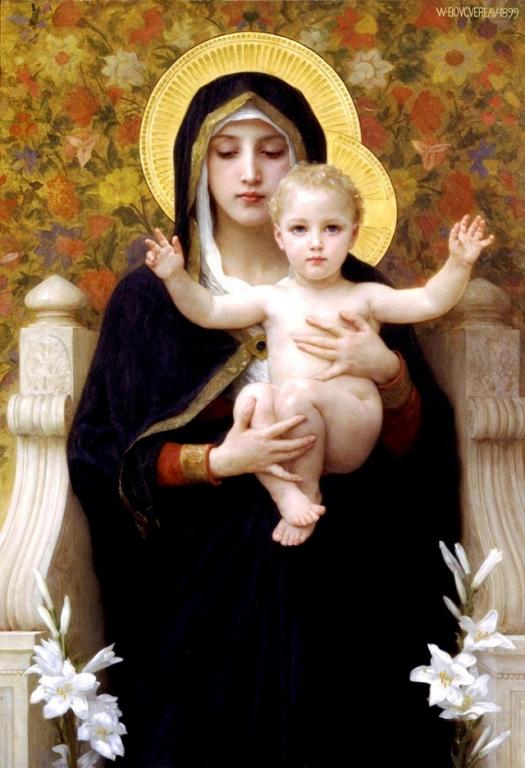
Photo credit: Madonna with child (1899), by William-Adolphe Bouguereau (1825-1905) [public domain / Wikimedia Commons]

***
Previous Post

May 13, 2020
Bible on Faith, Works, and Judgment (vs. Jason Engwer)
Next Post

May 14, 2020 1 Timothy 3:15 = Church Infallibility (vs. Steve Hays)
Browse Our Archives
Select a Category & Last Things About Me Anti-Catholicism Atheism & Agnosticism Baptism and Sacramentalism Bible and Tradition Blessed Virgin Mary Books by Dave Armstrong C. S. Lewis Calvinism & General Protestantism Catholic Apologetics Catholic Apologists Catholic conversion Catholic converts Christmas Church (Ecclesiology) Church History Conversion and Converts Development of Doctrine Eastern Orthodoxy Ecumenism & Christian Unity Eucharist & Liturgy Fathers of the Church French Translations G. K. Chesterton Hell Hell & Satan Hell & Satan & Last Things Heresies & Comparative Religion Holistic Health Inquisition & Crusades & Scandals James White Jews & Judaism & Old Testament John Calvin John Henry Newman Liberal / Modernist Theology Life Issues Literary Resume Lutheranism Mariology Martin Luther Music Orthodoxy Papacy & Infallibility Personal Page Philosophy & Science Political & Ethical & Moral Issues Protestant Persecution & Intolerance Protestantism Purgatory Purgatory & Penance Romantic & Imaginative Theology Saints & Purgatory & Penance Salvation Salvation & Justification Satan & Last Things Sexuality and Gender Issues Spanish Translations Traditionalism vs. Radical Catholic Reactionaries Traducciones al español / tradução para português Trinitarianism & Christology Uncategorized Videos
Select a Month October 2026 September 2026 August 2026 July 2026 June 2026 May 2026 April 2026 March 2026 February 2026 January 2026 December 2025 November 2025 October 2025 September 2025 August 2025 July 2025 June 2025 May 2025 April 2025 March 2025 February 2025 January 2025 December 2024 November 2024 October 2024 September 2024 August 2024 July 2024 June 2024 May 2024 April 2024 March 2024 February 2024 January 2024 December 2023 November 2023 October 2023 September 2023 August 2023 July 2023 June 2023 May 2023 April 2023 March 2023 February 2023 January 2023 December 2022 November 2022 October 2022 September 2022 August 2022 July 2022 June 2022 May 2022 April 2022 March 2022 February 2022 January 2022 December 2021 November 2021 October 2021 September 2021 August 2021 July 2021 June 2021 May 2021 April 2021 March 2021 February 2021 January 2021 December 2020 November 2020 October 2020 September 2020 August 2020 July 2020 June 2020 May 2020 April 2020 March 2020 February 2020 January 2020 December 2019 November 2019 October 2019 September 2019 August 2019 July 2019 June 2019 May 2019 April 2019 March 2019 February 2019 January 2019 December 2018 November 2018 October 2018 September 2018 August 2018 July 2018 June 2018 May 2018 April 2018 March 2018 February 2018 January 2018 December 2017 November 2017 October 2017 September 2017 August 2017 July 2017 June 2017 May 2017 April 2017 March 2017 February 2017 January 2017 December 2016 November 2016 October 2016 September 2016 August 2016 July 2016 June 2016 May 2016 April 2016 March 2016 February 2016 January 2016 December 2015 November 2015 October 2015 September 2015 August 2015 July 2015 June 2015 May 2015 April 2015 March 2015 February 2015 January 2015 December 2014 November 2014 October 2014 September 2014 August 2014 July 2014 June 2014 April 2014 March 2014 February 2014 January 2014 December 2013 November 2013 October 2013 September 2013 August 2013 July 2013 June 2013 April 2013 March 2013 February 2013 January 2013 December 2012 November 2012 October 2012 September 2012 August 2012 July 2012 June 2012 May 2012 April 2012 March 2012 February 2012 January 2012 December 2011 November 2011 October 2011 September 2011 August 2011 July 2011 June 2011 April 2011 March 2011 February 2011 October 2010 September 2010 August 2010 July 2010 April 2010 March 2010 December 2009 October 2009 August 2009 July 2009 June 2009 May 2009 March 2009 February 2009 October 2008 September 2008 April 2008 March 2008 February 2008 January 2008 December 2007 November 2007 October 2007 May 2007 March 2007 February 2007 January 2007 November 2006 October 2006 September 2006 August 2006 July 2006 June 2006 May 2006 April 2006 March 2006 February 2006 October 2005 June 2005 April 2005 February 2005 July 2004 May 2004 April 2004
Follow Us!
TAKE THE
Religious Wisdom Quiz
Who said: "Behold, I stand at the door and knock. If anyone hears My voice and opens the door, I will come in"?
Select your answer to see how you score.
The Spirit Jesus (to the church in Laodicea) John Paul
Books by This Author Books by Dave Armstrong
Related posts from Biblical Evidence for Catholicism

Top Three Anti-Catholic Lies About Catholicism
Biblical Evidence for Catholicism

Three More Anti-Catholic Lies About Catholicism (#6-4)
Biblical Evidence for Catholicism

Top Ten Anti-Catholic Lies (#10-7)
Biblical Evidence for Catholicism

Holy Ground: Why Mary Had NO Other Children...
Biblical Evidence for Catholicism
TRENDING AT PATHEOS Catholic

A new article, written by Jeff Lindsay and Gale L. Pooley,...

Swimfan: Forgotten Aughts Pleasures
This is a recovery effort. In 2002, My Big Fat Greek Wedding...

Top Three Anti-Catholic Lies About Catholicism
This is my initial transcript for the video, "THE 3 WORST...

Pope Leo Celebrates Mass for Nurses & Docs...
I don't have any idea how he did it, but Pope Leo...

The Sermon on the Mount, Part I: Matthew...
The Sermon on the Mount, Part I (Matthew 4:12-5:12) St. Matthew moves...

What's up from Crossway: Reviewing some of their latest A few weeks...
view all Catholic blogs
Ad-Free & Subscriber Log-In Subscription Support
- About Us
- 2026 Calendar
- Videos
- Podcasts
- Library of World Religions
- Faith In Media Tracker
- Advertise With Us
- Write for Us
- Privacy Policy
- Terms of Service
- Do Not Sell My Data
- Contact Us
- Radiant Digital
- Manage Newsletter Subscriptions
- Unsubscribe From Notifications
- Sitemap
Copyright 2008-2026, Patheos. All rights reserved.
Subscription Support Ad-Free & Subscriber Log-In
Follow Patheos