
BuddhistCatholicContemplativeEvangelicalGeneral ChristianHinduJewishLatter-day SaintMuslimNew VisionsProgressive Christian
Beliefs
- Buddhist
- Catholic
- Contemplative
- Evangelical
- General Christian
- Hindu
- Jewish
- Latter-day Saint
- More Voices
- Muslim
- New Visions
- Pagan
- Progressive Christian
Topics
- Religion News
- Food and Religion
- Sports and Religion
- Religious Art
- Religious Music and Entertainment
- Religious Events
- History and Religion
- Style and Religion
- Politics and Religion
- Women in Religion
- Recreation Outdoors and Religion
- Business Finance and Religion
- Careers Workplace and Religion
- Education and Religion
- Family Parenting and Religion
- Health Fitness and Religion
- Home and Religion
- Relationships and Religion
- Technology and Religion
- Travel and Religion
Columnists
- Buddhist Columnists
- Business Finance and Religion Columnists
- Careers Workplace and Religion Columnists
- Catholic Columnists
- Contemplative Columnists
- Education and Religion Columnists
- Evangelists Columnists
- Family Parenting and Religion Columnists
- General Christian Columnists
- Health Fitness and Religion Columnists
- Hindu Columnists
- History and Religion Columnists
- Home and Religion Columnists
- Jewish Columnists
- More Voices Columnists
- Latter Day Columnists
- Muslim Columnists
- New Visions Columnists
- Nonreligious Columnists
- Pagan Columnists
- Politics and Religion Columnists
- Progressive Columnists
- Recreation Outdoors and Religion Columnists
- Relationships and Religion Columnists
- Religion News Columnists
- Religious Art Columnists
- Religious Events Columnists
- Religious Music and Entertainment Columnists
- Sports and Religion Columnists
- Style and Religion Columnists
- Technology and Religion Columnists
- Travel and Religion Columnists
- Women in Religion Columnists
Resource Library
- 2026 Calendar
- Library of World Religions
- The 100 Most Holy Places on Earth
- Patheos Answers
- Podcasts
- Videos
- Faith Leaders Database
- Anglican Episcopalian
- Bahai
- Baptist
- Buddhism
- Christianity
- Confucianism
- Eastern Orthodoxy
- Hinduism
- Holiness and Pentecostal
- ISKCON
- Islam
- Judaism
- Lutheran
- Methodist
- The Church of Jesus Christ of Latter-day Saints
- New Age
- Paganism
- Presbytarian and Reformed
- Protestantism
- Religion Behind the Scenes
- Roman Catholic
- Scientology
- Shia Islam
- Sikhism
- Sufism
- Sunni Islam
- Taoism
- Zen
- See all religions
Research Tools
 Ad-Free & Subscriber Log-In Subscription Support
Ad-Free & Subscriber Log-In Subscription Support
Follow Patheos 

- Trending:
- Forgiveness
- |
- Marriage
- |
- Consciousness
- |
- Death Penalty
- |
- Election
- |
- Halloween

-
About
-
Catholic Apologetics
-
Church History
-
Great Apologists
-
Christian Worldview
-
Protestantism & Misc.
- Home
- Catholic
- History and Religion
- On Rebuking Popes & Obedience to Popes, Part II
On Rebuking Popes & Obedience to Popes, Part II
Last updated on: May 3, 2020 at 7:00 pm by Dave Armstrong
On Rebuking Popes & Obedience to Popes, Part II 2020-05-03T19:00:41-04:00 Dave Armstrong
Patheos Explore the world's faith through different perspectives on religion and spirituality! Patheos has the views of the prevalent religions and spiritualities of the world.
I have compiled various comments I made in a vigorous combox discussion on my Facebook page (see the whole thing), in response to my article, On Rebuking Popes & Catholic Obedience to Popes (12-27-17).
*****
I’ve written at National Catholic Register and expressed my opinion that it would be good for Pope Francis to answer the dubia. As my paper made clear, I’m not against all criticism whatever. My point is: how should it be done, when, and by whom? The “whom” is not every Tom, Dick, and Harry on Facebook who has a gripe with the pope and must express it publicly.
I completely agree that someone like St. Francis is the type of person who should do such things. That’s exactly my position. We should wait for a St. Francis or a St. Catherine to rebuke a pope privately, not in the eyes of the whole world.
I don’t see my article as bashing the pope; it’s simply offering an opinion that I think it would be good for him to follow. But he’s still the pope, and I won’t second-guess him or declare him some sort of heretic or bad guy without remotely enough evidence to do so.
It’s like the show The Crown. It had an episode where a guy was criticizing the Queen of England. People thought he “hated” her. But he clarified that he was actually pro-monarchy and was trying to offer constructive advice for it to flourish in modern times. The royals later admitted that he played a great role in helping to maintain the monarchy. And they adopted most of his suggestions.
My tone and approach was completely with respect and deference. This is the element that is missing in much “papal analysis” today. The pope is in effect often today “lectured” as if he is some sort of dolt or spiritual “midget”: as if he hasn’t given these matters a moment’s thought.
I don’t think we even understand the notion of what it is to be obedient to the pope. I think a lot of this is “Americanist”-type mentality. We never had a king, etc. We don’t understand how that works. I got into that in my post. Everyone thinks they know better. That is obviously Protestant and dissident liberal influence, in my opinion: at least to some extent.
***
A case can be made that it is stupid for anyone to think that “off the cuff remarks in an airplane” are dogmatic changes in Church teaching. It becomes an issue of how “dumbed-down” should a pope’s statements be, in order to not be ludicrously misinterpreted by some.
It’s not an easy question. I’ve had it come up many times in my own work: how simple should I make things? I have solved it by doing both: providing short papers and book excerpts for beginners and novices (The One-Minute Apologist, New Catholic Answer Bible one-page inserts, even some “comic tracts”, etc.), and very in-depth stuff for those more advanced. Generally speaking, I think it is better to challenge people to think more about things, than to make it so simple that some might think Catholicism was a simpleton’s religion.
With the pope, I agree that it would be good for him to directly clarify things that folks have misunderstood about what he is saying: maybe have a long conference devoted to just that.
I think he would do well to do both things: be spontaneous, but also clarify if something is repeatedly misunderstood. I don’t know why he doesn’t, but I am different from many in that I don’t assume that he is being lax or irresponsible. I assume that he must have a good reason, but I simply can’t figure it out. I don’t choose to immediately judge what I don’t understand, as many are doing. One sees it in their petulant, scolding, condescending tone towards the Holy Father.
I know that when people ask me to clarify something I wrote, I’m very happy for the opportunity to make it clearer and more plain. So when we get to the pope and see that he chooses not to do the same in many or most cases, it’s difficult to understand, yet I believe that he must have some reason: that he’s not just operating on some irrational, arbitrary, superficial level. It could be that he thinks explanations are being adequately done by others, such as Cdl. Muller, etc.
But it’s not like this is the first time popes have been misunderstood. With Pope St. John Paul II, we heard complaints (from orthodox Catholics, tending “traditional”) that his writing style was impossibly complex. So that is the same problem, but from the other end: too complex, hence, not understood, rather than too simplistic or off-the-cuff, and hence not understood. Different styles, different approaches, different people.
***
Objections to Pope Francis have gone far beyond just an alleged lack of “clearness”. Now it’s made out that he is either a heretic or just a hair away from that, or some sort of conniving conspiratorialist, who wants to change the Church: actually change moral teaching / orthodoxy.
Now, Philip Lawler, author of the upcoming book, Lost Shepherd: How Pope Francis is Misleading His Flock, states in the introduction: “I found I could no longer pretend that Francis was merely offering a novel interpretation of Catholic doctrine. No, it was more than that. He was engaged in a deliberate effort to change what the Church teaches.” And Karl Keating seemingly cites that in agreement . . .
This is an extremely serious charge. What is Lawler claiming? That Pope Francis thinks adultery is fine? Or that he denies some Catholic dogma (perhaps the indissolubility of marriage)? This simply hasn’t been shown. Even many of his critics grant that no heresy is being asserted or advocated. Instead we have the usual (familiar) reactionary game of claiming that Pope Francis is trying to move the goalposts while no one notices. He’s being ambiguous and sneaky: precisely what reactionaries have been saying about Vatican II for fifty years, and what they said about St. John Paul the Great.
In other words, Phil Lawler, Karl Keating, and others have agreed with the standard reactionary position for 50 years now: the subversives out to change the Church have now gotten control of the papacy itself. This is what extremist, fringe sites like 1 Peter 5, The Remnant, and Rorate Caeli have been maintaining all along. That’s why those folks dominated the Correctio, as I have documented.
Reactionaries also apply the same dynamics to Vatican II and the ordinary form Mass (and to ecumenism). The Francis critics haven’t gotten that far, but they are now accepting one of the key planks of classic reactionary thought. And that is very troubling indeed . . .
I’ve agreed that it would be good for the pope to clarify things that people are confused about. I do not agree that he is “engaged in a deliberate effort to change what the Church teaches.”
***
The controversy over Amoris Laetitia is with regard to a pastoral matter. Difficult cases come up that have already been dealt with by priests and popes before this one. He is not teaching that unrepentant adulterers can receive communion. That’s the caricature, but it hasn’t been proven at all. I’ve collected many articles about it (search “Amoris Laetitia” in my large collection of defenses of Pope Francis and the collection of my own defenses).
***
I do have a certain “long view” perspective as a Catholic apologist for 29 years (published one for 27): having observed past criticisms of popes (Pope St. Paul VI, Pope st. John Paul II, Pope Benedict XVI), and having defended them, and Pope Francis in many particulars. I’ve seen what comes of it (nothing good), and now I see people I admire and respect adopting key aspects of the same sort of thinking. I think they’re mistaken. They’re no doubt sincere, well-meaning, and worried about orthodoxy and the Church, but wrong about the facts.
***
I think with Pope Francis it is a lot of things coming together, where he has been vastly misunderstood. It’s a cumulative effect. People have heard so many things that they assume he is radically different, in terms of wanting to overthrow legitimate Catholic teaching. But when confronted with providing specific proof, most of the critics hesitate and fall back to an arbitrary vague conspiratorialism. It’s gone on so long, that people just keep jumping on the “bandwagon”: because they see others whom they respect, doing so.
Karl himself has made the distinction between impeccability and infallibility, noting that the former is irrelevant to the latter. But now he is highlighting what may be personal faults of the Holy Father. If they’re really there, we can do nothing better than to pray for him.
I don’t see any particular merit or usefulness in discussing his personality, approach, etc. It would be unseemly, for example, for an employee of Catholic Answers to go on and on about this and that personal fault in how Karl Keating used to run the organization. I’m sure people have some negative views (because they are universal in organizations of any sort). We all recognize that that would be improper and unedifying, and best left to private communications, if they must be discussed at all. And by the way, Catholic Answers has been savagely attacked by many individuals and I have always firmly defended it.
Yet with the Holy Father we have this mindset today that anything goes in discussing him. And so it gets back to my topic of respect, deference, and the spirit of obedience. It’s just not there. We’d rather criticize, grumble, and complain. I agree that there is confusion. I disagree as to why that is. I agree that it would be good for the pope to clarify areas people are confused about. I don’t know for sure why he doesn’t. But I won’t sit here and condemn him. I opined above that he may be content to let others clarify things; thinking they have done a good job of it.
One must distinguish between 1) what is actually being taught, and 2) relatively less or more clear presentations of the teaching. The pope may indeed be guilty of a lack of clearness or clarity in what he teaches, which would make it helpful for him to clarify. I hope he does, because this mess ain’t going away anytime soon.
I wrote today: “Knowing human nature (and group behavior), I don’t see how this will ever end, short of Pope Francis’ death. How sad. And then, for all we know, the same people may be willing to trash the next pope, since they have gotten so comfortable with doing so on a weekly basis. After all, Pope Francis’ two predecessors were trashed as well, as was Blessed Pope Paul VI (as I noted in the final portion of my paper).”
I think we’re past the point of no return now: past critical mass. Whoever’s fault it is (the pope’s or his critics or both), this is gonna become a bigger and bigger scandal and stink to high heaven and make the Catholic Church all the more unpopular, and harder to defend (my job).
It shouldn’t be a public discussion. That should have been agreed to by all parties. I’m forced to write about it publicly because it’s already out there and there ought to be a few “loud” voices who defend the pope or at least try to give him a fair shake: present a different view from the prevailing clamor of relentless criticism and attacks.
***
St. John Henry Cardinal Newman [cited at the top of the original Facebook discussion]: “I say with Cardinal Bellarmine whether the Pope be infallible or not in any pronouncement, anyhow he is to be obeyed. No good can come from disobedience.”
My original word in the title of the paper we’re discussing was “reverence” but I decided to make it stronger and use the word “obedience.” I knew that would ruffle some feathers, but whatever. What else is new? I started with the Newman quote for a reason: it expresses what I am trying to discuss and get at; for example, in this section:
[W]hat need I say more to measure our own duty to it and to him who sits in it, than to say that in his administration of Christ’s kingdom, in his religious acts, we must never oppose his will, or dispute his word, or criticise his policy, or shrink from his side? There are kings of the earth who have despotic authority, which their subjects obey indeed but disown in their hearts; but we must never murmur at that absolute rule which the Sovereign Pontiff has over us, because it is given to him by Christ, and, in obeying him, we are obeying his Lord.
My citation of his at the top of this post was along similar lines. I made it clear in my article that I didn’t agree with Cardinal Newman that no criticism can ever be made. But his general approach is far superior than what I see going on today. I’m not an ultramontanist; nor was Newman. I’m not for “blind obedience.” I’m for routine “deferential obedience.”
It’s about the spirit of reverence and obedience to a Holy Father: giving him immense respect due to the office. If he’s not perfect, pray about it; pray for him. Don’t run him down in public. If there are true issues (I grant that there are legitimate ones that can and should be discussed), they ought to be discussed privately, not aired in public: which has now resulted in Catholics (us orthodox ones) being a laughingstock.
***
The pope might be wrong about some political thing, though. No biggie. He can’t be up on all knowledge about everything.
***
In other areas of life, such as business, politics, the military, even in sports, there is a chain of command that is unquestionable. And there are reasons for it. Sometimes the commander / coach / CEO is wrong, but the authority remains. It’s always a dilemma when he or she is in fact wrong.
***
I wrote the following on Karl Keating’s page:
And the same complaints were made by traditionalists against recent popes: Pope St. Paul VI was lax on the modernists and wrecked the liturgy; ditto for Pope St. John Paul II, as to modernists, and he caught hell for kissing the Koran (if he even did) and for the Assisi ecumenical conferences. His “philosophical” writing style was criticized as dense and inexplicable. The reactionaries attacked his canonization as well.
Robert Sungenis went after Pope Benedict and John Paul II as supposed universalists. Michael Voris said that Pope Benedict exaggerated his illness to resign, which was a dereliction of duty. Reactionaries (and even some traditionalists) have called all popes since John XXIII modernists or “neo-Catholics.” I know (and so do you) because I defended all of them.
So, lots of folks (tending traditionalist or reactionary) were disenchanted with various aspects of those popes. Now we have another set of grumbling complaints about the present one. I don’t see any “fundamental” difference. The common ground is human nature: complaining and grumbling about our superiors. We know better. In every place that has a chain of command, this occurs. One would hope it would be different in the Church, but alas, it isn’t.
Is Francis perfect? No. Maybe he is imperious, or too scolding. He has faults like all of us. He’s confessing something . . . But that’s precisely my point. The others obviously weren’t thought to be perfect, either, or else they wouldn’t have been subject to the criticisms for alleged or real shortcomings. But, you and Lawler say, this time a lot of people (important, high-placed ones) are complaining. That’s significant, but it’s not compelling. A “lot” of people can be and have been wrong about a lot of things.
A “lot” of people thought Pope St. John XXIII wouldn’t do anything as momentous as calling an ecumenical council. They were wrong. A lot of people (including all or virtually all of his close advisors) thought Pope St. Paul VI wouldn’t reaffirm teaching on contraception. They were wrong.
A “lot” of people thought Reagan was a dunce who would start World War III. He not only didn’t do that; he achieved amazing arms reductions, that virtually none of the “lot of people” would have predicted. A lot of people thought Trump (whatever one thinks of him) could never be nominated, never win the election, never succeed in office. Wrong on all counts . . . [one Catholic academic, Dr. Rachel Lu, who decided to unfriend me, confidently predicted that because of Trump, Republicans would lose both the Senate and the House, too] Thus, I’m not always so impressed by merely appealing to numbers of folks who think thus-and-such. That often reduces to the ad populum fallacy.
Each controversy regarding Pope Francis has to be argued on its own. And there are good defenses out there (rest assured), just as there are serious criticisms. And I personally know that many of the criticisms had no basis; were bum raps, because I dealt with them myself. Many were entirely based on something as silly and foolish as bad translators.
***
I myself disagree with Pope Francis on global warming. It has nothing to do with faith and morals, as he himself noted when writing about scientific / environmental things. I disagree a lot with popes on political matters. That’s not their jurisdiction, and I think they get things wrong sometimes. It’s the same with bishops’ conferences, which aren’t even magisterial. They were dead-wrong about Obamacare. We conservatives knew all along that it would be the disaster that it has become.
***
I wrote this on another page:
It [my article above] was long for a few reasons:
1) I had to clear myself of the ubiquitous charge of “ultramontanism” and supposed belief in “blind faith.” That takes some ink.
2) I had to show that I was not saying we have to absolutely follow every jot and tittle of everything a pope says. I cited Newman and then explained that I didn’t *fully* agree with him.
3) This was a synthesis of about seven older papers, including one very long dialogue.
You perceive it as squabbling because most of this came out of interactions with extreme reactionaries, who were tearing down popes and Vatican II and the New Mass. Most of this was written long before Francis was pope, and some of it before Benedict, too.
***
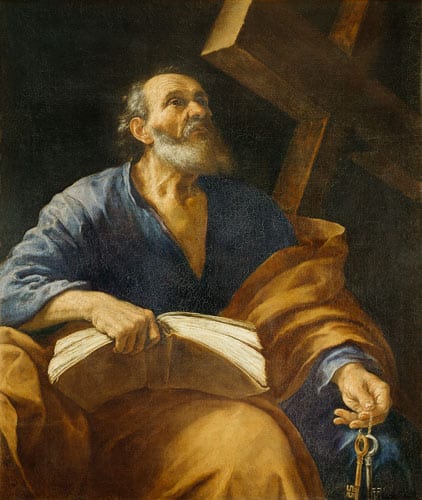
Photo credit: Saint Peter, by Paolo Emilio Besenzi (1608-1656) [public domain / Wikimedia Commons]

***
Previous Post

May 3, 2020
Cdl Ratzinger (Pope Benedict XVI): Vatican II Authority = Trent
Next Post
May 4, 2020 Reactionary Clan Unity: Skojec vs. Voris, Niles, & Coffin
Browse Our Archives
Select a Category & Last Things About Me Anti-Catholicism Atheism & Agnosticism Baptism and Sacramentalism Bible and Tradition Blessed Virgin Mary Books by Dave Armstrong C. S. Lewis Calvinism & General Protestantism Catholic Apologetics Catholic Apologists Catholic conversion Catholic converts Christmas Church (Ecclesiology) Church History Conversion and Converts Development of Doctrine Eastern Orthodoxy Ecumenism & Christian Unity Eucharist & Liturgy Fathers of the Church French Translations G. K. Chesterton Hell Hell & Satan Hell & Satan & Last Things Heresies & Comparative Religion Holistic Health Inquisition & Crusades & Scandals James White Jews & Judaism & Old Testament John Calvin John Henry Newman Liberal / Modernist Theology Life Issues Literary Resume Lutheranism Mariology Martin Luther Music Orthodoxy Papacy & Infallibility Personal Page Philosophy & Science Political & Ethical & Moral Issues Protestant Persecution & Intolerance Protestantism Purgatory Purgatory & Penance Romantic & Imaginative Theology Saints & Purgatory & Penance Salvation Salvation & Justification Satan & Last Things Sexuality and Gender Issues Spanish Translations Traditionalism vs. Radical Catholic Reactionaries Traducciones al español / tradução para português Trinitarianism & Christology Uncategorized Videos
Select a Month October 2026 September 2026 August 2026 July 2026 June 2026 May 2026 April 2026 March 2026 February 2026 January 2026 December 2025 November 2025 October 2025 September 2025 August 2025 July 2025 June 2025 May 2025 April 2025 March 2025 February 2025 January 2025 December 2024 November 2024 October 2024 September 2024 August 2024 July 2024 June 2024 May 2024 April 2024 March 2024 February 2024 January 2024 December 2023 November 2023 October 2023 September 2023 August 2023 July 2023 June 2023 May 2023 April 2023 March 2023 February 2023 January 2023 December 2022 November 2022 October 2022 September 2022 August 2022 July 2022 June 2022 May 2022 April 2022 March 2022 February 2022 January 2022 December 2021 November 2021 October 2021 September 2021 August 2021 July 2021 June 2021 May 2021 April 2021 March 2021 February 2021 January 2021 December 2020 November 2020 October 2020 September 2020 August 2020 July 2020 June 2020 May 2020 April 2020 March 2020 February 2020 January 2020 December 2019 November 2019 October 2019 September 2019 August 2019 July 2019 June 2019 May 2019 April 2019 March 2019 February 2019 January 2019 December 2018 November 2018 October 2018 September 2018 August 2018 July 2018 June 2018 May 2018 April 2018 March 2018 February 2018 January 2018 December 2017 November 2017 October 2017 September 2017 August 2017 July 2017 June 2017 May 2017 April 2017 March 2017 February 2017 January 2017 December 2016 November 2016 October 2016 September 2016 August 2016 July 2016 June 2016 May 2016 April 2016 March 2016 February 2016 January 2016 December 2015 November 2015 October 2015 September 2015 August 2015 July 2015 June 2015 May 2015 April 2015 March 2015 February 2015 January 2015 December 2014 November 2014 October 2014 September 2014 August 2014 July 2014 June 2014 April 2014 March 2014 February 2014 January 2014 December 2013 November 2013 October 2013 September 2013 August 2013 July 2013 June 2013 April 2013 March 2013 February 2013 January 2013 December 2012 November 2012 October 2012 September 2012 August 2012 July 2012 June 2012 May 2012 April 2012 March 2012 February 2012 January 2012 December 2011 November 2011 October 2011 September 2011 August 2011 July 2011 June 2011 April 2011 March 2011 February 2011 October 2010 September 2010 August 2010 July 2010 April 2010 March 2010 December 2009 October 2009 August 2009 July 2009 June 2009 May 2009 March 2009 February 2009 October 2008 September 2008 April 2008 March 2008 February 2008 January 2008 December 2007 November 2007 October 2007 May 2007 March 2007 February 2007 January 2007 November 2006 October 2006 September 2006 August 2006 July 2006 June 2006 May 2006 April 2006 March 2006 February 2006 October 2005 June 2005 April 2005 February 2005 July 2004 May 2004 April 2004
Follow Us!
TAKE THE
Religious Wisdom Quiz
Which book of the Bible has the most chapters?
Select your answer to see how you score.
Proverbs Genesis Psalms Isaiah
Books by This Author Books by Dave Armstrong
Related posts from Biblical Evidence for Catholicism

Was Peter "Any Old" Apostle? 10 Anti-Papal Arguments
Biblical Evidence for Catholicism

11 Protestant Objections to Papal Authority Debunked
Biblical Evidence for Catholicism

Matthew 16 & the Papacy (vs. Patrick O'Brien)
Biblical Evidence for Catholicism
Inspired Prophets: An Analogy to Infallible Popes
Biblical Evidence for Catholicism
TRENDING AT PATHEOS Catholic

The Sermon on the Mount, Part I: Matthew...
The Sermon on the Mount, Part I (Matthew 4:12-5:12) St. Matthew moves...

What's up from Crossway: Reviewing some of their latest A few weeks...

Janie Learns the Way of the Cross: A...
Teaching children about Jesus' Passion can be challenging. Many parents and educators...

Looking For Good Catholic Writing - October 2026
He alone extends the heavens, and he walks upon the waves of...

In "Irreplaceable," our book on vocation and technology, Trevor Sutton and I...

I was strolling through the top floor of the brand new Parthenon...
view all Catholic blogs
Ad-Free & Subscriber Log-In Subscription Support
- About Us
- 2026 Calendar
- Videos
- Podcasts
- Library of World Religions
- Faith In Media Tracker
- Advertise With Us
- Write for Us
- Privacy Policy
- Terms of Service
- Do Not Sell My Data
- Contact Us
- Radiant Digital
- Manage Newsletter Subscriptions
- Unsubscribe From Notifications
- Sitemap
Copyright 2008-2026, Patheos. All rights reserved.
Subscription Support Ad-Free & Subscriber Log-In
Follow Patheos