
BuddhistCatholicContemplativeEvangelicalGeneral ChristianHinduJewishLatter-day SaintMuslimNew VisionsProgressive Christian
Beliefs
- Buddhist
- Catholic
- Contemplative
- Evangelical
- General Christian
- Hindu
- Jewish
- Latter-day Saint
- More Voices
- Muslim
- New Visions
- Pagan
- Progressive Christian
Topics
- Religion News
- Food and Religion
- Sports and Religion
- Religious Art
- Religious Music and Entertainment
- Religious Events
- History and Religion
- Style and Religion
- Politics and Religion
- Women in Religion
- Recreation Outdoors and Religion
- Business Finance and Religion
- Careers Workplace and Religion
- Education and Religion
- Family Parenting and Religion
- Health Fitness and Religion
- Home and Religion
- Relationships and Religion
- Technology and Religion
- Travel and Religion
Columnists
- Buddhist Columnists
- Business Finance and Religion Columnists
- Careers Workplace and Religion Columnists
- Catholic Columnists
- Contemplative Columnists
- Education and Religion Columnists
- Evangelists Columnists
- Family Parenting and Religion Columnists
- General Christian Columnists
- Health Fitness and Religion Columnists
- Hindu Columnists
- History and Religion Columnists
- Home and Religion Columnists
- Jewish Columnists
- More Voices Columnists
- Latter Day Columnists
- Muslim Columnists
- New Visions Columnists
- Nonreligious Columnists
- Pagan Columnists
- Politics and Religion Columnists
- Progressive Columnists
- Recreation Outdoors and Religion Columnists
- Relationships and Religion Columnists
- Religion News Columnists
- Religious Art Columnists
- Religious Events Columnists
- Religious Music and Entertainment Columnists
- Sports and Religion Columnists
- Style and Religion Columnists
- Technology and Religion Columnists
- Travel and Religion Columnists
- Women in Religion Columnists
Resource Library
- 2026 Calendar
- Library of World Religions
- The 100 Most Holy Places on Earth
- Patheos Answers
- Podcasts
- Videos
- Faith Leaders Database
- Anglican Episcopalian
- Bahai
- Baptist
- Buddhism
- Christianity
- Confucianism
- Eastern Orthodoxy
- Hinduism
- Holiness and Pentecostal
- ISKCON
- Islam
- Judaism
- Lutheran
- Methodist
- The Church of Jesus Christ of Latter-day Saints
- New Age
- Paganism
- Presbytarian and Reformed
- Protestantism
- Religion Behind the Scenes
- Roman Catholic
- Scientology
- Shia Islam
- Sikhism
- Sufism
- Sunni Islam
- Taoism
- Zen
- See all religions
Research Tools
 Ad-Free & Subscriber Log-In Subscription Support
Ad-Free & Subscriber Log-In Subscription Support
Follow Patheos 

- Trending:
- Forgiveness
- |
- Marriage
- |
- Consciousness
- |
- Death Penalty
- |
- Election
- |
- Halloween

-
About
-
Catholic Apologetics
-
Church History
-
Great Apologists
-
Christian Worldview
-
Protestantism & Misc.
- Home
- Catholic
- History and Religion
- Jesus’ “Brothers” Were “Unbelievers”? (vs. Jason Engwer)
Jesus’ “Brothers” Were “Unbelievers”? (vs. Jason Engwer)
Last updated on: May 29, 2020 at 12:08 pm by Dave Armstrong
Jesus’ “Brothers” Were “Unbelievers”? (vs. Jason Engwer) 2020-05-29T12:08:35-04:00 Dave Armstrong
Patheos Explore the world's faith through different perspectives on religion and spirituality! Patheos has the views of the prevalent religions and spiritualities of the world.
Jason also claims that “Mary believed in Jesus,” but wavered, and had a “sort of inconsistent faith”
This is a response to a portion of an article by evangelical Protestant anti-Catholic apologist Jason Engwer (“The Underestimated Agreement Of The Gospels”: 1-24-11). He wrote:
Three of the gospels, including John, suggest that Mary believed in Jesus, but that her faith wavered. She seems to have had the sort of inconsistent faith that we see in Peter and other individuals in the gospels. But she didn’t follow Jesus as closely as somebody like Peter, so she seems to have been comparable to Nicodemus and other more distant followers. She followed Jesus to some extent, as the infancy narratives and John 2:3-5 and 19:25 suggest, but she also joined Jesus’ siblings in acting against Him at times and was sometimes rebuked by Jesus (Matthew 12:46-50, Mark 3:21-35, Luke 2:49, John 2:4). Mark doesn’t refer to Mary’s faith, but he doesn’t deny it either.
All four gospels portray Jesus’ siblings as unbelievers (Matthew 12:46-50, Mark 3:21-35, Luke 8:19-21, John 7:5).
For a fuller discussion of these and other relevant passages, see Eric Svendsen’s Who Is My Mother? (Amityville, New York: Calvary Press, 2001). It may appear at first that some of the passages cited above don’t say anything negative about Mary and/or Jesus’ siblings, but they do. Study the text and context carefully, and compare the passages to others that use similar language.
Regardless of the reason one suggests for these agreements among the gospels, they do agree. And Jesus’ family situation is so unusual and reported so widely early on, and in some ways caused difficulties for the early church, that it seems unlikely that the scenario was fabricated by the early Christians. The combination of an early death of Joseph, a wavering Mary, and unbelieving siblings is something that the Synoptics and John are unlikely to have agreed upon by independently making up stories. It’s also unlikely that they all agreed in making up the scenario or accepting one that was made up.
In another article (dated 3-17-11), Jason made an even stronger negative statement about the faith of the Blessed Virgin Mary:
What the gospels report about Mary’s unfaithfulness to Jesus, during both His childhood and His public ministry, creates problems for Roman Catholicism and other groups that hold a higher view of Mary.
And in an earlier paper (9-7-06), Jason opined:
The Biblical view of Mary seems to be that she was a believer who sometimes sinned. Like John the Baptist, Peter, and other New Testament figures, she’s sometimes an example of faithfulness to God and sometimes an example of how “we all stumble in many ways” (James 3:2). The belief that Mary was a sinner apparently goes back to scripture itself, . . .
In the gospels, Mary is often associated with Jesus’ unbelieving brothers, not just in terms of being with them, but also in terms of joining them in their opposition to Jesus . . .
Jason makes claims about Mary and then offers some Scripture in support. It’s not clear whether the Bible passages he offers to support his claims are all that he has in mind, but they are all we know about, so we will address them and leave it to Jason to bring up any others, if he counter-responds. I will not repeat relevant arguments I have made elsewhere. The initial response to such a claim as this was made in my paper, Mary’s Knowledge About Jesus’ Divinity [2000 and 1-8-02]. There may be a few (biblical / exegetical) points in there that Jason and other Protestants haven’t properly considered.
Mary was visited by an angel and told that she would bear (by the power of the Holy Spirit) the Messiah, Son of God (God the Son); God incarnate. Among other things, the angel told her that Jesus would be “called the Son of the Most High; and the Lord God will give to him the throne of his father David, and he will reign over the house of Jacob for ever; and of his kingdom there will be no end” and that He would be “called holy, the Son of God” (Lk 1:32-33, 35, RSV). Then she lived with Jesus for about thirty years: thirty years before any of the disciples or John the Baptist knew anything about Him. But we are to believe that “her faith wavered” and that she possessed a “sort of inconsistent faith” and merely “followed Jesus to some extent” [my italics]? It strains credulity beyond the breaking point. There is simply no biblical evidence for it, as I will now show.
Matthew 12:46-50 (RSV) While he was still speaking to the people, behold, his mother and his brothers stood outside, asking to speak to him. [48] But he replied to the man who told him, “Who is my mother, and who are my brothers?” [49] And stretching out his hand toward his disciples, he said, “Here are my mother and my brothers! [50] For whoever does the will of my Father in heaven is my brother, and sister, and mother.”
This is no rebuke at all, as I explain in my paper, “Who is My Mother?”: Beginning of “Familial Church” [8-26-19]. I summarized:
Jesus took this opportunity to show that He regarded all of His followers (in what would become the Christian Church) as family. Similarly, He told His disciples, “I have called you friends” (Jn 15:15). It doesn’t follow that this is “a rebuff of this kin” (i.e., his immediate family). He simply moved from literal talk of families to a larger conception and vision of families as those who do “the will of God.” Thus, Jesus habitually used “brethren” to describe those who were not His immediate family[.]
Mark 3:21-35 is the parallel passage, with some additional elements that I will examine below. I wrote about both passages in my paper about Mary’s knowledge:
It is not at all clear that Mary is included among those “family” who were doubting Jesus (insofar as the doubt goes; she came, yes, but it is not stated or implied that she doubted or was puzzled). We know that some doubted and disbelieved, because we are informed of that in inspired Holy Scripture, and Jesus said that “a prophet is without honor in his home town.”
But all it says in Mark 3:31 is that “his mother and his brothers came . . . and called him.” We can’t determine simply from this data, that Mary agreed with any of the negative appraisals. It’s an argument from silence. She may have gone out of concern (for any number of reasons, such as His personal safety from the unruly mobs), but to conclude that she was puzzled about Jesus or His mission, is not at all warranted from the text (thus an example of what is called “eisegesis” or reading our own preconceived biases into the biblical text).
Luke 2:49 And he said to them, “How is it that you sought me? Did you not know that I must be in my Father’s house?”
Likewise, this has nothing to do with Mary’s belief in Jesus as the Messiah and Son of God / God the Son. It simply gives an account of her being worried about Jesus because she didn’t know where He was. How in the world is this some “proof” that she lacked faith? Belief or faith in Jesus obviously doesn’t entail knowing His exact physical location at all times. I wrote about this (though from a different vantage-point) elsewhere:
Mary and Joseph were simply concerned about the welfare of their son, which is not a sin. All parents do that. The word for “anxiously” in RSV is . . . odunao (Strong’s #3600). The same word (“sorrowing” in RSV) is used when Paul’s followers say farewell to him (Acts 20:37-38). No sin . . .
John 2:4 And Jesus said to her, “O woman, what have you to do with me? My hour has not yet come.”
This tired argument was disposed of by Catholic apologist Jimmy Akin, citing three Protestant commentators:
The Protestant commentator William Barclay writes:
“The word Woman (gynai) is also misleading. It sounds to us very rough and abrupt. But it is the same word as Jesus used on the Cross to address Mary as he left her to the care of John (John 19:26). In Homer it is the title by which Odysseus addresses Penelope, his well-loved wife. It is the title by which Augustus, the Roman Emperor, addressed Cleopatara, the famous Egyptian queen. So far from being a rough and discourteous way of address, it was a title of respect. We have no way of speaking in English which exactly renders it; but it is better to translate it Lady which gives at least the courtesy in it” (The Gospel of John, revised edition, vol. 1, p. 98).
Similarly, the Protestant Expositor’s Bible Commentary, published by Zondervan, states:
Jesus’ reply to Mary was not so abrupt as it seems. ‘Woman’ (gynai) was a polite form of address. Jesus used it when he spoke to his mother from the cross (19:26) and also when he spoke to Mary Magdalene after the Resurrection (20:15)” (vol. 9, p. 42).
Even the Fundamentalist Wycliff Bible Commentary put out by Moody Press acknowledges in its comment on this verse, “In his reply, the use of ‘Woman’ does not involve disrespect (cf. 19:26)” (p. 1076).
That is the sum of Jason’s biblical arguments for Mary’s purported “faith [that] wavered” and “inconsistent faith”. I think it is plain to see that it is a pitiful and woefully inadequate collection of evidences. I say that it is no evidence at all, and I suspect that even Jason would concede that it is a relatively weak and unsubstantiated argument (especially if any of the above considerations moved his opinion at all).
Now I move onto Jesus’ “brothers”: my main topic. Jason calls them “siblings” (i.e., blood brothers or offspring of the same mother). Yet the Bible never refers to Mary as anyone’s “mother” besides Jesus (see Mt 1:18; 12:46; 13:55; Mk 3:31; Lk 8:19; Jn 2:1, 3, 5, 12; 19:25-26; Acts 1:14). I have written many times about the abundant biblical evidence for Mary’s perpetual virginity (Jesus being her only child):
Bible on the Perpetual Virginity of Mary [1996]
Why Believe in Mary’s Perpetual Virginity? [2-28-04]
James the Lord’s “Brother” (i.e., Cousin) + Who Wrote the Book of James? [11-6-08]
Jesus’ “Brothers” Always “Hangin’ Around” Mary … (Doesn’t This Prove That They Are Actually His Siblings?) [8-31-09]
Biblical Arguments for Mary’s Perpetual Virginity [2015]
“Holy Ground” & Mary’s Perpetual Virginity [5-24-16]
Virgin Mary = Mary Mother of Joses and James and “the Other Mary”? [5-14-17]
Biblical Evidence for the Perpetual Virginity of Mary [National Catholic Register, 4-13-18]
More Biblical Evidence for Mary’s Perpetual Virginity [National Catholic Register, 4-25-18]
The biblical data is so strong that all of the earliest Protestant leaders maintained this biblical, apostolic, and patristic belief:
Perpetual Virginity of Mary: Held by All Protestant Reformers [1-27-02]
Turretin & Bullinger Accepted Mary’s Perpetual Virginity [1-5-10 and 6-1-10]
John Calvin Believed in the Perpetual Virginity of Mary [6-17-10]
Luther & Mary’s Virginity During Childbirth [10-12-11]
Calvin Held to Mary’s Perpetual Virginity (with Tim Staples) [6-5-14]
John Calvin: Sermon 22 on Matthew 1:22-25 (Mary’s Perpetual Virginity) [10-14-14]
Biblical and Patristic Evidence for Mary’s “In Partu” Virginity [National Catholic Register, 11-14-19]
Jason goes on to argue that these “brothers” of Jesus were “unbelievers.” I suppose it comes down to what one means by “unbelievers” in Jesus in the first place: particularly before the Day of Pentecost when the Holy Spirit descended upon what would be the first believers in the Christian Church in the upper room (at least in what might be called a “formal” sense). Jason compared Mary’s supposedly “inconsistent” faith with that of Peter (even less than his, in context). Yet there is nothing whatever in the New Testament about Mary remotely like Peter’s outright rejection of what Jesus revealed to him about His redemptive death on the cross (and his “rebuke” of Jesus!). And this was right after Peter proclaimed that He was the Messiah (“Christ”) — Mark 8:29:
Mark 8:31-33 And he began to teach them that the Son of man must suffer many things, and be rejected by the elders and the chief priests and the scribes, and be killed, and after three days rise again. [32] And he said this plainly. And Peter took him, and began to rebuke him. [33] But turning and seeing his disciples, he rebuked Peter, and said, “Get behind me, Satan! For you are not on the side of God, but of men.” (cf. Mt 16:22: “And Peter took him and began to rebuke him, saying, ‘God forbid, Lord! This shall never happen to you.'”)
The disciples didn’t “understand” (before it happened) the basic facts of Jesus’ sacrificial death:
Mark 9:31-32 for he was teaching his disciples, saying to them, “The Son of man will be delivered into the hands of men, and they will kill him; and when he is killed, after three days he will rise.” [32] But they did not understand the saying, and they were afraid to ask him.
When Jesus again explained these things in Mark 10:33-34, all James and John could think about was the later, glorious aspects of the Messiah; asking Jesus whether they could sit on his right and left hand in heaven (Mk 10:35-37; cf. Lk 9:46). At least John was at the crucifixion: the only male disciple there. Mary was there; and she knew what was going on: its immense significance in salvation history.
The disciples couldn’t fully understand because they were not yet indwelt with the Holy Spirit, which they received at Jesus’ first post-resurrection appearance to them (Jn 20:22): shortly before Pentecost and Peter’s sermon, where many more would start to receive the Spirit. Before He was crucified, He noted more than once that they did not “understand” what He was teaching (Mt 15:16; Mk 4:13; 7:18; 8:21 ), and the narrative reiterates that they did not “understand” (Mk 6:52) and were “utterly astounded” (Mk 6:51), and even that “their hearts were hardened” (Mk 6:52). Jesus said about them:
Mark 8:15-18 . . . “Take heed, beware of the leaven of the Pharisees and the leaven of Herod.” [16] And they discussed it with one another, saying, “We have no bread.” [17] And being aware of it, Jesus said to them, “Why do you discuss the fact that you have no bread? Do you not yet perceive or understand? Are your hearts hardened? [18] Having eyes do you not see, and having ears do you not hear? And do you not remember?
Likewise, see Luke’s narrative:
Luke 9:44-45 “Let these words sink into your ears; for the Son of man is to be delivered into the hands of men.” [45] But they did not understand this saying, and it was concealed from them, that they should not perceive it; and they were afraid to ask him about this saying.
John reiterates and expands upon this notion:
John 12:16 His disciples did not understand this at first; but when Jesus was glorified, then they remembered that this had been written of him and had been done to him. (cf. Jesus in 13:7: “”What I am doing you do not know now, but afterward you will understand.”)
Let’s keep all of this crucial background information in mind when we examine Jesus’ relatives and whether or not we should single them out as “unbelievers” (in light of the record of even the disciples’ very poor understanding prior to Pentecost). In other words, if “All four gospels portray” Jesus’ “brothers” “as unbelievers,” as Jason argues, by the same token, we could also say that “All four gospels portray Jesus’ disciples as unbelievers,” too. Thus, his argument is seen to prove too much. Everyone (excepting Mary the Mother of God) was pretty much in the same “boat”: prior to being indwelt by the Holy Spirit, because the natural mind cannot understand spiritual things (1 Cor 2:13-14).
Nevertheless, Jason builds his case that Jesus’ “brothers” were “unbelievers.” We’ve already looked at Matthew 12:46-50. Just as it proved nothing in this respect with regard to Mary; it also proves nothing with regard to the “brothers.” Jesus’ point was a totally different one from what Protestants too often erroneously make it out to be. He’s not lambasting anyone; He’s opening wide the circle of believers; welcoming all in who want to be a part of it.
The latter part of Mark 3:21-35 is parallel to Matthew 12:46-50 (as is Luke 8:19-21). Thus, we need only examine the earlier relevant part of Mark 3:
Mark 3:21-22 And when his family heard it, they went out to seize him, for people were saying, “He is beside himself.” [22] And the scribes who came down from Jerusalem said, “He is possessed by Be-el’zebul, and by the prince of demons he casts out the demons.” (cf. Jn 10:20-21)
Note the italicized and bolded word. Other translations (including, unfortunately, KJV, NKJV, NIV, NASB) make it sound like Jesus’ family were agreeing and/or saying that Jesus’ was mad, but in fact the text is saying that “people” in general were doing so (just as the Pharisees did). But if the text doesn’t refer to them, it can simply be construed as His family coming out to remove Him from the crowds, who were massively misunderstanding Him, accusing, and perhaps becoming violent (as at Nazareth, when they tried to throw Him over a cliff). Hence, there would be no necessary implication of His family’s disbelief in Him. They were concerned for His safety. Other translations convey the true sense of the passage (which is interpreted by 3:22 indicating that the “scribes” were saying Jesus was crazy):
NRSV When his family heard it, they went out to restrain him, for people were saying, “He has gone out of his mind.”
Good News / (TEV) When his family heard about it, they set out to take charge of him, because people were saying, “He’s gone mad!”
Moffatt . . . . . . for men were saying, “He is out of his mind.”
Phillips . . . for people were saying, “He must be mad!”
NEB . . . for people were saying that he was out of his mind.
Even in the translation that has “they were saying.” etc., it’s a question of who “they” refers to. It can still be read as others besides the family. The 1953 Catholic Commentary, edited by Dom Bernard Orchard, has some very good commentary on the passage:
The usual interpretation is that relatives (or followers) of Christ, disturbed by reports, came out to take charge of him. The following points are to be noted. (1) The phrase οἱ παρ’αὐτοῦ does not necessarily mean relatives (friends). It has a wider usage which would include disciples, followers, members of a household. It is not certain that the persons designated by this phrase are the same as ‘his mother and brethren’, 31. Even if they are, there is no reason for thinking that our Lady shared in the sentiments of the others, though she would naturally wish to be present when the welfare of her divine Son was in question. (2) ‘For they said’, rather, ‘For people were saying’. If this be correct, then 21b refers to reports which reached Christ’s friends, not to an expression of opinion by them.
But I grant that it’s certainly possible that some of Jesus’ relatives — thinking with the carnal mind that virtually everyone possessed before Pentecost — may have vastly misunderstood Him. If so, nothing in that contradicts what Catholics believe. We need only look at Peter (rather remarkably) rebuking Jesus, to see that. We also know from Jesus that the prophet is without honor in his home town. So such a thing is not out of the question or utterly ruled out. But I have provided some arguments showing that it is not necessarily the case, from the text.
John 7:5 For even his brothers did not believe in him.
See the previous paragraph! But again, there are some questions about exactly what this means, to “believe” in Jesus (before Pentecost). It could merely mean that they didn’t believe He was performing miracles, or did, but did not believe or understand — like most of the disciples, most of the time — that He was the Messiah (or even claimed to be). The Protestant Barnes’ Notes on the Bible has observations along these lines:
It appears from this that they did not really believe that he performed miracles; or, if they did believe it, they did not suppose that he was the Christ. Yet it seems hardly credible that they could suppose that his miracles were real, and yet not admit that he was the Messiah. Besides, there is no evidence that these relatives had been present at any of his miracles, and all that they knew of them might have been from report.
Expositors Greek Testament adds:
[T]his does not mean that they did not believe He wrought miracles, but that they had not submitted to His claim to be Messiah. They required to see Him publicly acknowledged before they could believe.
The context of the preceding verse supports the latter take: “If you do these things, show yourself to the world.” They were perhaps thinking that He might be the Messiah; if so; He should go to Jerusalem and proclaim it and make a mighty show of attesting miracles (according to the then prevailing Jewish notion of the appearance of the Messiah). Until then, they remained skeptical. It seems perfectly plausible to me. Orchard’s Catholic Commentary pursues this line of thought:
The ‘brethren’ of Jesus — his cousins — were those who had once tried to restrain him when he seemed over-zealous, Mk 3:21. Now they want him to appear more in public by passing to Judaea — an apparent indication that he had not been to Jerusalem for the last Pasch, nor perhaps for 9 months (Dedication feast) or 12 (Tabernacles of last year) or even 18 (the Pasch of Bezatha). 4. The brethren emphasize the apparent contradiction of working miracles and thereby wishing to be a public personage in obscure Galilee. They want him to show himself to the great world in the centre of Judaism.
5. They had but an imperfect idea of his Messianic mission, since he was bringing no worldly glory to himself and them. 6. Christ’s answer means that the right time for a public ascent to Jerusalem involving a triumphant manifestation had not yet come — there were yet six months to Palm Sunday. The right time for the brethren is any time. 7. They have the peace of the worldly with the world; not so Jesus who has the hatred of the world for condemning its badness. 8. Although the text-critical balance between the reading ού, ‘not,’ and οὔηω*,* ‘not yet’, is rather even, it seems that Jesus really said he was ‘not’ going up to this festival, meaning that he was not going with his brethren in the public manner they desired. A scribal change from ού to οΰηω, in order to avoid the appearance of dissimulation, is more probable than the reverse. The reason given is the same as before. The appointed time for the public encounter with the full hatred of Jewry has not come.
If this is correct, again, it is not so much a manifestation of obstinate, stiff-necked unbelief (as with the scribes and certain of the Pharisees), but carnally minded, mistaken, incomplete, confused semi-belief, as with most of the twelve disciples at most times before Pentecost. And this occurred right after John 6, where it is reported that “many of his disciples [i.e., more than just the twelve] drew back and no longer went about with him” (Jn 6:66) because they couldn’t accept the eucharistic Real Presence and transubstantiation that Jesus had been emphatically stressing, to their disdain (“This is a hard saying; who can listen to it?”: 6:60).
***
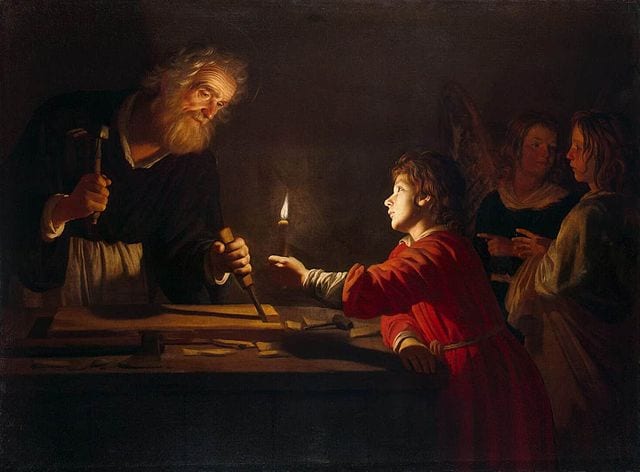
Photo credit: Childhood of Christ (c. 1620), by Gerard van Honthorst (1592-1656) [public domain / Wikimedia Commons]

***
Previous Post

May 27, 2020
James White: "Vow Breaker" Lie + His Resolve to Avoid Me
Next Post
May 28, 2020 James White Deacons-Elders-Bishops Controversy
Browse Our Archives
Select a Category & Last Things About Me Anti-Catholicism Atheism & Agnosticism Baptism and Sacramentalism Bible and Tradition Blessed Virgin Mary Books by Dave Armstrong C. S. Lewis Calvinism & General Protestantism Catholic Apologetics Catholic Apologists Catholic conversion Catholic converts Christmas Church (Ecclesiology) Church History Conversion and Converts Development of Doctrine Eastern Orthodoxy Ecumenism & Christian Unity Eucharist & Liturgy Fathers of the Church French Translations G. K. Chesterton Hell Hell & Satan Hell & Satan & Last Things Heresies & Comparative Religion Holistic Health Inquisition & Crusades & Scandals James White Jews & Judaism & Old Testament John Calvin John Henry Newman Liberal / Modernist Theology Life Issues Literary Resume Lutheranism Mariology Martin Luther Music Orthodoxy Papacy & Infallibility Personal Page Philosophy & Science Political & Ethical & Moral Issues Protestant Persecution & Intolerance Protestantism Purgatory Purgatory & Penance Romantic & Imaginative Theology Saints & Purgatory & Penance Salvation Salvation & Justification Satan & Last Things Sexuality and Gender Issues Spanish Translations Traditionalism vs. Radical Catholic Reactionaries Traducciones al español / tradução para português Trinitarianism & Christology Uncategorized Videos
Select a Month October 2026 September 2026 August 2026 July 2026 June 2026 May 2026 April 2026 March 2026 February 2026 January 2026 December 2025 November 2025 October 2025 September 2025 August 2025 July 2025 June 2025 May 2025 April 2025 March 2025 February 2025 January 2025 December 2024 November 2024 October 2024 September 2024 August 2024 July 2024 June 2024 May 2024 April 2024 March 2024 February 2024 January 2024 December 2023 November 2023 October 2023 September 2023 August 2023 July 2023 June 2023 May 2023 April 2023 March 2023 February 2023 January 2023 December 2022 November 2022 October 2022 September 2022 August 2022 July 2022 June 2022 May 2022 April 2022 March 2022 February 2022 January 2022 December 2021 November 2021 October 2021 September 2021 August 2021 July 2021 June 2021 May 2021 April 2021 March 2021 February 2021 January 2021 December 2020 November 2020 October 2020 September 2020 August 2020 July 2020 June 2020 May 2020 April 2020 March 2020 February 2020 January 2020 December 2019 November 2019 October 2019 September 2019 August 2019 July 2019 June 2019 May 2019 April 2019 March 2019 February 2019 January 2019 December 2018 November 2018 October 2018 September 2018 August 2018 July 2018 June 2018 May 2018 April 2018 March 2018 February 2018 January 2018 December 2017 November 2017 October 2017 September 2017 August 2017 July 2017 June 2017 May 2017 April 2017 March 2017 February 2017 January 2017 December 2016 November 2016 October 2016 September 2016 August 2016 July 2016 June 2016 May 2016 April 2016 March 2016 February 2016 January 2016 December 2015 November 2015 October 2015 September 2015 August 2015 July 2015 June 2015 May 2015 April 2015 March 2015 February 2015 January 2015 December 2014 November 2014 October 2014 September 2014 August 2014 July 2014 June 2014 April 2014 March 2014 February 2014 January 2014 December 2013 November 2013 October 2013 September 2013 August 2013 July 2013 June 2013 April 2013 March 2013 February 2013 January 2013 December 2012 November 2012 October 2012 September 2012 August 2012 July 2012 June 2012 May 2012 April 2012 March 2012 February 2012 January 2012 December 2011 November 2011 October 2011 September 2011 August 2011 July 2011 June 2011 April 2011 March 2011 February 2011 October 2010 September 2010 August 2010 July 2010 April 2010 March 2010 December 2009 October 2009 August 2009 July 2009 June 2009 May 2009 March 2009 February 2009 October 2008 September 2008 April 2008 March 2008 February 2008 January 2008 December 2007 November 2007 October 2007 May 2007 March 2007 February 2007 January 2007 November 2006 October 2006 September 2006 August 2006 July 2006 June 2006 May 2006 April 2006 March 2006 February 2006 October 2005 June 2005 April 2005 February 2005 July 2004 May 2004 April 2004
Follow Us!
TAKE THE
Religious Wisdom Quiz
What city did David capture and make the capital of Israel?
Select your answer to see how you score.
Bethlehem Samaria Jerusalem Hebron
Books by This Author Books by Dave Armstrong
Related posts from Biblical Evidence for Catholicism

Three More Anti-Catholic Lies About Catholicism (#6-4)
Biblical Evidence for Catholicism

Top Ten Anti-Catholic Lies (#10-7)
Biblical Evidence for Catholicism

Holy Ground: Why Mary Had NO Other Children...
Biblical Evidence for Catholicism
Protestant Confessions & "Ever-Virgin" Mary
Biblical Evidence for Catholicism
TRENDING AT PATHEOS Catholic

I was strolling through the top floor of the brand new Parthenon...

What Does Gêvâh Mean For Kimberley Guifoyle &...
This week, a lot of the news is focused on Kimberly Guilfoyle....

INNER CIRCLE: Profound Mystery (Of Christ In All...
Ephesians 5:31-32 “For this reason, a man will leave his father and...

Do Not Rejoice When Your Enemy Falls: The...
Turning an execution into a public spectacle is a disturbing expression of...

'The Chosen' S6 Trailer: The Passion Gets Very...
Not many watching 'The Chosen' worry about spoilers, but just because they...

The purpose-driven labor priest
A labor activist reads Rick Warren and it gets me wondering about...
view all Catholic blogs
Ad-Free & Subscriber Log-In Subscription Support
- About Us
- 2026 Calendar
- Videos
- Podcasts
- Library of World Religions
- Faith In Media Tracker
- Advertise With Us
- Write for Us
- Privacy Policy
- Terms of Service
- Do Not Sell My Data
- Contact Us
- Radiant Digital
- Manage Newsletter Subscriptions
- Unsubscribe From Notifications
- Sitemap
Copyright 2008-2026, Patheos. All rights reserved.
Subscription Support Ad-Free & Subscriber Log-In
Follow Patheos