
BuddhistCatholicContemplativeEvangelicalGeneral ChristianHinduJewishLatter-day SaintMuslimNew VisionsProgressive Christian
Beliefs
- Buddhist
- Catholic
- Contemplative
- Evangelical
- General Christian
- Hindu
- Jewish
- Latter-day Saint
- More Voices
- Muslim
- New Visions
- Pagan
- Progressive Christian
Topics
- Religion News
- Food and Religion
- Sports and Religion
- Religious Art
- Religious Music and Entertainment
- Religious Events
- History and Religion
- Style and Religion
- Politics and Religion
- Women in Religion
- Recreation Outdoors and Religion
- Business Finance and Religion
- Careers Workplace and Religion
- Education and Religion
- Family Parenting and Religion
- Health Fitness and Religion
- Home and Religion
- Relationships and Religion
- Technology and Religion
- Travel and Religion
Columnists
- Buddhist Columnists
- Business Finance and Religion Columnists
- Careers Workplace and Religion Columnists
- Catholic Columnists
- Contemplative Columnists
- Education and Religion Columnists
- Evangelists Columnists
- Family Parenting and Religion Columnists
- General Christian Columnists
- Health Fitness and Religion Columnists
- Hindu Columnists
- History and Religion Columnists
- Home and Religion Columnists
- Jewish Columnists
- More Voices Columnists
- Latter Day Columnists
- Muslim Columnists
- New Visions Columnists
- Nonreligious Columnists
- Pagan Columnists
- Politics and Religion Columnists
- Progressive Columnists
- Recreation Outdoors and Religion Columnists
- Relationships and Religion Columnists
- Religion News Columnists
- Religious Art Columnists
- Religious Events Columnists
- Religious Music and Entertainment Columnists
- Sports and Religion Columnists
- Style and Religion Columnists
- Technology and Religion Columnists
- Travel and Religion Columnists
- Women in Religion Columnists
Resource Library
- 2026 Calendar
- Library of World Religions
- The 100 Most Holy Places on Earth
- Patheos Answers
- Podcasts
- Videos
- Faith Leaders Database
- Anglican Episcopalian
- Bahai
- Baptist
- Buddhism
- Christianity
- Confucianism
- Eastern Orthodoxy
- Hinduism
- Holiness and Pentecostal
- ISKCON
- Islam
- Judaism
- Lutheran
- Methodist
- The Church of Jesus Christ of Latter-day Saints
- New Age
- Paganism
- Presbytarian and Reformed
- Protestantism
- Religion Behind the Scenes
- Roman Catholic
- Scientology
- Shia Islam
- Sikhism
- Sufism
- Sunni Islam
- Taoism
- Zen
- See all religions
Research Tools
 Ad-Free & Subscriber Log-In Subscription Support
Ad-Free & Subscriber Log-In Subscription Support
Follow Patheos 

- Trending:
- Forgiveness
- |
- Marriage
- |
- Consciousness
- |
- Death Penalty
- |
- Election
- |
- Halloween

-
About
-
Catholic Apologetics
-
Church History
-
Great Apologists
-
Christian Worldview
-
Protestantism & Misc.
- Home
- Catholic
- History and Religion
- Invocation of Saints and Angels (vs. Jason Engwer)
Invocation of Saints and Angels (vs. Jason Engwer)
Last updated on: May 26, 2020 at 12:57 pm by Dave Armstrong
Invocation of Saints and Angels (vs. Jason Engwer) 2020-05-26T12:57:34-04:00 Dave Armstrong
Patheos Explore the world's faith through different perspectives on religion and spirituality! Patheos has the views of the prevalent religions and spiritualities of the world.
Luke 16 (Lazarus & the Rich Man & Abraham) is One of the Most Unanswerable Arguments in Catholic Apologetics
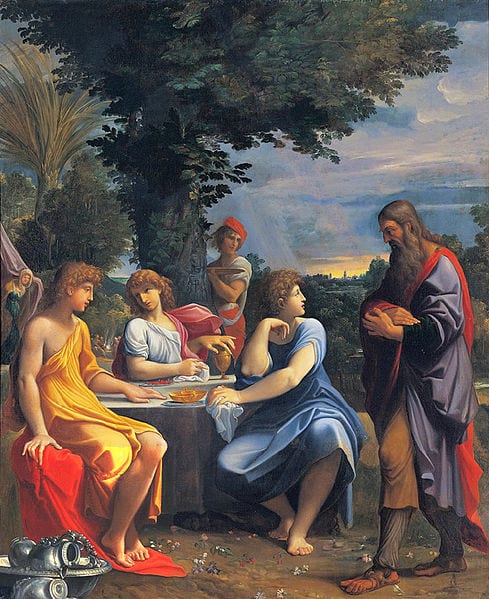
This is a response to Protestant anti-Catholic apologist Jason Engwer’s article, “Do Passages Like Genesis 19 And Luke 16 Support Prayers To Angels And The Deceased?” (6-13-08). It was a direct reply to my article, Bible on Invocation of Angels and Saved Human Beings in Heaven, for Intercessory Purposes (6-10-08). Jason’s words will be in blue.
*****
Dave Armstrong recently posted an article on prayers to the deceased and angels. I’ve written on the subject before (see here, for example), and I won’t repeat everything I’ve said in the past, but I want to comment on some of the issues addressed in Dave’s article.
Dave doesn’t cite any Biblical equivalent of the Roman Catholic prayers Evangelicals object to, because there is no Biblical equivalent.
That would be irrelevant, since my purpose (see my title) was to survey biblical examples of such prayers; whereas the prayers Jason refers to, that Protestants hate, are usually from a much later period, from Catholics, and obviously not part of the Bible. One must always be aware of a writer’s purpose and intent in any given piece of writing. In other efforts of mine, I address and defend precisely these sorts of prayers (regarding Mary): such as from St. Alphonsus de Liguori and St. Louis de Montfort.
Everything in its place and time . . . If there is any Catholic apologist who can be counted on to have addressed virtually every major Protestant objection, it’s me: with my 2900+ blog posts and 50 books. But I obviously can’t do everything in one paper! I get regularly blasted already by our anti-Catholic brethren for overly lengthy papers.
Rather, he cites some Biblical practices that are somewhat similar to the Roman Catholic practice, and he suggests that the former have implications for the latter.
Exactly! As with all doctrines, including the ones held in common by Protestants and Catholics, there is much development, and much after the time of the Bible (e.g., Christology and trinitarianism underwent a healthy development for 600 years after Christ; the canon of the Bible wasn’t finalized for another 300 years, etc.). So it’s altogether to be expected that the biblical data on intercession of the saints would be far less explicit than later developments. But the essential kernel of the doctrine is definitely in the Bible. And that was what I was driving at in this paper.
I don’t think many Evangelicals, if any, would argue that it’s inappropriate to communicate with the deceased and angels in every context. For example, Dave cites Luke 16:19-31, in which a deceased unbeliever, a rich man, communicates with a deceased believer, Abraham. What Evangelical would deny that if one deceased person appears before another, the two can communicate? I doubt that any Evangelical would maintain that two Christians in Heaven wouldn’t be permitted to speak with each other, since they had physically died. The rich man in Luke 16 is no longer living on earth, with all of the limitations and Divine commandments that apply to earthly life, and Abraham is within sight. That context is significantly different than a context in which a man on earth attempts to initiate contact, through prayer, with a deceased person whose ability to hear him he can’t verify, sometimes not even knowing whether the deceased person is saved.
That particular passage and my use of it has to do with two major prior premises in the larger debate of intercession of the saints:
- Is it proper to “pray” to anyone but God?,
and
- is it proper to ask anyone but God to not only pray for, but fufill (i.e., have the power and ability to bring about) an intercessory request?
These are the sorts of questions to which the Luke 16 passage is relevant. The rich man literally prays to Abraham in the passage (which is a story — not a parable! — from Jesus Himself), and asks him to send someone to warn his five brothers, so they can repent and not end up on his miserable state (on the “bad” side of the two divisions in Hades described in the passage).
Now, Protestantism utterly rejects #1 and #2 above; yet Luke 16 (from Jesus) clearly teach them. Hence lies the dilemma. So Jason plays games (in effect, “both people are dead! So how is it relevant?”) rather than squarely face the difficulty for his position. It matter not if both men are dead; the rich man still can’t do what he did, according to Protestant categories of thought and theology.
Distinctions like these aren’t just made by Evangelicals. If a Christian from China visits Dave’s church, and he speaks with that Christian while he’s visiting, Dave won’t assume that he can speak with that Christian through prayer after he returns to China.
Exactly! Jason is making my argument for me (thanks!). So how is it that the rich man prays to Abraham, when supposedly no one can pray to or ask to fulfill a request to anyone but God? The rich man actually makes two such requests, and then repeats the second, after Abraham refused it:
Luke 16:24 (RSV) And he called out, `Father Abraham, have mercy upon me, and send Laz’arus to dip the end of his finger in water and cool my tongue; for I am in anguish in this flame.’
Luke 16:27-28 And he said, `Then I beg you, father, to send him to my father’s house, [28] for I have five brothers, so that he may warn them, lest they also come into this place of torment.’
Luke 16:30 And he said, `No, father Abraham; but if some one goes to them from the dead, they will repent.’
How can that be in Protestant theology? No none has ever adequately explained this to me, and I’ve written about this passage many times:
Dialogue on Sheol / Hades (Limbo of the Fathers) and Luke 16 (the Rich Man and Lazarus) with a Baptist (vs. “Grubb”) [2-28-08]
The Bible on Asking Dead Men to Intercede (Luke 16) [7-8-14]
Dialogue on Praying to Abraham (Luke 16) [5-22-16]
Dialogue: Rich Man’s Prayer to Abraham (Luke 16) and the Invocation of Saints (vs. Lutheran Pastor Ken Howes) [5-3-17]
I already answered Jason’s objection that both men are dead, in the second paper above:
Whether Dives [the “rich man”] was dead or not is also irrelevant to the argument at hand, since standard Protestant theology holds that no one can make such a request to anyone but God. He’s asking Abraham to send Lazarus to him, and then to his brothers, to prevent them from going to hell. That is very much, prayer: asking for supernatural aid from those who have left the earthly life and attained sainthood and perfection, with God. . . .
Jesus told this story, and in the story is a guy praying to a dead man, to request things that the dead man appears to be able to fulfill by his own powers. That is quite sufficient to prove the point. . . .
It remains true that Protestant theology, generally speaking, forbids asking a dead man to intercede (thus, a dead man asking this is part of the larger category that remains forbidden in that theology), and makes prayer altogether a matter only between man and God . . .
In fact, God is never mentioned in the entire story (!!!) . . .
So why did Jesus teach in this fashion? Why did He teach that Dives was asking Abraham to do things that Protestant theology would hold that only God can do? And why is the whole story about him asking Abraham for requests, rather than going directly to God and asking Him: which would seem to be required by [Protestant] theology? . . .
Folks, this just ain’t how it’s supposed to be, from a Protestant perspective. All the emphases are wrong, and there are serous theological errors, committed by Jesus Himself (i.e., from their perspective).
And when Dave wrote an earlier article discussing whether we can pray to Jesus, he didn’t cite the centurion’s conversation with Jesus in Matthew 8 or the disciples’ conversations with Jesus in John 21, for example, to justify the practice of praying to Jesus.
Such comparisons would be irrelevant, since Jesus 1) wasn’t dead, and 2) He’s God in the first place, rather than a created human being, like the rest of us. But insofar as people asked Jesus to bring about a miracle or other desired outcome, in effect they were praying to Him while He was alive on the earth (before His crucifixion and death), and they could because he was God and could fulfill such requests. But Abraham is not supposed to be able to fulfill intercessory requests in the manner of Jesus, according to Protestant theology.
Why, then, does Jesus describe Dives praying to Abraham for precisely that? Note also that Abraham in turn never rebukes Dives, nor tells him that he shouldn’t be praying to him; that he should only pray to God. He merely turns down his request (which in turn proves that he had the power to do it but chose not to). Otherwise, he would or should have said (it seems to me), “I can’t do that; only God can” or “pray only to God, not to me.”
It seems that Dave understands that there’s a relevant difference between speaking with Jesus in a context like Matthew 8 or John 21 and speaking with Him today, while He’s in Heaven.
There is, to some extent, but this has no force to overcome the argument for intercession of saints from Luke 16, as explained. It’s apples and oranges and in the end, simply a non sequitur diversion from the actual issues at hand.
Yet, Dave repeatedly disregards such distinctions when citing Biblical passages about the deceased and angels. For example, he cites Matthew 17:1-4 and 27:50-53, even though those deceased believers had returned to life on earth,
They still underwent death, even though they returned. These two passages are more so about the false Protestant notion that “God wants no contact between heaven and earth; between the afterlife and this life.” So I retort with these passages (Moses and Elijah at the Transfiguration, and the saints rising from their graves after the crucifixion), about the dead returning. These are but two of the countless biblical refutations of various false precepts of Protestantism. God obviously does want such contact, or else He wouldn’t allow these “weird” instances. See also, the real prophet Samuel — not a demonic fake — appearing to Saul and telling him he was to die in battle.
yet he doesn’t cite passages like John 21, in which people speak with Jesus after He returned to life on earth, in order to justify prayers to Jesus. Maybe Dave will begin appealing to passages like John 21 in that context, but his apparent failure to do so in the past suggests to me that he’s aware of and agrees with distinctions such as the ones I’ve made above.
I don’t have to cite John 21, because all Christians agree that we can pray to Jesus, and 2) St. Stephen offers us an explicit example of it. If Protestants start saying we can’t pray to Jesus, then I could and would use this argument and similar ones to show that they would be wrong to do so.
If the people of Biblical times had practiced prayers to the deceased and angels, we would expect to see that practice reflected in the Biblical record. We wouldn’t expect angels to have to initiate contact with people on earth before we saw people on earth speaking to angels, for example. Why didn’t Saul pray to Samuel rather than attempting to contact him through a medium? The people of the Bible would speak with the deceased or angels if the deceased or angels manifested themselves in some manner, but they wouldn’t attempt to initiate communication through prayer to a being who gives no indication of being available for contact.
This is actually a fair point. The short answer is: I don’t know why there wouldn’t be more such examples than there are, but there are some. My guess (and that’s all it is) would be that God wanted to focus in His revelation on prayer to Him, before getting into the fine points of the various sorts of intercession, just as He wanted to overwhelmingly concentrate on Jesus in the Bible and have relatively little about Mary. That would come later, with pious theological reflection. Other doctrines are based on very few direct indications (e.g., the virgin birth and original sin).
But I would go on to say that the doctrine is still firmly taught, as (primarily but not solely) a deduction from plain and obvious biblical principles that we do know about. Many Protestant apologists will admit that there is no direct, explicit statement of even something so fundamental to their worldview as sola Scriptura. Jason himself wrote on 1-10-18:
I don’t think the Bible directly, explicitly teaches sola scriptura. Rather, I think sola scriptura is an implication of Biblical teaching. We limit ourselves to scripture for reasons similar to why we limit ourselves to the extant writings of Tertullian and other historical figures. . . . when we combine 2 Timothy 3 with what other sources tell us about scripture and what we know about other factors involved (e.g., ecclesiology), we arrive at the conclusion of sola scriptura.
I wholeheartedly agree with him here. There certainly is no statement in the Bible remotely like the way Protestant apologists like James White define sola Scriptura: [close paraphrase] “Scripture alone is the final and infallible standard for Christian doctrine, in a way that neither the Church nor tradition are.” But they hold to the doctrine (and indeed base their entire system and rule of faith on it) because they think it is the proper deduction from many other biblical passages. They’re wrong, but that’s what they think.
The canon of the Bible is of this nature as well. The Bible never lists its own books. Protestants know this and freely admit it. That ultimately (undeniably) came from tradition. It incorporated all kinds of biblical input and considerations, but the decision came from an authoritative Church, summarizing the tradition received.
This is how it is also for prayer to angels. In the paper that Jason is partially answering I summarized the evidence:
In summary, then, what have we learned about biblical data for the notion of asking angels . . . to pray for us and intercede before God for us? Plenty:
Men talk to angels (16 scriptural examples given)
Men make requests or petitions to angels and their wishes are granted (Gen 19, 32, 48).
Angels pray to God on behalf of men; they intercede for us (four examples given).
Angels even participate in giving grace (Rev 1:4; cf. Tob 12:12,15).
Angels talk to human beings from heaven (Gen 21:17-18).
Men see angels in heaven (11 examples given).
Angels protect and guard men (seven examples).
It is obvious that angels are aware of earthly events, and care about us. All of the data above leads to the deductive conclusion that it is perfectly permissible to ask an angel to pray for us. Three explicit examples occur in Holy Scripture of this very thing. It matters not where the angel is when it hears (#1) and grants the prayer request or intercedes before God, because, in fact, angels are not in space anyway. Our relation to them is the same wherever they “are.”
Therefore, since Scripture shows that they can be asked by human beings for their help, and fulfillments of these requests are even granted (#2), and grace given through angels (#4), the doctrine is proven, as they are extremely intelligent and are not confined to space. We know that angels intercede for us (four examples: #3). Therefore, since they are acutely aware of us, and in fact, we all have guardian angels (#7), we can ask them to do so. If the objection is to angels not being in front of us to talk to, we reply that in one instance, an angel talked to a person on earth from heaven (#5) and that men have often seen angels in heaven (#6). Thus, in all respects, the doctrine is proven from Holy Scripture.
Moreover, whether an angel appears first and then is asked to fulfill an intercessory prayer request is a secondary, not an essential consideration. Jason may point that out, but it doesn’t release him from the responsibility of explaining how human beings could ask angels to help (pray to them) at all: when we’re supposed to (in the Protestant view) only do that with God. After all, praying to an angel in heaven is not essentially different from asking them to intercede in a direct encounter on earth, since we know that they are aware of earthly events. Indeed, many (most?) Protestants even agree with us that there is such a thing as guardian angels, that watch over us. Billy Graham believed that. I read it in his book about angels.
So, to summarize: “we would expect to see that practice [prayer to angels] reflected in the Biblical record.” Yes, we would, just as we would “expect” (if we are Protestants) at least one clear, explicit, fully developed reflection in the Bible of the definition of sola Scriptura, or the canon of the Bible. But we don’t see either (and many Protestants are shocked to learn of that). Since Protestants still believe in both things minus explicit proofs; likewise, we do the same with regard to asking angels to intercede. It doesn’t have to be explicit in the Bible (whatever we “expect” to see or not see in Holy Scripture), if there is sufficient deductive evidence. Goose and gander . . . If Protestants do exactly as we do with some of their distinctive doctrines that we reject, then they have no grounds to complain that we do it as regards doctrines they reject.
Furthermore, it’s a bit of a unique scenario, but the Bible gives two instances, of “praying” (at any rate, communicating to / “contacting”) the dead (and also for the dead at the same time), without mediums or spiritists, initiated by the praying person:
John 11:43-44 . . . he cried with a loud voice, “Laz’arus, come out.” [44] The dead man came out, . . .
Acts 9:40-41 But Peter put them all outside and knelt down and prayed; then turning to the body he said, “Tabitha, rise.” And she opened her eyes, and when she saw Peter she sat up. [41] And he gave her his hand and lifted her up. Then calling the saints and widows he presented her alive.
In an article and huge discussion thread from June 2010 on “Prayers to the Dead”, Jason made several statements that expressly contradict the two passages above:
When scripture forbids attempting to contact the deceased, it’s addressing the physically deceased.
The Biblical passages about attempting to contact the dead are too broad to be limited to “necromancy” as you seem to be defining that term. Passages like Isaiah 8:19 and 19:3 don’t just condemn particular forms of attempting to contact the dead, but rather condemn the broad principle of consulting the deceased.
The fact that mediums and spiritists are mentioned [in Isaiah 8:19] doesn’t prove that the principles Isaiah lays out can only apply to attempts to contact the dead in those particular ways. (For example, Deuteronomy 18:11 mentions mediums and spiritists, then mentions the broad category of “calling up the dead”.
The physically dead are in view when the Biblical authors condemn attempts to contact the dead.
[S]eeking to contact the dead is problematic in itself.
If Isaiah condemns attempts to contact the dead, it doesn’t make sense to assume that only the particular forms of attempting to contact the dead that you disagree with are in view. . . . If Moses and Isaiah only meant to condemn attempts to contact the dead that involve mediums and spiritists, instead of condemning the larger category without such a qualification, then why don’t they only mention mediums and spiritists? Why do they also mention the broader category I’ve been citing? . . . Isaiah is condemning a series of practices broader than merely consulting mediums and spiritists.
I’ve repeatedly argued that scripture condemns attempts to contact the dead, citing passages in Deuteronomy and Isaiah, . . .
Deuteronomy 18:11 mentions mediums and spiritists, then mentions the broad category of “calling up the dead”. Mediums and spiritists are examples within a larger category.
Jesus raising Lazarus (including speaking to him) and Peter raising Tabitha (including speaking to her) are precisely examples of “contact” with or “calling up” the dead. Therefore, Jason’s repeated statements that any and all such practices to do with the dead are forbidden altogether in Scripture, is clearly false (unless he wants to believe that Jesus and Peter were both violating biblical commands).
Moreover, at least two more Bible passages contradict his claims of this broader condemnation in Scripture. He has to explain how Saul could petition Samuel. All agree that consulting a medium to do so was wrong. Yet when the real Samuel appeared, Saul petitioned him, and Samuel didn’t condemn him for that. I wrote in another related article of mine:
1 Samuel 28:15-16 (RSV) Then Samuel said to Saul, “Why have you disturbed me by bringing me up?” Saul answered, “I am in great distress; for the Philistines are warring against me, and God has turned away from me and answers me no more, either by prophets or by dreams; therefore I have summoned you to tell me what I shall do.” And Samuel said, “Why then do you ask me, since the LORD has turned from you and become your enemy?”
. . . Samuel could properly be petitioned or, in effect, “prayed to” but he also could refuse the request, and he did so. As Samuel explained, he didn’t question the asking as wrong and sinful, but rather, refused because the request to save Saul was against God’s expressed will: which Samuel also knew about, as a departed saint. Moreover, Samuel knew (after his death) that Saul was to be defeated in battle the next day and would die (1 Sam 28:18-19).
Lastly, I submitted another scriptural argument in the same article:
The “bystanders” at Jesus’ crucifixion provide another similar instance. They assumed that He could ask (pray to) the prophet Elijah to save Him from the agony of the cross (Mt 27:46-50). They’re presented as allies of Jesus (not enemies), since one of them gave Him a drink (Mt 27:48). Matthew 27:49 shows that this type of petition was commonly believed at the time.
See also my articles:
Does God Forbid All Contact with the Dead? [6-23-07]
Invocation of the Saints = Necromancy? [10-18-08]
***
Dave often makes comments such as:
“Saints in heaven are aware of earthly events.”
“Angels are aware of earthly events to an extraordinary degree, being super-intelligent beings.”
He claims that deceased believers are “perfectly aware of affairs on earth”.
But the deceased and angels can be aware of some events on earth without being aware of every event.
True, but the important thing is that they are aware, as opposed to being unaware. Once they are aware, then this awareness may quite possibly include awareness of our petitions and intercessions directed to them. The Bible appears to indicate a very profound awareness; for example in Hebrews 12:1:
Therefore, since we are surrounded by so great a cloud of witnesses, let us also lay aside every weight, and sin which clings so closely, and let us run with perseverance the race that is set before us,
Word Studies in the New Testament (Marvin R. Vincent, Grand Rapids, Michigan: Eerdmans, 1980; orig. 1887; vol. 4, 536), [a] standard Protestant language source, comments on this verse as follows:
‘Witnesses’ does not mean spectators, but those who have borne witness to the truth, as those enumerated in chapter 11. Yet the idea of spectators is implied, and is really the principal idea. The writer’s picture is that of an arena in which the Christians whom he addresses are contending in a race, while the vast host of the heroes of faith who, after having borne witness to the truth, have entered into their heavenly rest, watches the contest from the encircling tiers of the arena, compassing and overhanging it like a cloud, filled with lively interest and sympathy, and lending heavenly aid.
This includes angels, who (Jason will no doubt agree) are “super-intelligent beings.” This is just one verse, but how much it reveals!
Angels have limitations in understanding and interacting with events on earth (Daniel 10:13, 1 Peter 1:12).
All Daniel 10:13 says is that a demon opposed on particular angel, and Michael the archangel came to help him. That’s some sort of “limitation” I suppose, but it doesn’t follow that, therefore, they cannot intercede on our behalf or cause good things to happen. 1 Peter 1:12 is about how the angels seem to find the Good News of the gospel curious, since the good angels never fell and never had any need of salvation. That’s hardly a “limitation” that would hinder their hearing our prayer requests, either. Jason’s grasping at straws.
Passages like 1 Kings 8:38-39 and Revelation 2:23 suggest that only God thoroughly knows the human heart,
That’s true, and only He is omniscient. All Christians agree on those things. But again, angels can know enough to hear prayers and act upon them. They don’t have to “know our hearts” to be able to know what our hearts are expressing, when we verbalize it to them.
and 1 Kings 8 is addressed specifically to the context of prayer.
It doesn’t logically preclude angelic invocation and intercession, because it’s talking only about prayer to God. Mentioning one thing is not the same as saying it is exclusive in all respects.
We would need some further warrant before concluding that the deceased and angels are aware of people’s thoughts and speech.
I already provided Hebrews 12:1. Jesus told us that “there is joy before the angels of God over one sinner who repents” (Lk 15:10). Technically, repentance is an interior disposition; so the angels seem to be beware of our thoughts to some extent (not like God, but significantly). Both dead saints (Rev 5:8) and angels (Rev 8:3-4) are somehow aware of our prayers ascending to God. Even the context of one of the verses that Jason brought up above shows that an angel learned about Daniel’s thoughts in prayer: either directly or because God made him aware. Either way, he knew, and was sent and appeared to Daniel to help:
Daniel 10:11-12 . . . “I have been sent to you.” . . . [12]. . . “from the first day that you set your mind to understand and humbled yourself before your God, your words have been heard, and I have come because of your words.”
Angels are messengers. They’re sent to perform particular tasks.
That’s right. And they know lots of stuff, too: including our petitionary requests.
Different angels work in different parts of the universe. The fact that an angel is “aware of earthly events to an extraordinary degree” in the earthly context he’s sent to address doesn’t suggest that he would be aware of a prayer in the heart of a child in some other part of the world, for example.
It suggests at least as much that he would know such a thing, than that he would not, since if it’s said that he has great awareness of one thing, it stands to reason that he would of many other things, and Hebrews 12:1 lays it right out, with no doubt that indeed this is the case for both angels and dead saints.
The Bible addresses thousands of years of human history in a large variety of contexts. There are hundreds of Biblical examples of prayers offered to God. There are many Biblical examples of people interacting with the deceased and angels if they leave the earthly realm (in Heaven, in visions, etc.) or if the deceased or angels manifest themselves in the earthly realm. But we’re never encouraged to attempt to initiate communication with the deceased or angels through prayer.
Well, we are in Jesus’ story of Lazarus and the rich man in Luke 16. A dead man (Abraham) is prayed to, and it was initiated by Dives: the rich man. It matters not (with regard to the theological issues here under consideration) that he was also dead, as explained above. Jason still has the burden of explaining how Abraham, who was “far off” (16:23) could be prayed to and how he came to have power to fulfill requests (and to turn them down as well, as he did here).
Roman Catholics, Eastern Orthodox, and others who believe in praying to the deceased and angels do so millions of times every day, and their behavior leaves many and explicit traces in the historical record. How likely is it that there would be no such traces in the Biblical record if prayer to the deceased and angels had been a practice of the people of God in Biblical times?
As likely as there is no trace in the biblical record whatsoever of the list of the canonical books, and of the precise definition of sola Scriptura that is the very foundational principle of authority in Protestantism. Sometimes things aren’t explicit in the Bible because they are false in the first place (sola Scriptura) or are true even though no explicit passages exist to prove them, and only indirect evidences can be logically deduced (canon of the Bible, invocation of angels).
Or, if we’re to believe that it’s an appropriate practice that didn’t develop until post-Biblical times, then why should we consider it an appropriate development?
Because it was there in kernel and deductively in Holy Scripture: verified by the beliefs and practices of the Church fathers, who passed down the apostolic deposit undefiled and protected by the Holy Spirit.
Nothing in Dave’s article leads us to the conclusion that the deceased and angels are appropriate recipients of prayer.
Then he should dismantle my arguments point-by-point.
Dave doesn’t want us to speak with an angel who has appeared to us on earth, as in Genesis 19. He doesn’t want us to speak with an angel who appears to us in a vision, as in Zechariah 2. He doesn’t want us to speak with deceased believers who return to life on earth, such as the ones in Matthew 27. He doesn’t want us to speak with Abraham if we see him in the afterlife, as in Luke 16.
When did I ever claim any of this? I know he’s being rhetorical, but its a flawed use of that technique.
Dave wants those of us who are still in this life on earth to try to initiate communication with the deceased and angels through prayer, often when the deceased and angels aren’t known to have entered the earthly realm and without our knowing whether the deceased are saved. There’s a significant difference, and Dave’s article doesn’t do anything to bridge the gap.
It certainly does, in the paper, and especially as presently clarified and reiterated. I think I’ve shown more than enough to establish that such prayer is biblical, and that Protestant disbelief in it is a false and unbiblical doctrine.
I do sincerely thank Jason for providing good food for thought and his side of this dialogue, which allows readers to make up their own minds as to the best biblical case: yay or nay. I’m utterly confident that the Catholic side of the argument prevails, if fairly considered. If someone thinks otherwise, they are more than welcome to challenge this and scores and scores of other papers of mine on similar topics. Have at it. And I will reply back unless it is of exceptionally poor quality.
***
Photo credit: Three angels visiting Abraham (c. 1612), by Ludovico Carracci (1555-1619) [public domain / Wikimedia Commons]

***
Previous Post

May 26, 2020
Pope Francis vs. the Gospel? Outrageous & Absurd Lies!
Next Post
May 27, 2020 James White: "Vow Breaker" Lie + His Resolve to Avoid Me
Browse Our Archives
Select a Category & Last Things About Me Anti-Catholicism Atheism & Agnosticism Baptism and Sacramentalism Bible and Tradition Blessed Virgin Mary Books by Dave Armstrong C. S. Lewis Calvinism & General Protestantism Catholic Apologetics Catholic Apologists Catholic conversion Catholic converts Christmas Church (Ecclesiology) Church History Conversion and Converts Development of Doctrine Eastern Orthodoxy Ecumenism & Christian Unity Eucharist & Liturgy Fathers of the Church French Translations G. K. Chesterton Hell Hell & Satan Hell & Satan & Last Things Heresies & Comparative Religion Holistic Health Inquisition & Crusades & Scandals James White Jews & Judaism & Old Testament John Calvin John Henry Newman Liberal / Modernist Theology Life Issues Literary Resume Lutheranism Mariology Martin Luther Music Orthodoxy Papacy & Infallibility Personal Page Philosophy & Science Political & Ethical & Moral Issues Protestant Persecution & Intolerance Protestantism Purgatory Purgatory & Penance Romantic & Imaginative Theology Saints & Purgatory & Penance Salvation Salvation & Justification Satan & Last Things Sexuality and Gender Issues Spanish Translations Traditionalism vs. Radical Catholic Reactionaries Traducciones al español / tradução para português Trinitarianism & Christology Uncategorized Videos
Select a Month October 2026 September 2026 August 2026 July 2026 June 2026 May 2026 April 2026 March 2026 February 2026 January 2026 December 2025 November 2025 October 2025 September 2025 August 2025 July 2025 June 2025 May 2025 April 2025 March 2025 February 2025 January 2025 December 2024 November 2024 October 2024 September 2024 August 2024 July 2024 June 2024 May 2024 April 2024 March 2024 February 2024 January 2024 December 2023 November 2023 October 2023 September 2023 August 2023 July 2023 June 2023 May 2023 April 2023 March 2023 February 2023 January 2023 December 2022 November 2022 October 2022 September 2022 August 2022 July 2022 June 2022 May 2022 April 2022 March 2022 February 2022 January 2022 December 2021 November 2021 October 2021 September 2021 August 2021 July 2021 June 2021 May 2021 April 2021 March 2021 February 2021 January 2021 December 2020 November 2020 October 2020 September 2020 August 2020 July 2020 June 2020 May 2020 April 2020 March 2020 February 2020 January 2020 December 2019 November 2019 October 2019 September 2019 August 2019 July 2019 June 2019 May 2019 April 2019 March 2019 February 2019 January 2019 December 2018 November 2018 October 2018 September 2018 August 2018 July 2018 June 2018 May 2018 April 2018 March 2018 February 2018 January 2018 December 2017 November 2017 October 2017 September 2017 August 2017 July 2017 June 2017 May 2017 April 2017 March 2017 February 2017 January 2017 December 2016 November 2016 October 2016 September 2016 August 2016 July 2016 June 2016 May 2016 April 2016 March 2016 February 2016 January 2016 December 2015 November 2015 October 2015 September 2015 August 2015 July 2015 June 2015 May 2015 April 2015 March 2015 February 2015 January 2015 December 2014 November 2014 October 2014 September 2014 August 2014 July 2014 June 2014 April 2014 March 2014 February 2014 January 2014 December 2013 November 2013 October 2013 September 2013 August 2013 July 2013 June 2013 April 2013 March 2013 February 2013 January 2013 December 2012 November 2012 October 2012 September 2012 August 2012 July 2012 June 2012 May 2012 April 2012 March 2012 February 2012 January 2012 December 2011 November 2011 October 2011 September 2011 August 2011 July 2011 June 2011 April 2011 March 2011 February 2011 October 2010 September 2010 August 2010 July 2010 April 2010 March 2010 December 2009 October 2009 August 2009 July 2009 June 2009 May 2009 March 2009 February 2009 October 2008 September 2008 April 2008 March 2008 February 2008 January 2008 December 2007 November 2007 October 2007 May 2007 March 2007 February 2007 January 2007 November 2006 October 2006 September 2006 August 2006 July 2006 June 2006 May 2006 April 2006 March 2006 February 2006 October 2005 June 2005 April 2005 February 2005 July 2004 May 2004 April 2004
Follow Us!
TAKE THE
Religious Wisdom Quiz
Which book of the Bible has the most chapters?
Select your answer to see how you score.
Proverbs Genesis Psalms Isaiah
Books by This Author Books by Dave Armstrong
Related posts from Biblical Evidence for Catholicism

Three More Anti-Catholic Lies About Catholicism (#6-4)
Biblical Evidence for Catholicism

Bible & Catholicism on Mortal Sin (vs. John...
Biblical Evidence for Catholicism

Top Ten Anti-Catholic Lies (#10-7)
Biblical Evidence for Catholicism

Does Catholic Intercession of Saints Require Omniscience?
Biblical Evidence for Catholicism
TRENDING AT PATHEOS Catholic

The Sermon on the Mount, Part I: Matthew...
The Sermon on the Mount, Part I (Matthew 4:12-5:12) St. Matthew moves...

What's up from Crossway: Reviewing some of their latest A few weeks...

Janie Learns the Way of the Cross: A...
Teaching children about Jesus' Passion can be challenging. Many parents and educators...

Looking For Good Catholic Writing - October 2026
He alone extends the heavens, and he walks upon the waves of...

In "Irreplaceable," our book on vocation and technology, Trevor Sutton and I...

I was strolling through the top floor of the brand new Parthenon...
view all Catholic blogs
Ad-Free & Subscriber Log-In Subscription Support
- About Us
- 2026 Calendar
- Videos
- Podcasts
- Library of World Religions
- Faith In Media Tracker
- Advertise With Us
- Write for Us
- Privacy Policy
- Terms of Service
- Do Not Sell My Data
- Contact Us
- Radiant Digital
- Manage Newsletter Subscriptions
- Unsubscribe From Notifications
- Sitemap
Copyright 2008-2026, Patheos. All rights reserved.
Subscription Support Ad-Free & Subscriber Log-In
Follow Patheos