
BuddhistCatholicContemplativeEvangelicalGeneral ChristianHinduJewishLatter-day SaintMuslimNew VisionsProgressive Christian
Beliefs
- Buddhist
- Catholic
- Contemplative
- Evangelical
- General Christian
- Hindu
- Jewish
- Latter-day Saint
- More Voices
- Muslim
- New Visions
- Pagan
- Progressive Christian
Topics
- Religion News
- Food and Religion
- Sports and Religion
- Religious Art
- Religious Music and Entertainment
- Religious Events
- History and Religion
- Style and Religion
- Politics and Religion
- Women in Religion
- Recreation Outdoors and Religion
- Business Finance and Religion
- Careers Workplace and Religion
- Education and Religion
- Family Parenting and Religion
- Health Fitness and Religion
- Home and Religion
- Relationships and Religion
- Technology and Religion
- Travel and Religion
Columnists
- Buddhist Columnists
- Business Finance and Religion Columnists
- Careers Workplace and Religion Columnists
- Catholic Columnists
- Contemplative Columnists
- Education and Religion Columnists
- Evangelists Columnists
- Family Parenting and Religion Columnists
- General Christian Columnists
- Health Fitness and Religion Columnists
- Hindu Columnists
- History and Religion Columnists
- Home and Religion Columnists
- Jewish Columnists
- More Voices Columnists
- Latter Day Columnists
- Muslim Columnists
- New Visions Columnists
- Nonreligious Columnists
- Pagan Columnists
- Politics and Religion Columnists
- Progressive Columnists
- Recreation Outdoors and Religion Columnists
- Relationships and Religion Columnists
- Religion News Columnists
- Religious Art Columnists
- Religious Events Columnists
- Religious Music and Entertainment Columnists
- Sports and Religion Columnists
- Style and Religion Columnists
- Technology and Religion Columnists
- Travel and Religion Columnists
- Women in Religion Columnists
Resource Library
- 2026 Calendar
- Library of World Religions
- The 100 Most Holy Places on Earth
- Patheos Answers
- Podcasts
- Videos
- Faith Leaders Database
- Anglican Episcopalian
- Bahai
- Baptist
- Buddhism
- Christianity
- Confucianism
- Eastern Orthodoxy
- Hinduism
- Holiness and Pentecostal
- ISKCON
- Islam
- Judaism
- Lutheran
- Methodist
- The Church of Jesus Christ of Latter-day Saints
- New Age
- Paganism
- Presbytarian and Reformed
- Protestantism
- Religion Behind the Scenes
- Roman Catholic
- Scientology
- Shia Islam
- Sikhism
- Sufism
- Sunni Islam
- Taoism
- Zen
- See all religions
Research Tools
 Ad-Free & Subscriber Log-In Subscription Support
Ad-Free & Subscriber Log-In Subscription Support
Follow Patheos 

- Trending:
- Forgiveness
- |
- Marriage
- |
- Consciousness
- |
- Death Penalty
- |
- Election
- |
- Halloween

-
About
-
Catholic Apologetics
-
Church History
-
Great Apologists
-
Christian Worldview
-
Protestantism & Misc.
- Home
- Catholic
- History and Religion
- I Refuted James White’s Favorite Defenses of Sola Scriptura
I Refuted James White’s Favorite Defenses of Sola Scriptura
Last updated on: June 6, 2026 at 12:42 am by Dave Armstrong
I Refuted James White’s Favorite Defenses of Sola Scriptura 2026-06-06T00:42:24-04:00 Dave Armstrong
Patheos Explore the world's faith through different perspectives on religion and spirituality! Patheos has the views of the prevalent religions and spiritualities of the world.
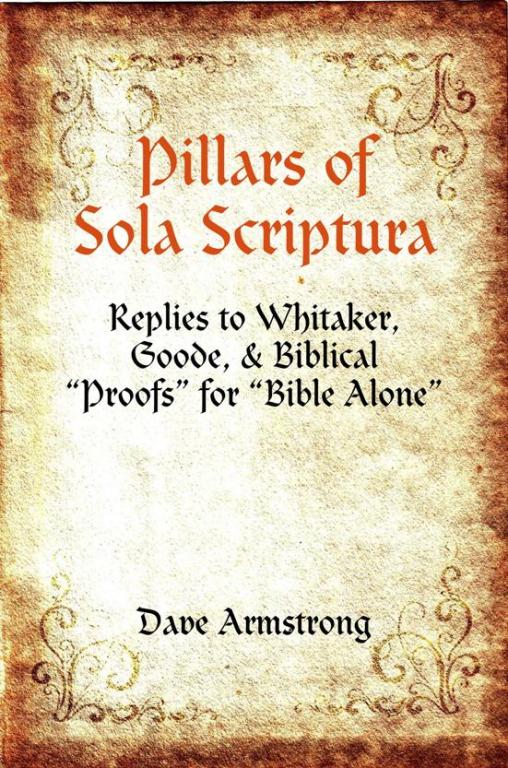
[see book and purchase information]
Words of Bishop “Dr.” [???] James White will be in blue.
*****
In an article on his blog, dated 10-31-09 [linked below], he attacked Dr. Francis Beckwith:
We get the distinct feeling that despite spending 90 days doing the study that led him back to Rome, Dr. Beckwith somehow missed the best works from the non-Roman Catholic viewpoint. I see no reason to believe he worked through Chemnitz or Whittaker [sic] or Goode or Salmon. It seems most of his reading was in secondary, pro-Roman sources, or at least fuzzy ecumenical ones.
Again, responding to Beckwith on 8-18-10, White wrote:
One will scan his notes in vain for any reference to any classical works on, say, sola scriptura, such as William Whitaker’s late 16th century classic, Disputations on Holy Scripture, or William Goode’s mid 19th century work, Divine Rule of Faith and Practice.
And again, about someone else on 9-3-07:
Of course, these issues have been addressed many times, so I wonder if this writer has, in fact, read Goode or Whitaker . . .?
And on 8-20-07:
Have you listened to both sides? That is, have you done more than read Rome Sweet Home and listen to a few emotion-tugging conversion stories? Have you actually taken the time to find sound, serious responses to Rome’s claims, those offered by writers ever since the Reformation, such as Goode, Whitaker, Salmon, and modern writers?
I see. Now, Dr. Beckwith is a professional philosopher (i.e. — very unlike Mr. White — , a professor, with a real doctorate, not a fake one bought with cereal boxtops: like White’s). That’s his life’s work. I doubt that he would even have a tenth of the time that full-time Christian apologists like myself and Bishop White have, to deal that fully in primary anti-Catholic or contra-Catholic Protestant sources.
I do have that time, and lo and behold, when I wrote one of my three books on sola Scriptura (the 310-page Pillars of Sola Scriptura: Replies to Whitaker, Goode, & Biblical “Proofs” for “Bible Alone” from 2012), it was a point-by-point refutation of the two men whom White and many other Protestants consider the best historic defenders of the false doctrine of sola Scriptura (absolutely central to Protestant thinking).
*
I devoted pages 13-186 to the 1588 work, Disputation on Holy Scripture: Against the Papists, Especially Bellarmine and Stapleton, by the Calvinist Anglican William Whitaker (1548-1595). And I devoted pages 187-236 to the 1853 tome, The Divine Rule of Faith and Practice, by the evangelical Anglican William Goode (1801-1868).
How’s that for “work[ing] through” the “best works from the non-Roman Catholic viewpoint”? This is what White constantly demands, yet when a Catholic actually does it, it’s crickets on his end: no response whatever from him or any other Protestant apologist.
He also mentions Martin Chemnitz (1522-1586), the Lutheran theologian, as one of these “best” sources. I haven’t written a book about him, but I’ve read his main polemical book and have done three lengthy examinations of his highly flawed arguments regarding the Church fathers and their supposed quasi-Lutheran leanings:
*
Church Fathers & Justification: Martin Chemnitz vs. Catholicism [9-9-07]
Moreover, I read George Salmon’s book against infallibility back in 1990 when I was fighting against the Catholic Church (infallibility was my biggest objection), and I have addressed it twice as a Catholic:
*
Absurd Anti-Newman Rhetoric in Anti-Catholic Polemics (9-27-05)
*
*
It contains atrocious and rather easily refuted argumentation, too. White has utterly ignored all of that material, too. I not only was familiar with Salmon’s polemics; I heavily utilized it when I was fighting against the Catholic Church an particularly infallibility in 1990. In a portion of my longest (75-page) conversion story I wrote (links added presently):
I quickly found some of the leading polemics against Catholic infallibility, such as the Irish Anglican anti-Catholic George Salmon (1819-1904), author of The Infallibility of the Church (1888) and Johann Joseph Ignaz von Döllinger (1799-1890), the German historian who rejected the ex cathedra declaration of papal infallibility and formed the Old Catholic schismatic group. His books, Letters of Quirinus and Letters of Janus, were written during the First Vatican Council in 1870.
Salmon’s work has been refuted decisively twice, by B.C. Butler, in his The Church and Infallibility: A Reply to the Abridged “Salmon” (New York, Sheed & Ward, 1954), and also in a series of articles in The Irish Ecclesiastical Record, in 1901 and 1902 [see p. 193 ff., March 1901] (probably able to be found online).
Yet Protestant apologists Norman Geisler and Ralph MacKenzie still claimed in 1995, in a major critique of Catholicism, Roman Catholics and Evangelicals: Agreements and Differences (Grand Rapids, Michigan: Baker Books, p. 206; cf. p. 459) that Salmon’s book has “never really been answered by the Catholic Church” and is the “classic refutation of papal infallibility.”
Prominent professional anti-Catholic James White, in the same year, claimed that I must have never been familiar with the best Protestant arguments against infallibility and Catholicism in general — hence my eventual conversion on flimsy grounds.
The truth was quite otherwise: the above works are the cream of the crop of this particular line of thought, as evidenced by Geisler and MacKenzie’s citation of both Salmon and Küng as “witnesses” for their case (ibid., pp. 206-207). Church historian Döllinger’s heretical opinions are also often utilized by Eastern Orthodox apologists as arguments against papal infallibility.
Using these severely biased, untrustworthy sources, I found the typical arguments used: for example, Pope Honorius, who supposedly was a heretic. I produced two long papers containing difficult “problems” of Catholic history and alleged contradictions and so forth (just as atheists love to do with the Bible), to “torment” my Catholic friends at the group discussions.
George Salmon revealed in his book his profound ignorance, not only concerning papal infallibility, but also with regard to even the basics of the development of doctrine:
Romish advocates . . . are now content to exchange tradition, which their predecessors had made the basis of their system, for this new foundation of development . . . The theory of development is, in short, an attempt to enable men, beaten off the platform of history, to hang on to it by the eyelids . . . The old theory was that the teaching of the Church had never varied. (The Infallibility of the Church, Grand Rapids, Michigan: Baker Book House [originally 1888], pp. 31-33; cf. pp. 35, 39)
Here Salmon is quixotically fighting a straw man of his own making and seeking to sophistically force his readers into the acceptance of a false and altogether logically unnecessary dichotomy. He contended that development of doctrine implies change in the essence of a doctrine and therefore is utterly contrary to the claims of the Church to be the guardian and custodian of an authoritative tradition of never-changing dogma.
But this is emphatically not the Catholic notion, nor that of Cardinal Newman, to whom Salmon was largely responding. Nor is it true that development was a “new” theory introduced by Cardinal Newman into Catholicism, while the “old theory” was otherwise. This is proven by the writing of St. Vincent of Lerins, one of the Church fathers, who died around 450 A. D., in his classic patristic exposition of development, The Notebooks:
Will there, then, be no progress of religion in the Church of Christ? Certainly there is, and the greatest . . . But it is truly progress and not a change of faith. What is meant by progress is that something is brought to an advancement within itself; by change, something is transformed from one thing into another. It is necessary, therefore, that understanding, knowledge and wisdom grow and advance strongly and mightily . . . and this must take place precisely within its own kind, that is, in the same teaching, in the same meaning, and in the same opinion. The progress of religion in souls is like the growth of bodies, which, in the course of years, evolve and develop, but still remain what they were . . . Although in the course of time something evolved from those first seeds and has now expanded under careful cultivation, nothing of the characteristics of the seeds is changed. Granted that appearance, beauty and distinction has been added, still, the same nature of each kind remains. (23:28-30; cited from William A. Jurgens, The Faith of the Early Fathers; Collegeville, Minnesota: The Liturgical Press, 1979, vol. 3, p. 265)
St. Augustine (354-430), the greatest of the Church fathers, whom Protestants also greatly revere, expressed similar sentiments in his City of God (16, 2, 1), and On the 54th Psalm (number 22). The (explicit) concept predated Newman by at least fourteen centuries, Salmon’s claims notwithstanding.
George Salmon thus loses much credibility as any sort of expert on Christian history, papal infallibility, or development, for this and many other reasons, as demonstrated by his Catholic critics. Yet Geisler and MacKenzie, while presenting a fairly accurate picture of Newman’s (and Catholic) development of doctrine, state that Salmon’s book is “a penetrating critique of Newman’s theory” (ibid., p. 459).
It is beyond our purview here to examine the faulty and jaundiced reasoning employed by the above-cited “anti-infallibility” works, and my own ambitious and zealous adoption of them, in my effort to refute the Catholic Church on historical grounds. Suffice it to say that it is largely a matter of misunderstanding or misapplying the true doctrine of infallibility, as defined dogmatically by the First Vatican Council in 1870, or else a conveniently selective and dishonest presentation of historical facts and patristic citations.
I thank James White for the unintended compliment.
***
*
(originally posted on Facebook on 11-11-19; expanded on 5-11-20)
***
Previous Post
May 9, 2020
Calvin & Mary Ever Virgin (w Tim Staples vs. James Swan)
Next Post

May 11, 2020 James White's "Doctorate": Dialogue w Seminary's Rick Walston
Browse Our Archives
Select a Category & Last Things About Me Anti-Catholicism Atheism & Agnosticism Baptism and Sacramentalism Bible and Tradition Blessed Virgin Mary Books by Dave Armstrong C. S. Lewis Calvinism & General Protestantism Catholic Apologetics Catholic Apologists Catholic conversion Catholic converts Christmas Church (Ecclesiology) Church History Conversion and Converts Development of Doctrine Eastern Orthodoxy Ecumenism & Christian Unity Eucharist & Liturgy Fathers of the Church French Translations G. K. Chesterton Hell Hell & Satan Hell & Satan & Last Things Heresies & Comparative Religion Holistic Health Inquisition & Crusades & Scandals James White Jews & Judaism & Old Testament John Calvin John Henry Newman Liberal / Modernist Theology Life Issues Literary Resume Lutheranism Mariology Martin Luther Music Orthodoxy Papacy & Infallibility Personal Page Philosophy & Science Political & Ethical & Moral Issues Protestant Persecution & Intolerance Protestantism Purgatory Purgatory & Penance Romantic & Imaginative Theology Saints & Purgatory & Penance Salvation Salvation & Justification Satan & Last Things Sexuality and Gender Issues Spanish Translations Traditionalism vs. Radical Catholic Reactionaries Traducciones al español / tradução para português Trinitarianism & Christology Uncategorized Videos
Select a Month October 2026 September 2026 August 2026 July 2026 June 2026 May 2026 April 2026 March 2026 February 2026 January 2026 December 2025 November 2025 October 2025 September 2025 August 2025 July 2025 June 2025 May 2025 April 2025 March 2025 February 2025 January 2025 December 2024 November 2024 October 2024 September 2024 August 2024 July 2024 June 2024 May 2024 April 2024 March 2024 February 2024 January 2024 December 2023 November 2023 October 2023 September 2023 August 2023 July 2023 June 2023 May 2023 April 2023 March 2023 February 2023 January 2023 December 2022 November 2022 October 2022 September 2022 August 2022 July 2022 June 2022 May 2022 April 2022 March 2022 February 2022 January 2022 December 2021 November 2021 October 2021 September 2021 August 2021 July 2021 June 2021 May 2021 April 2021 March 2021 February 2021 January 2021 December 2020 November 2020 October 2020 September 2020 August 2020 July 2020 June 2020 May 2020 April 2020 March 2020 February 2020 January 2020 December 2019 November 2019 October 2019 September 2019 August 2019 July 2019 June 2019 May 2019 April 2019 March 2019 February 2019 January 2019 December 2018 November 2018 October 2018 September 2018 August 2018 July 2018 June 2018 May 2018 April 2018 March 2018 February 2018 January 2018 December 2017 November 2017 October 2017 September 2017 August 2017 July 2017 June 2017 May 2017 April 2017 March 2017 February 2017 January 2017 December 2016 November 2016 October 2016 September 2016 August 2016 July 2016 June 2016 May 2016 April 2016 March 2016 February 2016 January 2016 December 2015 November 2015 October 2015 September 2015 August 2015 July 2015 June 2015 May 2015 April 2015 March 2015 February 2015 January 2015 December 2014 November 2014 October 2014 September 2014 August 2014 July 2014 June 2014 April 2014 March 2014 February 2014 January 2014 December 2013 November 2013 October 2013 September 2013 August 2013 July 2013 June 2013 April 2013 March 2013 February 2013 January 2013 December 2012 November 2012 October 2012 September 2012 August 2012 July 2012 June 2012 May 2012 April 2012 March 2012 February 2012 January 2012 December 2011 November 2011 October 2011 September 2011 August 2011 July 2011 June 2011 April 2011 March 2011 February 2011 October 2010 September 2010 August 2010 July 2010 April 2010 March 2010 December 2009 October 2009 August 2009 July 2009 June 2009 May 2009 March 2009 February 2009 October 2008 September 2008 April 2008 March 2008 February 2008 January 2008 December 2007 November 2007 October 2007 May 2007 March 2007 February 2007 January 2007 November 2006 October 2006 September 2006 August 2006 July 2006 June 2006 May 2006 April 2006 March 2006 February 2006 October 2005 June 2005 April 2005 February 2005 July 2004 May 2004 April 2004
Follow Us!
TAKE THE
Religious Wisdom Quiz
According to James, what should you do when you are in trouble?
Select your answer to see how you score.
Serve others Pray Repent Sing Hymns
Books by This Author Books by Dave Armstrong
Related posts from Biblical Evidence for Catholicism

A Few "Worst" & "Best" Arguments vs. Protestantism
Biblical Evidence for Catholicism

Jerusalem Council vs. James White & Sola Scriptura
Biblical Evidence for Catholicism

Biblical Perspicuity: Absurd Anti-Catholic "Defense"
Biblical Evidence for Catholicism

50 Biblical Disproofs of "Evident Clearness" of the...
Biblical Evidence for Catholicism
TRENDING AT PATHEOS Catholic

I was strolling through the top floor of the brand new Parthenon...

What Does Gêvâh Mean For Kimberley Guifoyle &...
This week, a lot of the news is focused on Kimberly Guilfoyle....

INNER CIRCLE: Profound Mystery (Of Christ In All...
Ephesians 5:31-32 “For this reason, a man will leave his father and...

Do Not Rejoice When Your Enemy Falls: The...
Turning an execution into a public spectacle is a disturbing expression of...

'The Chosen' S6 Trailer: The Passion Gets Very...
Not many watching 'The Chosen' worry about spoilers, but just because they...

The purpose-driven labor priest
A labor activist reads Rick Warren and it gets me wondering about...
view all Catholic blogs
Ad-Free & Subscriber Log-In Subscription Support
- About Us
- 2026 Calendar
- Videos
- Podcasts
- Library of World Religions
- Faith In Media Tracker
- Advertise With Us
- Write for Us
- Privacy Policy
- Terms of Service
- Do Not Sell My Data
- Contact Us
- Radiant Digital
- Manage Newsletter Subscriptions
- Unsubscribe From Notifications
- Sitemap
Copyright 2008-2026, Patheos. All rights reserved.
Subscription Support Ad-Free & Subscriber Log-In
Follow Patheos