
BuddhistCatholicContemplativeEvangelicalGeneral ChristianHinduJewishLatter-day SaintMuslimNew VisionsProgressive Christian
Beliefs
- Buddhist
- Catholic
- Contemplative
- Evangelical
- General Christian
- Hindu
- Jewish
- Latter-day Saint
- More Voices
- Muslim
- New Visions
- Pagan
- Progressive Christian
Topics
- Religion News
- Food and Religion
- Sports and Religion
- Religious Art
- Religious Music and Entertainment
- Religious Events
- History and Religion
- Style and Religion
- Politics and Religion
- Women in Religion
- Recreation Outdoors and Religion
- Business Finance and Religion
- Careers Workplace and Religion
- Education and Religion
- Family Parenting and Religion
- Health Fitness and Religion
- Home and Religion
- Relationships and Religion
- Technology and Religion
- Travel and Religion
Columnists
- Buddhist Columnists
- Business Finance and Religion Columnists
- Careers Workplace and Religion Columnists
- Catholic Columnists
- Contemplative Columnists
- Education and Religion Columnists
- Evangelists Columnists
- Family Parenting and Religion Columnists
- General Christian Columnists
- Health Fitness and Religion Columnists
- Hindu Columnists
- History and Religion Columnists
- Home and Religion Columnists
- Jewish Columnists
- More Voices Columnists
- Latter Day Columnists
- Muslim Columnists
- New Visions Columnists
- Nonreligious Columnists
- Pagan Columnists
- Politics and Religion Columnists
- Progressive Columnists
- Recreation Outdoors and Religion Columnists
- Relationships and Religion Columnists
- Religion News Columnists
- Religious Art Columnists
- Religious Events Columnists
- Religious Music and Entertainment Columnists
- Sports and Religion Columnists
- Style and Religion Columnists
- Technology and Religion Columnists
- Travel and Religion Columnists
- Women in Religion Columnists
Resource Library
- 2026 Calendar
- Library of World Religions
- The 100 Most Holy Places on Earth
- Patheos Answers
- Podcasts
- Videos
- Faith Leaders Database
- Anglican Episcopalian
- Bahai
- Baptist
- Buddhism
- Christianity
- Confucianism
- Eastern Orthodoxy
- Hinduism
- Holiness and Pentecostal
- ISKCON
- Islam
- Judaism
- Lutheran
- Methodist
- The Church of Jesus Christ of Latter-day Saints
- New Age
- Paganism
- Presbytarian and Reformed
- Protestantism
- Religion Behind the Scenes
- Roman Catholic
- Scientology
- Shia Islam
- Sikhism
- Sufism
- Sunni Islam
- Taoism
- Zen
- See all religions
Research Tools
 Ad-Free & Subscriber Log-In Subscription Support
Ad-Free & Subscriber Log-In Subscription Support
Follow Patheos 

- Trending:
- Forgiveness
- |
- Marriage
- |
- Consciousness
- |
- Death Penalty
- |
- Election
- |
- Halloween

-
About
-
Catholic Apologetics
-
Church History
-
Great Apologists
-
Christian Worldview
-
Protestantism & Misc.
- Home
- Catholic
- History and Religion
- Dialogue: Galatians 3 & Justification (vs. Jason Engwer)
Dialogue: Galatians 3 & Justification (vs. Jason Engwer)
Last updated on: June 5, 2026 at 11:56 pm by Dave Armstrong
Dialogue: Galatians 3 & Justification (vs. Jason Engwer) 2026-06-05T23:56:30-04:00 Dave Armstrong
Patheos Explore the world's faith through different perspectives on religion and spirituality! Patheos has the views of the prevalent religions and spiritualities of the world.
Protestant anti-Catholic apologist Jason Engwer wrote the article, “Focusing On Galatians 3 In Discussions About Justification” (7-4-18). This is my counter-reply. His words will be in blue.
***
Galatians 3:2 (RSV) Let me ask you only this: Did you receive the Spirit by works of the law, or by hearing with faith?
A good passage of scripture to focus on when justification through faith alone is being disputed is Galatians 3, especially verse 2. In that verse, Paul tells us about “the only thing” he wanted the Galatians to focus on. He didn’t want them to focus on something like the deity of Christ or his resurrection. As important as those issues were, they weren’t sufficient. Similarly, belief in Trinitarianism, belief in Jesus’ resurrection, opposition to abortion, and other matters of common ground between Roman Catholics and Protestants (and Eastern Orthodox, etc.) aren’t sufficient as long as their disagreement over faith and works persists.
The above passage doesn’t teach faith alone; it is simply referring to initial justification, which (in adults) normatively or normally comes through faith. There is nothing “unCatholic” about that at all. And it is opposing salvation by works: which (contrary to many historical false accusations) the Catholic Church fully opposes (the heresies of Pelagianism or semi-Pelagianism) and always has. I wrote a paper in 2004 called, “Initial Justification & ‘Faith Alone’: Harmonious?” Here are relevant excerpts:
Initial justification is not at all by works in the sense that it is not the equivalent of Pelagianism, according to Trent’s Decree on Justification, ch. 8. We can do nothing to earn it. And in initial justification, there is no time to do any work; it is a gift purely of grace, initiated by God. Works had nothing to do with it, as the Decree says.
Fernand Prat, S.J., a renowned biblical exegete and theologian, wrote:
Let us now return to Paul’s own declarations. That of the Epistle to the Romans is the simplest: ‘Man is justified by faith without the works of the Law.’ The requirement of the argument as well as the order of the sentence makes the emphasis fall on the last words of the statement which resolves itself into two propositions: ‘Man is justified without the works of the Law, independently of them’ — the principal proposition; ‘Man is justified by faith’ — an incidental proposition. It will be remarked that the Apostle here is not concerned with the part which works play after justification. They they are then necessary appears from his system of morals, and that they increase the justice already acquired follows from his principles; but in the controversy with the Judaizers the debate turns chiefly on FIRST justification — namely, on the passage from the state of sin to that of grace. The works of the Law are neither the cause nor the essential condition, nor even, in themselves, the occasion of it; and according to the most elementary principles of the Pauline theology one could say as much of natural works done before justification, and with more reason. But note well that St. Paul does not say that faith is the only disposition required, and we know by other passages that it must be accompanied by two complementary sentiments: repentance for the past and acceptance of the divine will for the future.
The second text is: ‘Man is not justified by the works of the Law, but by the faith of Jesus Christ.’ By making St. Paul say that man is not justified by works alone, but by works joined to faith, we get a meaning diametrically opposed to his doctrine and exactly what he fought against in the case of the Judaizers. The essentially complex phrase must be resolved thus: ‘Man is not justified by the works of the Law; he is justified only by the faith of Jesus Christ.’ Whether the faith of Jesus Christ is the faith of which he is the author, or the faith of which he is the object — faith in himself, his person, and his preaching — matters little; in either case it is the sum total of the Christian revelation, the Gospel as opposed to the Mosaic Law. We remark as before, that it is a question of works anterior to justification, and that the absolute necessity of faith does not exclude the other dispositions required. (The Theology of St. Paul, tr. by John L. Stoddard, Westminster, Maryland: The Newman Bookshop, 1952, vol. 1 of 2, 175-176, emphasis added in one place: “FIRST”) . . .
[A]pplying “initial justification” as a description of the chronologically first instance (a non-technical term) not only should not be controversial; it is simply common sense, and not contrary to Trent at all, as far as I can see. Trent teaches the concept in the above sense; it just doesn’t have the exact term, which is no big deal. Fr. John A. Hardon, S.J., uses similar terminology:
Adults are justified for the first time either by personal faith, sorrow for sin and baptism, or by the perfect love of God, which is at least an implicit baptism of desire. (Modern Catholic Dictionary, Garden City, New York: Doubleday & Co., 1980, “Justification, Theology of,” 302, emphasis added)
Also, Vatican I would appear to refer to a justifying faith without works, in some fashion:
Wherefore faith itself, even when it does not work by charity [Gal 5:6], is in itself a gift of God, and the act of faith is a work pertaining to salvation, by which man yields voluntary obedience to God Himself, by assenting to and cooperating with His grace, which he is able to resist (can. v). (Dogmatic Constitution on the Catholic Faith, ch. III, “Of Faith”)
Lastly, the article on the Councils of Orange in The Catholic Encyclopedia (1910), mentions “Operation of grace in initial justification or baptism.” (vol. 11, 267)
The one thing Paul focused on in Galatians 3:2 was whether justification is received “by hearing with faith” or by some other means that denies the sufficiency of faith.
The saving gospel is received by hearing, with faith, as a result of God’s prior enabling grace. This is not in the least bit disputed in Catholic doctrine. What is at issue with Protestants is the exclusive and unbiblical claim of faith alone, with regard to what happens after this initial justification. As Fernand Prat stated above (about Romans, but it also applies here in the same sense): “the Apostle here is not concerned with the part which works play after justification. They they are then necessary appears from his system of morals, and that they increase the justice already acquired follows from his principles . . .”
Since “by hearing with faith” doesn’t logically seem to include works of any type,
Yes; in a broad sense, how could it?: unless “obedience” is considered a work. Paul refers to the “obedience of faith” twice (Rom 1:5; 16:26) and “work of faith” twice (1 Thess 1:3; 2 Thess 1:11), and, right in this same book, “faith working through love” (Gal 5:6). Paul also uses the terminology of “obey[ed] the gospel” (Rom 10:16; 2 Thess 1:8). In other words, one can also argue that the very obedience entailed or decision to exercise faith in Jesus is itself a work, insofar as it is an action of human free will. If we have no free will, we have no choice, but if we do, it becomes a willful act of obedience, and in that specific sense, a “work” of sorts: something we do. See my paper, “Doing Something” for Salvation: Dialogue w Evangelical [1996]. One may reply that God did all that by His grace. And that’s true. But it’s also true that we did it, too, according to Pauline teaching:
1 Corinthians 3:6-10 I planted, Apol’los watered, but God gave the growth. [7] So neither he who plants nor he who waters is anything, but only God who gives the growth. [8] He who plants and he who waters are equal, and each shall receive his wages according to his labor. [9] For we are God’s fellow workers; you are God’s field, God’s building. [10] According to the grace of God given to me, like a skilled master builder I laid a foundation, and another man is building upon it. Let each man take care how he builds upon it.
1 Corinthians 15:10 But by the grace of God I am what I am, and his grace toward me was not in vain. On the contrary, I worked harder than any of them, though it was not I, but the grace of God which is with me.
1 Corinthians 15:58 Therefore, my beloved brethren, be steadfast, immovable, always abounding in the work of the Lord, knowing that in the Lord your labor is not in vain.
2 Corinthians 6:1 Working together with him, then, we entreat you not to accept the grace of God in vain.
Philippians 2:12-13 Therefore, my beloved, as you have always obeyed, so now, not only as in my presence but much more in my absence, work out your own salvation with fear and trembling; [13] for God is at work in you, both to will and to work for his good pleasure.
since Paul goes on to illustrate his point by citing a passage in which Abraham has faith without doing any work (3:6), and since he denies that there’s any law of works whereby justification can be attained (3:21-25), he’s excluding every form of works.
Except that — as just explained — Paul also talks elsewhere “obedience of faith” and “work of faith” and “obey[ed] the gospel”: so that it’s not so easy to say that no free will participation or “work” of ours is involved. The book of James teaches that works were intrinsically connected to Abraham’s faith:
James 2:20-26 Do you want to be shown, you shallow man, that faith apart from works is barren? [21] Was not Abraham our father justified by works, when he offered his son Isaac upon the altar? [22] You see that faith was active along with his works, and faith was completed by works, [23] and the scripture was fulfilled which says, “Abraham believed God, and it was reckoned to him as righteousness”; and he was called the friend of God. [24] You see that a man is justified by works and not by faith alone. [25] And in the same way was not also Rahab the harlot justified by works when she received the messengers and sent them out another way? [26] For as the body apart from the spirit is dead, so faith apart from works is dead.
As I wrote in my paper, Justification is Not by Faith Alone, and is Ongoing (Romans 4, James 2, and Abraham’s Multiple Justifications) [10-15-11):
This is a wonderful cross-reference to Romans 4 in another respect: both cite the same Old Testament passage (Gen 15:6: seen in Rom 4:3 and James 2:23; also Gal 3:6). James, however, gives an explicit interpretation of the Old Testament passage, by stating, “and the scripture was fulfilled which says, . . .” (2:23). The previous three verses were all about justification, faith, and works, all tied in together, and this is what James says “fulfilled” Genesis 15:6. The next verse then condemns distinctive Protestant and Lutheran soteriology by disagreeing the notion of “faith alone” in the clearest way imaginable.
Catholic apologist Jimmy Akin also proves that Abraham was justified by faith at least three times (not just once, as in Protestant soteriology):
One of the classic Old Testament texts on justification is Genesis 15:6. This verse, which figures prominently in Paul’s discussion of justification in Romans and Galatians, states that when God gave the promise to Abraham that his descendants would be as the stars of the sky (Gen. 15:5, cf. Rom. 4:18-22) Abraham “believed God and it was reckoned to him as righteousness” (Rom. 4:3). This passage clearly teaches us that Abraham was justified at the time he believed the promise concerning the number of his descendants.
Now, if justification is a once-for-all event, rather than a process, then that means that Abraham could not receive justification either before or after Genesis 15:6. However, Scripture indicates that he did both. First, the book of Hebrews tells us that “By faith Abraham obeyed when he was called to set out for a place that he was to receive as an inheritance, not knowing where he was going.” (Hebrews 11:8) Every Protestant will passionately agree that the subject of Hebrews 11 is saving faith—the kind that pleases God and wins his approval (Heb. 11:2, 6)—so we know that Abraham had saving faith according to Hebrews 11.
But when did he have this faith? The passage tells us: Abraham had it “when he was called to go out to the place he would afterward receive.” The problem for the once-for-all view of justification is that the call of Abraham to leave Haran is recorded in Genesis 12:1-4—three chapters before he is justified in 15:6. We therefore know that Abraham was justified well before (in fact, years before) he was justified in Gen. 15:6.
But if Abraham had saving faith back in Genesis 12, then he was justified back in Genesis 12. Yet Paul clearly tells us that he was also justified in Genesis 15. So justification must be more than just a once-for-all event.
But just as Abraham received justification before Genesis 15:6, he also received it afterwards, for the book of James tells us, “Was not our ancestor Abraham justified by works when he offered his son Isaac on the altar? You see that faith was active along with his works, and faith was brought to completion by the works. Thus the scripture was fulfilled that says, ‘Abraham believed God, and it was reckoned to him as righteousness,’ and he was called the friend of God.” (James 2:21-23)
James thus tells us “[w]as not our ancestor Abraham justified … when he offered his son Isaac on the altar?” In this instance, the faith which he had displayed in the initial promise of descendants was fulfilled in his actions (see also Heb. 11:17-19), thus bringing to fruition the statement of Genesis 15:6 that he believed God and it was reckoned to him as righteousness.
Abraham therefore received justification—that is, a fuller fruition of justification—when he offered Isaac. The problem for the once-for-all view is that the offering of Isaac is recorded in Gen. 22:1-18—seven chapters after Gen. 15:6. Therefore, just as Abraham was justified before 15:6 when he left Haran for the promised land, so he was also justified again when he offered Isaac after 15:6.
Therefore, we see that Abraham was justified on at least three different occasions: he was justified in Genesis 12, when he first left Haran and went to the promised land; he was justified in Genesis 15, when he believed the promise concerning his descendants; and he was justified in Genesis 22, when he offered his first promised descendant on the altar.
As a result, justification must be seen, not as a once-for-all event, but as a process which continues throughout the believer’s life.
[Footnote: Protestants often object to this understanding of James 2, claiming that in that passage Abraham was said to be justified before men rather than before God. There are abundant exegetical reasons why this is not the case. Abraham was justified before God by offering Isaac, as will be shown in our chapter on progressive justification. But once the Protestant recognizes that the Bible teaches in Hebrews 11:8 that Abraham was already justified before he was justified in Genesis 15:6, there is not nearly so much motive to try to twist James 2:21-23 into meaning something else. Hebrews 11:8 already showed that justification is a process, and James 2:21-23 merely confirms that fact.] (Salvation Past, Present, and Future; a somewhat expanded printed version of this argument occurs in his book, The Salvation Controversy [San Diego: Catholic Answers, 2001], 19-21)
Notice that verses 21-25 aren’t just about the Mosaic law or some other such narrower range of works, but rather any system of works you can imagine.
The text doesn’t support this contention. He’s referring specifically to the system of the Mosaic Law:
3:21 . . . the law . . . a law . . . the law.
3:23 . . . the law . . .
3:24 . . . the law was our custodian . . .
3:25 . . . we are no longer under a custodian;
Moreover, Paul’s particular use of the phrase “works of the law” (six times in Galatians 2 and 3) specifically refers to following the Mosaic Law, as is proven by this passage:
Galatians 3:10 For all who rely on works of the law are under a curse; for it is written, “Cursed be every one who does not abide by all things written in the book of the law, and do them.”
What Paul is referring to in 3:2 is the Galatians’ initial belief upon hearing the gospel. They believed in their hearts as they heard the gospel being preached, without any works of any type accompanying their faith at the time of their justification (as in Acts 10:44-8, 15:7-11).
Catholics wholeheartedly agree so far.
And they weren’t justified by any work that was added later (Galatians 3:3). The central issue for Paul in his letter to the Galatians is the acceptance of a view of justification that Roman Catholicism and other opponents of Protestantism reject.
3:3 is a comment on 3:2: “. . . Did you receive the Spirit by works of the law, or by hearing with faith?” Paul is placing the primacy on faith, over against the “works of the law”: by which he means full obedience to Mosaic Law (Galatians 3:10: see not far above). Obedience to the Mosaic Law in all particulars is not the same as all good works that a person may perform.
Near the end of the chapter, Paul refers to how “you who were baptized into Christ have clothed yourselves with Christ” (verse 27). Do those comments warrant including baptism as a means of justification? No, since it’s far easier to reconcile verse 27 with justification apart from baptism than it is to reconcile the earlier verses with baptismal justification.
Yes, it’s baptismal regeneration, according to Paul’s identical teaching in several other places:
Acts 22:16 And now why do you wait? Rise and be baptized, and wash away your sins, calling on his name.’ [Paul recounting his own baptism]
Romans 6:3-4 Or don’t you know that all of us who were baptized into Christ Jesus were baptized into his death? We were therefore buried with him through baptism into death in order that, just as Christ was raised from the dead through the glory of the Father, we too may live a new life. (cf. Romans 8:11, 1 Cor 15:20-23, Col 2:11-13)
1 Corinthians 6:11 And such were some of you. But you were washed, you were sanctified, you were justified in the name of the Lord Jesus Christ and in the Spirit of our God.
Titus 3:5 he saved us, not because of deeds done by us in righteousness, but in virtue of his own mercy, by the washing of regeneration and renewal in the Holy Spirit,
Again, “works of the law” only refers to works of the Mosaic Law, which don’t save. Paul has no antipathy towards works done in faith at all. It’s a frequent theme in his letters. Anyone can see this in the following 50 passages from the Apostle Paul (words related to “works” are in blue):
Romans 1:5 through whom we have received grace and apostleship to bring about the obedience of faith for the sake of his name among all the nations, (cf. Acts 6:7)
Romans 1:17 For in it the righteousness of God is revealed through faith for faith; as it is written, “He who through faith is righteous shall live.”
Romans 2:6-7 For he will render to every man according to his works: to those who by patience in well-doing seek for glory and honor and immortality, he will give eternal life; (cf. 2:8; 2:10)
Romans 2:13 For it is not the hearers of the law who are righteous before God, but the doers of the law who will be justified. (cf. James 1:22-23; 2:21-24)
Romans 3:22 the righteousness of God through faith in Jesus Christ for all who believe. For there is no distinction;
Romans 3:31 Do we then overthrow the law by this faith? By no means! On the contrary, we uphold the law.
Romans 6:17 But thanks be to God, that you who were once slaves of sin have become obedient from the heart to the standard of teaching to which you were committed,
Romans 8:13 for if you live according to the flesh you will die, but if by the Spirit you put to death the deeds of the body you will live. (cf. 2 Cor 11:15)
Romans 8:28 We know that in everything God works for good with those who love him, who are called according to his purpose.
Romans 10:16 But they have not all obeyed the gospel; for Isaiah says, “Lord, who has believed what he has heard from us?”
Romans 14:23 But he who has doubts is condemned, if he eats, because he does not act from faith; for whatever does not proceed from faith is sin.
Romans 15:17-18 In Christ Jesus, then, I have reason to be proud of my work for God. For I will not venture to speak of anything except what Christ has wrought through me to win obedience from the Gentiles, by word and deed,
Romans 16:26 but is now disclosed and through the prophetic writings is made known to all nations, according to the command of the eternal God, to bring about the obedience of faith — (cf. Heb 11:8)
1 Corinthians 3:9 For we are God’s fellow workers; you are God’s field, God’s building. (cf. 3:8; Mk 16:20)
1 Corinthians 3:10 According to the grace of God given to me, like a skilled master builder I laid a foundation, and another man is building upon it. Let each man take care how he builds upon it.
1 Corinthians 9:27 but I pommel my body and subdue it, lest after preaching to others I myself should be disqualified.
1 Corinthians 15:10 But by the grace of God I am what I am, and his grace toward me was not in vain. On the contrary, I worked harder than any of them, though it was not I, but the grace of God which is with me.
1 Corinthians 15:58 Therefore, my beloved brethren, be steadfast, immovable, always abounding in the work of the Lord, knowing that in the Lord your labor is not in vain.
1 Corinthians 16:13 Be watchful, stand firm in your faith, be courageous, be strong.
2 Corinthians 1:6 If we are afflicted, it is for your comfort and salvation; and if we are comforted, it is for your comfort, which you experience when you patiently endure the same sufferings that we suffer.
2 Corinthians 1:24 Not that we lord it over your faith; we work with you for your joy, for you stand firm in your faith.
2 Corinthians 5:10 For we must all appear before the judgment seat of Christ, so that each one may receive good or evil, according to what he has done in the body.
2 Corinthians 6:1 Working together with him, then, we entreat you not to accept the grace of God in vain.
2 Corinthians 8:3-7 For they gave according to their means, as I can testify, and beyond their means, of their own free will, begging us earnestly for the favor of taking part in the relief of the saints — and this, not as we expected, but first they gave themselves to the Lord and to us by the will of God. Accordingly we have urged Titus that as he had already made a beginning, he should also complete among you this gracious work. Now as you excel in everything — in faith, in utterance, in knowledge, in all earnestness, and in your love for us — see that you excel in this gracious work also.
2 Corinthians 10:15 We do not boast beyond limit, in other men’s labors; but our hope is that as your faith increases, our field among you may be greatly enlarged,
2 Corinthians 11:23 Are they servants of Christ? I am a better one — I am talking like a madman — with far greater labors, far more imprisonments, with countless beatings, and often near death.
2 Corinthians 13:5 Examine yourselves, to see whether you are holding to your faith. Test yourselves. Do you not realize that Jesus Christ is in you? — unless indeed you fail to meet the test!
Galatians 2:20 I have been crucified with Christ; it is no longer I who live, but Christ who lives in me; and the life I now live in the flesh I live by faith in the Son of God, who loved me and gave himself for me.
Galatians 5:6-7 For in Christ Jesus neither circumcision nor uncircumcision is of any avail, but faith working through love. You were running well; who hindered you from obeying the truth?
Galatians 6:7-9 Do not be deceived; God is not mocked, for whatever a man sows, that he will also reap. For he who sows to his own flesh will from the flesh reap corruption; but he who sows to the Spirit will from the Spirit reap eternal life. And let us not grow weary in well-doing, for in due season we shall reap, if we do not lose heart.
Ephesians 2:10 For we are his workmanship, created in Christ Jesus for good works, which God prepared beforehand, that we should walk in them.
Philippians 2:12-13 Therefore, my beloved, as you have always obeyed, so now, not only as in my presence but much more in my absence, work out your own salvation with fear and trembling; for God is at work in you, both to will and to work for his good pleasure.
Philippians 2:14-16 Do all things without grumbling or questioning, that you may be blameless and innocent, children of God without blemish in the midst of a crooked and perverse generation, among whom you shine as lights in the world, holding fast the word of life, so that in the day of Christ I may be proud that I did not run in vain or labor in vain.
Philippians 3:9 and be found in him, not having a righteousness of my own, based on law, but that which is through faith in Christ, the righteousness from God that depends on faith;
Philippians 4:3 And I ask you also, true yokefellow, help these women, for they have labored side by side with me in the gospel together with Clement and the rest of my fellow workers, whose names are in the book of life.
Colossians 3:23-25 Whatever your task, work heartily, as serving the Lord and not men, knowing that from the Lord you will receive the inheritance as your reward; you are serving the Lord Christ. For the wrongdoer will be paid back for the wrong he has done, and there is no partiality.
1Thessalonians 1:3 remembering before our God and Father your work of faith and labor of love and steadfastness of hope in our Lord Jesus Christ.
2 Thessalonians 1:8 inflicting vengeance upon those who do not know God and upon those who do not obey the gospel of our Lord Jesus.
2 Thessalonians 1:11 To this end we always pray for you, that our God may make you worthy of his call, and may fulfil every good resolve and work of faith by his power,
1 Timothy 6:11 But as for you, man of God, shun all this; aim at righteousness, godliness, faith, love, steadfastness, gentleness.
1 Timothy 6:18-19 They are to do good, to be rich in good deeds, liberal and generous, thus laying up for themselves a good foundation for the future, so that they may take hold of the life which is life indeed.
2 Timothy 2:10 Therefore I endure everything for the sake of the elect, that they also may obtain salvation in Christ Jesus with its eternal glory.
2 Timothy 2:22 So shun youthful passions and aim at righteousness, faith, love, and peace, along with those who call upon the Lord from a pure heart.
2 Timothy 4:7 I have fought the good fight, I have finished the race, I have kept the faith.
Titus 1:16 They profess to know God, but they deny him by their deeds; they are detestable, disobedient, unfit for any good deed.
Titus 3:8 The saying is sure. I desire you to insist on these things, so that those who have believed in God may be careful to apply themselves to good deeds; these are excellent and profitable to men.
Titus 3:14 And let our people learn to apply themselves to good deeds, so as to help cases of urgent need, and not to be unfruitful.
Works also play a central, key role in the determination of who gets into heaven. Catholics didn’t start this strain of thought: it’s explicitly biblical. I proved this in another collection of 50 Bible verses: Final Judgment & Works (Not Faith): 50 Passages [2-10-08].
***
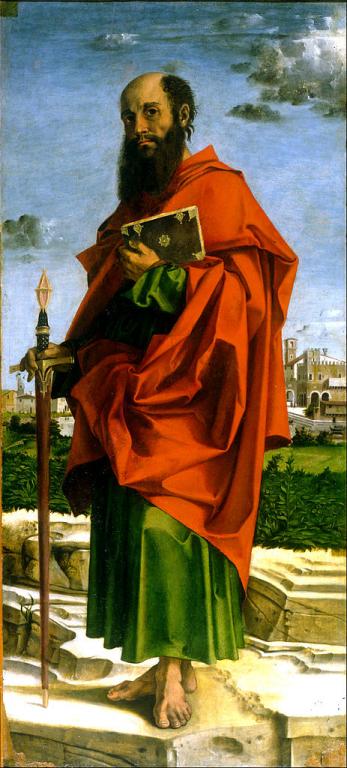
Photo credit: St. Paul (1482), by Bartolomeo Montegna (1450-1523) [public domain / Wikimedia Commons]

***
Previous Post
May 28, 2020
Dialogue on Whether Jesus' Kinfolk Were "Unbelievers"
Next Post

May 29, 2020 Do Catholic Reactionary Sites Have Little Influence?
Browse Our Archives
Select a Category & Last Things About Me Anti-Catholicism Atheism & Agnosticism Baptism and Sacramentalism Bible and Tradition Blessed Virgin Mary Books by Dave Armstrong C. S. Lewis Calvinism & General Protestantism Catholic Apologetics Catholic Apologists Catholic conversion Catholic converts Christmas Church (Ecclesiology) Church History Conversion and Converts Development of Doctrine Eastern Orthodoxy Ecumenism & Christian Unity Eucharist & Liturgy Fathers of the Church French Translations G. K. Chesterton Hell Hell & Satan Hell & Satan & Last Things Heresies & Comparative Religion Holistic Health Inquisition & Crusades & Scandals James White Jews & Judaism & Old Testament John Calvin John Henry Newman Liberal / Modernist Theology Life Issues Literary Resume Lutheranism Mariology Martin Luther Music Orthodoxy Papacy & Infallibility Personal Page Philosophy & Science Political & Ethical & Moral Issues Protestant Persecution & Intolerance Protestantism Purgatory Purgatory & Penance Romantic & Imaginative Theology Saints & Purgatory & Penance Salvation Salvation & Justification Satan & Last Things Sexuality and Gender Issues Spanish Translations Traditionalism vs. Radical Catholic Reactionaries Traducciones al español / tradução para português Trinitarianism & Christology Uncategorized Videos
Select a Month October 2026 September 2026 August 2026 July 2026 June 2026 May 2026 April 2026 March 2026 February 2026 January 2026 December 2025 November 2025 October 2025 September 2025 August 2025 July 2025 June 2025 May 2025 April 2025 March 2025 February 2025 January 2025 December 2024 November 2024 October 2024 September 2024 August 2024 July 2024 June 2024 May 2024 April 2024 March 2024 February 2024 January 2024 December 2023 November 2023 October 2023 September 2023 August 2023 July 2023 June 2023 May 2023 April 2023 March 2023 February 2023 January 2023 December 2022 November 2022 October 2022 September 2022 August 2022 July 2022 June 2022 May 2022 April 2022 March 2022 February 2022 January 2022 December 2021 November 2021 October 2021 September 2021 August 2021 July 2021 June 2021 May 2021 April 2021 March 2021 February 2021 January 2021 December 2020 November 2020 October 2020 September 2020 August 2020 July 2020 June 2020 May 2020 April 2020 March 2020 February 2020 January 2020 December 2019 November 2019 October 2019 September 2019 August 2019 July 2019 June 2019 May 2019 April 2019 March 2019 February 2019 January 2019 December 2018 November 2018 October 2018 September 2018 August 2018 July 2018 June 2018 May 2018 April 2018 March 2018 February 2018 January 2018 December 2017 November 2017 October 2017 September 2017 August 2017 July 2017 June 2017 May 2017 April 2017 March 2017 February 2017 January 2017 December 2016 November 2016 October 2016 September 2016 August 2016 July 2016 June 2016 May 2016 April 2016 March 2016 February 2016 January 2016 December 2015 November 2015 October 2015 September 2015 August 2015 July 2015 June 2015 May 2015 April 2015 March 2015 February 2015 January 2015 December 2014 November 2014 October 2014 September 2014 August 2014 July 2014 June 2014 April 2014 March 2014 February 2014 January 2014 December 2013 November 2013 October 2013 September 2013 August 2013 July 2013 June 2013 April 2013 March 2013 February 2013 January 2013 December 2012 November 2012 October 2012 September 2012 August 2012 July 2012 June 2012 May 2012 April 2012 March 2012 February 2012 January 2012 December 2011 November 2011 October 2011 September 2011 August 2011 July 2011 June 2011 April 2011 March 2011 February 2011 October 2010 September 2010 August 2010 July 2010 April 2010 March 2010 December 2009 October 2009 August 2009 July 2009 June 2009 May 2009 March 2009 February 2009 October 2008 September 2008 April 2008 March 2008 February 2008 January 2008 December 2007 November 2007 October 2007 May 2007 March 2007 February 2007 January 2007 November 2006 October 2006 September 2006 August 2006 July 2006 June 2006 May 2006 April 2006 March 2006 February 2006 October 2005 June 2005 April 2005 February 2005 July 2004 May 2004 April 2004
Follow Us!
TAKE THE
Religious Wisdom Quiz
What famous cathedral is in Paris, known for its flying buttresses and rose windows?
Select your answer to see how you score.
Notre Dame St. Paul's St. Peter's Canterbury
Books by This Author Books by Dave Armstrong
Related posts from Biblical Evidence for Catholicism

Three More Anti-Catholic Lies About Catholicism (#6-4)
Biblical Evidence for Catholicism

Bible & Catholicism on Mortal Sin (vs. John...
Biblical Evidence for Catholicism

Top Ten Anti-Catholic Lies (#10-7)
Biblical Evidence for Catholicism

Dialogue on Eternal Security / Absolute Assurance
Biblical Evidence for Catholicism
TRENDING AT PATHEOS Catholic

In "Irreplaceable," our book on vocation and technology, Trevor Sutton and I...

I was strolling through the top floor of the brand new Parthenon...

What Does Gêvâh Mean For Kimberley Guifoyle &...
This week, a lot of the news is focused on Kimberly Guilfoyle....

INNER CIRCLE: Profound Mystery (Of Christ In All...
Ephesians 5:31-32 “For this reason, a man will leave his father and...

Do Not Rejoice When Your Enemy Falls: The...
Turning an execution into a public spectacle is a disturbing expression of...

'The Chosen' S6 Trailer: The Passion Gets Very...
Not many watching 'The Chosen' worry about spoilers, but just because they...
view all Catholic blogs
Ad-Free & Subscriber Log-In Subscription Support
- About Us
- 2026 Calendar
- Videos
- Podcasts
- Library of World Religions
- Faith In Media Tracker
- Advertise With Us
- Write for Us
- Privacy Policy
- Terms of Service
- Do Not Sell My Data
- Contact Us
- Radiant Digital
- Manage Newsletter Subscriptions
- Unsubscribe From Notifications
- Sitemap
Copyright 2008-2026, Patheos. All rights reserved.
Subscription Support Ad-Free & Subscriber Log-In
Follow Patheos