
BuddhistCatholicContemplativeEvangelicalGeneral ChristianHinduJewishLatter-day SaintMuslimNew VisionsProgressive Christian
Beliefs
- Buddhist
- Catholic
- Contemplative
- Evangelical
- General Christian
- Hindu
- Jewish
- Latter-day Saint
- More Voices
- Muslim
- New Visions
- Pagan
- Progressive Christian
Topics
- Religion News
- Food and Religion
- Sports and Religion
- Religious Art
- Religious Music and Entertainment
- Religious Events
- History and Religion
- Style and Religion
- Politics and Religion
- Women in Religion
- Recreation Outdoors and Religion
- Business Finance and Religion
- Careers Workplace and Religion
- Education and Religion
- Family Parenting and Religion
- Health Fitness and Religion
- Home and Religion
- Relationships and Religion
- Technology and Religion
- Travel and Religion
Columnists
- Buddhist Columnists
- Business Finance and Religion Columnists
- Careers Workplace and Religion Columnists
- Catholic Columnists
- Contemplative Columnists
- Education and Religion Columnists
- Evangelists Columnists
- Family Parenting and Religion Columnists
- General Christian Columnists
- Health Fitness and Religion Columnists
- Hindu Columnists
- History and Religion Columnists
- Home and Religion Columnists
- Jewish Columnists
- More Voices Columnists
- Latter Day Columnists
- Muslim Columnists
- New Visions Columnists
- Nonreligious Columnists
- Pagan Columnists
- Politics and Religion Columnists
- Progressive Columnists
- Recreation Outdoors and Religion Columnists
- Relationships and Religion Columnists
- Religion News Columnists
- Religious Art Columnists
- Religious Events Columnists
- Religious Music and Entertainment Columnists
- Sports and Religion Columnists
- Style and Religion Columnists
- Technology and Religion Columnists
- Travel and Religion Columnists
- Women in Religion Columnists
Resource Library
- 2026 Calendar
- Library of World Religions
- The 100 Most Holy Places on Earth
- Patheos Answers
- Podcasts
- Videos
- Faith Leaders Database
- Anglican Episcopalian
- Bahai
- Baptist
- Buddhism
- Christianity
- Confucianism
- Eastern Orthodoxy
- Hinduism
- Holiness and Pentecostal
- ISKCON
- Islam
- Judaism
- Lutheran
- Methodist
- The Church of Jesus Christ of Latter-day Saints
- New Age
- Paganism
- Presbytarian and Reformed
- Protestantism
- Religion Behind the Scenes
- Roman Catholic
- Scientology
- Shia Islam
- Sikhism
- Sufism
- Sunni Islam
- Taoism
- Zen
- See all religions
Research Tools
 Ad-Free & Subscriber Log-In Subscription Support
Ad-Free & Subscriber Log-In Subscription Support
Follow Patheos 

- Trending:
- Forgiveness
- |
- Marriage
- |
- Consciousness
- |
- Death Penalty
- |
- Election
- |
- Halloween

-
About
-
Catholic Apologetics
-
Church History
-
Great Apologists
-
Christian Worldview
-
Protestantism & Misc.
- Home
- Catholic
- History and Religion
- Seidensticker Folly #38: Eternal Universe vs. an Eternal God
Seidensticker Folly #38: Eternal Universe vs. an Eternal God
Last updated on: April 16, 2020 at 4:26 pm by Dave Armstrong
Seidensticker Folly #38: Eternal Universe vs. an Eternal God 2020-04-16T16:26:54-04:00 Dave Armstrong
Patheos Explore the world's faith through different perspectives on religion and spirituality! Patheos has the views of the prevalent religions and spiritualities of the world.
Atheist and anti-theist Bob Seidensticker, who was “raised Presbyterian”, runs the influential Cross Examined blog. He asked me there, on 8-11-18: “I’ve got 1000+ posts here attacking your worldview. You just going to let that stand? Or could you present a helpful new perspective that I’ve ignored on one or two of those posts?” He also made a general statement on 6-22-17: “Christians’ arguments are easy to refute . . . I’ve heard the good stuff, and it’s not very good.” He added in the combox: “If I’ve misunderstood the Christian position or Christian arguments, point that out. Show me where I’ve mischaracterized them.”
Such confusion would indeed be predictable, seeing that Bob himself admitted (2-13-16): “My study of the Bible has been haphazard, and I jump around based on whatever I’m researching at the moment.” I’m always one to oblige people’s wishes if I am able, so I decided to do a series of posts in reply. It’s also been said, “be careful what you wish for.” If Bob responds to this post, and makes me aware of it, his reply will be added to the end along with my counter-reply. If you don’t see that, rest assured that he either hasn’t replied, or didn’t inform me that he did. But don’t hold your breath.
Bob (for the record) virtually begged and pleaded with me to dialogue with him in May 2018, via email. But by 10-3-18, following massive, childish name-calling attacks against me, encouraged by Bob on his blog (just prior to his banning me from it), his opinion was as follows: “Dave Armstrong . . . made it clear that a thoughtful intellectual conversation wasn’t his goal. . . . [I] have no interest in what he’s writing about.”
And on 10-25-18, utterly oblivious to the ludicrous irony of his making the statement, Bob wrote in a combox on his blog: “The problem, it seems to me, is when someone gets these clues, like you, but ignores them. I suppose the act of ignoring could be deliberate or just out of apathy, but someone who’s not a little bit driven to investigate cognitive dissonance will just stay a Christian, fat ‘n sassy and ignorant.” Again, Bob mocks some Christian in his combox on 10-27-18: “You can’t explain it to us, you can’t defend it, you can’t even defend it to yourself. Defend your position or shut up about it. It’s clear you have nothing.” And again on the same day: “If you can’t answer the question, man up and say so.” And on 10-26-18: “you refuse to defend it, after being asked over and over again.” And again: “You’re the one playing games, equivocating, and being unable to answer the challenges.”
Bob’s cowardly hypocrisy knows no bounds. Again, on 6-30-19, he was chiding someone who (very much like he himself) was (to hear him tell it) not backing up his position: “Spoken like a true weasel trying to run away from a previous argument. You know, you could just say, ‘Let me retract my previous statement of X’ or something like that.” Yeah, Bob could! He still hasn’t yet uttered one peep in reply to — now — 36 of my critiques of his atrocious reasoning. As of 7-9-19, this is how Bob absurdly rationalizes his non-response: “He’s written several blog posts titled, in effect, ‘In Which Bob Seidensticker Was Mean to Me.’ Normally, I’d enjoy a semi-thoughtful debate, but I’m sure they weren’t.”
Bible-Basher Bob’s words will be in blue. To find these posts, word-search “Seidensticker” on my atheist page or search “Seidensticker Folly #” in my sidebar search (near the top).
*****
Bob’s article, “BSR [Bite-Sized Reply] 4: Who Created God?” (3-25-20) is yet another display of Our Hero being out to sea without a life raft. Let’s take a closer look at it, shall we?
Challenge to the Christian: Who created God?
Christian response #1: This question is nonsensical. God is uncreated by definition.
Give God whatever properties you want—zero calories, organic, lemon scented, made of soap bubbles, whatever. You still must justify those claims. Some Bible verses suggest that God is eternal, but that’s not evidence. You can start by showing that God exists.
Folks who study the issue at all know that there are many philosophically serious theistic proofs. I have collected a great deal of them in these papers:
Cosmological Argument for God (Resources) [10-23-15]
*
Ontological Argument for God (Resources) [10-23-15]
*
Teleological (Design) Argument for God (Resources) [10-27-15]
*
15 Theistic Arguments (Copious Resources) [11-3-15]
*
Science and Christianity (Copious Resources) [11-3-15]
*
We’ve seen this trick before, . . . where the apologist tries to disqualify an argument to avoid having to address it. “Who created God?” is a reasonable question that follows naturally from the apologist saying, “Everything must have a creator, and in the case of the universe, God is that creator.” Or if the argument is, “Everything but God has a creator,” then justify that.
*
We’re happy to justify our beliefs through reason and have been doing so for nearly 2000 years. The main point I’d like to make in this treatment of mine is to emphasize that everyone is pretty much in the same “epistemological boat”. Whether atheist or Christian or whatever, every person has to explain how the universe got here; and it seems (intuitively, at least) that something was eternal: either matter or some sort of immaterial — and eternal — spirit that we call “God” (with different definitions in different religions or philosophical systems: but generally a Spirit that created matter and what we see).
*
As anyone who has learned / followed science at all knows, the current accepted cosmological model is the Big Bang Theory: whereby the universe began 13.8 billion years ago (according to the latest scientific reckoning). The universe is, therefore, not eternal; matter is not eternal. It had a beginning-point. Now how or what caused the big bang is the $64,000 question. Christians believe, as we always have, that God created the universe ex nihilo (from nothing). This is perfectly consistent with the Big Bang cosmology and (I submit) as good and rational and plausible an explanation as any other for the cause of the big bang. The alternative is the ludicrous notion that matter created itself out of nothing. Think about that for a moment, if you are bored and have run out of things to do. Try to wrap your brain around it.
*
Belief in an eternal God is a tenet of religious faith and/or philosophical speculation. It can’t be absolutely proven (in the way that atheists invariably demand), but then very little can be. It can be shown to be — in many different ways — rational and plausible. What has been demonstrated through science is the Big Bang Theory. As far as we can tell, it happened. The atheist is just as much in the realm of faith and speculation as the Christian, when he or she sets out to explain how this could happen apart from some non-material entity or force, if you will, that “preceded” it. When Christians assert God’s eternal existence, they stand on the shoulders of hundreds of eminent philosophers throughout history (i.e., the belief is not merely one of religious faith): even some whom atheists erroneously pretend to be on their side, like David Hume, who wrote:
The whole frame of nature bespeaks an intelligent author; and no rational enquirer can, after serious reflection, suspend his belief a moment with regard to the primary principles of genuine Theism and Religion . . .
Were men led into the apprehension of invisible, intelligent power by a contemplation of the works of nature, they could never possibly entertain any conception but of one single being, who bestowed existence and order on this vast machine, and adjusted all its parts, according to one regular plan or connected system . . .
All things of the universe are evidently of a piece. Every thing is adjusted to every thing. One design prevails throughout the whole. And this uniformity leads the mind to acknowledge one author. (Natural History of Religion, 1757, edited by H. E. Root, London: 1956, 21, 26)
Notice how Bob offers us a nothing burger when he “discusses” (if we can even call it that) these very perplexing questions. He has no more basis for his position than the Christian does, yet he has to try to change the subject, according to time-honored polemical atheist methodological tradition, and mock Christianity (which is his purpose in virtually ever article he writes):
Christian response #2: Everyone believes in something eternal—if not the universe, then what caused it. Christians just believe that cause was personal, which explains the personal attributes of existence.
Christians believe? “I believe” here is in the same category as “I have faith,” but it’s better to let belief follow from sufficient evidence. Let’s rely on evidence-driven science, the discipline that has taught us what we reliably know so far about reality.
Science doesn’t call the universe eternal. Time in our universe had a beginning, though there’s likely more to be discovered. Science has unanswered questions about the universe, but it has the track record of providing reliable answers. Religion also has answers, but each religion’s origin story is incompatible with the next, making none worth believing in.
Pointing out the gaps in scientific knowledge does nothing to bolster religion’s claims (for example, undercutting evolution does nothing to strengthen Creationism). If Christianity wants to provide answers to science’s unanswered questions, it needs to do the heavy lifting itself. “But science doesn’t have an answer!” is no argument.
Yeah, science has explained a lot of stuff. It’s wonderful. Modern science developed in an overwhelmingly Christian milieu during the late Renaissance, and was unquestionably dominated by Christian scientists until the mid-19th century. But it has not and cannot explain everything. It (like also mathematics and logic) starts with unfalsifiable axioms, just as religion does. Any honest scientists will concede that point in a second. By definition, it can only explain matter and the laws that determine how it behaves. It has nothing to say about spirit. But philosophy and religion do.
Science is not the sum total of all knowledge (much as so many atheists would love that to be true, since it has become their religion. Materialism (i.e., matter being all there is) is itself a belief-system that has not been absolutely proven, either. To hold that there could not possibly be such a thing as spirit is every bit a proposition of unprovable faith as the converse view that there couldn’t possibly not be.
At the point of origins, atheism has no solid answers in explanation: even of the most self-understood speculative sense. It ends up actually looking quite absurd, if scrutinized closely enough. I did a scathing satire some years ago, of what belief in atheist materialism entails. It was probably my most controversial online paper ever (out of now 2800+): certainly the most controversial according to atheists.
Almost to a person (perhaps literally every atheist who objected), they couldn’t even grasp the nature of the satire / parody, and the sarcasm employed. Targets of satire often do not comprehend it, because they are too blind to see what an outsider observes in them. So I wrote an explanatory post, which accomplished exactly nothing. They still couldn’t understand my entire point. But if you (reading this) are not an atheist, I think you will see what I was getting at. Here are some lengthy excerpts:
Matter essentially “becomes god” in the atheist / materialist view; it has the inherent ability to do everything by itself: . . .
The atheist places extraordinary faith in matter – arguably far more faith than we place in God, because it is much more difficult to explain everything that god-matter does by science alone. . . .
Indeed, this is a faith of the utmost non-rational, childlike kind. . . .
Atheist belief is a kind of polytheistic idolatry of the crudest, most primitive sort, putting to shame the colorful worship of the ancient Babylonians, Philistines, Aztecs, and other groups. They believed that their silver amulets and wooden idols could make the sun shine or defeat an enemy or cause crops to flourish.
The polytheistic materialist, on the other hand, is far more religious than that. He thinks that trillions of his atom-gods and their distant relatives, the cell-gods, can make absolutely everything in the universe occur, by their own power, possessed eternally either in full or (who knows how?) in inevitably unfolding potentiality.
One might call this (to coin a phrase) Atomism (“belief that the atom is God”). Trillions of omnipotent, omniscient atoms can do absolutely everything that the Christian God can do, and for little or no reason that anyone can understand (i.e., why and how the atom-god came to possess such powers in the first place). . . .
Oh, and we mustn’t forget the time-goddess. She is often invoked in worshipful, reverential, awe-inspiring terms as the be-all, end-all explanation for things inexplicable, as if by magic her very incantation rises to an explanatory level sufficient to shut up any silly Christian, who is foolish enough to believe in one God rather than trillions. . . .
Atomists may and do differ on secondary issues, just as the various ancient polytheistic cultures differed on quibbling details (which god could do what, which material made for a better idol, etc.), but despite all, they inevitably came out on the side of polytheistic idolatry, with crude material gods, and against spiritual monotheism. . . .
“Why” questions in the context of Atomism are senseless, because they can’t overcome the Impenetrable Fortress of blind faith that the Atomist possesses. The question, “Why do the atom-gods and cell-gods and the time-goddess exist and possess the extraordinary powers that they do?” is meaningless and ought not be put forth. It’s bad form, and impolite. We know how sensitive overly religious folk are. . . .
Yet we can’t help — almost despite ourselves — recalling with fondness the wonders and fancies and fairy-tales of childhood. Atomists seek very hard to maintain those marvels, and perhaps that’s not all bad. We must be tolerant and open-minded.
That is one way to approach it, and if you wanna see atheists foaming at the mouth and utterly unable to rationally defend what they believe, show them this. Be sure to be adequately prepared for the firestorm and tremendous fuss. Atheists like ntng less than this sort of turning-the-tables on them.
As I have contended above: belief in an eternal Creator-God is perfectly compatible with the Big Bang model, though not itself a scientific proposition. We have centuries of theistic philosophy on our side, too. There are only so many alternatives. If the atheist wants to mock our view then they are duty-bound in intellectual honesty to choose the other two main options (that I can see): an eternal universe (which is precisely what the Big Bang and present science has disproven) or the crazy notion that the universe created itself out of nothing.
Let’s take a brief look at these two options and see how plausible they look. Bob throws out more “nothing” in his attempt to evade his intellectual responsibility:
[R]elying on common sense at the frontier of science is to bring a knife to a gunfight. The Big Bang, the event that brought the universe as we know it into existence 14 billion years ago, might’ve been a quantum event, and quantum physics throws common sense out the window. It is completely counterintuitive—events without causes, virtual particles popping into existence, quantum entanglement, quantum tunneling, quantum superposition, and so on.
Before you hypothesize a Being that is the source of existence, show that natural explanations are insufficient. That is, don’t simply say that science has unanswered questions about the origin of the universe (yes, it does). You must show that no natural explanation is possible. Otherwise, the consistent record of failure of supernatural explanations means that we have no reason to expect such a thing.
Notice how he never for a second argues for a positive atheist viewpoint of how the universe got here. All he can do is endlessly throw it back to the Christians to explain. But we’ve made our explanations a million times. Science supports our view of creatio ex nihilo from God in a stronger way than it ever has before. It’s the atheists who have never remotely explained the plausibility of either an eternal universe or a universe from nothing.
I fully understand their reluctance. I sure wouldn’t want to have to explain and defend such scientifically, logically, and philosophically ridiculous things. Yet it seems clear and obvious that they must, in order to set forth atheism once and for all as the superior worldview, over against the despised Christianity (which is their raison d’etre [i.e., justification for their existence]).
Bob Seidensticker would never let Christians off so easily: without answering any challenge he outs out. Hence he wrote:
A word to the wise: whenever you read an apologetic article, make sure the Christian actually answers the question. Don’t be swayed with bluster and confidence so that you overlook them running from the question. . . .
That the question might make them uncomfortable isn’t the issue. They want to get the challenge dismissed on a technicality so they don’t have to answer it. Don’t let them. (11-19-19)
The late famous atheist scientist Stephen Hawking asserted in his 2010 book, The Grand Design: “Because there is a law such as gravity, the universe can and will create itself from nothing . . . Spontaneous creation is the reason there is something rather than nothing, why the universe exists, why we exist.” Scientist John Lennox responded to this claim:
[C]ontrary to what Hawking claims, physical laws can never provide a complete explanation of the universe. Laws themselves do not create anything, they are merely a description of what happens under certain conditions. . . .
[T]he laws of physics could never have actually built the universe. Some agency must have been involved.
To use a simple analogy, Isaac Newton’s laws of motion in themselves never sent a snooker ball racing across the green baize. That can only be done by people using a snooker cue and the actions of their own arms.
Hawking’s argument appears to me even more illogical when he says the existence of gravity means the creation of the universe was inevitable. But how did gravity exist in the first place? Who put it there? And what was the creative force behind its birth? . . .
For me, as a Christian believer, the beauty of the scientific laws only reinforces my faith in an intelligent, divine creative force at work. The more I understand science, the more I believe in God because of my wonder at the breadth, sophistication and integrity of his creation.
The very reason science flourished so vigorously in the 16th and 17th centuries was precisely because of the belief that the laws of nature which were then being discovered and defined reflected the influence of a divine law-giver. . . .
Some years ago, the scientist Joseph Needham made an epic study of technological development in China. He wanted to find out why China, for all its early gifts of innovation, had fallen so far behind Europe in the advancement of science.
He reluctantly came to the conclusion that European science had been spurred on by the widespread belief in a rational creative force, known as God, which made all scientific laws comprehensible.
Here are several more similar ludicrous utterances from atheists or agnostics:
It is now becoming clear that everything can—and probably did—come from nothing. (Robert A. J. Matthews, physicist, Ashton University, England)
Even if we don’t have a precise idea of exactly what took place at the beginning, we can at least see that the origin of the universe from nothing need not be unlawful or unnatural or unscientific. (Paul Davies, physicist, Arizona State University)
Assuming the universe came from nothing, it is empty to begin with . . . The fact that we have something is just what we would expect if there is no God. (Victor J. Stenger, Prof. of Physics, University of Hawaii; author of God: The Failed Hypothesis)
Few people are aware of the fact that many modern physicists claim that things—perhaps even the entire universe—can indeed arise from nothing via natural processes. (Mark I. Vuletic, Creation Ex Nihilo—Without God)
It is rather fantastic to realize that the laws of physics can describe how everything was created in a random quantum fluctuation out of nothing . . . (Alan Harvey Guth, theoretical physicist and cosmologist, Discover Magazine)
The fact that life evolved out of nearly nothing, some 10 billion years after the universe evolved out of literally nothing is a fact so staggering that I would be mad to attempt words to do it justice. (Richard Dawkins, The Ancestor’s Tale)
[T]he most reasonable belief is that we came from nothing, by nothing, and for nothing. (philosopher Quinton Smith)
The one thing that always seems to be missing from these bizarre statements, is how and why this supposed process ever happened. And why is that? Well, because no one has a clue. There is no scientific experiment that could even suggest, let alone prove such a thing. So at best it is implausible philosophy, and at worst, fideistic religion: believed in by blind faith. Have you observed the high irony yet?: isn’t that the very thing that Christians are blasted for believing (and made out to be unsophisticated, anti-science troglodytes): in a God Who created everything and set the universe in motion — without ironclad, indisputable proof?
All of a sudden atheists find themselves having to explain origins just as they always challenge us to do, and they offer either more nothing or else they have to admit they have no more (I would say, a lot less) reason to believe as they do than we do (which is what I’ve been maintaining now for forty years, in my philosophically and scientifically informed Christian apologetics).
*
It’s not just me saying this (although I think it is an utterly obvious conclusion). David Darling is an English astronomer who has written many books about science, and maintains the online Internet Encyclopedia of Science. He wrote in NewScientist magazine on 9-14-96:
What is a big deal—the biggest deal of all—is how you get something out of nothing.
Don’t let the cosmologists try to kid you on this one. They have not got a clue either—despite the fact that they are doing a pretty good job of convincing themselves and others that this is really not a problem. “In the beginning,” they will say, “there was nothing—no time, space, matter or energy. Then there was a quantum fluctuation from which . . . ” Whoa! Stop right there. You see what I mean? First there is nothing, then there is something. And the cosmologists try to bridge the two with a quantum flutter, a tremor of
uncertainty that sparks it all off. Then they are away and before you know it, they have pulled a hundred billion galaxies out of their quantum hats.I don’t have a problem with this scenario from the quantum fluctuation onward. Why shouldn’t human beings build a theory of how the Universe evolved from a simple to a complex state. But there is a very real problem in explaining how it got started in the first place. You cannot fudge this by appealing to quantum mechanics. Either there is nothing to begin with, in which case there is no quantum vacuum, no pre-geometric dust, no time in which anything can happen, no physical laws that can effect a change from nothingness into somethingness; or there is something, in which case that needs explaining. . . .
No, I’m sorry, I may not have been born in Yorkshire but I’m a firm believer that you cannot get owt for nowt. Not a Universe from a nothing-verse, nor consciousness from a thinking brain. I suspect that mainstream science may go on for a few more years before it bumps so hard against these problems that it is forced to recognise that something is wrong. And then? Let me guess: if you cannot get something for nothing then that must mean there has always been something. Hmmm.
Likewise, philosopher of science and physicist David Albert, stated:
[I]f what we formerly took for nothing turns out, on closer examination, to have the makings of protons and neutrons and tables and chairs and planets and solar systems and galaxies and universes in it, then it wasn’t nothing, and it couldn’t have been nothing, in the first place. And the history of science — if we understand it correctly — gives us no hint of how it might be possible to imagine otherwise. (“On the Origin of Everything,”The New York Times, 3-23-12)
The agnostic Ron Rosenbaum wrote with remarkable candor and far-mindedness:
Atheists display a credulous and childlike faith, worship a certainty as yet unsupported by evidence—the certainty that they can or will be able to explain how and why the universe came into existence. (And some of them can behave as intolerantly to heretics who deviate from their unproven orthodoxy as the most unbending religious Inquisitor.)
Faced with the fundamental question: “Why is there something rather than nothing?” atheists have faith that science will tell us eventually. Most seem never to consider that it may well be a philosophic, logical impossibility for something to create itself from nothing. (“An Agnostic Manifesto,”Slate, 6-28-10)
The other alternative is an eternal universe (which, of course, flies directly in the face of much scientific evidence for the Big Bang and a finite universe with a starting-point; and all that has to be overcome in order to believe it). Helge Kragh, in a paper on historic cosmology with regard to the universe’s origins, described Aristotle’s view:
He argued that the universe as a whole, apart from being unique (no other universes), was spatially finite but temporally infinite in both directions. In other words, it was eternal and hence uncreated as well as indestructible.
Albert Einstein, at the time of his theory of general relativity in 1917, following Newton, believed in an eternal, static universe. Helge Kragh describes his views:
The model presupposed that the universe as a whole was uniform and spatially closed corresponding to a positive curvature of space; it was finite yet with no boundary and therefore contained but a finite number of stars. Importantly, it was also static in the sense that the curvature of space and the mean density of matter remained constant. To maintain a static universe in accordance with astronomical observations Einstein had to introduce a new term in his cosmological field equations, the later so famous cosmological constant. Being static his universe had no temporal dimension but was eternal in both past and future time. For this reason alone the question of the origin of the universe did not enter Einstein’s mind. Nor did it enter the minds of the few other physicists and astronomers occupying themselves with his mathematically and conceptually abstruse theory.
Kragh chronicles the initial origin of the Big Bang Theory in 1931:
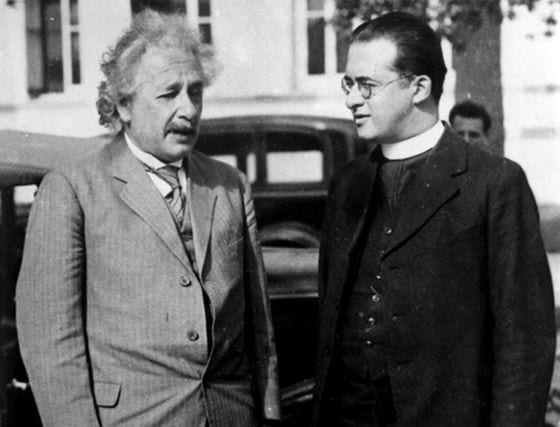
What became known as the big bang universe in a realistic sense was first proposed on 9 May 1931 in a brief note in the journal Nature. The author was Georges Lemaître, a 36-year-old Belgian astrophysicist and cosmologist who was also trained as a Catholic priest. “We could conceive,” Lemaître wrote in his 1931 paper, “the beginning of the universe in the form of a unique atom, the atomic weight of which is the total mass of the universe … [and which] would divide in smaller and smaller atoms by a kind of super-radioactive process.”
Einstein opposed his view at first (originally describing aspects of it as “abominable”), but was eventually won over in 1933 and stated: “This is the most beautiful and satisfactory explanation of the creation of the universe I’ve heard. “See more about their scientific relationship.
After the Big Bang Theory gained widespread and then nearly universal scientific acceptance from 1964, with the discovery of the cosmic microwave background (CMB). But in 1948, there had been an attempt to go back to the antiquated aristotelian eternal / static universe, with the “steady state” theory. Kragh provides a capsule history:
Finite-age models of the type proposed by Lemaître and Gamow were challenged by the fundamentally different steady state theory of the universe introduced by Fred Hoyle, Hermann Bondi and Thomas Gold in 1948. According to this theory the universe had existed in an eternity of time and would continue existing eternally. . . .
What matters is that by assuming an infinite age of the universe the steady state theorists avoided the thorny question of a beginning. It was in this context that Hoyle, on 28 March 1949, gave a BBC broadcast in which he coined the name “big bang” for the kind of cosmological theory which assumed an origin of the universe in an explosive event. The following year he characterized “the big bang assumption [as] an irrational process that cannot be described in scientific terms.” What he had in mind was the old objection that there can be no causal explanation, indeed no explanation of any kind, for the beginning of the universe. At more than one occasion he associated the big bang theory with theism, suggesting that a temporal beginning of the universe implied divine creation and was therefore unscientific. For example: “The passionate frenzy with which the big-bang cosmology is clutched to the corporate scientific bosom evidently arises from a deep-rooted attachment to the first page of Genesis, religious fundamentalism at its strongest.”
Virtually no astronomer, physicist, or any kind of scientist continues to accept the steady-state theory today.
***
Photo credit: Albert Einstein with Fr. Georges Lemaître, formulator of the Big Bang Theory (1932) [public domain / Reddit]
***
Previous Post

April 15, 2020
Seidensticker Folly #37: "What is a Contradiction?" 0101
Next Post

April 16, 2020 2nd Conversion? Reactionary Absurdities Satirized
Browse Our Archives
Select a Category & Last Things About Me Anti-Catholicism Atheism & Agnosticism Baptism and Sacramentalism Bible and Tradition Blessed Virgin Mary Books by Dave Armstrong C. S. Lewis Calvinism & General Protestantism Catholic Apologetics Catholic Apologists Catholic conversion Catholic converts Christmas Church (Ecclesiology) Church History Conversion and Converts Development of Doctrine Eastern Orthodoxy Ecumenism & Christian Unity Eucharist & Liturgy Fathers of the Church French Translations G. K. Chesterton Hell Hell & Satan Hell & Satan & Last Things Heresies & Comparative Religion Holistic Health Inquisition & Crusades & Scandals James White Jews & Judaism & Old Testament John Calvin John Henry Newman Liberal / Modernist Theology Life Issues Literary Resume Lutheranism Mariology Martin Luther Music Orthodoxy Papacy & Infallibility Personal Page Philosophy & Science Political & Ethical & Moral Issues Protestant Persecution & Intolerance Protestantism Purgatory Purgatory & Penance Romantic & Imaginative Theology Saints & Purgatory & Penance Salvation Salvation & Justification Satan & Last Things Sexuality and Gender Issues Spanish Translations Traditionalism vs. Radical Catholic Reactionaries Traducciones al español / tradução para português Trinitarianism & Christology Uncategorized Videos
Select a Month October 2026 September 2026 August 2026 July 2026 June 2026 May 2026 April 2026 March 2026 February 2026 January 2026 December 2025 November 2025 October 2025 September 2025 August 2025 July 2025 June 2025 May 2025 April 2025 March 2025 February 2025 January 2025 December 2024 November 2024 October 2024 September 2024 August 2024 July 2024 June 2024 May 2024 April 2024 March 2024 February 2024 January 2024 December 2023 November 2023 October 2023 September 2023 August 2023 July 2023 June 2023 May 2023 April 2023 March 2023 February 2023 January 2023 December 2022 November 2022 October 2022 September 2022 August 2022 July 2022 June 2022 May 2022 April 2022 March 2022 February 2022 January 2022 December 2021 November 2021 October 2021 September 2021 August 2021 July 2021 June 2021 May 2021 April 2021 March 2021 February 2021 January 2021 December 2020 November 2020 October 2020 September 2020 August 2020 July 2020 June 2020 May 2020 April 2020 March 2020 February 2020 January 2020 December 2019 November 2019 October 2019 September 2019 August 2019 July 2019 June 2019 May 2019 April 2019 March 2019 February 2019 January 2019 December 2018 November 2018 October 2018 September 2018 August 2018 July 2018 June 2018 May 2018 April 2018 March 2018 February 2018 January 2018 December 2017 November 2017 October 2017 September 2017 August 2017 July 2017 June 2017 May 2017 April 2017 March 2017 February 2017 January 2017 December 2016 November 2016 October 2016 September 2016 August 2016 July 2016 June 2016 May 2016 April 2016 March 2016 February 2016 January 2016 December 2015 November 2015 October 2015 September 2015 August 2015 July 2015 June 2015 May 2015 April 2015 March 2015 February 2015 January 2015 December 2014 November 2014 October 2014 September 2014 August 2014 July 2014 June 2014 April 2014 March 2014 February 2014 January 2014 December 2013 November 2013 October 2013 September 2013 August 2013 July 2013 June 2013 April 2013 March 2013 February 2013 January 2013 December 2012 November 2012 October 2012 September 2012 August 2012 July 2012 June 2012 May 2012 April 2012 March 2012 February 2012 January 2012 December 2011 November 2011 October 2011 September 2011 August 2011 July 2011 June 2011 April 2011 March 2011 February 2011 October 2010 September 2010 August 2010 July 2010 April 2010 March 2010 December 2009 October 2009 August 2009 July 2009 June 2009 May 2009 March 2009 February 2009 October 2008 September 2008 April 2008 March 2008 February 2008 January 2008 December 2007 November 2007 October 2007 May 2007 March 2007 February 2007 January 2007 November 2006 October 2006 September 2006 August 2006 July 2006 June 2006 May 2006 April 2006 March 2006 February 2006 October 2005 June 2005 April 2005 February 2005 July 2004 May 2004 April 2004
Follow Us!
TAKE THE
Religious Wisdom Quiz
Who asked Jesus, "What is truth?"
Select your answer to see how you score.
Caiaphas Pilate Nicodemus Herod
Books by This Author Books by Dave Armstrong
Related posts from Biblical Evidence for Catholicism

God, Modern Physics, & Dark Energy: An Analogy
Biblical Evidence for Catholicism
Jesus Proved He Was God in Six Ways...
Biblical Evidence for Catholicism

General Debate on Christianity with an Atheist
Biblical Evidence for Catholicism

Parting of the Red Sea & Lake Erie...
Biblical Evidence for Catholicism
TRENDING AT PATHEOS Catholic

I was strolling through the top floor of the brand new Parthenon...

What Does Gêvâh Mean For Kimberley Guifoyle &...
This week, a lot of the news is focused on Kimberly Guilfoyle....

INNER CIRCLE: Profound Mystery (Of Christ In All...
Ephesians 5:31-32 “For this reason, a man will leave his father and...

Do Not Rejoice When Your Enemy Falls: The...
Turning an execution into a public spectacle is a disturbing expression of...

'The Chosen' S6 Trailer: The Passion Gets Very...
Not many watching 'The Chosen' worry about spoilers, but just because they...

The purpose-driven labor priest
A labor activist reads Rick Warren and it gets me wondering about...
view all Catholic blogs
Ad-Free & Subscriber Log-In Subscription Support
- About Us
- 2026 Calendar
- Videos
- Podcasts
- Library of World Religions
- Faith In Media Tracker
- Advertise With Us
- Write for Us
- Privacy Policy
- Terms of Service
- Do Not Sell My Data
- Contact Us
- Radiant Digital
- Manage Newsletter Subscriptions
- Unsubscribe From Notifications
- Sitemap
Copyright 2008-2026, Patheos. All rights reserved.
Subscription Support Ad-Free & Subscriber Log-In
Follow Patheos