
BuddhistCatholicContemplativeEvangelicalGeneral ChristianHinduJewishLatter-day SaintMuslimNew VisionsProgressive Christian
Beliefs
- Buddhist
- Catholic
- Contemplative
- Evangelical
- General Christian
- Hindu
- Jewish
- Latter-day Saint
- More Voices
- Muslim
- New Visions
- Pagan
- Progressive Christian
Topics
- Religion News
- Food and Religion
- Sports and Religion
- Religious Art
- Religious Music and Entertainment
- Religious Events
- History and Religion
- Style and Religion
- Politics and Religion
- Women in Religion
- Recreation Outdoors and Religion
- Business Finance and Religion
- Careers Workplace and Religion
- Education and Religion
- Family Parenting and Religion
- Health Fitness and Religion
- Home and Religion
- Relationships and Religion
- Technology and Religion
- Travel and Religion
Columnists
- Buddhist Columnists
- Business Finance and Religion Columnists
- Careers Workplace and Religion Columnists
- Catholic Columnists
- Contemplative Columnists
- Education and Religion Columnists
- Evangelists Columnists
- Family Parenting and Religion Columnists
- General Christian Columnists
- Health Fitness and Religion Columnists
- Hindu Columnists
- History and Religion Columnists
- Home and Religion Columnists
- Jewish Columnists
- More Voices Columnists
- Latter Day Columnists
- Muslim Columnists
- New Visions Columnists
- Nonreligious Columnists
- Pagan Columnists
- Politics and Religion Columnists
- Progressive Columnists
- Recreation Outdoors and Religion Columnists
- Relationships and Religion Columnists
- Religion News Columnists
- Religious Art Columnists
- Religious Events Columnists
- Religious Music and Entertainment Columnists
- Sports and Religion Columnists
- Style and Religion Columnists
- Technology and Religion Columnists
- Travel and Religion Columnists
- Women in Religion Columnists
Resource Library
- 2026 Calendar
- Library of World Religions
- The 100 Most Holy Places on Earth
- Patheos Answers
- Podcasts
- Videos
- Faith Leaders Database
- Anglican Episcopalian
- Bahai
- Baptist
- Buddhism
- Christianity
- Confucianism
- Eastern Orthodoxy
- Hinduism
- Holiness and Pentecostal
- ISKCON
- Islam
- Judaism
- Lutheran
- Methodist
- The Church of Jesus Christ of Latter-day Saints
- New Age
- Paganism
- Presbytarian and Reformed
- Protestantism
- Religion Behind the Scenes
- Roman Catholic
- Scientology
- Shia Islam
- Sikhism
- Sufism
- Sunni Islam
- Taoism
- Zen
- See all religions
Research Tools
 Ad-Free & Subscriber Log-In Subscription Support
Ad-Free & Subscriber Log-In Subscription Support
Follow Patheos 

- Trending:
- Forgiveness
- |
- Marriage
- |
- Consciousness
- |
- Death Penalty
- |
- Election
- |
- Halloween

-
About
-
Catholic Apologetics
-
Church History
-
Great Apologists
-
Christian Worldview
-
Protestantism & Misc.
- Home
- Catholic
- History and Religion
- Pope Francis, Foot-Washing, & Humility (w Pete Vere)
Pope Francis, Foot-Washing, & Humility (w Pete Vere)
Last updated on: April 25, 2020 at 11:38 am by Dave Armstrong
Pope Francis, Foot-Washing, & Humility (w Pete Vere) 2020-04-25T11:38:54-04:00 Dave Armstrong
Patheos Explore the world's faith through different perspectives on religion and spirituality! Patheos has the views of the prevalent religions and spiritualities of the world.
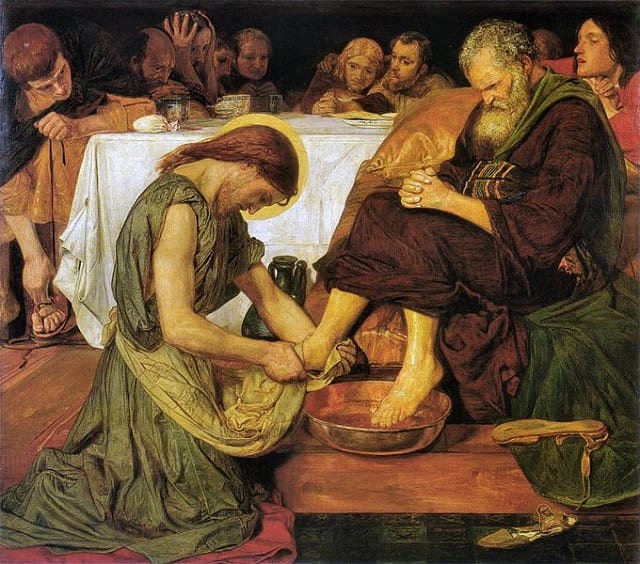
My friend Pete Vere is a canon lawyer, Catholic author, former and/or sometimes apologist, former member of the SSPX, Byzantine Catholic, and ecumenist. Since he is the primary author of this article, taken from several Facebook threads, his words will be in black, and mine in blue (the opposite of my usual custom). Fellow canon lawyer Ed Peters’ words will be in green. Their little debate makes it sound like there are three opinions whenever two canonists are in the room. I have edited all this to give it some sense of flow and coherence.
*****
For background, see: How Should We Understand Pope Francis Washing Women’s Feet? (Jimmy Akin, National Catholic Register, 3-28-13)
As one of the earliest contemporary proponents and apologists for the tridentine liturgy offered in fidelity with Rome, I what bothers me is not that certain radtrads and liberals in the media are freaking out over this, but just how many Catholic conservatives (or what the radtrads would call “neo-Catholics” – a term I have despised since it was first coined) and fellow moderate traditionalists are freaking out over radtrads and liberals in the media freaking out. So radtrads and the liberal media are freaking out over the Pope’s actions? It must be Thursday.
Seriously, the Roman approach to law (including liturgical rubrics) has always been subject to the Roman legal mindset, which historically has been much more flexible and broad-minded in the interpretation and application of legal text than the strict legal-positivism of Anglo-American jurisprudence. Hence the traditional Roman legal principle of “favors are to be multiplied, and burdens restricted.”
This may seem like liturgical abuse to English-speaking Catholics in the U.K. and North America, but please keep in mind that Christ founded the Roman Catholic Church and not the Anglo-Catholic Church.
What the pope did was perfectly licit (lawful). He may have departed from established liturgical rubrics, but rubric in question is mere ecclesiastical law — not a matter of Divine Positive Law or Natural Law. Hence the rubric in question is subject to Pope Francis’s authority as the Church’s Supreme Pontiff. Within Roman (and Catholic) legal tradition he can either depart from mere ecclesiastical law, dispense from it, or completely change it if he believes there is good reason to do so or if a compelling pastoral reason presents itself.
A good example is that of St. Pius X who, in order to combat growing threats of modernism and moral Jansenism within both the Church and the wider culture, lowered the age of Holy Communion from that of canonical adulthood to that of the age of reason. If canon law followed the principles of Anglo-American jurisprudence, rather than ancient Roman jurisprudence, St. Pius X also would have violated several canons when he ordered that a young child who had expressed to him faith in the Real Presence, but had not yet reached canonical age, be administered Holy Communion. It was only after that experience that he changed the law.
Canonically, given that Pope Francis is the Church’s Supreme Legislator, the rules now change by his actions. Basically, the practice of widening the pool of the twelve chosen for foot washing arose as a counter-custom within the Roman Rite. However, this practice did not previously have the force of law since it contradicted the rubric and sufficient time had not passed to give it the force of law. However, in carrying out the counter-custom, Pope Francis as Supreme Legislator automatically gives this counter-custom the force of law within the Roman Rite, meaning the counter-custom now automatically becomes custom with the force of law unless Pope Francis specifies otherwise.
Can. 26 Unless the competent legislator has specifically approved it, a custom contrary to the canon law now in force or one beyond a canonical law (praeter legem canonicam) obtains the force of law only if it has been legitimately observed for thirty continuous and complete years. Only a centenary or immemorial custom, however, can prevail against a canonical law which contains a clause prohibiting future customs.
1 – As the Church’s Supreme Legislator, Pope Francis is a competent legislator.
2 – The practice of broadening the pool of candidates for foot washing had been a counter-custom.
3 – In observing the counter-custom, Pope Francis has obviously specifically approved it by his actions.
Something I should clarify, since I have donned my canonical hat, is that no priest or bishop is bound to observe the counter-custom just because the Pope has done so. The previous rubric remains in place unless and until Pope Francis decides to change it. His observance of the counter-custom simply means that the counter-custom is now lawful to observe should a priest or bishop opt to do so. Again, this is the broad Roman legal mentality.
There is legal clarity on this issue . . . At least for “old school” traditionalists like myself who adhere to St. Pius X’s Pascendi in which the saintly pontiff condemned the Americanist heresy. Canon law–including liturgical law governing the Roman Rite–follows the Roman legal tradition. It is not subject to Anglo-American legal jurisprudence that attempts to legislate for every possibility, impose itself indiscriminately in every circumstance, and separate application of the law artificially between a lawful superior’s legislative, executive and judicial authority. The latter is the product of Enlightenment philosophy and not Catholic Tradition.
Essentially the Pope chose to follow the counter-custom that has arisen in many parts of the world. Because separation of powers — judicial, executive and legislative — is not recognized in the pope as Supreme Pontiff, his public act gives legal recognition to the counter-custom.
The previous law is not abrogated. It is still in effect, meaning it is still the law. Pope Francis’s actions simply mean that the counter-custom also has the force of law now, so one may choose lawfully to follow it as a counter-custom rather than abide strictly by the law.
Pope Francis does not have to issue a formal decree or discuss it publicly. The fact alone that he did it, in public, before a world-wide audience, reveals his thinking (or the mindset of the legislator) on the matter. Thus the counter-custom is now recognized under canon law. To restate an earlier point, minus the polemic, this is basically one of the differences between the Roman legal mindset and the Anglo-American legal mindset. We accept Pope Francis’s actions as revealing clearly his mind toward that specific law.
Would it be proper to compare this to the dispute about written tradition vs. oral tradition? If you’re correct (as I have no reason to doubt), then in effect (I speculate or submit), this was an instance of “oral” (i.e., acted out, or performed, or “lived,” but not yet written) tradition. Who better than the pope, after all, to exemplify oral tradition, or custom, as the case may be?
If my analysis is relevant, then it would not only be the difference between Roman and Anglo-American law, but also (perhaps) Protestantism’s rule of faith (written-only) vs. that of Catholicism and Orthodoxy (written + oral and incorporating profound conciliar + papal ecclesiastical authority).
In a certain sense, that makes for a good analogy, Dave. The irony here is that this discussion would be a lot easier to follow if it was taking place in Latin, or one of its descendant languages like French, rather than in English. This is because Latin and Romance languages (and even German) distinguish between two types of law through two different words, whereas English only has the one word that covers both concepts. Having said that, I will do my best to continue explaining in English – please do not hesitate to ask questions.
Custom is not law in the strict sense of lex — that is a specific law or series of laws. This is because lex must be legislated by one with legislative authority. (Hence the plural of lex in Latin is leges). Rather, custom is part of the broader sense of law as ius – from which we derive the word jurisprudence in English. Thus think of custom as jurisprudence. As such, custom is jurisprudence that arises from a community capable of receiving jurisprudence, but takes on the force of lex if it is practiced continuously over time or recognized by the competent ecclesiastical superior, and is not contrary to Natural Law or Divine Positive Law.
Having said that, where the analogy falls short is because this is not a matter of Divine Law or the Natural Law, and since “equals hold no power over each other”, a future Supreme Pontiff could lawfully suppress this custom even though Pope Francis has now recognized it. For me, who felt strongly against this practice until Pope Francis recognized it last Thursday, I see this as no different than patristic-era popes — who were canonized saints — who condemned the practice of reception of Holy Communion under one species vs. popes during the Reformation era, which includes the canonized St. Pius V, who condemned insistence upon receiving Holy Communion under both species.
Both at first seem to contradict each other, however, when one looks at the historical era in which they found themselves, each set of popes was trying to protect essential Catholic teaching concerning transubstantiation against their respective era’s predominant heresy concerning the Eucharist. So each set of popes were required to take opposing actions in order to preserve the same core Catholic teaching.
I wasn’t even definitely taking a side on this matter (though I certainly tend towards Pete’s view, as the canon lawyer). I think reasonable people can differ. It certainly shouldn’t be something that should cause any sort of rift.
My position is the same as Pete’s: “people are free to agree or disagree with the Pope’s decision, which is prudential in nature.” I had exactly the same view of the Koran-kissing incident. People are free to disagree, but it shouldn’t be the source of Chicken Little hysteria.
I think this is one of those areas where we need to adopt the more flexible Roman mindset in interpreting this event. That is, people are free to agree or disagree with the Pope’s decision, which is prudential in nature. The danger comes, as Mark points out, when certain groups become devolve into histrionics over the Pope’s decision and conclude automatically that his papacy is a failure, he’s an anti-pope, he’s a communist plant, etc… It’s a prudential decision that he is free to make, according to his office and pastoral understanding of the situation.
It also brings to my mind things like Jesus healing a man on the Sabbath, or talking about how even the Pharisees would rescue a sheep on the Sabbath that fell into a pit (both technically in violation of the Law). Jesus noted how King David had eaten the showbread, which it was lawful only for the priests to eat.
Our Lord Jesus radically, rapidly developed and re-interpreted the existing Law (so did St. Paul, of course). The laws existed for God, not vice versa. We think this dispute has even an infinitesimal significance, compared to something as momentous as the cessation of circumcision or the moving of the Sabbath to Sunday: the “Lord’s Day”?
Jesus had His feet washed by the tears of a repentant woman. Pope Francis washed the feet of a Muslim woman. Jesus treated open-minded Roman centurions and Samaritan women kindly. I see no huge differences here. This was an era of separation in the synagogues, so for a woman to wash Jesus’ feet with her tears was an unheard-of incident. The objection in two of these cases was to the introduction of women into a male-only milieu. Thus, the examples of Jesus and women are relevant to the present ruckus.
I think it’s a forest-trees scenario. All some folks can do is look at the DNA of the cells of the bark of the branches of one type of tree in the forest, that they proclaim defective. Others of us view the whole forest and think everything is fine.
Jesus talking to the Samaritan woman at the well or allowing Mary Magdalene to be the first person to see Him resurrected (not any of His disciples) were infinitely more “radical” than this incident. Far more radical, also, was Paul’s utterly innovative (the Jews would say “novel” or “revolutionary”) reinterpretation of the Law.
There are too many errors in the above post to correct here. It’s a hodge-podge of a mess of an analysis. People can make of it what they wish.
I’d invite folks to read my posts over at http://canonlawblog.wordpress.com/. Some of these exact points are addressed therein. Anyway, I can’t retype everything every time some one new wades in. Sorry.
Of course it’s a mess and a hodge-podge. It was not written as a formal analysis of various particulars to be submitted for academic publication, but as a series of blog commentaries responding to other posters. At the end of the day, however, the Pope through his actions recognized a custom that had been evolving. This is well within his competency to do so.
He did not. But I give reasons for my position. Most other folks give feelings.
Read it and think you raise some interesting points with regards to custom, but at the end of the day they are merely academic given that what Pope Francis has done is fait accomplit and has for the most part been well-received by the Catholic faithful. So unless he openly renounces his actions in coming days, I think it is very clear where his mind is at and that he has given this counter-custom his tacit approval. One can presume that as Supreme Pontiff he is well aware of what liturgical law stated, he likely knew about the emerging counter-custom over the past decade or two, and still he chose to follow the counter-custom in a very public way. Those who previously argued against this practice — as I did until last Thursday — are fighting a losing battle.
So what do us regular old folks do when two canonists disagree on how to interpret this?
Best I can make out (correct me if I’m wrong), the disagreement between Pete and Ed amounts to the following (and I read Ed Peters’ two articles):
1. Pete formerly argued against the practice, but accepts it now that the pope has set the example, which he has the technical right to do, per his office and relation to canon law.
2. Ed has argued for the practice, but objects to the pope’s actions because they didn’t follow the letter of canon law, and therefore can cause scandal and confusion (the law should be changed).
I think it is two legitimate points, but now how do we non-legal types figure out who is right (if anyone definitively is)? I don’t believe that the pope is always right, or has to be regarded as never making any mistakes whatever, but it seems to me that for the layperson in the pew, isn’t it sort of simple and straightforward?: “pope did it; chances are, then, that it’s an okay thing.”
Isn’t that kind of what the pope is about: one of his functions as the “front man”? I’m just trying to look at it from an unsophisticated point of view of an average Joe in the pews (not even as an apologist, for the moment): like how stained glass and sermons used to be primary teaching tools for those who were illiterate.
In the end, although other canonists may agree or disagree, I think this makes for an interesting theoretical debate among the professional Catholic classes, but in pastoral and liturgical practice I think the issue is moot. Pope Francis presumably knew what the law was and freely decided to move in a different direction, one in which he was recently elected by the College of Cardinals to move the Church (not necessarily over this particular issue, but in general). His actions were warmly and widely received by the average Catholic, many believers in the wider Christian community, and even many non-Christians.
The Vatican spokesman’s comments reported by Salt & Light urge us not to engage in canonical debate over the issue, but to reflect upon its broader meaning. Certainly this is what the average person seems to be doing.
Regardless of what the letter of the law currently states, I am fairly confident that this is direction in which Pope Francis intends to move the Church.
Washing the feet of women, and presumably non-baptized women (given that she was Muslim, if I understand correctly), is neither a case for women’s ordination nor permission to admit non-baptized persons to the sacramental life unless one first receives baptism. All this does is indicate that the Pope is okay with priests and bishops washing the feet of women during the Maundy Thursday service.
While Pope Francis’ actions may have upset a minority of progressives, traditionalists, liturgists and canonists, and talking heads in the Catholic media, overall I think he reached his intended audience. That is, he challenged the vast majority of Catholics, Christians from other denominations, and even non-Christians and hardened secularists to consider imitating Christ in living the Beatitudes.
From what I am experiencing, I think most Catholics (and most non-Catholic Christians) understood and appreciated Pope Francis’ action in not strictly adhering to liturgical law. They don’t have a problem with it. Some radtrads and radical feminists within the Church have expressed outrage, but this is fairly typical. What surprises me, . . . is the number of “Professional Catholics” who have taken issue with the Pope’s actions. This is not to say that Professional Catholics do not fulfill an important function within the Church — I use to be one and support various lay Catholic apostolates and ministries.
However, every so often there comes an issue or controversy where we need to take a break from our Catholic cocoon and take an candid look at how the broader Church and world reacts to a situation. Obviously, the Pope is okay with what he did. Likewise the majority of Cardinals, I would venture to guess, since inspired by the Holy Spirit they elected Francis to take the Church in this direction. And the average Catholic layperson, the wider Christian community and many non-Christians have warmly received the Pope’s actions. So for me this is not a windmill worth tilting at.
I’m not upset about this incident at all. I’m trying to understand why people are, and to foster discussion among different permissible opinions without rancor. I felt the same about Pope John Paul II kissing the Koran, and defended it at length, twice. I thought I understood what he was trying to do there, and I had no objection to it.
To me it was a “ho-hum” all along. The pope was being a servant. Nothing new there: it’s one of his official titles. I’m only talking about it because everyone else seems to be, so I thought I would offer a place for more reflection and discussion on it, and (hopefully) try to calm some nerves that need not be so upset. This is why I posted Pete Vere’s comments. I thought they did that. It’s not wrecking or disturbing in the least our celebrations of Easter in my house.
***
Pope Francis’ “Humble” Gestures: Could They Possibly “De-Sacralize” the Papacy?
Someone argued that the pope’s laudable desire to be humble and appeal to the masses could result in the unwanted effect of lessening or underemphasizing the grandeur and majesty of the papacy.
If the point is that it is in danger of giving some wrong impression, my reply is, “Jesus washed feet.” The pope can never go wrong if he is imitating Jesus, right? If Jesus Himself washed feet, why not popes? I don’t have the slightest worry about it. I think it’s wonderful.
Jesus’ foot-washing (that Pope Francis does to show humility and servanthood) didn’t have the effect of “de-sacralizing His divinity.” Therefore, if that is the case for the greater, so is it for the lesser.
Foot-washing is one aspect of his humility that has been discussed by many, along with his riding a bus, cooking his own food, etc. I could use other examples from Jesus of the same sort of thing: eating with sinners (to the horrors of all the “religious people”), forgiving adulterers, talking to the Samaritan woman at the well . . .
I was asked if the pope should wear a “cassock” or have a mitre. Yes, of course; Jesus dressed up when He went to temple and synagogue. The priests had their garb, etc. Humility is not about outward appearances, but the heart. No Catholic should object to nice cathedrals, nice vestments and holy items . . .
I’ve defended all that (“preaching to the choir” stuff). Not my point. I merely said I disagreed that the displays of humility would have an unwanted counter-effect. I don’t think they will at all. I think the original point was an interesting and thoughtful point; I simply disagree with it.
***
(originally 3-13-13 [my end commentary] and 3-30-13 on Facebook]
Photo credit: Jesus Washing Peter’s Feet (1856), by Ford Madox Brown (1821-1893) [public domain / Wikimedia Commons]

***
Previous Post
April 24, 2020
Sacraments vs. Jesus?: Unbiblical False Dichotomies
Next Post

April 25, 2020 2 Thessalonians 2:15, Sacred Tradition, & Sola Scriptura
Browse Our Archives
Select a Category & Last Things About Me Anti-Catholicism Atheism & Agnosticism Baptism and Sacramentalism Bible and Tradition Blessed Virgin Mary Books by Dave Armstrong C. S. Lewis Calvinism & General Protestantism Catholic Apologetics Catholic Apologists Catholic conversion Catholic converts Christmas Church (Ecclesiology) Church History Conversion and Converts Development of Doctrine Eastern Orthodoxy Ecumenism & Christian Unity Eucharist & Liturgy Fathers of the Church French Translations G. K. Chesterton Hell Hell & Satan Hell & Satan & Last Things Heresies & Comparative Religion Holistic Health Inquisition & Crusades & Scandals James White Jews & Judaism & Old Testament John Calvin John Henry Newman Liberal / Modernist Theology Life Issues Literary Resume Lutheranism Mariology Martin Luther Music Orthodoxy Papacy & Infallibility Personal Page Philosophy & Science Political & Ethical & Moral Issues Protestant Persecution & Intolerance Protestantism Purgatory Purgatory & Penance Romantic & Imaginative Theology Saints & Purgatory & Penance Salvation Salvation & Justification Satan & Last Things Sexuality and Gender Issues Spanish Translations Traditionalism vs. Radical Catholic Reactionaries Traducciones al español / tradução para português Trinitarianism & Christology Uncategorized Videos
Select a Month October 2026 September 2026 August 2026 July 2026 June 2026 May 2026 April 2026 March 2026 February 2026 January 2026 December 2025 November 2025 October 2025 September 2025 August 2025 July 2025 June 2025 May 2025 April 2025 March 2025 February 2025 January 2025 December 2024 November 2024 October 2024 September 2024 August 2024 July 2024 June 2024 May 2024 April 2024 March 2024 February 2024 January 2024 December 2023 November 2023 October 2023 September 2023 August 2023 July 2023 June 2023 May 2023 April 2023 March 2023 February 2023 January 2023 December 2022 November 2022 October 2022 September 2022 August 2022 July 2022 June 2022 May 2022 April 2022 March 2022 February 2022 January 2022 December 2021 November 2021 October 2021 September 2021 August 2021 July 2021 June 2021 May 2021 April 2021 March 2021 February 2021 January 2021 December 2020 November 2020 October 2020 September 2020 August 2020 July 2020 June 2020 May 2020 April 2020 March 2020 February 2020 January 2020 December 2019 November 2019 October 2019 September 2019 August 2019 July 2019 June 2019 May 2019 April 2019 March 2019 February 2019 January 2019 December 2018 November 2018 October 2018 September 2018 August 2018 July 2018 June 2018 May 2018 April 2018 March 2018 February 2018 January 2018 December 2017 November 2017 October 2017 September 2017 August 2017 July 2017 June 2017 May 2017 April 2017 March 2017 February 2017 January 2017 December 2016 November 2016 October 2016 September 2016 August 2016 July 2016 June 2016 May 2016 April 2016 March 2016 February 2016 January 2016 December 2015 November 2015 October 2015 September 2015 August 2015 July 2015 June 2015 May 2015 April 2015 March 2015 February 2015 January 2015 December 2014 November 2014 October 2014 September 2014 August 2014 July 2014 June 2014 April 2014 March 2014 February 2014 January 2014 December 2013 November 2013 October 2013 September 2013 August 2013 July 2013 June 2013 April 2013 March 2013 February 2013 January 2013 December 2012 November 2012 October 2012 September 2012 August 2012 July 2012 June 2012 May 2012 April 2012 March 2012 February 2012 January 2012 December 2011 November 2011 October 2011 September 2011 August 2011 July 2011 June 2011 April 2011 March 2011 February 2011 October 2010 September 2010 August 2010 July 2010 April 2010 March 2010 December 2009 October 2009 August 2009 July 2009 June 2009 May 2009 March 2009 February 2009 October 2008 September 2008 April 2008 March 2008 February 2008 January 2008 December 2007 November 2007 October 2007 May 2007 March 2007 February 2007 January 2007 November 2006 October 2006 September 2006 August 2006 July 2006 June 2006 May 2006 April 2006 March 2006 February 2006 October 2005 June 2005 April 2005 February 2005 July 2004 May 2004 April 2004
Follow Us!
TAKE THE
Religious Wisdom Quiz
Who asked Jesus, "What is truth?"
Select your answer to see how you score.
Caiaphas Pilate Nicodemus Herod
Books by This Author Books by Dave Armstrong
Related posts from Biblical Evidence for Catholicism

Was Peter "Any Old" Apostle? 10 Anti-Papal Arguments
Biblical Evidence for Catholicism

11 Protestant Objections to Papal Authority Debunked
Biblical Evidence for Catholicism

Matthew 16 & the Papacy (vs. Patrick O'Brien)
Biblical Evidence for Catholicism
Inspired Prophets: An Analogy to Infallible Popes
Biblical Evidence for Catholicism
TRENDING AT PATHEOS Catholic

I was strolling through the top floor of the brand new Parthenon...

What Does Gêvâh Mean For Kimberley Guifoyle &...
This week, a lot of the news is focused on Kimberly Guilfoyle....

INNER CIRCLE: Profound Mystery (Of Christ In All...
Ephesians 5:31-32 “For this reason, a man will leave his father and...

Do Not Rejoice When Your Enemy Falls: The...
Turning an execution into a public spectacle is a disturbing expression of...

'The Chosen' S6 Trailer: The Passion Gets Very...
Not many watching 'The Chosen' worry about spoilers, but just because they...

The purpose-driven labor priest
A labor activist reads Rick Warren and it gets me wondering about...
view all Catholic blogs
Ad-Free & Subscriber Log-In Subscription Support
- About Us
- 2026 Calendar
- Videos
- Podcasts
- Library of World Religions
- Faith In Media Tracker
- Advertise With Us
- Write for Us
- Privacy Policy
- Terms of Service
- Do Not Sell My Data
- Contact Us
- Radiant Digital
- Manage Newsletter Subscriptions
- Unsubscribe From Notifications
- Sitemap
Copyright 2008-2026, Patheos. All rights reserved.
Subscription Support Ad-Free & Subscriber Log-In
Follow Patheos