
BuddhistCatholicContemplativeEvangelicalGeneral ChristianHinduJewishLatter-day SaintMuslimNew VisionsProgressive Christian
Beliefs
- Buddhist
- Catholic
- Contemplative
- Evangelical
- General Christian
- Hindu
- Jewish
- Latter-day Saint
- More Voices
- Muslim
- New Visions
- Pagan
- Progressive Christian
Topics
- Religion News
- Food and Religion
- Sports and Religion
- Religious Art
- Religious Music and Entertainment
- Religious Events
- History and Religion
- Style and Religion
- Politics and Religion
- Women in Religion
- Recreation Outdoors and Religion
- Business Finance and Religion
- Careers Workplace and Religion
- Education and Religion
- Family Parenting and Religion
- Health Fitness and Religion
- Home and Religion
- Relationships and Religion
- Technology and Religion
- Travel and Religion
Columnists
- Buddhist Columnists
- Business Finance and Religion Columnists
- Careers Workplace and Religion Columnists
- Catholic Columnists
- Contemplative Columnists
- Education and Religion Columnists
- Evangelists Columnists
- Family Parenting and Religion Columnists
- General Christian Columnists
- Health Fitness and Religion Columnists
- Hindu Columnists
- History and Religion Columnists
- Home and Religion Columnists
- Jewish Columnists
- More Voices Columnists
- Latter Day Columnists
- Muslim Columnists
- New Visions Columnists
- Nonreligious Columnists
- Pagan Columnists
- Politics and Religion Columnists
- Progressive Columnists
- Recreation Outdoors and Religion Columnists
- Relationships and Religion Columnists
- Religion News Columnists
- Religious Art Columnists
- Religious Events Columnists
- Religious Music and Entertainment Columnists
- Sports and Religion Columnists
- Style and Religion Columnists
- Technology and Religion Columnists
- Travel and Religion Columnists
- Women in Religion Columnists
Resource Library
- 2026 Calendar
- Library of World Religions
- The 100 Most Holy Places on Earth
- Patheos Answers
- Podcasts
- Videos
- Faith Leaders Database
- Anglican Episcopalian
- Bahai
- Baptist
- Buddhism
- Christianity
- Confucianism
- Eastern Orthodoxy
- Hinduism
- Holiness and Pentecostal
- ISKCON
- Islam
- Judaism
- Lutheran
- Methodist
- The Church of Jesus Christ of Latter-day Saints
- New Age
- Paganism
- Presbytarian and Reformed
- Protestantism
- Religion Behind the Scenes
- Roman Catholic
- Scientology
- Shia Islam
- Sikhism
- Sufism
- Sunni Islam
- Taoism
- Zen
- See all religions
Research Tools
 Ad-Free & Subscriber Log-In Subscription Support
Ad-Free & Subscriber Log-In Subscription Support
Follow Patheos 

- Trending:
- Forgiveness
- |
- Marriage
- |
- Consciousness
- |
- Death Penalty
- |
- Election
- |
- Halloween

-
About
-
Catholic Apologetics
-
Church History
-
Great Apologists
-
Christian Worldview
-
Protestantism & Misc.
- Home
- Catholic
- History and Religion
- Development of Doctrine in Orthodoxy & Catholicism
Development of Doctrine in Orthodoxy & Catholicism
Last updated on: June 6, 2026 at 12:42 am by Dave Armstrong
Development of Doctrine in Orthodoxy & Catholicism 2026-06-06T00:42:05-04:00 Dave Armstrong
Patheos Explore the world's faith through different perspectives on religion and spirituality! Patheos has the views of the prevalent religions and spiritualities of the world.
Is There an Essential Difference?
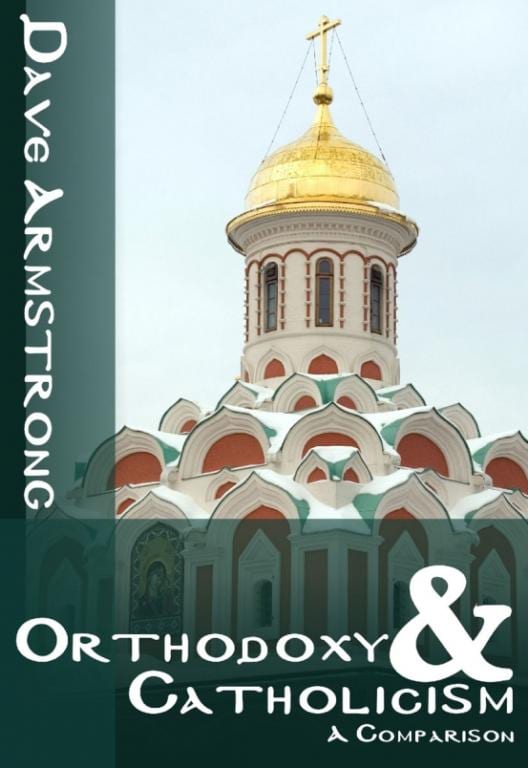
Original cover of my book, from which this is drawn (3rd edition: 2015). See book and purchase information.
*****
I have maintained that the apostolic deposit is not necessarily confined to one philosophical framework and one only, and that different philosophical approaches can be applied to it (as facilitators of increased understanding) without this necessarily involving any “corruption.”
Catholics hold that the “original categorical framework” is the apostolic deposit itself, as understood in light of the Old Testament, Jewish cultural background, hermeneutical and exegetical factors, patristic and conciliar interpretation, etc., as opposed to some sort of a single philosophy or axiomatic foundation arbitrarily superimposed onto the New Testament and the apostolic deposit.
Orthodox often seem to disparage development of doctrine, or argue that Orthodox development (insofar as it occurs at all) is essentially different from Catholic development. As a case study, allowing us to analyze the differential claims, where they exist, let’s consider hesychasm. One can trace it back in kernel form to St. Gregory Nyssa, St. Basil the Great, or Origen, yet it was not fully developed until St. Gregory Palamas (1296-1359). This seems to me, then, to also be a “development of a category” (a type of prayer and devotion, and – especially – the corresponding theology), since it has to do with the nature and essence of God, and a distinction between essence and energy.
As such, it is hardly distinguishable (philosophically speaking) from similar refinements of category such as the homoousios, Theotokos, transubstantiation, or procession within the Godhead. It was not formally adopted (relating it to the Divine Energies and Uncreated Light), until the Councils of Constantinople in 1341, 1347, and 1351, when it then became, according to the Oxford Dictionary of the Christian Church, “an accepted part of Orthodox tradition.”
I don’t see how this is any different (chronologically or essentially) from, for example, Catholic developments of transubstantiation or the Immaculate Conception (both fully developed one or two hundred years before hesychasm was). Can Orthodox claim that hesychasm and related concepts existed in their developed form all the way back to the early centuries of the Church? I think not.
Met. Kallistos Ware posed the dilemma of the hesychasts as follows:
A hesychast is one who in silence devotes himself to inner recollection and private prayer. While using the apophatic language of negative theology, these writers claimed an immediate experience of the unknowable God, a personal union with Him who is unapproachable. How were the two ‘ways’ to be reconciled? How can God be both knowable and unknowable at once?
This was one of the questions which was posed in an acute form in the fourteenth century.
. . . how was this vision of Divine Light to be reconciled with the apophatic doctrine of God the transcendent and unapproachable? All these questions concerning the transcendence of God, the role of the body in prayer, and the Divine Light came to a head in the middle of the fourteenth century.
. . . To explain how this was possible, Gregory developed the distinction between the essence and the energies of God. It was Gregory’s achievement to set Hesychasm on a firm dogmatic basis, by integrating it into Orthodox theology as a whole, and by showing how the Hesychast vision of Divine Light in no way undermined the apophatic doctrine of God.
. . . his work shows that Orthodox theology did not cease to be active after the eighth century and the seventh Ecumenical Council. (The Orthodox Church, New York: Penguin Books, 1980 revision, 73, 75-76, 79)
The late great Jaroslav Pelikan, writing while a Lutheran (later he became Orthodox), summarizes St. Gregory Palamas’ noteworthy accomplishment:
Deification had not been adequately defined in the creeds and dogmas of the church [in the time of St. Maximus: 7th century] . . . (The Christian Tradition: A History of the Development of Doctrine: The Spirit of Eastern Christendom (600-1700), Univ. of Chicago Press, 1974, 34)
The spiritual theology of Simeon was summarized in his doctrine of the vision of God as light . . . Maximus Confessor had taught that the true light was the same as God . . . Simeon did not formulate a systematic treatment of the relation between transcendence and the identity of God with the light, but the principal components for such a systematization were present in his thought.
. . . The task of articulating a new theology of the spiritual life, including the doctrine of God as light, was undertaken by Gregory Palamas more than three centuries after Simeon.
. . . The novelty of Palamite theology consisted in the fundamental reinterpretation of emphases going back to Origen and Dionysius the Areopagite, despite a continuing reverence for Dionysius; this issued in a ‘new theology,’ even in the narrow sense of the word ‘theology,’ for it brought about a further development in the Eastern doctrine of God. (Ibid., 260-262; italicized emphases added)
Gregory Palamas identified the three basic themes of Eastern Christian spirituality – theology as apophaticism, revelation as light, and salvation as deification – and redefined them in a way that sought to correct the formulation of them by Dionysius the Areopagite and his school. Before he had finished this redefinition, Palamas found it necessary to restate even that one dogma on which orthodoxy had always been thought to stand or fall, the dogma of the Trinity.
. . . Palamas sought to rescue divine transcendence and its corollary, apophatic theology, from the Neoplatonic context in which it had often stood, and to base it instead on the Christian doctrine of revelation. (Ibid., 264-265; italicized emphases added)
Note how the previous tendency in Eastern tradition is described as “Neoplatonic,” whereas Palamas attempts to disconnect hesychasm from that philosophical framework. This, too, flies in the face of a common Orthodox thesis of the non-presence of “change of categories” in Eastern development / Orthodoxy, and a supposed singular Eastern framework or presupposition.
Likewise, the Encyclopædia Britannica (1985 edition, under “St. Gregory Palamas,” volume 9, 73) states:
In his fusion of Platonic and Aristotelian philosophy, used as a vehicle to express his own spiritual experience, Palamas set a definitive standard for Orthodox theological acumen.
This fusion is not unlike the one accomplished by St. Thomas Aquinas (which is highly ironic, given the oft-expressed scorn of some Orthodox directed towards Aquinas and “rationalistic Scholasticism”). Again, it seems to me that this greatly undermines the Orthodox thesis (as far as I understand it) that there is either one “philosophy” underlying Orthodox theology and tradition, or none (it being typified by the absence of any “human” philosophy).
I don’t think it is nearly that simple. It appears that both East and West utilized different philosophical schools in the development of their respective theologies. Both would claim that this does no violence to consistent development per se. The philosophy is not the bottom line for either; rather, it is the theology, the revelation, and the apostolic deposit, passed down faithfully and preserved by the Church.
I imagine that Orthodox would retort that this doctrine (hesychasm) is nothing new, but can be traced in large part to St. Basil and other Church fathers. But I can say the same about transubstantiation (St. John Chrysostom, St. Augustine), the Immaculate Conception (St. Ephraem and St. Augustine and implicit biblical indications), papal infallibility (St. Ephraem, St. John Chrysostom, St. Maximus the Confessor, and St. Theodore of Studios and explicit biblical indications), and indeed, even the Filioque.
In each case, the kernel or implicit teaching was found fairly early on, yet the doctrine was not defined and made binding dogma until hundreds of years later. Therefore, there is no essential difference in this regard between hesychasm and the above-mentioned doctrines, and so the attempted differentiation of East and West with regard to “proper” development collapses, in my opinion.
I have heard many Orthodox deny that Orthodoxy accepts development of doctrine (including professed “apologists”). Judging from my many debates with them, there is a great deal of ignorance of the Catholic conception, even down to basic definitional questions. In the opinion of many Orthodox of this sort, development is equated with “theologically liberal excess” or “unchecked, unbridled departure from tradition” or “evolution” (none of which it is).
In conclusion, I contend that the actual principle is pretty much the same in both camps. Orthodoxy doesn’t have as much development, but then we come across a striking example such as St. Gregory Palamas and hesychasm. I have yet to see anyone prove that the biblical categories were strictly Platonic, or Alexandrian, or “Greek,” or whatever label or school an Orthodox apologist of a certain type would have them be.
Fr. Deacon Daniel Dozier [co-author]
Moving from matters of Christian history to those of doctrinal development seems quite fitting and logical. In this regard, I believe the question of doctrinal development and its meaning for the churches is a vital – and no less sensitive – one, since much of what follows in the remaining chapters of this text covering the issues that divide Orthodox and Catholic Christians directly relates to both history and development.
It should not be a matter for debate that any discussion of doctrinal development must take into account the separation and estrangement of Catholic and Orthodox churches from one another. (I am setting aside the question of true significance of the events of 1054 A.D., which serves as more of a symbolic rather than definitive point of separation, as even eminent Orthodox theologians and historians such as Father John Meyendorff have noted, with the Orthodox rejection of the 15th century failed reunion Council of Florence-Ferrara being characterized more accurately as the point of rupture. Such a point merits a much larger study.)
East and West both underwent periods of remarkable theological development along trajectories that were at times close and mutually influential and cross-fertilizing, as well as unique and separate. As the council fathers of Vatican II declared in the Decree on Ecumenism (Unitatis Redintegratio, no. 17):
In the study of revelation East and West have followed different methods, and have developed differently their understanding and confession of God’s truth. It is hardly surprising, then, if from time to time one tradition has come nearer to a full appreciation of some aspects of a mystery of revelation than the other, or has expressed it to better advantage. In such cases, these various theological expressions are to be considered often as mutually complementary rather than conflicting.
Even within the broad (and much more diverse than sometimes assumed) categories of both the “East” and the “West” we see divergent and convergent movements of theological development. Dave’s point of tracing the development of the Essence-Energy distinction is just such an example. Many Orthodox theologians rightly relish in the development of the golden thread in pneumatology from Basil, to Symeon to Gregory Palamas! And how could one doubt the conciliar dogmatic and theological progression from Nicea I to Nicea II – from homoousios to eikonas?
That being said, I believe Catholics need to endeavor to better understand Orthodox objections to the Catholic view of doctrinal development, and to hopefully arrive at a place of better mutual respect and understanding. In so doing, it will at least help to diminish the force and frequency of blanket assertions of any essential differences between Catholicism and Orthodoxy in the one Church of Christ.
Despite the almost contortionist denials of some Orthodox polemicists and even certain theologians in the matter of the question whether doctrine has developed historically, most reasonable theologians can agree and recognize the examples provided above as demonstrations of this principle in practice. The notion of some sort of unfolding progression in doctrine as a further explication rooted in the pneumatic experience of and reflection on the deposit of the divinely revealed apostolic traditio (of which the inspired words of Scripture are a part and exercise a certain primacy) is inherent in the shared conciliar tradition of Orthodoxy and Catholicism.
That being said, many of the Orthodox objections are made principally as a result of distortions of what should be universally recognized principles in Catholic practice. Here I wish to address three particular points of historical concern: popular evolutionary assumptions as applied to orthodoxy and orthopraxis, the Western tendency to want to codify and dogmatize theologoumena or theological opinions or even traditional doctrinal positions, and the constant temptation of Roman unilateralism and universalism.
Regarding the first point, in our age of post-Darwinian, “post-conciliar” progressivism, we see a distorted application of evolutionary principles to the faith and life of the Latin Church. In the mind of some, anything that smacks of ecclesial, theological and liturgical tradition prior to Vatican II is to be rejected out of hand as “old” and “pre-conciliar.” In certain Roman parishes, for instance, this at times faddish tyranny of the new can be seen in the wholesale introduction of musical, artistic and architectural forms that have little resemblance to the rich genius, modalities, and heritage of Latin Catholicism, which in turn is a particular cultural and historic manifestation of the Great Tradition shared with Orthodoxy.
The same can be said for theological content in homiletics and catechesis. It is important to note that such activities run contrary to official Catholic teaching and practice, and are reflective not of authentic doctrinal development, but of what Pope Benedict XVI refers to as the hermeneutic of rupture. From an Orthodox perspective (as well as an Eastern Catholic one, I might add) such attitudes and practices are scandalous, sectarian, and damaging to the communion of churches. It is seen by some Orthodox as the natural outgrowth of (rather than rightfully as a distortion of the principle of) doctrinal development. The Roman Church in all its local and national manifestations should endeavor to pastorally correct these tendencies, which cause such great harm to Christian unity.
Regarding the second point, there is a peculiarly Western tendency to want to codify, dogmatize, and authoritatively pronounce on theologoumena or theological opinions as well as traditional, non-dogmatically defined doctrines, even though no point of controversy or dispute (the normal historical circumstances that brought about the calling of Ecumenical Councils to address them) has arisen to warrant such a definition.
To a large extent, this can be seen in the Papal dogmas of the Immaculate Conception, the Assumption, and the current popular movement for the so-called “Fifth Marian Dogma” of Co-redemptrix. (Some might object that the Vatican I definitions of Papal Infallibility and Universal Jurisdiction also fall under this category, but these definitions were in part intended to directly address the contentious issue of conciliarism in the Catholic Church.)
Neither of the two papal and dogmatic definitions came about as a result of any contentious theological battle, similar to what occurred during the Christological controversies of the first millennium. And while one can identify ample theological, liturgical, and patristic evidence supporting their doctrinal truth within the Orthodox tradition (see, for instance, Father Lev Gillet’s article, “The Immaculate Conception and the Orthodox Church” as well as Father Christian W. Kappes’s “The Immaculate Conception: Why Thomas Aquinas Denied, While John Duns Scotus, Gregory Palamas, & Mark Eugenicus Professed the Absolute Immaculate Existence of Mary”), such efforts to dogmatize these matters – and to do so unilaterally from an Orthodox perspective – generates an unnecessary polarizing effect to the extent that certain Orthodox authors begin to assert (dogmatically and “magisterially”) opposite positions.
It was likely for this reason that St. John Paul II rightfully rejected the petition of the movement to dogmatically define the “Fifth Marian Dogma” (the other four being the Virgin Mary’s title as Theotokos or Mother of God, her perpetual virginity, her Immaculate Conception, and her Assumption into heaven), despite this doctrine having great sympathy among many Catholics (including Pope St. John Paul, as well as myself, when it is understood properly) and even support by a noted Orthodox theologian.
This largely Western tendency to explicitly dogmatize theological positions, which has some roots historically but seemed to take on the characteristics of a more acute tendency in part of the period of the modern papacy, needs to be held in greater check, without denying the great value of various non-dogmatically defined teachings. To fail to do so runs the risk as well of the tendency of some to assume that without a dogmatic definition, certain points of doctrine are “up for grabs.” A greater appreciation for the magisterial nature of the liturgy, which offers rich, doxological presentations of Christian doctrine which are definitive part of the rich tradition of the Church, would be a helpful corrective here.
Regarding my third and final point – the constant temptation of Roman unilateralism and universalism – here we see an issue directly related to the second point. The Latin West has at times suffered from the tendency to want to universalize its own particularisms, both doctrinally as well as in matters of discipline. This is not to call into question (which I would not do as a Catholic clergyman) the essential truths that are asserted as universally binding by the Catholic Church. But even in some of those definitions, we see a particular way of explaining the doctrinal essence exclusively in Western terms and expressions and according to Western modalities of thought.
This was even a critique offered on one occasion by Pope Paul VI in reference to the 15th century reunion Council of Florence-Ferrara, as well as what he referred to as General Synods of the West, including the Council of Trent. Some have taken this to mean that he reduced their Ecumenical standing in the canonical sense. I am more of the opinion that he was attempting to state their limited value ecumenically and the need to strive for a more ecumenically rich and complete means of expressing their essential doctrinal principles. No assumption should be made regarding any authoritative, infallible magisterial teaching (conciliar, papal, etc) that its auxiliary theological language is divinely protected in such a way as to represent the highest, richest and best expression of the essence of revealed truth. Such expressions are historically contingent and at times incomplete.
Since Vatican II, the Catholic Church has made great strides to “breathe with both lungs,” as St. John Paul II once said of the various Eastern and Western streams of spiritual and theological traditions in the Church. This shift to more universal modalities of expression (most especially those that are biblical and patristic) can be seen in many of the papal writings and the pronouncements of episcopal synods.
That being said, there are still tendencies in the Latin Church to universalize Roman views on such things as clerical celibacy, which includes the attempt by some (even within the Vatican) to assert an apostolic and dogmatic character to what is manifestly an historically contingent discipline. Concerns regarding this as an abuse of the authentic principles of doctrinal development have been noted among Orthodox and Eastern Catholic circles.
Dave Armstrong
I am happily in essential agreement with Fr. Deacon Dozier’s excellent points and observations. Regarding his second of three illustrative points (“a peculiarly Western tendency to want to codify, dogmatize, and authoritatively pronounce on theologoumena or theological opinions as well as traditional, non-dogmatically defined doctrines”), I mildly disagree, but mainly in a sense of wishing to clarify and expand upon the Western understanding in a certain sense.
He provided two examples of this: the Immaculate Conception of the Blessed Virgin Mary, and her Bodily Assumption; adding: “Neither of the two papal and dogmatic definitions came about as a result of any contentious theological battle.”
The point I wish to make is that there are relevant factors other than theological in play: cultural, social, and philosophical factors, which intersect with theology and spirituality at certain points. There are also larger theological “battles” with our Protestant brethren, with which these Marian doctrines have some relation. Catholic convert from Lutheranism, Fr. Louis Bouyer, elaborates upon one such theme, directly related to our topic:
If there is any Catholic belief that shows how much the Church believes in the sovereignty of grace, in its most gratuitous form, it is this one. It is remarkable that the Orthodox controversialists, contrary to the Protestants, reproach Catholics for admitting, in this one case of Our Lady, something analogous to what strict Calvinists admit for all the elect – a grace that saves us absolutely independently of us, not only without any merit of our own, but without any possibility of our cooperation, . . . whereas the Protestant view seems, not merely against reason, but completely absurd. To say that Mary is holy, with a super-eminent holiness, in virtue of a divine intervention previous to the first instant of her existence, is to affirm in her case as absolutely as possible that salvation is a grace, and purely a grace, of God. (The Spirit and Forms of Protestantism, translated by A.V. Littledale, London: Harvill Press, 1956, p. 247)
I’ve often noted this myself in dialogues with Protestants, who object to Catholic Mariology, saying that the Immaculate Conception: as a one-way, “monergistic” action by God, is as “pure grace” as anything that can be imagined. Mary couldn’t possibly have had anything to do with it, herself. Thus, in this way, the Immaculate Conception ties in with soteriology (the theology of salvation), and arguably, it was therefore important to define it at the highest levels.
Ven. Archbishop Fulton Sheen provides another extraordinary analysis of the definition of these two dogmas, that has to do with the cultural and philosophical factors that I alluded to above:
The definition of the Immaculate Conception was made when the Modern World was born. Within five years of that date, . . . Charles Darwin wrote his Origin of Species, Karl Marx completed his Introduction to the Critique of the Philosophy of Hegel (“Religion is the opium of the people”), and John Stuart Mill published his Essay on Liberty. . . . the Church came forward to challenge the falsity of the new philosophy. Darwin took man’s mind off his Divine Origin and fastened it on an unlimited future when he would become a kind of God. . . . Mill reduced the freedom of the new man to license and the right to do whatever he pleases, thus preparing a chaos of conflicting egotisms, which the world would solve by Totalitarianism.
If these philosophers were right, and if man is naturally good and capable of deification through his own efforts, then it follows that everyone is immaculately conceived. The Church arose in protest and affirmed that only one human person in all the world is immaculately conceived, that man is prone to sin, and that freedom is best preserved when, like Mary, a creature answers Fiat to the Divine Will.
The dogma of the Immaculate Conception wilted and killed the false optimism of the inevitable and necessary progress of man without God. Humbled in his Darwinian-Marxian-Millian pride, modern man saw his doctrine of progress evaporate.
. . . Then [after several horrible wars, including World Wars I and II] came the reaction. The Optimistic Man who boasted of his immaculate conception now became the Pessimistic Man who could see within himself nothing but a bundle of libidinous, dark, cavernous drives. As in the definition of the Immaculate Conception, the Church had to remind the world that perfection is not biologically inevitable, so now in the definition of the Assumption, it has to give hope to the creature of despair. Modern despair is the effect of a disappointed hedonism and centers principally around Sex and Death. To these two ideas, which preoccupy the modern mind, the Assumption is indirectly related.
. . . Agnosticism and Pride were the twin errors the Church had to meet in the Doctrine of the Immaculate Conception; now it is the despair resulting from Sex and Death it has to meet in this hour.
. . . These two basic ideas of modern thought, Sex and Death, are not unrelated. Freud himself hinted at the union of Eros and Thanatos. Sex brings death, first of all because in sex the other person is possessed, or annihilated, or ignored for the sake of pleasure. But this subjection implies a compression and a destruction of life for the sake of the Eros. Secondly, death is a shadow which is cast over sex. Sex seeks pleasure, but since it assumes that this life is all, every pleasure is seasoned not only with a diminishing return, but also with the thought that death will end pleasure forever. Eros is Thanatos. Sex is Death.
From a philosophical point of view, the Doctrine of the Assumption meets the Eros-Thanatos philosophy head on, by lifting humanity from the darkness of Sex and Death to the light of Love and Life. These are the two philosophical pillars on which rests the belief in the Assumption. (The World’s First Love, New York: McGraw-Hill Book Co., Inc., 1952, chapter 11: “The Assumption and the Modern World,” pp. 132-135)
Seen in this light, the Catholic Church exhibits her extraordinary insight and wisdom concerning the errors of the secular world and fashionable philosophies and the zeitgeist of our very evil modern age, and acts accordingly, offering tangible solutions and hope: even in her dogmatic definitions. It wasn’t just about theological squabbles with the Orthodox or Protestants, but also the well-being of all mankind.
This is arguably an area where Catholicism particularly excels relative to Orthodoxy: it seriously grapples with the modern world and its problems and travesties. In so doing, unfortunately, there are risks and some adverse effects: as we have seen in the aftermath of Vatican II, and the nonsense and rebellion of many theological liberals, who resist Church dogmas.
But it’s better to grapple with the world and provide life and light to it, as the biblical “city on a hill” than to not do so, and to retreat and separate from the modern world in a “fortress” fashion, since this is an important part of the mission of the Church. Vatican II made this a major goal, and I submit that it was quite right to do so.
The same dynamic was very much present in Ven. Pope Paul VI’s Humanae Vitae encyclical of 1968: which essentially took on the sexual revolution (even against the majority of his own advisers), predicting to a tee all of the disastrous societal results of the sanctioning of contraception. We orthodox Catholics hope and pray that our esteemed Orthodox brethren will join us in defying the secular sexual revolution and in officially condemning contraception as well as abortion. Sadly, this is not yet the case, as we shall examine in chapter nine.
***
See also my Development of Doctrine web page.
***
Essay on the development of Christian Doctrine
Previous Post

March 30, 2020
Pope Francis: 7 C-Sections is "Irresponsible" (Group Discussion)
Next Post

April 1, 2020 Malcolm Muggeridge & His Conversion to Catholicism
Browse Our Archives
Select a Category & Last Things About Me Anti-Catholicism Atheism & Agnosticism Baptism and Sacramentalism Bible and Tradition Blessed Virgin Mary Books by Dave Armstrong C. S. Lewis Calvinism & General Protestantism Catholic Apologetics Catholic Apologists Catholic conversion Catholic converts Christmas Church (Ecclesiology) Church History Conversion and Converts Development of Doctrine Eastern Orthodoxy Ecumenism & Christian Unity Eucharist & Liturgy Fathers of the Church French Translations G. K. Chesterton Hell Hell & Satan Hell & Satan & Last Things Heresies & Comparative Religion Holistic Health Inquisition & Crusades & Scandals James White Jews & Judaism & Old Testament John Calvin John Henry Newman Liberal / Modernist Theology Life Issues Literary Resume Lutheranism Mariology Martin Luther Music Orthodoxy Papacy & Infallibility Personal Page Philosophy & Science Political & Ethical & Moral Issues Protestant Persecution & Intolerance Protestantism Purgatory Purgatory & Penance Romantic & Imaginative Theology Saints & Purgatory & Penance Salvation Salvation & Justification Satan & Last Things Sexuality and Gender Issues Spanish Translations Traditionalism vs. Radical Catholic Reactionaries Traducciones al español / tradução para português Trinitarianism & Christology Uncategorized Videos
Select a Month October 2026 September 2026 August 2026 July 2026 June 2026 May 2026 April 2026 March 2026 February 2026 January 2026 December 2025 November 2025 October 2025 September 2025 August 2025 July 2025 June 2025 May 2025 April 2025 March 2025 February 2025 January 2025 December 2024 November 2024 October 2024 September 2024 August 2024 July 2024 June 2024 May 2024 April 2024 March 2024 February 2024 January 2024 December 2023 November 2023 October 2023 September 2023 August 2023 July 2023 June 2023 May 2023 April 2023 March 2023 February 2023 January 2023 December 2022 November 2022 October 2022 September 2022 August 2022 July 2022 June 2022 May 2022 April 2022 March 2022 February 2022 January 2022 December 2021 November 2021 October 2021 September 2021 August 2021 July 2021 June 2021 May 2021 April 2021 March 2021 February 2021 January 2021 December 2020 November 2020 October 2020 September 2020 August 2020 July 2020 June 2020 May 2020 April 2020 March 2020 February 2020 January 2020 December 2019 November 2019 October 2019 September 2019 August 2019 July 2019 June 2019 May 2019 April 2019 March 2019 February 2019 January 2019 December 2018 November 2018 October 2018 September 2018 August 2018 July 2018 June 2018 May 2018 April 2018 March 2018 February 2018 January 2018 December 2017 November 2017 October 2017 September 2017 August 2017 July 2017 June 2017 May 2017 April 2017 March 2017 February 2017 January 2017 December 2016 November 2016 October 2016 September 2016 August 2016 July 2016 June 2016 May 2016 April 2016 March 2016 February 2016 January 2016 December 2015 November 2015 October 2015 September 2015 August 2015 July 2015 June 2015 May 2015 April 2015 March 2015 February 2015 January 2015 December 2014 November 2014 October 2014 September 2014 August 2014 July 2014 June 2014 April 2014 March 2014 February 2014 January 2014 December 2013 November 2013 October 2013 September 2013 August 2013 July 2013 June 2013 April 2013 March 2013 February 2013 January 2013 December 2012 November 2012 October 2012 September 2012 August 2012 July 2012 June 2012 May 2012 April 2012 March 2012 February 2012 January 2012 December 2011 November 2011 October 2011 September 2011 August 2011 July 2011 June 2011 April 2011 March 2011 February 2011 October 2010 September 2010 August 2010 July 2010 April 2010 March 2010 December 2009 October 2009 August 2009 July 2009 June 2009 May 2009 March 2009 February 2009 October 2008 September 2008 April 2008 March 2008 February 2008 January 2008 December 2007 November 2007 October 2007 May 2007 March 2007 February 2007 January 2007 November 2006 October 2006 September 2006 August 2006 July 2006 June 2006 May 2006 April 2006 March 2006 February 2006 October 2005 June 2005 April 2005 February 2005 July 2004 May 2004 April 2004
Follow Us!
TAKE THE
Religious Wisdom Quiz
Who asked Jesus, "What is truth?"
Select your answer to see how you score.
Caiaphas Pilate Nicodemus Herod
Books by This Author Books by Dave Armstrong
Related posts from Biblical Evidence for Catholicism

The Mass & Development of Doctrine (vs. Wes...
Biblical Evidence for Catholicism
Newman, Sinless Mary, & Development (vs. Javier Perdomo)
Biblical Evidence for Catholicism
Patristic Development of a Sinless Mary (Cdl. Newman)
Biblical Evidence for Catholicism
Mary's Sinlessness & the Fathers (vs. Javier Perdomo)
Biblical Evidence for Catholicism
TRENDING AT PATHEOS Catholic

I was strolling through the top floor of the brand new Parthenon...

What Does Gêvâh Mean For Kimberley Guifoyle &...
This week, a lot of the news is focused on Kimberly Guilfoyle....

INNER CIRCLE: Profound Mystery (Of Christ In All...
Ephesians 5:31-32 “For this reason, a man will leave his father and...

Do Not Rejoice When Your Enemy Falls: The...
Turning an execution into a public spectacle is a disturbing expression of...

'The Chosen' S6 Trailer: The Passion Gets Very...
Not many watching 'The Chosen' worry about spoilers, but just because they...

The purpose-driven labor priest
A labor activist reads Rick Warren and it gets me wondering about...
view all Catholic blogs
Ad-Free & Subscriber Log-In Subscription Support
- About Us
- 2026 Calendar
- Videos
- Podcasts
- Library of World Religions
- Faith In Media Tracker
- Advertise With Us
- Write for Us
- Privacy Policy
- Terms of Service
- Do Not Sell My Data
- Contact Us
- Radiant Digital
- Manage Newsletter Subscriptions
- Unsubscribe From Notifications
- Sitemap
Copyright 2008-2026, Patheos. All rights reserved.
Subscription Support Ad-Free & Subscriber Log-In
Follow Patheos