
BuddhistCatholicContemplativeEvangelicalGeneral ChristianHinduJewishLatter-day SaintMuslimNew VisionsProgressive Christian
Beliefs
- Buddhist
- Catholic
- Contemplative
- Evangelical
- General Christian
- Hindu
- Jewish
- Latter-day Saint
- More Voices
- Muslim
- New Visions
- Pagan
- Progressive Christian
Topics
- Religion News
- Food and Religion
- Sports and Religion
- Religious Art
- Religious Music and Entertainment
- Religious Events
- History and Religion
- Style and Religion
- Politics and Religion
- Women in Religion
- Recreation Outdoors and Religion
- Business Finance and Religion
- Careers Workplace and Religion
- Education and Religion
- Family Parenting and Religion
- Health Fitness and Religion
- Home and Religion
- Relationships and Religion
- Technology and Religion
- Travel and Religion
Columnists
- Buddhist Columnists
- Business Finance and Religion Columnists
- Careers Workplace and Religion Columnists
- Catholic Columnists
- Contemplative Columnists
- Education and Religion Columnists
- Evangelists Columnists
- Family Parenting and Religion Columnists
- General Christian Columnists
- Health Fitness and Religion Columnists
- Hindu Columnists
- History and Religion Columnists
- Home and Religion Columnists
- Jewish Columnists
- More Voices Columnists
- Latter Day Columnists
- Muslim Columnists
- New Visions Columnists
- Nonreligious Columnists
- Pagan Columnists
- Politics and Religion Columnists
- Progressive Columnists
- Recreation Outdoors and Religion Columnists
- Relationships and Religion Columnists
- Religion News Columnists
- Religious Art Columnists
- Religious Events Columnists
- Religious Music and Entertainment Columnists
- Sports and Religion Columnists
- Style and Religion Columnists
- Technology and Religion Columnists
- Travel and Religion Columnists
- Women in Religion Columnists
Resource Library
- 2026 Calendar
- Library of World Religions
- The 100 Most Holy Places on Earth
- Patheos Answers
- Podcasts
- Videos
- Faith Leaders Database
- Anglican Episcopalian
- Bahai
- Baptist
- Buddhism
- Christianity
- Confucianism
- Eastern Orthodoxy
- Hinduism
- Holiness and Pentecostal
- ISKCON
- Islam
- Judaism
- Lutheran
- Methodist
- The Church of Jesus Christ of Latter-day Saints
- New Age
- Paganism
- Presbytarian and Reformed
- Protestantism
- Religion Behind the Scenes
- Roman Catholic
- Scientology
- Shia Islam
- Sikhism
- Sufism
- Sunni Islam
- Taoism
- Zen
- See all religions
Research Tools
 Ad-Free & Subscriber Log-In Subscription Support
Ad-Free & Subscriber Log-In Subscription Support
Follow Patheos 

- Trending:
- Forgiveness
- |
- Marriage
- |
- Consciousness
- |
- Death Penalty
- |
- Election
- |
- Halloween

-
About
-
Catholic Apologetics
-
Church History
-
Great Apologists
-
Christian Worldview
-
Protestantism & Misc.
- Home
- Catholic
- History and Religion
- Mockery in the Bible (One Peter [Vader] Five & Steve Skojec)
Mockery in the Bible (One Peter [Vader] Five & Steve Skojec)
Last updated on: March 21, 2020 at 11:33 am by Dave Armstrong
Mockery in the Bible (One Peter [Vader] Five & Steve Skojec) 2020-03-21T11:33:08-04:00 Dave Armstrong
Patheos Explore the world's faith through different perspectives on religion and spirituality! Patheos has the views of the prevalent religions and spiritualities of the world.
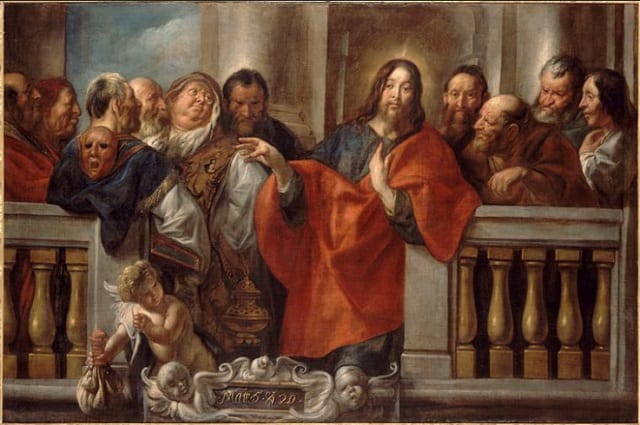
Once again it is time to defend the use of fully warranted biblical humor. This time, it’s over against James Russell, who takes objection to one line in my recent post, Priestly Celibacy as a Discipline: Steve Skojec’s Ignorance: “Reactionary Steve Skojec of One Vader Five infamy . . .” His words will be in blue.
*****
Armstrong’s petulant use of “One Vader Five” is childish and off-putting. He can do better than that.
Harmless sarcasm. Isn’t it interesting that anything goes when it comes to pope-bashing and trashing; literally lying about the Holy Father, which 1P5 does on virtually a daily basis. But try a little bit of gentle play-on-words (which the Bible is full of, along with other sarcasm and parody and satirical material) and it’s Chicken Little . . .
It’s a double standard among reactionaries bigger than the Grand Canyon.
It’s a weakness, not a strength. A vice, not a virtue.
Then Jesus, Paul, Elijah, and God in the Old Testament had it, too. You complain about this? You should see what Skojec writes about me. You wanna see some true insults?
I see a difference here from Biblical examples. I can think of no Biblical example in which it’s deemed okay to simply take either a person’s name or the name of their endeavor and mock it. I do see Biblical evidence for Christians avoiding any speech that intentionally serves merely to tear down another or objectify them.
You weaken your own intellectual arguments each time you resort to language that suggests your animus isn’t merely toward the erroneous claim or assertion, but that the animus also seems to attach to the person.
So in that sense it is harmful because it serves to distract from your actual points. As I said I found it off-putting for this reason. Additionally, you and I have both been the brunt of such supposedly harmless “sarcasm” from others, and the Patheos site is filled with other Catholic writers who regularly engage in this. “Everyone’s doing it” just isn’t a good defense. In this case, it probably should elicit in us a desire to avoid such weaknesses.
Put even more simply–sorry, but I simply cannot see the OT God, Elijah, or Paul, or Jesus referring to One Peter Five as “One Vader Five”….just not the same thing. My two cents.
You ought to be familiar with the biblical use of sarcasm. It’s irrelevant whether a name was made the object of a play-on-words or not. All that matters is whether satire and sarcasm are used in the Bible by those who are our models: Jesus, Paul, etc. And of course it is. It’s not arguable.
In the meantime, it’s a mortal sin to bear false witness: all the more so about a pope. That’s what One Peter Five does all the time. Yet you have nothing better to do than to condemn a simple play-on-words.
I showed in this very article of mine (above) how Skojec spewed falsehood about whether celibacy is essential to the priesthood, and whether it is a discipline. That is serious. The use of “Vader” is extremely mild to describe what Skojec and his site regularly do.
I haven’t called him a viper or a whitewashed tomb. I haven’t made a joke that he should castrate himself . . .
Whatever, Dave. I shared how your words distracted me from your actual point. That you wish to justify yourself here is inconsequential to me.
For the record, there is an important distinction to be made, in my experience at least, between *irony* and “sarcasm.”
I’d defend irony, but as a Christian I would not defend sarcasm directed at persons. .
St. Paul, when he wasn’t telling men to take circumcision to the next level, is the same guy who wrote in Ephesians 4:29 to say only the good things that people really need to hear. And I for one don’t claim to assume the mantle of authority of a prophet, apostle, or Messiah in order to justify mocking and objectifying persons. I’ll mock an erroneous idea with no problem. But creating pejorative pet names for ideological adversaries or their projects doesn’t seem to me to be the “good” that people need to hear. God bless.
And again, I say to you what Jesus said to the Pharisees:
Matthew 23:23 (RSV) “Woe to you, scribes and Pharisees, hypocrites! for you tithe mint and dill and cummin, and have neglected the weightier matters of the law, justice and mercy and faith; these you ought to have done, without neglecting the others.”
Here you are all concerned about one word of mild sarcasm, while you wink at the lies day in and day out, and slander of the Holy Father and Holy Mother Church, that goes on at 1P5. That is a violation of the Ten Commandments, and it breeds disunity and discord. Mine is simply sarcasm that is all over the Bible.
Biblical humor indeed includes mocking as well:
The Bible almost certainly only records part of the humorous taunts Elijah hurls, which were loud enough for the Israelites in attendance to hear. He mocks the prophets by stating, “‘You’ll have to shout louder than that,’ he scoffed, ‘to catch the attention of your god!'” (1Kings 18:27, The Living Bible).
Elijah’s deriding humor hits a crescendo when he offers reasons why Baal does not answer them. He sarcastically shouts, “Perhaps he is talking to someone, or is out SITTING ON THE TOILET, or maybe he is away on a trip, or is asleep and needs to be awakened!” (1Kings 18:27).
The verbal jabs, at the expense of the pagan priests, entail some of the best humor in Scripture. Could Baal’s lack of a response be due to severe constipation that has consigned him to a toilet? Maybe he is in a lengthy conversation that is far more interesting than listening to the whining of his priests. Could it be he is sound asleep? Maybe he needed a break and took a well-earned vacation! Baal certainly seemed too involved in his own self-interests to answer anyone!
Biblical commentators elaborate on this passage:
(27) Elijah mocked them.—The mockery of Elijah—apparently even blunter and more scornful in the sense of the original—has been with over-ingenuity explained as applying to various supposed actions of Baal. It is merely the bitter irony of sheer contempt, calling Baal a god only to heap upon him ideas most ungodlike; “He is busy, or he is in retirement; he is far away, or in the noon-day heat he is asleep.” Characteristic of the fierce indignation of Elijah’s nature, in this crisis of conflict, it is yet not unlike the righteous scorn of the psalmists or the prophets (see Psalm 115:4-8; Psalm 135:15-18; Isaiah 44:9-20; Isaiah 46:1-7; Jeremiah 10:2-10, &c.) for the worship of “the vanities” of the heathen. There was no place for toleration of prejudice, or tender appreciation of a blind worship feeling after God, like that of St. Paul at Athens (Acts 17:22-23). The conflict here was between spiritual worship and a foul, cruel idolatry; and the case was not of heathen ignorance, but of Israel’s apostasy. (Ellicott’s Commentary for English Readers)
The worship of idols being a most ridiculous thing, it is perfectly just to represent it so, and expose it to scorn. And “nothing can be imagined more cutting and sarcastic than these words of the prophet, in which he ridicules, in the finest manner possible, their wretched, false, and derogatory ideas of the Deity. The two last notions of being asleep and not at home, how absurd soever they may be, when applied to the Deity, were certainly such as several idolaters conceived of their gods, as appears from various passages in Homer; in one of which, (Iliad 1. 18:423,) he tells us, that Thetis could not meet with Jupiter, because he was gone abroad, and would not return in less than twelve days; and at the conclusion of that book he gives us an account of the manner in which the gods went to sleep. How debasing ideas these compared with that awful intelligence which revelation gives us of the true God, who neither slumbereth nor sleepeth; but who, everywhere present, is, at all times, conscious even of the secrets of the heart; at all times ready to hear, and able to grant the petitions of his people!” — Dodd. (Benson Commentary)
The drift of the whole passage is scornful ridicule of the anthropomorphic notions of God entertained by the Baal-priests and their followers (compare Psalm 50:21). The pagan gods, as we know from the Greek and Latin classics, ate and drank, went on journeys, slept, conversed, quarrelled, fought. The explanations of many of these absurdities were unknown to the ordinary worshipper, and probably even the most enlightened, if his religion was not a mere vague Pantheism, had notions of the gods which were largely tainted with a false anthropomorphism. (Barnes’ Notes on the Bible)
Elijah mocked them; derided them and their gods, which were indeed, and had now proved themselves to be, ridiculous and contemptible things. By this example we see that all jesting is not unlawful, but only that which intrencheth upon piety and good manners. (Matthew Poole’s Commentary)
R.V. gone aside. The word appears to be used here to express the idea that Baal had withdrawn himself for rest or some other physical necessity. (Cambridge Bible for Schools and Colleges)
Verse 27. – And it came to pass at noon, that Elijah mocked [or deceived] them, and said, Cry aloud [Heb. with a great voice]: for he is a god [i.e., in your estimation. “Here is one of the few examples of irony in Scripture” (Wordsworth)]; either he is talking [the marg. he meditateth is preferable. Cf. 1 Samuel 1:16; Psalm 142:3. But the word has both meanings (see 2 Kings 9:11), fairly preserved in the LXX., ἀδολεσχία αὐτῷ ἐστι], or he is pursuing [Heb. for he hath a withdrawal, i.e., for the purpose of relieving himself. A euphemism. Cf. Judges 3:24; 1 Samuel 24:3. Stanley attempts to preserve the paronomasia, שִׂיג שִׂיח, by the translation, “he has his head full” and “he has his stomach full”], or he is in a Journey [the thrice repeated כִּי must be noticed. It heightens the effect of the mockery], or peradventure he sleepeth [Though it was noon, it is not clear that there is a reference to the usual midday siesta of the East], and must be awaked. (Pulpit Commentary)
God mocks idolaters and other sinners throughout the Old Testament (obviously, then, it can’t be intrinsically wrong). Some examples of many:
Then the woodcarver takes the axe and uses it to make an idol. He measures and marks out a block of wood and carves the figure of a man. Now he has a wonderful idol that can’t so much as move from where it is placed (Isaiah 44:13, Living Bible).
Such stupidity and ignorance! . . . The man never stops to think or figure out, “Why, it’s just a block of wood! I’ve burned it for heat and used it to bake my bread and roast my meat. How can the rest of it be a god? Should I fall down before a chunk of wood?” (Isaiah 44:18 – 19).
Who but a fool would make his own god – an idol that can help him not one whit! (Isaiah 44:9 – 10).
Or, similarly, St. Paul (one of my favorites):
Philippians 3:18-19 (RSV) For many, of whom I have often told you and now tell you even with tears, live as enemies of the cross of Christ. [19] Their end is destruction, their god is the belly, and they glory in their shame, with minds set on earthly things.
“whose god is their belly” [KJV]? That’s not biting mockery and sarcasm? Really? And Paul was the one who said several times that we should imitate him. Equally sarcastic is his passage:
2 Timothy 4:3 For the time is coming when people will not endure sound teaching, but having itching ears they will accumulate for themselves teachers to suit their own likings,
Yes: those in sin are roundly mocked, by Paul, by God, throughout the Proverbs (the biblical “fool”), by the prophets, by Jesus . . . You can ignore all this if you like, simply because it’s not to your taste.
Me, I follow the biblical model all the way.
Yeah, Dave, sorry–I don’t really feel like a Pharisee by telling you that your use of childish name-calling in mature public discourse is off-putting and takes away from your main point.
Feels more like a work of mercy.
Right. I provide Bible. You insult (and thus contradict your already mistaken point).
***
Related Reading
Christianity, Sarcasm, Satire, Irony, Jesus & Paul (1999 and 6-2-07)
Atheism: A Remarkably Strong, Impervious Faith in “Atomism” [8-19-15]
Did Jesus, St. Paul, & the Prophets Use Sarcasm? Yes [8-16-17]
Silent Night: A “Progressive” and “Enlightened” Reinterpretation [National Catholic Register, 12-21-17]
Inept Satire Case Study: Dr. Edward Feser’s “Lexicon” [2-2-18]
***
Photo credit: Christ and the Pharisees (c. 1660), by Jacob Jordaens (1593-1678) [public domain / Wikimedia Commons]

***
Traditionalism vs. Radical Catholic Reactionaries
Previous Post

March 20, 2020
Verrecchio Trashes Pope Benedict as Wicked Lying Hypocrite
Next Post

March 21, 2020 St. Newman vs. Inconsistent Protestant Iconoclasts
Browse Our Archives
Select a Category & Last Things About Me Anti-Catholicism Atheism & Agnosticism Baptism and Sacramentalism Bible and Tradition Blessed Virgin Mary Books by Dave Armstrong C. S. Lewis Calvinism & General Protestantism Catholic Apologetics Catholic Apologists Catholic conversion Catholic converts Christmas Church (Ecclesiology) Church History Conversion and Converts Development of Doctrine Eastern Orthodoxy Ecumenism & Christian Unity Eucharist & Liturgy Fathers of the Church French Translations G. K. Chesterton Hell Hell & Satan Hell & Satan & Last Things Heresies & Comparative Religion Holistic Health Inquisition & Crusades & Scandals James White Jews & Judaism & Old Testament John Calvin John Henry Newman Liberal / Modernist Theology Life Issues Literary Resume Lutheranism Mariology Martin Luther Music Orthodoxy Papacy & Infallibility Personal Page Philosophy & Science Political & Ethical & Moral Issues Protestant Persecution & Intolerance Protestantism Purgatory Purgatory & Penance Romantic & Imaginative Theology Saints & Purgatory & Penance Salvation Salvation & Justification Satan & Last Things Sexuality and Gender Issues Spanish Translations Traditionalism vs. Radical Catholic Reactionaries Traducciones al español / tradução para português Trinitarianism & Christology Uncategorized Videos
Select a Month October 2026 September 2026 August 2026 July 2026 June 2026 May 2026 April 2026 March 2026 February 2026 January 2026 December 2025 November 2025 October 2025 September 2025 August 2025 July 2025 June 2025 May 2025 April 2025 March 2025 February 2025 January 2025 December 2024 November 2024 October 2024 September 2024 August 2024 July 2024 June 2024 May 2024 April 2024 March 2024 February 2024 January 2024 December 2023 November 2023 October 2023 September 2023 August 2023 July 2023 June 2023 May 2023 April 2023 March 2023 February 2023 January 2023 December 2022 November 2022 October 2022 September 2022 August 2022 July 2022 June 2022 May 2022 April 2022 March 2022 February 2022 January 2022 December 2021 November 2021 October 2021 September 2021 August 2021 July 2021 June 2021 May 2021 April 2021 March 2021 February 2021 January 2021 December 2020 November 2020 October 2020 September 2020 August 2020 July 2020 June 2020 May 2020 April 2020 March 2020 February 2020 January 2020 December 2019 November 2019 October 2019 September 2019 August 2019 July 2019 June 2019 May 2019 April 2019 March 2019 February 2019 January 2019 December 2018 November 2018 October 2018 September 2018 August 2018 July 2018 June 2018 May 2018 April 2018 March 2018 February 2018 January 2018 December 2017 November 2017 October 2017 September 2017 August 2017 July 2017 June 2017 May 2017 April 2017 March 2017 February 2017 January 2017 December 2016 November 2016 October 2016 September 2016 August 2016 July 2016 June 2016 May 2016 April 2016 March 2016 February 2016 January 2016 December 2015 November 2015 October 2015 September 2015 August 2015 July 2015 June 2015 May 2015 April 2015 March 2015 February 2015 January 2015 December 2014 November 2014 October 2014 September 2014 August 2014 July 2014 June 2014 April 2014 March 2014 February 2014 January 2014 December 2013 November 2013 October 2013 September 2013 August 2013 July 2013 June 2013 April 2013 March 2013 February 2013 January 2013 December 2012 November 2012 October 2012 September 2012 August 2012 July 2012 June 2012 May 2012 April 2012 March 2012 February 2012 January 2012 December 2011 November 2011 October 2011 September 2011 August 2011 July 2011 June 2011 April 2011 March 2011 February 2011 October 2010 September 2010 August 2010 July 2010 April 2010 March 2010 December 2009 October 2009 August 2009 July 2009 June 2009 May 2009 March 2009 February 2009 October 2008 September 2008 April 2008 March 2008 February 2008 January 2008 December 2007 November 2007 October 2007 May 2007 March 2007 February 2007 January 2007 November 2006 October 2006 September 2006 August 2006 July 2006 June 2006 May 2006 April 2006 March 2006 February 2006 October 2005 June 2005 April 2005 February 2005 July 2004 May 2004 April 2004
Follow Us!
TAKE THE
Religious Wisdom Quiz
What famous cathedral is in Paris, known for its flying buttresses and rose windows?
Select your answer to see how you score.
Notre Dame St. Paul's St. Peter's Canterbury
Books by This Author Books by Dave Armstrong
Related posts from Biblical Evidence for Catholicism

Why Wes Huff (and Everyone) Should Be Catholic
Biblical Evidence for Catholicism

Invocation of Saints: Catholic Scholars vs. Me? Nope!
Biblical Evidence for Catholicism
Foreword: "Ignorance of Things Divine" (Andrew Mioni)
Biblical Evidence for Catholicism

My “Number Articles”: Alphabetized by Topic
Biblical Evidence for Catholicism
TRENDING AT PATHEOS Catholic

In "Irreplaceable," our book on vocation and technology, Trevor Sutton and I...

I was strolling through the top floor of the brand new Parthenon...

What Does Gêvâh Mean For Kimberley Guifoyle &...
This week, a lot of the news is focused on Kimberly Guilfoyle....

INNER CIRCLE: Profound Mystery (Of Christ In All...
Ephesians 5:31-32 “For this reason, a man will leave his father and...

Do Not Rejoice When Your Enemy Falls: The...
Turning an execution into a public spectacle is a disturbing expression of...

'The Chosen' S6 Trailer: The Passion Gets Very...
Not many watching 'The Chosen' worry about spoilers, but just because they...
view all Catholic blogs
Ad-Free & Subscriber Log-In Subscription Support
- About Us
- 2026 Calendar
- Videos
- Podcasts
- Library of World Religions
- Faith In Media Tracker
- Advertise With Us
- Write for Us
- Privacy Policy
- Terms of Service
- Do Not Sell My Data
- Contact Us
- Radiant Digital
- Manage Newsletter Subscriptions
- Unsubscribe From Notifications
- Sitemap
Copyright 2008-2026, Patheos. All rights reserved.
Subscription Support Ad-Free & Subscriber Log-In
Follow Patheos