
BuddhistCatholicContemplativeEvangelicalGeneral ChristianHinduJewishLatter-day SaintMuslimNew VisionsProgressive Christian
Beliefs
- Buddhist
- Catholic
- Contemplative
- Evangelical
- General Christian
- Hindu
- Jewish
- Latter-day Saint
- More Voices
- Muslim
- New Visions
- Pagan
- Progressive Christian
Topics
- Religion News
- Food and Religion
- Sports and Religion
- Religious Art
- Religious Music and Entertainment
- Religious Events
- History and Religion
- Style and Religion
- Politics and Religion
- Women in Religion
- Recreation Outdoors and Religion
- Business Finance and Religion
- Careers Workplace and Religion
- Education and Religion
- Family Parenting and Religion
- Health Fitness and Religion
- Home and Religion
- Relationships and Religion
- Technology and Religion
- Travel and Religion
Columnists
- Buddhist Columnists
- Business Finance and Religion Columnists
- Careers Workplace and Religion Columnists
- Catholic Columnists
- Contemplative Columnists
- Education and Religion Columnists
- Evangelists Columnists
- Family Parenting and Religion Columnists
- General Christian Columnists
- Health Fitness and Religion Columnists
- Hindu Columnists
- History and Religion Columnists
- Home and Religion Columnists
- Jewish Columnists
- More Voices Columnists
- Latter Day Columnists
- Muslim Columnists
- New Visions Columnists
- Nonreligious Columnists
- Pagan Columnists
- Politics and Religion Columnists
- Progressive Columnists
- Recreation Outdoors and Religion Columnists
- Relationships and Religion Columnists
- Religion News Columnists
- Religious Art Columnists
- Religious Events Columnists
- Religious Music and Entertainment Columnists
- Sports and Religion Columnists
- Style and Religion Columnists
- Technology and Religion Columnists
- Travel and Religion Columnists
- Women in Religion Columnists
Resource Library
- 2026 Calendar
- Library of World Religions
- The 100 Most Holy Places on Earth
- Patheos Answers
- Podcasts
- Videos
- Faith Leaders Database
- Anglican Episcopalian
- Bahai
- Baptist
- Buddhism
- Christianity
- Confucianism
- Eastern Orthodoxy
- Hinduism
- Holiness and Pentecostal
- ISKCON
- Islam
- Judaism
- Lutheran
- Methodist
- The Church of Jesus Christ of Latter-day Saints
- New Age
- Paganism
- Presbytarian and Reformed
- Protestantism
- Religion Behind the Scenes
- Roman Catholic
- Scientology
- Shia Islam
- Sikhism
- Sufism
- Sunni Islam
- Taoism
- Zen
- See all religions
Research Tools
 Ad-Free & Subscriber Log-In Subscription Support
Ad-Free & Subscriber Log-In Subscription Support
Follow Patheos 

- Trending:
- Forgiveness
- |
- Marriage
- |
- Consciousness
- |
- Death Penalty
- |
- Election
- |
- Halloween

-
About
-
Catholic Apologetics
-
Church History
-
Great Apologists
-
Christian Worldview
-
Protestantism & Misc.
- Home
- Catholic
- History and Religion
- Salesian Apologetics #6: Papacy (St. Peter the Rock)
Salesian Apologetics #6: Papacy (St. Peter the Rock)
Last updated on: February 7, 2020 at 2:21 pm by Dave Armstrong
Salesian Apologetics #6: Papacy (St. Peter the Rock) 2020-02-07T14:21:53-04:00 Dave Armstrong
Patheos Explore the world's faith through different perspectives on religion and spirituality! Patheos has the views of the prevalent religions and spiritualities of the world.
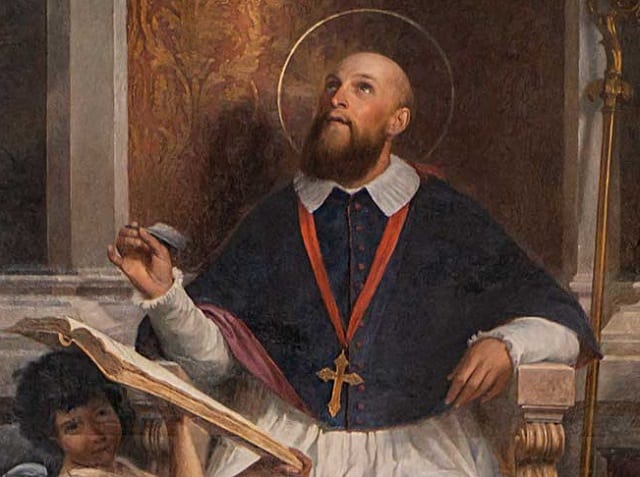
This is one of a series of extensive excerpts (with my occasional commentary) from The Catholic Controversy (1596): a classic of Catholic apologetics (originally a collection of pamphlets), written by St. Francis de Sales (1567-1622): a Doctor of the Church [see all the installments by searching “Salesian Apologetics #” on my blog sidebar search function]. Any comments of mine (apart from lists of related links) will be in blue. The rest is from the online, public domain text (3rd revised edition, New York: Benziger Brothers, 1909; translated by Henry Benedict Mackey, O.S.B.).
What I present is an edited abridgment, designed for modern readers: so I will dispense with the constant tedious use of ellipses (“. . .”). I will cite the section of the book used, so that anyone who desires it may consult the full text and/or particular contexts, patristic references (which I omit), etc. I will follow the custom of my paperback TAN Books edition: of italicizing scriptural passages.
*****
Part II, Article VI: Chapter 1: Of the First Promise Made to St. Peter: “Upon This Rock I Will Build My Church”
When Our Lord imposes a name upon men he always bestows some particular grace according to the name which he gives them. If he changes the name of that great father of believers, and of Abram makes him Abraham, also of a high father he makes him father of many, giving the reason at the same time : Thou shalt he called Abraham ; because I have made thee the father of many nations [Gen 17:5]. And changing that of Sarai into Sara [Gen 17:15], of lady that she was in Abraham’s house, he makes her lady of the nations and peoples who were to be born of her [Gen 17:16]. If he changes Jacob into Israel, the reason is immediately given : For if thou hast been powerful against God, how much more shalt thou prevail against men [Gen 32:28]. So that God by the names which he imposes not only marks the things named, but teaches us something of their qualities and conditions.
Witness the angels, who have names only according to their offices, and S. John Baptist, who has the grace in his name which he announced in his preaching ; as is customary in that holy language of the Israelites. The imposition of the name in the case of S. Peter is no small argument of the particular excellence of his charge, according to the very reason which Our Lord appended : Thou art Peter, &c. But what name does he give him ? A name full of majesty, not common, not trivial, but one expressive of superiority and authority, like unto that of Abraham himself. For if Abraham was thus called because he was to be father of many nations, S. Peter has received this name because upon him as upon a firm rock was to be founded the multitude of Christians. And it is on account of this resemblance that S. Bernard calls the dignity of Peter “patriarchate of Abraham.”
When Isaias would exhort the Jews by the example of Abraham, the stock from which they sprang, he calls Abraham Peter : Look unto Abraham, unto the rock (petram) whence you are hewn ; . . . . look unto Abraham your father ; [Is 51:1-2] where he shows that this name of rock very properly refers to paternal authority. This name is one of Our Lord’s names ; for what name do we find more frequently attributed to the Messias than that of rock ? [Eph 2:20; Ps 117:21; 1 Cor 10:4] This changing and imposition of name is then very worthy of consideration. For the names that God gives are full of power and might. He communicates Peter’s name to him; he has therefore communicated to him some quality corresponding with the name. Our Lord himself is by excellence called the rock, because he is the foundation of the Church, and the corner-stone, the support, and the firmness, of this spiritual edifice : and he has declared that on S. Peter should his Church be built, and that he would establish him in the faith : Confirm thy brethren. [Lk 22:32]
I am well aware that he imposed a name upon the two brothers John and James, Boanerges, the sons of thunder [Mk 3:17]; but this name is not one of superiority or command, but rather of obedience, nor proper or special but common to two, nor, apparently, was it permanent, since they have never since been called by it : it was rather a title of honour, on account of the excellence of their preaching. But in the case of S. Peter he gives a name permanent, full of authority, and so peculiar to him that we may well say : to which of the others hath he said at any time, Thou art Peter ? — showing that S. Peter was superior to the others.
But I will remind you that Our Lord did not change S. Peter’s name, but only added a new name to his old one, perhaps in order that he might remember in his authority what he had been, what his stock was, and that the majesty of the second name might be tempered by the humility of the first, and that if the name of Peter made us recognise him as chief, the name of Simon might tell us that he was not absolute chief, but obeying and subaltern chief, and head-servant. S. Basil seems to have given support to what I am saying, when he said :
Peter denied thrice and was placed in the foundation. Peter had previously not denied, and had been pronounced blessed. He had said : Thou art the Son of the living God [Mt 16:16], and thereupon had heard that he was Peter. The Lord thus returned his praise, because although he was a rock, yet he was not the rock ; for Christ is truly the immovable rock, but Peter on account of the rock. Christ indeed gives his own prerogative to others, yet he gives them not losing them himself, he holds them none the less. He is a rock, and he made a rock ; what is his, he communicates to his servants ; this is the proof of opulence, namely, to have and to give to others.
What does he [Christ] say ? three things ; but we must consider them one after the other : Thou art Peter ; and upon this rock I will build my church ; and the gates of hell shall not prevail against it [Mt 16:18]: he says that Peter was a stone or rock, and that on this rock or this stone he would build his Church.
But here we are in a difficulty : for it is granted that Our Lord has spoken to S. Peter, and of S. Peter as far as this — and upon this rock — but, it is said that in these words he no longer speaks of S. Peter. Now I ask you : — What likelihood is there that Our Lord would have made this grand preface : Blessed art thou Simon Bar-jona ; because flesh and blood hath not revealed it to thee, but my Father who is in heaven: and I say to thee, &c. [Mt 16:17], in order to say no more than : Thou art Peter, — and then suddenly have changed his subject and gone on to speak of something else ? And again, when he says : And on this rock I will build my church [Mt 16:18], — do you not see that he evidently speaks of the rock of which he had previously spoken ? and of what other rock had he spoken but Simon, to whom he had said : Thou art Peter ? But this is the ambiguity which may be causing hesitation in your mind ; you perhaps think that as Peter is now the proper name of a man, it was so then, and that so we transfer the signification of Peter to rock by equivocation of masculine and feminine.
But we do not equivocate here ; for it is but one same word, and taken in the same sense, when Our Lord said to Simon : Thou art Peter, and when he said : and on this rock I will build my church. And this name of Peter was not a proper name of a man, but was only [then] appropriated to Simon Bar-jona. This you will much better understand, if you take it in the language in which Our Lord said it; he spoke not Latin but Syriac. He therefore called him not Peter but Cephas, thus : Thou art Cephas, and on this Cephas I will build : as if one said in Latin : “Thou art saxum, and on this saxum” ; or in French : “Thou art rocher, and on this rocher I will build my church.” Now what doubt remains that it is the same person of whom he says : Thou art Rock, and of whom he says : And on this Rock ? Certainly there is no other Cephas spoken of in all this chapter but Simon.
You will say : — Yes, but the Latin says : Thou art “Petrus”, and not : Thou art “Petra”. But it does not come out so well in Latin as in Greek, because in Latin “Petrus” does not mean exactly the same as “petra”. I have only to add, on this interpretation, that nobody doubts that Our Lord called S. Peter Cephas (for S. John records it most explicitly, and S. Paul, to the Galatians), or that Cephas means a stone or a rock, as S. Jerome says.
In fine, to prove to you that it is really S. Peter of whom it is said : And on this rock, — I bring forward the words that follow. For it is all one to promise him the keys of the kingdom of heaven [Mt 16:19], and to say to him : Upon this rock ; now we cannot doubt that it is S. Peter to whom he promises the keys of the kingdom of heaven, since he says clearly : And to thee will I give the keys of the kingdom of heaven : if therefore we do not wish to disconnect this piece of the Gospel from the preceding and the following words in order to place it elsewhere at our fancy, we cannot believe but that all this is said to S. Peter and of S. Peter : Thou art Peter, and on this rock I will ‘build my church. And this the Catholic Church, when, even according to the admission of the ministers, she was true and pure, has confessed loudly and clearly in the assembly of 630 Bishops at the Council of Chalcedon [in 451].
Let us now see what these words are worth and what they import, (1.) We know that what the head is to a living body, the root to a tree, that the foundation is to a building. Our Lord then, who is comparing his Church to a building, when he says that he will build it on S. Peter, shows that S. Peter will be its foundation-stone, the root of this precious tree, the head of this excellent body. The French call both the building and the family, house, on this principle, that as a house is simply a collection of stones and other materials arranged with order, correspondence and measure, so a family is simply a collection of persons with order and interdependence. It is after this likeness that Our Lord calls his Church a building, and when he makes S. Peter its foundation, he makes him head and superior of this family.
(2.) By these words Our Lord shows the perpetuity and immovableness of this foundation. The stone on which one raises the building is the first, the others rest on it. Other stones may be removed without overthrowing the edifice, but he who takes away the foundation, knocks down the house. If then the gates of hell can in no wise prevail against the Church, they can in no wise prevail against its foundation and head, which they cannot take away and overturn without entirely overturning the whole edifice.
He shows one of the differences there are between S. Peter and himself. For Our Lord is foundation and founder, foundation and builder ; – but S. Peter is only foundation. Our Lord is its Master and Lord in perpetuity ; S. Peter has only the management of it, as we shall explain by and by.
(3.) By these words Our Lord shows that the stones which are not placed and fixed on this foundation are not in the Church, and form no part thereof.
***
Related Reading:
50 New Testament Proofs for Petrine Primacy & the Papacy [1994] [+ French version] [+ Portugese version]
*
Primacy of St. Peter Verified by Protestant Scholars [1994]
*
Is St. Paul Superior to St. Peter? (Dialogue) [1998; expanded 5-13-02]
*
Reply to Critique of “50 NT Proofs for the Papacy” (vs. Jason Engwer) [3-14-02]
*
Refutation of a Satirical “Pauline Papacy” Argument (vs. Jason Engwer) [9-30-03]
*
Refutation of “Catholicism Refuted”: Pt. II (Tradition, Papacy) [12-10-04]
*
Paul Rebuked Peter: Disproof of Papacy? [2007]
*
Biblical & Patristic Basis for the Papacy (vs. Calvin #13) [5-21-09]
*
Peter the “Rock”: Protestant Contra-Catholic Exegetical Bias [7-7-09]
*
Top 20 Biblical Proofs of the Papacy [12-12-15]
*
“No Pope in the New Testament” & Other Such Myths Debunked [1-21-16]
*
50 Biblical Indications of Petrine Primacy and the Papacy [National Catholic Register, 11-20-16]
*
Armstrong vs. Collins & Walls #10: St. Peter & the Papacy [10-21-17]
*
***
*
Unfortunately, Money Trees Do Not Exist: If you have been aided in any way by my work, or think it is valuable and worthwhile, please strongly consider financially supporting it (even $10 / month — a mere 33 cents a day — would be very helpful). I have been a full-time Catholic apologist since Dec. 2001, and have been writing Christian apologetics since 1981 (see my Resume). My work has been proven (by God’s grace alone) to be fruitful, in terms of changing lives (see the tangible evidences from unsolicited “testimonies”). I have to pay my bills like all of you: and have a (homeschooling) wife and two children still at home to provide for, and a mortgage to pay.
*
My book royalties from three bestsellers in the field (published in 2003-2007) have been decreasing, as has my overall income, making it increasingly difficult to make ends meet. I provide over 2700 free articles here, for the purpose of your edification and education, and have written 50 books. It’ll literally be a struggle to survive financially until Dec. 2020, when both my wife and I will be receiving Social Security. If you cannot contribute, I ask for your prayers (and “likes” and links and shares). Thanks!
*
See my information on how to donate (including 100% tax-deductible donations). It’s very simple to contribute to my apostolate via PayPal, if a tax deduction is not needed (my “business name” there is called “Catholic Used Book Service,” from my old bookselling days 17 or so years ago, but send to my email: [email protected]). Another easy way to send and receive money (with a bank account or a mobile phone) is through Zelle. Again, just send to my e-mail address. May God abundantly bless you.
*
***
Photo credit: St. Francis de Sales [Bosco Austalasia / Salesian Journeying with the young]
***
Previous Post
February 6, 2020
Salesian Apologetics #5: Authority of Church Fathers
Next Post

February 8, 2020 Natural Family Planning: Anti-Sex & Anti-Pleasure?
Browse Our Archives
Select a Category & Last Things About Me Anti-Catholicism Atheism & Agnosticism Baptism and Sacramentalism Bible and Tradition Blessed Virgin Mary Books by Dave Armstrong C. S. Lewis Calvinism & General Protestantism Catholic Apologetics Catholic Apologists Catholic conversion Catholic converts Christmas Church (Ecclesiology) Church History Conversion and Converts Development of Doctrine Eastern Orthodoxy Ecumenism & Christian Unity Eucharist & Liturgy Fathers of the Church French Translations G. K. Chesterton Hell Hell & Satan Hell & Satan & Last Things Heresies & Comparative Religion Holistic Health Inquisition & Crusades & Scandals James White Jews & Judaism & Old Testament John Calvin John Henry Newman Liberal / Modernist Theology Life Issues Literary Resume Lutheranism Mariology Martin Luther Music Orthodoxy Papacy & Infallibility Personal Page Philosophy & Science Political & Ethical & Moral Issues Protestant Persecution & Intolerance Protestantism Purgatory Purgatory & Penance Romantic & Imaginative Theology Saints & Purgatory & Penance Salvation Salvation & Justification Satan & Last Things Sexuality and Gender Issues Spanish Translations Traditionalism vs. Radical Catholic Reactionaries Traducciones al español / tradução para português Trinitarianism & Christology Uncategorized Videos
Select a Month October 2026 September 2026 August 2026 July 2026 June 2026 May 2026 April 2026 March 2026 February 2026 January 2026 December 2025 November 2025 October 2025 September 2025 August 2025 July 2025 June 2025 May 2025 April 2025 March 2025 February 2025 January 2025 December 2024 November 2024 October 2024 September 2024 August 2024 July 2024 June 2024 May 2024 April 2024 March 2024 February 2024 January 2024 December 2023 November 2023 October 2023 September 2023 August 2023 July 2023 June 2023 May 2023 April 2023 March 2023 February 2023 January 2023 December 2022 November 2022 October 2022 September 2022 August 2022 July 2022 June 2022 May 2022 April 2022 March 2022 February 2022 January 2022 December 2021 November 2021 October 2021 September 2021 August 2021 July 2021 June 2021 May 2021 April 2021 March 2021 February 2021 January 2021 December 2020 November 2020 October 2020 September 2020 August 2020 July 2020 June 2020 May 2020 April 2020 March 2020 February 2020 January 2020 December 2019 November 2019 October 2019 September 2019 August 2019 July 2019 June 2019 May 2019 April 2019 March 2019 February 2019 January 2019 December 2018 November 2018 October 2018 September 2018 August 2018 July 2018 June 2018 May 2018 April 2018 March 2018 February 2018 January 2018 December 2017 November 2017 October 2017 September 2017 August 2017 July 2017 June 2017 May 2017 April 2017 March 2017 February 2017 January 2017 December 2016 November 2016 October 2016 September 2016 August 2016 July 2016 June 2016 May 2016 April 2016 March 2016 February 2016 January 2016 December 2015 November 2015 October 2015 September 2015 August 2015 July 2015 June 2015 May 2015 April 2015 March 2015 February 2015 January 2015 December 2014 November 2014 October 2014 September 2014 August 2014 July 2014 June 2014 April 2014 March 2014 February 2014 January 2014 December 2013 November 2013 October 2013 September 2013 August 2013 July 2013 June 2013 April 2013 March 2013 February 2013 January 2013 December 2012 November 2012 October 2012 September 2012 August 2012 July 2012 June 2012 May 2012 April 2012 March 2012 February 2012 January 2012 December 2011 November 2011 October 2011 September 2011 August 2011 July 2011 June 2011 April 2011 March 2011 February 2011 October 2010 September 2010 August 2010 July 2010 April 2010 March 2010 December 2009 October 2009 August 2009 July 2009 June 2009 May 2009 March 2009 February 2009 October 2008 September 2008 April 2008 March 2008 February 2008 January 2008 December 2007 November 2007 October 2007 May 2007 March 2007 February 2007 January 2007 November 2006 October 2006 September 2006 August 2006 July 2006 June 2006 May 2006 April 2006 March 2006 February 2006 October 2005 June 2005 April 2005 February 2005 July 2004 May 2004 April 2004
Follow Us!
TAKE THE
Religious Wisdom Quiz
Who fell out of a window and was restored to life by Paul?
Select your answer to see how you score.
Silas Barnabas Eutychus Timothy
Books by This Author Books by Dave Armstrong
Related posts from Biblical Evidence for Catholicism

Was Peter "Any Old" Apostle? 10 Anti-Papal Arguments
Biblical Evidence for Catholicism

Jesus Founded the [Catholic] Church. If Not Him,...
Biblical Evidence for Catholicism

11 Protestant Objections to Papal Authority Debunked
Biblical Evidence for Catholicism

Matthew 16 & the Papacy (vs. Patrick O'Brien)
Biblical Evidence for Catholicism
TRENDING AT PATHEOS Catholic

In "Irreplaceable," our book on vocation and technology, Trevor Sutton and I...

I was strolling through the top floor of the brand new Parthenon...

What Does Gêvâh Mean For Kimberley Guifoyle &...
This week, a lot of the news is focused on Kimberly Guilfoyle....

INNER CIRCLE: Profound Mystery (Of Christ In All...
Ephesians 5:31-32 “For this reason, a man will leave his father and...

Do Not Rejoice When Your Enemy Falls: The...
Turning an execution into a public spectacle is a disturbing expression of...

'The Chosen' S6 Trailer: The Passion Gets Very...
Not many watching 'The Chosen' worry about spoilers, but just because they...
view all Catholic blogs
Ad-Free & Subscriber Log-In Subscription Support
- About Us
- 2026 Calendar
- Videos
- Podcasts
- Library of World Religions
- Faith In Media Tracker
- Advertise With Us
- Write for Us
- Privacy Policy
- Terms of Service
- Do Not Sell My Data
- Contact Us
- Radiant Digital
- Manage Newsletter Subscriptions
- Unsubscribe From Notifications
- Sitemap
Copyright 2008-2026, Patheos. All rights reserved.
Subscription Support Ad-Free & Subscriber Log-In
Follow Patheos