
BuddhistCatholicContemplativeEvangelicalGeneral ChristianHinduJewishLatter-day SaintMuslimNew VisionsProgressive Christian
Beliefs
- Buddhist
- Catholic
- Contemplative
- Evangelical
- General Christian
- Hindu
- Jewish
- Latter-day Saint
- More Voices
- Muslim
- New Visions
- Pagan
- Progressive Christian
Topics
- Religion News
- Food and Religion
- Sports and Religion
- Religious Art
- Religious Music and Entertainment
- Religious Events
- History and Religion
- Style and Religion
- Politics and Religion
- Women in Religion
- Recreation Outdoors and Religion
- Business Finance and Religion
- Careers Workplace and Religion
- Education and Religion
- Family Parenting and Religion
- Health Fitness and Religion
- Home and Religion
- Relationships and Religion
- Technology and Religion
- Travel and Religion
Columnists
- Buddhist Columnists
- Business Finance and Religion Columnists
- Careers Workplace and Religion Columnists
- Catholic Columnists
- Contemplative Columnists
- Education and Religion Columnists
- Evangelists Columnists
- Family Parenting and Religion Columnists
- General Christian Columnists
- Health Fitness and Religion Columnists
- Hindu Columnists
- History and Religion Columnists
- Home and Religion Columnists
- Jewish Columnists
- More Voices Columnists
- Latter Day Columnists
- Muslim Columnists
- New Visions Columnists
- Nonreligious Columnists
- Pagan Columnists
- Politics and Religion Columnists
- Progressive Columnists
- Recreation Outdoors and Religion Columnists
- Relationships and Religion Columnists
- Religion News Columnists
- Religious Art Columnists
- Religious Events Columnists
- Religious Music and Entertainment Columnists
- Sports and Religion Columnists
- Style and Religion Columnists
- Technology and Religion Columnists
- Travel and Religion Columnists
- Women in Religion Columnists
Resource Library
- 2026 Calendar
- Library of World Religions
- The 100 Most Holy Places on Earth
- Patheos Answers
- Podcasts
- Videos
- Faith Leaders Database
- Anglican Episcopalian
- Bahai
- Baptist
- Buddhism
- Christianity
- Confucianism
- Eastern Orthodoxy
- Hinduism
- Holiness and Pentecostal
- ISKCON
- Islam
- Judaism
- Lutheran
- Methodist
- The Church of Jesus Christ of Latter-day Saints
- New Age
- Paganism
- Presbytarian and Reformed
- Protestantism
- Religion Behind the Scenes
- Roman Catholic
- Scientology
- Shia Islam
- Sikhism
- Sufism
- Sunni Islam
- Taoism
- Zen
- See all religions
Research Tools
 Ad-Free & Subscriber Log-In Subscription Support
Ad-Free & Subscriber Log-In Subscription Support
Follow Patheos 

- Trending:
- Forgiveness
- |
- Marriage
- |
- Consciousness
- |
- Death Penalty
- |
- Election
- |
- Halloween

-
About
-
Catholic Apologetics
-
Church History
-
Great Apologists
-
Christian Worldview
-
Protestantism & Misc.
- Home
- Catholic
- History and Religion
- Salesian Apologetics #1: Indefectibility of the Church
Salesian Apologetics #1: Indefectibility of the Church
Last updated on: February 6, 2020 at 1:04 pm by Dave Armstrong
Salesian Apologetics #1: Indefectibility of the Church 2020-02-06T13:04:43-04:00 Dave Armstrong
Patheos Explore the world's faith through different perspectives on religion and spirituality! Patheos has the views of the prevalent religions and spiritualities of the world.
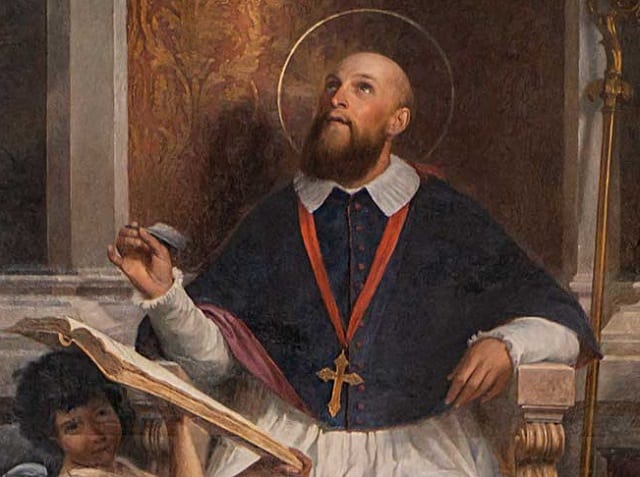
This is one of a series of extensive excerpts (with my occasional commentary) from The Catholic Controversy (1596): a classic of Catholic apologetics (originally a collection of pamphlets), written by St. Francis de Sales (1567-1622): a Doctor of the Church [see all the installments by searching “Salesian Apologetics #” on my blog sidebar search function]. Any comments of mine (apart from lists of related links) will be in blue. The rest is from the online, public domain text (3rd revised edition, New York: Benziger Brothers, 1909; translated by Henry Benedict Mackey, O.S.B.).
What I present is an edited abridgment, designed for modern readers: so I will dispense with the constant tedious use of ellipses (“. . .”). I will cite the section of the book used, so that anyone who desires it may consult the full text and/or particular contexts, patristic references (which I omit), etc. I will follow the custom of my paperback TAN Books edition: of italicizing scriptural passages.
*****
Part I, Chapter 9: That the Church cannot perish
Are you ignorant that Our Lord has purchased the Church with His own Blood ? [Acts 20:28] — and who can take it from him ? Think you that he is weaker than his adversary ? Ah ! I pray you, speak honourably of this captain. And who then shall snatch his Church out of his hands ? Perhaps you will say he is one who can keep it, but who will not. It is then his Providence, his goodness, his truth that you attack. The goodness of God has given gifts to men as he ascends to heaven . . . apostles, prophets, evangelists, pastors, doctors — for the perfection of the saints in the work of the ministry unto the edification of the body of Christ (Eph. iv. 12).
Was the perfection of the saints already accomplished eleven or twelve hundred years ago ? Had the edification of the mystical body of our Lord, that is, the Church, been completed ? Either cease to call yourselves edifiers or answer no : — and if it has not been completed, as in fact it has not, even yet, why wrong you thus the goodness of God, saying that he has taken back and carried away from men what he had given them ? It is one of the qualities of the goodness of God that, as S. Paul says (Rom. xi. 29) his gifts are without repentance : that is to say, he does not give in order to take away.
His divine Providence, as soon as it had created man, the heavens, the earth, and the things that are in heaven and on earth, preserved them and perpetually preserves them, in such a way that the species of each tiniest bird is not yet extinct. What then shall we say of the Church ? All this world cost him at the dearest but a simple word : he spoke and all were made (Ps. cxlviii. 5) ; and he preserves it with a perpetual and infallible Providence. How, I ask you, should he have abandoned the Church, which cost him all his blood, so many toils and travails ? He has drawn Israel out of Egypt, out of the desert, out of the Red Sea, out of so many calamities and captivities; — and we are to believe that he has let Christianity be engulfed in infidelity !
It is of the Church that the Psalmist sings : God hath founded it for ever (xlvii. 9) ; In his days shall justice spring up, and abundance of peace, till the moon be taken away for ever (Ixxi. 7). What peace, what justice, except in the Church ? His throne (he is speaking in the person of the eternal Father, of the Church, which is the throne of the Messiah, David’s son) shall he as the sun before me, and as the moon perfect for ever, and a faithful witness in heaven (Ixxxviii. 38). And: I will make his seed to endure for evermore; and his throne as the days of heaven (30) ; — that is, as long as heaven shall endure. Daniel (ii. 44) calls it: A kingdom which shall not he destroyed for ever. The angel says to Our Lady that of his kingdom there shall be no end (Luke i. 33), and he is speaking of the Church, as we prove elsewhere. Did not Isaias prophesy ([Is] Ixi. 8) : I will make a perpetual covenant with them ?
Is it not Our Lord who, speaking of his Church, says that the gates of hell shall not prevail against it [Mt 16:18]? How shall this promise be verified if the Church has been abolished a thousand years or more ? Or do we really wish to violate the sound rule of Gamaliel, who speaking of the rising Church used this argument : If this design or work be of men, it will fall to nothing ; but if it be of God, you are not able to destroy it (Acts v. 38, 39) ? Is not the Church the work of God ? — and how then shall we say that it has come to nothing ?
If this fair tree of the Church had been planted by man’s hand I would easily acknowledge that it could be rooted up, but having been planted by so good a hand as is that of our Lord, I could not offer better counsel to those who hear people crying at every turn that the Church had perished than what our Lord said : Let these blind people alone, for every plant which God hath not planted shall he rooted up (Matt. XV. 13, 14).
“O impudent cry ! ” says S. Augustine against the Donatists, ” the Church is not, because you are not in it ! ” ” No, no,” says S. Bernard, ” the floods came, and the winds blew, and they heat upon that house, and it fell not ; for it was founded upon a rock (Matt. vii. 25), and the rock was Christ (I Cor. x. 4).”
I will conclude this proof with S. Augustine, and say to your ministers :
What do you bring us new ? Shall it be necessary to sow again the good seed, whereas from the time of its sowing it is to grow till the harvest ? If you say that what the Apostles sowed has everywhere perished, we answer to you : read this to us from the Holy Scriptures : this you shall never do without having first shown us that this is false which is written, saying, that the seed which was sown in the beginning should grow till the time of the harvest. The good seed is the children of the kingdom, the cockle is the wicked, the harvest is the end of the world (Matt. xiii.). Say not then that the good seed is destroyed or choked, for it grows even to the consummation of the world.
Part I, Chapter 10: The counter- arguments of our adversaries, and the answers thereto.
(i.) Was not the Church everywhere destroyed when Adam and Eve sinned ? Answer : Adam and Eve were not the Church, but the commencement of the Church. And it is not true that the Church was ruined then, or yet that it had been, because they did not sin in doctrine or belief but in act.
(2.) Did not Aaron the High Priest adore the golden calf with all his people ? Answer : Aaron was not as yet High Priest, nor head of the people, but became so afterwards. And it is not true that all the people worshipped idols : — for were not the children of Levi men of God, who joined themselves to Moses ?
(3.) Elias [Elijah] lamented that he was alone in Israel (3 K. [1 Kings] xix. 14). Answer: Elias was not the only good man in Israel, for there were seven thousand men who had not given themselves up to idolatry, and what the Prophet says here is only to express better the justice of his complaint. It is not true again that if all Israel had failed, the Church would have there- by ceased to exist, for Israel was not the whole Church. Indeed it was already separated therefrom by the schism of Jeroboam ; and the kingdom of Juda was the better and principal part ; and it is Israel, not Juda, of which Azarias predicted (II Par. [2 Chronicles] xv. 3), that it should be without priest and sacrifice.
(4.) Isaias says (i. 6) that from head to foot there is no soundness. Answer : these are forms of speaking, and of vehemently detesting the vice of a people. And although the Prophets, pastors and preachers use these general modes of expression, we are not to understand them of each particular person, but only of a large proportion ; as appears by the example of Elias who complained that he was alone, notwithstanding that there were yet seven thousand faithful. S. Paul complains to the Philippians (ii. 21) that all seek their own interest and advantage ; still at the end of the Epistle he acknowledges that there were many good people with him and with them. Who knows not the complaint of David (Ps. xiii. 3), that there is none that doth good, no, not one ? — and who knows not on the other hand that there were many good people in his day ? These forms of speech are frequent, but we must not draw a particular conclusion about each individual. Further, — such things do not prove that faith had failed in the Church, nor that the Church was dead : for it does not follow that if a body is everywhere diseased it is therefore dead. Thus, without doubt, are to be understood all similar things which are found in the threats and rebukes of the Prophets.
(5.) Jeremias tells us (vii. 4) not to trust in lying words, saying : the Temple of the Lord, the Temple of the Lord. Answer : who maintains that under pretence of the Church we are to trust to a lie ? Yea, on the contrary, he who rests on the judgment of the Church rests on the pillar and ground of truth [1 Tim 3:15]; he who trusts to the infallibility of the Church trusts to no lie, unless that is a lie which is written : the gates of hell shall not prevail against it [Mt 16:18]. We place our trust then in the Holy Word, which promises perpetuity to the Church.
(6.) Is it not written that the revolt and separation must come (2 Thess. ii. 3), and that the sacrifice shall cease (Dan. xii. 11), and that the Son of Man shall hardly find faith on earth at his second visible return (Luke xviii. 8), when he will come to judge ? Answer : all these passages are understood of the affliction which antichrist will cause in the Church, during the three and a half years that he shall reign mightily ; but in spite of this the Church during even these three years shall not fail, and shall be fed and preserved amid the deserts and solitudes whither it shall retire, as the Scripture says (Apoc. xii.).
***
Related Reading:
“Could the Catholic Church Go Off the Rails?” (Indefectibility) [1997]
Indefectibility of Holy Mother Church: Believe It Or Not [2002]
Indefectibility: Does God Protect His Church from Doctrinal Error? [11-1-05; abridged and reformulated a bit on 2-14-17]
“The Gates of Hell Shall Not Prevail” Against the Church [11-11-08]
Indefectibility of the One True Church (vs. Calvin #9) [5-16-09]
Indefectibility & Apostolic Succession (vs. Calvin #10) [5-18-09]
Dialogue with a Lutheran on Ecclesiology & Old Testament Indefectibility Analogies [11-22-11]
The Bible on the Indefectibility of the Church [2013]
Michael Voris’ Ultra-Pessimistic Views Regarding the Church [7-3-13]
Critique of Three Michael Voris Statements Regarding the State of the Church [7-3-13]
Indefectibility, Fear, & the Synod on the Family [9-30-15]
Quasi-Defectibility and Phil Lawler vs. Pope Francis (see also more documentation of Lawler’s reactionary leanings, on the Facebook thread) [12-28-17]
***
Unfortunately, Money Trees Do Not Exist: If you have been aided in any way by my work, or think it is valuable and worthwhile, please strongly consider financially supporting it (even $10 / month — a mere 33 cents a day — would be very helpful). I have been a full-time Catholic apologist since Dec. 2001, and have been writing Christian apologetics since 1981 (see my Resume). My work has been proven (by God’s grace alone) to be fruitful, in terms of changing lives (see the tangible evidences from unsolicited “testimonies”). I have to pay my bills like all of you: and have a (homeschooling) wife and two children still at home to provide for, and a mortgage to pay.
*
My book royalties from three bestsellers in the field (published in 2003-2007) have been decreasing, as has my overall income, making it increasingly difficult to make ends meet. I provide over 2700 free articles here, for the purpose of your edification and education, and have written 50 books. It’ll literally be a struggle to survive financially until Dec. 2020, when both my wife and I will be receiving Social Security. If you cannot contribute, I ask for your prayers (and “likes” and links and shares). Thanks!
*
See my information on how to donate (including 100% tax-deductible donations). It’s very simple to contribute to my apostolate via PayPal, if a tax deduction is not needed (my “business name” there is called “Catholic Used Book Service,” from my old bookselling days 17 or so years ago, but send to my email: [email protected]). Another easy way to send and receive money (with a bank account or a mobile phone) is through Zelle. Again, just send to my e-mail address. May God abundantly bless you.
*
***
Photo credit: St. Francis de Sales [Bosco Austalasia / Salesian Journeying with the young]
***
Previous Post
February 1, 2020
Is Bestiality a Secular Sex Reductio ad Absurdum?
Next Post
February 5, 2020 Salesian Apologetics #2: Biblical Apostolic Tradition
Browse Our Archives
Select a Category & Last Things About Me Anti-Catholicism Atheism & Agnosticism Baptism and Sacramentalism Bible and Tradition Blessed Virgin Mary Books by Dave Armstrong C. S. Lewis Calvinism & General Protestantism Catholic Apologetics Catholic Apologists Catholic conversion Catholic converts Christmas Church (Ecclesiology) Church History Conversion and Converts Development of Doctrine Eastern Orthodoxy Ecumenism & Christian Unity Eucharist & Liturgy Fathers of the Church French Translations G. K. Chesterton Hell Hell & Satan Hell & Satan & Last Things Heresies & Comparative Religion Holistic Health Inquisition & Crusades & Scandals James White Jews & Judaism & Old Testament John Calvin John Henry Newman Liberal / Modernist Theology Life Issues Literary Resume Lutheranism Mariology Martin Luther Music Orthodoxy Papacy & Infallibility Personal Page Philosophy & Science Political & Ethical & Moral Issues Protestant Persecution & Intolerance Protestantism Purgatory Purgatory & Penance Romantic & Imaginative Theology Saints & Purgatory & Penance Salvation Salvation & Justification Satan & Last Things Sexuality and Gender Issues Spanish Translations Traditionalism vs. Radical Catholic Reactionaries Traducciones al español / tradução para português Trinitarianism & Christology Uncategorized Videos
Select a Month October 2026 September 2026 August 2026 July 2026 June 2026 May 2026 April 2026 March 2026 February 2026 January 2026 December 2025 November 2025 October 2025 September 2025 August 2025 July 2025 June 2025 May 2025 April 2025 March 2025 February 2025 January 2025 December 2024 November 2024 October 2024 September 2024 August 2024 July 2024 June 2024 May 2024 April 2024 March 2024 February 2024 January 2024 December 2023 November 2023 October 2023 September 2023 August 2023 July 2023 June 2023 May 2023 April 2023 March 2023 February 2023 January 2023 December 2022 November 2022 October 2022 September 2022 August 2022 July 2022 June 2022 May 2022 April 2022 March 2022 February 2022 January 2022 December 2021 November 2021 October 2021 September 2021 August 2021 July 2021 June 2021 May 2021 April 2021 March 2021 February 2021 January 2021 December 2020 November 2020 October 2020 September 2020 August 2020 July 2020 June 2020 May 2020 April 2020 March 2020 February 2020 January 2020 December 2019 November 2019 October 2019 September 2019 August 2019 July 2019 June 2019 May 2019 April 2019 March 2019 February 2019 January 2019 December 2018 November 2018 October 2018 September 2018 August 2018 July 2018 June 2018 May 2018 April 2018 March 2018 February 2018 January 2018 December 2017 November 2017 October 2017 September 2017 August 2017 July 2017 June 2017 May 2017 April 2017 March 2017 February 2017 January 2017 December 2016 November 2016 October 2016 September 2016 August 2016 July 2016 June 2016 May 2016 April 2016 March 2016 February 2016 January 2016 December 2015 November 2015 October 2015 September 2015 August 2015 July 2015 June 2015 May 2015 April 2015 March 2015 February 2015 January 2015 December 2014 November 2014 October 2014 September 2014 August 2014 July 2014 June 2014 April 2014 March 2014 February 2014 January 2014 December 2013 November 2013 October 2013 September 2013 August 2013 July 2013 June 2013 April 2013 March 2013 February 2013 January 2013 December 2012 November 2012 October 2012 September 2012 August 2012 July 2012 June 2012 May 2012 April 2012 March 2012 February 2012 January 2012 December 2011 November 2011 October 2011 September 2011 August 2011 July 2011 June 2011 April 2011 March 2011 February 2011 October 2010 September 2010 August 2010 July 2010 April 2010 March 2010 December 2009 October 2009 August 2009 July 2009 June 2009 May 2009 March 2009 February 2009 October 2008 September 2008 April 2008 March 2008 February 2008 January 2008 December 2007 November 2007 October 2007 May 2007 March 2007 February 2007 January 2007 November 2006 October 2006 September 2006 August 2006 July 2006 June 2006 May 2006 April 2006 March 2006 February 2006 October 2005 June 2005 April 2005 February 2005 July 2004 May 2004 April 2004
Follow Us!
TAKE THE
Religious Wisdom Quiz
What was Paul’s profession before becoming an apostle?
Select your answer to see how you score.
Tentmaker Tax Collector Fisherman Carpenter
Books by This Author Books by Dave Armstrong
Related posts from Biblical Evidence for Catholicism

Jesus Founded the [Catholic] Church. If Not Him,...
Biblical Evidence for Catholicism

Jerusalem Council vs. James White & Sola Scriptura
Biblical Evidence for Catholicism

Apostolic Succession: 40 Biblical Arguments
Biblical Evidence for Catholicism

350 Bible Passages vs. Sola Scriptura
Biblical Evidence for Catholicism
TRENDING AT PATHEOS Catholic

I was strolling through the top floor of the brand new Parthenon...

What Does Gêvâh Mean For Kimberley Guifoyle &...
This week, a lot of the news is focused on Kimberly Guilfoyle....

INNER CIRCLE: Profound Mystery (Of Christ In All...
Ephesians 5:31-32 “For this reason, a man will leave his father and...

Do Not Rejoice When Your Enemy Falls: The...
Turning an execution into a public spectacle is a disturbing expression of...

'The Chosen' S6 Trailer: The Passion Gets Very...
Not many watching 'The Chosen' worry about spoilers, but just because they...

The purpose-driven labor priest
A labor activist reads Rick Warren and it gets me wondering about...
view all Catholic blogs
Ad-Free & Subscriber Log-In Subscription Support
- About Us
- 2026 Calendar
- Videos
- Podcasts
- Library of World Religions
- Faith In Media Tracker
- Advertise With Us
- Write for Us
- Privacy Policy
- Terms of Service
- Do Not Sell My Data
- Contact Us
- Radiant Digital
- Manage Newsletter Subscriptions
- Unsubscribe From Notifications
- Sitemap
Copyright 2008-2026, Patheos. All rights reserved.
Subscription Support Ad-Free & Subscriber Log-In
Follow Patheos