
BuddhistCatholicContemplativeEvangelicalGeneral ChristianHinduJewishLatter-day SaintMuslimNew VisionsProgressive Christian
Beliefs
- Buddhist
- Catholic
- Contemplative
- Evangelical
- General Christian
- Hindu
- Jewish
- Latter-day Saint
- More Voices
- Muslim
- New Visions
- Pagan
- Progressive Christian
Topics
- Religion News
- Food and Religion
- Sports and Religion
- Religious Art
- Religious Music and Entertainment
- Religious Events
- History and Religion
- Style and Religion
- Politics and Religion
- Women in Religion
- Recreation Outdoors and Religion
- Business Finance and Religion
- Careers Workplace and Religion
- Education and Religion
- Family Parenting and Religion
- Health Fitness and Religion
- Home and Religion
- Relationships and Religion
- Technology and Religion
- Travel and Religion
Columnists
- Buddhist Columnists
- Business Finance and Religion Columnists
- Careers Workplace and Religion Columnists
- Catholic Columnists
- Contemplative Columnists
- Education and Religion Columnists
- Evangelists Columnists
- Family Parenting and Religion Columnists
- General Christian Columnists
- Health Fitness and Religion Columnists
- Hindu Columnists
- History and Religion Columnists
- Home and Religion Columnists
- Jewish Columnists
- More Voices Columnists
- Latter Day Columnists
- Muslim Columnists
- New Visions Columnists
- Nonreligious Columnists
- Pagan Columnists
- Politics and Religion Columnists
- Progressive Columnists
- Recreation Outdoors and Religion Columnists
- Relationships and Religion Columnists
- Religion News Columnists
- Religious Art Columnists
- Religious Events Columnists
- Religious Music and Entertainment Columnists
- Sports and Religion Columnists
- Style and Religion Columnists
- Technology and Religion Columnists
- Travel and Religion Columnists
- Women in Religion Columnists
Resource Library
- 2026 Calendar
- Library of World Religions
- The 100 Most Holy Places on Earth
- Patheos Answers
- Podcasts
- Videos
- Faith Leaders Database
- Anglican Episcopalian
- Bahai
- Baptist
- Buddhism
- Christianity
- Confucianism
- Eastern Orthodoxy
- Hinduism
- Holiness and Pentecostal
- ISKCON
- Islam
- Judaism
- Lutheran
- Methodist
- The Church of Jesus Christ of Latter-day Saints
- New Age
- Paganism
- Presbytarian and Reformed
- Protestantism
- Religion Behind the Scenes
- Roman Catholic
- Scientology
- Shia Islam
- Sikhism
- Sufism
- Sunni Islam
- Taoism
- Zen
- See all religions
Research Tools
 Ad-Free & Subscriber Log-In Subscription Support
Ad-Free & Subscriber Log-In Subscription Support
Follow Patheos 

- Trending:
- Forgiveness
- |
- Marriage
- |
- Consciousness
- |
- Death Penalty
- |
- Election
- |
- Halloween

-
About
-
Catholic Apologetics
-
Church History
-
Great Apologists
-
Christian Worldview
-
Protestantism & Misc.
- Home
- Catholic
- History and Religion
- Seidensticker Folly #36: Disease, Jesus, Paul, Miracles, & Demons
Seidensticker Folly #36: Disease, Jesus, Paul, Miracles, & Demons
Last updated on: June 5, 2026 at 11:55 pm by Dave Armstrong
Seidensticker Folly #36: Disease, Jesus, Paul, Miracles, & Demons 2026-06-05T23:55:51-04:00 Dave Armstrong
Patheos Explore the world's faith through different perspectives on religion and spirituality! Patheos has the views of the prevalent religions and spiritualities of the world.
Atheist and anti-theist Bob Seidensticker, who was “raised Presbyterian”, runs the influential Cross Examined blog. He asked me there, on 8-11-18: “I’ve got 1000+ posts here attacking your worldview. You just going to let that stand? Or could you present a helpful new perspective that I’ve ignored on one or two of those posts?” He also made a general statement on 6-22-17: “Christians’ arguments are easy to refute . . . I’ve heard the good stuff, and it’s not very good.” He added in the combox: “If I’ve misunderstood the Christian position or Christian arguments, point that out. Show me where I’ve mischaracterized them.”
Such confusion would indeed be predictable, seeing that Bob himself admitted (2-13-16): “My study of the Bible has been haphazard, and I jump around based on whatever I’m researching at the moment.” I’m always one to oblige people’s wishes if I am able, so I decided to do a series of posts in reply. It’s also been said, “be careful what you wish for.” If Bob responds to this post, and makes me aware of it, his reply will be added to the end along with my counter-reply. If you don’t see that, rest assured that he either hasn’t replied, or didn’t inform me that he did. But don’t hold your breath.
Bob (for the record) virtually begged and pleaded with me to dialogue with him in May 2018, via email. But by 10-3-18, following massive, childish name-calling attacks against me, encouraged by Bob on his blog (just prior to his banning me from it), his opinion was as follows: “Dave Armstrong . . . made it clear that a thoughtful intellectual conversation wasn’t his goal. . . . [I] have no interest in what he’s writing about.”
And on 10-25-18, utterly oblivious to the ludicrous irony of his making the statement, Bob wrote in a combox on his blog: “The problem, it seems to me, is when someone gets these clues, like you, but ignores them. I suppose the act of ignoring could be deliberate or just out of apathy, but someone who’s not a little bit driven to investigate cognitive dissonance will just stay a Christian, fat ‘n sassy and ignorant.” Again, Bob mocks some Christian in his combox on 10-27-18: “You can’t explain it to us, you can’t defend it, you can’t even defend it to yourself. Defend your position or shut up about it. It’s clear you have nothing.” And again on the same day: “If you can’t answer the question, man up and say so.” And on 10-26-18: “you refuse to defend it, after being asked over and over again.” And again: “You’re the one playing games, equivocating, and being unable to answer the challenges.”
Bob’s cowardly hypocrisy knows no bounds. Again, on 6-30-19, he was chiding someone who (very much like he himself and my 35 critiques) was (to hear him tell it) not backing up his position: “Spoken like a true weasel trying to run away from a previous argument. You know, you could just say, ‘Let me retract my previous statement of X’ or something like that.” Yeah, Bob could! He still hasn’t yet uttered one peep in reply to — now — 35 of my critiques of his atrocious reasoning. As of 7-9-19, this is how Bob absurdly rationalizes his non-response to these 35 articles: “He’s written several blog posts titled, in effect, ‘In Which Bob Seidensticker Was Mean to Me.’ Normally, I’d enjoy a semi-thoughtful debate, but I’m sure they weren’t.”
Bible-Basher Bob’s words will be in blue. To find these posts, word-search “Seidensticker” on my atheist page or search “Seidensticker Folly #” in my sidebar search (near the top).
*****
Bob’s article, “Jesus Thought Demons Cause Disease (Doctors Disagree)” [1-3-20] is a virtual encyclopedic catalogue of lies, whoppers, distortions, misrepresentations, cynically ignoring of relevant texts, and half-truths regarding Jesus and biblical teaching. Apologists (of which I am one) dream at night about finding such articles: that we can systematically refute and dismantle, so that Christianity and the Bible can be vindicated again for the umpteenth time, and the imbecilities of anti-theist Bible-bashing atheism can be yet again exposed for what they are. This is a gift!
Jesus cured disease with exorcisms.
Sometimes He did. Most times that He healed did not involve exorcisms or demons.
But if demons really are a cause of disease, why isn’t exorcism a part of medical practice today?
Quite obviously (for those who aren’t blinded by bigotry), because exorcism is a religiously-based ritual (confined mostly to Catholicism, within larger Christianity), not a scientific / medical exercise. It’s not part of science, by definition, and thus, no one would or should expect medical doctors qua doctors to perform it, just as we wouldn’t want a non-medically trained priest or pastor to perform heart surgery or to even give a simple shot.
That said, there are many instances of medical doctors and psychiatrists noting that they can’t explain from a scientific perspective, various phenomena that have been documented and recorded with regard to exorcisms of people who are thought to be possessed by a demon or demons (i.e., those who believe in faith that demons exist — as part of historic Christian belief — , think that they are in play in these cases). They are honest (and in effect, also humble) about their limitation of knowledge.
William Friedkin, director of the famous 1973 film, The Exorcist, wrote an article in Vanity Fair (10-31-16), in which he noted the opinions of eminent doctors and psychiatrists about exorcism:
Dr. Neil Martin is chief of neurosurgery at the UCLA Medical Center. He has performed more than 5,000 brain surgeries and is regularly cited as in the top 1 percent of his specialty. On August 3, I showed him the video of Rosa’s exorcism. This is his response: “Absolutely amazing. There’s a major force at work within her somehow. I don’t know the underlying origin of it. She’s not separated from the environment. She’s not in a catatonic state. She’s responding to the priest and is aware of the context. The energy she shows is amazing. The priest on the right is struggling to control her. He’s holding her down, as are the others, and the sweat is dripping off his face at a time when she’s not sweating. This doesn’t seem to be hallucinations. She appears to be engaged in the process but resisting. You can see she has no ability to pull herself back.”
I asked Dr. Martin if this was some kind of brain disorder. “It doesn’t look like schizophrenia or epilepsy,” he said. “It could be delirium, an agitated disconnection from normal behavior. But the powerful verbalization we’re hearing, that’s not what you get with delirium. With delirium you see the struggling, maybe the yelling, but this guttural voice seems like it’s coming from someplace else. I’ve done thousands of surgeries, on brain tumors, traumatic brain injuries, ruptured brain aneurysms, infections affecting the brain, and I haven’t seen this kind of consequence from any of those disorders. This goes beyond anything I’ve ever experienced—that’s for certain.”
I also showed the video to Dr. Itzhak Fried, a neurosurgeon and clinical specialist in epilepsy surgery, seizure disorder, and the study of human memory. He is based at both UCLA and the Tel-Aviv Sourasky Medical Center. This was his conclusion: “It looks like something authentic. She is like a caged animal. I don’t think there’s a loss of consciousness or contact, because she’s in contact with the people. She appears to respond to the people who talk to her. It’s a striking change in behavior. I believe everything originates in the brain. So which part of the brain could serve this type of behavior? The limbic system, which has to do with emotional processing of stimuli, and the temporal lobe. I don’t see this as epilepsy. It’s not necessarily a lesion. It’s a physiological state. It seems to be associated with religious things. In the temporal lobe there’s something called hyper-religiosity. You probably won’t have this in somebody who has no religious background. Can I characterize it? Maybe. Can I treat it? No.”
I asked Dr. Fried if he believed in God, and he took a long pause before answering: “I do believe there is a limit to human understanding. Beyond this limit, I’m willing to recognize an entity called God.”
The reaction of the neurosurgeons took me by surprise. I had expected they would quickly dismiss Rosa’s symptoms as madness or unintentional fraud or suggest that she might be cured by brain surgery. They did not.
They wouldn’t come out and say, “Of course this woman is possessed by Satan,” but they seemed baffled as to how to define her ailment, and both agreed it was not something they would attempt to cure with surgery.
I was eager to pursue another path, one devoted to the treatment and prevention of mental disorder. I took the video to a group of some of the leading psychiatrists in the country, all in residence at Columbia University: Jeffrey Lieberman, director of the New York State Psychiatric Institute; Michael B. First, professor of clinical psychiatry; Roberto Lewis-Fernández, president-elect of the World Association of Cultural Psychiatry; and Ryan Lawrence, M.D., assistant professor of clinical psychiatry.
After showing the Columbia psychiatrists the video on a 36-inch screen, they had an open discussion about it for an hour and a half. . . .
I went to these doctors to try to get a rational, scientific explanation for what I had experienced. I thought they’d say, “This is some sort of psychosomatic disorder having nothing to do with possession.” That’s not what I came away with. Forty-five years after I directed The Exorcist, there’s more acceptance of the possibility of possession than there was when I made the film.
Note that Friedkin himself characterizes his philosophical / religious view as “agnostic” in the article. He has no “Christian agenda.”
The Bible records Jesus performing seven distinct exorcisms (sometimes repeated between the gospels). The most famous may be the Gerasene demoniac, a man possessed by many demons. Jesus cured him by expelling the demons into pigs, which then drowned.
Where does disease come from?
Some of the sick people in these exorcism stories had what we would probably diagnose as mental illness, but some illnesses were physical. For example, Jesus healed a demon-possessed man who was blind and mute (Matthew 12:22–32).
These things can be mixed together. For example, a person could suffer from any number of physical maladies, and also from schizophrenia. The same person might eventually become demon-possessed. The presence of the latter doesn’t instantly wipe out the two former conditions. These aren’t “either/or” propositions. Doctors and psychiatrists also point out that diagnosis is often a very complex, tricky process.
Moreover, it can’t be absolutely denied (granting the existence of a devil and demons) that these evil forces may have some interference or causative influence on mental illness, generally speaking, or broadly considered. In Christian belief, demons love to make human beings miserable and to lead them away from happiness and fulfillment, and away from God. Mental illness is no picnic for anyone to experience.
So it’s possible to conceive that the devil and/or demons contribute in some way to the whole process, even short of visible manifestations deemed to be “possession.” But I’m simply speculating here and thinking out loud. Christians are not nearly as arbitrarily limited and bound as atheists, in terms of eliminating possibilities form the outset. We’re far more open-minded and willing to follow evidence (of all sorts) where it leads.
To make the picture more complicated still, one final category of illness is that caused by sin. Jesus cured the invalid at the pool of Bethesda (John 5:1–16) and cautioned him, “See, you are well again. Stop sinning or something worse may happen to you.”
I think it’s self-evident and indisputable that sometimes (not all the time: either biblically or scientifically) sickness can be adversely influenced by sinful (and/or “unhealthy”) behavior. Two brief examples will suffice to demonstrate this:
a person who keeps drinking to the point of alcoholism (the biblical sin of “drunkenness”) will eventually develop a much greater likelihood of contracting cirrhosis of the liver.
People who habitually worry too much (the biblical lack of faith or excessive anxiety) — or react to stress in unhealthy ways — can develop any number of debilitating conditions, such as high blood pressure or heart disease.
It’s also well-known and utterly uncontroversial that various states of mind or emotions can affect physical health. Solomon understood this in several of his Proverbs: written around 950 BC (Prov 14:30; 15:30; 16:24; 17:22).
Sin and illness are also connected in the story of the paralyzed man lowered through the roof (Mark 2:1–12) and when Jesus’s disciples asked about a blind man, “Who sinned, this man or his parents, that he was born blind?” (John 9:1–7).
What Bible-Basher Bob deliberately ignores in the latter passage, is that it refutes his effort to pretend that the Bible wants to always or usually connect disease with sin. Jesus here expressly denied that the man’s blindness was caused by sin:
John 9:3 (RSV) Jesus answered, “It was not that this man sinned, or his parents, but that the works of God might be made manifest in him.
He reiterated the same thought at another time:
Luke 13:1-5 There were some present at that very time who told him of the Galileans whose blood Pilate had mingled with their sacrifices. [2] And he answered them, “Do you think that these Galileans were worse sinners than all the other Galileans, because they suffered thus? [3] I tell you, No; but unless you repent you will all likewise perish. [4] Or those eighteen upon whom the tower in Silo’am fell and killed them, do you think that they were worse offenders than all the others who dwelt in Jerusalem? [5] I tell you, No; but unless you repent you will all likewise perish.”
This sin/disease connection comes from the Old Testament. In the book of Job, Job’s friends assured him that his difficult situation must’ve been caused by his own sin, since God wouldn’t inflict this without cause.
This is ludicrous. That book does not teach that Job was afflicted because of his sin. This was only the jaded, false view of the notorious group known to posterity as “Job’s comforters.” The overall thrust of the book — indeed, its central message — is quite to the contrary. I dealt with similar questions in refuting atheist David Madison:
God describes Job: “there is none like him on the earth, a blameless and upright man, who fears God and turns away from evil” (1:8; cf. 2:3). Yet the entire book is about his extreme sufferings. Obviously, the teaching and “moral” of that book is not that he suffered because of his sins, but rather, in a state of extraordinary holiness.
The comforters and Job himself were roundly rebuked by God at the end of the book, for their lack of faith and their extreme presumption:
Job 38:2-5 “Who is this that darkens counsel by words without knowledge? [3] Gird up your loins like a man, I will question you, and you shall declare to me. [4] “Where were you when I laid the foundation of the earth? Tell me, if you have understanding. [5] Who determined its measurements — surely you know! . . .
Etc., etc.
Moses lectured Israel that they’d better follow all of God’s commands. Of the many curses they would receive if they didn’t, “The LORD will plague you with diseases” (Deuteronomy 28:15–22).
But this is the judgment of God, which is a special case. It doesn’t establish that there is a direct causal connection of sin every time there is illness and sickness or any kind of malady. This connection was expressly denied by Jesus in John 9:3 and Luke 13:1-5 (above). Moreover, the lack of such a universal connection is shown in the Old testament dietary laws and other observances: given by God to the Jews. I demonstrated at length (in response to Dr. David Madison elsewhere) that the principles of germs, related to disease, and hygiene, were present in the Old Testament, long before they were discovered by modern science. I cite this paper of mine:
The Bible Ask site has an article, “Did the Bible teach the germs theory?” (5-30-16):
The Bible writers did not write a medical textbook. However, there are numerous rules for sanitation, quarantine, and other medical procedures (found in the first 5 book of the OT) . . .
Had the medical community paid attention to God’s instructions that were given 3000 years before, many lives would have been saved. The Lord gave the Israelites hygienic principles against the contamination of germs and taught the necessity to quarantine the sick (Numbers 19:11-12). And the book of Leviticus lists a host of diseases and ways where a person would come in contact with germs (Leviticus 13:46).
Germs were no new discovery in 1847. And for this fact, Roderick McGrew testified in the Encyclopedia of Medical History: “The idea of contagion was foreign to the classic medical tradition and found no place in the voluminous Hippocratic writings. The Old Testament, however, is a rich source for contagionist sentiment, especially in regard to leprosy and venereal disease” (1985, pp. 77-78). . . .
- The Bible contained instructions for the Israelites to wash their bodies and clothes in running water if they had a discharge, came in contact with someone else’s discharge, or had touched a dead body. They were also instructed about objects that had come into contact with dead things, and about purifying items with an unknown history with either fire or running water. They were also taught to bury human waste outside the camp, and to burn animal waste (Num 19:3-22;Lev. 11:1-47; 15:1-33;Deut 23:12). . . .
3. It was not until 1873 that leprosy was shown to be an infectious disease rather than hereditary. Of course, the laws of Moses already were aware of that (Lev 13, 14, 22; Num 19:20). It contains instructions about quarantine and about quarantined persons needing to thoroughly shave and wash. Priests who cared for them also were instructed to change their clothes and wash thoroughly. The Israelites were the only culture to practice quarantine until the 19th century, when medical advances discovered the biblical medical principles and practices.
4. Hippocrates, the “father of medicine” (born 460 BC), thought “bad air” from swampy areas was the cause of disease.
See also: “Old Testament Laws About Infectious Diseases.”
The entry on “Health” in Baker’s Evangelical Dictionary of Biblical Theology reveals that ordinary medicinal remedies were widely practiced in Bible times. There wasn’t solely a belief that sin or demons caused all disease (as Bob often implies in his anti-Christian writings, and in this paper: “According to the Bible, evil spirits cause disease.”). There was also a natural cause-and-effect understanding:
Ordinary means of healing were of most diverse kinds. Balm ( Gen 37:25 ) is thought to have been an aromatic resin (or juice) with healing properties; oil was the universal emollient ( Isa 1:6 ), and was sometimes used for wounds with cleansing wine ( Luke 10:34 ). Isaiah recommended a fig poultice for a boil ( 38:21 ); healing springs and saliva were thought effectual ( Mark 8:23 ; John 5 ; 9:6-7 ). Medicine is mentioned ( Prov 17:22 ) and defended as “sensible” ( Sirach 38:4). Wine mixed with myrrh was considered sedative ( Mark 15:23 ); mint, dill, and cummin assisted digestion ( Matt 23:23 ); other herbs were recommended for particular disorders. Most food rules had both ritual and dietary purposes, while raisins, pomegranates, milk, and honey were believed to assist restoration. . . .
Luke’s constant care of Paul reminds us that nonmiraculous means of healing were not neglected in that apostolic circle. Wine is recommended for Timothy’s weak stomach, eye-salve for the Thyatiran church’s blindness (metaphorical, but significant).
All of this establishes beyond doubt that the Bible is not “anti-scientific”. It doesn’t contradict the findings of science as we know them today. Nor is it fundamentally opposed to scientific inquiry and a reasoned approach to alleviation of physical maladies. And we have to somehow explain how the ancient Jews (though “pre-scientific” as opposed to, for example, the ancient Greeks), were able to obtain such remarkable knowledge regarding contagious disease over 3000 years before modern science figured it out. We explain it by supernatural revelation form God. And what alternate explanation is there?
And it demonstrates (our immediate purpose in this paper) how the biblical understanding of afflictions and disease is predominantly natural (natural causation, ruled by the laws of nature and science), while not ruling out other (or additional / multiple) causes in some cases, such as demons and God’s judgment or permissive will (as the case may be).
I see three explanations.
1. Demons/sin caused disease in the time of Jesus but not today
The Christian might argue that the Bible is accurate and that some diseases were caused by demons and others by sin. However, it doesn’t work that way today, and now all illness has an organic cause.
I’ve already shown how medical doctors and psychiatrists cannot explain instances that Christians would characterize as demon possession. So in those cases, they do not know the “organic cause.” They can’t explain it by present scientific knowledge and are honest enough to admit it. That is a truly agnostic and neutral, objective position; whereas on the other hand, an atheist like Bob would simply dogmatically deny that any supernatural explanation could possibly be correct. He can’t prove that. It’s a matter of blind faith for him: made necessary by his prior atheism and epistemologically outlandish belief that no miracle or supernatural occurrence could ever possibly happen anywhere.
To say, “we simply don’t know [according to science]” is vastly different from saying, “demon possession can’t possibly be the explanation, in any possible universe.” The first outlook recognizes its own ignorance and limitations (something Socrates praised and advocated). The second is equal parts intellectually arrogant and pretentious, and ludicrous. We shouldn’t pretend to know what we do not know.
This, of course, is stated without evidence. The Bible doesn’t say this.
Yes, that’s correct. Once in a blue moon, Bob gets it right. The Bible never states that demonic activity would cease over time. People simply stopped believing in it, at the same time, they stopped believing in any number of Christian beliefs. It’s a function of the general loss of faith, that can happen over centuries in formerly Christian cultures and societies.
The naturalistic explanation, as usual, is sufficient: we have categories labeled Pseudoscience and Mythology for stories like these.
It wasn’t sufficient for the neurosurgeons and psychiatrists interviewed by agnostic film director William Friedkin: documented above. They were intellectually honest and didn’t have a cynical agenda, like Bob does. So they are objective, whereas Bob is not at all.
2. Demons/sin caused disease 2000 years ago, and that’s still true today
This is what faith healers like Benny Hinn would tell us. I’d be more convinced by his claims if he weren’t taking money from desperate people who have exhausted conventional medicine or if he were magically curing people in hospitals or if he convinced skeptics like James Randi.
It’s what the Bible, Jesus, and Christianity teach, and we continue to observe people acting very strange, in a way that is not inconsistent with the hypothesis of demon possession. Christian belief is not confined to faith healers (real or so-called), and belief in demons does not depend on folks who are “taking money” (often unethically) from (in many cases) dupes. Bob does the old polemical trick of collapsing a belief-system into only the belief of lunatics, bad people, and other questionable characters. To say, “x is untrue because bad character y believes it” is merely the genetic fallacy (with a dose of good ol’ ad hominem thrown in), and of no explanatory or persuasive value. This is what he routinely does with Christians and the Bible. He’s a bigot, and a highly ignorant and obnoxious one to boot.
3. Demons/sin never caused disease, and the gospels are simply the product of a prescientific time
Different New Testament authors handled exorcisms and cures differently.
Now Bob will attempt to play the game of pitting biblical authors against each other, and I will shoot it down and expose the illogical and untrue nature of this pseudo-argument, built upon suspicious and factually untrue false premises.
The gospel of John had plenty of miracles but no exorcisms.
Jesus refers to demons, when He was asked if He was possessed by one Himself (Jn 8:48): “I have not a demon” (Jn 8:49). Note that He doesn’t say, “there is no such thing as a demon.” He denies that He is possessed by one, while assuming that it is possible (therefore, deductively, that a removal of one, or exorcism, is also possible). Jesus also expressly accepts the existence of the devil (Satan):
John 8:44 You are of your father the devil, and your will is to do your father’s desires. He was a murderer from the beginning, and has nothing to do with the truth, because there is no truth in him. When he lies, he speaks according to his own nature, for he is a liar and the father of lies.
This is an important expression of New Testament belief in Satan. The author / narrator refers to “the devil” (Jn 13:2) and states that “Satan entered into” Judas Iscariot (Jn 13:27), and Jesus (Jn 6:70-71) calls Judas “a devil” (i.e., a demon; in context, “one whose actions are controlled or dominated or inspired by a demon or the devil”). Thus, supernatural evil spirits (demons) and Satan, who leads them, are hardly absent from the Gospel of John. And possession is referred to. Thus, exorcism is implicitly acknowledged (in complete harmony with the data in the other three Gospels).
Paul has no mention of healings;
This is untrue:
1 Corinthians 12:9 to another faith by the same Spirit, to another gifts of healing by the one Spirit,
1 Corinthians 12:28 And God has appointed in the church first apostles, second prophets, third teachers, then workers of miracles, then healers, helpers, administrators, speakers in various kinds of tongues.
St. Paul mentions his own supernatural conversion (i.e., a spiritual healing) and subsequent healing of his supernaturally-induced blindness, as recorded in the book of Acts:
Acts 22:6-13 “As I made my journey and drew near to Damascus, about noon a great light from heaven suddenly shone about me. [7] And I fell to the ground and heard a voice saying to me, `Saul, Saul, why do you persecute me?’ [8] And I answered, `Who are you, Lord?’ And he said to me, `I am Jesus of Nazareth whom you are persecuting.’ [9] Now those who were with me saw the light but did not hear the voice of the one who was speaking to me. [10] And I said, `What shall I do, Lord?’ And the Lord said to me, `Rise, and go into Damascus, and there you will be told all that is appointed for you to do.’ [11] And when I could not see because of the brightness of that light, I was led by the hand by those who were with me, and came into Damascus. [12] “And one Anani’as, a devout man according to the law, well spoken of by all the Jews who lived there, [13] came to me, and standing by me said to me, `Brother Saul, receive your sight.’ And in that very hour I received my sight and saw him.”
St. Paul also referred to a miraculous vision that he had experienced:
2 Corinthians 12:1-7 I must boast; there is nothing to be gained by it, but I will go on to visions and revelations of the Lord. [2] I know a man in Christ who fourteen years ago was caught up to the third heaven — whether in the body or out of the body I do not know, God knows. [3] And I know that this man was caught up into Paradise — whether in the body or out of the body I do not know, God knows — [4] and he heard things that cannot be told, which man may not utter. [5] On behalf of this man I will boast, but on my own behalf I will not boast, except of my weaknesses. [6] Though if I wish to boast, I shall not be a fool, for I shall be speaking the truth. But I refrain from it, so that no one may think more of me than he sees in me or hears from me. [7] And to keep me from being too elated by the abundance of revelations, a thorn was given me in the flesh, a messenger of Satan, to harass me, to keep me from being too elated.
Moreover, Acts records that he healed several people:
Acts 28:8-9 It happened that the father of Publius lay sick with fever and dysentery; and Paul visited him and prayed, and putting his hands on him healed him. [9] And when this had taken place, the rest of the people on the island who had diseases also came and were cured.
. . . and that he did other miracles, and “indirect” healings (including exorcisms):
Acts 19:11-12 And God did extraordinary miracles by the hands of Paul, [12] so that handkerchiefs or aprons were carried away from his body to the sick, and diseases left them and the evil spirits came out of them.
in fact, Paul mentions no Jesus miracles of any sort.
This is also massively untrue. St. Paul repeatedly refers to Jesus rising from the dead. Jesus said that this was a miracle that He Himself performed:
John 2:19-21 Jesus answered them, “Destroy this temple, and in three days I will raise it up.” [20] The Jews then said, “It has taken forty-six years to build this temple, and will you raise it up in three days?” [21] But he spoke of the temple of his body.
John 10:17-18 “For this reason the Father loves me, because I lay down my life, that I may take it again. [18] No one takes it from me, but I lay it down of my own accord. I have power to lay it down, and I have power to take it again; this charge I have received from my Father.”
[the Bible also says that God the Father raised Him [e.g., Gal 1:1; 1 Thess 1:10], and that the Holy Spirit did [Rom 8:11], because in Christian trinitarian theology, the three persons of the Trinity share their divine attributes; this is called circumincession or perichoresis ]
Here is the Apostle Paul referring to His resurrection, which was His own miracle (and the Father’s, and the Holy Spirit’s):
Romans 6:9 . . . Christ being raised from the dead . . .
Romans 7:4 . . . raised from the dead . . .
Romans 8:34 . . . Christ Jesus, who died, yes, who was raised from the dead . . .
1 Corinthians 15:4 . . . he was raised on the third day in accordance with the scriptures
1 Corinthians 15:12 . . . Christ is preached as raised from the dead . . .
2 Corinthians 5:15 . . . him who for their sake died and was raised.
St. Paul also repeatedly refers to the deity or divinity of Christ, and His [supernatural] incarnation:
Philippians 2:6 who, though he was in the form of God, did not count equality with God a thing to be grasped,
Colossians 1:18-19 He is the head of the body, the church; he is the beginning, the first-born from the dead, that in everything he might be pre-eminent. [19] For in him all the fulness of God was pleased to dwell, (cf. 1:15-16)
Colossians 2:9 For in him the whole fulness of deity dwells bodily, (cf. 1 Tim 3:15-16)
Titus 2:13 awaiting our blessed hope, the appearing of the glory of our great God and Savior Jesus Christ,
St. Paul, thirdly, refers to His supernatural ascension into heaven (as well as His descent into Hades to deliver the “captives” there):
Ephesians 4:8-10 Therefore it is said, “When he ascended on high he led a host of captives, and he gave gifts to men.” [9] (In saying, “He ascended,” what does it mean but that he had also descended into the lower parts of the earth? [10] He who descended is he who also ascended far above all the heavens, that he might fill all things.)
St. Paul simply didn’t have to recount the stories of Jesus’ life and many or all of His miracles, since it was already done four times in the Gospels. It’s awful silly for atheists to in effect demand that this must be done five times, or else Paul’s testimony is suspect. It’s absurd.
Paul assumes and repeatedly asserts that Jesus was 1) God, and that 2) He died on the cross on our behalf, 3) He rose from the dead; consequently, 4) we can be saved by His redeeming death, by God’s grace, made possible by the fact that He was God: proven by His resurrection. Paul’s task was to present Christian theology (as the first “systematic theologian”), not to be a biographer of chronicler of the events in the life of Jesus.
To recap: Paul does refer to at least three miracles of Christ: His incarnation, resurrection, and ascension to heaven.
Different authors had different agendas, which explains why some made a big deal of healings and some seem not to have known about them.
This is standard atheist skeptical, anti-miraculous supposed “explaining away” of biblical inspiration: leading to consistent teachings and theology throughout the Bible. I have demonstrated that his hostile premises are simply untrue. John knew about demons, the devil, and demonic possession (contrary to Bob’s claim), and St. Paul knew about miracles of Jesus and healings. Bob was dead-wrong, as usual. One thing we can always count on in his analyses of Christianity, is that he is consistently wrong, every time. It’s the only common thread that runs through his writings. He can’t get it right to save his life. His record for accuracy and truth-telling is even worse than an unplugged clock, which gives the correct time twice each day.
The Bible says that demons and sin cause disease
Again, Bob flat-out lies. He makes out (by subtle implication) that the Bible always explains disease by sin. This is simply not the case, as I have now massively shown. At most, it teaches that demons do sometimes trouble people, including physical symptoms.
but modern medicine has found no category of disease for which faith healings or exorcisms provide cures.
It can’t do what is impossible for it to do, by definition and category. Science deals with matter, and demons and exorcisms do not deal with matter, but rather, with immaterial (and malevolent) spirits; spiritual entities and processes. It remains true that in fact, there are things called exorcisms which do indeed cure people of terrible maladies and suffering. Honest, objective doctors, and scientists will admit that this cannot be explained by modern science.
The naturalistic explanation works best.
Of course: when it is a question of explaining matter . . . DUH!
There’s no reason to believe that the stories of Jesus’s healing miracles are accurate and every reason to conclude that they’re simply legend.
“Nice” ending of a bald, gratuitous assertion with no evidence or reason provided for believing it.
Related Reading:
Divine Healing: Is It God’s Will to Heal in Every Case? (Biblical Refutation of “Hyperfaith” / “Name-It-Claim-It” Teaching) [1982; rev. 7-5-02]
Seidensticker Folly #21: Atheist “Bible Science” Absurdities [9-25-18]
*
Seidensticker Folly #23: Atheist “Bible Science” Inanities, Pt. 2 [10-2-18]
*
***
Unfortunately, Money Trees Do Not Exist: If you have been aided in any way by my work, or think it is valuable and worthwhile, please strongly consider financially supporting it (even $10 / month — a mere 33 cents a day — would be very helpful). I have been a full-time Catholic apologist since Dec. 2001, and have been writing Christian apologetics since 1981 (see my Resume). My work has been proven (by God’s grace alone) to be fruitful, in terms of changing lives (see the tangible evidences from unsolicited “testimonies”). I have to pay my bills like all of you: and have a (homeschooling) wife and three children still at home to provide for, and a mortgage to pay.
*
My book royalties from three bestsellers in the field (published in 2003-2007) have been decreasing, as has my overall income, making it increasingly difficult to make ends meet. I provide over 2600 free articles here, for the purpose of your edification and education, and have written 50 books. It’ll literally be a struggle to survive financially until Dec. 2020, when both my wife and I will be receiving Social Security. If you cannot contribute, I ask for your prayers (and “likes” and links and shares). Thanks!
*
See my information on how to donate (including 100% tax-deductible donations). It’s very simple to contribute to my apostolate via PayPal, if a tax deduction is not needed (my “business name” there is called “Catholic Used Book Service,” from my old bookselling days 17 or so years ago, but send to my email: [email protected]). Another easy way to send and receive money (with a bank account or a mobile phone) is through Zelle. Again, just send to my e-mail address. May God abundantly bless you.
*
***
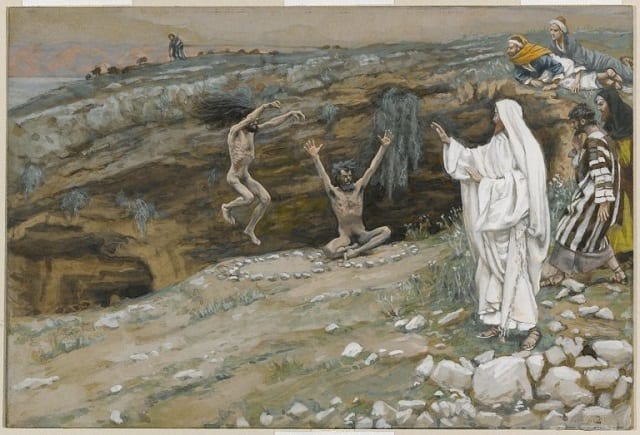
Photo credit: The Two Men Possessed with Devils, by James Tissot (1836-1902) [public domain / Wikimedia Commons]

***
alleged biblical contradictions
Previous Post

January 10, 2020
In What Century Did the Title, "Catholic Church" Begin?
Next Post
January 13, 2020 Passover in Judaism & a Mass that Transcends Time
Browse Our Archives
Select a Category & Last Things About Me Anti-Catholicism Atheism & Agnosticism Baptism and Sacramentalism Bible and Tradition Blessed Virgin Mary Books by Dave Armstrong C. S. Lewis Calvinism & General Protestantism Catholic Apologetics Catholic Apologists Catholic conversion Catholic converts Christmas Church (Ecclesiology) Church History Conversion and Converts Development of Doctrine Eastern Orthodoxy Ecumenism & Christian Unity Eucharist & Liturgy Fathers of the Church French Translations G. K. Chesterton Hell Hell & Satan Hell & Satan & Last Things Heresies & Comparative Religion Holistic Health Inquisition & Crusades & Scandals James White Jews & Judaism & Old Testament John Calvin John Henry Newman Liberal / Modernist Theology Life Issues Literary Resume Lutheranism Mariology Martin Luther Music Orthodoxy Papacy & Infallibility Personal Page Philosophy & Science Political & Ethical & Moral Issues Protestant Persecution & Intolerance Protestantism Purgatory Purgatory & Penance Romantic & Imaginative Theology Saints & Purgatory & Penance Salvation Salvation & Justification Satan & Last Things Sexuality and Gender Issues Spanish Translations Traditionalism vs. Radical Catholic Reactionaries Traducciones al español / tradução para português Trinitarianism & Christology Uncategorized Videos
Select a Month October 2026 September 2026 August 2026 July 2026 June 2026 May 2026 April 2026 March 2026 February 2026 January 2026 December 2025 November 2025 October 2025 September 2025 August 2025 July 2025 June 2025 May 2025 April 2025 March 2025 February 2025 January 2025 December 2024 November 2024 October 2024 September 2024 August 2024 July 2024 June 2024 May 2024 April 2024 March 2024 February 2024 January 2024 December 2023 November 2023 October 2023 September 2023 August 2023 July 2023 June 2023 May 2023 April 2023 March 2023 February 2023 January 2023 December 2022 November 2022 October 2022 September 2022 August 2022 July 2022 June 2022 May 2022 April 2022 March 2022 February 2022 January 2022 December 2021 November 2021 October 2021 September 2021 August 2021 July 2021 June 2021 May 2021 April 2021 March 2021 February 2021 January 2021 December 2020 November 2020 October 2020 September 2020 August 2020 July 2020 June 2020 May 2020 April 2020 March 2020 February 2020 January 2020 December 2019 November 2019 October 2019 September 2019 August 2019 July 2019 June 2019 May 2019 April 2019 March 2019 February 2019 January 2019 December 2018 November 2018 October 2018 September 2018 August 2018 July 2018 June 2018 May 2018 April 2018 March 2018 February 2018 January 2018 December 2017 November 2017 October 2017 September 2017 August 2017 July 2017 June 2017 May 2017 April 2017 March 2017 February 2017 January 2017 December 2016 November 2016 October 2016 September 2016 August 2016 July 2016 June 2016 May 2016 April 2016 March 2016 February 2016 January 2016 December 2015 November 2015 October 2015 September 2015 August 2015 July 2015 June 2015 May 2015 April 2015 March 2015 February 2015 January 2015 December 2014 November 2014 October 2014 September 2014 August 2014 July 2014 June 2014 April 2014 March 2014 February 2014 January 2014 December 2013 November 2013 October 2013 September 2013 August 2013 July 2013 June 2013 April 2013 March 2013 February 2013 January 2013 December 2012 November 2012 October 2012 September 2012 August 2012 July 2012 June 2012 May 2012 April 2012 March 2012 February 2012 January 2012 December 2011 November 2011 October 2011 September 2011 August 2011 July 2011 June 2011 April 2011 March 2011 February 2011 October 2010 September 2010 August 2010 July 2010 April 2010 March 2010 December 2009 October 2009 August 2009 July 2009 June 2009 May 2009 March 2009 February 2009 October 2008 September 2008 April 2008 March 2008 February 2008 January 2008 December 2007 November 2007 October 2007 May 2007 March 2007 February 2007 January 2007 November 2006 October 2006 September 2006 August 2006 July 2006 June 2006 May 2006 April 2006 March 2006 February 2006 October 2005 June 2005 April 2005 February 2005 July 2004 May 2004 April 2004
Follow Us!
TAKE THE
Religious Wisdom Quiz
Who prayed for rain after a long drought and sent his servant to look seven times?
Select your answer to see how you score.
Elijah Isaiah Samuel Hosea
Books by This Author Books by Dave Armstrong
Related posts from Biblical Evidence for Catholicism

No Hell? Dialogue on Conditional Immortality, Pt. 3
Biblical Evidence for Catholicism
No Hell? Dialogue on Conditional Immortality, Pt. 2
Biblical Evidence for Catholicism
No Hell? Dialogue on Conditional Immortality
Biblical Evidence for Catholicism
Eternal Hell: Biblical? 25 Verses Say So
Biblical Evidence for Catholicism
TRENDING AT PATHEOS Catholic

I was strolling through the top floor of the brand new Parthenon...

What Does Gêvâh Mean For Kimberley Guifoyle &...
This week, a lot of the news is focused on Kimberly Guilfoyle....

INNER CIRCLE: Profound Mystery (Of Christ In All...
Ephesians 5:31-32 “For this reason, a man will leave his father and...

Do Not Rejoice When Your Enemy Falls: The...
Turning an execution into a public spectacle is a disturbing expression of...

'The Chosen' S6 Trailer: The Passion Gets Very...
Not many watching 'The Chosen' worry about spoilers, but just because they...

The purpose-driven labor priest
A labor activist reads Rick Warren and it gets me wondering about...
view all Catholic blogs
Ad-Free & Subscriber Log-In Subscription Support
- About Us
- 2026 Calendar
- Videos
- Podcasts
- Library of World Religions
- Faith In Media Tracker
- Advertise With Us
- Write for Us
- Privacy Policy
- Terms of Service
- Do Not Sell My Data
- Contact Us
- Radiant Digital
- Manage Newsletter Subscriptions
- Unsubscribe From Notifications
- Sitemap
Copyright 2008-2026, Patheos. All rights reserved.
Subscription Support Ad-Free & Subscriber Log-In
Follow Patheos