
BuddhistCatholicContemplativeEvangelicalGeneral ChristianHinduJewishLatter-day SaintMuslimNew VisionsProgressive Christian
Beliefs
- Buddhist
- Catholic
- Contemplative
- Evangelical
- General Christian
- Hindu
- Jewish
- Latter-day Saint
- More Voices
- Muslim
- New Visions
- Pagan
- Progressive Christian
Topics
- Religion News
- Food and Religion
- Sports and Religion
- Religious Art
- Religious Music and Entertainment
- Religious Events
- History and Religion
- Style and Religion
- Politics and Religion
- Women in Religion
- Recreation Outdoors and Religion
- Business Finance and Religion
- Careers Workplace and Religion
- Education and Religion
- Family Parenting and Religion
- Health Fitness and Religion
- Home and Religion
- Relationships and Religion
- Technology and Religion
- Travel and Religion
Columnists
- Buddhist Columnists
- Business Finance and Religion Columnists
- Careers Workplace and Religion Columnists
- Catholic Columnists
- Contemplative Columnists
- Education and Religion Columnists
- Evangelists Columnists
- Family Parenting and Religion Columnists
- General Christian Columnists
- Health Fitness and Religion Columnists
- Hindu Columnists
- History and Religion Columnists
- Home and Religion Columnists
- Jewish Columnists
- More Voices Columnists
- Latter Day Columnists
- Muslim Columnists
- New Visions Columnists
- Nonreligious Columnists
- Pagan Columnists
- Politics and Religion Columnists
- Progressive Columnists
- Recreation Outdoors and Religion Columnists
- Relationships and Religion Columnists
- Religion News Columnists
- Religious Art Columnists
- Religious Events Columnists
- Religious Music and Entertainment Columnists
- Sports and Religion Columnists
- Style and Religion Columnists
- Technology and Religion Columnists
- Travel and Religion Columnists
- Women in Religion Columnists
Resource Library
- 2026 Calendar
- Library of World Religions
- The 100 Most Holy Places on Earth
- Patheos Answers
- Podcasts
- Videos
- Faith Leaders Database
- Anglican Episcopalian
- Bahai
- Baptist
- Buddhism
- Christianity
- Confucianism
- Eastern Orthodoxy
- Hinduism
- Holiness and Pentecostal
- ISKCON
- Islam
- Judaism
- Lutheran
- Methodist
- The Church of Jesus Christ of Latter-day Saints
- New Age
- Paganism
- Presbytarian and Reformed
- Protestantism
- Religion Behind the Scenes
- Roman Catholic
- Scientology
- Shia Islam
- Sikhism
- Sufism
- Sunni Islam
- Taoism
- Zen
- See all religions
Research Tools
 Ad-Free & Subscriber Log-In Subscription Support
Ad-Free & Subscriber Log-In Subscription Support
Follow Patheos 

- Trending:
- Forgiveness
- |
- Marriage
- |
- Consciousness
- |
- Death Penalty
- |
- Election
- |
- Halloween

-
About
-
Catholic Apologetics
-
Church History
-
Great Apologists
-
Christian Worldview
-
Protestantism & Misc.
- Home
- Catholic
- History and Religion
- Dialogue w Lutheran Pastor on the Protestant Revolt
Dialogue w Lutheran Pastor on the Protestant Revolt
Last updated on: January 8, 2020 at 1:15 pm by Dave Armstrong
Dialogue w Lutheran Pastor on the Protestant Revolt 2020-01-08T13:15:21-04:00 Dave Armstrong
Patheos Explore the world's faith through different perspectives on religion and spirituality! Patheos has the views of the prevalent religions and spiritualities of the world.
. . . with special emphasis on the beliefs of the Church Fathers: were they were more “Catholic” or “Protestant”?
Pastor Ken Howes (Missouri Synod) is a good friend of mine, with whom I have enjoyed several cordial, constructive dialogues. I have great respect for him. This is a prime example of one of them. He was responding on Facebook to my article, Medieval Catholic Corruption: Main Cause of Protestant Revolt? His words will be in blue.
*****
There’s a lot to answer there, and I won’t undertake more than a short answer. Papal corruption, though it was not the chief issue in the Reformation, was indeed the immediate trigger, and it was the reason that there was so much of a response from the laity. The immediate trigger of the Reformation was that for about half a century, Popes had been routinely selling benefices, and they had been doing it on and off for several centuries.
For about thirty years, the customary way to become Pope had been to bribe the right cardinals; the Popes had been buying their office. The Simon they were most resembling wasn’t Simon Peter but Simon Magus. Leo X sold the archepiscopal see of Mainz to Albrecht von Brandenburg, who was already Archbishop of Halberstadt and bishop of one other diocese as well.
This was in violation of a couple of canons of ancient councils condemning the sale of benefices and holding more than one bishopric at the same time. Albrecht did not have the money to buy this archdiocese, so Leo suggested that he borrow the money, and raise the money to repay the banker (Bankhaus Fugger, in Augsburg) by the sale of indulgences. Leo agreed to sign the indulgences to enable Albrecht to do that. Albrecht became Archbishop of Mainz, and commissioned a Dominican monk named Johann Tetzel to sell the indulgences.
Again, this has the stench of Simon Magus about it–the sale of grace. The practice would only be outlawed in the Church in the early 1900’s by Pope Benedict XV. Martin Luther objected to the idea that absolution was being decoupled from penitence. Indeed, he wrote the 95 Theses in the belief that the Pope did not know what was going on, how his indulgences were being dispensed, as a loyal Catholic.
There was, however, another, bigger issue, and it went back to a terrific blowup in the Church in the 13th century between the Scholastics, the greatest of whom was St Thomas Aquinas, and the Augustinians who had previously dominated the Catholic Church. As the great English Catholic writer Chesterton recognizes, the Reformation was above all the great counter-stroke of the Augustinians.
It was no accident that Luther, who began the Reformation in Germany, and Robert Barnes, who began the Reformation in England, were not only both Augustinians but fairly prominent ones; Barnes was the prior of the Augustinian cloister in Cambridge, and Luther was an up-and-coming monk, priest and theologian in the Augustinian order.
It was not only a matter of bribery when, at the Diet of Worms, the Archbishop of Trier attempted to settle the dispute by offering Luther the position of prior of one of the richest monasteries in the Moselle valley in return for his being willing to cease public criticism of the papacy–he could preach what he wanted in his monastery but would have to stop making it public outside the monastery’s walls.
According to Catholic Answers (“Does the Catholic Church Still Sell Indulgences?”):
The Catholic Church does not now nor has it ever approved the sale of indulgences. This is to be distinguished from the undeniable fact that individual Catholics (perhaps the best known of them being the German Dominican Johann Tetzel [1465-1519]) did sell indulgences–but in doing so they acted contrary to explicit Church regulations. This practice is utterly opposed to the Catholic Church’s teaching on indulgences, and it cannot be regarded as a teaching or practice of the Church.
In the 16th century, when the abuse of indulgences was at its height, Cardinal Cajetan (Tommaso de Vio, 1469-1534) wrote about the problem: “Preachers act in the name of the Church so long as they teach the doctrines of Christ and the Church; but if they teach, guided by their own minds and arbitrariness of will, things of which they are ignorant, they cannot pass as representatives of the Church; it need not be wondered at that they go astray.”
For more on this topic, see my papers:
Classic Catholic Reflections on Indulgences [1994]
*
Biblical Evidence for Indulgences [1996]
*
Catholic Indulgences: History & Myths [8-6-16]
*
Myths and Facts Regarding Tetzel and Indulgences [11-25-16; published in Catholic Herald]
*
The Biblical Roots and History of Indulgences [National Catholic Register, 5-25-18]
*
Vs. James White #11: Biblical Evidence for Indulgences [11-15-19]
*
The Augustinian/Scholastic controversy is far more complex than could be set forth in a few paragraphs–even in his discussion of it in his biography of St. Thomas Aquinas, Chesterton, a better mind than I, is simplifying it greatly. The shortest possible condensation would be that St Augustine had taught, “If anyone tells you anything, and cannot support it from Scripture, do not believe him, no matter who he is;” the Scholastics had said, “But we receive Scripture by reason and together with the traditions of the Church; in applying our reason, we will use the principles of reason introduced by the classical philosophers such as Socrates, Plato and Aristotle.”
*
Luther and the other conservative Reformers (I am not making the case for more radical people like Zwingli, whom I wouldn’t claim) sought to restore Augustinian principles. They considered themselves good Catholics who were re-forming the Catholic faith to what it had been in the days of late antiquity. Whether they were right or wrong about that is the real question between those who remain in the Roman Catholic Church and those in the more conservative churches of the Reformation (Lutheran and Anglican); but the German and English Reformers sought to restore what they understood to be the true tradition of the Catholic Church. When you read the most important writings of Lutheranism, you will see profuse quotation from St Augustine, St Jerome, St Ambrose, St John Chrysostom, and other early Fathers.
*
The Scholastics had some honorable early Church precedent in applying classical philosophy to theology. Clement of Alexandria and Origen were great early Fathers of the Church who relied greatly on classical philosophy. On the other hand, that was very controversial even then–that’s why they’re not St Clement of Alexandria or St Origen; the Church in the third and fourth centuries, especially in the West, took a dim view of giving such weight to classical philosophy.
*
They were dealing with Neo-Platonism, which, though it influenced the Church greatly in that period, was nonetheless something of a rival to Christian thought. St Augustine, St John Chrysostom and St Jerome had to contend against Neo-Platonism, which was why they insisted that all doctrine must be supported by Scripture. (The phrase “sola Scriptura” was coined by St Thomas Aquinas, much later.)
*
Let’s present St. Augustine’s views on the rule of faith in a balance, not in a one-sided way. He also wrote:
And thus a man who is resting upon faith, hope, and love, and who keeps a firm hold upon these, does not need the Scriptures except for the purpose of instructing others. Accordingly, many live without copies of the Scriptures, even in solitude, on the strength of these three graces. (On Christian Doctrine, I, 39:43; NPNF 1, Vol. II, 534)
I believe that this practice [of not rebaptizing heretics and schismatics] comes from apostolic tradition, just as so many other practices not found in their writings nor in the councils of their successors, but which, because they are kept by the whole Church everywhere, are believed to have been commanded and handed down by the Apostles themselves. (On Baptism, 2, 7, 12; cf. NPNF 1, IV, 430)
. . . the custom, which is opposed to Cyprian, may be supposed to have had its origin in apostolic tradition, just as there are many things which are observed by the whole Church, and therefore are fairly held to have been enjoined by the apostles, which yet are not mentioned in their writings. (On Baptism, 5, 23:31; NPNF 1, IV, 475)
But those reasons which I have here given, I have either gathered from the authority of the church, according to the tradition of our forefathers, or from the testimony of the divine Scriptures, or from the nature itself of numbers, and of similitudes. No sober person will decide against reason, no Christian against the Scriptures, no peaceable person against the church. (On the Trinity, 4,6:10; NPNF 1, Vol. III, 75)
Lutheran historian Heiko Oberman noted concerning St. Augustine and the rule of faith:
Augustine’s legacy to the middle ages on the question of Scripture and Tradition is a two-fold one. In the first place, he reflects the early Church principle of the coinherence of Scripture and Tradition. While repeatedly asserting the ultimate authority of Scripture, Augustine does not oppose this at all to the authority of the Church Catholic . . . The Church has a practical priority: her authority as expressed in the direction-giving meaning of commovere is an instrumental authority, the door that leads to the fullness of the Word itself.
But there is another aspect of Augustine’s thought . . . we find mention of an authoritative extrascriptural oral tradition. While on the one hand the Church “moves” the faithful to discover the authority of Scripture, Scripture on the other hand refers the faithful back to the authority of the Church with regard to a series of issues with which the Apostles did not deal in writing. Augustine refers here to the baptism of heretics . . . (The Harvest of Medieval Theology, Grand Rapids, Michigan: Eerdmans, revised, 1967, 370-371)
The quotation from St Augustine was a direct quotation. My statement of the Scholastics’ position was a summary, but I think a fair one. As to the quotations Dave introduces, of course many could not read the Scriptures and therefore lived without reading them; but St Augustine certainly is not saying that those who teach can teach without the Scriptures. There are indeed some issues which the apostles and evangelists did not address directly; those still have to be approached Scripturally, in terms of reasonable deduction from what they did say.
*
Catholic dogma on this point of course says that tradition cannot speak against Scripture; the problem from the Lutheran viewpoint is that Catholic dogma, and even more so, practice, and even more so, the popular piety within the Catholic Church, has at various points become contrary to Scripture.
*
Just to sum up, it can fairly be debated whether the Reformers were correctly applying the early Church Fathers. I think they were; Dave thinks they weren’t. That’s why I’m a Lutheran and he’s a Roman Catholic. What should not be said is that they were attempting to overthrow the Church. What they were trying to do was restore the Church to what they believed was its true tradition. In their minds, they were good Catholics trying to bring their church back to correct teaching and practice; the mindset, though not the specifics of doctrine, would be the same as that of the traditionalist Catholics who have dissented from certain actions of the Church in the last century.
*
Are you saying that the following is a “direct quotation” from Augustine?: “If anyone tells you anything, and cannot support it from Scripture, do not believe him, no matter who he is.” I’m trying to search for it and I’m coming up with nothing. Can you give me a primary source reference for it? Thanks.
*
I’ll see if I can get it for you. I read it in a secondary source (Chemnitz, I believe); I’ll see if he or the editor of the English translation gives the specific source.
*
I see some stuff in Chemnitz, Examination of Trent, pp. 151-152 that might be (or are similar to) the quote you reference. I did a very lengthy three-part critique of this book [one / two / three].
*
Yes, that’s the book I’m in at the moment.
*
“In their minds, they were good Catholics trying to bring their church back to correct teaching and practice”
I think this is fundamentally absurd, in light of, e.g., Luther’s dissent on at least 50 points by 1520, before he was excommunicated (as I have documented). Here are Luther’s 50 points of departure:
1. Separation of justification from sanctification.
2. Extrinsic, forensic, imputed notion of justification.
3. Fiduciary faith.
4. Private judgment over against ecclesial infallibility.
5. Tossing out seven books of the Bible.
6. Denial of venial sin.
7. Denial of merit.
8. The damned should be happy that they are damned and accept God’s will.
9. Jesus offered Himself for damnation and possible hellfire.
10. No good work can be done except by a justified man.
11. All baptized men are priests (denial of the sacrament of ordination).
12. All baptized men can give absolution.
13. Bishops do not truly hold that office; God has not instituted it.
14. Popes do not truly hold that office; God has not instituted it.
15. Priests have no special, indelible character.
16. Temporal authorities have power over the Church; even bishops and popes; to assert the contrary was a mere presumptuous invention.
17. Vows of celibacy are wrong and should be abolished.
18. Denial of papal infallibility.
19. Belief that unrighteous priests or popes lose their authority (contrary to Augustine’s rationale against the Donatists).
20. The keys of the kingdom were not just given to Peter.
21. Private judgment of every individual to determine matters of faith.
22. Denial that the pope has the right to call or confirm a council.
23. Denial that the Church has the right to demand celibacy of certain callings.
24. There is no such vocation as a monk; God has not instituted it.
25. Feast days should be abolished, and all church celebrations confined to Sundays.
26. Fasts should be strictly optional.
27. Canonization of saints is thoroughly corrupt and should stop.
28. Confirmation is not a sacrament.
29. Indulgences should be abolished.
30. Dispensations should be abolished.
31. Philosophy (Aristotle as prime example) is an unsavory, detrimental influence on Christianity.
32. Transubstantiation is “a monstrous idea.”
33. The Church cannot institute sacraments.
34. Denial of the “wicked” belief that the mass is a good work.
35. Denial of the “wicked” belief that the mass is a true sacrifice.
36. Denial of the sacramental notion of ex opere operato.
37. Denial that penance is a sacrament.
38. Assertion that the Catholic Church had “completely abolished” even the practice of penance.
39. Claim that the Church had abolished faith as an aspect of penance.
40. Denial of apostolic succession.
41. Any layman who can should call a general council.
42. Penitential works are worthless.
43. None of what Catholics believe to be the seven sacraments have any biblical proof.
44. Marriage is not a sacrament.
45. Annulments are a senseless concept and the Church has no right to determine or grant annulments.
46. Whether divorce is allowable is an open question.
47. Divorced persons should be allowed to remarry.
48. Jesus allowed divorce when one partner committed adultery.
49. The priest’s daily office is “vain repetition.”
50. Extreme unction is not a sacrament (there are only two sacraments: baptism and the Eucharist).
If that is “reform” and not “revolution” then certainly a different definition of “reform” is being utilized. It’s easy to grasp my point, by using analogy: I go into the headquarters of LCMS and say that LCMS has gotten 50 major things wrong about the Christian faith, and I demand that I should be treated like a good Lutheran who has no desire to leave Lutheranism: but merely to bring Lutheranism back to its proper roots.
Without going to more time, one could get plenty of support from early Fathers for 31 and 33, and from Gelasius for 32. Many of the things you list simply were not taught or practiced in the early Church. Indulgences? Papal infallibility? Those are things for which you can find little or no support in the early Church.
*
You see a great many bishops, often a consensus of bishops, opposing decisions of the Bishop of Rome, made in his capacity as such and dealing with issues of faith and morals in the early Church; the sixth Council anathematized a Pope who had accepted monothelitism. The list of bishops who opposed Rome at different times on issues affecting faith and morals includes several saints, the most prominent of whom would be St Cyprian, who specifically said that the decisions of a synod over which he presided at Carthage were not appealable to Rome.
*
***
I took a look at your critique of his [Chemnitz’] book. It doesn’t really get to my point which was that they believed that they were simply restoring Catholic doctrine. As to your last, on how many of those points did Luther say, “The Catholic Church has always been wrong since its first days?” Wasn’t he in all cases saying, “The teaching I am disputing is contrary to Scripture,” and in all or almost all cases saying, “The teaching of the Church was formerly different” or at least “The Church did not teach this before (some date after 500 AD)”?
*
I am not here arguing whether the Reformers were right or wrong. I am arguing that they did not believe they were introducing a novel teaching not before seen in the Church. And be careful that you are not adopting the posture for which you criticize Chemnitz–that of imputing the worst motives to the opponent.
*
Well, the most charitable way I can view it is granting that they wrongly thought they were appealing to true patristic doctrine, but in fact were almost systematically wrong about it, as I have shown time and again in debates with Lutherans and Calvinists over patristic beliefs.
I’m happy to grant sincerity: no problem; always have been. Luther was sincere (and dead wrong on much of his agenda). Calvin was sincere; so were Zwingli and all the rest. I am vigorously disputing the patristic interpretation of the Protestant founders and Protestant polemicists ever since.
It’s easy to refute using exclusively Protestant historians (Pelikan, Schaff, Kelly Oberman et al). The most frequent mistake is to quote certain statements of the fathers while ignoring other equally relevant ones, to get the whole picture. I see this time and again in my debates and critiques of such efforts. It happens all the time.
*
Here is one easy way to show the fallacies of “Reformed” patristics. Augustine believed in seven sacraments, just as the Church did. Luther believed in two. Yet he claimed to be appealing to Augustine.
*
Luther and Melanchthon, however, increasingly distanced themselves from St. Augustine as they realized that he didn’t agree with their novelties. See:
*
Early Protestants & St. Augustine: Ambiguity [1-28-04]
*
Luther’s Views of Augustine & the Church Fathers [July 2009]
*
The question is whether those really are refutations. By the way, you may want to look at to what degree what you’re doing is apologetics and to what degree it is polemics. Apologetics is the defense of your own doctrine; polemics, the attempt to refute the opposing doctrine. Melanchthon was an apologist; Chemnitz a polemicist.
*
Well, I tend to do polemics in dialogue, when I am dealing with a position that is trying to refute my position (or, “counter-apologetics” if you will). It’s not much of a difference, anyway. To defend one thing necessarily is at least an opposition to other views. I think the key is to grant good faith and good intentions, as I do, and to not demonize the opponent.
*
***
For much more material on all these topics, see my web pages on Martin Luther and Lutheranism; also John Calvin and Calvinism, as well as on historic Protestant persecution and anti-Catholicism. See also, in particular:
*
Transubstantiation & Church History: Dialogue w Lutheran [2-12-05; abridged on 10-23-18]
*
Dialogue: Lutherans, Sola Scriptura, & the Church Fathers [5-29-05]
*
Dialogue: Is Lutheranism or Catholicism Closer to the Fathers? (vs. Kristo Miettinen) [6-3-05]
Development of Sacrifice of the Mass: Dialogue w Lutheran [9-22-05]
Dialogue with a Lutheran: Church Fathers & Sola Scriptura (vs. Nathan Rinne) [10-13-11]
Dialogue with a Lutheran: Rule of Faith / Fathers / Ecclesiology (vs. Nathan Rinne) [10-17-11]
*
***
*
Unfortunately, Money Trees Do Not Exist: If you have been aided in any way by my work, or think it is valuable and worthwhile, please strongly consider financially supporting it (even $10 / month — a mere 33 cents a day — would be very helpful). I have been a full-time Catholic apologist since Dec. 2001, and have been writing Christian apologetics since 1981 (see my Resume). My work has been proven (by God’s grace alone) to be fruitful, in terms of changing lives (see the tangible evidences from unsolicited “testimonies”). I have to pay my bills like all of you: and have a (homeschooling) wife and three children still at home to provide for, and a mortgage to pay.
*
My book royalties from three bestsellers in the field (published in 2003-2007) have been decreasing, as has my overall income, making it increasingly difficult to make ends meet. I provide over 2600 free articles here, for the purpose of your edification and education, and have written 50 books. It’ll literally be a struggle to survive financially until Dec. 2020, when both my wife and I will be receiving Social Security. If you cannot contribute, I ask for your prayers (and “likes” and links and shares). Thanks!
*
See my information on how to donate (including 100% tax-deductible donations). It’s very simple to contribute to my apostolate via PayPal, if a tax deduction is not needed (my “business name” there is called “Catholic Used Book Service,” from my old bookselling days 17 or so years ago, but send to my email: [email protected]). Another easy way to send and receive money (with a bank account or a mobile phone) is through Zelle. Again, just send to my e-mail address. May God abundantly bless you.
*
***
(originally 3-27-12 on Facebook; edited with links added on 1-8-20)
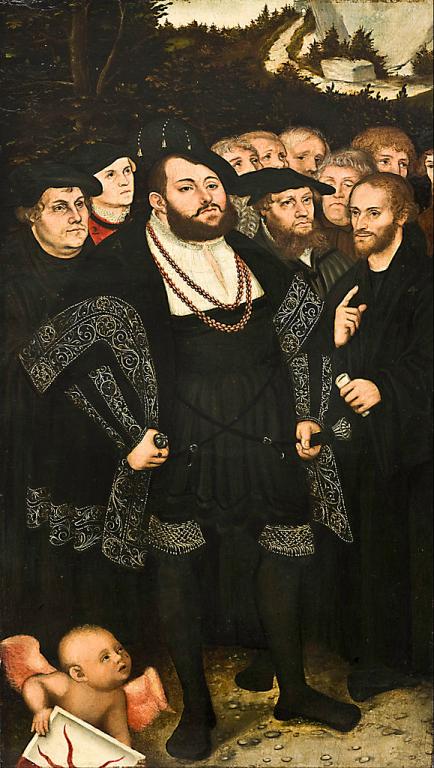
Photo credit: Martin Luther and the Wittenberg Reformers (c. 1543), by Lucas Cranach the Younger (1515-1586). Luther (left) with the Reformers and their protector, the Elector of Saxony, John Frederick the Magnanimous (1532-1547), right Philipp Melanchthon (1497-1560), man behind Luther is most often identified as Georg Spalatin (1484-1545), the man behind John Frederick’s left shoulder is probably Saxon Chancellor Gregor Brück (1485-1557) [public domain / Wikimedia Commons]

***
Previous Post

January 8, 2020
"Warmonger" Reagan & World War III: How Soon We Forget
Next Post

January 9, 2020 Dialogue: Jesus, Peter, Elijah & Elisha Prayed for the Dead
Browse Our Archives
Select a Category & Last Things About Me Anti-Catholicism Atheism & Agnosticism Baptism and Sacramentalism Bible and Tradition Blessed Virgin Mary Books by Dave Armstrong C. S. Lewis Calvinism & General Protestantism Catholic Apologetics Catholic Apologists Catholic conversion Catholic converts Christmas Church (Ecclesiology) Church History Conversion and Converts Development of Doctrine Eastern Orthodoxy Ecumenism & Christian Unity Eucharist & Liturgy Fathers of the Church French Translations G. K. Chesterton Hell Hell & Satan Hell & Satan & Last Things Heresies & Comparative Religion Holistic Health Inquisition & Crusades & Scandals James White Jews & Judaism & Old Testament John Calvin John Henry Newman Liberal / Modernist Theology Life Issues Literary Resume Lutheranism Mariology Martin Luther Music Orthodoxy Papacy & Infallibility Personal Page Philosophy & Science Political & Ethical & Moral Issues Protestant Persecution & Intolerance Protestantism Purgatory Purgatory & Penance Romantic & Imaginative Theology Saints & Purgatory & Penance Salvation Salvation & Justification Satan & Last Things Sexuality and Gender Issues Spanish Translations Traditionalism vs. Radical Catholic Reactionaries Traducciones al español / tradução para português Trinitarianism & Christology Uncategorized Videos
Select a Month October 2026 September 2026 August 2026 July 2026 June 2026 May 2026 April 2026 March 2026 February 2026 January 2026 December 2025 November 2025 October 2025 September 2025 August 2025 July 2025 June 2025 May 2025 April 2025 March 2025 February 2025 January 2025 December 2024 November 2024 October 2024 September 2024 August 2024 July 2024 June 2024 May 2024 April 2024 March 2024 February 2024 January 2024 December 2023 November 2023 October 2023 September 2023 August 2023 July 2023 June 2023 May 2023 April 2023 March 2023 February 2023 January 2023 December 2022 November 2022 October 2022 September 2022 August 2022 July 2022 June 2022 May 2022 April 2022 March 2022 February 2022 January 2022 December 2021 November 2021 October 2021 September 2021 August 2021 July 2021 June 2021 May 2021 April 2021 March 2021 February 2021 January 2021 December 2020 November 2020 October 2020 September 2020 August 2020 July 2020 June 2020 May 2020 April 2020 March 2020 February 2020 January 2020 December 2019 November 2019 October 2019 September 2019 August 2019 July 2019 June 2019 May 2019 April 2019 March 2019 February 2019 January 2019 December 2018 November 2018 October 2018 September 2018 August 2018 July 2018 June 2018 May 2018 April 2018 March 2018 February 2018 January 2018 December 2017 November 2017 October 2017 September 2017 August 2017 July 2017 June 2017 May 2017 April 2017 March 2017 February 2017 January 2017 December 2016 November 2016 October 2016 September 2016 August 2016 July 2016 June 2016 May 2016 April 2016 March 2016 February 2016 January 2016 December 2015 November 2015 October 2015 September 2015 August 2015 July 2015 June 2015 May 2015 April 2015 March 2015 February 2015 January 2015 December 2014 November 2014 October 2014 September 2014 August 2014 July 2014 June 2014 April 2014 March 2014 February 2014 January 2014 December 2013 November 2013 October 2013 September 2013 August 2013 July 2013 June 2013 April 2013 March 2013 February 2013 January 2013 December 2012 November 2012 October 2012 September 2012 August 2012 July 2012 June 2012 May 2012 April 2012 March 2012 February 2012 January 2012 December 2011 November 2011 October 2011 September 2011 August 2011 July 2011 June 2011 April 2011 March 2011 February 2011 October 2010 September 2010 August 2010 July 2010 April 2010 March 2010 December 2009 October 2009 August 2009 July 2009 June 2009 May 2009 March 2009 February 2009 October 2008 September 2008 April 2008 March 2008 February 2008 January 2008 December 2007 November 2007 October 2007 May 2007 March 2007 February 2007 January 2007 November 2006 October 2006 September 2006 August 2006 July 2006 June 2006 May 2006 April 2006 March 2006 February 2006 October 2005 June 2005 April 2005 February 2005 July 2004 May 2004 April 2004
Follow Us!
TAKE THE
Religious Wisdom Quiz
Who fell out of a window and was restored to life by Paul?
Select your answer to see how you score.
Silas Barnabas Eutychus Timothy
Books by This Author Books by Dave Armstrong
Related posts from Biblical Evidence for Catholicism

Does Catholic Intercession of Saints Require Omniscience?
Biblical Evidence for Catholicism

Protestant Confessions & "Ever-Virgin" Mary
Biblical Evidence for Catholicism

Jesus Founded the [Catholic] Church. If Not Him,...
Biblical Evidence for Catholicism

A Few "Worst" & "Best" Arguments vs. Protestantism
Biblical Evidence for Catholicism
TRENDING AT PATHEOS Catholic

In "Irreplaceable," our book on vocation and technology, Trevor Sutton and I...

I was strolling through the top floor of the brand new Parthenon...

What Does Gêvâh Mean For Kimberley Guifoyle &...
This week, a lot of the news is focused on Kimberly Guilfoyle....

INNER CIRCLE: Profound Mystery (Of Christ In All...
Ephesians 5:31-32 “For this reason, a man will leave his father and...

Do Not Rejoice When Your Enemy Falls: The...
Turning an execution into a public spectacle is a disturbing expression of...

'The Chosen' S6 Trailer: The Passion Gets Very...
Not many watching 'The Chosen' worry about spoilers, but just because they...
view all Catholic blogs
Ad-Free & Subscriber Log-In Subscription Support
- About Us
- 2026 Calendar
- Videos
- Podcasts
- Library of World Religions
- Faith In Media Tracker
- Advertise With Us
- Write for Us
- Privacy Policy
- Terms of Service
- Do Not Sell My Data
- Contact Us
- Radiant Digital
- Manage Newsletter Subscriptions
- Unsubscribe From Notifications
- Sitemap
Copyright 2008-2026, Patheos. All rights reserved.
Subscription Support Ad-Free & Subscriber Log-In
Follow Patheos