
BuddhistCatholicContemplativeEvangelicalGeneral ChristianHinduJewishLatter-day SaintMuslimNew VisionsProgressive Christian
Beliefs
- Buddhist
- Catholic
- Contemplative
- Evangelical
- General Christian
- Hindu
- Jewish
- Latter-day Saint
- More Voices
- Muslim
- New Visions
- Pagan
- Progressive Christian
Topics
- Religion News
- Food and Religion
- Sports and Religion
- Religious Art
- Religious Music and Entertainment
- Religious Events
- History and Religion
- Style and Religion
- Politics and Religion
- Women in Religion
- Recreation Outdoors and Religion
- Business Finance and Religion
- Careers Workplace and Religion
- Education and Religion
- Family Parenting and Religion
- Health Fitness and Religion
- Home and Religion
- Relationships and Religion
- Technology and Religion
- Travel and Religion
Columnists
- Buddhist Columnists
- Business Finance and Religion Columnists
- Careers Workplace and Religion Columnists
- Catholic Columnists
- Contemplative Columnists
- Education and Religion Columnists
- Evangelists Columnists
- Family Parenting and Religion Columnists
- General Christian Columnists
- Health Fitness and Religion Columnists
- Hindu Columnists
- History and Religion Columnists
- Home and Religion Columnists
- Jewish Columnists
- More Voices Columnists
- Latter Day Columnists
- Muslim Columnists
- New Visions Columnists
- Nonreligious Columnists
- Pagan Columnists
- Politics and Religion Columnists
- Progressive Columnists
- Recreation Outdoors and Religion Columnists
- Relationships and Religion Columnists
- Religion News Columnists
- Religious Art Columnists
- Religious Events Columnists
- Religious Music and Entertainment Columnists
- Sports and Religion Columnists
- Style and Religion Columnists
- Technology and Religion Columnists
- Travel and Religion Columnists
- Women in Religion Columnists
Resource Library
- 2026 Calendar
- Library of World Religions
- The 100 Most Holy Places on Earth
- Patheos Answers
- Podcasts
- Videos
- Faith Leaders Database
- Anglican Episcopalian
- Bahai
- Baptist
- Buddhism
- Christianity
- Confucianism
- Eastern Orthodoxy
- Hinduism
- Holiness and Pentecostal
- ISKCON
- Islam
- Judaism
- Lutheran
- Methodist
- The Church of Jesus Christ of Latter-day Saints
- New Age
- Paganism
- Presbytarian and Reformed
- Protestantism
- Religion Behind the Scenes
- Roman Catholic
- Scientology
- Shia Islam
- Sikhism
- Sufism
- Sunni Islam
- Taoism
- Zen
- See all religions
Research Tools
 Ad-Free & Subscriber Log-In Subscription Support
Ad-Free & Subscriber Log-In Subscription Support
Follow Patheos 

- Trending:
- Forgiveness
- |
- Marriage
- |
- Consciousness
- |
- Death Penalty
- |
- Election
- |
- Halloween

-
About
-
Catholic Apologetics
-
Church History
-
Great Apologists
-
Christian Worldview
-
Protestantism & Misc.
- Home
- Catholic
- History and Religion
- Vs. Atheist David Madison #36: Matthew & Christmas
Vs. Atheist David Madison #36: Matthew & Christmas
Last updated on: June 5, 2026 at 11:55 pm by Dave Armstrong
Vs. Atheist David Madison #36: Matthew & Christmas 2026-06-05T23:55:51-04:00 Dave Armstrong
Patheos Explore the world's faith through different perspectives on religion and spirituality! Patheos has the views of the prevalent religions and spiritualities of the world.
Dr. David Madison is an atheist who was a Methodist minister for nine years: with a Ph.D. in Biblical Studies from Boston University. You can see (by the number in the title) how many times I have replied to his videos or articles. Thus far, I haven’t heard one peep back from him (since 8-1-19 to this date). This certainly doesn’t suggest to me that he is very confident in his opinions. All I’ve seen is expressions of contempt from Dr. Madison and from his buddy, atheist author and polemicist, the extraordinarily volatile John Loftus, who runs the notoriously insulting Debunking Christianity blog.
Loftus even went to the length of changing his blog’s rules of engagement, in order for himself and Dr. Madison to avoid replying to me. Obviously, I have “hit a nerve” over there. In any event, their utter non-responses and intellectual cowardice do not affect me in the slightest. No skin off of my back. If I want to critique more of their material, I will. If my replies go out unopposed, all the better for my cause.
This is a reply to Dr. Madison’s article, O Holy Night! How Matthew Screwed Up the Christmas Story (12-21-18). Dr. Madison’s words will be in blue below.
*****
We can imagine the literary agents for Matthew, Mark, Luke, and John meeting for drinks one Friday evening after work. They all get texts that the church’s Authorized Bible Committee has decided to publish the four gospels together, back-to-back. They all wince. Not a good idea! This will encourage the faithful to compare the four Jesus accounts. Matthew and Luke plagiarized (and altered) Mark extensively—without telling anyone—and the author of John’s gospel was pretty sure that the other three hadn’t told the story well at all, and made up stuff to ‘improve’ to tale. What a mess.
Very cute. Of course, this is sheer cynical speculation, and so has no argumentative value whatsoever. It’s simply thrown out as red meat for online anti-theist atheist audiences, who will (as long experience invariably illustrates) sop up any dig at Christianity, no matter how imbecilic or devoid of substance. Of course, what atheists like Madison never seem to realize is: why in the world would this “Authorized Bible Committee” publish all four gospels if in fact (assuming for the sake of argument), they are a mess of endless contradictions? It makes no sense. But that’s what this silly atheist “scenario” would entail.
But, never fear, it would be many centuries before the faithful would have access to the Bible, and even when they could have their own copies, they would never develop the habit of critically comparing the four gospels. These were holy books, after all, and anything that seemed fishy or hard to swallow was just part of the mystery.
There came a time, however, when pious New Testament scholars decided to study the gospels using the methods of historians, and it became a challenge to explain the mess. Specifically, this was the beginning of the end for the familiar birth narratives in Matthew and Luke, which fail on all accounts as history. But let’s take a close look at Matthew’s version as if he thought he was telling the truth.
For dissident liberals, who deny the inspiration of the Bible and approach Scripture like a butcher does a hog, they will end up finding what they desire to find, based on their prior lack of faith and incoherent worldview. For them (at least the most extreme ones) and for Dr. Madison, Matthew is simply a deliberate liar with an agenda.
But there is quite a bit of literature, too, from serious historic Christians, dealing with difficulties that naturally come up (as with all complex issues) and with all the so-called, trumped-up alleged “contradictions” that atheists imagine: which are almost always not even logical contradictions at all, but simply different but complementary texts. I’ve dealt with this mentality time and again in my own apologetics (and in my previous 35 replies to Dr. Madison). But again, it sounds good to the anti-theists, so (like all good sophists) Madison uses it.
Familiar traditions have staying power, and Christians aren’t about to give up their Nativity Scenes, with shepherds and Wise Men worshipping the baby Jesus in a stable. The folks in the pews don’t seem to notice that this depiction is an impossible mash-up of Matthew and Luke. These two authors wrote different stories about the birth of Jesus—
This is actually correct, and it’s the Bible scholars who tell us that the wise men actually visited two years later. The Nativity scenes are simply engaging in what might be called “dramatic compression.” As an analogy, in the recent movie about the musical group The Four Seasons (Jersey Boys), it portrayed lead singer Frankie Valli sadly enduring the death of his youngest daughter Francine in the year 1967, whereas it was actually in 1980. There were other liberties taken as to when there were dramatic conflicts and departures of certain members of the band (with “errors” as much as five years off). I’m sure similar anomalies could be found in the recent biopics of Freddie Mercury of Queen and Elton John.
Movies do this all the time (mostly because biopics have two hours or so to deal with biographies and the entire lives of real people, so they conflate or compress events). So why is it inconceivable that Christians (with the sanction of the Church) might do it with regard to nativity scenes and the wise men? It’s simply putting different elements of the early life of Jesus together, for the sake of devotion and reflection. The time of the visit of the wise men is not nearly as important as the fact that they visited Jesus at all. The time isn’t the essence of it. This sort of thing doesn’t have to be either ignorance or dishonesty.
actually, Matthew doesn’t describe the birth of Jesus at all—and if Christians paid attention, they could figure it out. . . . Matthew’s story doesn’t even take place at Christmas time; he says nothing whatever about the night Jesus was born. No stable, no shepherds, no angels.
Why does he have to do that? In other words, I question Dr. Madison’s false premise. Where is it written that every Gospel account must include details of Jesus’ birth? Christians believe that, in God’s providence, the Gospels complement each other and have different emphases. What in the world is wrong with that? It’s just plain dumb “reasoning.” Luke was the one with the details of the birth and the Annunciation nine months prior. Matthew just offers a few bare facts (“Jesus was born in Bethlehem of Judea in the days of Herod the king”: 2:1, RSV), Mark offers none (it starts with John the Baptist and Jesus at age 30, at the start of His public ministry), and John has no “birth facts” (it starts with theological words about trinitarianism, the incarnation, and the divinity of Christ; again, a different emphasis).
he seems to have timed their [the wise men’s] visit well after Jesus’ birth. . . . When they arrived in Bethlehem—after a detour to Jerusalem (more about that later)—they came to the house (not a stable) where Mary and the child were Matthew 2:11). Not a newborn, but a paidion—the Greek word for little child. In Matthew 19:14 Jesus himself uses the same word, “Permit the children to come unto me.”
Exactly! Now how is this a supposed “difficulty” for Christianity, or some kind of “lie”? I won’t hold my breath for an answer, since — as I noted above — Dr. Madison completely ignores every criticism of his articles I make. My readers can see how silly all of this is.
The newborn babe (Greek brephos), in swaddling clothes in a manger, is found in Luke’s account of the night Jesus was born, presumably weeks or months earlier. So the Nativity Scenes that include the Wise Men kneeling in front of a trough to present their gifts is part of the impossible mash-up. Note also Matthew 2:16, which reports Herod’s dragnet to eliminate Jesus: “…he sent and killed all the children in and around Bethlehem who were two years old or under, according to the time that he had learned from the wise men.”
That’s precisely how Bible scholars have deduced that he wise men visited Jesus at about two years of age. Ho hum . . .
The Jesus in Matthew’s story could have been a toddler. So please, Christians, get those Wise Men out of the stable!
Again: why do we have to: anymore than the film Jersey Boys must be meticulously accurate as to the years that events portrayed in it actually happened. Once again: the essence of the thing is that the wise men (who were Gentiles, not Jews, and of a different religion: probably Zoroastrianism) visited Jesus, offering gifts and adoration, not when they visited. So the nativities simply compress the time frame to present all of it together, just as biographical films do all the time.
It’s much ado about nothing: which is a good summary of the entirety of the Bible-bashing work of Dr. Madison. I have shown myself (now literally 36 times) how he is in error and commits illogical fallacies over and over and over. But he doesn’t care. His goal isn’t to arrive at the truth or fuller understanding of these matters, but rather, to drive as many Christians away from Christianity, and into a hatred of their former belief, as possible. It’s all “chum” for the hungry anti-theist atheist sharks circling the Christian “boat.” It reduces to humorous folly in our view, but we also pity and pray for the poor man, to emerge from his self-imposed bondage to falsehoods and the slop of atheist disbelief.
Mixing Theology with Astrology
Even more inept, however, is Matthew’s invention of astrologers ‘from the East’ in the first place. Why would they even bother with the birth of a Jewish messiah? How in the world could they ‘see a star’ and infer that it had anything do to with a bit of Jewish theology? Well, astrologers talk even more nonsense than theologians do, so No, Matthew, this doesn’t make sense.
There have been several in-depth treatments of the wise men. Dr. Madison asks questions only rhetorically and polemically: never hoping to actually receive any sort of answer from us stupid Christians. But we actually examine the thing in the greatest depth:
Catholic Encyclopedia (“Magi”)
“The Magi” (Fr. William Saunders)
“Who Were the Three Wise Men?” (Fr. Dwight Longenecker)
Mystery of the Magi: The Quest to Identify the Three Wise Men (2017 book by Fr. Dwight Longenecker)
“Wise Men from the East and the Feast of the Epiphany of the Lord” (Sandra Miesel)
“The Magi” (International Standard Bible Encyclopedia)
“Magi” (Smith’s Bible Dictionary)
And how can Christians be comfortable with the embrace of astrology anyway, especially concerning the story of Jesus? That omens in the sky relate to famous humans was a common superstition of the time; do Christians really want to go there? It would be hard to figure how astrology—the notion that human destinies are determined by star and planetary alignments—can be spliced into Christian theology. Astrology thrives where there is no grasp of confirmation bias and the capacity for critical thought has collapsed; theology has weak epistemology, astrology has none at all.
We don’t embrace astrology, nor does the Bible. It simply recounts the story of people who believed in astrology finding out about a very significant birth. All truth is God’s truth. Many great scientists (even those lionized by atheists) like Copernicus, Galileo, and Kepler were enamored of astrology (and Newton with alchemy and the occult), while folks like Augustine and Aquinas (lowly theologian types) were not at all.
Why the Nile?
Matthew’s goofs get even worse. He is well known for his outrageous out-of-context quotes from the Old Testament to ‘prove’ that Jesus was the messiah, and perhaps the most egregious example is his use (Matt 2:15) of Hosea 11:1: “When Israel was a child, I loved him, and out of Egypt I called my son.” Yes, Hosea meant Israel. But Matthew wanted desperately to make this apply to Jesus. How was he to get Joseph, Mary, and Jesus to Egypt?
Well, here is an excellent article that deals with the question: “Out of Egypt I Called My Son” (Kevin DeYoung).
God told Joseph in a dream that Herod was about to go on a rampage, so they should flee to…where? Why would they go to Egypt of all places? It’s not as if the toddler Jesus had been branded somehow (the halo wasn’t added until artists worked on the story much later), so the Holy Family could have blended in among the peasantry almost anywhere away from Bethlehem. But for Matthew’s contrived plot, it had to be Egypt.
They probably went there because Herod had no jurisdiction there. It was a populated place relatively close, away from Roman Judea. Dr. Madison simply assumes without proof that Matthew “made it up” so as to dishonestly fulfill and Old Testament prophecy. When it comes to the Bible, he’s usually a stranger to rational argument. How odd for a man who has a doctorate in biblical studies. It depends on what one studies and whether one is operating with false premises.
Eventually they had to go home again. But where was home? Joseph planned to return to Judea (Matt. 2:22)—back to Bethlehem, presumably—but that was still unsafe, so “…he went away to the district of Galilee. There he made his home in a town called Nazareth…” Sounds like for the first time! Matthew’s assumption was that Joseph and Mary had lived in Bethlehem all along.
Luke thought they were originally based in Nazareth, and he had to contrive a way to get them to Bethlehem for the birth. Hence he told of a census that required people to go to their ancestral homes to be ‘registered.’ On several grounds historians have dismissed the story as nonsense. There obviously was a strong tradition that Jesus was from Nazareth; Luke had Mary and Joseph there from the beginning; Matthew got them there after abandoning their home in Bethlehem. More of the impossible mash-up.
There is no problem here. Much ado about nothing. I dealt with these sorts of groundless assertions in the following articles:
The Census, Jesus’ Birth in Bethlehem, & History [2-3-11]
Reply to Atheist Jonathan MS Pearce: Herod’s Death & Alleged “Contradictions” (with Jimmy Akin) [7-25-17]
The Star Screws Up
Earlier I called the story of the Wise Men ‘disastrous” because, the way Matthew spins it, a lot of babies ended up getting killed. He reports that the astrologers headed to Jerusalem to inquire where the holy child could be found. The top religious bureaucrats, consulted by an alarmed King Herod, agreed that Bethlehem was the place, based on Micah 5:2, “…for from you shall come a ruler who is to shepherd my people Israel.” So the Wise Men set out for Bethlehem, but now—wait for it—the star had turned into a GPS!
“…and there, ahead of them, went the star that they had seen …until it stopped over the place where the child was. When they saw that the star had stopped, they were overwhelmed with joy.” (Matthew 2:9-10) . . .
In fact we are talking about a major plot flaw, and a bungling God who didn’t think things through; or was it just Matthew who didn’t notice God’s incompetence?
For thorough Christian treatments of the topic of the star of Bethlehem, see:
“The Star of Bethlehem” (T. Michael Davis)
“Star of the Magi” (International Standard Bible Encyclopedia)
“Seeking the Star of Bethlehem” (Jimmy Akin)
That Other Famous Misquote
I might get pushback for my suggestion earlier that Matthew’s use of Hosea 11:1 was his most egregious misquote. His biggest blunder, no doubt, which was noticed long ago and has been discussed ad infinitum, is his use of a mistranslation of Isaiah 7:14 in the Greek version of the Old Testament: “Behold, a virgin shall conceive and bear a son…” In the original Hebrew, the word isn’t virgin at all, but simply young woman and, in the context of Isaiah 7 concerned a political/military situation at the time. It had nothing whatever to do with the birth of a messiah centuries later. In pulling this text into his story, Matthew was sloppy or devious—maybe both.
I and many others have dealt with this false accusation, too:
Reply to Atheist Jonathan MS Pearce: “Mistranslation” of “Virgin”? (Isaiah 7:14) (with Glenn Miller) [7-26-17]
But the even bigger question is why Matthew thought it was a good idea to graft virgin birth onto the Jesus story. This concept clearly derived from other religions of the ancient world . . . Was it a matter of ‘anything your god can do, my god can do better’? Or did Matthew just want to make sure that Jesus’ divine pedigree was guaranteed? “…the child conceived in her is from the Holy Spirit” (Matt 1:20).
Maybe because . . . it was actually true? Just a thought . . . We can’t prove that it was true (i.e., we can’t examine the actual conception — be there before it took place — to see if it was miraculous). But neither can Madison and our overlord atheist superiors prove that it did not happen. Dr. Madison simply assumes it didn’t, because his overall belief that miracles are either impossible or cannot and have not in fact been sufficiently proven / documented, precludes him from accepting the virgin birth even before he ever examines the question.
This is a minority opinion in the New Testament, by the way. Luke ran with it enthusiastically, but Mark knew nothing about it; for him the status of Jesus was sealed at his baptism and his Transfiguration. For the apostle Paul, the resurrection was all that mattered, and he probably wouldn’t have mentioned virgin birth even if he had heard of it. The author of John’s gospel most certainly knew of Matthew’s story, but didn’t need it, didn’t want it: his Jesus had been present at creation! Maybe he thought virgin birth was, by his time, a cliché.
Now here is a classic example of a trumped-up “contradiction” or “difficulty” in Scripture that is in fact none at all. It’s Dr. Madison who is thinking illogically. Here’s a bit of logical analysis at no extra charge: to not mention a thing is not the equivalent of a denial of the same thing. Let me illustrate by analogy. The two following statements are both true:
Dave: “Yesterday we visited downtown and went ice skating.”
Dave’s wife Judy: “Yesterday we visited downtown, had lunch at a great Italian restaurant, went ice skating, and caught the bus home.”
Are these two statements contradictory? No, not at all. One simply has more information and a recounting of facts than the other (which happens in the Gospel accounts innumerable times). Judy’s account includes the information that lunch was enjoyed downtown, and that a bus was taken home. Did Dave deny those two things? Not logically. He simply highlighted the most important aspects of the visit: the place and their main reason for going (eating lunch and taking a bus being “secondary” details). If — logically speaking — Dave were to truly contradict Judy’s account, he would have to say something like:
“Yesterday we visited downtown and ice skating is all that we did, before returning by car.”
That is undeniably a contradiction to Judy’s account, by the rules of logic, because it denied that lunch was also eaten downtown, and differs in the mode of transportation. But in “Madison-logic” and that of so many atheists in analyzing the Bible, the first two statements above would be “contradictory.” Madison would conclude that Dave denied the fact of the downtown lunch and the bus trip home, because he didn’t see fit to mention them. After all, he claims that Gospel writer Mark “knew nothing about” the virgin birth because he didn’t mention that.
For Dr. Madison, the virgin birth is a “minority opinion in the New Testament” because it’s mentioned very few times. For Christians and logical thinkers, we believe in the inspiration of Scripture (for many good reasons, but ultimately as an article of faith and belief). If in fact all of the Bible is inspired (which means literally “God-breathed” and God’s revelation of Himself), the virgin birth need not be noted or recorded in every book. Even once is enough to suffice. That’s the outlook of Christian faith. But my primary concern here is to show how Dr. Madison is not even thinking logically: even before we get to questions of faith.
One of the unfortunate consequences has been the idealization of chastity, and the exaggeration of Mary’s virtue. Indeed, in Catholic piety, Mary had to remain a virgin to preserve her special holiness; this is a challenge to Catholic apologists since the gospels mention Jesus’ siblings!
Actually, in Catholic thinking and theology, Mary didn’t have to (that is, necessarily in all possible worlds) be a perpetual virgin, anymore than she “had to” be immaculately conceived. In this strict sense, Jesus didn’t even have to necessarily become a man and die on the cross, either, if God the Father had in fact simply decided to proclaim all human beings (or a certain number) forgiven: a forgiveness that they would have to receive on their end. We believe that both things are fitting and appropriate and that they both actually happened in fact.
The Bible has more than enough information in it to explain the use of the term “brothers” in the Hebraic sense, which could refer to (just as it also does in English) far more than merely siblings. Since that is a rabbit trail, I refer readers to many of my articles on the topic in its own section, on my web page about the Blessed Virgin Mary. And it’s not only “Catholic piety.” All of the original Protestant “Reformers” believed the same thing, as have the Orthodox all along.
Virgin Birth = another installment of magical thinking. This doesn’t help make the case for Christianity.
The virgin birth is what it is: an actual historical event. It was a miracle, fitting for the incarnate God, Who is a pretty special human being, after all. Dr. Madison denies and ridicules all miracles, and for him they can only be fictional “magic.” He’s bound and prohibited from free inquiry by his false presuppositions, that have no basis themselves. No one has ever “proven” that no miracle could ever possibly occur, or that an omnipotent God (assuming for a moment that He exists) could not bring one about.
In Dreamland
Matthew reports that Joseph heard from God in dreams, and even the Wise Men were “warned about Herod” in a dream. A novelist has the ‘omniscient perspective,’ i.e., he/she knows what’s going on inside the heads of the characters. Those who claim that Matthew’s story is history have to explain how the author knew the content of the dreams.
I can think of at least two scenarios right off the bat:
1) Since biblical writing is divinely inspired, God could have directly revealed this fact to Matthew, just as He revealed things to Abraham and Moses, and the prophets, and St. Paul at his conversion, and St. John in the revelations of the last book of the New Testament, and to many other people.
- The disciples knew Mary the mother of Jesus, who lived some years after Jesus’ death. For example, the Bible informs us that Mary was with the disciples in the upper room, when they received the Holy Spirit on the Day of Pentecost (Acts 1:13-14). Early Christian tradition tells us that the apostle John lived with her in Ephesus. Thus, it’s a simple matter (and possibility): Joseph could have told Mary about the dream he had. Later Mary told Matthew, or told someone else, from whom he heard the story. It’s “earwitness” testimony of a second person, in relation to the person who experienced it.
Now ask yourselves: why is it that Dr. Madison didn’t seem to be able to imagine or comprehend such a scenario?
Of course, people have dreams, so that’s not the issue. However, for Matthew the historian to report the content of the dreams—what God said to Joseph, for example—he would have needed access to some kind of contemporary documentation: that’s how history is written. If Joseph had kept a diary in which he wrote down what God told him, well, that’s the kind of documentation Matthew could have used. It doesn’t mean that a god really did speak to Joseph, but it would be documentation of what Joseph thought his god told him.
I just explained in #2 above a perfectly plausible, sensible, rational scenario where this very thing could have happened.
Since there is no evidence whatever that there was a diary and since we know that Matthew fails as a careful historian, then it’s no surprise that we find his use of the omniscient perspective in creating this fantasy literature.
Rather, it’s no surprise that Dr. Madison has so “dumbed himself down” in his rejection of the gospel and Christianity, that he can’t even imagine a simple procedure: “Joseph told Mary about x; Mary told Matthew about x, or told someone else who told Matthew.” Such skepticism causes folks to become less rational and logical.
***
Unfortunately, Money Trees Do Not Exist: If you have been aided in any way by my work, or think it is valuable and worthwhile, please strongly consider financially supporting it (even $10 / month — a mere 33 cents a day — would be very helpful). I have been a full-time Catholic apologist since Dec. 2001, and have been writing Christian apologetics since 1981 (see my Resume). My work has been proven (by God’s grace alone) to be fruitful, in terms of changing lives (see the tangible evidences from unsolicited “testimonies”). I have to pay my bills like all of you: and have a (homeschooling) wife and three children still at home to provide for, and a mortgage to pay.
*
My book royalties from three bestsellers in the field (published in 2003-2007) have been decreasing, as has my overall income, making it increasingly difficult to make ends meet. I provide over 2600 free articles here, for the purpose of your edification and education, and have written 50 books. It’ll literally be a struggle to survive financially until Dec. 2020, when both my wife and I will be receiving Social Security. If you cannot contribute, I ask for your prayers (and “likes” and links and shares). Thanks!
*
See my information on how to donate (including 100% tax-deductible donations). It’s very simple to contribute to my apostolate via PayPal, if a tax deduction is not needed (my “business name” there is called “Catholic Used Book Service,” from my old bookselling days 17 or so years ago, but send to my email: [email protected]). Another easy way to send and receive money (with a bank account or a mobile phone) is through Zelle. Again, just send to my e-mail address. May God abundantly bless you.
***
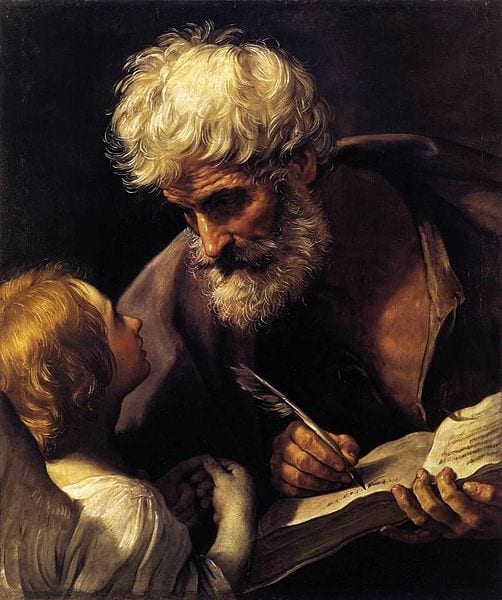
Photo credit: St. Matthew and the Angel (bet. 1635-1640), by Guido Reni (1575-1642) [public domain / Wikimedia Commons]

***
alleged biblical contradictions
Previous Post
December 9, 2019
Does the Bible Prohibit Homosexual (Non-Procreative) Sex?
Next Post
December 10, 2019 Vs. Atheist David Madison #37: Bible, Science, & Germs
Browse Our Archives
Select a Category & Last Things About Me Anti-Catholicism Atheism & Agnosticism Baptism and Sacramentalism Bible and Tradition Blessed Virgin Mary Books by Dave Armstrong C. S. Lewis Calvinism & General Protestantism Catholic Apologetics Catholic Apologists Catholic conversion Catholic converts Christmas Church (Ecclesiology) Church History Conversion and Converts Development of Doctrine Eastern Orthodoxy Ecumenism & Christian Unity Eucharist & Liturgy Fathers of the Church French Translations G. K. Chesterton Hell Hell & Satan Hell & Satan & Last Things Heresies & Comparative Religion Holistic Health Inquisition & Crusades & Scandals James White Jews & Judaism & Old Testament John Calvin John Henry Newman Liberal / Modernist Theology Life Issues Literary Resume Lutheranism Mariology Martin Luther Music Orthodoxy Papacy & Infallibility Personal Page Philosophy & Science Political & Ethical & Moral Issues Protestant Persecution & Intolerance Protestantism Purgatory Purgatory & Penance Romantic & Imaginative Theology Saints & Purgatory & Penance Salvation Salvation & Justification Satan & Last Things Sexuality and Gender Issues Spanish Translations Traditionalism vs. Radical Catholic Reactionaries Traducciones al español / tradução para português Trinitarianism & Christology Uncategorized Videos
Select a Month October 2026 September 2026 August 2026 July 2026 June 2026 May 2026 April 2026 March 2026 February 2026 January 2026 December 2025 November 2025 October 2025 September 2025 August 2025 July 2025 June 2025 May 2025 April 2025 March 2025 February 2025 January 2025 December 2024 November 2024 October 2024 September 2024 August 2024 July 2024 June 2024 May 2024 April 2024 March 2024 February 2024 January 2024 December 2023 November 2023 October 2023 September 2023 August 2023 July 2023 June 2023 May 2023 April 2023 March 2023 February 2023 January 2023 December 2022 November 2022 October 2022 September 2022 August 2022 July 2022 June 2022 May 2022 April 2022 March 2022 February 2022 January 2022 December 2021 November 2021 October 2021 September 2021 August 2021 July 2021 June 2021 May 2021 April 2021 March 2021 February 2021 January 2021 December 2020 November 2020 October 2020 September 2020 August 2020 July 2020 June 2020 May 2020 April 2020 March 2020 February 2020 January 2020 December 2019 November 2019 October 2019 September 2019 August 2019 July 2019 June 2019 May 2019 April 2019 March 2019 February 2019 January 2019 December 2018 November 2018 October 2018 September 2018 August 2018 July 2018 June 2018 May 2018 April 2018 March 2018 February 2018 January 2018 December 2017 November 2017 October 2017 September 2017 August 2017 July 2017 June 2017 May 2017 April 2017 March 2017 February 2017 January 2017 December 2016 November 2016 October 2016 September 2016 August 2016 July 2016 June 2016 May 2016 April 2016 March 2016 February 2016 January 2016 December 2015 November 2015 October 2015 September 2015 August 2015 July 2015 June 2015 May 2015 April 2015 March 2015 February 2015 January 2015 December 2014 November 2014 October 2014 September 2014 August 2014 July 2014 June 2014 April 2014 March 2014 February 2014 January 2014 December 2013 November 2013 October 2013 September 2013 August 2013 July 2013 June 2013 April 2013 March 2013 February 2013 January 2013 December 2012 November 2012 October 2012 September 2012 August 2012 July 2012 June 2012 May 2012 April 2012 March 2012 February 2012 January 2012 December 2011 November 2011 October 2011 September 2011 August 2011 July 2011 June 2011 April 2011 March 2011 February 2011 October 2010 September 2010 August 2010 July 2010 April 2010 March 2010 December 2009 October 2009 August 2009 July 2009 June 2009 May 2009 March 2009 February 2009 October 2008 September 2008 April 2008 March 2008 February 2008 January 2008 December 2007 November 2007 October 2007 May 2007 March 2007 February 2007 January 2007 November 2006 October 2006 September 2006 August 2006 July 2006 June 2006 May 2006 April 2006 March 2006 February 2006 October 2005 June 2005 April 2005 February 2005 July 2004 May 2004 April 2004
Follow Us!
TAKE THE
Religious Wisdom Quiz
Proverbs warns against what kind of woman as a symbol of temptation?
Select your answer to see how you score.
Widow Mother-in-law Queen Adulterous woman
Books by This Author Books by Dave Armstrong
Related posts from Biblical Evidence for Catholicism

A Few "Worst" & "Best" Arguments vs. Protestantism
Biblical Evidence for Catholicism

Jerusalem Council vs. James White & Sola Scriptura
Biblical Evidence for Catholicism

Biblical Perspicuity: Absurd Anti-Catholic "Defense"
Biblical Evidence for Catholicism

50 Biblical Disproofs of "Evident Clearness" of the...
Biblical Evidence for Catholicism
TRENDING AT PATHEOS Catholic

The Sermon on the Mount, Part I: Matthew...
The Sermon on the Mount, Part I (Matthew 4:12-5:12) St. Matthew moves...

What's up from Crossway: Reviewing some of their latest A few weeks...

Janie Learns the Way of the Cross: A...
Teaching children about Jesus' Passion can be challenging. Many parents and educators...

Looking For Good Catholic Writing - October 2026
He alone extends the heavens, and he walks upon the waves of...

In "Irreplaceable," our book on vocation and technology, Trevor Sutton and I...

I was strolling through the top floor of the brand new Parthenon...
view all Catholic blogs
Ad-Free & Subscriber Log-In Subscription Support
- About Us
- 2026 Calendar
- Videos
- Podcasts
- Library of World Religions
- Faith In Media Tracker
- Advertise With Us
- Write for Us
- Privacy Policy
- Terms of Service
- Do Not Sell My Data
- Contact Us
- Radiant Digital
- Manage Newsletter Subscriptions
- Unsubscribe From Notifications
- Sitemap
Copyright 2008-2026, Patheos. All rights reserved.
Subscription Support Ad-Free & Subscriber Log-In
Follow Patheos