
BuddhistCatholicContemplativeEvangelicalGeneral ChristianHinduJewishLatter-day SaintMuslimNew VisionsProgressive Christian
Beliefs
- Buddhist
- Catholic
- Contemplative
- Evangelical
- General Christian
- Hindu
- Jewish
- Latter-day Saint
- More Voices
- Muslim
- New Visions
- Pagan
- Progressive Christian
Topics
- Religion News
- Food and Religion
- Sports and Religion
- Religious Art
- Religious Music and Entertainment
- Religious Events
- History and Religion
- Style and Religion
- Politics and Religion
- Women in Religion
- Recreation Outdoors and Religion
- Business Finance and Religion
- Careers Workplace and Religion
- Education and Religion
- Family Parenting and Religion
- Health Fitness and Religion
- Home and Religion
- Relationships and Religion
- Technology and Religion
- Travel and Religion
Columnists
- Buddhist Columnists
- Business Finance and Religion Columnists
- Careers Workplace and Religion Columnists
- Catholic Columnists
- Contemplative Columnists
- Education and Religion Columnists
- Evangelists Columnists
- Family Parenting and Religion Columnists
- General Christian Columnists
- Health Fitness and Religion Columnists
- Hindu Columnists
- History and Religion Columnists
- Home and Religion Columnists
- Jewish Columnists
- More Voices Columnists
- Latter Day Columnists
- Muslim Columnists
- New Visions Columnists
- Nonreligious Columnists
- Pagan Columnists
- Politics and Religion Columnists
- Progressive Columnists
- Recreation Outdoors and Religion Columnists
- Relationships and Religion Columnists
- Religion News Columnists
- Religious Art Columnists
- Religious Events Columnists
- Religious Music and Entertainment Columnists
- Sports and Religion Columnists
- Style and Religion Columnists
- Technology and Religion Columnists
- Travel and Religion Columnists
- Women in Religion Columnists
Resource Library
- 2026 Calendar
- Library of World Religions
- The 100 Most Holy Places on Earth
- Patheos Answers
- Podcasts
- Videos
- Faith Leaders Database
- Anglican Episcopalian
- Bahai
- Baptist
- Buddhism
- Christianity
- Confucianism
- Eastern Orthodoxy
- Hinduism
- Holiness and Pentecostal
- ISKCON
- Islam
- Judaism
- Lutheran
- Methodist
- The Church of Jesus Christ of Latter-day Saints
- New Age
- Paganism
- Presbytarian and Reformed
- Protestantism
- Religion Behind the Scenes
- Roman Catholic
- Scientology
- Shia Islam
- Sikhism
- Sufism
- Sunni Islam
- Taoism
- Zen
- See all religions
Research Tools
 Ad-Free & Subscriber Log-In Subscription Support
Ad-Free & Subscriber Log-In Subscription Support
Follow Patheos 

- Trending:
- Forgiveness
- |
- Marriage
- |
- Consciousness
- |
- Death Penalty
- |
- Election
- |
- Halloween

-
About
-
Catholic Apologetics
-
Church History
-
Great Apologists
-
Christian Worldview
-
Protestantism & Misc.
- Home
- Catholic
- History and Religion
- Perspicuity (Clearness) of Scripture (vs. Wm. Whitaker)
Perspicuity (Clearness) of Scripture (vs. Wm. Whitaker)
Last updated on: June 6, 2026 at 12:40 am by Dave Armstrong
Perspicuity (Clearness) of Scripture (vs. Wm. Whitaker) 2026-06-06T00:40:46-04:00 Dave Armstrong
Patheos Explore the world's faith through different perspectives on religion and spirituality! Patheos has the views of the prevalent religions and spiritualities of the world.
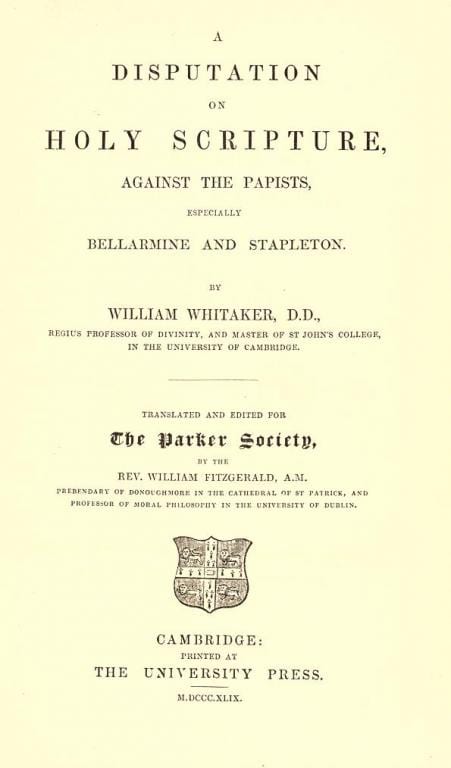
William Whitaker (1548-1595) was a Calvinist Anglican apologist and Master of St. John’s College, Cambridge. His masterwork was Disputation on Holy Scripture: Against the Papists, Especially Bellarmine and Stapleton, published in 1588. I have utilized an online copy published in 1849 by the University Press of Cambridge. Bishop “Dr.” [???] James White, a zealous Reformed Baptist apologist and prominent defender of sola Scriptura, has sold the book on his website, and wrote about it in one such ad in 2007:
Since the Reformation, only a few godly servants of the truth have invested the time and effort necessary to produce for God’s people a full-orbed defense of Scriptural sufficiency against those who would subject Scripture to external authorities. William Whitaker was one of those servants, and his work should be carefully studied by all concerned shepherds of Christ’s flock.
Whitaker’s words will be in blue. This is chapter four of my book, Pillars of Sola Scriptura: Replies to Whitaker, Goode, & Biblical “Proofs” for “Bible Alone” (completed in July 2012): pages 59-74.
*****
The first is contained in his treatise against Faustus the Manichee, Lib. xi. c. 5, where Augustine says that “the scripture is settled upon a certain lofty throne to command the service of every faithful and pious understanding.” (p. 353)
Oddly enough, Whitaker omits the context of the citation (Book 11, section 5), which shows clearly that St. Augustine (like a good sola Scriptura Protestant) does not pit Scripture against the Church. Quite the contrary:
The authority of these books has come down to us from the apostles through the successions of bishops and the extension of the Church, and, from a position of lofty supremacy, claims the submission of every faithful and pious mind. (my bolding)
[W]e never said that every thing in scripture is easy, perspicuous, and plain ; that there is nothing obscure, nothing difficult to be understood; but we confess openly that there are many obscure and difficult passages of scripture: and yet these men object to us this, and affirm that we maintain the scriptures to be perfectly easy. . . . But they do us injustice, and openly preach falsehood concerning us, when they affirm us to say that all things in scripture are so plain that they may be understood by any unlearned person, and need no exposition or interpretation. Hence we see, . . . what they say, but falsely say, that we think, that all things are plain in the scriptures, and that they suffice without any interpretation to determine all controversies. Let us now see what our opinion really is. (pp. 359, 361)
This is how perspicuity is generally understood among Protestant thinkers. Note it well, as we must not misrepresent what we oppose, and need to fully understand opposing views before setting out to refute them.
Luther, in his assertion of the articles condemned by Leo X., in the preface, says that the scripture is its own most plain, easy, and certain interpreter, proving, judging, and illustrating all things. This is said by him most truly, if it be candidly understood. The same author, in his book of the Slavery of the Will against the Diatribe of Erasmus, writes almost in the beginning, that in the scriptures there is nothing abstruse, nothing obscure, but that all things are plain. And because this may seem a paradox, he afterwards explains himself thus: he confesses that many places of scripture are obscure, that there are many words and sentences shrouded in difficulty, but he affirms nevertheless that no dogma is obscure; as, for instance, that God is one and three, that Christ hath suffered, and will reign for ever, and so forth. All which is perfectly true: for although there is much obscurity in many words and passages, yet all the articles of faith are plain. (pp. 361-362)
Well, that’s fascinating, seeing that baptism, a pretty important doctrine and practice of Christianity, is subject to notoriously different interpretations in Protestant camps (all believing in perspicuity). Luther believed in baptismal regeneration, but the Calvinists did not. He and the Calvinists and the Anglicans all believed in infant baptism, but the Anabaptists and Baptists today do not. Wasn’t Scripture clear enough? We are told that it is (“all the articles of faith are plain”), yet all the manifest evidence to the contrary in real life and practice, shows otherwise.
According to Whitaker’s earlier reasoning in his book, “the other guy” is wrong because he lacks a fuller measure of the Holy Spirit. But of course this is a hopelessly contradictory state of affairs. Who decides who is right in the first place, and who lacks the Holy Spirit? Each one says this about the other. Who decides where the truth lies, and how? All appeal to Scripture, so obviously, Scripture cannot settle the question itself.
The same thing holds for the Eucharist, and many other doctrines. Luther affirmed the Real Presence. The Anabaptists and Calvinists did not, etc. We’re left with a scenario where Scripture is supposedly plain (without the authoritative aid of the Church), for all major doctrines, yet Protestants can’t resolve many such doctrines, and continue to perpetually disagree. It’s rather absurd . . . all they can say about each other is that the “other guys” are blind to the plain teachings of Scripture.
But some persons complain greatly of the obscurity of the things also, so that this distinction of Luther’s between the things and the signs of the things may seem to be idle. Luther answers that this occurs, not from the obscurity and difficulty of the things themselves, but from our blindness and ignorance. . . . Furthermore he says, that the reason why so many dispute about the things of scripture is to be found in the perversity and depraved desires of men, especially the sophists and schoolmen, who, not content with the simplicity of scripture, have rendered every thing obscure and intricate by their traps and devices; but that the scripture must not be falsely blamed on account of men’s abuse of it. (p. 362)
There’s the stock answer that has been used ever since. But it is thoroughly problematic and unsatisfactory, for reasons detailed above.
The state of the question, therefore, is not really such as the papists would have it appear; but our fundamental principles are these: First, that the scriptures are sufficiently clear to admit of their being read by the people and the unlearned with some fruit and utility. Secondly, that all things necessary to salvation are propounded in plain words in the scriptures. Meanwhile, we concede that there are many obscure places, and that the scriptures need explication; and that, on this account, God’s ministers are to be listened to when they expound the word of God, and the men best skilled in scripture are to be consulted. So far concerning the state of the question. (p. 364)
Both baptism and the Eucharist are necessary to salvation:
Baptism:
Mark 16:16 [disputed manuscript, but still indicates the early Christian, apostolic belief] He who believes and is baptized will be saved; but he who does not believe will be condemned.
Acts 2:38 And Peter said to them, “Repent, and be baptized every one of you in the name of Jesus Christ for the forgiveness of your sins;”
Acts 22:16 And now why do you wait? Rise and be baptized, and wash away your sins, calling on his name.’
Romans 6:3-4 Or don’t you know that all of us who were baptized into Christ Jesus were baptized into his death? We were therefore buried with him through baptism into death in order that, just as Christ was raised from the dead through the glory of the Father, we too may live a new life. (cf. Romans 8:11, 1 Cor 15:20-23, Col 2:11-13)
Titus 3:5 he saved us, not because of deeds done by us in righteousness, but in virtue of his own mercy, by the washing of regeneration and renewal in the Holy Spirit,
1 Peter 3:18-21 For Christ also died for sins once for all, the righteous for the unrighteous, that he might bring us to God, being put to death in the flesh but made alive in the spirit; in which he went and preached to the spirits in prison, who formerly did not obey, when God’s patience waited in the days of Noah, during the building of the ark, in which a few, that is, eight persons, were saved through water. Baptism, which corresponds to this, now saves you, not as a removal of dirt from the body but as an appeal to God for a clear conscience, through the resurrection of Jesus Christ,
Eucharist:
John 6:48-51 I am the bread of life. Your fathers ate the manna in the wilderness, and they died. This is the bread which comes down from heaven, that a man may eat of it and not die. I am the living bread which came down from heaven; if any one eats of this bread, he will live for ever; and the bread which I shall give for the life of the world is my flesh.”
John 6:53-58 So Jesus said to them, “Truly, truly, I say to you, unless you eat the flesh of the Son of man and drink his blood, you have no life in you; he who eats my flesh and drinks my blood has eternal life, and I will raise him up at the last day. For my flesh is food indeed, and my blood is drink indeed. He who eats my flesh and drinks my blood abides in me, and I in him. As the living Father sent me, and I live because of the Father, so he who eats me will live because of me. This is the bread which came down from heaven, not such as the fathers ate and died; he who eats this bread will live for ever.”
But Protestants notoriously disagree on both of these things necessary for salvation; therefore, it appears that it is not true that Scripture is plain enough for all to agree on matters concerning salvation. It is much easier to hold that there are false premises somewhere, in cases of contradiction, and to go after those. But it is manifest that people may interpret “plain” Scripture and come up with contradictory conclusions.
We should carefully bear in memory the preceding distinctions drawn by Luther; for they are sufficient to obviate almost all the arguments of the papists in this question. (p. 365)
They haven’t “obviated” the argument I just made; nor has any Protestant I have ever met in 20 years of Catholic apologetics come up with a rational rebuttal of it.
[I]n order to dispute pertinently against Luther and us, he ought to have shewn some doctrines or articles of faith not openly and plainly set forth in scripture. (p. 367)
If Protestants can’t agree on baptism and the Eucharist, then it follows (by their premises) that these teachings must not be perspicuous; therefore, a key plank of perspicuity as Whitaker has defined it, following Luther, is refuted. Or else the Protestant can fall back on the ridiculous “other guy has a lesser measure of the Holy Spirit and can’t see the truth” so-called “argument.”
Either these two teachings (baptism and the Eucharist) are not plain in Scripture, in which case, Luther and Whitaker are wrong, and perspicuity: a key aspect of sola Scriptura, is false, or they are plain in Scripture, in which case it makes no practical difference in Protestant adoption of beliefs (since they can’t bring themselves to agree upon them); therefore, of what use is perspicuity, if it can’t even bring about Protestant agreement and consensus?
The conclusion is one of two things: perspicuity is either false or it is so irrelevant and useless that it may as well be false, for all the good it does. Needless to say, neither scenario is very impressive. Catholics, on the other hand, easily achieve doctrinal unity by means of an infallible, authoritative Church (the very thing that sola Scriptura precludes from the outset).
Bellarmine alleges five arguments in order to prove the scriptures to be obscure, which we acknowledge in some places to be true. But let us see of what sort these arguments are. His first argument is taken from the authority of scripture, from which he cites some passages. In the first place he reasons thus: David was ignorant of many things, therefore much more we; consequently, the scriptures are obscure. Now that David was ignorant of many things, he proves from Psalm cxix. [119], where it is said, “Give me understanding, and I will search thy law;” where also the psalmist entreats God “to teach him” his law, to “illuminate his eyes;” and in many places of that same Psalm he ingenuously confesses his ignorance of many things. To the same purpose he alleges what Jerome writes of David, to Paulinus, Ep. 13, de Institit. Monachi: “If so great a prophet confesses the darkness of ignorance, with what night of ignorance do you suppose that we, mere babes and hardly more than sucklings, are surrounded?” From all which he concludes that the scriptures are obscure. I answer, in the first place, these things do not touch the question. There is no one amongst us who does not confess with David, that God is to be constantly besought to teach us his law, to illuminate our hearts, &c. Therefore the example of David is objected to us in vain. Who would believe that these men know what they are saying? Do we indeed affirm that the scripture is so plain, that God needs not to be prayed to to teach us his law, his will, and his word? No one was ever so impious and so mad. Therefore we ought continually to pray with David, that God would give us understanding, that he would open our eyes, illuminate our minds, and teach us himself: otherwise we shall never understand any thing aright. For it is not enough to know the words, the letter or the history, but a full persuasion is required. This it was that David sought, that he might more and more make progress in true understanding and faith. Secondly, David speaks there not principally of the external understanding (for doubtless he knew the letter, and the grammatical and historical sense of most passages), but of that internal full assurance . . . (p. 367)
We readily grant what Whitaker says about the general Protestant belief (Catholics are indeed sometimes prone to misrepresent this), but nevertheless, I submit that the problem is ultimately one of extreme subjectivity: to such an extent that there can never be any conceivable disproof in Scripture of this sort (which is not reasonable: if something is beyond disproof or verifiability). The Protestant simply says (as Whitaker did), “this proves nothing, because we don’t deny that Scriptures need to be interpreted.”
But I would contend that this amounts to a distinction without a difference, for how is the Protestant to determine when he has received enough teaching aid (that Whitaker concedes is usually needed) to be able to confidently conclude that any given passage is sufficiently “plain,” according to perspicuity? In other words, it simply removes the problem one step back; it doesn’t resolve it.
If Scripture is sufficiently unclear, so that we need authoritative interpretation, then it makes perfect sense that the Church would serve that purpose (in the sense that it actually does in the Catholic system). The main remaining difference would then be that the Protestant has necessary but non-binding, non-infallible hermeneutical teaching, while the Catholic has infallible scriptural guidance, and a clear parameter and framework of orthodoxy within which Bible passages have to be understood (which Protestants have to a lesser extent also in creeds and confessions).
But if non-binding, non-infallible teaching is necessary and helpful for the Protestant to understand Scripture, yet no reasonable certainty can be obtained, and men differ, of what good is a perspicuous Scripture? Why claim to believe in that at all, if it has to be qualified so much that it is scarcely distinguishable from a Catholic position? It’s only as “good” as it allows folks to obtain the supposed “plain” (major doctrinal) truth without error. Thus, the individual Protestant remains at sea in a sense, and cannot arrive at the “clear” meaning of Scripture without any nagging doubts that he “got it wrong.”
How, then, is this a superior system to the Catholic one? Whitaker puts his belief out of the range of rational critique by making it so subjective that (it seems that) nothing from Scripture can possibly falsify it. He immediately dismisses every passage that Catholics bring up, to suggest that Scripture is not always so “clear and plain” after all. I don’t think he can dismiss Bellarmine’s prooftext of Psalm 119 and its implications so easily and cavalierly as he does. Let’s take a look at it:
Psalm 119:18-19, 26-34 Open my eyes, that I may behold wondrous things out of thy law. [19] I am a sojourner on earth; hide not thy commandments from me! . . . [26] When I told of my ways, thou didst answer me; teach me thy statutes! [27] Make me understand the way of thy precepts, and I will meditate on thy wondrous works. [28] My soul melts away for sorrow; strengthen me according to thy word! [29] Put false ways far from me; and graciously teach me thy law! [30] I have chosen the way of faithfulness, I set thy ordinances before me. [31] I cleave to thy testimonies, O LORD; let me not be put to shame! [32] I will run in the way of thy commandments when thou enlargest my understanding! [33] Teach me, O LORD, the way of thy statutes; and I will keep it to the end. [34] Give me understanding, that I may keep thy law and observe it with my whole heart.
This is a classic illustration of how (in so many instances) false Protestant tenets are based on illogical or shoddy thinking. The premises are false; therefore, what is built upon them is also false. The house is only as good as its foundation. Whitaker tries to rationalize that it is not understanding per se that King David sought, but full internal assurance (bringing it back — typically for Protestants — to the purely subjective aspects again). But it is apparent that this is not the case. David is seeking to learn the thing itself; not to be sure that he has properly learned it. He wants to learn and “understand” various essential aspects of the law. He wants his eyes to be opened to them.
Moreover (to follow Bellarmine’s line of thought), if David, a writer of Scripture and one with whom God made a covenant: the forerunner of Jesus Himself, needed this much direct instruction and guidance from God Himself, why is it now impermissible to simply say that the individual needs authoritative (not optional, or relativistic) guidance from Holy Mother Church?
Which is harder to believe? If David needed that, why should we think that it is less necessary for every Christian to simply have infallible Church guidance? If the more difficult thing is laid out in Scripture, then surely the less difficult thing by analogy (and direct Bible teaching elsewhere) is not difficult to either grasp or accept.
All of this is going on underneath the surface, at the level of premises and assumptions, yet we are still to believe that Scripture is plain enough for the individual to arrive at all doctrinal truth, with no necessary aid of the Church. Meanwhile, Protestants can agree on virtually nothing except those things where they already agree with Catholics. It doesn’t make any sense. The Catholic perspective is far more biblical and logical.
The second passage of scripture which he objects is Luke xxiv. 27, from which place he reasons thus: Christ interpreted the scriptures to his disciples: therefore the scriptures are not easy, but need an interpreter. I answer, in the first place, which of us ever took away the interpretation of scripture? Certainly, none of us; for we all readily confess that the scriptures need interpretation. Secondly, those disciples were crushed and stricken at that time with a sort of amazement, and slow and unapt to understand any thing; so that it is no wonder that they could not understand the scriptures without an interpretation. Thirdly, those who under- stand the grammatical sense of scripture, ought nevertheless to hear the exposition of scripture, to help them to a better understanding. This we never denied. (p. 368)
Whitaker misses the entire point. He rationalizes the passage away with scarcely any consideration at all. This was not simply a case of Jesus giving a little aid, to provide a “better understanding” (as if it were only a matter of degree). They had completely gotten it wrong; missed the truth, and in that sense were little better than the hypocritical Pharisees whom Jesus excoriated. Thus, Jesus exclaimed:
Luke 24:25-27 . . . “O foolish men, and slow of heart to believe all that the prophets have spoken! [26] Was it not necessary that the Christ should suffer these things and enter into his glory?” [27] And beginning with Moses and all the prophets, he interpreted to them in all the scriptures the things concerning himself.
The Suffering Messiah, or “Servant” was a manifest teaching in the Old Testament (most prominent in Isaiah 53) — even the Jews (historically) understood this, though they thought Jesus wasn’t this suffering Messiah — , yet they didn’t get it. It wasn’t plain to them, and indeed all of the disciples did not understand that Jesus was to suffer and die for the sins of mankind (see, e.g., Matt 17:22-23; Mk 9:31-32; Lk 18:31-34).
Only His mother Mary showed some semblance of understanding. The argument can strongly be made, then, that Old Testament Scripture was not perspicuous on the matter of the redeeming death of Jesus: a central aspect of Christian teaching.
It was so unclear to Jesus’ own disciples that they never grasped it till He actually died. But there it is in Isaiah 53. The point is that it’s not a matter of Scripture itself being utterly obscure and some deep mystery that no one can grasp (the Protestant caricature of what Catholics actually believe), but that some considerable number of men will miss even the most plain teachings in it; hence the need for the infallible Church to guide and to prevent men’s propensity for getting things wrong and not comprehending things, from ruining the very notion of orthodoxy and a revealed truth shared by one and all.
They needed authoritative teaching. Again, it was God Himself doing it; therefore, it is not unreasonable to expect that we should merely have authoritative human teachers provide the same necessary aid. In 24:32 they say, “he opened to us the scriptures”; again, it wasn’t a minor assistance or a little shove in the right direction; it was a matter of black and white. Before, they had no understanding at all, then they did.
This is a profound disproof of perspicuity, yet Whitaker is so blinded by his partisan zeal for his cause that he can’t see it, right in front of him. It is, once again, about a major doctrine of the faith: the redeeming death of Jesus, which was already taught in the Old Testament.
The scene is repeated even more dramatically with all eleven disciples (minus Judas). He appeared to them, but they did not yet grasp that He was to rise from the dead, even though He had told them He would — several times (Lk 24:36-41). He went on:
Luke 24:44-47 Then he said to them, “These are my words which I spoke to you, while I was still with you, that everything written about me in the law of Moses and the prophets and the psalms must be fulfilled.” [45] Then he opened their minds to understand the scriptures, [46] and said to them, “Thus it is written, that the Christ should suffer and on the third day rise from the dead, [47] and that repentance and forgiveness of sins should be preached in his name to all nations, beginning from Jerusalem.”
It had all been written, in what Protestants agree is Scripture (the Old Testament), yet they entirely missed it without Jesus’ help (He had already told them, as He alludes in 24:44). And this had to do with very important things: the Messiah, His redeeming death, the atonement, salvation itself (which was made possible by this means), the Resurrection, repentance and forgiveness of sins, the opening of the gospel and Christianity to the Gentiles, etc.
These are extremely important things. Jesus’ disciples didn’t get it. He had to rise from the dead and come back and specifically tell them, explaining the Old Testament scriptures, before they did.
Yet Whitaker and Protestants want us to believe that there is no need for authoritative and binding biblical interpretation from the Church? I don’t buy it. The Scripture never suggests such an absurd thing, and often disproves it, as in these passages: cavalierly dismissed by Whitaker almost without any reply. He has not looked at them closely enough. They were not perspicuous to him (!). Far from being no disproof of the doctrine at all; I find them to be compelling; almost the best conceivable disproofs.
In the third place, he objects to us the case of the eunuch. Acts viii., whom he states to have been a pious man and studious of the scripture; and to prove this he cites the superfluous testimony of Jerome, from his epistle to Paulinus concerning the study of the scriptures. He, being asked by Philip if he understood what he was reading, replied, “How can I understand, unless some man declare it unto me?” Therefore, says Bellarmine, the scriptures need interpretation. I answer, in the first place, we concede that many things in scripture are obscure and need interpretation; therefore this place concludes nothing against us. Secondly, although this eunuch was pious and very studious of scripture, he was yet unskilful and not much familiar with scripture, as is plain from his question; for he asked Philip whether the prophet spoke of himself, or of some other person. Now, we do not say that every thing is immediately plain and easy in the scriptures, so as to be intelligible to every one; but we say that those things which at first seem obscure and difficult, are afterwards rendered easy, if one be diligent in reading them, and bring with him a pure and pious mind. (pp. 368-369)
The same analysis I made above applies to this passage as well. Whitaker can’t see that it is a disproof in any way, shape, or form, of perspicuity, because he qualifies it out of existence as a disproof. But it is certainly relevant to the overall discussion. It’s fascinating that Whitaker does with the Ethiopian eunuch what he recommends that Protestants do with all who disagree with them: suggest that their understanding is grossly inadequate and that they are, well, stupid, and that they lack the necessary measure of the Holy Spirit. This is what Luther and all the original “reformers” did, and Protestants (at least when pressed) have done it ever since. And again (as always), this is too simplistic of an answer.
Ironically (given the prior passage and subject matter that we looked at), we know that the passage in question was from Isaiah 53. The eunuch didn’t understand it, and it’s true, I concede, that it doesn’t take much knowledge of the Old Testament to know from context and cross-referencing, that Isaiah was not referring to himself (Acts 8:34), but rather, to the Messiah (Jesus).
But then again, the eunuch in his ignorance was in very good company, since (as I have just shown), all of Jesus’ disciples also did not understand or grasp in the slightest, Isaiah 53, either. If they had, they would have recognized that it was about Jesus, and a graphic description of His sufferings and death, and of the atonement (gained on the cross) itself. All of this is, I dare say, quite an effective disproof of perspicuity (rightly understood, as Whitaker defines it, after Luther).
Whitaker futilely spins the passage as an indication of the initially difficult biblical passage being rendered easier and comprehensible with a little help. The actual state of affairs is precisely as we observed in Luke 24 and Psalm 119: going from literally no understanding or profound misunderstandings to grasping the very notion that is involved.
The disciples didn’t know that Jesus (the Messiah) was to die and suffer, even though it was foretold in the Old Testament in a number of passages, including Isaiah 53. Likewise, the eunuch didn’t know that Isaiah 53 was about Jesus.
In both cases, it was necessary to enlighten on a rather fundamental level. That is a vastly different scenario from what Whitaker describes, in an attempt to special plead the implications of all this away. I’m delighted that he makes such abysmally weak counter-replies, that we can now scrutinize, and in so doing, immensely strengthen the biblical and logical case against perspicuity. I am thankful and delighted for the opportunity that bad opposing arguments offer us!
In the fourth place, he objects to us the words of Peter which are contained in 2 Epistle iii. 16, where Peter says expressly that there are [unreadable Greek] (some things hard to be understood) in Paul’s epistles. And the Jesuit bids us observe, that Peter does not say that there are some things hard to be understood merely by the unlearned and unstable, but simply and absolutely [Greek], difficulties; whence he wishes to infer that they are difficult to all, though especially to the unlearned. . . . I answer, first, We concede that some places are hard to be understood: therefore, this passage does not make against us. Secondly, Peter does not say that [Greek], all things, but only [Greek], some things, are hard to be understood. And what if some things be obscure? Yet it follows that the greatest part is plain and easy. Thirdly, Although Peter inveighs against . . . “the unlearned and unstable,” who [Greek] “wrest” the scriptures, he nevertheless does not debar them altogether from the reading of the scriptures. (p. 369)
Nor do we do so (as to the last sentence). The Church has opposed bad translations into the vernacular, not all vernacular translations (by a long shot). All the Church is saying is that there is a framework of orthodoxy beyond which the individual exegete cannot go. Protestants lacked this from the start, and so they disagreed on a host of things, making themselves ridiculous and hopelessly chaotic and de facto theological relativists within a generation.
But in his rush to minimize the disproof, Whitaker (this seems to be a tendency with him) misses much of the import. We grant all of his qualifications (no problem), but it remains a problem in all Christian circles, of folks running across in Scripture, “things . . . hard to understand, which the ignorant and unstable twist to their own destruction.” It is precisely the latter scenario that is the concern of the Church. Again, we are not declaring an utterly dark, mysterious, unfathomable Scripture, but rather (as seen here), one that men too often distort, bringing misery and causing heresy to spring forth, ensnaring many souls.
Lastly, St. Paul was a very subtle, nuanced, and advanced thinker: one of the very greatest of his time (or any time). Entire books have been written about single words of his. To say that there are relatively few (exegetical) “difficulties” in his teaching is a vast understatement. Protestants have wrangled amongst themselves for 500 years over very many aspects of his teaching. Whitaker can quibble about St. Peter saying there were “some” things (rather than “many”) in his writing “hard to understand” but any exegete who specializes in Pauline theology knows the difficulties involved, in the finer points.
Calvinists, for example, think that their full-fledged notion of double predestination, TULIP, is easily found and grasped in Paul’s writings, yet amazingly enough, no one saw this teaching for 1500 years till John Calvin and his successors came around and “discovered” it in the perspicuous Pauline epistles. That is merely one example of many doctrines where they endlessly fight and disagree.
Whitaker attacks the honesty of his opponent: St. Robert Bellarmine, proclaiming, “Here the Jesuit betrays his remarkable unfairness, and really singular dishonesty . . . he displays his own extraordinary desire to deceive us.” (pp. 374-375). This kind of unnecessary silliness need not detain us long. I simply wanted to document how it always lurks just under the surface of Whitaker’s critiques of Catholic arguments. We Catholics (incorrigible rascals that we are) always have to be dishonest. It can’t possibly be an honest disagreement.
***
Related Reading:
Dialogue: Clearness (Perspicuity) of Scripture and the Formal Sufficiency of Scripture (vs. Carmen Bryant) [6-8-00]
Dialogue: Church Fathers on Perspicuity & Sola Scriptura [6-11-00]
The Sufficiency & Perspicuity of Scripture & the Trinity [6-16-03; slightly revised on 1-20-04]
Is the Bible in Fact Clear, or “Perspicuous” to Every Individual? [2007]
Luther: Scripture Easily Grasped by “Plowboys” [11-1-08]
Erasmus’ Hyperaspistes (1526): Sola Scriptura and Perspicuity of Scripture [2-12-09]
25 Brief Arguments Regarding Biblical “Clearness” [2009]
The Perspicuity (Clearness) of Scripture: A Summary [1-22-10]
The Anglican Newman (1833-1838) on the Falsity of Perspicuity (Clearness) of Holy Scripture [3-7-11]
The Bible: “Clear” & “Self-Interpreting”? [February 2014]
Perspicuity (Clarity) of Holy Scripture [11-21-15]
The Clearness, or “Perspicuity,” of Sacred Scripture [National Catholic Register, 11-16-17]
***
Unfortunately, Money Trees Do Not Exist: If you have been aided in any way by my work, or think it is valuable and worthwhile, please strongly consider financially supporting it (even $10 / month — a mere 33 cents a day — would be very helpful). I have been a full-time Catholic apologist since Dec. 2001, and have been writing Christian apologetics since 1981 (see my Resume). My work has been proven (by God’s grace alone) to be fruitful, in terms of changing lives (see the tangible evidences from unsolicited “testimonies”). I have to pay my bills like all of you: and have a (homeschooling) wife and three children still at home to provide for, and a mortgage to pay.
*
My book royalties from three bestsellers in the field (published in 2003-2007) have been decreasing, as has my overall income, making it increasingly difficult to make ends meet. I provide over 2600 free articles here, for the purpose of your edification and education, and have written 50 books. It’ll literally be a struggle to survive financially until Dec. 2020, when both my wife and I will be receiving Social Security. If you cannot contribute, I ask for your prayers (and “likes” and links and shares). Thanks!
*
See my information on how to donate (including 100% tax-deductible donations). It’s very simple to contribute to my apostolate via PayPal, if a tax deduction is not needed (my “business name” there is called “Catholic Used Book Service,” from my old bookselling days 17 or so years ago, but send to my email: [email protected]). Another easy way to send and receive money (with a bank account or a mobile phone) is through Zelle. Again, just send to my e-mail address. May God abundantly bless you.
***
Photo credit: scan of 1849 (Cambridge) cover of William Whitaker’s book, Disputation on Holy Scripture, at Internet Archive.
***
Previous Post

December 3, 2019
Hysterical Reactionaries Opposed Pope Francis from Day One
Next Post

December 4, 2019 What is “Traditional Femininity”? (Attempted Definition)
Browse Our Archives
Select a Category & Last Things About Me Anti-Catholicism Atheism & Agnosticism Baptism and Sacramentalism Bible and Tradition Blessed Virgin Mary Books by Dave Armstrong C. S. Lewis Calvinism & General Protestantism Catholic Apologetics Catholic Apologists Catholic conversion Catholic converts Christmas Church (Ecclesiology) Church History Conversion and Converts Development of Doctrine Eastern Orthodoxy Ecumenism & Christian Unity Eucharist & Liturgy Fathers of the Church French Translations G. K. Chesterton Hell Hell & Satan Hell & Satan & Last Things Heresies & Comparative Religion Holistic Health Inquisition & Crusades & Scandals James White Jews & Judaism & Old Testament John Calvin John Henry Newman Liberal / Modernist Theology Life Issues Literary Resume Lutheranism Mariology Martin Luther Music Orthodoxy Papacy & Infallibility Personal Page Philosophy & Science Political & Ethical & Moral Issues Protestant Persecution & Intolerance Protestantism Purgatory Purgatory & Penance Romantic & Imaginative Theology Saints & Purgatory & Penance Salvation Salvation & Justification Satan & Last Things Sexuality and Gender Issues Spanish Translations Traditionalism vs. Radical Catholic Reactionaries Traducciones al español / tradução para português Trinitarianism & Christology Uncategorized Videos
Select a Month October 2026 September 2026 August 2026 July 2026 June 2026 May 2026 April 2026 March 2026 February 2026 January 2026 December 2025 November 2025 October 2025 September 2025 August 2025 July 2025 June 2025 May 2025 April 2025 March 2025 February 2025 January 2025 December 2024 November 2024 October 2024 September 2024 August 2024 July 2024 June 2024 May 2024 April 2024 March 2024 February 2024 January 2024 December 2023 November 2023 October 2023 September 2023 August 2023 July 2023 June 2023 May 2023 April 2023 March 2023 February 2023 January 2023 December 2022 November 2022 October 2022 September 2022 August 2022 July 2022 June 2022 May 2022 April 2022 March 2022 February 2022 January 2022 December 2021 November 2021 October 2021 September 2021 August 2021 July 2021 June 2021 May 2021 April 2021 March 2021 February 2021 January 2021 December 2020 November 2020 October 2020 September 2020 August 2020 July 2020 June 2020 May 2020 April 2020 March 2020 February 2020 January 2020 December 2019 November 2019 October 2019 September 2019 August 2019 July 2019 June 2019 May 2019 April 2019 March 2019 February 2019 January 2019 December 2018 November 2018 October 2018 September 2018 August 2018 July 2018 June 2018 May 2018 April 2018 March 2018 February 2018 January 2018 December 2017 November 2017 October 2017 September 2017 August 2017 July 2017 June 2017 May 2017 April 2017 March 2017 February 2017 January 2017 December 2016 November 2016 October 2016 September 2016 August 2016 July 2016 June 2016 May 2016 April 2016 March 2016 February 2016 January 2016 December 2015 November 2015 October 2015 September 2015 August 2015 July 2015 June 2015 May 2015 April 2015 March 2015 February 2015 January 2015 December 2014 November 2014 October 2014 September 2014 August 2014 July 2014 June 2014 April 2014 March 2014 February 2014 January 2014 December 2013 November 2013 October 2013 September 2013 August 2013 July 2013 June 2013 April 2013 March 2013 February 2013 January 2013 December 2012 November 2012 October 2012 September 2012 August 2012 July 2012 June 2012 May 2012 April 2012 March 2012 February 2012 January 2012 December 2011 November 2011 October 2011 September 2011 August 2011 July 2011 June 2011 April 2011 March 2011 February 2011 October 2010 September 2010 August 2010 July 2010 April 2010 March 2010 December 2009 October 2009 August 2009 July 2009 June 2009 May 2009 March 2009 February 2009 October 2008 September 2008 April 2008 March 2008 February 2008 January 2008 December 2007 November 2007 October 2007 May 2007 March 2007 February 2007 January 2007 November 2006 October 2006 September 2006 August 2006 July 2006 June 2006 May 2006 April 2006 March 2006 February 2006 October 2005 June 2005 April 2005 February 2005 July 2004 May 2004 April 2004
Follow Us!
TAKE THE
Religious Wisdom Quiz
What animal is mentioned in Proverbs as having little strength but great wisdom?
Select your answer to see how you score.
Lion Ox Ant Bear
Books by This Author Books by Dave Armstrong
Related posts from Biblical Evidence for Catholicism

A Few "Worst" & "Best" Arguments vs. Protestantism
Biblical Evidence for Catholicism

Jerusalem Council vs. James White & Sola Scriptura
Biblical Evidence for Catholicism

Biblical Perspicuity: Absurd Anti-Catholic "Defense"
Biblical Evidence for Catholicism

50 Biblical Disproofs of "Evident Clearness" of the...
Biblical Evidence for Catholicism
TRENDING AT PATHEOS Catholic

The Sermon on the Mount, Part I: Matthew...
The Sermon on the Mount, Part I (Matthew 4:12-5:12) St. Matthew moves...

What's up from Crossway: Reviewing some of their latest A few weeks...

Janie Learns the Way of the Cross: A...
Teaching children about Jesus' Passion can be challenging. Many parents and educators...

Looking For Good Catholic Writing - October 2026
He alone extends the heavens, and he walks upon the waves of...

In "Irreplaceable," our book on vocation and technology, Trevor Sutton and I...

I was strolling through the top floor of the brand new Parthenon...
view all Catholic blogs
Ad-Free & Subscriber Log-In Subscription Support
- About Us
- 2026 Calendar
- Videos
- Podcasts
- Library of World Religions
- Faith In Media Tracker
- Advertise With Us
- Write for Us
- Privacy Policy
- Terms of Service
- Do Not Sell My Data
- Contact Us
- Radiant Digital
- Manage Newsletter Subscriptions
- Unsubscribe From Notifications
- Sitemap
Copyright 2008-2026, Patheos. All rights reserved.
Subscription Support Ad-Free & Subscriber Log-In
Follow Patheos