
BuddhistCatholicContemplativeEvangelicalGeneral ChristianHinduJewishLatter-day SaintMuslimNew VisionsProgressive Christian
Beliefs
- Buddhist
- Catholic
- Contemplative
- Evangelical
- General Christian
- Hindu
- Jewish
- Latter-day Saint
- More Voices
- Muslim
- New Visions
- Pagan
- Progressive Christian
Topics
- Religion News
- Food and Religion
- Sports and Religion
- Religious Art
- Religious Music and Entertainment
- Religious Events
- History and Religion
- Style and Religion
- Politics and Religion
- Women in Religion
- Recreation Outdoors and Religion
- Business Finance and Religion
- Careers Workplace and Religion
- Education and Religion
- Family Parenting and Religion
- Health Fitness and Religion
- Home and Religion
- Relationships and Religion
- Technology and Religion
- Travel and Religion
Columnists
- Buddhist Columnists
- Business Finance and Religion Columnists
- Careers Workplace and Religion Columnists
- Catholic Columnists
- Contemplative Columnists
- Education and Religion Columnists
- Evangelists Columnists
- Family Parenting and Religion Columnists
- General Christian Columnists
- Health Fitness and Religion Columnists
- Hindu Columnists
- History and Religion Columnists
- Home and Religion Columnists
- Jewish Columnists
- More Voices Columnists
- Latter Day Columnists
- Muslim Columnists
- New Visions Columnists
- Nonreligious Columnists
- Pagan Columnists
- Politics and Religion Columnists
- Progressive Columnists
- Recreation Outdoors and Religion Columnists
- Relationships and Religion Columnists
- Religion News Columnists
- Religious Art Columnists
- Religious Events Columnists
- Religious Music and Entertainment Columnists
- Sports and Religion Columnists
- Style and Religion Columnists
- Technology and Religion Columnists
- Travel and Religion Columnists
- Women in Religion Columnists
Resource Library
- 2026 Calendar
- Library of World Religions
- The 100 Most Holy Places on Earth
- Patheos Answers
- Podcasts
- Videos
- Faith Leaders Database
- Anglican Episcopalian
- Bahai
- Baptist
- Buddhism
- Christianity
- Confucianism
- Eastern Orthodoxy
- Hinduism
- Holiness and Pentecostal
- ISKCON
- Islam
- Judaism
- Lutheran
- Methodist
- The Church of Jesus Christ of Latter-day Saints
- New Age
- Paganism
- Presbytarian and Reformed
- Protestantism
- Religion Behind the Scenes
- Roman Catholic
- Scientology
- Shia Islam
- Sikhism
- Sufism
- Sunni Islam
- Taoism
- Zen
- See all religions
Research Tools
 Ad-Free & Subscriber Log-In Subscription Support
Ad-Free & Subscriber Log-In Subscription Support
Follow Patheos 

- Trending:
- Forgiveness
- |
- Marriage
- |
- Consciousness
- |
- Death Penalty
- |
- Election
- |
- Halloween

-
About
-
Catholic Apologetics
-
Church History
-
Great Apologists
-
Christian Worldview
-
Protestantism & Misc.
- Home
- Catholic
- History and Religion
- Bible: Completely Self-Authenticating? (vs. Wm. Whitaker)
Bible: Completely Self-Authenticating? (vs. Wm. Whitaker)
Last updated on: June 6, 2026 at 12:40 am by Dave Armstrong
Bible: Completely Self-Authenticating? (vs. Wm. Whitaker) 2026-06-06T00:40:46-04:00 Dave Armstrong
Patheos Explore the world's faith through different perspectives on religion and spirituality! Patheos has the views of the prevalent religions and spiritualities of the world.
. . . So that Anyone Could Come up with the Complete Canon without Formal Church Proclamations?
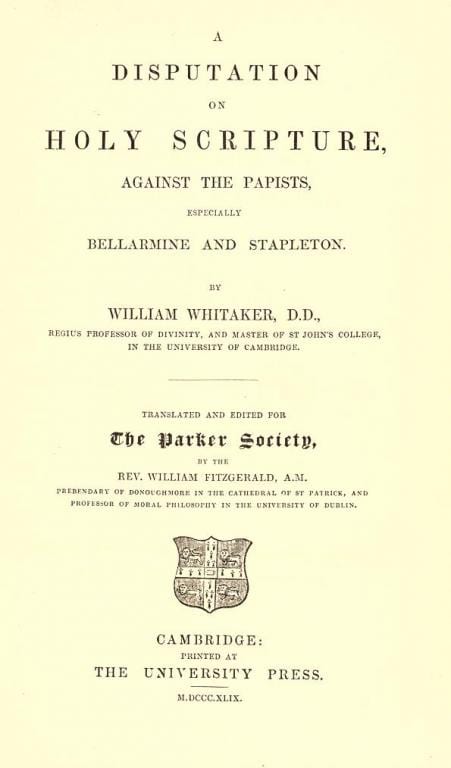
William Whitaker (1548-1595) was a Calvinist Anglican apologist and Master of St. John’s College, Cambridge. His masterwork was Disputation on Holy Scripture: Against the Papists, Especially Bellarmine and Stapleton, published in 1588. I have utilized an online copy published in 1849 by the University Press of Cambridge. Bishop “Dr.” [???] James White, a zealous Reformed Baptist apologist and prominent defender of sola Scriptura, has sold the book on his website, and wrote about it in one such ad in 2007:
Since the Reformation, only a few godly servants of the truth have invested the time and effort necessary to produce for God’s people a full-orbed defense of Scriptural sufficiency against those who would subject Scripture to external authorities. William Whitaker was one of those servants, and his work should be carefully studied by all concerned shepherds of Christ’s flock.
Whitaker’s words will be in blue. This is chapter three of my book, Pillars of Sola Scriptura: Replies to Whitaker, Goode, & Biblical “Proofs” for “Bible Alone” (completed in July 2012): pages 45-57.
*****
But now let us come to the examination of the argument itself, to which I return a twofold answer. First, I affirm that the scripture can be understood, perceived, known and proved from scripture. Secondly, I say that if it cannot be perceived and proved in this way, still less can it be proved by the church. (p. 289)
It can be “proved by the church” because we don’t deny that Scripture can be known in and of itself; we only assert that men en masse can err, and have indeed erred before authoritative ecclesiastical proclamations on the canon were made. We believe much of what Protestants believe in this regard, about Holy Scripture: just not to the extent that they do (an extent that excludes the key role of the Church and tradition in the Rule of faith).
Much of the debate about Scripture itself is a matter of degree, and comes down to the usual “either/or” vs. “both/and” dynamic. Whitaker wants to say, “either the Church or the Bible must be supreme.” Catholics reject what we contend is a false dichotomy and say, “why do we have to choose? What logical necessity requires this? Both are supreme, and entirely harmonious.”
[I]t is compared to a lamp shining in a dark place, . . . It hath therefore light in itself, and such light as we may see in the darkness. But if the opinion of our opponents were correct, this light should be in the church, not in the scriptures. (p. 289)
This is a prime example of a purely ridiculous, “dichotomous” assertion in Whitaker, that bears no resemblance, in any way, shape, matter, or form, to the Catholic belief it reputedly describes. Whitaker apparently can’t comprehend that an authoritative Church can co-exist with, and be in harmony with, Holy Scripture, even though the latter plainly declares that the Church has sublime authority.
There is the greatest perspicuity and light in the scriptures: therefore the scripture may be understood by the scripture, if one only have eyes to perceive this light. (p. 289)
It can indeed, for the most part, but Whitaker stumbles upon the reason why the Church is still needed to guide interpretation: “if one only have eyes to perceive this light.” It’s precisely because many do not “have eyes” that the Church’s guidance is necessary. The Church brings the unity in belief and truth that God desires. It doesn’t follow that Scripture is therefore utterly obscure.
The blind cannot perceive even the light of the sun; nor can they distinguish the splendour of the scriptures, whose minds are not divinely illuminated. But those who have eyes of faith can behold this light. Besides, if we recognise men when they speak, why should we not also hear and recognise God speaking in his word? For what need is there that another should teach that this is the voice of somebody, when I recognise it myself; or should inform me that my friend speaks, when I myself hear and understand him speaking? (p. 290)
Yes; men are perfectly capable (in faith, by God’s grace) of perceiving that the Bible is God’s Word without necessarily hearing this from the Church. I did it myself as a Protestant. But that is only the beginning. One can believe the Bible is inspired, but proceed to interpret it wrongly. Entire heretical denominations (Jehovah’s Witnesses, Mormons, Christian Science, United Pentecostal Church, so-called “apostolic” churches, et al) manage to miss, for example, the truth of the Holy Trinity, despite hundreds of indications taken together in the Bible.
Most heresies and cults appeal to Scripture Alone. This has always been the case, because they know that they can’t appeal to the unbroken apostolic tradition and Church history, that will contradict them at every turn. The Church, therefore, is practically necessary, both for the purpose of determining the canon (parameters) of Scripture and its meaning (interpretation within an orthodox framework of received apostolic tradition).
Thus, the Arians appealed to the Bible Alone, while their most vigorous opponents: people like St. Athanasius, also appealed to Scripture to refute the error (as I habitually do in my own apologetics), but decisively to apostolic tradition and apostolic succession, which they felt “clinched the case” against the heretics.
But they object that we cannot recognise the voice of God, because we do not hear God speaking. This I deny. For those who have the Holy Spirit, are taught of God: these can recognise the voice of God as much as any one can recognise a friend, with whom he hath long and familiarly lived, by his voice. Nay, they can even hear God. For so Augustine (Ep. iii.), “God addresses us every day. He speaks to the heart of every one of us.” If we do not understand, the reason is because we have not the Spirit, by which our hearts should be enlightened. (p. 290)
This is largely or mostly true. Sin does indeed blind one to spiritual reality and truth. Not having the Holy Spirit (being unregenerate) is the cause of blindness. But the overall analysis is too simple and breaks down (as I have noted countless times in my writing) as soon as two clearly godly, zealous, faithful men disagree.
The Protestant “Reformation” was characterized from the beginning by schisms and divisions. I need not catalogue those here; I have many times. It is too simplistic and naive to conclude that every time there is a difference it is because “the other guy” is unregenerate or wicked or blind or willfully obtuse to what is so plain. No; these are honestly-held differences by sincere men seeking to follow God.
Now, the relevant, crucial question is: what does the Protestant do in light of the internal differences in their own ranks, on almost every doctrine except ones where they agree with Catholics? There is no solution in the end, within their presuppositions.
At least Martin Luther was consistent. As soon as someone disagreed with him — no matter how eminent; for example, Erasmus — he concluded that they were rascals, evil, atheists, libertines. He felt this way about Zwingli because that fellow “reformer” denied the Real Presence in the Eucharist. The Anabaptists were evil and out of the fold and worthy of death because they believed in adult baptism.
Therefore, as a result, Protestants have endless internal divisions, because (if they follow Luther and Whitaker in this respect) everyone is always a wicked knave who disagrees on some point of theology. It makes infinitely more sense to accept the fact that man is inherently limited and prone to error; therefore, God has provided a Church that He specially protects and guides, to proclaim true doctrine, and to condemn false doctrine and heresy. In this fashion, doctrinal unity is achieved. There is a way to definitively divide falsehood from truth.
All of this is, I think, patently, glaringly obvious; yet every time sola Scriptura or Christian authority is discussed, the Catholic must run through this manifest logical and practical deficiency in the Protestant system. We have to reinvent the wheel. Protestants mightily struggle to come up with an adequate reply, because they have nowhere to go with it. Appealing to Scripture Alone as the final authority inevitably leads to this impasse, when men disagree with each other (each appealing to the same “plain” Scripture).
But now, if it be the word of God which we hear, it must needs have a divine authority of itself, and should be believed by itself and for itself. Otherwise we should ascribe more to the church than to God, if we did not believe him except for the sake of the church. (p. 290)
This doesn’t follow. It’s not “either/or” (and no doubt some Catholics have fallen into the same bad thinking and have denigrated Scripture too much or made it too mysterious); but Whitaker has now demonstrated that the Church teaches what he claims it does about the Bible. The Bible can be what it is (inspired revelation), while at the same time the Church can play a role in declaring the canon and interpretation beyond which no one can go.
The two things are not mutually exclusive. Men need the guidance of the Church as well as the internal guidance of the Spirit. Catholics are not denying the latter; we’re only denying that it contradicts or wipes out the former; while Protestants reject the former altogether, as part and parcel of the false tradition of sola Scriptura.
For the truth of the New Testament is shadowed forth in the figures of the old; and whatever things were predicted in the old, those we read to have been fulfilled in the new. Whatever was said obscurely in the former, is said plainly in the latter. (p. 292)
I hereby, then, challenge the first Protestant who is able and willing to answer (Whitaker being dead) to tell me what the following “plain” and “perspicuous” New Testament Scripture means?:
1 Corinthians 15:29 (RSV) Otherwise, what do people mean by being baptized on behalf of the dead? If the dead are not raised at all, why are people baptized on their behalf?
Or how about this “plain” passage:
Revelation 8:3-4 And another angel came and stood at the altar with a golden censer; and he was given much incense to mingle with the prayers of all the saints upon the golden altar before the throne; [4] and the smoke of the incense rose with the prayers of the saints from the hand of the angel before God.
What in the world is an angel doing with the “prayers of all the saints”? I thought (so we’re told) prayer could only be to God, and no one else (not even in a mediatory, intercessory sense, if they are in heaven)? I wrote an entire book (The Catholic Verses) about how Protestants have, historically, futilely attempted to rationalize away Bible passages that appear to be quite “Catholic” and inconsistent with their own views.
Peter confirms Paul’s epistles by his authority, 2 Pet. iii. 16, and distinctly calls them scriptures. “The unlearned,” says he, “wrest them, as they do also the other scriptures.” (p. 292)
Yes, Peter does do that. Isn’t it strange, though, how Whitaker misses the other aspect of the passage, showing how the Bible can be misinterpreted (hence the need for the Church to put an end to heretical hermeneutics)? He rushes right past that, and moves on to other prooftexts, as if it is of no relevance to the discussion. The following verse is very instructive also: “You therefore, beloved, knowing this beforehand, beware lest you be carried away with the error of lawless men and lose your own stability.” Note that St. Peter is writing to Christians:
2 Peter 1:1-4 Simeon Peter, a servant and apostle of Jesus Christ, To those who have obtained a faith of equal standing with ours in the righteousness of our God and Savior Jesus Christ: [2] May grace and peace be multiplied to you in the knowledge of God and of Jesus our Lord. [3] His divine power has granted to us all things that pertain to life and godliness, through the knowledge of him who called us to his own glory and excellence, [4] by which he has granted to us his precious and very great promises, that through these you may escape from the corruption that is in the world because of passion, and become partakers of the divine nature. [. . . , etc.]
This disproves Whitaker’s point that it is only the “blind” and unregenerate, wicked folks who may misunderstand or not grasp at all the Scriptures because of those handicaps. St. Peter clearly teaches otherwise, since he warns the very Christians about whom he wrote so glowingly in the beginning of his letter, about being “carried away with the error of lawless men.”
That was in the context of the previous verse about distorting the meaning of Scriptures. Therefore, it is possible for good Christians to fall into the same error; thus, it is not just “sin” that blinds us to not see Scripture clearly. The good Christian, too, can fall into erroneous interpretation of the Scripture, and/or heresy, if unduly influenced by those already in error. Hence, the need of an authoritative Church.
And this is not, of course, the only passage about the necessity of “official” interpretation of a Scripture supposedly so clear that any right-intentioned person can immediately understand them, solely by the illumination of the Holy Spirit:
Nehemiah 8:8 And they read from the book, from the law of God, clearly; and they gave the sense, so that the people understood the reading.
Malachi 2:7-8 For the lips of a priest should guard knowledge, and men should seek instruction from his mouth, for he is the messenger of the LORD of hosts. [8] But you have turned aside from the way; you have caused many to stumble by your instruction; you have corrupted the covenant of Levi, says the LORD of hosts,
Luke 24:27, 32 And beginning with Moses and all the prophets, he interpreted to them in all the scriptures the things concerning himself.. . . They said to each other, “Did not our hearts burn within us while he talked to us on the road, while he opened to us the scriptures?”
Luke 24:45 Then he opened their minds to understand the scriptures,
Acts 8:30-31 So Philip ran to him, and heard him reading Isaiah the prophet, and asked, “Do you understand what you are reading?” [31] And he said, “How can I, unless some one guides me?”. . .
Moreover, at the Jerusalem Council, apostles and elders determined the law henceforth about circumcision for Christians. Peter acted very much like a pope there. After he spoke, no one stated differently. Paul went out and proclaimed the council’s decision for observance of his hearers (Acts 16:4). This was authoritative interpretation of Scripture, making what was unclear (did male Gentile Christians need to be circumcised?), clear.
Paul confirms his own epistles by his name, and by his judgment. (p. 292)
He never declares his own letters as Scripture. He knows, however, that he speaks with apostolic authority; akin to the sublime authority of a prophet. Hence, he does not prove from his own words that he is writing Scripture under the inspiration of God. This is merely Whitaker’s gratuitous assumption. Even if he did do so, Whitaker has not provided his readers with the actual passage as proof; he simply asserts it (which is no argument).
But St. Paul does describe what he passes along as “tradition” (1 Cor 11:2; 2 Thess 2:15; 3:6) and says that his oral teaching to his followers is as binding and authoritative as his epistles (Phil 4:9; 2 Tim 1:13-14; 2:2). This is not what one would expect at all, coming to the Bible with the prior tradition of men, sola Scriptura.
I would also contend that Paul’s constant references to “the message” or “the commandment” or “the truth” or “tradition,” etc. presupposes a known doctrinal content. This is where the need for creeds come in: written by men, that summarize the content of the apostolic deposit. The Church confirms true doctrine; not Scripture alone.
This is what we saw in the Jerusalem Council and at future councils like Nicaea — and it is not merely based on “seeing what the Bible has to say” — not by a long shot. It’s not that the Church interprets individually every single passage, but that it provides parameters of orthodoxy, beyond which one may not go.
[I]f any pious persons have yet doubts concerning the scriptures, much more certain evidences may be gathered from the books themselves, to prove them canonical, than from any authority of the church. I speak not now of the internal testimony of the Spirit, but of certain external testimonies, which may be drawn from the books themselves to prove them divinely inspired writings. (p. 293)
There are unarguably many such signs in Scripture itself; we only deny that such manifestations are universal or such that all men (of good will) can agree on the canon. This is hardly disputable because we have proof in history itself: the first four centuries, with men regarded as good churchmen on all sides, disagreeing on some of the books of the Bible (with some holding that non-biblical books were part of the canon). I submit, therefore, that this particular point is beyond all contention.
Whitaker himself (on the same page) mentioned that “we nowhere read that the books of Esther, Nehemiah, and Ezra, were confirmed by the authority of the new Testament.” Therefore, they are accepted simply because the tradition of the Jews included them? I guess so. They’re mostly historical accounts. Esther doesn’t even mention God.
One would look in vain in that book for “the majesty of the doctrine itself, which everywhere shines forth in the sacred and canonical books” (p. 293; my italics). Only one book in the New Testament claims explicitly that it is inspired (Revelation; see 1:1-3; 22:10, 18-19). That’s it. All the rest is human deduction and discernment.
In order, therefore, that we should be internally in our consciences persuaded of the authority of scripture, it is needful that the testimony of the Holy Ghost should be added. And he, as he seals all the doctrines of faith and the whole teaching of salvation in our hearts, and confirms them in our consciences, so also does he give us a certain persuasion that these books, from which are drawn all the doctrines of faith and salvation, are sacred and canonical. But, you will say, this testimony is not taken from the books themselves: it is, therefore, external, and not inherent in the word. I answer: Although the testimony of the Holy Ghost be not, indeed, the same as the books themselves; yet it is not external, nor separate, or alien from the books, because it is perceived in the doctrine delivered in those books . . . (p. 295)
How utterly strange and odd, then (if this be true), that holy and learned men close to the time of Jesus and the apostles, such as St. Justin Martyr, St. Clement of Alexandria, Origen, St. Irenaeus, St. Cyril of Jerusalem, St. John Chrysostom, St. Gregory Nazianzen, and Tertullian didn’t get it, like Whitaker and his fellow Protestant revolutionaries “got it” in the 16th century. Even St. Augustine: virtually the patron saint of Protestants (so much do they cite him) accepted the deutoerocanonical (or so-called “apocryphal”) books that Protestants reject. Even St. Athanasius (the first to correctly list all 27 New Testament books, in 367), accepted the canonicity of the deuterocanonical book Baruch.
Everywhere one turns in the first four centuries of the Church, the historical testimony is against these foolish notions that Whitaker tries to put across, in sheer subjectivism. Even after that time, the deuterocanon was almost universally accepted. St. Jerome is the main Church father cited against it, and even he submitted his judgment to that of the Church. Replying to the Catholic objection that division exists in Protestant ranks, Whitaker now nuances his argument about the Holy Spirit to “degrees”:
Nor does it immediately follow, that all who are in error are without the Holy Spirit, because all errors are not capital. Now the reason why all who have the Holy Spirit do not think exactly alike of all things, is because there is not precisely the same equal measure of the Holy Spirit in all; otherwise there would be the fullest agreement in all points. (p. 296; my italics)
This reduces to the same simplistic, unrealistic mentality: disagreement exists? “Well, that is obviously because person B who believes doctrine Y (contradictory of doctrine X) has a lesser measure of the Holy Spirit than person A who believes doctrine X [that I happen to agree with].” Thus, every doctrinal disagreement is chalked up to a person’s spiritual state, with those who disagree with us being disparaged as less spiritual. One can see how that state of affairs will quickly become both chaotic and pharisaical (as indeed Protestant history (at least in its more unsavory schismatic and divisive tendency) has affirmed).
But what? Is it only by the testimony of the church, that we know all other points of religion and doctrines of the faith? Is it not the office of the Holy Spirit to teach us all things necessary to salvation? (p. 297)
This is how we know it on our human, fallible level, because God grants the Church the charism of infallibility. The Bible never says that individuals are the final judges of truth; the standards or arbiters of truth, but it refers to “the church of the living God, the pillar and bulwark of the truth” (1 Tim 3:15). Falsehood cannot be the support or pillar of truth; therefore it follows that the Church is infallible. And the Bible gives an account of the Jerusalem Council determining a point of doctrine and practice, regarding circumcision (Acts 15).
The Bible puts the Holy Spirit and the Church together, working for the spread of His truth, in this same council: “For it has seemed good to the Holy Spirit and to us to lay upon you no greater burden than these necessary things:” (Acts 15:28). The Church and the Holy Spirit lead one into truth. Not the Holy Spirit only; not the Church only; not the Bible only; but Church and Holy Spirit, in harmony with Holy Scripture and apostolic tradition (preceded by the legitimate Jewish tradition acknowledged by Jesus in Matthew 5:17 and 23:2-3 and developed by Christianity).
I answer: Therefore men cannot give us this persuasion, but there is need of some higher, greater, more certain testimony than that of man. Now the church is an assembly of men, and is composed of men. (p. 297)
Clever, but of course Whitaker neglects to see that the Church is a rather special assemblage: one that is expressly guided by God. Yes, it is composed of mere “men” (and women), but this was also true of the writers of Scripture. They were men, too. Protestants (and Catholics concur) believe that God could take sinful men and write an inspired, infallible Scripture through them. Catholics also believe a thing that is a less huge claim: that God can also protect from doctrinal error, His Church, and make it infallible, even though it is composed of sinful men.
If he can do one thing, He can do the other lesser thing (and Scripture reveals that He in fact did both). If one can believe the more extraordinary notion (inspiration and infallibility of the Bible), one can also accept the relatively less extraordinary notion (infallibility of the Church). It all comes about because of God, by His grace and power and omnipotence and providence.
Do you yourself deem him a Christian who denies the whole scripture? Certainly, he replies; for he affirms that some Christians deny the scriptures, such as the Schwenkfeldians, Anabaptists, . . . I answer, our question is about real Christians. These are not Christians truly but equivocally, as the papists are equivocal catholics. (p. 298)
This is fascinating and most illuminating. The Anabaptists are not “real” or “truly” Christians? Their belief was typified by belief in adult baptism. They were the closest to the Baptists of their time. I’m sure that the apologist James White and other virulently anti-Catholic Baptists today who like to trace themselves back to the Anabaptists would be thrilled to know that Whitaker doesn’t even think that Anabaptists are Christians. I guess that’s why Whitaker’s masters Luther and Calvin had the Anabaptists drowned for their beliefs.
It is quite the delicious irony that Whitaker — whose book James White heartily recommends (see the Introduction) – would read White out of Christianity: thrown out onto the unregenerate dung heap along with us lowly “papists”.
Likewise, Schwenkfeldians are certainly Christians, whatever one may think of them. But Whitaker is ready to kick them out of the fold at the drop of a hat. The Catholic Church, on the other hand, far more tolerant than this, would acknowledge them (and Whitaker and his Anglican cohorts) as brothers in Christ, on the basis of trinitarian baptism.
***
Unfortunately, Money Trees Do Not Exist: If you have been aided in any way by my work, or think it is valuable and worthwhile, please strongly consider financially supporting it (even $10 / month — a mere 33 cents a day — would be very helpful). I have been a full-time Catholic apologist since Dec. 2001, and have been writing Christian apologetics since 1981 (see my Resume). My work has been proven (by God’s grace alone) to be fruitful, in terms of changing lives (see the tangible evidences from unsolicited “testimonies”). I have to pay my bills like all of you: and have a (homeschooling) wife and three children still at home to provide for, and a mortgage to pay.
*
My book royalties from three bestsellers in the field (published in 2003-2007) have been decreasing, as has my overall income, making it increasingly difficult to make ends meet. I provide over 2600 free articles here, for the purpose of your edification and education, and have written 50 books. It’ll literally be a struggle to survive financially until Dec. 2020, when both my wife and I will be receiving Social Security. If you cannot contribute, I ask for your prayers (and “likes” and links and shares). Thanks!
*
See my information on how to donate (including 100% tax-deductible donations). It’s very simple to contribute to my apostolate via PayPal, if a tax deduction is not needed (my “business name” there is called “Catholic Used Book Service,” from my old bookselling days 17 or so years ago, but send to my email: [email protected]). Another easy way to send and receive money (with a bank account or a mobile phone) is through Zelle. Again, just send to my e-mail address. May God abundantly bless you.
***
Photo credit: scan of 1849 (Cambridge) cover of William Whitaker’s book, Disputation on Holy Scripture, at Internet Archive.
***
Previous Post

December 2, 2019
My Ancestry (English Royalty, St. Margaret, Cleopatra, Etc.)
Next Post

December 3, 2019 Hysterical Reactionaries Opposed Pope Francis from Day One
Browse Our Archives
Select a Category & Last Things About Me Anti-Catholicism Atheism & Agnosticism Baptism and Sacramentalism Bible and Tradition Blessed Virgin Mary Books by Dave Armstrong C. S. Lewis Calvinism & General Protestantism Catholic Apologetics Catholic Apologists Catholic conversion Catholic converts Christmas Church (Ecclesiology) Church History Conversion and Converts Development of Doctrine Eastern Orthodoxy Ecumenism & Christian Unity Eucharist & Liturgy Fathers of the Church French Translations G. K. Chesterton Hell Hell & Satan Hell & Satan & Last Things Heresies & Comparative Religion Holistic Health Inquisition & Crusades & Scandals James White Jews & Judaism & Old Testament John Calvin John Henry Newman Liberal / Modernist Theology Life Issues Literary Resume Lutheranism Mariology Martin Luther Music Orthodoxy Papacy & Infallibility Personal Page Philosophy & Science Political & Ethical & Moral Issues Protestant Persecution & Intolerance Protestantism Purgatory Purgatory & Penance Romantic & Imaginative Theology Saints & Purgatory & Penance Salvation Salvation & Justification Satan & Last Things Sexuality and Gender Issues Spanish Translations Traditionalism vs. Radical Catholic Reactionaries Traducciones al español / tradução para português Trinitarianism & Christology Uncategorized Videos
Select a Month October 2026 September 2026 August 2026 July 2026 June 2026 May 2026 April 2026 March 2026 February 2026 January 2026 December 2025 November 2025 October 2025 September 2025 August 2025 July 2025 June 2025 May 2025 April 2025 March 2025 February 2025 January 2025 December 2024 November 2024 October 2024 September 2024 August 2024 July 2024 June 2024 May 2024 April 2024 March 2024 February 2024 January 2024 December 2023 November 2023 October 2023 September 2023 August 2023 July 2023 June 2023 May 2023 April 2023 March 2023 February 2023 January 2023 December 2022 November 2022 October 2022 September 2022 August 2022 July 2022 June 2022 May 2022 April 2022 March 2022 February 2022 January 2022 December 2021 November 2021 October 2021 September 2021 August 2021 July 2021 June 2021 May 2021 April 2021 March 2021 February 2021 January 2021 December 2020 November 2020 October 2020 September 2020 August 2020 July 2020 June 2020 May 2020 April 2020 March 2020 February 2020 January 2020 December 2019 November 2019 October 2019 September 2019 August 2019 July 2019 June 2019 May 2019 April 2019 March 2019 February 2019 January 2019 December 2018 November 2018 October 2018 September 2018 August 2018 July 2018 June 2018 May 2018 April 2018 March 2018 February 2018 January 2018 December 2017 November 2017 October 2017 September 2017 August 2017 July 2017 June 2017 May 2017 April 2017 March 2017 February 2017 January 2017 December 2016 November 2016 October 2016 September 2016 August 2016 July 2016 June 2016 May 2016 April 2016 March 2016 February 2016 January 2016 December 2015 November 2015 October 2015 September 2015 August 2015 July 2015 June 2015 May 2015 April 2015 March 2015 February 2015 January 2015 December 2014 November 2014 October 2014 September 2014 August 2014 July 2014 June 2014 April 2014 March 2014 February 2014 January 2014 December 2013 November 2013 October 2013 September 2013 August 2013 July 2013 June 2013 April 2013 March 2013 February 2013 January 2013 December 2012 November 2012 October 2012 September 2012 August 2012 July 2012 June 2012 May 2012 April 2012 March 2012 February 2012 January 2012 December 2011 November 2011 October 2011 September 2011 August 2011 July 2011 June 2011 April 2011 March 2011 February 2011 October 2010 September 2010 August 2010 July 2010 April 2010 March 2010 December 2009 October 2009 August 2009 July 2009 June 2009 May 2009 March 2009 February 2009 October 2008 September 2008 April 2008 March 2008 February 2008 January 2008 December 2007 November 2007 October 2007 May 2007 March 2007 February 2007 January 2007 November 2006 October 2006 September 2006 August 2006 July 2006 June 2006 May 2006 April 2006 March 2006 February 2006 October 2005 June 2005 April 2005 February 2005 July 2004 May 2004 April 2004
Follow Us!
TAKE THE
Religious Wisdom Quiz
In 2 Corinthians, Paul describes a man being caught up to the third heaven. How many years before writing did this happen?
Select your answer to see how you score.
Ten years Fourteen years Seven years Twelve years
Books by This Author Books by Dave Armstrong
Related posts from Biblical Evidence for Catholicism

A Few "Worst" & "Best" Arguments vs. Protestantism
Biblical Evidence for Catholicism

Deuterocanon & Javier Perdomo's Straw Men
Biblical Evidence for Catholicism

St. Athanasius & the Deuterocanon (vs. Javier Perdomo)
Biblical Evidence for Catholicism

Jerusalem Council vs. James White & Sola Scriptura
Biblical Evidence for Catholicism
TRENDING AT PATHEOS Catholic

57th Dove Awards Honor Dolly Parton, Crown New...
On gospel music’s biggest night, the 57th annual GMA Dove Awards honored...

The First Eucharistic Controversy: Christ’s Real Presence
For Catholics, the Eucharist is the source and summit of the Christian...

What a Stop Sign Can Teach Us About...
How to Make a Decision When You Can't Hear God Main point:...

Archdiocese Hosts Military Marriage Retreat in Germany
RASTATT, Germany — The transient military lifestyle, with its frequent deployments and...

Nearly every morning, I make the drive to Detroit with my high-school-age...

The Real AI Story Is Adoption Without Trust
Artificial intelligence has crossed a political threshold. It is no longer a...
view all Catholic blogs
Ad-Free & Subscriber Log-In Subscription Support
- About Us
- 2026 Calendar
- Videos
- Podcasts
- Library of World Religions
- Faith In Media Tracker
- Advertise With Us
- Write for Us
- Privacy Policy
- Terms of Service
- Do Not Sell My Data
- Contact Us
- Radiant Digital
- Manage Newsletter Subscriptions
- Unsubscribe From Notifications
- Sitemap
Copyright 2008-2026, Patheos. All rights reserved.
Subscription Support Ad-Free & Subscriber Log-In
Follow Patheos