
BuddhistCatholicContemplativeEvangelicalGeneral ChristianHinduJewishLatter-day SaintMuslimNew VisionsProgressive Christian
Beliefs
- Buddhist
- Catholic
- Contemplative
- Evangelical
- General Christian
- Hindu
- Jewish
- Latter-day Saint
- More Voices
- Muslim
- New Visions
- Pagan
- Progressive Christian
Topics
- Religion News
- Food and Religion
- Sports and Religion
- Religious Art
- Religious Music and Entertainment
- Religious Events
- History and Religion
- Style and Religion
- Politics and Religion
- Women in Religion
- Recreation Outdoors and Religion
- Business Finance and Religion
- Careers Workplace and Religion
- Education and Religion
- Family Parenting and Religion
- Health Fitness and Religion
- Home and Religion
- Relationships and Religion
- Technology and Religion
- Travel and Religion
Columnists
- Buddhist Columnists
- Business Finance and Religion Columnists
- Careers Workplace and Religion Columnists
- Catholic Columnists
- Contemplative Columnists
- Education and Religion Columnists
- Evangelists Columnists
- Family Parenting and Religion Columnists
- General Christian Columnists
- Health Fitness and Religion Columnists
- Hindu Columnists
- History and Religion Columnists
- Home and Religion Columnists
- Jewish Columnists
- More Voices Columnists
- Latter Day Columnists
- Muslim Columnists
- New Visions Columnists
- Nonreligious Columnists
- Pagan Columnists
- Politics and Religion Columnists
- Progressive Columnists
- Recreation Outdoors and Religion Columnists
- Relationships and Religion Columnists
- Religion News Columnists
- Religious Art Columnists
- Religious Events Columnists
- Religious Music and Entertainment Columnists
- Sports and Religion Columnists
- Style and Religion Columnists
- Technology and Religion Columnists
- Travel and Religion Columnists
- Women in Religion Columnists
Resource Library
- 2026 Calendar
- Library of World Religions
- The 100 Most Holy Places on Earth
- Patheos Answers
- Podcasts
- Videos
- Faith Leaders Database
- Anglican Episcopalian
- Bahai
- Baptist
- Buddhism
- Christianity
- Confucianism
- Eastern Orthodoxy
- Hinduism
- Holiness and Pentecostal
- ISKCON
- Islam
- Judaism
- Lutheran
- Methodist
- The Church of Jesus Christ of Latter-day Saints
- New Age
- Paganism
- Presbytarian and Reformed
- Protestantism
- Religion Behind the Scenes
- Roman Catholic
- Scientology
- Shia Islam
- Sikhism
- Sufism
- Sunni Islam
- Taoism
- Zen
- See all religions
Research Tools
 Ad-Free & Subscriber Log-In Subscription Support
Ad-Free & Subscriber Log-In Subscription Support
Follow Patheos 

- Trending:
- Forgiveness
- |
- Marriage
- |
- Consciousness
- |
- Death Penalty
- |
- Election
- |
- Halloween

-
About
-
Catholic Apologetics
-
Church History
-
Great Apologists
-
Christian Worldview
-
Protestantism & Misc.
- Home
- Catholic
- History and Religion
- Vs. James White #8: St. Basil on Mortal & Venial Sin
Vs. James White #8: St. Basil on Mortal & Venial Sin
Last updated on: June 5, 2026 at 11:55 pm by Dave Armstrong
Vs. James White #8: St. Basil on Mortal & Venial Sin 2026-06-05T23:55:34-04:00 Dave Armstrong
Patheos Explore the world's faith through different perspectives on religion and spirituality! Patheos has the views of the prevalent religions and spiritualities of the world.
Reformed Baptist anti-Catholic apologist Bishop “Dr.” [???] James White put up a post entitled, Mortal and Venial Sins? (3-4-10). He implied that St. Basil the Great denied the Catholic notion of mortal and venial sins:
Pastor David King, co-author of the three-volume set titled Holy Scripture: The Ground and Pillar of our Faith, has been spending a great deal of time in the years since the publication of that work continuing his work of cataloging patristic citations that are relevant to Rome’s claims and dogmas. He just posted the following in our chat channel:
Basil of Caesarea (AD. 329-379): How are we to deal with those who avoid greater sins but commit small sins regarding them as venial sins? First of all we must know that in the New Testament it is impossible to observe this distinction. For one sentence is passed against all sins, that of the Lord Who said: Every one that committeth sin is the bondservant of sin [Jn 8:34]. —-W. K. L. Clarke, The Ascetic Works of Saint Basil, Translations of Christian Literature Series I, Greek Texts (London: S.P.C.K., 1925), The Shorter Rules, Question & Answer #293 (CCXCIII), pp. 342-343.
There are a few choices here in interpretation. First, it may be that St. Basil the Great had a particular shade of meaning, so as not to deny the categories of mortal and venial sin altogether, or that he later changed his mind. I don’t know. I found the quote in context, but couldn’t make out exactly what he meant. The context did not particularly illuminate his more specific or exact meaning (if there is one to be had).
In any event, we know that St. Basil — however he divides up, or doesn’t distinguish between types and degrees of sins — was a big advocate of confession to a priest, with resulting absolution: a practice (and underlying theology) which is equally anathema to almost all Protestants.
On the other hand, it may be that St. Basil was simply wrong (though further evidences I produce below suggest otherwise). This would (if true) be no surprise or supposed devastating “disproof” of the Catholic view of the Church fathers. We Catholics never held that all, without exception, are infallible, as if their writings are quasi-inspired or specially protected by God in some way different from inspiration. We also don’t believe that any single father is completely infallible. Even the theologians we consider the greatest, were sometimes declared in authoritative, magisterial Church documents, to be in error on certain points.
For example: St. Augustine was in error as regards double predestination, and St. Thomas Aquinas, concerning the Immaculate Conception of Mary. Several Church fathers (mostly in the east) even thought that Mary sinned, and some later became heretics (Tertullian) or held to some seriously heretical views (e.g., Origen on the afterlife: which is why he isn’t St. Origen).
The phrase, used by the Catholic Church: “unanimous consent of the fathers” is widely misunderstood. It doesn’t mean “absolutely every” — as it is commonly used today in general usage, but rather, “consensus of the vast majority” in line with the magisterium of the Church. As I explained in my paper on the topic:
Dictionary meanings for the term unanimity bear out the traditional Catholic theological understanding, too. For example, Roget’s Thesaurus provides the following synonyms for unanimity:
unanimity (520.5; under general category, “Assent”)
like-mindedness, meeting of minds, concurrence, consent, accord, general agreement, consensus, consensus of opinion, general acclamation. [partial list] (New York: Thomas Y. Crowell Co., 3rd edition, 1962, p. 339)
. . . The Latin phrase used in the Catholic Church is unanimem consensum Patrum. Note St. Vincent of Lerins’ famous passage, from the 5th century:
In the Catholic Church itself, all possible care must be taken, that we hold that Faith which has been believed everywhere, always, by all. For that is truly and in the strictest sense ‘Catholic,’ which, as the name itself and the reason of the thing declare, comprehends all universally. This rule we shall observe if we follow universality, antiquity, consent. We shall follow universality if we confess that one Faith to be true, which the whole Church throughout the world confesses; antiquity, if we in no wise depart from those interpretations which it is manifest were notoriously held by our holy ancestors and fathers; consent, in like manner, if in antiquity itself we adhere to the consentient definitions and determinations of all, or at the least of almost all priests and doctors. (Commonitory, 2; my emphasis)
Whether or not St. Basil was wrong, in the sense that an anti-Catholic like White wishes and hopes for him to be wrong (i.e., if he denied the very categories of mortal and venial sin), it seems clear to me that Holy Scripture does indeed teach that these categories exist. Scripture in fact provides several indications of differences in seriousness of sin and also in subjective guiltiness (which is a key component in the Catholic understanding, tying into confession of sin and absolution):
1 John 5:17 (RSV) All wrongdoing is sin, but there is sin which is not mortal (KJV: “not unto death”).
Matthew 5:22 But I say to you that every one who is angry with his brother shall be liable to judgment; whoever insults his brother shall be liable to the council, and whoever says, “You fool!” shall be liable to the hell of fire.
Luke 12:47-48 And that servant who knew his master’s will, but did not make ready or act according to his will, shall receive a severe beating. But he who did not know, and did what deserved a beating, shall receive a light beating. Every one to whom much is given, of him will much be required; and of him to whom men commit much they will demand the more.
Luke 23:34 And Jesus said, “Father, forgive them; for they know not what they do.” . . .
John 9:41 Jesus said to them, “If you were blind, you would have no guilt; but now that you say, ‘We see,’ your guilt remains.”
John 19:11. . . he who delivered me to you has the greater sin.
Acts 17:30 The times of ignorance God overlooked, but now he commands all men everywhere to repent,
Romans 3:25 . . . This was to show God’s righteousness, because in his divine forbearance he had passed over former sins;
1 Timothy 1:13 though I formerly blasphemed and persecuted and insulted him; but I received mercy because I had acted ignorantly in unbelief.
Hebrews 10:26 For if we sin deliberately after receiving the knowledge of the truth, there no longer remains a sacrifice for sins,
James 1:14-15 but each person is tempted when he is lured and enticed by his own desire. [15] Then desire when it has conceived gives birth to sin; and sin when it is full-grown brings forth death.
James 3:1 Let not many of you become teachers, my brethren, for you know that we who teach shall be judged with greater strictness.
Some objectors to these notions bring up James 2:10: “For whoever keeps the whole law but fails in one point has become guilty of all of it.” Does this prove that all sins are the same; equally destructive and worthy of judgment? No; the passage is dealing with man’s inability to keep the entire Law of God: a common theme in Scripture. James accepts differences in degrees of sin and righteousness elsewhere in the same letter, such as 1:14-15 and 3:1 (above).
Furthermore, the Bible provides several lists of sins that are said to prohibit one from entering “the kingdom of heaven”:
1 Corinthians 6:9-10 Do you not know that the unrighteous will not inherit the kingdom of God? Do not be deceived; neither the immoral, nor idolaters, nor adulterers, nor sexual perverts, [10] nor thieves, nor the greedy, nor drunkards, nor revilers, nor robbers will inherit the kingdom of God.
Galatians 5:19-21 Now the works of the flesh are plain: fornication, impurity, licentiousness, [20] idolatry, sorcery, enmity, strife, jealousy, anger, selfishness, dissension, party spirit, [21] envy, drunkenness, carousing, and the like. I warn you, as I warned you before, that those who do such things shall not inherit the kingdom of God.
Ephesians 5:3-6 But fornication and all impurity or covetousness must not even be named among you, as is fitting among saints. [4] Let there be no filthiness, nor silly talk, nor levity, which are not fitting; but instead let there be thanksgiving. [5] Be sure of this, that no fornicator or impure man, or one who is covetous (that is, an idolater), has any inheritance in the kingdom of Christ and of God. [6] Let no one deceive you with empty words, for it is because of these things that the wrath of God comes upon the sons of disobedience. (cf. Gal 1:8; Heb 12:16; Rev 21:8; 22:15).
In other words, such lists presuppose serious distinctions among sins. Otherwise, if Calvinists are correct (and if in fact St. Basil agrees with them on this point), these quite “Catholic” texts seemingly should have stated – without the specificity – “all sins bar one from heaven.” It would be meaningless to provide a lists of all the sins (a, b, c, . . .) that bar one from heaven, if this is the characteristic of each and every sin.
Thus, even if St. Basil was wrong on this point, the many passages from Scripture above clearly differentiate between types and degrees of sin: precisely as in Catholic theology and spirituality. Since Scripture alone is Bishop White’s only infallible authority, he’s in far more of a pickle in explaining away all these inspired passages of God’s written revelation, than we are in interpreting one passage in St. Basil. It’s not problem at all for us, as explained. It’s a huge one, however, for him.
Lastly, St. Basil himself does make distinctions of sins, at least in the sense of our subjective relationship to them, and a differential understanding of culpability (which is part and parcel of the full Catholic view of mortal and venial sins):
Q. 8 Whether the work enjoined by the command is acceptable to God if the manner of performing it is not in conformity with the divine ordinance.
R. We learn the answer to this question, and at the same time a rule, so to speak, for dealing with every question of this sort, from the Old Testament where God says in His own Person, as it were: If rightly thou didst make thy offering, but didst not rightly divide it, thou hast sinned. Peace; his turning is unto thee. These words show that not only is an offering which is improperly made unacceptable, but such an action is imputed as sin to him who has made the offering.
From the simile used by the Apostle we can learn, by a human illustration, as it were, the inviolable rule of piety which Is to be applied in general to all cases. The Apostle says: ‘He also that striveth for the mastery is not crowned except he strive lawfully.’ Moreover, we can adduce and we do it with deeper reverence the rule given by our Lord Jesus Christ Himself when He said: ‘Blessed is that servant whom when his lord shall come, he shall find so doing.’
In using the word ‘so’ the Lord shows that He excludes from His blessing one who does not perform his actions as we can accurately be taught and fully persuaded to do by many stories and sayings in both the Old and New Testament. Not ‘so’ doing means acting inappropriately as regards the place, the time, the person, the matter involved, or in a manner intemperate or disorderly, or with improper dispositions. (Ascetical Works, Vol. 9, Catholic University of America Press, 1950; translated by Sister M. Monica Wagner, pp. 407-408)
I have also found St. Basil referring to “faults” that are “trivial and venial” and “not to the death of thy soul” (Exhortation to Baptism, in Saint Basil Collection, Aeterna Press, 2016, p. 103)
All of this is basically meaningless in the theology and spirituality of most Protestants, who hold that sin is sin, and that (forget or ignore all the Bible passages above!) distinguishing them in this way (let alone confessing to a priest), is of little or no use in theology or the Christian life. In any event, it would strongly appear that St. Basil is far closer to present-day Catholicism in this regard, than any form of Protestantism.
***
Unfortunately, Money Trees Do Not Exist: If you have been aided in any way by my work, or think it is valuable and worthwhile, please strongly consider financially supporting it (even $10 / month — a mere 33 cents a day — would be very helpful). I have been a full-time Catholic apologist since Dec. 2001, and have been writing Christian apologetics since 1981 (see my Resume). My work has been proven (by God’s grace alone) to be fruitful, in terms of changing lives (see the tangible evidences from unsolicited “testimonies”). I have to pay my bills like all of you: and have a (homeschooling) wife and three children still at home to provide for, and a mortgage to pay.
*
My book royalties from three bestsellers in the field (published in 2003-2007) have been decreasing, as has my overall income, making it increasingly difficult to make ends meet. I provide over 2600 free articles here, for the purpose of your edification and education, and have written 50 books. It’ll literally be a struggle to survive financially until Dec. 2020, when both my wife and I will be receiving Social Security. If you cannot contribute, I ask for your prayers (and “likes” and links and shares). Thanks!
*
See my information on how to donate (including 100% tax-deductible donations). It’s very simple to contribute to my apostolate via PayPal, if a tax deduction is not needed (my “business name” there is called “Catholic Used Book Service,” from my old bookselling days 17 or so years ago, but send to my email: [email protected]). Another easy way to send and receive money (with a bank account or a mobile phone) is through Zelle. Again, just send to my e-mail address. May God abundantly bless you.
***
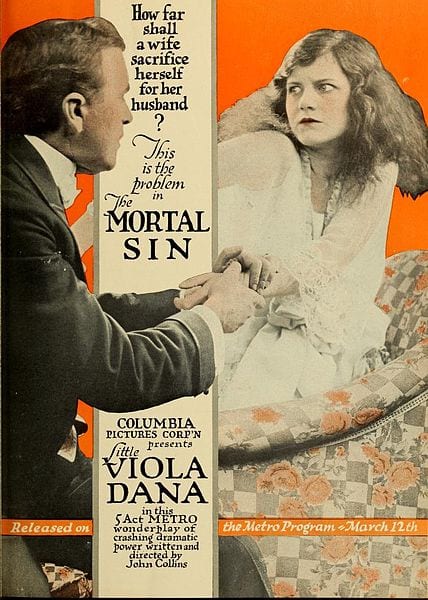
Photo credit: March 1917 advertisement in Moving Picture World for the American film, The Mortal Sin (1917) [public domain / Wikimedia Commons]

***
Previous Post

November 12, 2019
Vs. James White #7: My Refutations of Calvinism & His Non-Replies
Next Post
November 13, 2019 Vs. James White #9: White's Self-Title of "Bishop" (I Use It!)
Browse Our Archives
Select a Category & Last Things About Me Anti-Catholicism Atheism & Agnosticism Baptism and Sacramentalism Bible and Tradition Blessed Virgin Mary Books by Dave Armstrong C. S. Lewis Calvinism & General Protestantism Catholic Apologetics Catholic Apologists Catholic conversion Catholic converts Christmas Church (Ecclesiology) Church History Conversion and Converts Development of Doctrine Eastern Orthodoxy Ecumenism & Christian Unity Eucharist & Liturgy Fathers of the Church French Translations G. K. Chesterton Hell Hell & Satan Hell & Satan & Last Things Heresies & Comparative Religion Holistic Health Inquisition & Crusades & Scandals James White Jews & Judaism & Old Testament John Calvin John Henry Newman Liberal / Modernist Theology Life Issues Literary Resume Lutheranism Mariology Martin Luther Music Orthodoxy Papacy & Infallibility Personal Page Philosophy & Science Political & Ethical & Moral Issues Protestant Persecution & Intolerance Protestantism Purgatory Purgatory & Penance Romantic & Imaginative Theology Saints & Purgatory & Penance Salvation Salvation & Justification Satan & Last Things Sexuality and Gender Issues Spanish Translations Traditionalism vs. Radical Catholic Reactionaries Traducciones al español / tradução para português Trinitarianism & Christology Uncategorized Videos
Select a Month October 2026 September 2026 August 2026 July 2026 June 2026 May 2026 April 2026 March 2026 February 2026 January 2026 December 2025 November 2025 October 2025 September 2025 August 2025 July 2025 June 2025 May 2025 April 2025 March 2025 February 2025 January 2025 December 2024 November 2024 October 2024 September 2024 August 2024 July 2024 June 2024 May 2024 April 2024 March 2024 February 2024 January 2024 December 2023 November 2023 October 2023 September 2023 August 2023 July 2023 June 2023 May 2023 April 2023 March 2023 February 2023 January 2023 December 2022 November 2022 October 2022 September 2022 August 2022 July 2022 June 2022 May 2022 April 2022 March 2022 February 2022 January 2022 December 2021 November 2021 October 2021 September 2021 August 2021 July 2021 June 2021 May 2021 April 2021 March 2021 February 2021 January 2021 December 2020 November 2020 October 2020 September 2020 August 2020 July 2020 June 2020 May 2020 April 2020 March 2020 February 2020 January 2020 December 2019 November 2019 October 2019 September 2019 August 2019 July 2019 June 2019 May 2019 April 2019 March 2019 February 2019 January 2019 December 2018 November 2018 October 2018 September 2018 August 2018 July 2018 June 2018 May 2018 April 2018 March 2018 February 2018 January 2018 December 2017 November 2017 October 2017 September 2017 August 2017 July 2017 June 2017 May 2017 April 2017 March 2017 February 2017 January 2017 December 2016 November 2016 October 2016 September 2016 August 2016 July 2016 June 2016 May 2016 April 2016 March 2016 February 2016 January 2016 December 2015 November 2015 October 2015 September 2015 August 2015 July 2015 June 2015 May 2015 April 2015 March 2015 February 2015 January 2015 December 2014 November 2014 October 2014 September 2014 August 2014 July 2014 June 2014 April 2014 March 2014 February 2014 January 2014 December 2013 November 2013 October 2013 September 2013 August 2013 July 2013 June 2013 April 2013 March 2013 February 2013 January 2013 December 2012 November 2012 October 2012 September 2012 August 2012 July 2012 June 2012 May 2012 April 2012 March 2012 February 2012 January 2012 December 2011 November 2011 October 2011 September 2011 August 2011 July 2011 June 2011 April 2011 March 2011 February 2011 October 2010 September 2010 August 2010 July 2010 April 2010 March 2010 December 2009 October 2009 August 2009 July 2009 June 2009 May 2009 March 2009 February 2009 October 2008 September 2008 April 2008 March 2008 February 2008 January 2008 December 2007 November 2007 October 2007 May 2007 March 2007 February 2007 January 2007 November 2006 October 2006 September 2006 August 2006 July 2006 June 2006 May 2006 April 2006 March 2006 February 2006 October 2005 June 2005 April 2005 February 2005 July 2004 May 2004 April 2004
Follow Us!
TAKE THE
Religious Wisdom Quiz
Who fell out of a window and was restored to life by Paul?
Select your answer to see how you score.
Silas Barnabas Eutychus Timothy
Books by This Author Books by Dave Armstrong
Related posts from Biblical Evidence for Catholicism

Bible & Catholicism on Mortal Sin (vs. John...
Biblical Evidence for Catholicism

Dialogue on Eternal Security / Absolute Assurance
Biblical Evidence for Catholicism

"Faith Alone" Dialogue with a Calvinist
Biblical Evidence for Catholicism

Exegesis of 75 NT Faith [Alone?] & Works...
Biblical Evidence for Catholicism
TRENDING AT PATHEOS Catholic

In "Irreplaceable," our book on vocation and technology, Trevor Sutton and I...

I was strolling through the top floor of the brand new Parthenon...

What Does Gêvâh Mean For Kimberley Guifoyle &...
This week, a lot of the news is focused on Kimberly Guilfoyle....

INNER CIRCLE: Profound Mystery (Of Christ In All...
Ephesians 5:31-32 “For this reason, a man will leave his father and...

Do Not Rejoice When Your Enemy Falls: The...
Turning an execution into a public spectacle is a disturbing expression of...

'The Chosen' S6 Trailer: The Passion Gets Very...
Not many watching 'The Chosen' worry about spoilers, but just because they...
view all Catholic blogs
Ad-Free & Subscriber Log-In Subscription Support
- About Us
- 2026 Calendar
- Videos
- Podcasts
- Library of World Religions
- Faith In Media Tracker
- Advertise With Us
- Write for Us
- Privacy Policy
- Terms of Service
- Do Not Sell My Data
- Contact Us
- Radiant Digital
- Manage Newsletter Subscriptions
- Unsubscribe From Notifications
- Sitemap
Copyright 2008-2026, Patheos. All rights reserved.
Subscription Support Ad-Free & Subscriber Log-In
Follow Patheos