
BuddhistCatholicContemplativeEvangelicalGeneral ChristianHinduJewishLatter-day SaintMuslimNew VisionsProgressive Christian
Beliefs
- Buddhist
- Catholic
- Contemplative
- Evangelical
- General Christian
- Hindu
- Jewish
- Latter-day Saint
- More Voices
- Muslim
- New Visions
- Pagan
- Progressive Christian
Topics
- Religion News
- Food and Religion
- Sports and Religion
- Religious Art
- Religious Music and Entertainment
- Religious Events
- History and Religion
- Style and Religion
- Politics and Religion
- Women in Religion
- Recreation Outdoors and Religion
- Business Finance and Religion
- Careers Workplace and Religion
- Education and Religion
- Family Parenting and Religion
- Health Fitness and Religion
- Home and Religion
- Relationships and Religion
- Technology and Religion
- Travel and Religion
Columnists
- Buddhist Columnists
- Business Finance and Religion Columnists
- Careers Workplace and Religion Columnists
- Catholic Columnists
- Contemplative Columnists
- Education and Religion Columnists
- Evangelists Columnists
- Family Parenting and Religion Columnists
- General Christian Columnists
- Health Fitness and Religion Columnists
- Hindu Columnists
- History and Religion Columnists
- Home and Religion Columnists
- Jewish Columnists
- More Voices Columnists
- Latter Day Columnists
- Muslim Columnists
- New Visions Columnists
- Nonreligious Columnists
- Pagan Columnists
- Politics and Religion Columnists
- Progressive Columnists
- Recreation Outdoors and Religion Columnists
- Relationships and Religion Columnists
- Religion News Columnists
- Religious Art Columnists
- Religious Events Columnists
- Religious Music and Entertainment Columnists
- Sports and Religion Columnists
- Style and Religion Columnists
- Technology and Religion Columnists
- Travel and Religion Columnists
- Women in Religion Columnists
Resource Library
- 2026 Calendar
- Library of World Religions
- The 100 Most Holy Places on Earth
- Patheos Answers
- Podcasts
- Videos
- Faith Leaders Database
- Anglican Episcopalian
- Bahai
- Baptist
- Buddhism
- Christianity
- Confucianism
- Eastern Orthodoxy
- Hinduism
- Holiness and Pentecostal
- ISKCON
- Islam
- Judaism
- Lutheran
- Methodist
- The Church of Jesus Christ of Latter-day Saints
- New Age
- Paganism
- Presbytarian and Reformed
- Protestantism
- Religion Behind the Scenes
- Roman Catholic
- Scientology
- Shia Islam
- Sikhism
- Sufism
- Sunni Islam
- Taoism
- Zen
- See all religions
Research Tools
 Ad-Free & Subscriber Log-In Subscription Support
Ad-Free & Subscriber Log-In Subscription Support
Follow Patheos 

- Trending:
- Forgiveness
- |
- Marriage
- |
- Consciousness
- |
- Death Penalty
- |
- Election
- |
- Halloween

-
About
-
Catholic Apologetics
-
Church History
-
Great Apologists
-
Christian Worldview
-
Protestantism & Misc.
- Home
- Catholic
- History and Religion
- Vs. James White #16: St. Basil Held to Sola Scriptura?
Vs. James White #16: St. Basil Held to Sola Scriptura?
Last updated on: June 5, 2026 at 11:55 pm by Dave Armstrong
Vs. James White #16: St. Basil Held to Sola Scriptura? 2026-06-05T23:55:34-04:00 Dave Armstrong
Patheos Explore the world's faith through different perspectives on religion and spirituality! Patheos has the views of the prevalent religions and spiritualities of the world.
Reformed Baptist anti-Catholic apologist Bishop “Dr.” [???] James White wrote a book in 1996, entitled The Roman Catholic Controversy (Minneapolis: Bethany House Publishers). His words below will be in blue.
*****
As his opening of his chapter 5: “Sola Scriptura: God Speaks Clearly,” on page 55, Bishop White cites St. Basil the Great (c. 330-379):
If custom is to be taken in proof of what is right, then it is certainly competent for me to put forward on my side the custom which obtains here. If they reject this, we are clearly not bound to follow them. Therefore, let God-inspired Scripture decide between us; and on whichever side be found doctrines in harmony with the word of God, in favor of that side will be cast the vote of truth. (Letter 189 [To Eustathius the Physician, Vol. VIII] )
Apparently, this is quite the popular “patristic prooftext” of sola Scriptura. It’s also found in the article, “Basil of Caesarea: A Champion of Sola Scriptura” (Matthew Ervin, 5-11-14), The Shape of Sola Scriptura: a 2001 book by Keith A. Mathison, p. 35, and David T. King and William Webster’s self-published book (also from 2001): Holy Scripture: The Ground and Pillar of Our Faith: Volume III: The Writings of the Church Fathers Affirming the Reformation Principle of Sola Scriptura” (pp. 72-73).
White commented on the passage as follows:
Basil was content to allow that divine document to stand as judge between him and his opponents. . . . he referred to that which was binding on all Christians in all places at all times: the Scriptures. (p. 55)
Now to his great credit, White at least qualifies this somewhat in footnote 2 for this chapter (p. 235). I think he does this because he knows full well (if he simply read the relevant passages) that this is not the sum total of all of Basil’s thought on matters of authority and the Christian rule of faith. In this way, he saves himself from complete intellectual dishonesty:
It does not follow that every man who confesses the ultimacy of Scripture will exhibit perfect application of this truth in his life or doctrine. I would say Basil, for example, at times allowed his traditions to override the testimony of Scripture.
White (praise be to God!) didn’t descend to the stupefying, utterly uncomprehending (and flat-out dishonest) views of his buddies King and Webster (book above), who breathtakingly stated:
[T]he Church fathers . . . universally taught sola Scriptura in the fullest sense of the term . . .
[I]t is the Reformation principle of sola Scriptura which [is] true to the ancient faith and practice of the Church and that it is, in fact, the Roman Catholic Church which has misrepresented the Church fathers . . . (pp. 9-10)
Protestant patristics expert J. N. D. Kelly stated, regarding St. Basil:
Basil made the liturgical custom of baptizing in the threefold name a pivot in his argument for the coequality of the Spirit with Father and Son, pleading that the apostolic witness was conveyed to the Church in the mysteries as well as in Scripture, and that it was apostolic to abide by this unwritten tradition. (Early Christian Doctrines, HarperSanFrancisco, revised 1978 edition, 45)
I have written two lengthy and comprehensive articles on St. Basil’s view of Christian authority (including the Bible):
Basil the Great (d. 379) vs. Sola Scriptura as the Rule of Faith [8-1-03]
I summed up in the second article:
[T]he fathers, including St. Basil, do not oppose Scripture to the binding authority of the Church and apostolic tradition: all are regarded as perfectly harmonious and complementary. . . .
[The King and Webster collection of Basil citations] gives us a thorough survey of St. Basil’s view of Scripture. No problem for Catholics here at all. But there is a huge problem for sola Scriptura Protestants, when we also look at what Basil wrote about tradition, including oral tradition, and the Church. So why don’t we take a few minutes to examine the whole picture now, rather than a slanted, one-sided presentation for polemical purposes, that deliberately ignores all of this other relevant data (which amounts — I would argue — to sophistry and half-truth).
Since I massively documented Basil’s overall views on Christian authority in those two papers, I need not do so again. But here’s a good chunk of the highlights (all that follows is from St. Basil the Great):
Apostolic Tradition / “Three-Legged Stool” (Bible + Tradition + Church)
Can I then, perverted by these men’s seductive words, abandon the tradition which guided me to the light, which bestowed on me the boon of the knowledge of God, whereby I, so long a foe by reason of sin, was made a child of God? (The Holy Spirit, 10)
Scripture, however, in the case of baptism, sometimes plainly mentions the Spirit alone.“For into one Spirit,” it says, “we were all baptized in one body.” And in harmony with this are the passages: “You shaft be baptized with the Holy Ghost,” and “He shall baptize you with the Holy Ghost.” But no one on this account would be justified in calling that baptism a perfect baptism wherein only the name of the Spirit was invoked. For the tradition that has been given us by the quickening grace must remain for ever inviolate. (The Holy Spirit, 12)
But we do not rest only on the fact that such is the tradition of the Fathers; for they too followed the sense of Scripture, and started from the evidence which, a few sentences back, I deduced from Scripture and laid before you. (The Holy Spirit, 16)
The one aim of the whole band of opponents and enemies of “sound doctrine” is to shake down the foundation of the faith of Christ by levelling apostolic tradition with the ground, and utterly destroying it. (The Holy Spirit, 25)
Now one of the institutions of Gregory is the very form of the doxology to which objection is now made, preserved by the Church on the authority of his tradition; . . . (The Holy Spirit, 29)
. . . novel and unfamiliar doctrines which they allege to be deduced from the teaching of Scripture . . . These, brethren, are the mysteries of the Church; these are the traditions of the Fathers. Every man who fears the Lord, and is awaiting God’s judgment, I charge not to be carried away by various doctrines. If any one teaches a different doctrine, and refuses to accede to the sound words of the faith, rejecting the oracles of the Spirit, and making his own teaching of more authority than the lessons of the Gospels, of such an one beware . . . (Letter #261)
Oral and Unwritten Traditions
Let us now investigate what are our common conceptions concerning the Spirit, as well those which have been gathered by us from Holy Scripture concerning It as those which we have received from the unwritten tradition of the Fathers. (The Holy Spirit, 9:22)
*
Let us now investigate what are our common conceptions concerning the Spirit, as well those which have been gathered by us from Holy Scripture concerning It as those which we have received from the unwritten tradition of the Fathers. (The Holy Spirit, 22)
*
[T]hey clamour for written proof, and reject as worthless the unwritten tradition of the Fathers. But we will not slacken in our defence of the truth. We will not cowardly abandon the cause. The Lord has delivered to us as a necessary and saving doctrine that the Holy Spirit is to be ranked with the Father. (The Holy Spirit, 25)
*
Time will fail me if I attempt to recount the unwritten mysteries of the Church. Of the rest I say nothing; but of the very confession of our faith in Father, Son, and Holy Ghost, what is the written source? If it be granted that, as we are baptized, so also under the obligation to believe, we make our confession in like terms as our baptism, in accordance with the tradition of our baptism and in conformity with the principles of true religion, let our opponents grant us too the right to be as consistent in our ascription of glory as in our confession of faith. If they deprecate our doxology on the ground that it lacks written authority, let them give us the written evidence for the confession of our faith and the other matters which we have enumerated. While the unwritten traditions are so many, and their bearing on “the mystery of godliness is so important, can they refuse to allow us a single word which has come down to us from the Fathers; – which we found, derived from untutored custom, abiding in unperverted churches; . . . (The Holy Spirit, 27)
*
Is answer to the objection that the doxology in the form “with the Spirit” has no written authority, we maintain that if there is no other instance of that which is unwritten, then this must not be received. But if the greater number of our mysteries are admitted into our constitution without written authority, then, in company with the many others, let us receive this one. For I hold it apostolic to abide also by the unwritten traditions. “I praise you,” it is said, “that ye remember me in all things, and keep the ordinances as I delivered them to you;” and “Hold fast the traditions which ye have been taught whether by word, or our Epistle.” One of these traditions is the practice which is now before us, which they who ordained from the beginning, rooted firmly in the churches, delivering it to their successors, and its use through long custom advances pace by pace with time. (The Holy Spirit, 27)
*
Of the beliefs and practices whether generally accepted or publicly enjoined which are preserved in the Church some we possess derived from written teaching; others we have received delivered to us “in a mystery” by the tradition of the apostles; and both of these in relation to true religion have the same force. And these no one will gainsay;—no one, at all events, who is even moderately versed in the institutions of the Church. For were we to attempt to reject such customs as have no written authority, on the ground that the importance they possess is small, we should unintentionally injure the Gospel in its very vitals; or, rather, should make our public definition a mere phrase and nothing more. For instance, to take the first and most general example, who is thence who has taught us in writing to sign with the sign of the cross those who have trusted in the name of our Lord Jesus Christ? What writing has taught us to turn to the East at the prayer? Which of the saints has left us in writing the words of the invocation at the displaying of the bread of the Eucharist and the cup of blessing? For we are not, as is well known, content with what the apostle or the Gospel has recorded, but both in preface and conclusion we add other words as being of great importance to the validity of the ministry, and these we derive from unwritten teaching. Moreover we bless the water of baptism and the oil of the chrism, and besides this the catechumen who is being baptized. On what written authority do we do this? Is not our authority silent and mystical tradition? Nay, by what written word is the anointing of oil itself taught? And whence comes the custom of baptizing thrice? And as to the other customs of baptism from what Scripture do we derive the renunciation of Satan and his angels? Does not this come from that unpublished and secret teaching which our fathers guarded in a silence out of the reach of curious meddling and inquisitive investigation? Well had they learnt the lesson that the awful dignity of the mysteries is best preserved by silence. What the uninitiated are not even allowed to look at was hardly likely to be publicly paraded about in written documents. . . . the Apostles and Fathers who laid down laws for the Church from the beginning thus guarded the awful dignity of the mysteries in secrecy and silence, for what is bruited abroad random among the common folk is no mystery at all. This is the reason for our tradition of unwritten precepts and practices, that the knowledge of our dogmas may not become neglected and contemned by the multitude through familiarity. . . . Time will fail me if I attempt to recount the unwritten mysteries of the Church. Of the rest I say nothing; but of the very confession of our faith in Father, Son, and Holy Ghost, what is the written source? If it be granted that, as we are baptized, so also under the obligation to believe, we make our confession in like terms as our baptism, in accordance with the tradition of our baptism and in conformity with the principles of true religion, let our opponents grant us too the right to be as consistent in our ascription of glory as in our confession of faith. If they deprecate our doxology on the ground that it lacks written authority, let them give us the written evidence for the confession of our faith and the other matters which we have enumerated. While the unwritten traditions are so many, and their bearing on “the mystery of godliness” is so important, can they refuse to allow us a single word which has come down to us from the Fathers;—which we found, derived from untutored custom, abiding in unperverted churches;—a word for which the arguments are strong, and which contributes in no small degree to the completeness of the force of the mystery? (The Holy Spirit, 30)
*
Apostolic Succession
*
[T]hat doctrine, which by the tradition of the Fathers has been preserved by an unbroken sequence of memory to our own day. (The Holy Spirit, 30)
*
For, truly, the boon given you by the Lord is fit subject for the highest congratulation, your power of discernment between the spurious and the genuine and pure, and your preaching the faith of the Fathers without any dissimulation. That faith we have received; that faith we know is stamped with the marks of the Apostles; to that faith we assent, as well as to all that was canonically and lawfully promulgated in the Synodical Letter. (Letter #92 to the Italians and Gauls, 3)
*
Binding Authority of Ecumenical Councils
*
. . . the same Fathers who once at Nicæa promulgated their great decree concerning the faith. Of this, some portions are universally accepted without cavil, but the homoousion, ill received in certain quarters, is still rejected by some. . . . To refuse to follow the Fathers, not holding their declaration of more authority than one’s own opinion, is conduct worthy of blame, as being brimful of self-sufficiency. (Letter #52 to the Canonicae)
*
[Y]ou should confess the faith put forth by our Fathers once assembled at Nicæa, that you should not omit any one of its propositions, but bear in mind that the three hundred and eighteen who met together without strife did not speak without the operation of the Holy Ghost, . . . (Letter #114 to Cyriacus, at Tarsus; NPNF2-8)
*
Roman and Papal Primacy
*
It has seemed to me to be desirable to send a letter to the bishop of Rome, begging him to examine our condition, and since there are difficulties in the way of representatives being sent from the West by a general synodical decree, to advise him to exercise his own personal authority in the matter by choosing suitable persons to sustain the labours of a journey,—suitable, too, by gentleness and firmness of character, to correct the unruly among us here; . . . ( Letter #69 to St. Athanasius, 1-2)
Nearly all the East (I include under this name all the regions from Illyricum to Egypt) is being agitated, right honourable father, by a terrible storm and tempest. The old heresy, sown by Arius the enemy of the truth, has now boldly and unblushingly reappeared. Like some sour root, it is producing its deadly fruit and is prevailing. . . . I have looked upon the visit of your mercifulness as the only possible solution of our difficulties. Ever in the past I have been consoled by your extraordinary affection; and for a short time my heart was cheered by the gratifying report that we shall be visited by you. . . . For I well remember learning from the answers made by our fathers when asked, and from documents still preserved among us, that the illustrious and blessed bishop Dionysius, conspicuous in your see as well for soundness of faith as for all other virtues, visited by letter my Church of Cæsarea, and by letter exhorted our fathers, and sent men to ransom our brethren from captivity. . . . Should you not, even now, be moved to succour us, ere long all will have fallen under the dominion of the heresy, and you will find none left to whom you may hold out your hand. (Letter #70 to Pope Damasus)
***
Unfortunately, Money Trees Do Not Exist: If you have been aided in any way by my work, or think it is valuable and worthwhile, please strongly consider financially supporting it (even $10 / month — a mere 33 cents a day — would be very helpful). I have been a full-time Catholic apologist since Dec. 2001, and have been writing Christian apologetics since 1981 (see my Resume). My work has been proven (by God’s grace alone) to be fruitful, in terms of changing lives (see the tangible evidences from unsolicited “testimonies”). I have to pay my bills like all of you: and have a (homeschooling) wife and three children still at home to provide for, and a mortgage to pay.
*
My book royalties from three bestsellers in the field (published in 2003-2007) have been decreasing, as has my overall income, making it increasingly difficult to make ends meet. I provide over 2600 free articles here, for the purpose of your edification and education, and have written 50 books. It’ll literally be a struggle to survive financially until Dec. 2020, when both my wife and I will be receiving Social Security. If you cannot contribute, I ask for your prayers (and “likes” and links and shares). Thanks!
*
See my information on how to donate (including 100% tax-deductible donations). It’s very simple to contribute to my apostolate via PayPal, if a tax deduction is not needed (my “business name” there is called “Catholic Used Book Service,” from my old bookselling days 17 or so years ago, but send to my email: [email protected]). Another easy way to send and receive money (with a bank account or a mobile phone) is through Zelle. Again, just send to my e-mail address. May God abundantly bless you.
***
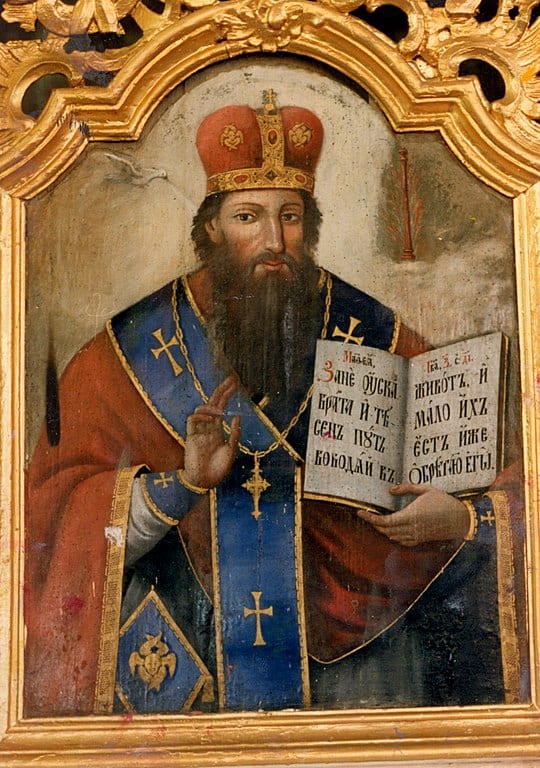
Photo credit: Misko3 (8-22-17) Basil the Great: painting from Slovakia [Wikimedia Commons / Creative Commons Attribution-Share Alike 4.0 International license]

***
Basil the Great & sola Scriptura
Previous Post

November 18, 2019
Vs. James White #15: Canon & "Catholic" Traditions
Next Post
November 19, 2019 Did Jesus Deny That Mary Was "Blessed" (Lk 11:27-28)?
Browse Our Archives
Select a Category & Last Things About Me Anti-Catholicism Atheism & Agnosticism Baptism and Sacramentalism Bible and Tradition Blessed Virgin Mary Books by Dave Armstrong C. S. Lewis Calvinism & General Protestantism Catholic Apologetics Catholic Apologists Catholic conversion Catholic converts Christmas Church (Ecclesiology) Church History Conversion and Converts Development of Doctrine Eastern Orthodoxy Ecumenism & Christian Unity Eucharist & Liturgy Fathers of the Church French Translations G. K. Chesterton Hell Hell & Satan Hell & Satan & Last Things Heresies & Comparative Religion Holistic Health Inquisition & Crusades & Scandals James White Jews & Judaism & Old Testament John Calvin John Henry Newman Liberal / Modernist Theology Life Issues Literary Resume Lutheranism Mariology Martin Luther Music Orthodoxy Papacy & Infallibility Personal Page Philosophy & Science Political & Ethical & Moral Issues Protestant Persecution & Intolerance Protestantism Purgatory Purgatory & Penance Romantic & Imaginative Theology Saints & Purgatory & Penance Salvation Salvation & Justification Satan & Last Things Sexuality and Gender Issues Spanish Translations Traditionalism vs. Radical Catholic Reactionaries Traducciones al español / tradução para português Trinitarianism & Christology Uncategorized Videos
Select a Month October 2026 September 2026 August 2026 July 2026 June 2026 May 2026 April 2026 March 2026 February 2026 January 2026 December 2025 November 2025 October 2025 September 2025 August 2025 July 2025 June 2025 May 2025 April 2025 March 2025 February 2025 January 2025 December 2024 November 2024 October 2024 September 2024 August 2024 July 2024 June 2024 May 2024 April 2024 March 2024 February 2024 January 2024 December 2023 November 2023 October 2023 September 2023 August 2023 July 2023 June 2023 May 2023 April 2023 March 2023 February 2023 January 2023 December 2022 November 2022 October 2022 September 2022 August 2022 July 2022 June 2022 May 2022 April 2022 March 2022 February 2022 January 2022 December 2021 November 2021 October 2021 September 2021 August 2021 July 2021 June 2021 May 2021 April 2021 March 2021 February 2021 January 2021 December 2020 November 2020 October 2020 September 2020 August 2020 July 2020 June 2020 May 2020 April 2020 March 2020 February 2020 January 2020 December 2019 November 2019 October 2019 September 2019 August 2019 July 2019 June 2019 May 2019 April 2019 March 2019 February 2019 January 2019 December 2018 November 2018 October 2018 September 2018 August 2018 July 2018 June 2018 May 2018 April 2018 March 2018 February 2018 January 2018 December 2017 November 2017 October 2017 September 2017 August 2017 July 2017 June 2017 May 2017 April 2017 March 2017 February 2017 January 2017 December 2016 November 2016 October 2016 September 2016 August 2016 July 2016 June 2016 May 2016 April 2016 March 2016 February 2016 January 2016 December 2015 November 2015 October 2015 September 2015 August 2015 July 2015 June 2015 May 2015 April 2015 March 2015 February 2015 January 2015 December 2014 November 2014 October 2014 September 2014 August 2014 July 2014 June 2014 April 2014 March 2014 February 2014 January 2014 December 2013 November 2013 October 2013 September 2013 August 2013 July 2013 June 2013 April 2013 March 2013 February 2013 January 2013 December 2012 November 2012 October 2012 September 2012 August 2012 July 2012 June 2012 May 2012 April 2012 March 2012 February 2012 January 2012 December 2011 November 2011 October 2011 September 2011 August 2011 July 2011 June 2011 April 2011 March 2011 February 2011 October 2010 September 2010 August 2010 July 2010 April 2010 March 2010 December 2009 October 2009 August 2009 July 2009 June 2009 May 2009 March 2009 February 2009 October 2008 September 2008 April 2008 March 2008 February 2008 January 2008 December 2007 November 2007 October 2007 May 2007 March 2007 February 2007 January 2007 November 2006 October 2006 September 2006 August 2006 July 2006 June 2006 May 2006 April 2006 March 2006 February 2006 October 2005 June 2005 April 2005 February 2005 July 2004 May 2004 April 2004
Follow Us!
TAKE THE
Religious Wisdom Quiz
Above all else, guard your ____, for everything you do flows from it.
Select your answer to see how you score.
Actions Heart Words Mind
Books by This Author Books by Dave Armstrong
Related posts from Biblical Evidence for Catholicism

17 Church Fathers on Purgatory (Esp. 1 Cor...
Biblical Evidence for Catholicism

Deuterocanon & Javier Perdomo's Straw Men
Biblical Evidence for Catholicism

St. Athanasius & the Deuterocanon (vs. Javier Perdomo)
Biblical Evidence for Catholicism

Jerusalem Council vs. James White & Sola Scriptura
Biblical Evidence for Catholicism
TRENDING AT PATHEOS Catholic

I was strolling through the top floor of the brand new Parthenon...

What Does Gêvâh Mean For Kimberley Guifoyle &...
This week, a lot of the news is focused on Kimberly Guilfoyle....

INNER CIRCLE: Profound Mystery (Of Christ In All...
Ephesians 5:31-32 “For this reason, a man will leave his father and...

Do Not Rejoice When Your Enemy Falls: The...
Turning an execution into a public spectacle is a disturbing expression of...

'The Chosen' S6 Trailer: The Passion Gets Very...
Not many watching 'The Chosen' worry about spoilers, but just because they...

The purpose-driven labor priest
A labor activist reads Rick Warren and it gets me wondering about...
view all Catholic blogs
Ad-Free & Subscriber Log-In Subscription Support
- About Us
- 2026 Calendar
- Videos
- Podcasts
- Library of World Religions
- Faith In Media Tracker
- Advertise With Us
- Write for Us
- Privacy Policy
- Terms of Service
- Do Not Sell My Data
- Contact Us
- Radiant Digital
- Manage Newsletter Subscriptions
- Unsubscribe From Notifications
- Sitemap
Copyright 2008-2026, Patheos. All rights reserved.
Subscription Support Ad-Free & Subscriber Log-In
Follow Patheos