
BuddhistCatholicContemplativeEvangelicalGeneral ChristianHinduJewishLatter-day SaintMuslimNew VisionsProgressive Christian
Beliefs
- Buddhist
- Catholic
- Contemplative
- Evangelical
- General Christian
- Hindu
- Jewish
- Latter-day Saint
- More Voices
- Muslim
- New Visions
- Pagan
- Progressive Christian
Topics
- Religion News
- Food and Religion
- Sports and Religion
- Religious Art
- Religious Music and Entertainment
- Religious Events
- History and Religion
- Style and Religion
- Politics and Religion
- Women in Religion
- Recreation Outdoors and Religion
- Business Finance and Religion
- Careers Workplace and Religion
- Education and Religion
- Family Parenting and Religion
- Health Fitness and Religion
- Home and Religion
- Relationships and Religion
- Technology and Religion
- Travel and Religion
Columnists
- Buddhist Columnists
- Business Finance and Religion Columnists
- Careers Workplace and Religion Columnists
- Catholic Columnists
- Contemplative Columnists
- Education and Religion Columnists
- Evangelists Columnists
- Family Parenting and Religion Columnists
- General Christian Columnists
- Health Fitness and Religion Columnists
- Hindu Columnists
- History and Religion Columnists
- Home and Religion Columnists
- Jewish Columnists
- More Voices Columnists
- Latter Day Columnists
- Muslim Columnists
- New Visions Columnists
- Nonreligious Columnists
- Pagan Columnists
- Politics and Religion Columnists
- Progressive Columnists
- Recreation Outdoors and Religion Columnists
- Relationships and Religion Columnists
- Religion News Columnists
- Religious Art Columnists
- Religious Events Columnists
- Religious Music and Entertainment Columnists
- Sports and Religion Columnists
- Style and Religion Columnists
- Technology and Religion Columnists
- Travel and Religion Columnists
- Women in Religion Columnists
Resource Library
- 2026 Calendar
- Library of World Religions
- The 100 Most Holy Places on Earth
- Patheos Answers
- Podcasts
- Videos
- Faith Leaders Database
- Anglican Episcopalian
- Bahai
- Baptist
- Buddhism
- Christianity
- Confucianism
- Eastern Orthodoxy
- Hinduism
- Holiness and Pentecostal
- ISKCON
- Islam
- Judaism
- Lutheran
- Methodist
- The Church of Jesus Christ of Latter-day Saints
- New Age
- Paganism
- Presbytarian and Reformed
- Protestantism
- Religion Behind the Scenes
- Roman Catholic
- Scientology
- Shia Islam
- Sikhism
- Sufism
- Sunni Islam
- Taoism
- Zen
- See all religions
Research Tools
 Ad-Free & Subscriber Log-In Subscription Support
Ad-Free & Subscriber Log-In Subscription Support
Follow Patheos 

- Trending:
- Forgiveness
- |
- Marriage
- |
- Consciousness
- |
- Death Penalty
- |
- Election
- |
- Halloween

-
About
-
Catholic Apologetics
-
Church History
-
Great Apologists
-
Christian Worldview
-
Protestantism & Misc.
- Home
- Catholic
- History and Religion
- Vs. James White #11: Biblical Evidence for Indulgences
Vs. James White #11: Biblical Evidence for Indulgences
Last updated on: November 15, 2019 at 4:40 pm by Dave Armstrong
Vs. James White #11: Biblical Evidence for Indulgences 2019-11-15T16:40:11-04:00 Dave Armstrong
Patheos Explore the world's faith through different perspectives on religion and spirituality! Patheos has the views of the prevalent religions and spiritualities of the world.
Reformed Baptist anti-Catholic apologist Bishop “Dr.” [???] James White wrote a post entitled, “The Dizzying Effect of the Tiber on the Mind” (7-24-12). It was the usual potpourri (“popery”?) of 101 things where “Rome” is (so he is absolutely “sure”) mistaken and anti-biblical and blasphemous, etc., but at the end after his dizzying survey, he concentrated on one issue: indulgences.
And that allows me to respond, since he actual produced some semblance (though, alas, not much) of a rational argument against it. I don’t play the silly games of either “biblical hopscotch” or “Catholic doctrine hopscotch.” One thing at a time . . . He cited at length, “Indulgentiarum Doctrina, a post Vatican II document defining, and defending, the doctrine of indulgences.” [see a link to the document from 1 January 1967] He then concluded, in typical Bishop White condescending, “look all dumb all these Roman Catholics are!” fashion:
I challenged [then a recent convert] Jason Stellman to read it. He hadn’t when we met. I’ll be honest, I sorta doubt he took up my challenge. Not that reading this kind of stuff will dissuade someone who has lost their foundation and are grasping for anything, but for most folks, these words are sufficient warning of the emptiness of Rome’s non-gospel. They are so plainly non-apostolic, so plainly contrary to everything the Apostles cherished and proclaimed, that to believe them is to show, clearly, the true direction of one’s heart. But, in any case, when you hear a wide-eyed Tiber Swimmer talking about how the Bible doesn’t teach sola fide, remember that what they are really telling you is that you can’t know what the Bible really does teach, and that what you should believe is what you just read from Indulgentiarum Doctrina. And once you realize that, well, you realize what Romanism really is.
What I’d like to do, then, is take some of the portions of this Church document (in green below), that White cited in mockery (thinking they are self-evidently unbiblical and anti-biblical) and show how they are eminently biblical. The document itself, of course, contains many references to Holy Scripture, as a quick perusal of the 47 footnotes quickly proves. White has no interest in presenting those to his readers, since it doesn’t fit his cynical agenda: i.e., to make out that Catholic doctrines are utterly devoid of even claimed biblical support. Even what he cited, contained biblical references in the footnotes.
White doesn’t even properly or accurately cite the words that he cites. He correctly cites Chapter 1, section 1 (complete) and then two sentences of section 2. But then his citation “jumps” (with no indication or mention to the reader, who thinks it is still section 2) to chapter 2, section 5, third paragraph (complete). This is inexcusable in a man with a legitimate Master’s degree, and who claims (illegitimately) to have a doctorate.
Even a tenth grader could do better than to cite material in this shoddy, haphazard fashion. White’s buddy, James Swan, who also frequently posts on his blog, has excoriated as incompetent nincompoops, — times without number –, anyone who (deliberately or not) messes up a Luther citation in a similar manner. But here is his hero doing exactly the same thing. How ironic, huh?
White deliberately omits two footnotes that occur in section 2 (connected to the words he cites). Here are the two footnotes (note all the Bible passages):
Cf. Gen. 3:16-19; also cf. Luke 19:41-44; Rom. 2:9 and 1 Cor. 11:30. Cf. Augustine, Exposition on Psalm 58 1:13—”Iniquitas omnis…Deo vindicante” (CCL 39, p. 739; PL 36, 701). Cf. Thomas, Summa Theol. 1-2, q. 86, a. 1: “Cum autem…depressio poena est.”
Cf. Matt. 25:41-42; see also Mark 9:42-43; John 5:28-29; Rom. 2:9; Gal. 6:6-8. Cf. Council of Lyons II, Session 4, profession of faith of Michael Palaeologus (DS 856-858). Cf. Council of Florence, decree for the Greeks (DS 1304-1306). Cf. Augustine, Enchiridion, 66, 17: “Multa etiam…mundo damnemur” (ed. Scheel, Tubingen 1930, p. 42; PL 40, 263).
He also omits footnote 21 from section 5: “Cf. Heb. 7:23-25; 9:11-28.”
So let’s take a look at the amount of Holy Scripture a Catholic can bring to bear on this issue:
1. The doctrine and practice of indulgences which have been in force for many centuries in the Catholic Church have a solid foundation in divine revelation which comes from the Apostles and “develops in the Church with the help of the Holy Spirit,” while “as the centuries succeed one another the Church constantly moves forward toward the fullness of divine truth until the words of God reach their complete fulfillment in her.”
Matthew 16:19 (RSV) I will give you the keys of the kingdom of heaven, and whatever you bind on earth shall be bound in heaven, and whatever you loose on earth shall be loosed in heaven.
Matthew 18:18 Whatever you bind on earth shall be bound in heaven, and whatever you loose on earth shall be loosed in heaven.
John 20:23 If you forgive the sins of any, they are forgiven; if you retain the sins of any, they are retained.
These passages form the biblical basis for priestly absolution (forgiveness), and broadly speaking, for both papal and Church jurisdiction (by extension, for the power to impose penance — binding, retaining — and to grant indulgences — loosing, forgiving). Matthew 16:19 was spoken by our Lord to St. Peter alone, and is the primary foundation for the concept of the papacy (along with the preceding verse). Matthew 18:18 and John 20:23 were directed toward the twelve disciples.
1 Corinthians 5:3-5 It is actually reported that there is immorality among you, and of a kind that is not found even among pagans; for a man is living with his father’s wife. And you are arrogant! Ought you not rather to mourn? Let him who has done this be removed from among you. I have already pronounced judgment in the name of the Lord Jesus on the man who has done such a thing. When you are assembled, and my spirit is present, with the power of our Lord Jesus, you are to deliver this man to Satan for the destruction of the flesh, that his spirit may be saved in the day of the Lord Jesus.
2 Corinthians 2:6-8, 10-11 For such a one this punishment by the majority is enough; so you should rather turn to forgive and comfort him, or he may be overwhelmed by excessive sorrow. So I beg you to reaffirm your love for him . . . Any one whom you forgive, I also forgive . . . in the presence of Christ, to keep Satan from gaining the advantage over us; for we are not ignorant of his designs.
St. Paul in his commands and exhortations to the Corinthians is in entire agreement with the Catholic tenets of penance and indulgences. He binds in 1 Corinthians 5:3-5 and looses in 2 Corinthians 2:6-7, 10, acting as a type of papal figure in 2 Corinthians 2:10, much like St. Peter among the apostles. He forgives, and bids the Corinthian elders to forgive also, even though the offense was not committed against them personally.
Clearly, both parties are acting as God’s representatives in the matter of the forgiveness of sins and the remission of sin’s temporal penalties (an indulgence). In this as in all other doctrinal matters, the Catholic Church is grounded in the Bible, takes seriously all that it teaches, and grapples with all the implications and deepest wellsprings of truth to be found within the pages of God’s Holy Scriptures.
James Cardinal Gibbons elaborates:
Here we have all the elements that constitute an Indulgence. First — A penance, or temporal punishment proportioned to the gravity of the offence, is imposed on the transgressor. Second — The penitent is truly contrite for his crime. Third — This determines the Apostle to remit the penalty. Fourth — The Apostle considers the relaxation of the penance ratified by Jesus Christ, in whose name it is imparted. (The Faith of Our Fathers, New York: P. J. Kenedy & Sons, revised edition, 1917, 308-309)
2. It is a divinely revealed truth that sins bring punishments inflicted by God’s sanctity and justice. These must be expiated either on this earth through the sorrows, miseries and calamities of this life and above all through death, or else in the life beyond through fire and torments or “purifying” punishments.
We must be without sin to enter into God’s presence (Eph 5:5; Heb 12:14; Rev 21:27; 22:3, 14-15). Therefore, God must purge or wash away our sin to make us fit to be in heaven with Him. All agree so far. The only disagreement is whether this “divine cleansing” takes place in an instant or is more of a process. It’s merely a quantitative difference; not an essential one. Purgatory is indicated most directly in 1 Corinthians 3:13, 15:
Each man’s work will become manifest; for the Day will disclose it, because it will be revealed with fire, and the fire will test what sort of work each one has done. . . . [15] If any man’s work is burned up, he will suffer loss, though he himself will be saved, but only as through fire.
[see my lengthy rebuttal of James White with regard to this passage]
The Bible also often refers to this same purging process taking place before we die: the very common biblical theme of God’s chastising or purifying His people. By analogy, this shows us the same notions that lie behind the apostolic and Catholic doctrine of purgatory (methods of how God works, so to speak). When these passages are included, one can find (as I did) as many as fifty biblical passages that are relevant to purgatory.
Scripture refers to a purging fire (in addition to 1 Corinthians 3 above): whatever “shall pass through the fire” will be made “clean” (Num 31:23); “Out of heaven he let you hear his voice, that he might discipline you; and on earth he let you see his great fire, and you heard his words out of the midst of the fire” (Dt 4:36); “we went through fire” (Ps 66:12); “For gold is tested in the fire, and acceptable men in the furnace of humiliation” (Sir 2:5); “our God is a consuming fire” (Heb 12:29); “do not be surprised at the fiery ordeal which comes upon you to prove you” (1 Pet 4:12); We also see passages about the “baptism of fire” (Mt 3:11; Mk 10:38-39; Lk 3:16; 12:50).
The Bible makes frequent use also of the metaphor of various metals being refined (in a fire): “when he has tried me, I shall come forth as gold” (Job 23:10); “thou, O God, hast tested us; thou hast tried us as silver is tried” (Ps 66:10); “The crucible is for silver, and the furnace is for gold, and the LORD tries hearts” (Prov 17:3); “I will turn my hand against you and will smelt away your dross as with lye and remove all your alloy” (Is 1:25); “I have refined you, . . . I have tried you in the furnace of affliction” (Is 48:10); “I will refine them and test them” (Jer 9:7); “I will put this third into the fire, and refine them as one refines silver, and test them as gold is tested” (Zech 13:9); “he is like a refiner’s fire, and like fullers’ soap; he will sit as a refiner and purifier of silver, and he will purify the sons of Levi, and refine them like gold and silver” (Mal 3:2-3); “Having been disciplined a little, they will receive great good, because God tested them and found them worthy of himself; [6] like gold in the furnace he tried them, . . . “ (Wis 3:5-6); “. . . your faith, more precious than gold which though perishable is tested by fire” (1 Pet 1:6-7).
God cleansing or washing us is another common biblical theme: “Wash me thoroughly from my iniquity, and cleanse me from my sin! . . . Purge me with hyssop, and I shall be clean” (Ps 51:2, 7); “Blows that wound cleanse away evil; strokes make clean the innermost parts” (Prov 20:30; cf. 30:12); “the Lord shall have washed away the filth of the daughters of Zion and cleansed the bloodstains of Jerusalem from its midst by a spirit of judgment and by a spirit of burning” (Is 4:4); “I will cleanse them from all the guilt of their sin against me” (Jer 33:8); “I will sprinkle clean water upon you, and you shall be clean from all your uncleannesses” (Ezek 36:25); “cleanse them from sin and uncleanness” (Zech 13:1); “our hearts sprinkled clean from an evil conscience and our bodies washed with pure water” (Heb 10:22); “he was cleansed from his old sins” (2 Pet 1:9); “the blood of Jesus his Son cleanses us from all sin” (1 John 1:7).
Divine “chastisement” is taught clearly in many passages: “as a man disciplines his son, the LORD your God disciplines you” (Dt 8:5); “do not despise the LORD’s discipline or be weary of his reproof,” (Prov 3:11); “I will chasten you in just measure” (Jer 30:11); “For thou didst test them as a father does in warning” (Wis 11:10); “God who tests our hearts” (1 Thess 2:4); “For the Lord disciplines him whom he loves, and chastises every son whom he receives. It is for discipline that you have to endure. God is treating you as sons; for what son is there whom his father does not discipline? . . . he disciplines us for our good, that we may share his holiness” (Heb 12:6-7, 10).
We are subject to God’s indignation or wrath, insofar as we sin: “God will bring every deed into judgment” (Ecc 12:14); “I will bear the indignation of the Lord because I have sinned against him, . . . He will bring me forth to the light” (Mic 7:9).
Purgatory is “written all over” the passages above.
This treasury also includes the truly immense, unfathomable and ever pristine value before God of the prayers and good works of the Blessed Virgin Mary and all the saints, . . .
Word Studies in the New Testament (Presbyterian Marvin R. Vincent, Grand Rapids, Michigan: Eerdmans, 1980; orig. 1887; vol. 4, 536), another standard Protestant language source, comments on Hebrews 12:1 (“we are surrounded by so great a cloud of witnesses”) as follows:
‘Witnesses’ does not mean spectators, but those who have borne witness to the truth, as those enumerated in chapter 11. Yet the idea of spectators is implied, and is really the principal idea. The writer’s picture is that of an arena in which the Christians whom he addresses are contending in a race, while the vast host of the heroes of faith who, after having borne witness to the truth, have entered into their heavenly rest, watches the contest from the encircling tiers of the arena, compassing and overhanging it like a cloud, filled with lively interest and sympathy, and lending heavenly aid.
Jeremiah 15:1 Then the LORD said to me, “Though Moses and Samuel stood before me, yet my heart would not turn toward this people. . . .” [in other words, there is such a thing as a dead prophet sanding before God and interceding]
Revelation 5:8 And when he had taken the scroll, the four living creatures and the twenty-four elders fell down before the Lamb, each holding a harp, and with golden bowls full of incense, which are the prayers of the saints;
Revelation 6:9-10 When he opened the fifth seal, I saw under the altar the souls of those who had been slain for the word of God and for the witness they had borne; [10] they cried out with a loud voice, “O Sovereign Lord, holy and true, how long before thou wilt judge and avenge our blood on those who dwell upon the earth?”
Revelation 8:3 And another angel came and stood at the altar with a golden censer; and he was given much incense to mingle with the prayers of all the saints upon the golden altar before the throne;
Jesus also taught in a parable that Abraham could be prayed to (petitioned), in his story of Lazarus and the rich man. If he had the power to answer (or deny, as here) a prayer request, then it follows that he can pray for us as well (being a conscious being exercising loving concern). I’ve addressed this several times:
Bible on Asking Dead Men to Intercede (Luke 16) [7-8-14]
*
Asking Saints to Intercede: Teaching of Jesus [2015]
Dialogue on Praying to Abraham (Luke 16) [5-22-16]
Dialogue: Rich Man’s Prayer to Abraham (Luke 16) and the Invocation of Saints (vs. Lutheran Pastor Ken Howes) [5-3-17]
Thus while attaining their own salvation, . . .
Acts 2:40 . . . “Save yourselves from this crooked generation.”
Philippians 2:12 . . . work out your own salvation with fear and trembling;
Philippians 3:12-14 . . . I press on to make it my own, because Christ Jesus has made me his own. [13] Brethren, I do not consider that I have made it my own; but one thing I do, forgetting what lies behind and straining forward to what lies ahead, [14] I press on toward the goal for the prize of the upward call of God in Christ Jesus.
1 Timothy 4:16 Take heed to yourself and to your teaching; hold to that, for by so doing you will save both yourself and your hearers.
2 Timothy 3:15 . . . the sacred writings which are able to instruct you for salvation through faith in Christ Jesus. [i.e., we do the work of reading Scripture and this in turn can save us, so we helped save ourselves by reading it]
James 5:20 let him know that whoever brings back a sinner from the error of his way will save his soul from death and will cover a multitude of sins.
1 Peter 2:2 Like newborn babes, long for the pure spiritual milk, that by it you may grow up to salvation;
[we all participate in helping to save ourselves, in the sense of merit, that originates always from God’s grace, and as a result of baptism: more mediation of God’s grace and salvation: this time through the natural conduit of a sacrament (cf. Mk 16:16)]
. . . they have also cooperated in the salvation of their brothers in the unity of the Mystical Body.
Romans 11:13-14 Now I am speaking to you Gentiles. Inasmuch then as I am an apostle to the Gentiles, I magnify my ministry in order to make my fellow Jews jealous, and thus save some of them.
1 Corinthians 7:16 Wife, how do you know whether you will save your husband? Husband, how do you know whether you will save your wife?
1 Corinthians 9:22 To the weak I became weak, that I might win the weak. I have become all things to all men, that I might by all means save some.
2 Corinthians 1:6 If we are afflicted, it is for your comfort and salvation; . . .
1 Timothy 4:16 . . . you will save . . . your hearers.
2 Timothy 2:10 Therefore I endure everything for the sake of the elect, that they also may obtain salvation in Christ Jesus with its eternal glory.
1 Peter 3:1 . . . some, though they do not obey the word, may be won without a word by the behavior of their wives
[St. Paul and others “save” other people, thus becoming “mini-mediators” in the sense that they are vessels for the grace and salvation that comes from God, won by Jesus’ wholly sufficient and perfect sacrificial death on the cross]
Next question?
***
Unfortunately, Money Trees Do Not Exist: If you have been aided in any way by my work, or think it is valuable and worthwhile, please strongly consider financially supporting it (even $10 / month — a mere 33 cents a day — would be very helpful). I have been a full-time Catholic apologist since Dec. 2001, and have been writing Christian apologetics since 1981 (see my Resume). My work has been proven (by God’s grace alone) to be fruitful, in terms of changing lives (see the tangible evidences from unsolicited “testimonies”). I have to pay my bills like all of you: and have a (homeschooling) wife and three children still at home to provide for, and a mortgage to pay.
*
My book royalties from three bestsellers in the field (published in 2003-2007) have been decreasing, as has my overall income, making it increasingly difficult to make ends meet. I provide over 2600 free articles here, for the purpose of your edification and education, and have written 50 books. It’ll literally be a struggle to survive financially until Dec. 2020, when both my wife and I will be receiving Social Security. If you cannot contribute, I ask for your prayers (and “likes” and links and shares). Thanks!
*
See my information on how to donate (including 100% tax-deductible donations). It’s very simple to contribute to my apostolate via PayPal, if a tax deduction is not needed (my “business name” there is called “Catholic Used Book Service,” from my old bookselling days 17 or so years ago, but send to my email: [email protected]). Another easy way to send and receive money (with a bank account or a mobile phone) is through Zelle. Again, just send to my e-mail address. May God abundantly bless you.
***
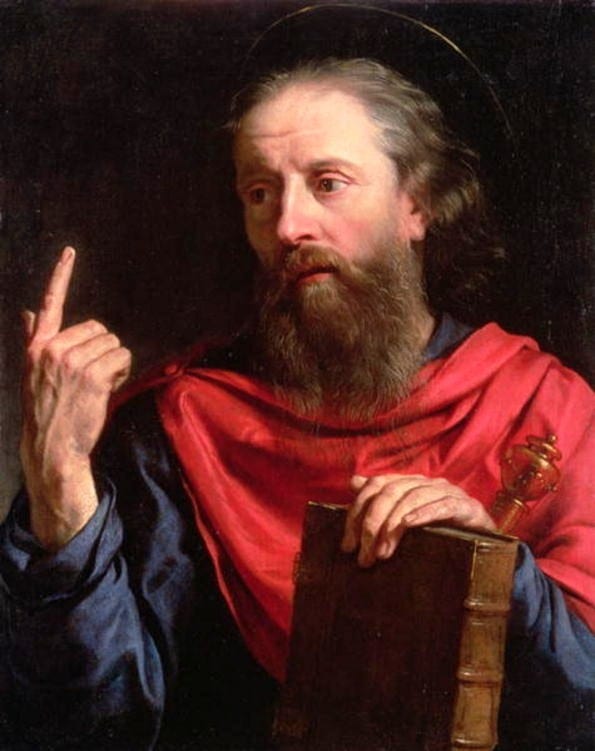
Photo credit: Saint Paul, by Philippe de Champaigne (1602-1674) [public domain / Wikimedia Commons]

***
Previous Post
November 15, 2019
Vatican II --> Alleged "Pachamama" Idolatry, Sez Fanatics
Next Post
November 16, 2019 Mary's "In Partu" Virginity: Reply to False Charges
Browse Our Archives
Select a Category & Last Things About Me Anti-Catholicism Atheism & Agnosticism Baptism and Sacramentalism Bible and Tradition Blessed Virgin Mary Books by Dave Armstrong C. S. Lewis Calvinism & General Protestantism Catholic Apologetics Catholic Apologists Catholic conversion Catholic converts Christmas Church (Ecclesiology) Church History Conversion and Converts Development of Doctrine Eastern Orthodoxy Ecumenism & Christian Unity Eucharist & Liturgy Fathers of the Church French Translations G. K. Chesterton Hell Hell & Satan Hell & Satan & Last Things Heresies & Comparative Religion Holistic Health Inquisition & Crusades & Scandals James White Jews & Judaism & Old Testament John Calvin John Henry Newman Liberal / Modernist Theology Life Issues Literary Resume Lutheranism Mariology Martin Luther Music Orthodoxy Papacy & Infallibility Personal Page Philosophy & Science Political & Ethical & Moral Issues Protestant Persecution & Intolerance Protestantism Purgatory Purgatory & Penance Romantic & Imaginative Theology Saints & Purgatory & Penance Salvation Salvation & Justification Satan & Last Things Sexuality and Gender Issues Spanish Translations Traditionalism vs. Radical Catholic Reactionaries Traducciones al español / tradução para português Trinitarianism & Christology Uncategorized Videos
Select a Month October 2026 September 2026 August 2026 July 2026 June 2026 May 2026 April 2026 March 2026 February 2026 January 2026 December 2025 November 2025 October 2025 September 2025 August 2025 July 2025 June 2025 May 2025 April 2025 March 2025 February 2025 January 2025 December 2024 November 2024 October 2024 September 2024 August 2024 July 2024 June 2024 May 2024 April 2024 March 2024 February 2024 January 2024 December 2023 November 2023 October 2023 September 2023 August 2023 July 2023 June 2023 May 2023 April 2023 March 2023 February 2023 January 2023 December 2022 November 2022 October 2022 September 2022 August 2022 July 2022 June 2022 May 2022 April 2022 March 2022 February 2022 January 2022 December 2021 November 2021 October 2021 September 2021 August 2021 July 2021 June 2021 May 2021 April 2021 March 2021 February 2021 January 2021 December 2020 November 2020 October 2020 September 2020 August 2020 July 2020 June 2020 May 2020 April 2020 March 2020 February 2020 January 2020 December 2019 November 2019 October 2019 September 2019 August 2019 July 2019 June 2019 May 2019 April 2019 March 2019 February 2019 January 2019 December 2018 November 2018 October 2018 September 2018 August 2018 July 2018 June 2018 May 2018 April 2018 March 2018 February 2018 January 2018 December 2017 November 2017 October 2017 September 2017 August 2017 July 2017 June 2017 May 2017 April 2017 March 2017 February 2017 January 2017 December 2016 November 2016 October 2016 September 2016 August 2016 July 2016 June 2016 May 2016 April 2016 March 2016 February 2016 January 2016 December 2015 November 2015 October 2015 September 2015 August 2015 July 2015 June 2015 May 2015 April 2015 March 2015 February 2015 January 2015 December 2014 November 2014 October 2014 September 2014 August 2014 July 2014 June 2014 April 2014 March 2014 February 2014 January 2014 December 2013 November 2013 October 2013 September 2013 August 2013 July 2013 June 2013 April 2013 March 2013 February 2013 January 2013 December 2012 November 2012 October 2012 September 2012 August 2012 July 2012 June 2012 May 2012 April 2012 March 2012 February 2012 January 2012 December 2011 November 2011 October 2011 September 2011 August 2011 July 2011 June 2011 April 2011 March 2011 February 2011 October 2010 September 2010 August 2010 July 2010 April 2010 March 2010 December 2009 October 2009 August 2009 July 2009 June 2009 May 2009 March 2009 February 2009 October 2008 September 2008 April 2008 March 2008 February 2008 January 2008 December 2007 November 2007 October 2007 May 2007 March 2007 February 2007 January 2007 November 2006 October 2006 September 2006 August 2006 July 2006 June 2006 May 2006 April 2006 March 2006 February 2006 October 2005 June 2005 April 2005 February 2005 July 2004 May 2004 April 2004
Follow Us!
TAKE THE
Religious Wisdom Quiz
Who fell out of a window and was restored to life by Paul?
Select your answer to see how you score.
Silas Barnabas Eutychus Timothy
Books by This Author Books by Dave Armstrong
Related posts from Biblical Evidence for Catholicism

Bible & Catholicism on Mortal Sin (vs. John...
Biblical Evidence for Catholicism

Does Catholic Intercession of Saints Require Omniscience?
Biblical Evidence for Catholicism

Capabilities of Heavenly Saints: Protestant Commentaries
Biblical Evidence for Catholicism

Revelation 5 & 8 (Intercession of Saints &...
Biblical Evidence for Catholicism
TRENDING AT PATHEOS Catholic

In "Irreplaceable," our book on vocation and technology, Trevor Sutton and I...

I was strolling through the top floor of the brand new Parthenon...

What Does Gêvâh Mean For Kimberley Guifoyle &...
This week, a lot of the news is focused on Kimberly Guilfoyle....

INNER CIRCLE: Profound Mystery (Of Christ In All...
Ephesians 5:31-32 “For this reason, a man will leave his father and...

Do Not Rejoice When Your Enemy Falls: The...
Turning an execution into a public spectacle is a disturbing expression of...

'The Chosen' S6 Trailer: The Passion Gets Very...
Not many watching 'The Chosen' worry about spoilers, but just because they...
view all Catholic blogs
Ad-Free & Subscriber Log-In Subscription Support
- About Us
- 2026 Calendar
- Videos
- Podcasts
- Library of World Religions
- Faith In Media Tracker
- Advertise With Us
- Write for Us
- Privacy Policy
- Terms of Service
- Do Not Sell My Data
- Contact Us
- Radiant Digital
- Manage Newsletter Subscriptions
- Unsubscribe From Notifications
- Sitemap
Copyright 2008-2026, Patheos. All rights reserved.
Subscription Support Ad-Free & Subscriber Log-In
Follow Patheos