
BuddhistCatholicContemplativeEvangelicalGeneral ChristianHinduJewishLatter-day SaintMuslimNew VisionsProgressive Christian
Beliefs
- Buddhist
- Catholic
- Contemplative
- Evangelical
- General Christian
- Hindu
- Jewish
- Latter-day Saint
- More Voices
- Muslim
- New Visions
- Pagan
- Progressive Christian
Topics
- Religion News
- Food and Religion
- Sports and Religion
- Religious Art
- Religious Music and Entertainment
- Religious Events
- History and Religion
- Style and Religion
- Politics and Religion
- Women in Religion
- Recreation Outdoors and Religion
- Business Finance and Religion
- Careers Workplace and Religion
- Education and Religion
- Family Parenting and Religion
- Health Fitness and Religion
- Home and Religion
- Relationships and Religion
- Technology and Religion
- Travel and Religion
Columnists
- Buddhist Columnists
- Business Finance and Religion Columnists
- Careers Workplace and Religion Columnists
- Catholic Columnists
- Contemplative Columnists
- Education and Religion Columnists
- Evangelists Columnists
- Family Parenting and Religion Columnists
- General Christian Columnists
- Health Fitness and Religion Columnists
- Hindu Columnists
- History and Religion Columnists
- Home and Religion Columnists
- Jewish Columnists
- More Voices Columnists
- Latter Day Columnists
- Muslim Columnists
- New Visions Columnists
- Nonreligious Columnists
- Pagan Columnists
- Politics and Religion Columnists
- Progressive Columnists
- Recreation Outdoors and Religion Columnists
- Relationships and Religion Columnists
- Religion News Columnists
- Religious Art Columnists
- Religious Events Columnists
- Religious Music and Entertainment Columnists
- Sports and Religion Columnists
- Style and Religion Columnists
- Technology and Religion Columnists
- Travel and Religion Columnists
- Women in Religion Columnists
Resource Library
- 2026 Calendar
- Library of World Religions
- The 100 Most Holy Places on Earth
- Patheos Answers
- Podcasts
- Videos
- Faith Leaders Database
- Anglican Episcopalian
- Bahai
- Baptist
- Buddhism
- Christianity
- Confucianism
- Eastern Orthodoxy
- Hinduism
- Holiness and Pentecostal
- ISKCON
- Islam
- Judaism
- Lutheran
- Methodist
- The Church of Jesus Christ of Latter-day Saints
- New Age
- Paganism
- Presbytarian and Reformed
- Protestantism
- Religion Behind the Scenes
- Roman Catholic
- Scientology
- Shia Islam
- Sikhism
- Sufism
- Sunni Islam
- Taoism
- Zen
- See all religions
Research Tools
 Ad-Free & Subscriber Log-In Subscription Support
Ad-Free & Subscriber Log-In Subscription Support
Follow Patheos 

- Trending:
- Forgiveness
- |
- Marriage
- |
- Consciousness
- |
- Death Penalty
- |
- Election
- |
- Halloween

-
About
-
Catholic Apologetics
-
Church History
-
Great Apologists
-
Christian Worldview
-
Protestantism & Misc.
- Home
- Catholic
- History and Religion
- James Swan Foolishly Attacks Catholic Conversion Stories
James Swan Foolishly Attacks Catholic Conversion Stories
Last updated on: June 6, 2026 at 12:40 am by Dave Armstrong
James Swan Foolishly Attacks Catholic Conversion Stories 2026-06-06T00:40:46-04:00 Dave Armstrong
Patheos Explore the world's faith through different perspectives on religion and spirituality! Patheos has the views of the prevalent religions and spiritualities of the world.
James Swan is a Reformed Protestant anti-Catholic polemicist, who specializes in defenses of Martin Luther. I have dealt with his arguments off and on since 2002. He wrote an article, “The Protestant’s Dilemma: A Review (Part One)” (1-15-15), on Bishop James White’s blog. It was a partial review of Devin Rose’s book, The Protestant’s Dilemma: How the Reformation’s Shocking Consequences Point to the Truth of Catholicism (San Diego: Catholic Answers Press, 2014). I’d like to concentrate on one portion where he gets really ridiculous. Swan’s words will be in blue.
***
This is typical of these conversion stories. They do not point to Christ—they point to a triumphal entry into the Roman Church from one’s own intellectual abilities. Their conversion stories are about what they did. They are about what wisdom and glory they achieved. They are not conversion stories of the broken sinner bowing his knee to the merciful God, given by the Father to Christ and irresistibly drawn (like Paul’s recounting in Galatians 1; cf. Acts 9); rather, these are accounts of people accepting the alleged Roman Catholic “fullness of truth”, and a rejection of Protestant essentials like sola fide and sola scriptura. In other words, the emphasis is not on spiritual rebirth, but rather the acceptance and realization of a “higher knowledge.” The conversion is not to Christ, but to an infallible church.
I’d like to pick this apart a bit: using as an example, my own conversion story (the longest, 75-page version of it, that was part of my 2013 book, Catholic Converts and Conversion). I’m the world’s biggest expert on my own conversion, so I can speak “authoritatively” about it, whereas I can’t do that with regard to the stories of Devin Rose or anyone else (though I will quote some of their personal accounts). Swan insists on judgmental broad-brushing (note the persistent use of “they” above). Therefore, I am included in his critiques, since I am a member of the class — converts to Catholicism — that he unjustly attacks.
This is typical of these conversion stories. They do not point to Christ . . .
This is an absurd and condescending charge, as I shall now explain. It so happens that almost all Catholic conversions that take place today (i.e., those which become known via the person sharing their story with others via writing or You Tube: sometimes a great number of others), are from the position of an existing Protestantism: generally a robust and confident Protestantism. Hence, many of the converts (or reverts) that we know about were former pastors (e.g., Tim Staples, Scott Hahn, Al Kresta, Marcus Grodi); others were apologists and/or evangelists / missionaries of some sort in the Protestant world (e.g., Steve Ray and myself).
Therefore, our conversions to Catholicism were (by nature) not conversions to Christ per se. That had already happened, as we were zealous Protestants. In other words, the yielding of oneself to Jesus Christ as a committed disciple is present in the person’s total story, but it’s just that it came earlier on, before the process of becoming convinced of Catholicism.
Thus, it’s most unfair for Swan to imply that we had no particular devotion to our Lord and Savior; as if all we were concerned about is “Rome” (to the supposed exclusion of Jesus). It’s an old and tired and dumb criticism. We had found Jesus long since. We were seeking to find His One True Church: if indeed there was such a thing (the Bible seems to teach that there is, and certainly does not teach denominationalism).
My conversion to Christ was in 1977, after going through a terrible clinical depression (that I have never experienced since). I wrote about it in Part 3 of my story:
It was (on the human level; not to neglect grace) the combination of my depression and new found knowledge of Christianity that caused me to decide to follow Jesus as my Lord and Savior in a much more serious fashion, in July 1977: what I would still regard as a “conversion to Christ,” and what evangelicals regard as the “born-again” experience or getting “saved.” Others might view it as being filled with the Spirit. I continue to look at this as a valid and indispensable spiritual step, even though, as a Catholic, I would, of course, interpret it (theologically) in a somewhat different way than I did formerly. It was a profound event for me, and transformed and changed my life. I’ve never been the same since.
I even wrote a poem about it (to this day, the only one I’ve ever written about myself; I usually do only Christmas poems or love poems to my wife, Judy). Here’s part of it:
I made my way up the hill as night began to fall
I was lost and confused when I heard someone call
This man knew my name and my thoughts, which was odd
And before long we started talking about God
I was astounded by how much he knew
He spoke with a wisdom possessed by very few
We arrived at his house and I said goodbye
He embraced me and looked directly into my eyes
Deep down in my soul I knew the reason why
I awoke with Heaven’s rays shining down on my face
Full of joy and peace and an indescribable grace
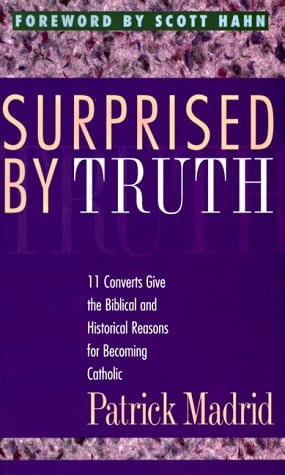
Anyone can figure out that this was about Jesus (very loosely inspired by the two disciples on the road to Emmaus, mixed in with “nature mystic” themes: since music and nature had been virtually my religion prior to that time, just as mythology was for C. S. Lewis). This sort of story of commitment to Jesus is not at all uncommon. For example, my friend Al Kresta, whose story was in the book, Surprised by Truth, along with mine and those of nine others, devoted eight pages out a total of 17 to his early years, culminating in his conversion to Christ in 1974. T. L. Frazier, in the same book, described his conversion to Christ as follows:
I made a solemn covenant to forever be his friend and follower. I accepted his claims upon me and looked to him alone for my salvation. (p. 185)
Later, he explained the nature of his further Catholic conversion:
Scripture states the Church is the mystical Body of Christ and Christ is its head (Eph. 1:22-23; Col. 1:18). One can’t have a personal relationship with the Head as Lord and Savior in its fullness if one doesn’t embrace the Body as well. (p. 209)
Now, there may be all kinds of honest Protestant objections to that statement, but one thing it is clearly not is any sort of denigration or demotion of Christ. He felt (as most of us converts do) that what he came to believe was the one Church is the appropriate place to worship Jesus all the more. It’s not about “Church vs. Jesus” or sola ecclesia. It’s about (as we now believe in faith) the Church that Jesus Himself established (Matthew 16). The Church isn’t schizophrenic (opposed to Jesus its Head).
My friend Steve Ray, wrote in his 1997 book, Crossing the Tiber:
Janet and I, independently of each other and before we met, became ardent followers of Jesus Christ in the Evangelical tradition . . . (p. 18)
Steve had a particular admiration for Martin Luther (as I also did, and still do, in a much more limited sense). One time Al Kresta (who would shortly return to the Church) and myself (who had just converted), visited Steve Ray at his house. When I made some critical remarks about Martin Luther, I thought he was actually gonna punch me.
Scott Hahn (the most well-known recent convert), in his book, Rome Sweet Home (1993), wrote about his initial “commitment to Christ”:
I . . . prayed, “Lord Jesus, I am a sinner. I believe you died to save me. I want to give my life to you right now. Amen.” . . . the next morning, . . . I knew something was different. (p. 4)
they point to a triumphal entry into the Roman Church from one’s own intellectual abilities. Their conversion stories are about what they did. They are about what wisdom and glory they achieved.
I just don’t see it. This is simply judgmental condemnation and the attempted reading of another’s heart. Swan, being an anti-Catholic, simply can’t imagine a legitimate, spiritual reason for any Protestant to ever become a Catholic, and so he pulls out of thin air this cynical interpretation that we only did it for “glory” and self-worship of our own intellect. It’s sheer nonsense. And he can’t prove this, in any event (which is why he doesn’t attempt to; he simply makes the bald assertion). This is sinful calumny.
I know how often he has brought this up, because he has often directed it towards me. But I think the false charge reveals a lot more about him than it does anything about us. At one point, Swan was even claiming that it was prideful and self-centered for someone to have a Facebook page (!). That’s how ridiculous he got.
Yet, after all his anti-Catholic cronies got on Facebook, one-by-one, sure enough, he did so himself. Swan wrote about me on 4-14-09: “Mr. Armstrong is a theologian of glory. It’s all about the glory of DA.” On 4-15-10, he again called me the same name, which is contrary to being “a theologian of the cross.” It’s just a bunch of hot air.
They are not conversion stories of the broken sinner bowing his knee to the merciful God, given by the Father to Christ and irresistibly drawn (like Paul’s recounting in Galatians 1; cf. Acts 9);
Again, those aspects of our stories came earlier, when we decided to wholeheartedly follow Christ into our hearts and became committed Protestant Christians. I gave five examples above. In his article, “Roman Catholic Conversion Stories” (originally, 2-5-07 on White’s blog and then re-posted on 2-20-09 on his own), Swan digs in all the more:
These glorious tales of “former theological step-children” are nothing more than aspects of what Martin Luther called the “theology of glory”. The late medieval Roman church Luther was confronted with was a church filled with “glory.” By “glory,” Luther meant that the emphasis was not on the achievements of Christ, but on the achievement of the Roman Church, and those achievements were accomplished by the churches’ own power. Luther rejected the “glory of the church” and said the church is a suffering church, rather than a church of beauty and splendor. The church is not supposed to be a “glory” of political power and luxury. Conversion stories repeatedly put forth by Catholics are just that: examples of achievement and glory. They point to the abilities of a person and the supposed wisdom gained by crossing the Tiber. They do not point to Christ—they point to a triumphal entry into a magnificent human institution: the Roman Catholic Church. Their conversion stories are about what they did. They are about what wisdom and glory they achieved.
In an article on 12-25-05, Swan classified all Catholic apologists as “theologians of glory” and stated:
The Theology of Glory is founded on man’s wisdom and works. It is a worldview that seems “sensible and right” by worldly standards. Glory theologians have to understand by the use of reason, and they have to “do” by their own moral energy to be right with God.
Again, on 7-24-10, he pontificated:
There is of course still the Romanist glory of works. But wait, they say those works they do are prompted by Christ, or done with the help of the Holy Spirit. Hogwash. They are a denial of the perfect work of Christ. . . .
Rome’s apologists and defenders are still theologians of glory. They stand opposed to the foolishness of the cross, and actively work against God’s kingdom. However well-meaning, they are ultimately deniers of the perfect work of Christ. All their websites, blogs, discussion boards, seminars, books, tracts, etc., are examples of the theology of glory.
This is outrageous and amounts to classifying us as Pelagian heretics and scarcely followers of Christ at all: a false view that the Catholic Church roundly condemned in the time of St. Augustine: more than a thousand years before Luther was a twinkle in his father’s eye.
rather, these are accounts of people accepting the alleged Roman Catholic “fullness of truth”, and a rejection of Protestant essentials like sola fide and sola scriptura. In other words, the emphasis is not on spiritual rebirth, but rather the acceptance and realization of a “higher knowledge.” The conversion is not to Christ, but to an infallible church.
It is rather hypocritical for a Calvinist to carp on and on about someone accepting what they believe is a “fullness of truth”: seeing that they often talk about having converted from Arminian Protestantism (often disparaging it in many unfair ways, and caricaturing what its beliefs are). They make the same sort of arguments that Catholic converts make (but with a condescension that we usually don’t exhibit towards our former beliefs).
At some point they grasped the “fuller truth” of Calvinism and God predestining people to hell from all eternity (wholly apart from the damned persons’ free will: this is unconditional election and irresistible grace). They accept the “glory” of Calvinism in all its ugly colors.
It turns out that Swan doesn’t care for any conversion or “testimony” stories at all: even among Protestants. It’s an odd quirk that he has. But this doesn’t stop him from hypocritically telling quite a bit of his own personal story prior to the astonishing and wonderful revelation of Calvinism, which was his own “pearl of great price”:
I was not brought up Presbyterian, but similar to this CTC author, I was raised on the “magic moment conversion” paradigm. I sat through years of altar calls and heard many versions of “with every eye closed and every head bowed, slip up your hand if you want to accept Christ… yes I see you…. yes I see you…” etc. I was raised with this sort of paradigm. It was a normal part of the church experience for me. If you were a Christian, you were expected to be able to point to the year, day, and hour in which you accepted Christ into your heart. Anything less than this was a bit suspicious. You had to have a magic moment in which you were born again.
Here’s the ironic part. Despite at least three decades of opportunities, I never once lifted my hand when every head was bowed and every eye was closed (and by the way, every head and eye didn’t obey this liturgical rule). Nor did I ever leave my seat, walk the isle, head towards the front to be prayed with. This at times was met with consternation by those presenting the salvation offer. I recall really giving the counselors at the Word of Life Bible camp in New York state quite a challenge. They had these invitations every night that never made any sort of dent on me. In fact, I enjoyed not providing them with any sort of certainty of my spiritual state.
It wasn’t just the altar calls. By the time I got into my twenties, the idea of standing up and committing to something had grown. I recall going out to the big Intervarsity Urbana conference and one of the speakers got the entire stadium on their feet to commit to some form of Christian behavior. I was one of the only persons that didn’t stand up (God bless my friend Bob who likewise sat there with me). The last church I went to previous to my paradigm shift to a Reformed perspective was a rocking Church of the Nazarene (what a band!). Each service ended with a 10 to 15 minute altar call. . . .
One of the helpful aspects of going “Reformed” was that it made sense of my own conversion “experience.” Reformed theology understands that not every one hears a voice from heaven and falls to the ground like the the apostle Paul. The idea of a dramatic “once I was blind, but now I see” magic moment isn’t the rule. In fact, some people can’t locate a specific date in which they realized their own sin, need of savior, and desired to live a life of gratitude to God for salvation. It just happens. . . .
Now I certainly realize the author of the CTC article in question has a different intent with his article than what I’m talking about. He does though claim a Reformed heritage. I can’t help but be very suspicious as to whether or not he really was raised… Reformed or as any sort of a Calvinist. He concludes with the following: “As a very young child, I believed that salvation came through recitation of a mantra: the sinner’s prayer.” This certainly isn’t taught in my Reformed church, nor do I think this prayer finds its way into to Westminster Small Catechism. It is though taught in the tradition I was raised in: garden-variety-evangelical-fundamentalism. It appears to me that the Presbyterian church the CTC author was raised in had been infected by “magic moment” theology. (Magic Moment Conversions and Called to Communion: 3-18-12)
So this is at least some semblance of Swan’s own “conversion story” from “fundamentalism” to the sublime and glorious heights of Calvinism. Whaddya know: another former fundamentalist (something I never was). I have debated many atheists who have the same background. Swan is blessed that he managed to survive it. He told his “story” despite the fact that less than three months later he decried this very thing:
Some people hold that at baptism, it’s good for the person to tell their “story”- I disagree. Perhaps it’s because I’m embarrassed at the sins I’ve committed against Christ. . . .
On a positive note, I have no problem with getting to know someone and hearing their “story”. This is fine over a cup of coffee. But please, keep your “story” out of the spotlight. If you want to tell a “story”- tell Christ’s story.
Yet Swan posted his own (and quite in-depth at that), on his website, where potentially many thousands could read it. Is that being a “theologian of glory”? Go figure . . .
***
Unfortunately, Money Trees Do Not Exist: If you have been aided in any way by my work, or think it is valuable and worthwhile, please strongly consider financially supporting it (even $10 / month — a mere 33 cents a day — would be very helpful). I have been a full-time Catholic apologist since Dec. 2001, and have been writing Christian apologetics since 1981 (see my Resume). My work has been proven (by God’s grace alone) to be fruitful, in terms of changing lives (see the tangible evidences from unsolicited “testimonies”). I have to pay my bills like all of you: and have a (homeschooling) wife and three children still at home to provide for, and a mortgage to pay.
*
My book royalties from three bestsellers in the field (published in 2003-2007) have been decreasing, as has my overall income, making it increasingly difficult to make ends meet. I provide over 2600 free articles here, for the purpose of your edification and education, and have written 50 books. It’ll literally be a struggle to survive financially until Dec. 2020, when both my wife and I will be receiving Social Security. If you cannot contribute, I ask for your prayers (and “likes” and links and shares). Thanks!
*
See my information on how to donate (including 100% tax-deductible donations). It’s very simple to contribute to my apostolate via PayPal, if a tax deduction is not needed (my “business name” there is called “Catholic Used Book Service,” from my old bookselling days 17 or so years ago, but send to my email: [email protected]). Another easy way to send and receive money (with a bank account or a mobile phone) is through Zelle. Again, just send to my e-mail address. May God abundantly bless you.
***
Previous Post
November 23, 2019
Mary's Assumption & Death (?): Debunking James Swan
Next Post

November 25, 2019 Viganò, Schneider, Pachamama, & VCII (vs. Janet E. Smith)
Browse Our Archives
Select a Category & Last Things About Me Anti-Catholicism Atheism & Agnosticism Baptism and Sacramentalism Bible and Tradition Blessed Virgin Mary Books by Dave Armstrong C. S. Lewis Calvinism & General Protestantism Catholic Apologetics Catholic Apologists Catholic conversion Catholic converts Christmas Church (Ecclesiology) Church History Conversion and Converts Development of Doctrine Eastern Orthodoxy Ecumenism & Christian Unity Eucharist & Liturgy Fathers of the Church French Translations G. K. Chesterton Hell Hell & Satan Hell & Satan & Last Things Heresies & Comparative Religion Holistic Health Inquisition & Crusades & Scandals James White Jews & Judaism & Old Testament John Calvin John Henry Newman Liberal / Modernist Theology Life Issues Literary Resume Lutheranism Mariology Martin Luther Music Orthodoxy Papacy & Infallibility Personal Page Philosophy & Science Political & Ethical & Moral Issues Protestant Persecution & Intolerance Protestantism Purgatory Purgatory & Penance Romantic & Imaginative Theology Saints & Purgatory & Penance Salvation Salvation & Justification Satan & Last Things Sexuality and Gender Issues Spanish Translations Traditionalism vs. Radical Catholic Reactionaries Traducciones al español / tradução para português Trinitarianism & Christology Uncategorized Videos
Select a Month October 2026 September 2026 August 2026 July 2026 June 2026 May 2026 April 2026 March 2026 February 2026 January 2026 December 2025 November 2025 October 2025 September 2025 August 2025 July 2025 June 2025 May 2025 April 2025 March 2025 February 2025 January 2025 December 2024 November 2024 October 2024 September 2024 August 2024 July 2024 June 2024 May 2024 April 2024 March 2024 February 2024 January 2024 December 2023 November 2023 October 2023 September 2023 August 2023 July 2023 June 2023 May 2023 April 2023 March 2023 February 2023 January 2023 December 2022 November 2022 October 2022 September 2022 August 2022 July 2022 June 2022 May 2022 April 2022 March 2022 February 2022 January 2022 December 2021 November 2021 October 2021 September 2021 August 2021 July 2021 June 2021 May 2021 April 2021 March 2021 February 2021 January 2021 December 2020 November 2020 October 2020 September 2020 August 2020 July 2020 June 2020 May 2020 April 2020 March 2020 February 2020 January 2020 December 2019 November 2019 October 2019 September 2019 August 2019 July 2019 June 2019 May 2019 April 2019 March 2019 February 2019 January 2019 December 2018 November 2018 October 2018 September 2018 August 2018 July 2018 June 2018 May 2018 April 2018 March 2018 February 2018 January 2018 December 2017 November 2017 October 2017 September 2017 August 2017 July 2017 June 2017 May 2017 April 2017 March 2017 February 2017 January 2017 December 2016 November 2016 October 2016 September 2016 August 2016 July 2016 June 2016 May 2016 April 2016 March 2016 February 2016 January 2016 December 2015 November 2015 October 2015 September 2015 August 2015 July 2015 June 2015 May 2015 April 2015 March 2015 February 2015 January 2015 December 2014 November 2014 October 2014 September 2014 August 2014 July 2014 June 2014 April 2014 March 2014 February 2014 January 2014 December 2013 November 2013 October 2013 September 2013 August 2013 July 2013 June 2013 April 2013 March 2013 February 2013 January 2013 December 2012 November 2012 October 2012 September 2012 August 2012 July 2012 June 2012 May 2012 April 2012 March 2012 February 2012 January 2012 December 2011 November 2011 October 2011 September 2011 August 2011 July 2011 June 2011 April 2011 March 2011 February 2011 October 2010 September 2010 August 2010 July 2010 April 2010 March 2010 December 2009 October 2009 August 2009 July 2009 June 2009 May 2009 March 2009 February 2009 October 2008 September 2008 April 2008 March 2008 February 2008 January 2008 December 2007 November 2007 October 2007 May 2007 March 2007 February 2007 January 2007 November 2006 October 2006 September 2006 August 2006 July 2006 June 2006 May 2006 April 2006 March 2006 February 2006 October 2005 June 2005 April 2005 February 2005 July 2004 May 2004 April 2004
Follow Us!
TAKE THE
Religious Wisdom Quiz
Proverbs warns against what kind of woman as a symbol of temptation?
Select your answer to see how you score.
Widow Mother-in-law Queen Adulterous woman
Books by This Author Books by Dave Armstrong
Related posts from Biblical Evidence for Catholicism

On Protestant Explanations of Catholic Conversion
Biblical Evidence for Catholicism

Three More Anti-Catholic Lies About Catholicism (#6-4)
Biblical Evidence for Catholicism

Top Ten Anti-Catholic Lies (#10-7)
Biblical Evidence for Catholicism

"Baptism" & Romans 10 (Engwer's Silly Word Games)
Biblical Evidence for Catholicism
TRENDING AT PATHEOS Catholic

The Sermon on the Mount, Part I: Matthew...
The Sermon on the Mount, Part I (Matthew 4:12-5:12) St. Matthew moves...

What's up from Crossway: Reviewing some of their latest A few weeks...

Janie Learns the Way of the Cross: A...
Teaching children about Jesus' Passion can be challenging. Many parents and educators...

Looking For Good Catholic Writing - October 2026
He alone extends the heavens, and he walks upon the waves of...

In "Irreplaceable," our book on vocation and technology, Trevor Sutton and I...

I was strolling through the top floor of the brand new Parthenon...
view all Catholic blogs
Ad-Free & Subscriber Log-In Subscription Support
- About Us
- 2026 Calendar
- Videos
- Podcasts
- Library of World Religions
- Faith In Media Tracker
- Advertise With Us
- Write for Us
- Privacy Policy
- Terms of Service
- Do Not Sell My Data
- Contact Us
- Radiant Digital
- Manage Newsletter Subscriptions
- Unsubscribe From Notifications
- Sitemap
Copyright 2008-2026, Patheos. All rights reserved.
Subscription Support Ad-Free & Subscriber Log-In
Follow Patheos