
BuddhistCatholicContemplativeEvangelicalGeneral ChristianHinduJewishLatter-day SaintMuslimNew VisionsProgressive Christian
Beliefs
- Buddhist
- Catholic
- Contemplative
- Evangelical
- General Christian
- Hindu
- Jewish
- Latter-day Saint
- More Voices
- Muslim
- New Visions
- Pagan
- Progressive Christian
Topics
- Religion News
- Food and Religion
- Sports and Religion
- Religious Art
- Religious Music and Entertainment
- Religious Events
- History and Religion
- Style and Religion
- Politics and Religion
- Women in Religion
- Recreation Outdoors and Religion
- Business Finance and Religion
- Careers Workplace and Religion
- Education and Religion
- Family Parenting and Religion
- Health Fitness and Religion
- Home and Religion
- Relationships and Religion
- Technology and Religion
- Travel and Religion
Columnists
- Buddhist Columnists
- Business Finance and Religion Columnists
- Careers Workplace and Religion Columnists
- Catholic Columnists
- Contemplative Columnists
- Education and Religion Columnists
- Evangelists Columnists
- Family Parenting and Religion Columnists
- General Christian Columnists
- Health Fitness and Religion Columnists
- Hindu Columnists
- History and Religion Columnists
- Home and Religion Columnists
- Jewish Columnists
- More Voices Columnists
- Latter Day Columnists
- Muslim Columnists
- New Visions Columnists
- Nonreligious Columnists
- Pagan Columnists
- Politics and Religion Columnists
- Progressive Columnists
- Recreation Outdoors and Religion Columnists
- Relationships and Religion Columnists
- Religion News Columnists
- Religious Art Columnists
- Religious Events Columnists
- Religious Music and Entertainment Columnists
- Sports and Religion Columnists
- Style and Religion Columnists
- Technology and Religion Columnists
- Travel and Religion Columnists
- Women in Religion Columnists
Resource Library
- 2026 Calendar
- Library of World Religions
- The 100 Most Holy Places on Earth
- Patheos Answers
- Podcasts
- Videos
- Faith Leaders Database
- Anglican Episcopalian
- Bahai
- Baptist
- Buddhism
- Christianity
- Confucianism
- Eastern Orthodoxy
- Hinduism
- Holiness and Pentecostal
- ISKCON
- Islam
- Judaism
- Lutheran
- Methodist
- The Church of Jesus Christ of Latter-day Saints
- New Age
- Paganism
- Presbytarian and Reformed
- Protestantism
- Religion Behind the Scenes
- Roman Catholic
- Scientology
- Shia Islam
- Sikhism
- Sufism
- Sunni Islam
- Taoism
- Zen
- See all religions
Research Tools
 Ad-Free & Subscriber Log-In Subscription Support
Follow Patheos 

- Trending:
- Advent
- |
- Forgiveness
- |
- Thanksgiving
- |
- Election
- |
- Seasonal Holidays
- |
- Marriage

-
About
-
Catholic Apologetics
-
Church History
-
Great Apologists
-
Christian Worldview
-
Protestantism & Misc.
- Home
- Catholic
- History and Religion
- Is Pope Francis Against Apologetics & Defending the Faith?
Is Pope Francis Against Apologetics & Defending the Faith?
Last updated on: December 3, 2019 at 11:29 am by Dave Armstrong
Is Pope Francis Against Apologetics & Defending the Faith? 2019-12-03T11:29:02-04:00 Dave Armstrong
Patheos Explore the world's faith through different perspectives on religion and spirituality! Patheos has the views of the prevalent religions and spiritualities of the world.
[all the words below — unless indicated otherwise — are Pope Francis’ own; blue highlighting and bolding are my own]
132. Proclaiming the Gospel message to different cultures also involves proclaiming it to professional, scientific and academic circles. This means an encounter between faith, reason and the sciences with a view to developing new approaches and arguments on the issue of credibility, a creative apologetics which would encourage greater openness to the Gospel on the part of all. When certain categories of reason and the sciences are taken up into the proclamation of the message, these categories then become tools of evangelization; water is changed into wine. Whatever is taken up is not just redeemed, but becomes an instrument of the Spirit for enlightening and renewing the world.
133. It is not enough that evangelizers be concerned to reach each person, or that the Gospel be proclaimed to the cultures as a whole. A theology – and not simply a pastoral theology – which is in dialogue with other sciences and human experiences is most important for our discernment on how best to bring the Gospel message to different cultural contexts and groups. The Church, in her commitment to evangelization, appreciates and encourages the charism of theologians and their scholarly efforts to advance dialogue with the world of cultures and sciences. I call on theologians to carry out this service as part of the Church’s saving mission. In doing so, however, they must always remember that the Church and theology exist to evangelize, and not be content with a desk-bound theology.
134. Universities are outstanding environments for articulating and developing this evangelizing commitment in an interdisciplinary and integrated way. Catholic schools, which always strive to join their work of education with the explicit proclamation of the Gospel, are a most valuable resource for the evangelization of culture, even in those countries and cities where hostile situations challenge us to greater creativity in our search for suitable methods. (Apostolic Exhortation Evangelii Gaudium, 11-24-13; evangelism and proclamation of the gospel are discussed in sections 110-131 as well)
*****
The word “Confirmation” then reminds us that this Sacrament brings an increase and deepening of baptismal grace: it unites us more firmly to Christ, it renders our bond with the Church more perfect, and it gives us a special strength of the Holy Spirit to spread and defend the faith, … to confess the name of Christ boldly, and never to be ashamed of his Cross (cf. Catechism of the Catholic Church, n. 1303). (General Audience, 1-29-14)
*****
Dialogue is so important, but to dialogue two things are necessary: one’s identity as a starting point and empathy toward others. If I am not sure of my identity and I go to speak, I end up bartering my faith. You cannot dialogue without starting from your own identity, and empathy, which is a priori not condemning. Every man, every woman has something of their own to give us; every man, every woman has their own story, their own situation and we have to listen to it. Then the prudence of the Holy Spirit will tell us how to respond. Start from your own identity in order to dialogue, but a dialogue is not doing apologetics, although sometimes you must do so, when we are asked questions that require an explanation. Dialogue is a human thing. It is hearts and souls that dialogue, and this is so important! Do not be afraid to dialogue with anyone. It was said of a saint, joking somewhat — I do not remember, I think it was St Philip Neri, but I’m not sure — that he was able to dialogue even with the devil. Why? Because he had that freedom to listen to all people, but starting from his own identity. He was so sure, but being sure of one’s identity does not mean proselytizing. Proselytism is a trap, which even Jesus condemns a little, en passant, when he speaks to the Pharisees and the Sadducees: “You who go around the world to find a proselyte and then you remember that…”. But, it’s a trap. And Pope Benedict has a beautiful expression. He said it in Aparecida but I believe he repeated it elsewhere: “The Church grows not by proselytism, but by attraction”. And what’s the attraction? It is this human empathy, which is then guided by the Holy Spirit. Therefore, what will be the profile of the priest of this century, which is so secularized? A man of creativity, who follows God’s commandment — “to create things”; a man of transcendence, both with God in prayer and with others always; a man who is approachable and who is close to the people. To distance people is not priestly and people are tired of this attitude, and yet they still come to us. But he who welcomes the people and is close to them and dialogues with them does so because he feels certain of his identity, which leads him to have a heart open to empathy. (Meeting with the Clergy: Palatine Chapel in the Royal Palace of Caserta, 7-26-14)
*****
How many of you pray for Christians who are being persecuted? How many? Everyone respond in you heart. Do I pray for my brother, for my sister who is in difficulty because they confess and defend their faith? It is important to look beyond our own boundaries, to feel that we are Church, one family in God! (General Audience, 1-25-13)
*****
It is to research conducted in ecclesiastical universities, faculties and institutes that I primarily entrust the task of developing that “creative apologetics” which I called for in Evangelii Gaudium, in order to “encourage greater openness to the Gospel on the part of all”. (Apostolic Constitution Veritatis Gaudium, section 5; 1-29-18)
*****
The Pope recalled that both Paul and Jesus seem “a little angry, and annoyed, one might say”. Where did Paul’s malaise come from? Francis said the answer was that the Apostle “defended the doctrine, he was a great defender of the doctrine, and the annoyance came from these people who did not tolerate the doctrine”. Which doctrine? “The gratuitousness of salvation”. . . . This, Pope explained, was “the struggle that both Jesus and Paul faced in order to defend the doctrine”. (Morning Meditation, 10-15-15)
*****
St. Vincent of Lerins makes a comparison between the biological development of man and the transmission from one era to another of the deposit of faith, which grows and is strengthened with time. Here, human self-understanding changes with time and so also human consciousness deepens. . . . we grow in the understanding of the truth. Exegetes and theologians help the church to mature in her own judgment. Even the other sciences and their development help the church in its growth in understanding. There are ecclesiastical rules and precepts that were once effective, but now they have lost value or meaning. The view of the church’s teaching as a monolith to defend without nuance or different understandings is wrong. (Interview with Fr. Antonio Spadaro, September 2013)
*****
[Dave: many mistakenly think that when Pope Francis condemns “proselytizing” he is condemning all apologetics and/or evangelism. Nothing could be further from the truth. He is rejecting (as Pope Benedict XVI also did) a certain limited, flawed methodology, and distortion of what evangelism should be; with the wrong attitude, as the following excerpts clearly illustrate. I, as an apologist, completely agree with him on this score. He’s not condemning what we apologists do, or should seek to be doing (if we are doing it wrongly, or with flawed intentions)]
* * * * *
The Apostle Paul said that he felt in his heart: “Woe to me if I do not proclaim the Gospel!” (1 Cor 9:16). We want the Gospel to be lived as a grace, a treasure, which we have received freely. We need to ask the Lord to give us the grace to feel as Paul did: to feel that fire, that burning in our hearts, to evangelize. This has nothing to do with proselytizing, not at all. The Church, the Kingdom of God, does not grow by proselytizing. She grows by witness. That means showing by our words and our lives the treasure we have received. That is what it means to evangelize. I live this way, I live this word, and may others see this; but that is not to proselytize. (unprepared remarks before meeting with the Bishops of Bangladesh, 12-1-17)
***
“The apostle Paul explains to the Corinthians what it means to evangelize”, the Pope affirmed, referring to the first reading in the day’s liturgy (1 Cor 9:16-19, 22-27). “We too can reflect today upon what it means to evangelize”, he said, “because we Christians are called to evangelize, to convey the Gospel, which means bearing witness to Jesus Christ”.
And Paul, addressing the Christians of Corinth, begins his reasoning by pointing out what evangelization does not consist of: “To me, proclaiming the Gospel is not boasting”. Therefore, you should certainly not boast “of going to evangelize: I am going to do this, I am going to do that”, as if evangelizing was like “taking a stroll”. This would be “reducing evangelization to a task: I have this task”. And “I am speaking about things that happen in parishes around the world”, the Pope said, “when a parish priest always has his door closed”.
It can also happen, Pope Francis continued, that you meet “lay people who say: ‘I teach this catechism class, I do this, this and this…”. In doing so, they reduce “what they call evangelization to a task”. Perhaps they even boast, saying: “I perform this task, I am a catechist official, I am an official of this, of this or that”.
This is precisely the attitude of those who boast, the Pope insisted, and “it is reducing the Gospel to a task or even a source of pride: ‘I go and evangelize and I have brought many people to Church’”. In this way, he said, “even proselytizing is boasting”. However, “evangelization is not proselytism”. It is more: evangelization is never “taking a stroll; reducing the Gospel to a task; proselytizing”.
St Paul emphatically repeats what evangelization means, the Pope explained: preaching the Gospel “is not boasting. It is a necessity imposed upon me”. Indeed, the Pope said, referring to an expression of Paul, “a Christian is obligated, but with this force, as a necessity, to convey the name of Jesus, but from one’s own heart”. Repeating the Apostle’s clear words, the Pontiff said: “Woe to me if I do not preach the Gospel!”.
A reprimand — “Woe to you!” — that reaches those Catholics who think: “I go to Mass, I do this and then nothing more”. However, Pope Francis cautioned, “if you say that you are Catholic, that you have been baptized, that you have been confirmed, you must go further, to convey the name of Jesus: this is an obligation!”.
Paul’s precise indications, the Pope continued, lead us to question what our “style of evangelization” should be. In short, “how can I be sure that I am not taking a stroll, that I am neither proselytizing nor reducing evangelization to a task? How can I understand what the right style is?”.
The answer Paul always gives is: “The style is to be all things to everyone”. In fact, the Apostle writes: “I have become all things to all men”. In essence it means “to go and share the lives of others, to accompany them on the journey of faith, to help them grow on the journey of faith”. (Morning Meditation: “A matter of style”: 9-9-16)
***
The example given by the Pope was from the Apostle Paul in the Areopagus (Acts 17:15-22, 18-1) proclaiming the name of Jesus Christ among the worshipers of idols. It is the way in which he did this, said the Pope, that is so important: “He did not say: Idolaters! You will go to hell… ”. No, he “tried to reach their hearts”; he did not condemn from the outset but sought dialogue. “Paul is a Pope, a builder of bridges. He did not want to become a builder of walls”. Building bridges to proclaim the Gospel, “this was the Paul’s outlook in Athens: build a bridge to their hearts, and then take a step further and proclaim Jesus Christ”. Paul followed the attitude of Jesus, who spoke to everyone, “he heard the Samaritan woman… ate with the Pharisees, with sinners, with publicans, with doctors of the law. Jesus listened to everyone and when he said a word of condemnation, it was at the end, when there was nothing left to do”. But Paul, too, was “aware that he must evangelize, not proselytize”. The Church “does not grow by proselytizing, as Benedict XVI has told us, but grows by attracting people, by its witness, and by its preaching”. Ultimately, “Paul acted because he was sure, sure of Jesus Christ. He had no doubt of his Lord”. (Morning Meditation: “Jesus excludes no one”: 5-8-13)
***
A first distinction: evangelizing is not proselytizing. The Church grows not through proselytizing but through attraction, that is, through witness. Pope Benedict XVI said this. What is evangelization? It is living the Gospel; it is witnessing to how one lives the Gospel: witnessing to the Beatitudes, witnessing to Matthew 25, witnessing to the Good Samaritan, witnessing to forgiveness seventy times seven. And in this witnessing, the Holy Spirit works and there are conversions. But we are not very enthusiastic about bringing about conversions straight away. If they come, they wait: you speak …, your tradition…, you make sure that a conversion is the response to something that the Holy Spirit has moved in my heart before the testimony of a Christian. (Press conference on the return flight from Bangladesh, 12-2-17)
***
Evangelization does not consist in proselytizing, for proselytizing is a caricature of evangelization, but rather evangelizing entails attracting by our witness those who are far off, it means humbly drawing near to those who feel distant from God in the Church, drawing near to those who feel judged and condemned outright by those who consider themselves to be perfect and pure. We are to draw near to those who are fearful or indifferent, and say to them: “The Lord, with great respect and love, is also calling you to be a part of your people” (cf. Evangelii Gaudium, 113). Because our God respects us even in our lowliness and in our sinfulness. This calling of the Lord is expressed with such humility and respect in the text from the Book of Revelation: “Look, I am at the door and I am calling; do you want to open the door?” He does not use force, he does not break the lock, but instead, quite simply, he presses the doorbell, knocks gently on the door and then waits. This is our God! (Homily at Parque Bicentenario, Quito, Ecuador, 7-7-15)
***
Related Reading:
Did Pope Francis just say that evangelization is “nonsense”? 8 things to know and share (Jimmy Akin, National Catholic Register, 10-1-13)
Pope Francis on “Proselytism” (Jimmy Akin, Catholic Answers, 10-21-13)
Did Pope Francis just diss apologists? 9 things to know and share (Jimmy Akin, National Catholic Register, 3-9-14)
***
Unfortunately, Money Trees Do Not Exist: If you have been aided in any way by my work, or think it is valuable and worthwhile, please strongly consider financially supporting it (even $10 / month — a mere 33 cents a day — would be very helpful). I have been a full-time Catholic apologist since Dec. 2001, and have been writing Christian apologetics since 1981 (see my Resume). My work has been proven (by God’s grace alone) to be fruitful, in terms of changing lives (see the tangible evidences from unsolicited “testimonies”). I have to pay my bills like all of you: and have a (homeschooling) wife and three children still at home to provide for, and a mortgage to pay.
*
My book royalties from three bestsellers in the field (published in 2003-2007) have been decreasing, as has my overall income, making it increasingly difficult to make ends meet. I provide over 2600 free articles here, for the purpose of your edification and education, and have written 50 books. It’ll literally be a struggle to survive financially until Dec. 2020, when both my wife and I will be receiving Social Security. If you cannot contribute, I ask for your prayers (and “likes” and links and shares). Thanks!
*
See my information on how to donate (including 100% tax-deductible donations). It’s very simple to contribute to my apostolate via PayPal, if a tax deduction is not needed (my “business name” there is called “Catholic Used Book Service,” from my old bookselling days 17 or so years ago, but send to my email: [email protected]). Another easy way to send and receive money (with a bank account or a mobile phone) is through Zelle. Again, just send to my e-mail address. May God abundantly bless you.
***
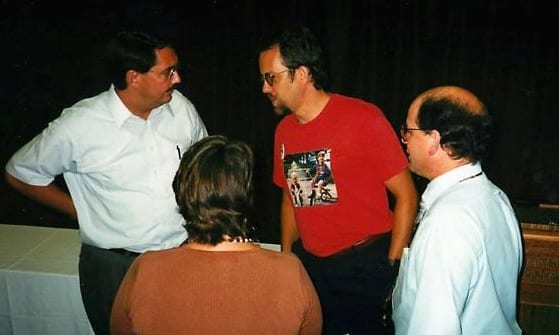
Photo credit: three apologists (all converts): Scott Hahn, yours truly, and Steve Ray: July 1999 at the Franciscan University of Steubenville.
***
biblical rationale for apologetics
Previous Post

November 25, 2019
Viganò, Schneider, Pachamama, & VCII (vs. Janet E. Smith)
Next Post

November 26, 2019 G. K. Chesterton on the Incompetence of Journalists
Browse Our Archives
Select a Category & Last Things About Me Anti-Catholicism Atheism & Agnosticism Baptism and Sacramentalism Bible and Tradition Blessed Virgin Mary Books by Dave Armstrong C. S. Lewis Calvinism & General Protestantism Catholic Apologetics Catholic Apologists Catholic conversion Catholic converts Christmas Church (Ecclesiology) Church History Conversion and Converts Development of Doctrine Eastern Orthodoxy Ecumenism & Christian Unity Eucharist & Liturgy Fathers of the Church French Translations G. K. Chesterton Hell Hell & Satan Hell & Satan & Last Things Heresies & Comparative Religion Holistic Health Inquisition & Crusades & Scandals James White Jews & Judaism & Old Testament John Calvin John Henry Newman Liberal / Modernist Theology Life Issues Literary Resume Lutheranism Mariology Martin Luther Music Orthodoxy Papacy & Infallibility Personal Page Philosophy & Science Political & Ethical & Moral Issues Protestant Persecution & Intolerance Protestantism Purgatory Purgatory & Penance Romantic & Imaginative Theology Saints & Purgatory & Penance Salvation Salvation & Justification Satan & Last Things Sexuality and Gender Issues Spanish Translations Traditionalism vs. Radical Catholic Reactionaries Traducciones al español / tradução para português Trinitarianism & Christology Uncategorized Videos
Select a Month November 2026 October 2026 September 2026 August 2026 July 2026 June 2026 May 2026 April 2026 March 2026 February 2026 January 2026 December 2025 November 2025 October 2025 September 2025 August 2025 July 2025 June 2025 May 2025 April 2025 March 2025 February 2025 January 2025 December 2024 November 2024 October 2024 September 2024 August 2024 July 2024 June 2024 May 2024 April 2024 March 2024 February 2024 January 2024 December 2023 November 2023 October 2023 September 2023 August 2023 July 2023 June 2023 May 2023 April 2023 March 2023 February 2023 January 2023 December 2022 November 2022 October 2022 September 2022 August 2022 July 2022 June 2022 May 2022 April 2022 March 2022 February 2022 January 2022 December 2021 November 2021 October 2021 September 2021 August 2021 July 2021 June 2021 May 2021 April 2021 March 2021 February 2021 January 2021 December 2020 November 2020 October 2020 September 2020 August 2020 July 2020 June 2020 May 2020 April 2020 March 2020 February 2020 January 2020 December 2019 November 2019 October 2019 September 2019 August 2019 July 2019 June 2019 May 2019 April 2019 March 2019 February 2019 January 2019 December 2018 November 2018 October 2018 September 2018 August 2018 July 2018 June 2018 May 2018 April 2018 March 2018 February 2018 January 2018 December 2017 November 2017 October 2017 September 2017 August 2017 July 2017 June 2017 May 2017 April 2017 March 2017 February 2017 January 2017 December 2016 November 2016 October 2016 September 2016 August 2016 July 2016 June 2016 May 2016 April 2016 March 2016 February 2016 January 2016 December 2015 November 2015 October 2015 September 2015 August 2015 July 2015 June 2015 May 2015 April 2015 March 2015 February 2015 January 2015 December 2014 November 2014 October 2014 September 2014 August 2014 July 2014 June 2014 April 2014 March 2014 February 2014 January 2014 December 2013 November 2013 October 2013 September 2013 August 2013 July 2013 June 2013 April 2013 March 2013 February 2013 January 2013 December 2012 November 2012 October 2012 September 2012 August 2012 July 2012 June 2012 May 2012 April 2012 March 2012 February 2012 January 2012 December 2011 November 2011 October 2011 September 2011 August 2011 July 2011 June 2011 April 2011 March 2011 February 2011 October 2010 September 2010 August 2010 July 2010 April 2010 March 2010 December 2009 October 2009 August 2009 July 2009 June 2009 May 2009 March 2009 February 2009 October 2008 September 2008 April 2008 March 2008 February 2008 January 2008 December 2007 November 2007 October 2007 May 2007 March 2007 February 2007 January 2007 November 2006 October 2006 September 2006 August 2006 July 2006 June 2006 May 2006 April 2006 March 2006 February 2006 October 2005 June 2005 April 2005 February 2005 July 2004 May 2004 April 2004
Follow Us!
TAKE THE
Religious Wisdom Quiz
What Christian group refers to their main worship service as "Mass"?
Select your answer to see how you score.
Presbyterians Baptists Methodists Catholics
Books by This Author Books by Dave Armstrong
Related posts from Biblical Evidence for Catholicism
Was Peter "Any Old" Apostle? 10 Anti-Papal Arguments
Biblical Evidence for Catholicism

11 Protestant Objections to Papal Authority Debunked
Biblical Evidence for Catholicism
Why Wes Huff (and Everyone) Should Be Catholic
Biblical Evidence for Catholicism
Matthew 16 & the Papacy (vs. Patrick O'Brien)
Biblical Evidence for Catholicism
TRENDING AT PATHEOS Catholic

When Worry Gets You Nowhere, How Can Faith...
Sometimes, we think that by worrying, we can somehow predict the future....

The Wasp And I: Meditations on Repentance
How can we enter the power and joy of the repentant self...

Reflections on the Evangelical Theological Society
As I mentioned before, this year, for the first time since 2005,...

Demmed if it do and demmed if it...
"First Presidency Announces Salt Lake Temple Rededication Date" Apropos of that,...

Stop Making Thanksgiving Problematic And Just Give Thanks
“What if, today, we were grateful for everything?” –Charlie Brown I...

Sunday Readings: Stay Awake and Hope
The First Sunday of Advent begins a new liturgical year, and the...
view all Catholic blogs
Ad-Free & Subscriber Log-In Subscription Support
- About Us
- 2026 Calendar
- Videos
- Podcasts
- Library of World Religions
- Faith In Media Tracker
- Advertise With Us
- Write for Us
- Privacy Policy
- Terms of Service
- Do Not Sell My Data
- Contact Us
- Radiant Digital
- Manage Newsletter Subscriptions
- Unsubscribe From Notifications
- Sitemap
Copyright 2008-2026, Patheos, part of the Radiant Digital network of media brands. All rights reserved.
Subscription Support Ad-Free & Subscriber Log-In
Follow Patheos