
BuddhistCatholicContemplativeEvangelicalGeneral ChristianHinduJewishLatter-day SaintMuslimNew VisionsProgressive Christian
Beliefs
- Buddhist
- Catholic
- Contemplative
- Evangelical
- General Christian
- Hindu
- Jewish
- Latter-day Saint
- More Voices
- Muslim
- New Visions
- Pagan
- Progressive Christian
Topics
- Religion News
- Food and Religion
- Sports and Religion
- Religious Art
- Religious Music and Entertainment
- Religious Events
- History and Religion
- Style and Religion
- Politics and Religion
- Women in Religion
- Recreation Outdoors and Religion
- Business Finance and Religion
- Careers Workplace and Religion
- Education and Religion
- Family Parenting and Religion
- Health Fitness and Religion
- Home and Religion
- Relationships and Religion
- Technology and Religion
- Travel and Religion
Columnists
- Buddhist Columnists
- Business Finance and Religion Columnists
- Careers Workplace and Religion Columnists
- Catholic Columnists
- Contemplative Columnists
- Education and Religion Columnists
- Evangelists Columnists
- Family Parenting and Religion Columnists
- General Christian Columnists
- Health Fitness and Religion Columnists
- Hindu Columnists
- History and Religion Columnists
- Home and Religion Columnists
- Jewish Columnists
- More Voices Columnists
- Latter Day Columnists
- Muslim Columnists
- New Visions Columnists
- Nonreligious Columnists
- Pagan Columnists
- Politics and Religion Columnists
- Progressive Columnists
- Recreation Outdoors and Religion Columnists
- Relationships and Religion Columnists
- Religion News Columnists
- Religious Art Columnists
- Religious Events Columnists
- Religious Music and Entertainment Columnists
- Sports and Religion Columnists
- Style and Religion Columnists
- Technology and Religion Columnists
- Travel and Religion Columnists
- Women in Religion Columnists
Resource Library
- 2026 Calendar
- Library of World Religions
- The 100 Most Holy Places on Earth
- Patheos Answers
- Podcasts
- Videos
- Faith Leaders Database
- Anglican Episcopalian
- Bahai
- Baptist
- Buddhism
- Christianity
- Confucianism
- Eastern Orthodoxy
- Hinduism
- Holiness and Pentecostal
- ISKCON
- Islam
- Judaism
- Lutheran
- Methodist
- The Church of Jesus Christ of Latter-day Saints
- New Age
- Paganism
- Presbytarian and Reformed
- Protestantism
- Religion Behind the Scenes
- Roman Catholic
- Scientology
- Shia Islam
- Sikhism
- Sufism
- Sunni Islam
- Taoism
- Zen
- See all religions
Research Tools
 Ad-Free & Subscriber Log-In Subscription Support
Ad-Free & Subscriber Log-In Subscription Support
Follow Patheos 

- Trending:
- Forgiveness
- |
- Marriage
- |
- Consciousness
- |
- Death Penalty
- |
- Election
- |
- Halloween

-
About
-
Catholic Apologetics
-
Church History
-
Great Apologists
-
Christian Worldview
-
Protestantism & Misc.
- Home
- Catholic
- History and Religion
- Dialogue with a Deconvert on Deconversion, Part II
Dialogue with a Deconvert on Deconversion, Part II
Last updated on: October 9, 2019 at 11:57 am by Dave Armstrong
Dialogue with a Deconvert on Deconversion, Part II 2019-10-09T11:57:03-04:00 Dave Armstrong
Patheos Explore the world's faith through different perspectives on religion and spirituality! Patheos has the views of the prevalent religions and spiritualities of the world.
See Part I for background. This is a continuation of that discussion, after Joe Omundson, who runs the website, Recovering from Religion: Ex-Communications, made a second lengthy counter-reply in the combox. His words will be in blue.
*****
Thanks for your additional reply. I’d like especially to clarify a few things where either you misunderstood or I did not express my view clearly enough, and make some other responses. Perhaps that may set us on a course of even more fruitful dialogue and mutual understanding.
I don’t think fundamentalism is equivalent to Christianity, but I don’t think it isn’t Christianity either.
I never said it wasn’t Christianity. It’s highly flawed Christianity: so much so that it sets off so many thousands of people straight to atheism . . .
I still think it’s a valid choice to reject fundamentalism and the rest of Christianity / all religions at the same time.
I don’t see how. It’s as if you are equating the two, when you just said you didn’t. We may call fundamentalism FC and more mainstream orthodox Christianity OC. They both share the C but are different forms of the C, just as (not a perfect analogy, but . . .) water and carbon dioxide both share oxygen but are different. Thus, logically, to reject FC is not the same as rejecting OC.
Now, if you are merely saying that all can be rejected in one fell swoop, at one time, then to my mind you would have to have additional (solid) reasons to reject OC, where it differed from FC. If someone just says, “to hell with all religion,” then that is usually mostly an emotional rather than logical / intellectual decision.
In the case of fundamentalists, they are usually mainly rejecting what they know, and (by their own account; not my mere speculation) it’s usually misguided, false aspects of fundamentalism. Having replied to many of these deconversion stories (probably 75% from former fundamentalists), I have observed this pattern over and over.
I also don’t think anyone needs an “excuse” to dismiss Christianity. It’s not an imperative. Just like you don’t need an excuse to dismiss Islam or Buddhism.
In our relativist / postmodernist / subjective world, no. They don’t, anymore than they need an excuse to change preference from vanilla to chocolate ice cream. But in the world of reason and logic, they do need such reasons: or at least such sufficient and adequate reasons ought to exist somewhere (people being of widely varying levels of education and knowledge) in the world of academia and folks like me who provide reasons for why we believe what we believe, and why we reject other religious and philosophical viewpoints.
But you might be making assumptions about people’s thought processes.
Maybe. But as I see it, I’m simply responding to expressed opinions. That’s what socratics do, and I am one of those.
Just because someone presents the most significant personal reasons for leaving fundamentalist Christianity doesn’t mean they don’t also have nuanced reasons for rejecting liberal Christianity. It just wasn’t the focal point of their own experience.
Understood. As I said, I am responding (with these deconversions) to what is written, not what is not written (which is only common sense). There may be all the submitted reasons in the world for why they changed their view, but I can only respond to what I see. And in this case, and all others so far in such analyses, I have not seen sufficient reason to reject all of Christianity.
You guys are always demanding reasons from us. I’m simply doing the same thing back. And it’s universally disliked, believe me. You have expressed one of the milder reactions, but then again, we’re not dealing with your story, so you are one huge step removed from it.
Well, that’s convenient isn’t it? How did you conclude this is the “proper” view of biblical interpretation? . . . What gives you the power to decide which parts are literal and which ones aren’t? Do sections shift from literal to symbolic as science advances?
It’s like anything else: the consensus of those (scholars and devoted amateurs like myself) who study the Bible in great depth is that it (like, in fact, all literature) has different genres, which must be understood in order to be properly interpreted. It would be like scientists talking about the nature of scientific evidence of hypotheses.
Someone comes along and asks, “well, that’s convenient isn’t it? How did you conclude this is the “proper” view of scientific evidences and hypotheses? . . . What gives you the power to decide that?” And the answer is the same: this is the consensus of scientists.
Lots of other Christians have a wide spectrum of opinions on how to interpret these things. And they’re all convinced they have the “proper view, of course.”
Absolutely. Again, like any other field of knowledge, it takes study to develop a consistent and plausible hermeneutics and exegesis. As in all fields, there are people who go down wrong paths and who reject the consensus. The problem in Christianity is that we have millions of folks who say they still believe in it but who have rejected key parts of it (liberal theology). They are being intellectually dishonest in a similar way as young earth creationists or geocentrists are not really doing science, even though they are convinced they are.
. . . To me this very much comes across as starting with the conclusion and then finding an interpretation that fits it. Cherry picking. You can do the same with any holy book.
That’s how you would see it, yes. You are wrong. What you describe is called eisegesis (reading into Scripture what we want, from our prior intellectual commitments and opinions). That’s the very worst way to approach the Bible or any piece of literature.
We might have a miscommunication about the semantics of this. My definition of fundamentalism might not be the same as yours — but when I say I oppose it, what I mean is that I oppose people pushing the idea that there’s a literal hell, and a literal heaven,
That’s true of virtually all Christians at all times, and is simply Christianity, not fundamentalism. Jesus talked more about hell than about heaven.
and the only way to get there is through the correct form of religion,
Fundamentalists and Calvinists think that, but not the vast majority of Christians now and throughout history. St. Paul in Romans 2 makes it pretty clear that those who haven’t heard or understood the gospel can possibly be saved. To sum up: we’re judged by what we know and how we act upon it.
and you must evangelize your friends and neighbors and children to accept this idea, and sacrifice your life on earth for that eternal end.
Christians are called to share the good news of Jesus Christ and salvation (evangelism). Sadly, most don’t. And many who do, do so in an obnoxious and ineffective way.
I think that’s a virus on humanity that harms people deeply. I don’t care much if it’s called evangelicalism or fundamentalism.
I disagree as to the false parts of that, but with regard to what I have expressed, I couldn’t disagree more strongly than I do.
Generally speaking, we support people who are already on the path of leaving any kind of religion, because we believe such belief systems are illogical and can be damaging, so that’s the kind of content I post . . .
Exactly what I was saying: your site is opposed to religion, period, not just Christian fundamentalism. Thanks for making my point for me again. And that gets back to, again, why I would spend my time critiquing one of the articles on your site.
But I think when your content makes personal attacks about ex-believers’ faculty of reasoning
To critique another’s reasoning is not to make a personal attack. I could see how it might feel that way, but it is not, because a person is not the same as his or her beliefs. They are two different things. I’m disagreeing with you now, but I am not attacking you personally to the slightest degree.
it comes across as kind of desperate. Are you threatened by what we have to say?
No, not in the least bit. That’s how you see it. I see it as simply honest, passionate disagreement on the topic of whether Christianity is a good and true thing or a false and bad thing. You defend your positions; I defend mine. Apologetics is not “desperation”; it’s the thinking process applied to religion.
You guys so often make out that Christians are dummies and ignoramuses (check out just about any combox of atheist sites online; I’ve never found one that didn’t do this, and quite a bit at that: usually the leading theme by far), yet when you run across an apologist who is certainly seeking to be rational and reasonable in religious matters, you start making this sort of quack psychoanalysis (which — ironically — is actually ad hominem or personal attack). There is no call for that.
That’s interesting that you say that, because I’ve been told many times that any true Christian would experience God’s love in such a profound way that they could never dream of leaving him. At least, that’s how my story has been discredited — I must have never been a true believer, if I ended up leaving, because if I’d really believed I would have never changed my mind…
Exactly, because that’s the fundamentalist and Calvinist line, and it is false, because it’s unbiblical (as well as viciously logically circular), as I have argued many times. The Bible, in my opinion, and that of the vast majority of Christians now and all through history. teaches that someone can be a true believer and still fall from grace and salvation. If you want to see where it teaches that, I’ll be more than happy to show you.
So what do you think makes a person want to hang around atheists and agnostics rather than other Christians? What led them to seek these alternative perspectives?
There could be any number of reasons. How could I possibly answer such a question (i.e., broadly)? We would have to ask them to see why they wanted to do so. To take Don R’s case as an example, he told us what started the ball rolling: “I believed in a literal interpretation of the bible, and to hear that someone who was as fully devoted as I was could believe in evolution was really difficult.”
He was wrong in thinking that the Bible was always to be interpreted literally, and that no Christian could possibly believe in the Bible and evolution, too, so when he discovered someone did that, it rocked his world. It was the first domino to fall.
So sometimes, folks with that background will “ride” that shock emotion and move on to start rejecting Christianity altogether, because they were never taught proper biblical interpretation and in many cases, not taught true doctrine, either. That’s just one of hundreds of possible reasons. We decide who we will start listening to and who is gonna influence us the most.
We are what we eat. So we better get it right what we decide to eat, or else we should read both sides of big disputes and make up our mind in the most objective way possible.
Isn’t God captivating enough to hold a believer’s attention?
Absolutely. But the heart can’t rejoice in what the mind rejects as false. If we don’t know and study and live our faith, and don;t know why we believe it (apologetics), that same faith teaches that the world, the flesh, and the devil can come along and erode our faith and cause us to fall away. The Bible warns about it. Even the apostle Paul said that it could happen to him if he wasn’t vigilant.
I just think you could be more effective with a less reactionary approach. It feels like you’re threatened by what these stories are saying, . . .
Now you’re back to quack psychoanalysis again . . . you can do better than this. But if simple honest disagreement is being a “reactionary” then I am proud to be one, because all it is is thinking and using our noggin.
First you say: it can’t be expected to be scientifically accurate, as it was written by pre-science cultures. But then you say it is in fact scientifically accurate and so this proves its accuracy (implying that the anti-scientific parts should also be considered to detract from its accuracy). So which is it?
This misrepresents what I stated, which was this:
It’s not a scientific treatise. It came from a pre-scientific culture (which even the ancient Greeks still were) and speaks in phenomenological terms. Yet what it teaches is true, and it sometimes touches tangentially on scientific matters.
My point was not that it was scientifically inaccurate, but that it was not scientifically technical, and not a scientific treatise, since it came from a pre-scientific culture. If I say, “the sun rose at 6 AM” (as any meteorologist might also say), I am making an accurate statement (from a phenomenological, non-technical point of view). That’s exactly what the Bible does.
Then I gave the example of “the principles of hygiene and proper sewage and disease control” and challenged you to explain how the Bible cold get this right, where science didn’t have a clue till the 1800s. I was writing today in another article how the Bible doesn’t accept the existence of mythical animals, whereas even Pliny the Elder (AD 23–79), the Roman author, naturalist, and natural philosopher, who wrote the 37-volume Naturalis Historia (Natural History), which became an editorial model for encyclopedias, believed in legendary creatures such as the manticore, basilisk, werewolf, catoblepas, and phoenix.
Likewise, Herodotus, Ovid, and Virgil all wrote seriously about werewolves. The Bible never does; nor does it accept any mythical animal as literally real.
As for that specific example, assuming it is true, why should it be surprising that some people discovered good hygiene standards before it was widespread? All kinds of different advancements are made by different cultures across history…
Oh, I agree. It doesn’t make sense only if one regards the Bible writers as ignorant iron age troglodytes (as a million atheists I have come across, do), while scientists are virtually infallible and the new gods. So given that background and baggage, I asked, “how could that be?”
In other words, how could this ancient people figure this out, whereas the “far superior” modern scientist did not till the 19th century. In any event, the Bible got that right, and it’s the perfect example of how it is scientifically accurate, while at the same time it expresses itself in pre-scientific modes of thought.
Or you could just observe that humans have the capacity for both of what we consider “good” and “bad”, regardless of what they believe, and leave out the mythological backstory that any religion uses as a metaphor.
The first clause is obvious and self-evident, but it is desirable to have a deeper understanding of why that is: why human beings are capable of such good and nobility, but also such wicked, heinous evil. I think original sin is a pretty plausible hypothesis. It’s certainly more plausible than the notion that all men are naturally good and only corrupted by their environments, or saying that all men are utterly wicked, with no good in them at all (Calvinist supralapsarianism).
If the truth is that Jesus dwells inside believers, that he washes them and breaks their bondage to sin (while the rest of the world are still slaves to sin), you’d generally expect see some decrease in “sinfulness”/strife/division/pride compared to the rest of the population, wouldn’t you?
Yes, if the Christian is truly following Him and doing what He commands them to do. I totally agree. But its a hard road, so most of us only show signs here and there of sanctity or holiness. What really reveals this are the saints.
Otherwise, what power does Jesus have? Believing in him has not seemed to reliably make people act better. I think if you explain the divisions in Christianity by saying that all humans are sinful, you’re admitting that being saved has little or no effect on a person.
There are signs that Christianity does indeed have a positive effect, as indicated even in secular sociological literature. For example, I have written about how committed Christian married couples (according to controlled sociological studies) are happier and have far less divorce, and even (surprise!) more sexual fulfillment.
There are other indications as well, that support traditional Christian family and sexual morality, such as studies showing that absence of a mother or father in the home is harmful, or that cohabitation is a strong predictor of increased chances for later divorce (if they ever marry). For example, a 2014 article in The Atlantic stated:
Since the 1970’s, study after study found that living together before marriage could undercut a couple’s future happiness and ultimately lead to divorce. On average, researchers concluded that couples who lived together before they tied the knot saw a 33 percent higher rate of divorce than those who waited to live together until after they were married.
I would also note that it is established that political conservatives (who strongly tend to be more religious) give more to charity than liberals do, and Christians give more than atheists.
OK, then you can probably understand why many people, who were severely traumatized and depressed within various kinds of religion, and who find a great deal of relief, joy, and purpose in non-theistic worldviews, might be passionate about that transition as well.
Certainly.
. . . your bad experience with “practical atheism/occultism” does nothing to discredit agnosticism or atheism as a whole. I’m sorry you spent 6 months in serious clinical depression. I’m glad you’re feeling better now. But being an agnostic atheist, for me and many others, has been nothing but a massive relief and a source of freedom and meaning.
I’m just saying that they could find a much more fulfilling and rewarding way: one of inner peace and joy and the deepest purpose and meaning. My life was transformed, too. And many millions of Christians can give this same testimony.
We’re not perfect; we still sin (as Christianity teaches us to fully expect), but our lives are tangibly different. You can point to a thousand lousy, hypocritical Christians out there. I’d probably agree on most of ’em. But there are many positive examples, too.
***
Unfortunately, Money Trees Do Not Exist: If you have been aided in any way by my work, or think it is valuable and worthwhile, please strongly consider financially supporting it (even $10 / month — a mere 33 cents a day — would be very helpful). I have been a full-time Catholic apologist since Dec. 2001, and have been writing Christian apologetics since 1981 (see my Resume). My work has been proven (by God’s grace alone) to be fruitful, in terms of changing lives (see the tangible evidences from unsolicited “testimonies”). I have to pay my bills like all of you: and have a (homeschooling) wife and three children still at home to provide for, and a mortgage to pay.
My book royalties from three bestsellers in the field (published in 2003-2007) have been decreasing, as has my overall income, making it increasingly difficult to make ends meet. I provide over 2500 free articles here, for the purpose of your edification and education, and have written 50 books. It’ll literally be a struggle to survive financially until Dec. 2020, when both my wife and I will start receiving Social Security. If you cannot contribute, I ask for your prayers. Thanks! See my information on how to donate (including 100% tax-deductible donations). It’s very simple to contribute to my apostolate via PayPal, if a tax deduction is not needed (my “business name” there is called “Catholic Used Book Service,” from my old bookselling days 17 or so years ago). May God abundantly bless you.
***
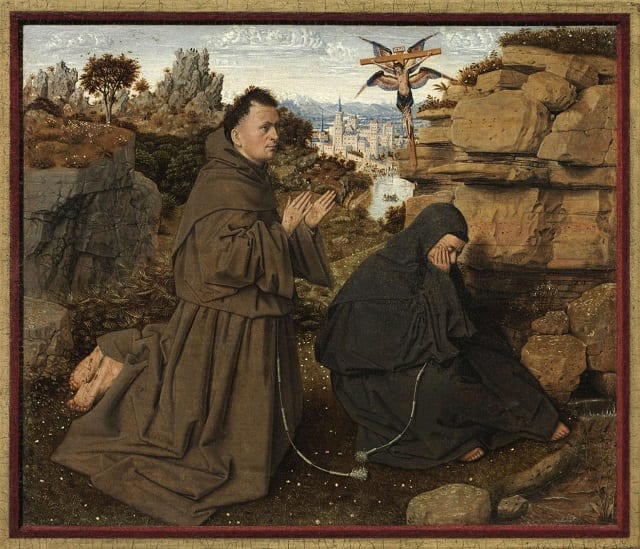
Photo credit: Saint Francis of Assisi Receiving the Stigmata, by Jan van Eyck (bet. 1430 and 1432) [Wikipedia / public domain]

***
Previous Post

October 9, 2019
St. John Henry Cardinal Newman: Articles & Books About Him
Next Post
October 10, 2019 C. S. Lewis & the Invocation & Communion of Saints
Browse Our Archives
Select a Category & Last Things About Me Anti-Catholicism Atheism & Agnosticism Baptism and Sacramentalism Bible and Tradition Blessed Virgin Mary Books by Dave Armstrong C. S. Lewis Calvinism & General Protestantism Catholic Apologetics Catholic Apologists Catholic conversion Catholic converts Christmas Church (Ecclesiology) Church History Conversion and Converts Development of Doctrine Eastern Orthodoxy Ecumenism & Christian Unity Eucharist & Liturgy Fathers of the Church French Translations G. K. Chesterton Hell Hell & Satan Hell & Satan & Last Things Heresies & Comparative Religion Holistic Health Inquisition & Crusades & Scandals James White Jews & Judaism & Old Testament John Calvin John Henry Newman Liberal / Modernist Theology Life Issues Literary Resume Lutheranism Mariology Martin Luther Music Orthodoxy Papacy & Infallibility Personal Page Philosophy & Science Political & Ethical & Moral Issues Protestant Persecution & Intolerance Protestantism Purgatory Purgatory & Penance Romantic & Imaginative Theology Saints & Purgatory & Penance Salvation Salvation & Justification Satan & Last Things Sexuality and Gender Issues Spanish Translations Traditionalism vs. Radical Catholic Reactionaries Traducciones al español / tradução para português Trinitarianism & Christology Uncategorized Videos
Select a Month October 2026 September 2026 August 2026 July 2026 June 2026 May 2026 April 2026 March 2026 February 2026 January 2026 December 2025 November 2025 October 2025 September 2025 August 2025 July 2025 June 2025 May 2025 April 2025 March 2025 February 2025 January 2025 December 2024 November 2024 October 2024 September 2024 August 2024 July 2024 June 2024 May 2024 April 2024 March 2024 February 2024 January 2024 December 2023 November 2023 October 2023 September 2023 August 2023 July 2023 June 2023 May 2023 April 2023 March 2023 February 2023 January 2023 December 2022 November 2022 October 2022 September 2022 August 2022 July 2022 June 2022 May 2022 April 2022 March 2022 February 2022 January 2022 December 2021 November 2021 October 2021 September 2021 August 2021 July 2021 June 2021 May 2021 April 2021 March 2021 February 2021 January 2021 December 2020 November 2020 October 2020 September 2020 August 2020 July 2020 June 2020 May 2020 April 2020 March 2020 February 2020 January 2020 December 2019 November 2019 October 2019 September 2019 August 2019 July 2019 June 2019 May 2019 April 2019 March 2019 February 2019 January 2019 December 2018 November 2018 October 2018 September 2018 August 2018 July 2018 June 2018 May 2018 April 2018 March 2018 February 2018 January 2018 December 2017 November 2017 October 2017 September 2017 August 2017 July 2017 June 2017 May 2017 April 2017 March 2017 February 2017 January 2017 December 2016 November 2016 October 2016 September 2016 August 2016 July 2016 June 2016 May 2016 April 2016 March 2016 February 2016 January 2016 December 2015 November 2015 October 2015 September 2015 August 2015 July 2015 June 2015 May 2015 April 2015 March 2015 February 2015 January 2015 December 2014 November 2014 October 2014 September 2014 August 2014 July 2014 June 2014 April 2014 March 2014 February 2014 January 2014 December 2013 November 2013 October 2013 September 2013 August 2013 July 2013 June 2013 April 2013 March 2013 February 2013 January 2013 December 2012 November 2012 October 2012 September 2012 August 2012 July 2012 June 2012 May 2012 April 2012 March 2012 February 2012 January 2012 December 2011 November 2011 October 2011 September 2011 August 2011 July 2011 June 2011 April 2011 March 2011 February 2011 October 2010 September 2010 August 2010 July 2010 April 2010 March 2010 December 2009 October 2009 August 2009 July 2009 June 2009 May 2009 March 2009 February 2009 October 2008 September 2008 April 2008 March 2008 February 2008 January 2008 December 2007 November 2007 October 2007 May 2007 March 2007 February 2007 January 2007 November 2006 October 2006 September 2006 August 2006 July 2006 June 2006 May 2006 April 2006 March 2006 February 2006 October 2005 June 2005 April 2005 February 2005 July 2004 May 2004 April 2004
Follow Us!
TAKE THE
Religious Wisdom Quiz
Who was Jacob's first wife?
Select your answer to see how you score.
Rachel Dinah Leah Rebekah
Books by This Author Books by Dave Armstrong
Related posts from Biblical Evidence for Catholicism

Dialogue on Eternal Security / Absolute Assurance
Biblical Evidence for Catholicism

God, Modern Physics, & Dark Energy: An Analogy
Biblical Evidence for Catholicism

General Debate on Christianity with an Atheist
Biblical Evidence for Catholicism

Can Atheists Be Saved? Surprising Biblical Data
Biblical Evidence for Catholicism
TRENDING AT PATHEOS Catholic

The Sermon on the Mount, Part I: Matthew...
The Sermon on the Mount, Part I (Matthew 4:12-5:12) St. Matthew moves...

What's up from Crossway: Reviewing some of their latest A few weeks...

Janie Learns the Way of the Cross: A...
Teaching children about Jesus' Passion can be challenging. Many parents and educators...

Looking For Good Catholic Writing - October 2026
He alone extends the heavens, and he walks upon the waves of...

In "Irreplaceable," our book on vocation and technology, Trevor Sutton and I...

I was strolling through the top floor of the brand new Parthenon...
view all Catholic blogs
Ad-Free & Subscriber Log-In Subscription Support
- About Us
- 2026 Calendar
- Videos
- Podcasts
- Library of World Religions
- Faith In Media Tracker
- Advertise With Us
- Write for Us
- Privacy Policy
- Terms of Service
- Do Not Sell My Data
- Contact Us
- Radiant Digital
- Manage Newsletter Subscriptions
- Unsubscribe From Notifications
- Sitemap
Copyright 2008-2026, Patheos. All rights reserved.
Subscription Support Ad-Free & Subscriber Log-In
Follow Patheos