
BuddhistCatholicContemplativeEvangelicalGeneral ChristianHinduJewishLatter-day SaintMuslimNew VisionsProgressive Christian
Beliefs
- Buddhist
- Catholic
- Contemplative
- Evangelical
- General Christian
- Hindu
- Jewish
- Latter-day Saint
- More Voices
- Muslim
- New Visions
- Pagan
- Progressive Christian
Topics
- Religion News
- Food and Religion
- Sports and Religion
- Religious Art
- Religious Music and Entertainment
- Religious Events
- History and Religion
- Style and Religion
- Politics and Religion
- Women in Religion
- Recreation Outdoors and Religion
- Business Finance and Religion
- Careers Workplace and Religion
- Education and Religion
- Family Parenting and Religion
- Health Fitness and Religion
- Home and Religion
- Relationships and Religion
- Technology and Religion
- Travel and Religion
Columnists
- Buddhist Columnists
- Business Finance and Religion Columnists
- Careers Workplace and Religion Columnists
- Catholic Columnists
- Contemplative Columnists
- Education and Religion Columnists
- Evangelists Columnists
- Family Parenting and Religion Columnists
- General Christian Columnists
- Health Fitness and Religion Columnists
- Hindu Columnists
- History and Religion Columnists
- Home and Religion Columnists
- Jewish Columnists
- More Voices Columnists
- Latter Day Columnists
- Muslim Columnists
- New Visions Columnists
- Nonreligious Columnists
- Pagan Columnists
- Politics and Religion Columnists
- Progressive Columnists
- Recreation Outdoors and Religion Columnists
- Relationships and Religion Columnists
- Religion News Columnists
- Religious Art Columnists
- Religious Events Columnists
- Religious Music and Entertainment Columnists
- Sports and Religion Columnists
- Style and Religion Columnists
- Technology and Religion Columnists
- Travel and Religion Columnists
- Women in Religion Columnists
Resource Library
- 2026 Calendar
- Library of World Religions
- The 100 Most Holy Places on Earth
- Patheos Answers
- Podcasts
- Videos
- Faith Leaders Database
- Anglican Episcopalian
- Bahai
- Baptist
- Buddhism
- Christianity
- Confucianism
- Eastern Orthodoxy
- Hinduism
- Holiness and Pentecostal
- ISKCON
- Islam
- Judaism
- Lutheran
- Methodist
- The Church of Jesus Christ of Latter-day Saints
- New Age
- Paganism
- Presbytarian and Reformed
- Protestantism
- Religion Behind the Scenes
- Roman Catholic
- Scientology
- Shia Islam
- Sikhism
- Sufism
- Sunni Islam
- Taoism
- Zen
- See all religions
Research Tools
 Ad-Free & Subscriber Log-In Subscription Support
Ad-Free & Subscriber Log-In Subscription Support
Follow Patheos 

- Trending:
- Forgiveness
- |
- Marriage
- |
- Consciousness
- |
- Death Penalty
- |
- Election
- |
- Halloween

-
About
-
Catholic Apologetics
-
Church History
-
Great Apologists
-
Christian Worldview
-
Protestantism & Misc.
- Home
- Catholic
- History and Religion
- Cardinal Newman’s Conversion Agonies: Jan. 1842 to Feb. 1844
Cardinal Newman’s Conversion Agonies: Jan. 1842 to Feb. 1844
Last updated on: October 10, 2019 at 11:14 am by Dave Armstrong
Cardinal Newman’s Conversion Agonies: Jan. 1842 to Feb. 1844 2019-10-10T11:14:42-04:00 Dave Armstrong
Patheos Explore the world's faith through different perspectives on religion and spirituality! Patheos has the views of the prevalent religions and spiritualities of the world.
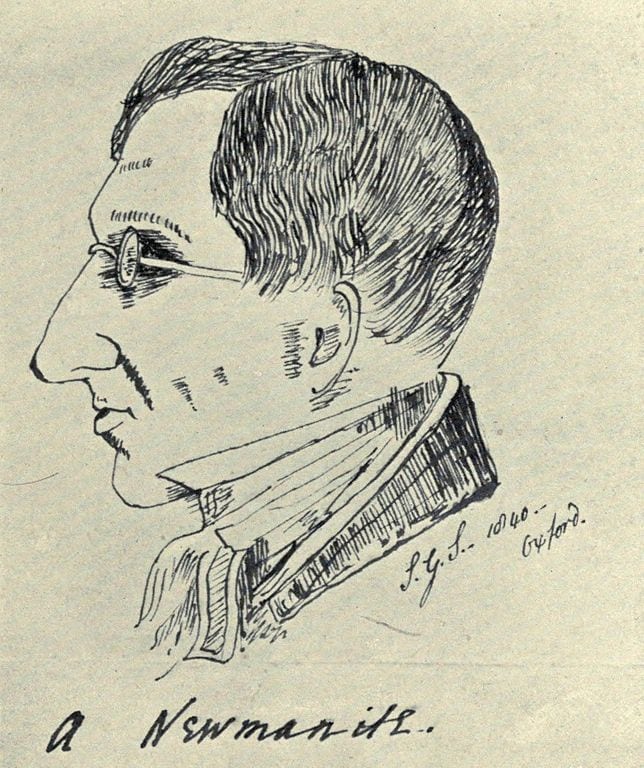
The simple case then, much as I grieve to say it, is this: – about two years and a half ago I began reading the Monophysite controversy, and with great concern and dismay found how much we were in the position of the Monophysites. I am not saying there is anything peculiar in their history, but merely that it put me into a new train of thought. After that I turned my mind to the Donatists, and there the same truth, or a parallel one, came out in the strongest colours. In the Monophysite history it is that the Church of Rome, in the Donatist that that body which spreads through the world, is always ipso facto right. I am not measuring my words as if I were arguing, but giving you my line of thought. Since then whatever line of early history I look into, I see as in a glass reflected our own Church in the heretical party, and the Roman Church in the Catholic. This is an appalling fact – which, do what I will, I cannot shake off. One special test of the heretical party is absence of stay or consistence, ever crumbling ever shifting, ever new forming – ever self consumed by internal strife. Our present state, half year by half year, the opposition of Bishop to Bishop, is a most miserable and continual fulfilment of this Note of error. . . . Another is a constant effort to make alliance with other heresies and schisms, though differing itself from them. . . . This has led me anxiously to look out for grounds of remaining where Providence has placed me . . . It has also forced me back upon the internal or personal Notes of the Church; and with thankfulness I say that I have received great comfort there. But, alas, in seeking to draw out this comfort for the benefit of others, who (without knowing my state) have been similarly distressed, eager inquisitive sensitive minds have taken the alarm, and (though I acted with the greatest anxiety and tried to do what I could to avoid the suspicion) they are beginning to guess that I have not an implicit faith in the validity of the external Notes of our Church. . . . One obvious consequence is to be mentioned besides – a growing dread lest in speaking against the Church of Rome I may be speaking against the Holy Ghost. This is quite consistent with a full conviction of the degraded state of that Church whether here or elsewhere. . . . my fears slept for very many months, and have only lately been re-animated by our dreadful divisions, the Bishops’ charges, and this Prussian affair, . . . You are the first person to whom I have drawn it out. . . . Of course this painful thought comes into my mind – whether, if Rome be the true Church, the divinely appointed method of raising her from her present degradation be not to join her. Whether either she or we can correct our mutual errors while separated from each other. (Letters & Diaries [as throughout], v. 8; To Robert I. Wilberforce, 26 Jan. 1842)
I wish to be guided not by controversy but by ethos – so that (please God) nothing would seem to me a reason for so very awful and dreadful a step as you point at, but the quiet growth of a feeling through many years. I may sincerely say that no one has exerted himself more than I have to make a case for the English Church and theory, from the Fathers – perhaps (following our divines) I have succeeded – but I mean that I have honestly set myself to it and spared no pains. I really think I have examined and replied to more objections than most people. I don’t think argument will help me. (v. 8; To Robert I. Wilberforce, 1 Feb. 1842)
I advise you to be very much on your guard about the approaching visit of Dr Wiseman. You may be committed before you know where you are. Do consider that you are about to be submitted to temptation; that is, the temptation of acting, not on judgment but on feeling. Your feelings are in favor of Rome, so are mine – your judgment is against joining it – so is mine. Yet I would not trust myself among R[oman] Catholics without recollecting how apt feeling is to get the better of judgment – and I warn you of the same. I remind you, as I should wish to remind myself, of the necessity of keeping a strict watch over yourself. (v. 9; To Miss Holmes, 8 Feb. 1843)
[W]hat influence I exert is simply and exactly, be it more or less, in the direction of the Church of Rome – and that whether I will or no – What men learn from me, who learn anything, is to lean towards doctrines and practices which our Church does not sanction. There was a time when I tried to balance this by strong statements against Rome, which I suppose to a certain extent effected my object. But now, when I feel I can do this no more, how greatly is the embarrassment of my position increased! I am in danger of acting as a traitor to that system, to which I must profess attachment . . . I am conscious too, as I have said above, that I am not advocating, that I am not promoting, the Anglican system of doctrine, but one very much more resembling in matter of fact, the doctrine of the Roman Church. (v. 9; To John Keble, 14 March 1843)
In June and July 1839, near four years ago, I read the Monophysite Controversy, and it made a deep impression on me, which I was not able to shake off, that the Pope bad a certain gift of infallibility, and that communion with the see of Rome was the divinely intended means of grace and illumination. I do not know how far I fully recognized this at the moment, – but towards the end of the same Long Vacation I considered attentively the Donatist history, and became quite excited. It broke upon me that we were in a state of schism. Since that [then], all history, particularly that of Arianism, has appeared to me in a new light, confirmatory of the same doctrine. In order to conquer this feeling, I wrote my article on the Catholicity of the English Church, as I have written other things since. For awhile my mind was quieted; but from that time to this the impression, though fading and reviving, has been on the whole becoming stronger and deeper. At present, I fear, as far as I can realize my own convictions, I consider the Roman Catholic Communion the Church of the Apostles, and that what grace is among us (which, through God’s mercy, is not little,) is extraordinary, and from the overflowings of His Dispensation. I am very far more sure that England is in schism, than that the Roman additions to the Primitive Creed may not be developments, arising out of a keen and vivid realizing of the Divine Depositum of faith. (v. 9; To John Keble, 4 May 1843)
If I have been very bold in nearing the Roman system, this has risen mainly from over-secure reliance on our position, and from a keen impression of our great need of what the Roman system contains. . . . my present feelings have arisen naturally and gradually, and have been resisted. (v. 9; To John Keble, 18 May 1843)
Do you know, though you need not say it, that I have taken to liking the Jesuits? (v. 9; To Henry Wilberforce, 9 June 1843)
There is no doubt at all that I am approximating towards Rome; nor any doubt that those who are very much about me see this, little as I wish it. (v. 9; To Mrs. William Froude, 28 July 1843)
The truth then is, I am not a good son enough of the Church of England, to feel I can in conscience hold preferment under her. I love the Church of Rome too well. (v. 9; To James P. Mozley, 1 Sep. 1843)
I do so despair of the Church of England, I am so evidently cast off by her, and, on the other hand[,] I am so drawn to the Church of Rome, that I think it safer, as a matter of honesty, not to keep my living. This is a very different thing from having any intention of joining the Church of Rome. . . . People cannot understand a state of doubt, of misgiving, of being unequal to responsibilities etc – but they will conclude either that you have a clear view one way or the other. All I know is, that I could not without hypocrisy profess myself any longer a teacher in and a champion of our Church. (v. 9; To [sister] Harriet Mozley, 29 Sep. 1843)
My present views were taken up in the summer of 1839 upon reading the Monophysite and Donatist controversies. I saw from them that Rome was the centre of unity and the judge of controversies. (v. 9; To [sister] Harriet Mozley, 2 Oct.? 1843)
I think the Church of Rome the Catholic Church, and ours not a part of the Catholic Church, because not in communion with Rome, and feel that I could not honestly be a teacher in it any longer. This conviction came upon me last summer four years. I mentioned it to two friends in the autumn of that year, 1839. And for a while I was in a state of excitement. It arose in the first instance from reading the Monophysite and Donatist controversies; in the former of which I was engaged in that course of theological study to which I had given myself. . . . that wretched Jerusalem Bishoprick affair, no personal matter, revived all my alarms. They have increased up to this moment. . . . the various ecclesiastical and quasi-ecclesiastical acts, which have taken place in the course of the last two years and a half, are not the cause of my state of opinion; but are keen stimulants and weighty confirmations of a conviction forced upon me, while engaged in the course of duty, viz the theological reading to which I have given myself. (v. 9; To Henry Edward Manning, 25 Oct. 1843)
The early Church has all along been my line of study – and I am still occupied upon it. For some time, I suppose, I shall be upon the ’the Arians’ and the second part of the volume of St Athanasius. It is this line of reading, and no other, which has led me Romeward. Not that I read it with that view. I wish to resist, as I always have – and think it a duty. I am sure, if it be right to go forward, I shall be forced on in spite of myself. . . . What I wish is, not to go by my own judgment, but by something external, like the pillar of the cloud in the desert. Such is the united movement of many. . . . If my thoughts have been led through the early Church to Rome why should not others? . . . I hope I am not wrong, – but I have lately been praying that ’if I am right, Pusey, Manning etc may be brought forward; but if Pusey, Manning etc are right, I may be brought back – that nothing, if it be possible may separate us.’ (v. 10; To John Keble, 23 Jan. 1844)
I am in no perplexity or anxiety at present. I fear that I must say that for four years and a half I have had a conviction, weaker or stronger, but on the whole constantly growing, and at present very strong, that we are not part of the Church. I am too much accustomed to this idea to feel pain at it. I could only feel pain, if I found it led me to action. At present I do not feel any such call. . . . It was the Monophysite and Donatist controversies which in 1839 led me to this clear and distinct judgment. (v. 10; To Edward B. Pusey, 19 Feb. 1844)
People kindly think that I have much to bear externally – disappointment, slander, etc., No, I have nothing to bear but the anxiety which I feel for my friends’ anxiety for me and [[their]] perplexity. (v. 10; To John William Bowden, 21 Feb. 1844)
***
Unfortunately, Money Trees Do Not Exist: If you have been aided in any way by my work, or think it is valuable and worthwhile, please strongly consider financially supporting it (even $10 / month — a mere 33 cents a day — would be very helpful). I have been a full-time Catholic apologist since Dec. 2001, and have been writing Christian apologetics since 1981 (see my Resume). My work has been proven (by God’s grace alone) to be fruitful, in terms of changing lives (see the tangible evidences from unsolicited “testimonies”). I have to pay my bills like all of you: and have a (homeschooling) wife and three children still at home to provide for, and a mortgage to pay.
My book royalties from three bestsellers in the field (published in 2003-2007) have been decreasing, as has my overall income, making it increasingly difficult to make ends meet. I provide over 2500 free articles here, for the purpose of your edification and education, and have written 50 books. It’ll literally be a struggle to survive financially until Dec. 2020, when both my wife and I will start receiving Social Security. If you cannot contribute, I ask for your prayers. Thanks! See my information on how to donate (including 100% tax-deductible donations). It’s very simple to contribute to my apostolate via PayPal, if a tax deduction is not needed (my “business name” there is called “Catholic Used Book Service,” from my old bookselling days 17 or so years ago). May God abundantly bless you.
***
blessed john henry Cardinal newman
conversion of john henry newman
St. John Henry Cardinal Newman
Previous Post
October 10, 2019
C. S. Lewis & the Invocation & Communion of Saints
Next Post
October 10, 2019 C. S. Lewis Believed in the Sacrament of Confirmation
Browse Our Archives
Select a Category & Last Things About Me Anti-Catholicism Atheism & Agnosticism Baptism and Sacramentalism Bible and Tradition Blessed Virgin Mary Books by Dave Armstrong C. S. Lewis Calvinism & General Protestantism Catholic Apologetics Catholic Apologists Catholic conversion Catholic converts Christmas Church (Ecclesiology) Church History Conversion and Converts Development of Doctrine Eastern Orthodoxy Ecumenism & Christian Unity Eucharist & Liturgy Fathers of the Church French Translations G. K. Chesterton Hell Hell & Satan Hell & Satan & Last Things Heresies & Comparative Religion Holistic Health Inquisition & Crusades & Scandals James White Jews & Judaism & Old Testament John Calvin John Henry Newman Liberal / Modernist Theology Life Issues Literary Resume Lutheranism Mariology Martin Luther Music Orthodoxy Papacy & Infallibility Personal Page Philosophy & Science Political & Ethical & Moral Issues Protestant Persecution & Intolerance Protestantism Purgatory Purgatory & Penance Romantic & Imaginative Theology Saints & Purgatory & Penance Salvation Salvation & Justification Satan & Last Things Sexuality and Gender Issues Spanish Translations Traditionalism vs. Radical Catholic Reactionaries Traducciones al español / tradução para português Trinitarianism & Christology Uncategorized Videos
Select a Month October 2026 September 2026 August 2026 July 2026 June 2026 May 2026 April 2026 March 2026 February 2026 January 2026 December 2025 November 2025 October 2025 September 2025 August 2025 July 2025 June 2025 May 2025 April 2025 March 2025 February 2025 January 2025 December 2024 November 2024 October 2024 September 2024 August 2024 July 2024 June 2024 May 2024 April 2024 March 2024 February 2024 January 2024 December 2023 November 2023 October 2023 September 2023 August 2023 July 2023 June 2023 May 2023 April 2023 March 2023 February 2023 January 2023 December 2022 November 2022 October 2022 September 2022 August 2022 July 2022 June 2022 May 2022 April 2022 March 2022 February 2022 January 2022 December 2021 November 2021 October 2021 September 2021 August 2021 July 2021 June 2021 May 2021 April 2021 March 2021 February 2021 January 2021 December 2020 November 2020 October 2020 September 2020 August 2020 July 2020 June 2020 May 2020 April 2020 March 2020 February 2020 January 2020 December 2019 November 2019 October 2019 September 2019 August 2019 July 2019 June 2019 May 2019 April 2019 March 2019 February 2019 January 2019 December 2018 November 2018 October 2018 September 2018 August 2018 July 2018 June 2018 May 2018 April 2018 March 2018 February 2018 January 2018 December 2017 November 2017 October 2017 September 2017 August 2017 July 2017 June 2017 May 2017 April 2017 March 2017 February 2017 January 2017 December 2016 November 2016 October 2016 September 2016 August 2016 July 2016 June 2016 May 2016 April 2016 March 2016 February 2016 January 2016 December 2015 November 2015 October 2015 September 2015 August 2015 July 2015 June 2015 May 2015 April 2015 March 2015 February 2015 January 2015 December 2014 November 2014 October 2014 September 2014 August 2014 July 2014 June 2014 April 2014 March 2014 February 2014 January 2014 December 2013 November 2013 October 2013 September 2013 August 2013 July 2013 June 2013 April 2013 March 2013 February 2013 January 2013 December 2012 November 2012 October 2012 September 2012 August 2012 July 2012 June 2012 May 2012 April 2012 March 2012 February 2012 January 2012 December 2011 November 2011 October 2011 September 2011 August 2011 July 2011 June 2011 April 2011 March 2011 February 2011 October 2010 September 2010 August 2010 July 2010 April 2010 March 2010 December 2009 October 2009 August 2009 July 2009 June 2009 May 2009 March 2009 February 2009 October 2008 September 2008 April 2008 March 2008 February 2008 January 2008 December 2007 November 2007 October 2007 May 2007 March 2007 February 2007 January 2007 November 2006 October 2006 September 2006 August 2006 July 2006 June 2006 May 2006 April 2006 March 2006 February 2006 October 2005 June 2005 April 2005 February 2005 July 2004 May 2004 April 2004
Follow Us!
TAKE THE
Religious Wisdom Quiz
What was Paul’s profession before becoming an apostle?
Select your answer to see how you score.
Tentmaker Tax Collector Fisherman Carpenter
Books by This Author Books by Dave Armstrong
Related posts from Biblical Evidence for Catholicism

On Protestant Explanations of Catholic Conversion
Biblical Evidence for Catholicism

C. S. Lewis: More Evidences of Anti-Catholic Prejudice
Biblical Evidence for Catholicism
15 "Roman Catholic" Views of C. S. Lewis
Biblical Evidence for Catholicism

C. S. Lewis On Why He Never Became...
Biblical Evidence for Catholicism
TRENDING AT PATHEOS Catholic

I was strolling through the top floor of the brand new Parthenon...

What Does Gêvâh Mean For Kimberley Guifoyle &...
This week, a lot of the news is focused on Kimberly Guilfoyle....

INNER CIRCLE: Profound Mystery (Of Christ In All...
Ephesians 5:31-32 “For this reason, a man will leave his father and...

Do Not Rejoice When Your Enemy Falls: The...
Turning an execution into a public spectacle is a disturbing expression of...

'The Chosen' S6 Trailer: The Passion Gets Very...
Not many watching 'The Chosen' worry about spoilers, but just because they...

The purpose-driven labor priest
A labor activist reads Rick Warren and it gets me wondering about...
view all Catholic blogs
Ad-Free & Subscriber Log-In Subscription Support
- About Us
- 2026 Calendar
- Videos
- Podcasts
- Library of World Religions
- Faith In Media Tracker
- Advertise With Us
- Write for Us
- Privacy Policy
- Terms of Service
- Do Not Sell My Data
- Contact Us
- Radiant Digital
- Manage Newsletter Subscriptions
- Unsubscribe From Notifications
- Sitemap
Copyright 2008-2026, Patheos. All rights reserved.
Subscription Support Ad-Free & Subscriber Log-In
Follow Patheos