
BuddhistCatholicContemplativeEvangelicalGeneral ChristianHinduJewishLatter-day SaintMuslimNew VisionsProgressive Christian
Beliefs
- Buddhist
- Catholic
- Contemplative
- Evangelical
- General Christian
- Hindu
- Jewish
- Latter-day Saint
- More Voices
- Muslim
- New Visions
- Pagan
- Progressive Christian
Topics
- Religion News
- Food and Religion
- Sports and Religion
- Religious Art
- Religious Music and Entertainment
- Religious Events
- History and Religion
- Style and Religion
- Politics and Religion
- Women in Religion
- Recreation Outdoors and Religion
- Business Finance and Religion
- Careers Workplace and Religion
- Education and Religion
- Family Parenting and Religion
- Health Fitness and Religion
- Home and Religion
- Relationships and Religion
- Technology and Religion
- Travel and Religion
Columnists
- Buddhist Columnists
- Business Finance and Religion Columnists
- Careers Workplace and Religion Columnists
- Catholic Columnists
- Contemplative Columnists
- Education and Religion Columnists
- Evangelists Columnists
- Family Parenting and Religion Columnists
- General Christian Columnists
- Health Fitness and Religion Columnists
- Hindu Columnists
- History and Religion Columnists
- Home and Religion Columnists
- Jewish Columnists
- More Voices Columnists
- Latter Day Columnists
- Muslim Columnists
- New Visions Columnists
- Nonreligious Columnists
- Pagan Columnists
- Politics and Religion Columnists
- Progressive Columnists
- Recreation Outdoors and Religion Columnists
- Relationships and Religion Columnists
- Religion News Columnists
- Religious Art Columnists
- Religious Events Columnists
- Religious Music and Entertainment Columnists
- Sports and Religion Columnists
- Style and Religion Columnists
- Technology and Religion Columnists
- Travel and Religion Columnists
- Women in Religion Columnists
Resource Library
- 2026 Calendar
- Library of World Religions
- The 100 Most Holy Places on Earth
- Patheos Answers
- Podcasts
- Videos
- Faith Leaders Database
- Anglican Episcopalian
- Bahai
- Baptist
- Buddhism
- Christianity
- Confucianism
- Eastern Orthodoxy
- Hinduism
- Holiness and Pentecostal
- ISKCON
- Islam
- Judaism
- Lutheran
- Methodist
- The Church of Jesus Christ of Latter-day Saints
- New Age
- Paganism
- Presbytarian and Reformed
- Protestantism
- Religion Behind the Scenes
- Roman Catholic
- Scientology
- Shia Islam
- Sikhism
- Sufism
- Sunni Islam
- Taoism
- Zen
- See all religions
Research Tools
 Ad-Free & Subscriber Log-In Subscription Support
Ad-Free & Subscriber Log-In Subscription Support
Follow Patheos 

- Trending:
- Forgiveness
- |
- Marriage
- |
- Consciousness
- |
- Death Penalty
- |
- Election
- |
- Halloween

-
About
-
Catholic Apologetics
-
Church History
-
Great Apologists
-
Christian Worldview
-
Protestantism & Misc.
- Home
- Catholic
- History and Religion
- Biblical “Truth” (vs. “Primary & Secondary” Doctrines)
Biblical “Truth” (vs. “Primary & Secondary” Doctrines)
Last updated on: October 21, 2019 at 12:06 pm by Dave Armstrong
Biblical “Truth” (vs. “Primary & Secondary” Doctrines) 2019-10-21T12:06:53-04:00 Dave Armstrong
Patheos Explore the world's faith through different perspectives on religion and spirituality! Patheos has the views of the prevalent religions and spiritualities of the world.
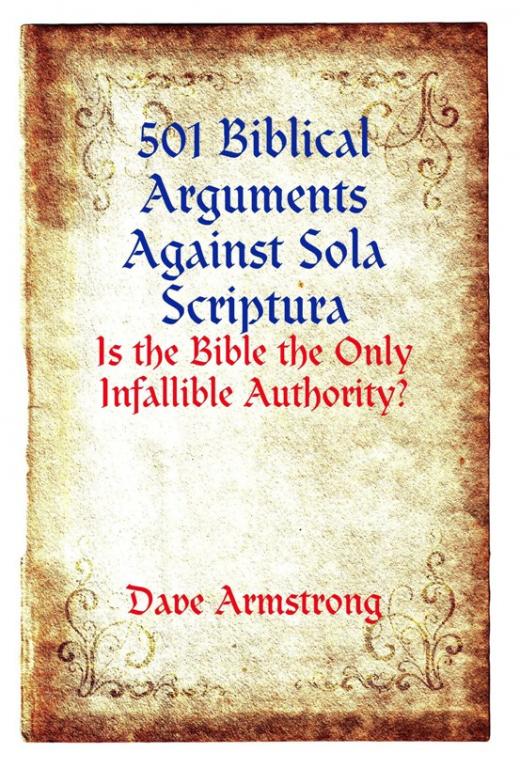
The following material is a remnant of my discontinued book, 501 Biblical Arguments Against Sola Scriptura (Lulu: Jan. 2009): which was revised and published as 100 Biblical Arguments Against Sola Scriptura (San Diego: Catholic Answers Press, May 2012).
The newer book is of a completely different structure, with the best arguments modified, improved, and honed down to get the best “meat” of the various arguments against sola Scriptura. It also contains several sections that are brand-new.
The older book was a compilation in the style of Blaise Pascal’s Pensées (“thoughts”): short arguments or just observations, piled one on another. Oftentimes, an “argument” was only one sentence, and it had too much repetition, because it was compiled from many of my existing writings (from previous books or from the Internet).
To use an analogy: the original book was like a rehearsal of a band, with all kinds of “jams” and musical ideas or fragments, but a lot less structure. The new book is like the musical album that results from sessions: carefully produced to present to the public as a finished product.
In any event, some material of worth from the first book didn’t make it into the second. This chapter compiles a bit of that (ones not included in previous books of mine).
*****
1) What does the Protestant tell the man on the street who is looking for spiritual and theological truth: “we can’t give you any certainty, but at least we’re not Catholic”?
2) People over time then tend to consider the doctrines that are highly disputed to be relatively unimportant, whereas from a biblical point of view, all spiritual and theological truth is important.
3) One has the burden of finding the “most true church” within Protestantism or else succumbing to doctrinal indifferentism and de facto relativism, as millions of Protestants do, because their system is of little use in leading them to theological certainty in faith.
4) God likes truth and certainty. He wants us to have it: the certitude of faith. Yet Protestants would have us believe that no such thing is possible, and it is almost an obsession lately with Protestants, that uncertainty and de facto theological relativism is fashionable, trendy; even desirable. Christianity is not a perpetual quest after theological truth. We ought to be questing after righteousness, not theology, our entire lives.
5) Protestants, in effect, if not literally, don’t have enough faith to believe that God could or would preserve His truth without error, in any institution of men: even if such an institution believes itself to be identifiable as the “Christian Church.” Most Protestants, if they think about it long enough, conclude that all of this is implausible and that it is beyond the realm of possibility. They assume this at the outset, without argument, as a self-evident truth.
6) Many Protestants are unable to accept Catholic authority in faith, based on Scripture and historical evidences, and so are left with the thoroughly unacceptable and unbiblical “alternative” of doctrinal relativism and no chance of finding one theological Truth or Church. This odd state of affairs doesn’t even comply with how Luther and Calvin and the original Protestants conceived of themselves. It’s a postmodernist corruption of historic or “classic, Reformation” Protestantism.
7) Protestants today often claim that no Christian tradition can reasonably claim apostolic succession, indefectibility, infallibility, or a self-consistency throughout Church history. This is standard Protestantism in the sense that it denies the existence of any infallible Church. But on the other hand, the early Protestants did still claim that each of their traditions was truer than the other ones (else why should they exist at all?). It was the claim to theological truth that largely drove these “reformers” to do what they did, for better or ill.
8) Liberals (both political and theological) and secularists speak of “diversity,” etc., because in their mind that bolsters their false opinions that no truth can be found, or that all opinions are on an equal plane and equally valid, because they are subjective to the person rather than objective. Cultural diversity is great. But in matters of theology, it seems utterly clear in the Bible that God wants the Church to be completely unified. Truth can be known. The Church can declare on what is true and what is not. But once one eliminates an infallible Church, then no one can definitely resolve the conflicts.
9) I disagree that everyone must have an outlook of skepticism, no matter what type of Christian they are. Rather, I contend that we should all seek Christian truth and not despair that it can never be found because of human foibles and follies. And I refuse accept the fashionable notion that anyone confident in his tradition as the best or fullest Christian tradition must inevitably be “triumphalistic”. I suppose that is how it will always look to someone less confident in his or her own position, but what can one say? Religious truth is no less able to be found (nor less important) than scientific or historical truths. Why must we be so pessimistic about it?
10) Is it always “presumptuous” to dare to have a belief in an authoritative Church and to not be so fashionably uncertain that we garner respect from many for being “nuanced” and “sophisticated” and so on, because we haven’t figured out the answer to the question, and come to believe that no answer can possibly be obtained? If not, then I wish critics of the Catholic Church would please provide a “non-presumptuous” example of a defense of Catholic ecclesiology. Is such skepticism and agnosticism on ecclesiology the default position of Protestantism?
11) Many Protestants are reduced to embracing a counsel of despair: the very opposite of a hopeful, sunny biblical faith. In this mentality, one cannot find the one true Church of Scripture. It’s futile to even try. God is not able to preserve one truth or lead His followers to it. Many Protestants no longer think it is even possible to find and believe in one Christian truth (it is viewed as a “romantic” and childlike notion). This was not at all true of the original Protestant “Reformers” (Luther, Calvin et al), but it has been the sadly predictable outcome of a wild proliferation of contradictory beliefs.
12) It is exceedingly strange for many Protestants to essentially relegate the Eucharist to relativism and relative insignificance, when our Lord Himself made it a point of division. John 6:66 tells us of “many of his disciples” forsaking Him. Now, if the Eucharist were just minutiae on the grand scale of matters theological, why didn’t Jesus beg and plead with these people to stay? If the Protestant view is correct, it seems reasonable that Jesus should then have said, “Hey, don’t go: this isn’t a matter which should divide us. We agree that I am God. Who cares about what happens in the central act of Christian worship!?” And we know also that Jesus said “unless you eat the flesh of the Son of Man and drink his blood, you have no life in you” (Jn 6:53). But that’s “secondary”; “non-essential”? I can’t give my assent to such an incoherent and manifestly unbiblical viewpoint.
13) It is my contention that God wants to provide His people with doctrinal certainty and not confusion. Protestants deliberately chose private judgment and the primacy of abstract ideals over concrete, institutional unity and infallible received truths (via apostolic succession). Their mistake and naivete was the belief that abstract principles would lead to unity. Every decent Christian (Protestant) would inevitably arrive at the truths expounded upon by a self-proclaimed Protestant authority (Luther, Calvin, Zwingli, the Anabaptists, English “Reformers” et al). We all know what it in fact led to. Lots of decent, equally committed Christian men came to all kinds of conclusions that were contradictory. Thus, the Church was divided against itself. God didn’t want that. Scripture gives no indication whatsoever of any notion of competing denominations and Christian “pseudo-truths.”
14) Protestants, since they can’t figure out theological truth once and for all, and must fight interminably, have to necessarily take a pessimistic view of things. So analogies from the Old Testament must needs be pessimistic. Therefore, they look at the corruption and all the nonsense that went on in ancient Israel, conclude that authoritative teachers are not to be had, and say that therefore, the chaos in Protestantism is justified because that is how it has always been. And so the individual is thrown upon himself as his own authority (a spectacle every bit as horrifying — if not more so — as having to weed through 17 false prophets to get to a true one). It’s as if there is no Holy Spirit, no further guidance, no death of Jesus on the cross (in terms of making a difference as to men’s ascertaining of truth); no apostolic deposit that we can know and identify, and no succession so that folks could identify the one Church with the one faith. We don’t say that the age of the Church is no more advanced than all the tragic Jewish history. No; the Christian has faith that because Jesus died and made it possible to obtain the graces of baptism and the Eucharist, and to be indwelt by the Holy Spirit, therefore, now we can know what Christian truth is. Paul certainly presupposes this in his writing, constantly referring nonchalantly (as if it were self-evident) to the one true tradition, received, and passed along.
15) The Catholic believes in faith that the Catholic Church was founded by Christ, and we believe that one can trace the Church back to apostolic times in unbroken historical succession. Apart from this faith aspect, the Catholic claims that our view of ecclesiology and theology is backed up by both history and the Bible, as well as reason. I would argue (among many other things) the fact that the Bible teaches one true Church, as evidenced by the early Protestant internal divisions. In the early days, they still believed that each school was the one, and the true Church in some sense. There was a visible structure (e.g., Calvin’s Geneva, or the Lutheran princes, who took over from the bishops). They believed in one church and one truth, however they may have defined it. Today’s Protestants, however, are much less concerned with that and oftentimes become literally ecclesiological relativists, where church affiliation comes down to worship styles, a good choir, a pastor who gives “meaty” or heart-stirring sermons, etc.). I exaggerate a little to make a point. This is how many people choose where to go to church: not by a long study and comparison of competing doctrines or reading apologetics. I know many Protestants detest this as I do, but it still exists and is a problem. And it comes from the extreme application of the principle of “private judgment”.
16) It’s almost as if there is a “cult of uncertainty” today in some Protestant circles. It is fashionable and tolerant (and all the other buzzwords) to be uncertain, so that one is not perceived as “triumphalistic” and closed-minded and “rigidly orthodox” or “fundamentalist.” Many folks seem to have a hard time with any claims of religious certainty. Why is it that religious truths are placed (more and more today) in a category of radical uncertainty? This is itself not a traditional Christian outlook. It is, at bottom (in my hopefully humble opinion), a post-Enlightenment skeptical, hyper-rationalistic viewpoint. And so those of this bent view folks who claim more certainty (people like Catholics, who have a very firm faith) as somehow psychologically troubled; faced with an unbalanced, abnormal need for certainty which cannot be attained in this world. This is reminiscent of a famous atheist retort to all of Christianity: the “psychological crutch” and infantile need for a father figure and spoon-fed truth, in order to face the day and the world with an illusory framework of (supposedly) objective truth to fall back on. That’s what many atheists think about all or virtually all Christians, yet now I see this same kind of mentality applied by Protestant Christians who feel less certain about doctrine to those of us who claim relatively greater certainty in faith. Now fellow Christians are making analyses that only atheists would have made, for the most part, say, 100 years ago. I find that equal parts fascinating and tragic.
17) I don’t see anywhere indicated in Holy Scripture that only some can know the whole truth of Christian doctrine, or that no one can, or that there are competing schools that contradict each other, rather than one unified Church, or that doctrinal dissensions and disagreements are to be expected and tolerated, let alone praised and glorified as open-mindedness or the status quo, etc. Jesus and the Bible writers (St. John and St. Paul above all) all assume that there is one truth (“the truth”), one tradition, one doctrine: that can be known with God’s help, and the Church’s guidance:
Luke 1:4 (RSV) that you may know the truth concerning the things of which you have been informed.
John 1:17 For the law was given through Moses; grace and truth came through Jesus Christ.
John 4:23 But the hour is coming, and now is, when the true worshipers will worship the Father in spirit and truth, for such the Father seeks to worship him. (cf. 8:31-32)
John 15:26 But when the Counselor comes, whom I shall send to you from the Father, even the Spirit of truth, who proceeds from the Father, he will bear witness to me; (cf. 14:6; 16:13; 17:17-19)
John 18:37 . . . For this I was born, and for this I have come into the world, to bear witness to the truth. Every one who is of the truth hears my voice.”
John 19:35 He who saw it has borne witness — his testimony is true, and he knows that he tells the truth — that you also may believe.
Romans 9:1 I am speaking the truth in Christ, I am not lying; my conscience bears me witness in the Holy Spirit,
1 Corinthians 2:13 And we impart this in words not taught by human wisdom but taught by the Spirit, interpreting spiritual truths to those who possess the Spirit. (cf. 2 Cor 13:8)
Galatians 5:7 You were running well; who hindered you from obeying the truth?
Ephesians 1:13 In him you also, who have heard the word of truth, the gospel of your salvation, and have believed in him, were sealed with the promised Holy Spirit,
Ephesians 4:25 Therefore, putting away falsehood, let every one speak the truth with his neighbor, for we are members one of another.
Ephesians 5:9 (for the fruit of light is found in all that is good and right and true), (cf. 6:14)
Philippians 4:8 Finally, brethren, whatever is true, whatever is honorable, whatever is just, whatever is pure, whatever is lovely, whatever is gracious, if there is any excellence, if there is anything worthy of praise, think about these things.
Colossians 1:3-10 We always thank God, the Father of our Lord Jesus Christ, when we pray for you, because we have heard of your faith in Christ Jesus and of the love which you have for all the saints, because of the hope laid up for you in heaven. Of this you have heard before in the word of the truth, the gospel which has come to you, as indeed in the whole world it is bearing fruit and growing — so among yourselves, from the day you heard and understood the grace of God in truth, as you learned it from Ep’aphras our beloved fellow servant. He is a faithful minister of Christ on our behalf and has made known to us your love in the Spirit. And so, from the day we heard of it, we have not ceased to pray for you, asking that you may be filled with the knowledge of his will in all spiritual wisdom and understanding, to lead a life worthy of the Lord, fully pleasing to him, bearing fruit in every good work and increasing in the knowledge of God.
1 Timothy 2:4 who desires all men to be saved and to come to the knowledge of the truth.
1 Timothy 3:15 if I am delayed, you may know how one ought to behave in the household of God, which is the church of the living God, the pillar and bulwark of the truth.
1 Timothy 4:3 . . . those who believe and know the truth.
2 Timothy 2:25 God may perhaps grant that they will repent and come to know the truth, (cf. 1:14; 3:7-8)
2 Timothy 4:4 and will turn away from listening to the truth and wander into myths.
Titus 1:1 Paul, a servant of God and an apostle of Jesus Christ, to further the faith of God’s elect and their knowledge of the truth which accords with godliness,
Titus 1:14 instead of giving heed to Jewish myths or to commands of men who reject the truth.
Hebrews 10:26 . . . the knowledge of the truth, . . .
James 5:19 My brethren, if any one among you wanders from the truth and some one brings him back,
2 Peter 1:12 Therefore I intend always to remind you of these things, though you know them and are established in the truth that you have. (cf. 1 Pet 1:22)
1 John 2:27 but the anointing which you received from him abides in you, and you have no need that any one should teach you; as his anointing teaches you about everything, and is true, and is no lie, just as it has taught you, abide in him. (cf. 2:21)
1 John 3:19 By this we shall know that we are of the truth, and reassure our hearts before him. (cf. 4:6)
1 John 5:7 And the Spirit is the witness, because the Spirit is the truth.
2 John 1:1-2 The elder to the elect lady and her children, whom I love in the truth, and not only I but also all who know the truth, because of the truth which abides in us and will be with us for ever:
3 John 1:3-4 For I greatly rejoiced when some of the brethren arrived and testified to the truth of your life, as indeed you do follow the truth. No greater joy can I have than this, to hear that my children follow the truth.
3 John 1:12 Deme’trius has testimony from every one, and from the truth itself; I testify to him too, and you know my testimony is true.
***
Related Reading:
Bible vs. Denominationalism and Against “Primary / Secondary” Doctrines [8-18-06]
“Reply to Calvin” #4: “Primary” & “Secondary” Doctrines [4-3-17]
***
Unfortunately, Money Trees Do Not Exist: If you have been aided in any way by my work, or think it is valuable and worthwhile, please strongly consider financially supporting it (even $10 / month — a mere 33 cents a day — would be very helpful). I have been a full-time Catholic apologist since Dec. 2001, and have been writing Christian apologetics since 1981 (see my Resume). My work has been proven (by God’s grace alone) to be fruitful, in terms of changing lives (see the tangible evidences from unsolicited “testimonies”). I have to pay my bills like all of you: and have a (homeschooling) wife and three children still at home to provide for, and a mortgage to pay.
*
My book royalties from three bestsellers in the field (published in 2003-2007) have been decreasing, as has my overall income, making it increasingly difficult to make ends meet. I provide over 2500 free articles here, for the purpose of your edification and education, and have written 50 books. It’ll literally be a struggle to survive financially until Dec. 2020, when both my wife and I will start receiving Social Security. If you cannot contribute, I ask for your prayers. Thanks! See my information on how to donate (including 100% tax-deductible donations). It’s very simple to contribute to my apostolate via PayPal, if a tax deduction is not needed (my “business name” there is called “Catholic Used Book Service,” from my old bookselling days 17 or so years ago, but send to my email: [email protected]). May God abundantly bless you.
***
Previous Post
October 21, 2019
C. S. Lewis: A Life of Extraordinary Charity & Selflessness
Next Post

October 22, 2019 C. S. Lewis on Ubiquitous Media Bias & Incompetence
Browse Our Archives
Select a Category & Last Things About Me Anti-Catholicism Atheism & Agnosticism Baptism and Sacramentalism Bible and Tradition Blessed Virgin Mary Books by Dave Armstrong C. S. Lewis Calvinism & General Protestantism Catholic Apologetics Catholic Apologists Catholic conversion Catholic converts Christmas Church (Ecclesiology) Church History Conversion and Converts Development of Doctrine Eastern Orthodoxy Ecumenism & Christian Unity Eucharist & Liturgy Fathers of the Church French Translations G. K. Chesterton Hell Hell & Satan Hell & Satan & Last Things Heresies & Comparative Religion Holistic Health Inquisition & Crusades & Scandals James White Jews & Judaism & Old Testament John Calvin John Henry Newman Liberal / Modernist Theology Life Issues Literary Resume Lutheranism Mariology Martin Luther Music Orthodoxy Papacy & Infallibility Personal Page Philosophy & Science Political & Ethical & Moral Issues Protestant Persecution & Intolerance Protestantism Purgatory Purgatory & Penance Romantic & Imaginative Theology Saints & Purgatory & Penance Salvation Salvation & Justification Satan & Last Things Sexuality and Gender Issues Spanish Translations Traditionalism vs. Radical Catholic Reactionaries Traducciones al español / tradução para português Trinitarianism & Christology Uncategorized Videos
Select a Month October 2026 September 2026 August 2026 July 2026 June 2026 May 2026 April 2026 March 2026 February 2026 January 2026 December 2025 November 2025 October 2025 September 2025 August 2025 July 2025 June 2025 May 2025 April 2025 March 2025 February 2025 January 2025 December 2024 November 2024 October 2024 September 2024 August 2024 July 2024 June 2024 May 2024 April 2024 March 2024 February 2024 January 2024 December 2023 November 2023 October 2023 September 2023 August 2023 July 2023 June 2023 May 2023 April 2023 March 2023 February 2023 January 2023 December 2022 November 2022 October 2022 September 2022 August 2022 July 2022 June 2022 May 2022 April 2022 March 2022 February 2022 January 2022 December 2021 November 2021 October 2021 September 2021 August 2021 July 2021 June 2021 May 2021 April 2021 March 2021 February 2021 January 2021 December 2020 November 2020 October 2020 September 2020 August 2020 July 2020 June 2020 May 2020 April 2020 March 2020 February 2020 January 2020 December 2019 November 2019 October 2019 September 2019 August 2019 July 2019 June 2019 May 2019 April 2019 March 2019 February 2019 January 2019 December 2018 November 2018 October 2018 September 2018 August 2018 July 2018 June 2018 May 2018 April 2018 March 2018 February 2018 January 2018 December 2017 November 2017 October 2017 September 2017 August 2017 July 2017 June 2017 May 2017 April 2017 March 2017 February 2017 January 2017 December 2016 November 2016 October 2016 September 2016 August 2016 July 2016 June 2016 May 2016 April 2016 March 2016 February 2016 January 2016 December 2015 November 2015 October 2015 September 2015 August 2015 July 2015 June 2015 May 2015 April 2015 March 2015 February 2015 January 2015 December 2014 November 2014 October 2014 September 2014 August 2014 July 2014 June 2014 April 2014 March 2014 February 2014 January 2014 December 2013 November 2013 October 2013 September 2013 August 2013 July 2013 June 2013 April 2013 March 2013 February 2013 January 2013 December 2012 November 2012 October 2012 September 2012 August 2012 July 2012 June 2012 May 2012 April 2012 March 2012 February 2012 January 2012 December 2011 November 2011 October 2011 September 2011 August 2011 July 2011 June 2011 April 2011 March 2011 February 2011 October 2010 September 2010 August 2010 July 2010 April 2010 March 2010 December 2009 October 2009 August 2009 July 2009 June 2009 May 2009 March 2009 February 2009 October 2008 September 2008 April 2008 March 2008 February 2008 January 2008 December 2007 November 2007 October 2007 May 2007 March 2007 February 2007 January 2007 November 2006 October 2006 September 2006 August 2006 July 2006 June 2006 May 2006 April 2006 March 2006 February 2006 October 2005 June 2005 April 2005 February 2005 July 2004 May 2004 April 2004
Follow Us!
TAKE THE
Religious Wisdom Quiz
Who succeeded Moses as the leader of Israel?
Select your answer to see how you score.
Caleb Samuel Aaron Joshua
Books by This Author Books by Dave Armstrong
Related posts from Biblical Evidence for Catholicism

On Protestant Explanations of Catholic Conversion
Biblical Evidence for Catholicism

Jesus Founded the [Catholic] Church. If Not Him,...
Biblical Evidence for Catholicism

A Few "Worst" & "Best" Arguments vs. Protestantism
Biblical Evidence for Catholicism

Jerusalem Council vs. James White & Sola Scriptura
Biblical Evidence for Catholicism
TRENDING AT PATHEOS Catholic

Methodist Central Hall and Westminster Abbey
Situated on the same square is Methodist Central Hall and Westminster Abbey. ...

57th Dove Awards Honor Dolly Parton, Crown New...
On gospel music’s biggest night, the 57th annual GMA Dove Awards honored...

The First Eucharistic Controversy: Christ’s Real Presence
For Catholics, the Eucharist is the source and summit of the Christian...

What a Stop Sign Can Teach Us About...
How to Make a Decision When You Can't Hear God Main point:...

Archdiocese Hosts Military Marriage Retreat in Germany
RASTATT, Germany — The transient military lifestyle, with its frequent deployments and...

Nearly every morning, I make the drive to Detroit with my high-school-age...
view all Catholic blogs
Ad-Free & Subscriber Log-In Subscription Support
- About Us
- 2026 Calendar
- Videos
- Podcasts
- Library of World Religions
- Faith In Media Tracker
- Advertise With Us
- Write for Us
- Privacy Policy
- Terms of Service
- Do Not Sell My Data
- Contact Us
- Radiant Digital
- Manage Newsletter Subscriptions
- Unsubscribe From Notifications
- Sitemap
Copyright 2008-2026, Patheos. All rights reserved.
Subscription Support Ad-Free & Subscriber Log-In
Follow Patheos