
BuddhistCatholicContemplativeEvangelicalGeneral ChristianHinduJewishLatter-day SaintMuslimNew VisionsProgressive Christian
Beliefs
- Buddhist
- Catholic
- Contemplative
- Evangelical
- General Christian
- Hindu
- Jewish
- Latter-day Saint
- More Voices
- Muslim
- New Visions
- Pagan
- Progressive Christian
Topics
- Religion News
- Food and Religion
- Sports and Religion
- Religious Art
- Religious Music and Entertainment
- Religious Events
- History and Religion
- Style and Religion
- Politics and Religion
- Women in Religion
- Recreation Outdoors and Religion
- Business Finance and Religion
- Careers Workplace and Religion
- Education and Religion
- Family Parenting and Religion
- Health Fitness and Religion
- Home and Religion
- Relationships and Religion
- Technology and Religion
- Travel and Religion
Columnists
- Buddhist Columnists
- Business Finance and Religion Columnists
- Careers Workplace and Religion Columnists
- Catholic Columnists
- Contemplative Columnists
- Education and Religion Columnists
- Evangelists Columnists
- Family Parenting and Religion Columnists
- General Christian Columnists
- Health Fitness and Religion Columnists
- Hindu Columnists
- History and Religion Columnists
- Home and Religion Columnists
- Jewish Columnists
- More Voices Columnists
- Latter Day Columnists
- Muslim Columnists
- New Visions Columnists
- Nonreligious Columnists
- Pagan Columnists
- Politics and Religion Columnists
- Progressive Columnists
- Recreation Outdoors and Religion Columnists
- Relationships and Religion Columnists
- Religion News Columnists
- Religious Art Columnists
- Religious Events Columnists
- Religious Music and Entertainment Columnists
- Sports and Religion Columnists
- Style and Religion Columnists
- Technology and Religion Columnists
- Travel and Religion Columnists
- Women in Religion Columnists
Resource Library
- 2026 Calendar
- Library of World Religions
- The 100 Most Holy Places on Earth
- Patheos Answers
- Podcasts
- Videos
- Faith Leaders Database
- Anglican Episcopalian
- Bahai
- Baptist
- Buddhism
- Christianity
- Confucianism
- Eastern Orthodoxy
- Hinduism
- Holiness and Pentecostal
- ISKCON
- Islam
- Judaism
- Lutheran
- Methodist
- The Church of Jesus Christ of Latter-day Saints
- New Age
- Paganism
- Presbytarian and Reformed
- Protestantism
- Religion Behind the Scenes
- Roman Catholic
- Scientology
- Shia Islam
- Sikhism
- Sufism
- Sunni Islam
- Taoism
- Zen
- See all religions
Research Tools
 Ad-Free & Subscriber Log-In Subscription Support
Ad-Free & Subscriber Log-In Subscription Support
Follow Patheos 

- Trending:
- Forgiveness
- |
- Marriage
- |
- Consciousness
- |
- Death Penalty
- |
- Election
- |
- Halloween

-
About
-
Catholic Apologetics
-
Church History
-
Great Apologists
-
Christian Worldview
-
Protestantism & Misc.
- Home
- Catholic
- History and Religion
- Vs. James White #4: Eternal Security of Believers?
Vs. James White #4: Eternal Security of Believers?
Last updated on: September 19, 2019 at 12:01 pm by Dave Armstrong
Vs. James White #4: Eternal Security of Believers? 2019-09-19T12:01:27-04:00 Dave Armstrong
Patheos Explore the world's faith through different perspectives on religion and spirituality! Patheos has the views of the prevalent religions and spiritualities of the world.
This is a point-by-point response to Bishop “Dr.” [???] James White’s article, “The Believer’s Security — A Response to James Akin” (12-5-98).
See my Introduction to what will be a very long series (and the other installments). Words of James White will be in blue.
*****
Mr. Akin begins with a five paragraph discussion of how Protestants, under the influence of sola scriptura, misread the Bible. He takes as his text the precious words of the Lord Jesus in the Gospel of John, specifically, John 6:37 and John 10:27-30. To help with context, however, we provide a little more context:
(John 6:36-40) “But I said to you that you have seen Me, and yet do not believe. [37] “All that the Father gives Me will come to Me, and the one who comes to Me I will certainly not cast out. [38] “For I have come down from heaven, not to do My own will, but the will of Him who sent Me. [39] “This is the will of Him who sent Me, that of all that He has given Me I lose nothing, but raise it up on the last day. [40] “For this is the will of My Father, that everyone who beholds the Son and believes in Him will have eternal life, and I Myself will raise him up on the last day.”
(John 10:26-30) “But you do not believe because you are not of My sheep. [27] “My sheep hear My voice, and I know them, and they follow Me; [28] and I give eternal life to them, and they will never perish; and no one will snatch them out of My hand. [29] “My Father, who has given them to Me, is greater than all; and no one is able to snatch them out of the Father’s hand. [30] “I and the Father are one.” . . .
In the final four paragraphs, Mr. Akin insists that John 6 and John 10 are merely “partial” statements of the truth that have to be understood in light of another passage in John, that being John 15:1-2, 6, 9-10.
[John 15:1-2, 6, 9-10 (RSV) “I am the true vine, and my Father is the vinedresser. [2] Every branch of mine that bears no fruit, he takes away, and every branch that does bear fruit he prunes, that it may bear more fruit. . . . [6] If a man does not abide in me, he is cast forth as a branch and withers; and the branches are gathered, thrown into the fire and burned. [9] As the Father has loved me, so have I loved you; abide in my love. [10] If you keep my commandments, you will abide in my love, just as I have kept my Father’s commandments and abide in his love.” (cf. Mt 3:10; Lk 3:9)]
He insists, “But if the believer fails to bear fruit and abide in God’s love, God himself will take him out and, barring repentance, the believer will end up in hell.” . . .
Interestingly, Mr. Akin falls into his own trap when he refers to John 15. First, he offers us only the most shallow interpretation of the passage, which assumes the exact same audience is in view in the fifteenth chapter as in the sixth and tenth. He then assumes that this means that true believers, Christ’s sheep, those given to Him by the Father, can, by their own lack of fruitfulness, be lost.
It depends how Jesus is defining “sheep” in these contexts. We can’t know for sure, I don’t think, if He means the elect; i.e., those who are finally or eschatologically saved in the end (who obviously, then, would not fall away), or those who follow for a while (“sheep” for a time) and fall away. In John 15:2 He refers to “branch of mine” which would appear to be saying that they truly were grafted in the “true vine”, as Christians and sheep, but fell away.
These particular branches did in fact “abide” in Jesus and then later they did not. John 15:2 also states that these believers who fell away did so because they bore “no fruit” (cf. Mt 7:19-20) whereas White expressly denies this very thing, that they “can, by their own lack of fruitfulness, be lost.” It takes considerable chutzpah to directly contradict and reject the words and teaching of Jesus.
We will see below that this is not a possible interpretation of John 6, and that the Lord Jesus utterly precludes the idea that any who are given to Him by the Father could ever perish.
Again, this would be true of the elect, but this doesn’t preclude believers falling away from grace and the faith. John 6 makes this abundantly clear by describing some followers of Jesus (three times) as “his disciples” (6:60-61, 66), and then proceeding to note that “many “of these “drew back and no longer went about with him” (6:66: appropriate verse number, huh?!). Moreover, in the parable of the sower (Mt 18:23) it’s implied that believers can fall away.
Jesus noted two kinds of followers: one “receives it [the word of the kingdom: 13:19] with joy” (13:20) but then “falls away” because of “tribulation or persecution” (13:21). The other kind “hears the word, but the cares of the world and the delight in riches choke the word, and it proves unfruitful” (13:22). But the one who remains and doesn’t fall away “bears fruit, and yields” (13:23).
And of course, what White deliberately overlooks about John 6 is the explicit passage about His real, substantial presence in the Eucharist having saving power:
John 6:48-58 I am the bread of life. [49] Your fathers ate the manna in the wilderness, and they died. [50] This is the bread which comes down from heaven, that a man may eat of it and not die. [51] I am the living bread which came down from heaven; if any one eats of this bread, he will live for ever; and the bread which I shall give for the life of the world is my flesh.” [52] The Jews then disputed among themselves, saying, “How can this man give us his flesh to eat?” [53] So Jesus said to them, “Truly, truly, I say to you, unless you eat the flesh of the Son of man and drink his blood, you have no life in you; [54] he who eats my flesh and drinks my blood has eternal life, and I will raise him up at the last day. [55] For my flesh is food indeed, and my blood is drink indeed. [56] He who eats my flesh and drinks my blood abides in me, and I in him. [57] As the living Father sent me, and I live because of the Father, so he who eats me will live because of me. [58] This is the bread which came down from heaven, not such as the fathers ate and died; he who eats this bread will live for ever.”
But what of John 15? Is Mr. Akin’s assumed interpretation the only one borne out by the text? By no means.
Mr. Akin misses the important contextual fact that when Jesus speaks to the disciples in John 14-17, Judas, who has been with them for the entire length of the ministry, has now left. One of the “branches” has been cast aside, pruned by the Vinedresser, who is the Father.
Yes, but he was a branch for a time, which is our point. If Calvinism is true and no one can ever fall away, he couldn’t have been a branch at all, or abiding in Christ, or be called a disciple (as Judas was: Jn 12:4; cf. Mt 10:1-4; 20:17; 26:20-21, 47), or an apostle (as Judas was: Mt 10:2-4). See many other instances of “the twelve” (disciples or apostles).
1) the Lord Jesus uses language He used elsewhere to describe surface level or false believers (cf. Mark 4:5-6).
White refers to the parable of the sower, and this would be the expected Calvinist response. They start with the premise that “a true believer cannot possibly fall away” and then approach the Bible and try to force it into that false framework. The problem with this interpretation is the factors I have brought out above: abiding in Jesus, being “a branch of mine” [Jesus talking], and being a disciple or apostle, and then falling away. There are other passages, even more compelling that I will cite later.
2) It is merely an assumption that outward appearance equals inward reality, that is, that any branch, as long as it has the appearance of a branch, therefore represents one of Christ’s sheep.
It’s not, given the descriptions of such people that I have been highlighting.
3) The branches that are pruned by the Father are those that abide in Christ. Again, this is not an action that comes from the branch but from the vine. That is, those branches that have a vital union with the vine are the ones that bear fruit. The fruitfulness of the branch is a function of the vine, not of the branch itself! The error of man-centered theology is in thinking that it is the branch that bears fruit by its own effort, while in reality, it is the vine that makes for the fruitful branch.
Catholic theology of grace and salvation states that any good work and the entire enabling cause of salvation lies in God. But we do cooperate with or reject this grace, out of our own free will. It’s not either/or: all God and no man at all. It’s man “working together with him” (2 Cor 6:1) and being “God’s fellow workers” (1 Cor 3:9). This is not merely Catholic theology and supposed “inventions.” It’s straight from Paul!
Most importantly, it is merely the assumption of Mr. Akin (and many other interpreters who attempt to present this passage as one that promotes a conditional relationship between Christ and His sheep) that the branches that do not bear fruit are, by their nature, indicative of true believers. The text indicates otherwise, as only those who abide in the vine can bear fruit, for apart from the vine, the branch can do nothing. Those branches, then, that “do nothing” were obviously “apart from” the vine, apart from Christ.
Yeah, eventually they were apart, in their rejection, but not always. Otherwise, how could Jesus call such a person a “branch of mine” (Jn 15:2)? If he or she never was, He simply couldn’t say that.
[T]here is no such thing as a person who truly comes to Christ apart from the enablement of the Father (John 6:44, 65). There is no Christian who sought out God on his or her own without His first drawing them by His power and regenerating them by His grace (Romans 3:11).
We totally agree (Trent teaches this), and Catholics believe in the predestination of the elect, but it doesn’t follow, therefore, that no believer could ever fall away. And now we bring in the “big guns” of biblical proof of apostasy:
1 Samuel 18:12 Saul was afraid of David, because the LORD was with him but had departed from Saul.
1 Corinthians 9:27 but I pommel my body and subdue it, lest after preaching to others I myself should be disqualified.
1 Corinthians 10:12 Therefore let any one who thinks that he stands take heed lest he fall.
Galatians 4:9 but now that you have come to know God, or rather to be known by God, how can you turn back again to the weak and beggarly elemental spirits, whose slaves you want to be once more?
Galatians 5:1, 4 . . . stand fast therefore, and do not submit again to a yoke of slavery . . . You are severed from Christ, you who would be justified by the law; you have fallen away from grace.
Colossians 1:22-23 he has now reconciled in his body of flesh by his death, in order to present you holy and blameless and irreproachable before him, [23] provided that you continue in the faith, stable and steadfast, not shifting from the hope of the gospel which you heard, which has been preached to every creature under heaven, . . .
1 Timothy 4:1 Now the Spirit expressly says that in later times some will depart from the faith by giving heed to deceitful spirits and doctrines of demons.
1 Timothy 5:15 For some have already strayed after Satan.
Hebrews 3:12-14 Take care, brethren, lest there be in any of you an evil, unbelieving heart, leading you to fall away from the living God. But exhort one another every day . . . that none of you may be hardened by the deceitfulness of sin. For we share in Christ, if only we hold our first confidence firm to the end.
Hebrews 6:4-6 For it is impossible to restore again to repentance those who have once been enlightened, who have tasted the heavenly gift, and have become partakers of the Holy Spirit, and have tasted the goodness of the word of God, and the powers of the age to come, if they then commit apostasy . . .
Hebrews 6:11-12 And we desire each one of you to show the same earnestness in realizing the full assurance of hope until the end, [12] so that you may not be sluggish, but imitators of those who through faith and patience inherit the promises.
Hebrews 10:26-29, 36, 39 For if we sin deliberately after receiving the knowledge of the truth, there no longer remains a sacrifice for sins, [27] but a fearful prospect of judgment, and a fury of fire which will consume the adversaries. [28] A man who has violated the law of Moses dies without mercy at the testimony of two or three witnesses. [29] How much worse punishment do you think will be deserved by the man who has spurned the Son of God, and profaned the blood of the covenant by which he was sanctified, and outraged the Spirit of grace? . . . [36] For you have need of endurance, so that you may do the will of God and receive what is promised. . . . [39] But we are not of those who shrink back and are destroyed, but of those who have faith and keep their souls.
Hebrews 12:15 See to it that no one fail to obtain the grace of God; that no “root of bitterness” spring up and cause trouble, and by it the many become defiled;
2 Peter 2:15, 20-21 Forsaking the right way they have gone astray; they have followed the way of Balaam, . . . For if, after they have escaped the defilements of the world through the knowledge of our Lord and Saviour Jesus Christ, they are again entangled in them and overpowered, the last state has become worse for them than the first. For it would have been better for them never to have known the way of righteousness than after knowing it to turn back from the holy commandment delivered to them.
Revelation 2:4-5 But I have this against you, that you have abandoned the love you had at first. [5] Remember then from what you have fallen, repent and do the works you did at first. If not, I will come to you and remove your lampstand from its place, unless you repent.
Obviously, if we believed that salvation was the work of man, and man was the one who got himself into the relationship with Christ, it would be more than understandable how man could, then, get himself out. If we were the ones who initiated our relationship with Christ, we could obviously end it, too.
That’s not what we believe [straw man alert!]. It’s Pelagianism, which has been consistently rejected by the Catholic Church as heresy (reiterated again at Trent). What we do believe is that the true disciples of Jesus will inevitably produce good fruit and good works, as evidence of a genuine faith, which is what Luther and Calvin also taught. It’s for this reason that when the Bible discusses the Final Judgment, these confirming works are what are always discussed (I found 50 biblical examples). Strikingly enough, faith alone is never given as the reason why God accepted someone into heaven.
And when the rich young ruler asked Jesus how he could obtain eternal life, Jesus never mentioned faith in Him. He asked him if he observed the commandments, and then told him to go sell all that he had (i.e., two things related to observance of laws and works).
The divine decree of the Father in giving a people to Christ is the grounds of our coming to Christ. Hence, since it is God’s will that the elect come to Christ, and it is God’s initiative that has brought about their regeneration and their union with Christ, it is not within man’s power to sever that relationship. Not only this, but since the elect are given a new nature in Christ, one that loves Christ and longs to be with Him, the idea of one of His elect ones desiring to be severed from Christ is unthinkable.
The fifteen passages I produced above demonstrate that a true believer can fall away:
The Lord was “with” Saul and “departed.”
Even Paul (a chosen apostle) could be “disqualified.”
Paul warns the believer to “take heed lest he fall.” Paul was addressing the Corinthians, whom he described as follows: “the church of God which is at Corinth, to those sanctified in Christ Jesus, called to be saints together with all those who in every place call on the name of our Lord Jesus Christ, both their Lord and ours . . . [4] I give thanks to God always for you because of the grace of God which was given you in Christ Jesus, [5] that in every way you were enriched in him with all speech and all knowledge — [6] even as the testimony to Christ was confirmed among you” (1 Cor 2:4-6).
Now White would no doubt highlight 1:7-8: “our Lord Jesus Christ; who will sustain you to the end”. Yes He will. But we can reject that sustenance, which is why Paul warns in the same book to “take heed” in order to avoid a “fall” and noted that he himself could be “disqualified.” Thus, we have to incorporate all of the relevant data in a harmonious fashion. I believe the Catholic interpretation does that, while White’s Calvinism does not. Lastly, his view would logically require that every individual in the Corinthian church could and would never fall away. They were all in the elect: all eschatologically saved. This is self-evidently false.
Those who “have come to know God, or rather to be known by God” can fall away (Gal 4:9).
Believers can be “severed from Christ” and can fall “away from grace” (Gal 5:4).
Paul says that “some will depart from the faith” (1 Tim 4:1). How can they depart if they were never in it?
The author of Hebrews says that we can “fall away from the living God” and can “share in Christ, if only we hold our first confidence firm to the end” (3:12-14), and that “those who have once been enlightened, who have tasted the heavenly gift, and have become partakers of the Holy Spirit, and have tasted the goodness of the word of God” can “commit apostasy” (6:4-6), and refers to “the man who has spurned the Son of God, and profaned the blood of the covenant by which he was sanctified” (10:29).
Peter talks about those who partook of “the right way” and “the knowledge of our Lord and Saviour Jesus Christ”; those who “have known the way of righteousness”; these same people can forsake all that and “turn back” (2 Pet 2:15, 20-21).
What more proof is needed? I can’t imagine these texts being any more plain than they are, and opposed to eternal security and Calvinist perseverance.
While most of those who teach that Christ’s work of salvation is imperfect are not aware of it (and what else is it to deny the unconditional position of the elect in Christ than to deny the perfection of Christ’s work?), they are, in fact, saying that it is possible for the Son either to fail to do the will of the Father, or to disobey the Father.
This is hogwash. Of course the elect will be saved and cannot be not saved. It’s the very definition of the word. It’s like saying, “the Detroit Tigers won the World Series in 1984 and it cannot be otherwise.” Duh! Everyone agrees. They won it. It’s an accomplished fact. That’s how the elect are. They will go to heaven. And Catholics agree that they are predestined to go there, but not without their free will cooperation.
We’re not talking about the elect (this is simply a sleight-of-hand that White keeps introducing), but rather, followers or disciples of Christ who fall away from a faith and a grace and relationship with Christ that they truly possessed. Once that happens, and they die in that state, it more or less proves that they were not in the elect, but it doesn’t prove that they were never in Christ. The Bible repeatedly indicates that they were. Meanwhile, even John Calvin agreed that we can’t know who is of the elect. Only God knows that.
The will of the Father for the Son is tied to the elect, those the Father “has given to Me.” Of those who are so given (and who is a part of this group is indeed the decision of the Father, based upon His own mercy and will, Ephesians 1:4ff), Jesus says He is to lose none.
Exactly! The elect will be saved. No one disagrees with that. It’s the definition of the word: one who is saved in the end. As finite, fallible human beings, we can’t know for sure who these people are.
[T]hese words strike at any religious system that gives place to the will of man rather than the will of God. Men, so concerned about their “freedom,” trample under foot the freedom and sovereignty of God.
This is the Calvinist and fundamentalist caricature of not just Catholicism, but non-Calvinist forms of Protestantism (Arminianism, Wesleyanism), and Orthodoxy. If you have to misrepresent and lie about what you are opposing, you’re no further ahead. You only show how misinformed you are. This is classic James White: always warring against straw men.
Nothing is said, we note in passing, about this eternal life being a just reward given to the good works of the sheep that are done in a state of grace.
Really?:
Matthew 16:27 For the Son of man is to come with his angels in the glory of his Father, and then he will repay every man for what he has done.
Matthew 25:20-23 And he who had received the five talents came forward, bringing five talents more, saying, `Master, you delivered to me five talents; here I have made five talents more.’ [21] His master said to him, `Well done, good and faithful servant; you have been faithful over a little, I will set you over much; enter into the joy of your master.’ [22] And he also who had the two talents came forward, saying, `Master, you delivered to me two talents; here I have made two talents more.’ [23] His master said to him, `Well done, good and faithful servant; you have been faithful over a little, I will set you over much; enter into the joy of your master.’
Matthew 25:34-36, 41-43 Then the King will say to those at his right hand, `Come, O blessed of my Father, inherit the kingdom prepared for you from the foundation of the world; [35] for I was hungry and you gave me food, I was thirsty and you gave me drink, I was a stranger and you welcomed me, [36] I was naked and you clothed me, I was sick and you visited me, I was in prison and you came to me.’ . . . [41] Then he will say to those at his left hand, `Depart from me, you cursed, into the eternal fire prepared for the devil and his angels; [42] for I was hungry and you gave me no food, I was thirsty and you gave me no drink, [43] I was a stranger and you did not welcome me, naked and you did not clothe me, sick and in prison and you did not visit me.’
Luke 3:9 (+ Mt 3:10; 7:19) Even now the axe is laid to the root of the trees; every tree therefore that does not bear good fruit is cut down and thrown into the fire.
John 5:28-29 Do not marvel at this; for the hour is coming when all who are in the tombs will hear his voice [29] and come forth, those who have done good, to the resurrection of life, and those who have done evil, to the resurrection of judgment.
Romans 2:5-13 But by your hard and impenitent heart you are storing up wrath for yourself on the day of wrath when God’s righteous judgment will be revealed. For he will render to every man according to his works: To those who by patience in well-doing seek for glory and honour and immortality, he will give eternal life; but for those who are factious and do not obey the truth, but obey wickedness, there will be wrath and fury. There will be tribulation and distress for every human being who does evil, the Jew first and also the Greek, but glory and honour and peace for every one who does good, the Jew first and also the Greek. For God shows no partiality. All who have sinned without the law will also perish without the law, and all who have sinned under the law will be judged by the law. For it is not the hearers of the law who are righteous before God, but the doers of the law who will be justified.
2 Thessalonians 2:7-9 . . . when the Lord Jesus is revealed from heaven with his mighty angels in flaming fire, [8] inflicting vengeance upon those who do not know God and upon those who do not obey the gospel of our Lord Jesus. [9] They shall suffer the punishment of eternal destruction and exclusion from the presence of the Lord and from the glory of his might,
1 Peter 1:17 . . . who judges each one impartially according to his deeds . . .
Revelation 2:5 Remember then from what you have fallen, repent and do the works you did at first. If not, I will come to you and remove your lampstand from its place, unless you repent.
Revelation 2:23 . . . I am he who searches mind and heart, and I will give to each of you as your works deserve.
Revelation 20:12-13 . . . And the dead were judged by what was written in the books, by what they had done. [13] . . . and all were judged by what they had done.
Revelation 22:12 Behold, I am coming soon, bringing my recompense, to repay every one for what he has done.
***
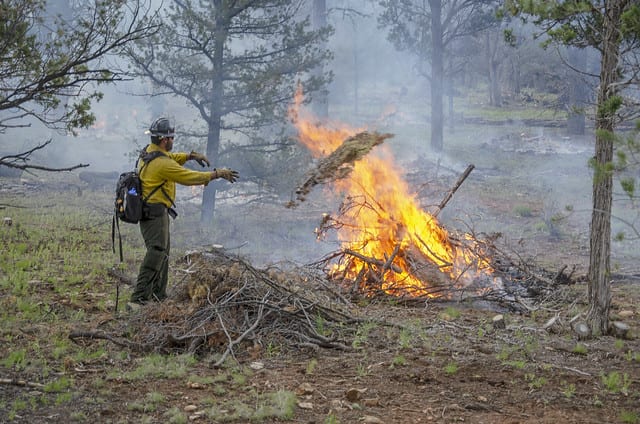
Photo credit: Grand Canyon National Park: Prescribed Pile Burning, 30 May 2019 [Flickr / CC BY 2.0 license]
***
Calvinism & General Protestantism
religious status of Catholicism
Previous Post

September 19, 2019
Sociology: Absence of Mother or Father Harms Children
Next Post
September 20, 2019 Extraordinarily Excessive Use of Extraordinary Ministers
Browse Our Archives
Select a Category & Last Things About Me Anti-Catholicism Atheism & Agnosticism Baptism and Sacramentalism Bible and Tradition Blessed Virgin Mary Books by Dave Armstrong C. S. Lewis Calvinism & General Protestantism Catholic Apologetics Catholic Apologists Catholic conversion Catholic converts Christmas Church (Ecclesiology) Church History Conversion and Converts Development of Doctrine Eastern Orthodoxy Ecumenism & Christian Unity Eucharist & Liturgy Fathers of the Church French Translations G. K. Chesterton Hell Hell & Satan Hell & Satan & Last Things Heresies & Comparative Religion Holistic Health Inquisition & Crusades & Scandals James White Jews & Judaism & Old Testament John Calvin John Henry Newman Liberal / Modernist Theology Life Issues Literary Resume Lutheranism Mariology Martin Luther Music Orthodoxy Papacy & Infallibility Personal Page Philosophy & Science Political & Ethical & Moral Issues Protestant Persecution & Intolerance Protestantism Purgatory Purgatory & Penance Romantic & Imaginative Theology Saints & Purgatory & Penance Salvation Salvation & Justification Satan & Last Things Sexuality and Gender Issues Spanish Translations Traditionalism vs. Radical Catholic Reactionaries Traducciones al español / tradução para português Trinitarianism & Christology Uncategorized Videos
Select a Month October 2026 September 2026 August 2026 July 2026 June 2026 May 2026 April 2026 March 2026 February 2026 January 2026 December 2025 November 2025 October 2025 September 2025 August 2025 July 2025 June 2025 May 2025 April 2025 March 2025 February 2025 January 2025 December 2024 November 2024 October 2024 September 2024 August 2024 July 2024 June 2024 May 2024 April 2024 March 2024 February 2024 January 2024 December 2023 November 2023 October 2023 September 2023 August 2023 July 2023 June 2023 May 2023 April 2023 March 2023 February 2023 January 2023 December 2022 November 2022 October 2022 September 2022 August 2022 July 2022 June 2022 May 2022 April 2022 March 2022 February 2022 January 2022 December 2021 November 2021 October 2021 September 2021 August 2021 July 2021 June 2021 May 2021 April 2021 March 2021 February 2021 January 2021 December 2020 November 2020 October 2020 September 2020 August 2020 July 2020 June 2020 May 2020 April 2020 March 2020 February 2020 January 2020 December 2019 November 2019 October 2019 September 2019 August 2019 July 2019 June 2019 May 2019 April 2019 March 2019 February 2019 January 2019 December 2018 November 2018 October 2018 September 2018 August 2018 July 2018 June 2018 May 2018 April 2018 March 2018 February 2018 January 2018 December 2017 November 2017 October 2017 September 2017 August 2017 July 2017 June 2017 May 2017 April 2017 March 2017 February 2017 January 2017 December 2016 November 2016 October 2016 September 2016 August 2016 July 2016 June 2016 May 2016 April 2016 March 2016 February 2016 January 2016 December 2015 November 2015 October 2015 September 2015 August 2015 July 2015 June 2015 May 2015 April 2015 March 2015 February 2015 January 2015 December 2014 November 2014 October 2014 September 2014 August 2014 July 2014 June 2014 April 2014 March 2014 February 2014 January 2014 December 2013 November 2013 October 2013 September 2013 August 2013 July 2013 June 2013 April 2013 March 2013 February 2013 January 2013 December 2012 November 2012 October 2012 September 2012 August 2012 July 2012 June 2012 May 2012 April 2012 March 2012 February 2012 January 2012 December 2011 November 2011 October 2011 September 2011 August 2011 July 2011 June 2011 April 2011 March 2011 February 2011 October 2010 September 2010 August 2010 July 2010 April 2010 March 2010 December 2009 October 2009 August 2009 July 2009 June 2009 May 2009 March 2009 February 2009 October 2008 September 2008 April 2008 March 2008 February 2008 January 2008 December 2007 November 2007 October 2007 May 2007 March 2007 February 2007 January 2007 November 2006 October 2006 September 2006 August 2006 July 2006 June 2006 May 2006 April 2006 March 2006 February 2006 October 2005 June 2005 April 2005 February 2005 July 2004 May 2004 April 2004
Follow Us!
TAKE THE
Religious Wisdom Quiz
Who fell out of a window and was restored to life by Paul?
Select your answer to see how you score.
Silas Barnabas Eutychus Timothy
Books by This Author Books by Dave Armstrong
Related posts from Biblical Evidence for Catholicism

On Protestant Explanations of Catholic Conversion
Biblical Evidence for Catholicism

Three More Anti-Catholic Lies About Catholicism (#6-4)
Biblical Evidence for Catholicism

Bible & Catholicism on Mortal Sin (vs. John...
Biblical Evidence for Catholicism

Top Ten Anti-Catholic Lies (#10-7)
Biblical Evidence for Catholicism
TRENDING AT PATHEOS Catholic

In "Irreplaceable," our book on vocation and technology, Trevor Sutton and I...

I was strolling through the top floor of the brand new Parthenon...

What Does Gêvâh Mean For Kimberley Guifoyle &...
This week, a lot of the news is focused on Kimberly Guilfoyle....

INNER CIRCLE: Profound Mystery (Of Christ In All...
Ephesians 5:31-32 “For this reason, a man will leave his father and...

Do Not Rejoice When Your Enemy Falls: The...
Turning an execution into a public spectacle is a disturbing expression of...

'The Chosen' S6 Trailer: The Passion Gets Very...
Not many watching 'The Chosen' worry about spoilers, but just because they...
view all Catholic blogs
Ad-Free & Subscriber Log-In Subscription Support
- About Us
- 2026 Calendar
- Videos
- Podcasts
- Library of World Religions
- Faith In Media Tracker
- Advertise With Us
- Write for Us
- Privacy Policy
- Terms of Service
- Do Not Sell My Data
- Contact Us
- Radiant Digital
- Manage Newsletter Subscriptions
- Unsubscribe From Notifications
- Sitemap
Copyright 2008-2026, Patheos. All rights reserved.
Subscription Support Ad-Free & Subscriber Log-In
Follow Patheos