
BuddhistCatholicContemplativeEvangelicalGeneral ChristianHinduJewishLatter-day SaintMuslimNew VisionsProgressive Christian
Beliefs
- Buddhist
- Catholic
- Contemplative
- Evangelical
- General Christian
- Hindu
- Jewish
- Latter-day Saint
- More Voices
- Muslim
- New Visions
- Pagan
- Progressive Christian
Topics
- Religion News
- Food and Religion
- Sports and Religion
- Religious Art
- Religious Music and Entertainment
- Religious Events
- History and Religion
- Style and Religion
- Politics and Religion
- Women in Religion
- Recreation Outdoors and Religion
- Business Finance and Religion
- Careers Workplace and Religion
- Education and Religion
- Family Parenting and Religion
- Health Fitness and Religion
- Home and Religion
- Relationships and Religion
- Technology and Religion
- Travel and Religion
Columnists
- Buddhist Columnists
- Business Finance and Religion Columnists
- Careers Workplace and Religion Columnists
- Catholic Columnists
- Contemplative Columnists
- Education and Religion Columnists
- Evangelists Columnists
- Family Parenting and Religion Columnists
- General Christian Columnists
- Health Fitness and Religion Columnists
- Hindu Columnists
- History and Religion Columnists
- Home and Religion Columnists
- Jewish Columnists
- More Voices Columnists
- Latter Day Columnists
- Muslim Columnists
- New Visions Columnists
- Nonreligious Columnists
- Pagan Columnists
- Politics and Religion Columnists
- Progressive Columnists
- Recreation Outdoors and Religion Columnists
- Relationships and Religion Columnists
- Religion News Columnists
- Religious Art Columnists
- Religious Events Columnists
- Religious Music and Entertainment Columnists
- Sports and Religion Columnists
- Style and Religion Columnists
- Technology and Religion Columnists
- Travel and Religion Columnists
- Women in Religion Columnists
Resource Library
- 2026 Calendar
- Library of World Religions
- The 100 Most Holy Places on Earth
- Patheos Answers
- Podcasts
- Videos
- Faith Leaders Database
- Anglican Episcopalian
- Bahai
- Baptist
- Buddhism
- Christianity
- Confucianism
- Eastern Orthodoxy
- Hinduism
- Holiness and Pentecostal
- ISKCON
- Islam
- Judaism
- Lutheran
- Methodist
- The Church of Jesus Christ of Latter-day Saints
- New Age
- Paganism
- Presbytarian and Reformed
- Protestantism
- Religion Behind the Scenes
- Roman Catholic
- Scientology
- Shia Islam
- Sikhism
- Sufism
- Sunni Islam
- Taoism
- Zen
- See all religions
Research Tools
 Ad-Free & Subscriber Log-In Subscription Support
Ad-Free & Subscriber Log-In Subscription Support
Follow Patheos 

- Trending:
- Forgiveness
- |
- Marriage
- |
- Consciousness
- |
- Death Penalty
- |
- Election
- |
- Halloween

-
About
-
Catholic Apologetics
-
Church History
-
Great Apologists
-
Christian Worldview
-
Protestantism & Misc.
- Home
- Catholic
- History and Religion
- Vs. James White #1: “Papal Pretensions” & “New” Apologists
Vs. James White #1: “Papal Pretensions” & “New” Apologists
Last updated on: June 5, 2026 at 11:54 pm by Dave Armstrong
Vs. James White #1: “Papal Pretensions” & “New” Apologists 2026-06-05T23:54:56-04:00 Dave Armstrong
Patheos Explore the world's faith through different perspectives on religion and spirituality! Patheos has the views of the prevalent religions and spiritualities of the world.
James White wrote his first known anti-Catholic article in May 1991, for the Pros Apologian theological journal, entitled: “Papal Pretensions: Evaluating the New Roman Catholic Apologists.” He was responding to the rapidly budding Catholic apologetics movement, of which I am a part: spearheaded by Scott Hahn, Karl Keating (who had just begun Catholic Answers), and Keating’s co-worker, Patrick Madrid (all of whom have enthusiastically recommended my work).
Prior to that time he had concentrated on (agreeable) anti-cult apologetics: particularly Mormonism, and some Jehovah’s Witnesses research also. We actually came out of the same milieu: the evangelical anti-cult movement, which included Dr. Walter Martin and his Christian Research institute. Some of my earliest apologetics, like White’s, starting in 1981, was devoted to Jehovah’s Witnesses, and biblical evidences regarding the deity of Christ, and the Holy Trinity. My only radio appearance as an evangelical (November 1989), was a discussion of Jehovah’s Witnesses. But I was an Arminian / Wesleyan evangelical, and not anti-Catholic, whereas White was Reformed Baptist, which view largely tends to be also anti-Catholic.
So he wrote the above article, and I was received into the Church three months earlier (after having written a long letter to Karl Keating in February 1990, as a Protestant, and having first met Scott Hahn the day before I was received). I had my first “officially published” Catholic article in The Catholic Answer in January 1993 (on Martin Luther) and my conversion story was included in Pat Madrid’s runaway bestseller Surprised by Truth in 1994. In March 1995 I wrote to White and we engaged in our only sustained debate (i.e., before he split and ignored my extensive, 36-page third “round”) ever, and the rest is history.
See my Introduction to what will be a very long series (see other installments). Words of James White will be in blue.
*****
[Footnote] 1. It is ironic to note that they are willing to use the Bible to prove a doctrine that, in reality, asserts that the Bible is not sufficient in and of itself to know religious truth with finality.
It’s not ironic at all. Catholics agree that the Bible is God’s inspired, inerrant, infallible revelation. We know that in argument with our separated brethren, they will not accept Catholic proclamations or arguments from tradition, so we largely stick to the Bible: the thing we have in common. It’s a straightforward application of the Pauline “I have become all things to all men.” But it’s simply practical common sense. Debates must proceed from shared premises or they go nowhere.
Lastly, the Church fathers massively used Scripture in their argumentation, as do virtually all Catholic magisterial documents. It’s nothing new at all. Utilizing the Bible is not the same thing as an assertion that the Bible is the only infallible and final authority in Christianity (sola Scriptura). But both sides agree that it is the only divinely inspired authority.
In looking for Biblical support for the Papacy, Roman apologists are extremely limited with regard to the texts they can utilize, and for obvious reason. Outside of Matthew 16:17-19, Luke 22:31-32 and John 21:15-17, there is precious little ground upon which to build papal pretensions.
I disagree, having listed fifty such arguments in one of my more well-known articles. But even if White’s three listed passages were the only evidence, that would be three more passages than ones that support his belief in sola Scriptura, and three more than those in the Bible that list the canon of the Bible. Sola Scriptura is a mere man-made, unbiblical Protestant tradition and the biblical canon is an authentic, apostolic, patristic, and Catholic tradition.
Given this simple fact, what is the Roman apologist to do? Examining the actual structure of the New Testament Church would be disastrous, for the equality of the believers, the lack of the “clergy/laity” split, the universal priesthood of believers,
Protestants sometimes cite 1 Peter 2:5, 9 to the effect that all Christians are priests. But Peter was citing Exodus 19:6: “you shall be to me a kingdom of priests and a holy nation.” The problem with this is that the older passage couldn’t possibly have meant that there was no priesthood among the ancient Hebrews, since they clearly had a separate class of priests (Leviticus: chapters 4-7, 13-14).
This is even seen in the same chapter, since Exodus 19:21-24 twice contrasts “priests” and “people.” Thus, it makes much more sense to interpret 1 Peter 2:5 as meaning a separate, holy, “chosen” class of priests.
and the equality of the servants of the Church (i.e., elders are bishops, etc.) is all in contradiction to the Roman doctrines.
The absurd low church doctrine that elders = bishops is unbiblical. I extensively debated the issue with James White on 10 January 2001. This was the exchange where he famously stated:
Biblically speaking, sir, the offices of bishop, overseer, elder, or pastor, are one. There is no differentiation between them in the relevant NT passages. I am an elder in the church: hence, I am a bishop, overseer, pastor, of a local body of believers, the Phoenix Reformed Baptist Church.
Based on this statement, I have referred to him as “Bishop” ever since. So he falsely ascribes to himself the office of bishop, and also maintains the pretense that he earned a legitimate doctorate (he did not). How’s that for hubris? See also a related paper of mine, responding to Bishop White about deacons.
If they were to examine Peter’s own writings, they would be unable to find a single instance where he claimed to be the “Vicar of Christ on earth” or the “Holy Father,”
[later in his article] . . . the Vicar of Christ on earth (who, of course, is the Holy Spirit of God, not the bishop of Rome).
We need not find specific terms to prove our case, any more than Protestants can (or are required to) find the terms “Trinity” or “Two Natures” of Christ or “original sin”: none of which are biblical terminology. Even their beloved faith alone doctrine is mentioned once in the Bible: and expressly denied:
James 2:24 (RSV) You see that a man is justified by works and not by faith alone.
Nor do “Scripture alone” or Scripture only” ever appear.
I have shown, I think, that “Vicar of Christ” and “Holy Father” are terms that are perfectly consistent with Holy Scripture.
nor could they even begin to find any other passage in Scripture where anyone else gave any indication of viewing Peter in this way, either. So the above mentioned passages must somehow be made to stretch to fit the task assigned to them.
To the contrary, there are many indications of Peter’s authority and leadership among the disciples and in the early Church. Even the great Protestant scholar F. F. Bruce, whom White often cites, wrote:
A Paulinist (and I myself must be so described) is under a constant temptation to underestimate Peter . . . An impressive tribute is paid to Peter by Dr. J.D.G. Dunn towards the end of his Unity and Diversity in the New Testament [London: SCM Press, 1977, 385; emphasis in original]. Contemplating the diversity within the New Testament canon, he thinks of the compilation of the canon as an exercise in bridge-building, and suggests that
it was Peter who became the focal point of unity in the great Church, since Peter was probably in fact and effect the bridge-man who did more than any other to hold together the diversity of first-century Christianity.
Paul and James, he thinks, were too much identified in the eyes of many Christians with this and that extreme of the spectrum to fill the role that Peter did. Consideration of Dr. Dunn’s thoughtful words has moved me to think more highly of Peter’s contribution to the early church, without at all diminishing my estimate of Paul’s contribution. (Peter, Stephen, James, and John, Grand Rapids, Michigan: Eerdmans, 1979, 42-43)
Another rock-solid Protestant scholarly work states similarly:
In the . . . exercise of the power of the keys, in ecclesiastical discipline, the thought is of administrative authority (Is 22:22) with regard to the requirements of the household of faith. The use of censures, excommunication, and absolution is committed to the Church in every age, to be used under the guidance of the Spirit . . .
So Peter, in T. W. Manson’s words, is to be ‘God’s vicegerent . . . The authority of Peter is an authority to declare what is right and wrong for the Christian community. His decisions will be confirmed by God’ (The Sayings of Jesus, 1954, p. 205). (New Bible Dictionary, edited by J. D. Douglas, Grand Rapids, Michigan: Eerdmans Pub. Co., 1962, 1018)
Obviously, then, not all Protestants (including those far more eminent than he himself) agree with White’s opinion on this. They disagree with the papacy, of course, but not with a strong biblical view of Peter as an early Church leader: which is the present consideration.
The primary passage used in defense of the Papacy continues to be Matthew 16:17-19. . . .
They have ready answers for anyone who would dispute that Peter is the “rock” spoken of here. In fact, they have plenty of quotations from Protestant commentaries to back them up in identifying Peter as the rock!
Yes we do: citing many Protestant scholars.
Without turning what should be a readable article into a small book, we point out that the Roman position is inconsistent at a number of points. First, since Romanism claims that their understanding of Petrine supremacy is in “accordance with the ancient and constant faith of the universal Church,” it is instructive to realize that the interpretation of Matthew 16:18 upon which this supremacy is based is by far the minority position of the early Fathers.
But this is a red herring. The assertion is that papal primacy and supremacy was always there in some form, from the beginning, not that the only basis for same is Matthew 16. Thus, it is irrelevant for White to note that many Fathers disagreed with the “Peter is the Rock” interpretation of Matthew 16. It was mixed, and even White noted that 17 fathers agreed with it. The irony is that many Protestant scholars now agree with us that Peter is the Rock referred to in Matthew 16: not merely his faith, or Christ as the rock. Peter means rock, so it would seem pretty straightforward:
Matthew 16:18-19 “And I tell you, you are Peter, and on this rock I will build my church, and the powers of death shall not prevail against it. [19] I will give you the keys of the kingdom of heaven, and whatever you bind on earth shall be bound in heaven, and whatever you loose on earth shall be loosed in heaven.”
“But,” the Roman apologists retorts, “your own Protestant scholars admit that Peter was the rock.” Let’s now examine this, always keeping in mind that even if it could be established without question that this is the proper interpretation, it does not follow that the bishop of Rome has some kind of supremacy! Nothing in Matthew 16:18 establishes an office that is to be passed on to others.
I don’t think it is inconsistent with the notion at all. After all, if Peter was indeed appointed as leader in the Church, why wouldn’t that office be passed on for posterity: just like most of the other offices? A strong argument can be made for papal succession, and I have made it; even more than once.
I do not necessarily agree with the interpretation put forward by Hendrickson, Cullmann, etc., with reference to Peter being the rock. However, the point is that the modern-day Roman apologist who refers to these men must be held accountable for telling the people all that these Protestant writers are saying. It is often the case that the Catholic is left with the impression that these Protestant writers accept the Roman Catholic understanding of Peter as the “rock” with all that entails, and this simply is not the case.
We Catholic apologists agree that Protestant scholars saying Peter was the rock does not imply at all that they agree with either papal succession or the office of the papacy as a perpetual one (no Catholic apologist I am aware of has made those arguments; we simply note that hey are denying that “rock” refers only to Peter’s faith). But it surely means something significant, and I think honest Protestants have to ask themselves what that is. The Catholic biblical argument for Petrine primacy and the papacy that we think developed from it is a multi-faceted and cumulative one.
Another twist that has been added, especially by Scott Hahn . . . has been the use of Isaiah 22:21- 22. This passage has been pressed into service to attempt to find some kind of basis for asserting that the supremacy supposedly given to Peter in Matthew 16 actually has the character of a dynastic office replete with successors. Here we read of Eliakim, son of Hilkiah. The passage reads,
And I will clothe him with your tunic, and tie your sash securely about him, I will entrust him with your authority, and he will become a father to the inhabitants of Jerusalem and to the house of Jacob. Then I will set the key of the house of David on his shoulder, when he opens no one will shut, when he shuts no one will open.
Roman apologists assert the following things. First, the position Eliakim was put into was a dynastic position, i.e., one that had successors. Secondly, they point out the usage of the term “key” and connect this with Jesus’ statements in Matthew 16:19, going so far as to directly assert that Jesus is quoting Isaiah 22:22 of Peter. Obviously, they then parallel the “opening and shutting” of Isaiah 22 with the “binding and loosing” of Matthew 16. Peter, they assert, is the “Prime Minister” of the Church. There is no tension or “tug-of-war” between Peter and Jesus, just as there was none between the king and the prime minister in the Old Testament.
Scott Hahn spent some time establishing this connection in a talk entitled “Peter and the Papacy.” He insists that Jesus is quoting this passage from Isaiah 22 with reference to Peter, and that Jesus would never quote a passage from the Old Testament and wrench it from its original context. Since, therefore, the passage in Isaiah refers to an office that has successors, then Jesus must mean Peter to have successors as the “prime minister” of the Church, that is, the Pope. Hahn says,
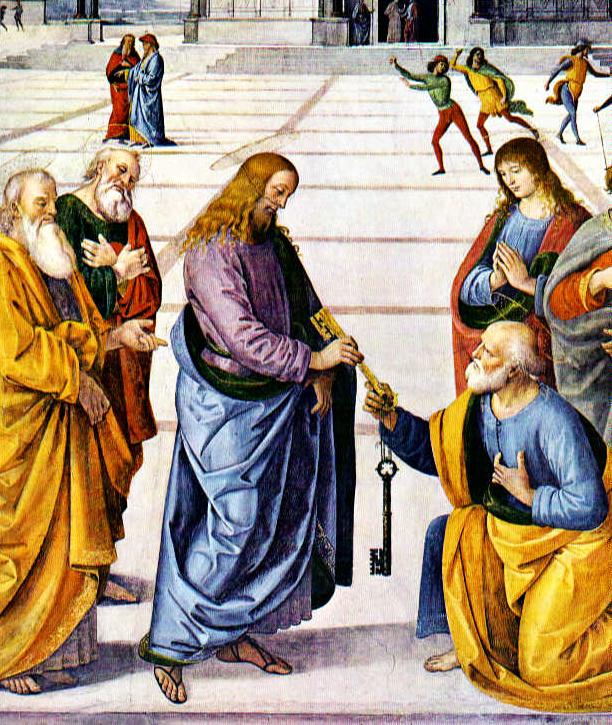
The long and short of all of this, is, that when Jesus entrusts to Peter the keys of the kingdom, He is designating and appointing Simon to be the prime Minister; and with the keys you have a clear symbol showing us that an office is being instituted; so that when Peter dies there automatically assumes a successor; and when that successor dies, yet another one, and so on and so forth. We do have the biblical grounds for believing that Jesus instituted Peter’s office to include successors known as the popes.
Again, if so eminent a Protestant scholar as F. F. Bruce thought this was a plausible interpretation (and adopted it himself), it ain’t just “special pleading Catholic polemics”:
The keys of a royal or noble establishment were entrusted to the chief steward or majordomo; . . . About 700 B.C. an oracle from God announced that this authority in the royal palace in Jerusalem was to be conferred on a man called Eliakim . . . (Isa. 22:22). So in the new community which Jesus was about to build, Peter would be, so to speak, chief steward. (The Hard Sayings of Jesus, Downers Grove, Illinois: InterVarsity Press, 1983, 143-144)
Several other Protestants make the same sort of exegetical argument:
New Bible Commentary:
Eliakim stands in strong contrast to Shebna . . . Godward he is called `my servant’ (v.20; cf. `this steward’, v.15); manward, he will be `a father’ to his community (v.21) . . .
The opening words of v.22, with their echo of 9:6, emphasize the God-given responsibility that went with it [possession of the keys], to be used in the king’s interests. The `shutting’ and `opening’ mean the power to make decisions which no one under the king could override. This is the background of the commission to Peter (cf. Mt 16:19) and to the church (cf. Mt 18:18). (p. 603)
Tyndale New Testament Commentaries (R. T. France):
Not only is Peter to have a leading role, but this role involves a daunting degree of authority (though not an authority which he alone carries, as may be seen from the repetition of the latter part of the verse in 18:18 with reference to the disciple group as a whole). The image of `keys’ (plural) perhaps suggests not so much the porter, who controls admission to the house, as the steward, who regulates its administration (cf. Is 22:22, in conjunction with 22:15). The issue then is not that of admission to the church . . . , but an authority derived from a “delegation” of God’s sovereignty.
Oscar Cullmann:
Just as in Isaiah 22:22 the Lord puts the keys of the house of David on the shoulders of his servant Eliakim, so does Jesus hand over to Peter the keys of the house of the kingdom of heaven and by the same stroke establishes him as his superintendent. There is a connection between the house of the Church, the construction of which has just been mentioned and of which Peter is the foundation, and the celestial house of which he receives the keys. The connection between these two images is the notion of God’s people. (St. Peter: Disciple, Apostle, Martyr, Neuchatel: Delachaux & Niestle, 1952 [French edition], 183-184)
Note that Scott Hahn was born in 1957 and became a Catholic in 1985. White says that this argument from him was some new “twist.” Yet, the four Protestant scholars or reference sources cited above made this argument in the years 1983, 1970, 1985, and 1952, respectively. Obviously, then, Hahn didn’t invent it or pull it out of a hat. For all we know, he may have actually discovered it in Protestant exegetes and commentators such as these.
What we do know for sure is that this take is not exclusively a Catholic one. Protestant Bible scholars (and very good ones that White can’t dismiss) also hold this position. And that is significant and proves that it is an exegetical argument to be seriously grappled with by people like White. But, true to form, he doesn’t. Rather, he states: “does the argument hold water? When all the excess verbiage is stripped away, we find out that it is an argument built upon air.”
One of the most amazing things that I have noted in listening to the defenses provided by the new Roman apologists is the selectivity with which they present their arguments. Rarely is the Protestant argument portrayed in its best formulation, that is for certain! Straw men abound, but straw men that are skillfully constructed by men who should, it would seem, know better, given their background and training. But here with reference to Isaiah 22, I have been amazed to note this one single thing: . . . Each time I have listened to these men or read their discussions of the supposed connection between Isaiah 22:22 and Matthew 16:18-19, I have never once heard them inform their audiences that Isaiah 22:22 is specifically cited by the Lord Jesus, with reference to Himself, in Revelation 3:7! Note what the Word says,
And to the angel of the church in Philadelphia write: He who is holy, who is true, who has the key of David, who opens and no one will shut, and who shuts and no one will open, says this:
That’s funny; I had no problem in including it in the Protestant citations I utilized in my paper, Primacy of St. Peter Verified by Protestant Scholars. It appears three times there. It took me less than a minute in a Google search to find Scott Hahn not only mentioning it in this respect, but incorporating it into his argument:
Jesus, the root and offspring of David, alone holds the kingdom’s keys (see Revelation 1:18; 3:7; 22:16). In giving those keys to Peter, Jesus fulfills that prophecy, establishing Peter—and all who succeed him—as holy father of His Church.
Scriptural passages often have a dual application. Surely, James White: an avid student of the Bible, must know this. I could think of a dozen examples just off the top of my head. Jesus is the Good Shepherd (Jn 10:11, 14), but the Greek for shepherd here (poimḗn: Strong’s word 4166), is translated as pastor in Ephesians 4:11. So Jesus applied it to himself and then Paul applied it to pastors. St. Paul again writes about the same idea, referring to congregations or laypeople as the “flock”:
Acts 20:28-19 Take heed to yourselves and to all the flock, in which the Holy Spirit has made you overseers, to care for the church of God which he obtained with the blood of his own Son. [29] I know that after my departure fierce wolves will come in among you, not sparing the flock;
So does St. Peter:
1 Peter 5:2-3 Tend the flock of God that is your charge, not by constraint but willingly, not for shameful gain but eagerly, [3] not as domineering over those in your charge but being examples to the flock.
And of course the risen Jesus said to St. Peter, the first pope:
John 21:15-17 When they had finished breakfast, Jesus said to Simon Peter, “Simon, son of John, do you love me more than these?” He said to him, “Yes, Lord; you know that I love you.” He said to him, “Feed my lambs.” [16] A second time he said to him, “Simon, son of John, do you love me?” He said to him, “Yes, Lord; you know that I love you.” He said to him, “Tend my sheep.” [17] He said to him the third time, “Simon, son of John, do you love me?” Peter was grieved because he said to him the third time, “Do you love me?” And he said to him, “Lord, you know everything; you know that I love you.” Jesus said to him, “Feed my sheep.
Patrick Madrid — in a classic article from 1992 — elaborates upon this:
Jesus is the shepherd of his flock the Church (Jn 10:16), yet he shares his shepherdhood in a subordinate way with others, beginning with Peter (Jn 21:15-17) and extending it later to others (Eph 4:11). It is true that Jesus says he is the only shepherd (Jn 10:11-16), yet this seemingly exclusive statement does not conflict with him making Peter shepherd over the flock (Jn 21:15-17) or with his calling others to be shepherds as well (Eph 4:11). Peter emphasizes that Jesus shares his role as shepherd with others by calling Jesus the chief shepherd, thus implying lesser shepherds (1 Pt 5:4). Note also that the Greek construction of John 10:16 ([there is] one shepherd, heis poimen) is the same as 1 Timothy 2:5 ([there is] one mediator, heis mesites). The apostles and their successors, the bishops, are truly shepherds also.
God even shares his glory with His creatures, for heaven’s sake. And we know that God saves whoever is saved, and gives all the grace to (solely) make that possible yet we see Paul saying that he and Timothy (as “God’s fellow workers”: 1 Cor 3:9) “save” people too, and Paul and Peter talking about distributing God’s grace!:
1 Corinthians 9:22 I have become all things to all men, that I might by all means save some.
2 Corinthians 4:15 For it [his many sufferings: 4:8-12, 17] is all for your sake, so that as grace extends to more and more people it may increase thanksgiving, to the glory of God.
Ephesians 3:2 assuming that you have heard of the stewardship of God’s grace that was given to me for you . . .
1 Timothy 4:16 Take heed to yourself and to your teaching: hold to that, for by so doing you will save both yourself and your hearers. (cf. 1 Cor 7:16; James 5:20; 1 Pet 3:1)
1 Peter 4:10 As each has received a gift, employ it for one another, as good stewards of God’s varied grace.
So Jesus has the keys in Revelation 3:7? No biggie (ho hum). Of course He does. No one is denying it. But Jesus says that He will give them to Peter (“I will give you the keys of the kingdom of heaven”: Mt 16:19), so White has to grapple with and come to terms with that. What does it mean?
Who is speaking here? The Lord Jesus, of course. And is there any question whatsoever that the Lord is citing Isaiah 22:22? None at all! He mentions the “key of David,” and then quotes the rest of Isaiah 22:22 directly! And who is the one who holds (present tense-since this is spoken after the resurrection, and, it would seem probable, after the death of Peter, then why isn’t the Pope, Peter’s supposed successor, holding this key?) the key? Jesus Christ Himself! Obviously, therefore, the entire Roman Catholic position falls flat on its face with the simple acknowledgment that the Lord Jesus is a better interpreter of Scripture than the modern apologists of Rome, and He obviously felt that Isaiah 22:22 was fulfilled in Himself, not in Peter or the bishop of Rome!
This is all overcome by understanding the notion of dual or double application in Scripture; examples of which were just provided. White thinks in the hyper-rationalistic, typically Protestant either/or way, rather than the biblical and Catholic both/and, paradoxical way, and so he misses this. No one is so blind as he who will not see.
When one then considers all the time that is spent by Hahn and Matatics in developing this argument, and all that without even attempting to deal with Revelation 3:7, what is obviously the death-blow to their entire concept, one is tempted to wonder about much of what they have to say. Surely the Roman Catholic who listens to such apologetics should be aware of this kind of tremendously selective interpretation! It is, in my opinion, nothing short of dishonest to present the Isaiah 22/Matthew 16 connection as a support of the Roman concept of the Papacy without even trying to deal with Revelation 3:7 and the simple fact that Jesus did not interpret Isaiah 22:22 in the same way the apologist is suggesting we should! Hahn insisted that it was important to remember that Jesus would never twist or contort the context of the Old Testament passages He was citing. We agree. But when we apply Hahn’s own words to himself, we find that Jesus’ use of Isaiah 22:22 in Revelation 3:7 forever shuts the door on Hahn’s forced interpretation of Isaiah with reference to Matthew 16:18-19.
How melodramatic! This is White’s tedious method: over-argue to the extreme and then prematurely and triumphantly declare victory. It makes it — admittedly — fun to debate him, because (as someone on my Facebook page noted today) he “falls hard.” And so he does here, and (I predict) will many many more times, as I proceed with this series. You can’t “make a silk purse out of a sow’s ear.” White could be the most brilliant rhetorician and polemicist in the history of the world, but if he is defending falsehood, it won’t matter.
You can only go so far with that: like a lawyer defending a client who truly is guilty. The person possessing the truth, and who knows how to effectively contend for it, will prevail, because the truth has an inherent divinely ordained power within itself, whereas falsehood comes from the devil: the father of lies. That’s the advantage of the Catholic who is dealing with an anti-Catholic, and the blessing of the Catholic apologist (strengthening our faith all the more, all the time, as we see the weakness of the opposing arguments). It’s not mere empty and prideful triumphalism: it’s the power of truth.
***
Photo credit: Detail of Christ Handing the Keys to St. Peter (1481-82) by Pietro Perugino (1448-1523) [public domain / Wikimedia Commons]

religious status of Catholicism
Previous Post
September 15, 2019
“Ad Orientem” (Facing the Altar at Mass): A Defense
Next Post

September 16, 2019 Is Premarital Sex Morally Wrong? Why? (A Dialogue)
Browse Our Archives
Select a Category & Last Things About Me Anti-Catholicism Atheism & Agnosticism Baptism and Sacramentalism Bible and Tradition Blessed Virgin Mary Books by Dave Armstrong C. S. Lewis Calvinism & General Protestantism Catholic Apologetics Catholic Apologists Catholic conversion Catholic converts Christmas Church (Ecclesiology) Church History Conversion and Converts Development of Doctrine Eastern Orthodoxy Ecumenism & Christian Unity Eucharist & Liturgy Fathers of the Church French Translations G. K. Chesterton Hell Hell & Satan Hell & Satan & Last Things Heresies & Comparative Religion Holistic Health Inquisition & Crusades & Scandals James White Jews & Judaism & Old Testament John Calvin John Henry Newman Liberal / Modernist Theology Life Issues Literary Resume Lutheranism Mariology Martin Luther Music Orthodoxy Papacy & Infallibility Personal Page Philosophy & Science Political & Ethical & Moral Issues Protestant Persecution & Intolerance Protestantism Purgatory Purgatory & Penance Romantic & Imaginative Theology Saints & Purgatory & Penance Salvation Salvation & Justification Satan & Last Things Sexuality and Gender Issues Spanish Translations Traditionalism vs. Radical Catholic Reactionaries Traducciones al español / tradução para português Trinitarianism & Christology Uncategorized Videos
Select a Month October 2026 September 2026 August 2026 July 2026 June 2026 May 2026 April 2026 March 2026 February 2026 January 2026 December 2025 November 2025 October 2025 September 2025 August 2025 July 2025 June 2025 May 2025 April 2025 March 2025 February 2025 January 2025 December 2024 November 2024 October 2024 September 2024 August 2024 July 2024 June 2024 May 2024 April 2024 March 2024 February 2024 January 2024 December 2023 November 2023 October 2023 September 2023 August 2023 July 2023 June 2023 May 2023 April 2023 March 2023 February 2023 January 2023 December 2022 November 2022 October 2022 September 2022 August 2022 July 2022 June 2022 May 2022 April 2022 March 2022 February 2022 January 2022 December 2021 November 2021 October 2021 September 2021 August 2021 July 2021 June 2021 May 2021 April 2021 March 2021 February 2021 January 2021 December 2020 November 2020 October 2020 September 2020 August 2020 July 2020 June 2020 May 2020 April 2020 March 2020 February 2020 January 2020 December 2019 November 2019 October 2019 September 2019 August 2019 July 2019 June 2019 May 2019 April 2019 March 2019 February 2019 January 2019 December 2018 November 2018 October 2018 September 2018 August 2018 July 2018 June 2018 May 2018 April 2018 March 2018 February 2018 January 2018 December 2017 November 2017 October 2017 September 2017 August 2017 July 2017 June 2017 May 2017 April 2017 March 2017 February 2017 January 2017 December 2016 November 2016 October 2016 September 2016 August 2016 July 2016 June 2016 May 2016 April 2016 March 2016 February 2016 January 2016 December 2015 November 2015 October 2015 September 2015 August 2015 July 2015 June 2015 May 2015 April 2015 March 2015 February 2015 January 2015 December 2014 November 2014 October 2014 September 2014 August 2014 July 2014 June 2014 April 2014 March 2014 February 2014 January 2014 December 2013 November 2013 October 2013 September 2013 August 2013 July 2013 June 2013 April 2013 March 2013 February 2013 January 2013 December 2012 November 2012 October 2012 September 2012 August 2012 July 2012 June 2012 May 2012 April 2012 March 2012 February 2012 January 2012 December 2011 November 2011 October 2011 September 2011 August 2011 July 2011 June 2011 April 2011 March 2011 February 2011 October 2010 September 2010 August 2010 July 2010 April 2010 March 2010 December 2009 October 2009 August 2009 July 2009 June 2009 May 2009 March 2009 February 2009 October 2008 September 2008 April 2008 March 2008 February 2008 January 2008 December 2007 November 2007 October 2007 May 2007 March 2007 February 2007 January 2007 November 2006 October 2006 September 2006 August 2006 July 2006 June 2006 May 2006 April 2006 March 2006 February 2006 October 2005 June 2005 April 2005 February 2005 July 2004 May 2004 April 2004
Follow Us!
TAKE THE
Religious Wisdom Quiz
Who asked Jesus, "What is truth?"
Select your answer to see how you score.
Caiaphas Pilate Nicodemus Herod
Books by This Author Books by Dave Armstrong
Related posts from Biblical Evidence for Catholicism

Three More Anti-Catholic Lies About Catholicism (#6-4)
Biblical Evidence for Catholicism

Top Ten Anti-Catholic Lies (#10-7)
Biblical Evidence for Catholicism

Was Peter "Any Old" Apostle? 10 Anti-Papal Arguments
Biblical Evidence for Catholicism

A Few "Worst" & "Best" Arguments vs. Protestantism
Biblical Evidence for Catholicism
TRENDING AT PATHEOS Catholic

I was strolling through the top floor of the brand new Parthenon...

What Does Gêvâh Mean For Kimberley Guifoyle &...
This week, a lot of the news is focused on Kimberly Guilfoyle....

INNER CIRCLE: Profound Mystery (Of Christ In All...
Ephesians 5:31-32 “For this reason, a man will leave his father and...

Do Not Rejoice When Your Enemy Falls: The...
Turning an execution into a public spectacle is a disturbing expression of...

'The Chosen' S6 Trailer: The Passion Gets Very...
Not many watching 'The Chosen' worry about spoilers, but just because they...

The purpose-driven labor priest
A labor activist reads Rick Warren and it gets me wondering about...
view all Catholic blogs
Ad-Free & Subscriber Log-In Subscription Support
- About Us
- 2026 Calendar
- Videos
- Podcasts
- Library of World Religions
- Faith In Media Tracker
- Advertise With Us
- Write for Us
- Privacy Policy
- Terms of Service
- Do Not Sell My Data
- Contact Us
- Radiant Digital
- Manage Newsletter Subscriptions
- Unsubscribe From Notifications
- Sitemap
Copyright 2008-2026, Patheos. All rights reserved.
Subscription Support Ad-Free & Subscriber Log-In
Follow Patheos