
BuddhistCatholicContemplativeEvangelicalGeneral ChristianHinduJewishLatter-day SaintMuslimNew VisionsProgressive Christian
Beliefs
- Buddhist
- Catholic
- Contemplative
- Evangelical
- General Christian
- Hindu
- Jewish
- Latter-day Saint
- More Voices
- Muslim
- New Visions
- Pagan
- Progressive Christian
Topics
- Religion News
- Food and Religion
- Sports and Religion
- Religious Art
- Religious Music and Entertainment
- Religious Events
- History and Religion
- Style and Religion
- Politics and Religion
- Women in Religion
- Recreation Outdoors and Religion
- Business Finance and Religion
- Careers Workplace and Religion
- Education and Religion
- Family Parenting and Religion
- Health Fitness and Religion
- Home and Religion
- Relationships and Religion
- Technology and Religion
- Travel and Religion
Columnists
- Buddhist Columnists
- Business Finance and Religion Columnists
- Careers Workplace and Religion Columnists
- Catholic Columnists
- Contemplative Columnists
- Education and Religion Columnists
- Evangelists Columnists
- Family Parenting and Religion Columnists
- General Christian Columnists
- Health Fitness and Religion Columnists
- Hindu Columnists
- History and Religion Columnists
- Home and Religion Columnists
- Jewish Columnists
- More Voices Columnists
- Latter Day Columnists
- Muslim Columnists
- New Visions Columnists
- Nonreligious Columnists
- Pagan Columnists
- Politics and Religion Columnists
- Progressive Columnists
- Recreation Outdoors and Religion Columnists
- Relationships and Religion Columnists
- Religion News Columnists
- Religious Art Columnists
- Religious Events Columnists
- Religious Music and Entertainment Columnists
- Sports and Religion Columnists
- Style and Religion Columnists
- Technology and Religion Columnists
- Travel and Religion Columnists
- Women in Religion Columnists
Resource Library
- 2026 Calendar
- Library of World Religions
- The 100 Most Holy Places on Earth
- Patheos Answers
- Podcasts
- Videos
- Faith Leaders Database
- Anglican Episcopalian
- Bahai
- Baptist
- Buddhism
- Christianity
- Confucianism
- Eastern Orthodoxy
- Hinduism
- Holiness and Pentecostal
- ISKCON
- Islam
- Judaism
- Lutheran
- Methodist
- The Church of Jesus Christ of Latter-day Saints
- New Age
- Paganism
- Presbytarian and Reformed
- Protestantism
- Religion Behind the Scenes
- Roman Catholic
- Scientology
- Shia Islam
- Sikhism
- Sufism
- Sunni Islam
- Taoism
- Zen
- See all religions
Research Tools
 Ad-Free & Subscriber Log-In Subscription Support
Ad-Free & Subscriber Log-In Subscription Support
Follow Patheos 

- Trending:
- Forgiveness
- |
- Marriage
- |
- Consciousness
- |
- Death Penalty
- |
- Election
- |
- Halloween

-
About
-
Catholic Apologetics
-
Church History
-
Great Apologists
-
Christian Worldview
-
Protestantism & Misc.
- Home
- Catholic
- History and Religion
- Loftus Atheist Error #10: Prophet Jeremiah vs. Mosaic Law?
Loftus Atheist Error #10: Prophet Jeremiah vs. Mosaic Law?
Last updated on: June 5, 2026 at 11:54 pm by Dave Armstrong
Loftus Atheist Error #10: Prophet Jeremiah vs. Mosaic Law? 2026-06-05T23:54:56-04:00 Dave Armstrong
Patheos Explore the world's faith through different perspectives on religion and spirituality! Patheos has the views of the prevalent religions and spiritualities of the world.
This is the last of my ten critiques of Why I Became an Atheist, by John W. Loftus.
I first ran across former Christian minister Loftus back in 2006. We dialogued about the problem of evil, and whether God was in time. During that period I also replied to an online version of his deconversion: which (like my arguments about God and time) he didn’t care for at all. I’ve critiqued many atheist deconversion stories, and maintain a very extensive web page about atheism. In 2007 I critiqued his “Outsider Test of Faith” series: to which he gave no response. Loftus’ biggest objection to my critique of his descent into atheism was that I responded to what he called a “brief testimony.” He wrote in December 2006 (his words in blue henceforth):
Deconversion stories are piecemeal. They cannot give a full explanation for why someone left the faith. They only give hints at why they left the faith. It requires writing a whole book about why someone left the faith to understand why they did, and few people do that. I did. If you truly want to critique my deconversion story then critique my book. . . . I challenge you to really critique the one deconversion story that has been published in a book. . . . Do you accept my challenge?
I declined at that time, mainly (but not solely) for the following stated reason:
If you send me your book in an e-file for free, I’d be more than happy to critique it. I won’t buy it, and I refuse to type long portions of it when it is possible to cut-and-paste. That is an important factor since my methodology is Socratic and point-by-point. . . . You railed against that, saying that it was a “handout.” I responded that you could have any of my (14 completed) books in e-book form for free.
Throughout August 2019, I critiqued Dr. David Madison, a prominent contributor to Loftus’ website, Debunking Christianity, no less than 35 times. As of this writing, they remain completely unanswered. I was simply providing (as a courtesy) links to my critiques underneath each article of Dr. Madison’s, till Loftus decided I couldn’t do that (after having claimed that I “hate” atheists and indeed, everyone I disagree with). I replied at length regarding his censorship on his website. Loftus’ explanation for the complete non-reply to my 35 critiques was this: “We know we can respond. It’s just that we don’t have the time to do so. Plus, it’s pretty clear our time would be better spent doing something else than wrestling in the mud with you.” Meanwhile, I discovered that Dr. Madison wrote glowingly about Loftus on 1-23-17:
When the history of Christianity’s demise is written (it will fade eventually away, as do all religions), your name will feature prominently as one who helped bring the world to its senses. Your legacy is secure and is much appreciated.
This was underneath an article where Loftus claimed: “I’ve kicked this dead rodent of the Christian faith into a lifeless blob so many times there is nothing left of it.” I hadn’t realized that Loftus had single-handedly managed to accomplish the stupendous feat of vanquishing the Hideous Beast of Christianity (something the Roman Empire, Muslims, Communists, and many others all miserably failed to do). Loftus waxed humbly and modestly ten days later: “I cannot resist the supposition that my books are among the best. . . . Every one of my books is unique, doing what few other atheist books have done, if any of them.”
These last three cited statements put me “over the edge” and I decided to buy a used copy of his book, Why I Became an Atheist (revised version, 2012, 536 pages) and critique it, as he wanted me to do in 2006. Moreover, on 8-27-07 he made a blanket challenge about the original version of this book: “I challenge someone to try this with my book. I might learn a few things, and that’s always a goal of mine. Pick it up and deal with as many arguments in it that you can. Deal with them all if you can.” His wish is granted (I think he will at length regret it), and this will be my primary project (as a professional apologist) in the coming weeks.
Despite all his confident bluster, I fully expect him to ignore my critiques: just like Madison and “Bible Basher” Bob Seidensticker, who also has ignored 35 of my critiques (that he requested I do). If Loftus decides to defend his views, I’m here; always have been. And I won’t flee for the hills, like atheists habitually do, when faced with substantive criticism.
The words of John Loftus will be in blue.
*****
Judge Jephthah sacrificed his daughter to “God” (Judg. 11:39). Was the God of the universe really pleased at that? (p. 266).
This is at least the second time that Loftus has brought this up in his book. Scripture repeatedly states that God disapproved of such acts as abominable, evil, and wicked. It couldn’t be more clear and definite than it is. But since Loftus can’t trouble himself to discover that, I’ve collected the passages in my paper on the topic: for folks who are actually willing to give the Bible and God a fair shake (rather than cherry-pick what merely appears to support his case, and ignoring passages that don’t.
The prophet Jeremiah did not like some of the scribes, so God told him [cites Jeremiah 8:7-9]:
Jeremiah 8:7b-9a (RSV) . . . my people know not the ordinance of the LORD. [8] “How can you say, `We are wise, and the law of the LORD is with us’? But, behold, the false pen of the scribes has made it into a lie. [9] The wise men shall be put to shame, they shall be dismayed and taken; . . .
What did God just say to Jeremiah? He said lying scribes have falsely altered the law and that there are lies in it! Jeremiah even denies God instituted the priestly sacrificial system. God says through him [he cites Jeremiah 7:22-23, omitting the first part of 7:22, which I include]:
Jeremiah 7:22-23 For in the day that I brought them out of the land of Egypt, I did not speak to your fathers or command them concerning burnt offerings and sacrifices. [23] But this command I gave them, ‘Obey my voice, and I will be your God, and you shall be my people; and walk in all the way that I command you, that it may be well with you.’
. . . Jeremiah “denies categorically that a command to offer sacrifice was part of the divine law at all,” [he cited Burton Scott Easton] even though in the book of Leviticus, Moses supposedly gave detailed instruction about who were to offer sacrifices, where they were to do so, and how. (p. 300)
Concerning Jeremiah 8:7-9, Pulpit Commentary explains:
Jeremiah is evidently addressing the priests and the prophets, whom he so constantly described as among the chief causes of Judah’s ruin (comp. Ver. 10; Jeremiah 2:8, 26; Jeremiah 4:9; Jeremiah 5:31), and who, in Isaiah’s day, regarded it as an unwarrantable assumption on the part of that prophet to pretend to instruct them in their duty (Isaiah 28:9). The law of the Lord is with us. “With us;” i.e. in our hands and mouths. (comp. Psalm 1:16). The word torah, commonly rendered” Law,” is ambiguous, and a difference of opinion as to the meaning of this verse is inevitable. Some think these self-styled “wise” men reject Jeremiah’s counsels on the ground that they already have the divinely given Law in a written form (comp. Romans 2:17-20), and that the Divine revelation is complete. Others that torah here, as often elsewhere in the prophets (e.g. Isaiah 1:10; Isaiah 8:16; Isaiah 42:4), simply means “instruction,” or “direction,” and describes the authoritative counsel given orally by the priests (Deuteronomy 17:11) and prophets to those who consulted them on points of ritual and practice respectively. The usage of Jeremiah himself favors the latter view (see Jeremiah 2:8; Jeremiah 18:18; and especially Jeremiah 26:4, 5, where “to walk in my Torah” is parallel to “to hearken to the words of my servants the prophets.” The context equally points in this direction. The most natural interpretation, then, is this: The opponents of Jeremiah bade him keep his exhortations to himself, seeing that they themselves were wise and the divinely appointed teachers of the people. To this Jeremiah replies, not (as the Authorized Version renders) Lo, certainly in vain made he it, etc.; but, Yea, behold I for a lie hath it wrought – the lying pen of the scribes (so Authorized Version, margin).
Ellicott’s Commentary for English Readers concurs:
The meaning of the clause is clear. The sophistry of men was turning the truth of God into a lie, and emptying it of its noblest meaning. Already, as in other things, so here, in his protest against the teaching of the scribes, with their traditional and misleading casuistry, Jeremiah appears as foreshadowing the prophet of Nazareth (Matthew 5:20-48; Matthew 23:2-26).
The phrase “made it into a lie: is, I think, obviously, referring to a corruption or distortion of a teaching or practice which was itself good. Hence, later Jesus cites the same Jeremiah with regard to corruption of temple worship:
Luke 19:46 “It is written, ‘My house shall be a house of prayer’; but you have made it a den of robbers.”
Jeremiah condemned this very thing elsewhere:
Jeremiah 2:8 The priests did not say, ‘Where is the LORD?’ Those who handle the law did not know me; the rulers transgressed against me; the prophets prophesied by Ba’al, and went after things that do not profit.
As to Jeremiah 7:22-23, Ellicott’s Commentary for English Readers states:
The words seem at first hard to reconcile with the multiplied rules as to sacrifices both in Exodus and Leviticus. They are, however, rightly understood, strictly in harmony with the facts. They were not the end contemplated. The first promulgation of the Law, the basis of the covenant with Israel, contemplated a spiritual, ethical religion, of which the basis was found in the ten great Words, or commandments, of Exodus 20. . . . The book of Deuteronomy, representing the higher truth from which Moses started (Exodus 19:5), and upon which he at last fell back, bore its witness to the original purport of the Law (Deuteronomy 6:3; Deuteronomy 10:12). Its re-discovery under Josiah left, here as elsewhere, its impress on the mind of Jeremiah; but prophets, as in 1Samuel 15:22; Hosea 6:6; Hosea 8:11-13; Amos 5:21-27; Micah 6:6-8; Psalms 50, 51, had all along borne a like witness, even while recognising to the full the fact and the importance of a sacrificial ritual.
In other passages, Jeremiah is clearly fully supportive of the sacrifices of the Mosaic Law, including the priestly function (i.e., those who ritually offered the sacrifices:
Jeremiah 17:26 And people shall come from the cities of Judah and the places round about Jerusalem, from the land of Benjamin, from the Shephe’lah, from the hill country, and from the Negeb, bringing burnt offerings and sacrifices, cereal offerings and frankincense, and bringing thank offerings to the house of the LORD.
Jeremiah 33:18 and the Levitical priests shall never lack a man in my presence to offer burnt offerings, to burn cereal offerings, and to make sacrifices for ever. . . . [21] then also my covenant with David my servant may be broken, so that he shall not have a son to reign on his throne, and my covenant with the Levitical priests my ministers. [22] As the host of heaven cannot be numbered and the sands of the sea cannot be measured, so I will multiply the descendants of David my servant, and the Levitical priests who minister to me.”
Thus, our task is to interpret and understand Jeremiah 7:22-23 (which appears prima facie at odds) in harmony with those. It’s the biblical hermeneutical principle of “interpret less clear verses by more clear related passages.”
And this is pretty easy to do, simply by reading the progression of events whereby God delivered the law to Moses, and he delivered it in turn to the Hebrews:
Exodus 19:1-8 On the third new moon after the people of Israel had gone forth out of the land of Egypt, on that day they came into the wilderness of Sinai. [2] And when they set out from Reph’idim and came into the wilderness of Sinai, they encamped in the wilderness; and there Israel encamped before the mountain. [3] And Moses went up to God, and the LORD called to him out of the mountain, saying, “Thus you shall say to the house of Jacob, and tell the people of Israel: [4] You have seen what I did to the Egyptians, and how I bore you on eagles’ wings and brought you to myself. [5] Now therefore, if you will obey my voice and keep my covenant, you shall be my own possession among all peoples; for all the earth is mine, [6] and you shall be to me a kingdom of priests and a holy nation. These are the words which you shall speak to the children of Israel.” [7] So Moses came and called the elders of the people, and set before them all these words which the LORD had commanded him. [8] And all the people answered together and said, “All that the LORD has spoken we will do.” And Moses reported the words of the people to the LORD.
Note a few things about this. First of all, Jeremiah was citing by paraphrase (which was perfectly acceptable in ancient Hebrew culture), part of this passage:
Exodus 19:3, 5-6 . . . and the LORD called to him out of the mountain, saying, “Thus you shall say to the house of Jacob, and tell the people of Israel: . . . [5] Now therefore, if you will obey my voice and keep my covenant, you shall be my own possession among all peoples; for all the earth is mine, [6] and you shall be to me a kingdom of priests and a holy nation. . . .”
Jeremiah 7:23 But this command I gave them, ‘Obey my voice, and I will be your God, and you shall be my people; and walk in all the way that I command you, that it may be well with you.’
The second thing to note is the timing. This was before the law was delivered; even before the Ten Commandments were received. Therefore, it was before the time that God instructed the Hebrews through Moses, of the sacrificial system and laws. Hence, Jeremiah (far from denying anything in and of this whole process) accurately describes this particular moment in salvation history: “For in the day that I brought them out of the land of Egypt, I did not speak to your fathers or command them concerning burnt offerings and sacrifices” (7:22).
The command described in Exodus and reiterated by Jeremiah was chronologically prior to the sacrificial commands (part of the overall Law). God gave Moses the Ten Commandments two days later (see Ex 19:10-12 ff.). The Ten Commandments themselves (Ex 20:3-17) did not contain anything about sacrifices. But God introduced it at the same time he gave Moses the Commandments:
Exodus 20:24 An altar of earth you shall make for me and sacrifice on it your burnt offerings and your peace offerings, your sheep and your oxen; in every place where I cause my name to be remembered I will come to you and bless you.
Again, this was two days after the simpler and broad ethical commandment that Jeremiah cites from Exodus in Jeremiah 7:23. It’s all explained by consulting the text in Exodus which Jeremiah cited. Once one does that , the supposed “problem” vanishes. Meanwhile, as Moses was on Mt. Sinai communicating with God, the people below decided to make an idolatrous golden calf (Ex 32:1-8). Moses’ “anger grew hot”, and he “threw the tables out of his hands and broke them at the foot of the mountain” (Ex 32:19). Thus, the people still hadn’t heard even the Ten Commandments, let alone the sacrificial instructions. But they had heard the “pre-sacrificial” command that Jeremiah referred to (Ex 19:7-8, above).
Later, the text informs us that Moses made two new tablets for the Ten Commandments and went up on Mt Sinai again (Ex 34:1-4), where he communed with God for forty days and nights (34:28), and then communicated with the people, the Law that he had received from God (which included the sacrifices: Ex 34:32; 35:1). So where’s the beef?
Once again, context (mostly, simply reading the relevant passages involved) demolishes the “higher critical” anti-scriptural bloviations of the former Christian atheists, who seem constitutionally unable to comprehend and practice simple cross-referencing and consideration of textual context. It’s embarrassing to have to point this out 7,167 times. But such is one of the repetitive tasks of the apologist, in correcting folks who “will not endure sound teaching, but having itching ears they will accumulate for themselves teachers to suit their own likings” (2 Tim 4:3).
I’m honored and privileged to have the opportunity to defend God’s inspired revelation, the Bible, over against those who seek to savage it without cause or reason.
***
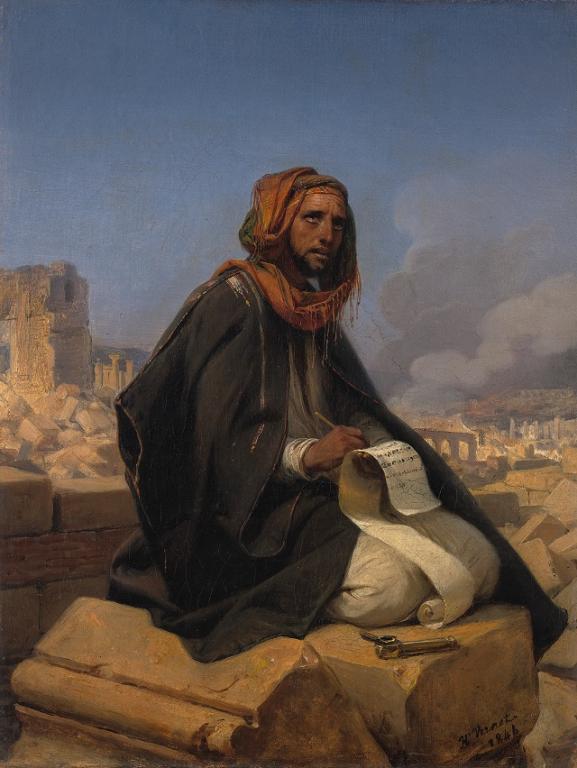
Photo credit: Jeremiah on the ruins of Jerusalem (1844), by Horace Vernet (1789-1863) [public domain / Wikimedia Commons]

***
Jews & Judaism & Old Testament
alleged biblical contradictions
Previous Post

September 10, 2019
Loftus Atheist Error #9: Bible Espouses Mythical Animals?
Next Post
September 11, 2019 The "Problem of Good": Dialogue w Atheist Academic
Browse Our Archives
Select a Category & Last Things About Me Anti-Catholicism Atheism & Agnosticism Baptism and Sacramentalism Bible and Tradition Blessed Virgin Mary Books by Dave Armstrong C. S. Lewis Calvinism & General Protestantism Catholic Apologetics Catholic Apologists Catholic conversion Catholic converts Christmas Church (Ecclesiology) Church History Conversion and Converts Development of Doctrine Eastern Orthodoxy Ecumenism & Christian Unity Eucharist & Liturgy Fathers of the Church French Translations G. K. Chesterton Hell Hell & Satan Hell & Satan & Last Things Heresies & Comparative Religion Holistic Health Inquisition & Crusades & Scandals James White Jews & Judaism & Old Testament John Calvin John Henry Newman Liberal / Modernist Theology Life Issues Literary Resume Lutheranism Mariology Martin Luther Music Orthodoxy Papacy & Infallibility Personal Page Philosophy & Science Political & Ethical & Moral Issues Protestant Persecution & Intolerance Protestantism Purgatory Purgatory & Penance Romantic & Imaginative Theology Saints & Purgatory & Penance Salvation Salvation & Justification Satan & Last Things Sexuality and Gender Issues Spanish Translations Traditionalism vs. Radical Catholic Reactionaries Traducciones al español / tradução para português Trinitarianism & Christology Uncategorized Videos
Select a Month October 2026 September 2026 August 2026 July 2026 June 2026 May 2026 April 2026 March 2026 February 2026 January 2026 December 2025 November 2025 October 2025 September 2025 August 2025 July 2025 June 2025 May 2025 April 2025 March 2025 February 2025 January 2025 December 2024 November 2024 October 2024 September 2024 August 2024 July 2024 June 2024 May 2024 April 2024 March 2024 February 2024 January 2024 December 2023 November 2023 October 2023 September 2023 August 2023 July 2023 June 2023 May 2023 April 2023 March 2023 February 2023 January 2023 December 2022 November 2022 October 2022 September 2022 August 2022 July 2022 June 2022 May 2022 April 2022 March 2022 February 2022 January 2022 December 2021 November 2021 October 2021 September 2021 August 2021 July 2021 June 2021 May 2021 April 2021 March 2021 February 2021 January 2021 December 2020 November 2020 October 2020 September 2020 August 2020 July 2020 June 2020 May 2020 April 2020 March 2020 February 2020 January 2020 December 2019 November 2019 October 2019 September 2019 August 2019 July 2019 June 2019 May 2019 April 2019 March 2019 February 2019 January 2019 December 2018 November 2018 October 2018 September 2018 August 2018 July 2018 June 2018 May 2018 April 2018 March 2018 February 2018 January 2018 December 2017 November 2017 October 2017 September 2017 August 2017 July 2017 June 2017 May 2017 April 2017 March 2017 February 2017 January 2017 December 2016 November 2016 October 2016 September 2016 August 2016 July 2016 June 2016 May 2016 April 2016 March 2016 February 2016 January 2016 December 2015 November 2015 October 2015 September 2015 August 2015 July 2015 June 2015 May 2015 April 2015 March 2015 February 2015 January 2015 December 2014 November 2014 October 2014 September 2014 August 2014 July 2014 June 2014 April 2014 March 2014 February 2014 January 2014 December 2013 November 2013 October 2013 September 2013 August 2013 July 2013 June 2013 April 2013 March 2013 February 2013 January 2013 December 2012 November 2012 October 2012 September 2012 August 2012 July 2012 June 2012 May 2012 April 2012 March 2012 February 2012 January 2012 December 2011 November 2011 October 2011 September 2011 August 2011 July 2011 June 2011 April 2011 March 2011 February 2011 October 2010 September 2010 August 2010 July 2010 April 2010 March 2010 December 2009 October 2009 August 2009 July 2009 June 2009 May 2009 March 2009 February 2009 October 2008 September 2008 April 2008 March 2008 February 2008 January 2008 December 2007 November 2007 October 2007 May 2007 March 2007 February 2007 January 2007 November 2006 October 2006 September 2006 August 2006 July 2006 June 2006 May 2006 April 2006 March 2006 February 2006 October 2005 June 2005 April 2005 February 2005 July 2004 May 2004 April 2004
Follow Us!
TAKE THE
Religious Wisdom Quiz
Who was the king who arranged for Hezekiah's scribes to compile additional Proverbs?
Select your answer to see how you score.
Jeroboam Hezekiah Solomon Ahab
Books by This Author Books by Dave Armstrong
Related posts from Biblical Evidence for Catholicism

A Few "Worst" & "Best" Arguments vs. Protestantism
Biblical Evidence for Catholicism

Jerusalem Council vs. James White & Sola Scriptura
Biblical Evidence for Catholicism

Biblical Perspicuity: Absurd Anti-Catholic "Defense"
Biblical Evidence for Catholicism

50 Biblical Disproofs of "Evident Clearness" of the...
Biblical Evidence for Catholicism
TRENDING AT PATHEOS Catholic

Nearly every morning, I make the drive to Detroit with my high-school-age...

The Real AI Story Is Adoption Without Trust
Artificial intelligence has crossed a political threshold. It is no longer a...

A new article, written by Jeff Lindsay and Gale L. Pooley,...

Swimfan: Forgotten Aughts Pleasures
This is a recovery effort. In 2002, My Big Fat Greek Wedding...

Top Three Anti-Catholic Lies About Catholicism
This is my initial transcript for the video, "THE 3 WORST...

Pope Leo Celebrates Mass for Nurses & Docs...
I don't have any idea how he did it, but Pope Leo...
view all Catholic blogs
Ad-Free & Subscriber Log-In Subscription Support
- About Us
- 2026 Calendar
- Videos
- Podcasts
- Library of World Religions
- Faith In Media Tracker
- Advertise With Us
- Write for Us
- Privacy Policy
- Terms of Service
- Do Not Sell My Data
- Contact Us
- Radiant Digital
- Manage Newsletter Subscriptions
- Unsubscribe From Notifications
- Sitemap
Copyright 2008-2026, Patheos. All rights reserved.
Subscription Support Ad-Free & Subscriber Log-In
Follow Patheos