
BuddhistCatholicContemplativeEvangelicalGeneral ChristianHinduJewishLatter-day SaintMuslimNew VisionsProgressive Christian
Beliefs
- Buddhist
- Catholic
- Contemplative
- Evangelical
- General Christian
- Hindu
- Jewish
- Latter-day Saint
- More Voices
- Muslim
- New Visions
- Pagan
- Progressive Christian
Topics
- Religion News
- Food and Religion
- Sports and Religion
- Religious Art
- Religious Music and Entertainment
- Religious Events
- History and Religion
- Style and Religion
- Politics and Religion
- Women in Religion
- Recreation Outdoors and Religion
- Business Finance and Religion
- Careers Workplace and Religion
- Education and Religion
- Family Parenting and Religion
- Health Fitness and Religion
- Home and Religion
- Relationships and Religion
- Technology and Religion
- Travel and Religion
Columnists
- Buddhist Columnists
- Business Finance and Religion Columnists
- Careers Workplace and Religion Columnists
- Catholic Columnists
- Contemplative Columnists
- Education and Religion Columnists
- Evangelists Columnists
- Family Parenting and Religion Columnists
- General Christian Columnists
- Health Fitness and Religion Columnists
- Hindu Columnists
- History and Religion Columnists
- Home and Religion Columnists
- Jewish Columnists
- More Voices Columnists
- Latter Day Columnists
- Muslim Columnists
- New Visions Columnists
- Nonreligious Columnists
- Pagan Columnists
- Politics and Religion Columnists
- Progressive Columnists
- Recreation Outdoors and Religion Columnists
- Relationships and Religion Columnists
- Religion News Columnists
- Religious Art Columnists
- Religious Events Columnists
- Religious Music and Entertainment Columnists
- Sports and Religion Columnists
- Style and Religion Columnists
- Technology and Religion Columnists
- Travel and Religion Columnists
- Women in Religion Columnists
Resource Library
- 2026 Calendar
- Library of World Religions
- The 100 Most Holy Places on Earth
- Patheos Answers
- Podcasts
- Videos
- Faith Leaders Database
- Anglican Episcopalian
- Bahai
- Baptist
- Buddhism
- Christianity
- Confucianism
- Eastern Orthodoxy
- Hinduism
- Holiness and Pentecostal
- ISKCON
- Islam
- Judaism
- Lutheran
- Methodist
- The Church of Jesus Christ of Latter-day Saints
- New Age
- Paganism
- Presbytarian and Reformed
- Protestantism
- Religion Behind the Scenes
- Roman Catholic
- Scientology
- Shia Islam
- Sikhism
- Sufism
- Sunni Islam
- Taoism
- Zen
- See all religions
Research Tools
 Ad-Free & Subscriber Log-In Subscription Support
Ad-Free & Subscriber Log-In Subscription Support
Follow Patheos 

- Trending:
- Forgiveness
- |
- Marriage
- |
- Consciousness
- |
- Death Penalty
- |
- Election
- |
- Halloween

-
About
-
Catholic Apologetics
-
Church History
-
Great Apologists
-
Christian Worldview
-
Protestantism & Misc.
- Home
- Catholic
- History and Religion
- Madison vs. the Gospel of Mark #1: Intro. & Overview
Madison vs. the Gospel of Mark #1: Intro. & Overview
Last updated on: August 26, 2019 at 3:06 pm by Dave Armstrong
Madison vs. the Gospel of Mark #1: Intro. & Overview 2019-08-26T15:06:21-04:00 Dave Armstrong
Patheos Explore the world's faith through different perspectives on religion and spirituality! Patheos has the views of the prevalent religions and spiritualities of the world.
Gospels as “Con Job”? / Parables & Repentance / Old Testament Sacrifices & Jesus / “Weird” Mark 16 / Why Jesus Was Killed
This is an installment of my replies to a series of articles on Mark by Dr. David Madison: an atheist who was a Methodist minister for nine years: with a Ph.D. in Biblical Studies from Boston University. His summary article is called, “Not-Your-Pastor’s Tour of Mark’s Gospel: The falsification of Christianity made easy” (Debunking Christianity, 7-17-19). His words will be in blue below.
Dr. Madison has utterly ignored my twelve refutations of his “dirty dozen” podcasts against Jesus, and I fully expect that stony silence to continue. If he wants to be repeatedly critiqued and make no response, that’s his choice (which would challenge Bob Seidensticker as the most intellectually cowardly atheist I know). I will continue on, whatever he decides to do (no skin off my back).
Dr. Madison believes we are not at all sure whether Jesus in fact said anything recorded in the Gospels. The atheist always has a convenient “out” (when refuted in argument about some biblical text) that Jesus never said it anyway and that the text in question was simply made up and added later by unscrupulous and “cultish” Christian propagandists.
I always refuse to play this silly and ultimately intellectually dishonest game, because there is no way to “win” with such a stacked, subjective deck. I start with the assumption (based on many historical evidences) that the manuscripts we have are quite sufficient for us to know what is in the Bible (believe it or not).
Dr. Madison himself — in his anti-Jesus project noted above, granted my outlook, strictly in terms of practical “x vs. y” debate purposes: “For the sake of argument, I’m willing to say, okay, Jesus was real and, yes, we have gospels that tell the story.” And in the combox: “So, we can go along with their insistence that he did exist. We’ll play on their field, i.e., the gospels.” Excellent! Otherwise, there would be no possible discussion at all.
*****
Dr. Madison called his Introduction to Mark, “Getting the Gospels Off on the Wrong Foot: The strange Jesus in Mark’s story” (1-19-18).
The Christian church has managed to pull off one of the biggest con jobs in history.
One readily perceives that Dr. Madison is perhaps not the most objective and fair observer of the Christianity that he forsook, doesn’t one? Sun Tzu, a contemporary of the prophet Jeremiah, wrote in The Art of War in the 6th century BC: “If you know yourself but not the enemy, for every victory gained you will also suffer a defeat. If you know neither the enemy nor yourself, you will succumb in every battle.”
The laity trusted their priests that Christ the Redeemer was all that mattered; hence the down-and-dirty details in the gospels went unnoticed.
Ignorance is always at a premium in any large social / religious [or any type of] group — no argument there. Take a look at, for example, any combox at the Debunking Christianity site where Dr. Madison posts, for ample confirmation. But this is silly as a sweeping generalization, since all Catholics, at least, have heard a great deal of Bible reading from the pulpit (especially the Gospels) at Mass every week. We’re not as stupid and clueless as Dr. Madison would like his readers to believe. And he’s not nearly as “smart”: as I continue to repeatedly demonstrate, if I do say so: insofar as he thinks he has made mincemeat of the Bible.
If you accept the Jesus of Mark’s gospel, you are well on the way to full-throttle crazy religion.
Well, we’ll see about that, won’t we? Dr. Madison, I submit, exhibits far more fanaticism and distemper in his anti-theist atheism than the average Christian I have known (and I’ve known a million of them these past 42 years).
The other gospel writers, in their spinning of Jesus fiction, carried on the tradition of invention, . . .
As I stated in the generic introduction above, I will not entertain arbitrary and foolish silliness of this sort (just to make that crystal clear). I’m here to defend the text as we have it and to show that Dr. Madison’s assertions are logically fallacious or factually incorrect.
Gospel experts, of the apologetic Christian variety, won’t hear any of this. . . . they devote their careers to smoothing out rough edges and erasing Jesus blemishes.
And Dr. Madison devotes his Bible-bashing “career” (or prevalent pastime?) to running from every critique of his arguments; or at least that’s how it’s always been with me, thus far, and I am a professional Christian / Catholic apologist, after all. I make arguments that I find plausible and defensible (or else I wouldn’t bother making them), and I can hardly change my mind if there is no counter-reply at all.
In the many instances in my life where I have undergone a major change of mind, it was always through substantive but cordial interaction with critics of a different view. Thinkers engage in back-and-forth dialogue. But demagogues and propagandists split at the first whiff of opposition to their infallible ideas.
(1) Jesus was an exorcist.
This is most vividly illustrated by the story in Mark 5:1-13, in which Jesus transfers demons from a severely mentally ill man into a herd of pigs. See what I mean by full-throttle crazy? Mark depicts Jesus talking to, bargaining with, the demons. Is this really the worldview that Christians these days want to adopt? Well, maybe so, since many Christians believe in ghosts, angels and dead saints who hear prayers—and demons, apparently.
Yes, this is Christianity. We believe in all those things, including Satan. But of course, this would lead into a huge exterior discussion on Christian ontology / metaphysics and the existence of the supernatural. It’s simply too complex to get into in the middle of textual discussions. Dr. Madison obviously has a virulently anti-supernatural view, and he is on the level of thinking anyone who believes in these things as nuts. There is no discussion with that, and I can’t follow every rabbit trail that he brings up, anyway, or I wouldn’t have enough time in my entire life to reply to his hostile contentions.
(2) Jesus tried to fool people by teaching in parables.
Of course, this doesn’t make sense. What was Mark thinking? But here it is, Mark 4:10-12, which includes a quotation from Isaiah 6:9-10:
“When he was alone, those who were around him along with the twelve asked him about the parables. And he said to them, ‘To you has been given the secret of the kingdom of God, but for those outside, everything comes in parables; in order that they may indeed look, but not perceive, and may indeed listen, but not understand; so that they may not turn again and be forgiven.’”
I thoroughly disposed of this objection in my paper, “Madison vs. Jesus #7: God Prohibits Some Folks’ Repentance?”
It’s odd because—ooops—in John’s gospel, Jesus doesn’t teach in parables.
That’s correct. But Jesus does talk (as recorded in the Gospel of John) in many metaphorical or proverbial (non-literal) ways that bear resemblance to the synoptic parables. For example:
John 2:19-21 (RSV) Jesus answered them, “Destroy this temple, and in three days I will raise it up.” [20] The Jews then said, “It has taken forty-six years to build this temple, and will you raise it up in three days?” [21] But he spoke of the temple of his body.
John 3:8 The wind blows where it wills, and you hear the sound of it, but you do not know whence it comes or whither it goes; so it is with every one who is born of the Spirit.
John 4:13-14 Jesus said to her, “Every one who drinks of this water will thirst again, [14] but whoever drinks of the water that I shall give him will never thirst; the water that I shall give him will become in him a spring of water welling up to eternal life.”
John 6:35 Jesus said to them, “I am the bread of life; he who comes to me shall not hunger, and he who believes in me shall never thirst.
John 10:11 I am the good shepherd. The good shepherd lays down his life for the sheep. (see also 10:1-10, 12-18, including Jesus calling Himself “the door” three times)
John 11:12-14 But if any one walks in the night, he stumbles, because the light is not in him.” [11] Thus he spoke, and then he said to them, “Our friend Laz’arus has fallen asleep, but I go to awake him out of sleep.” [12] The disciples said to him, “Lord, if he has fallen asleep, he will recover.” [13] Now Jesus had spoken of his death, but they thought that he meant taking rest in sleep. [14] Then Jesus told them plainly, “Laz’arus is dead;”
(3) Jesus believed in human sacrifice to get right with God.
This is a vestige of animal sacrifice superstition, and is a fine specimen of magical thinking: How can killing an animal cancel human sin? Why would a good god set up such a scheme?
I guess in the same way that He set up the animal kingdom, including meat-eating, which also required the killing of animals (which is also a feature of evolution and nature: construed as utterly self-governed [i.e., materialistic evolution], without any supervision by God). Or is Dr. Madison a vegetarian? Something tells me that he is not.
It’s not that animal blood has intrinsic magical or curative properties. It’s simply the symbolism that God ordained: to show human beings the seriousness of sin. The writer of Hebrews expressly denied that the old covenant system of animal sacrifice actually took away sins:
Hebrews 10:1-4, 11 For since the law has but a shadow of the good things to come instead of the true form of these realities, it can never, by the same sacrifices which are continually offered year after year, make perfect those who draw near. [2] Otherwise, would they not have ceased to be offered? If the worshipers had once been cleansed, they would no longer have any consciousness of sin. [3] But in these sacrifices there is a reminder of sin year after year. [4] For it is impossible that the blood of bulls and goats should take away sins. . . . [11] And every priest stands daily at his service, offering repeatedly the same sacrifices, which can never take away sins.
Even in the Old Testament, there are many indications that the sacrificial system was to be abolished, and was never the most important thing: righteousness and obedience to God’s commands were that:
Proverbs 15:8 The sacrifice of the wicked is an abomination to the LORD, but the prayer of the upright is his delight.
Amos 5:12, 14, 21-24 For I know how many are your transgressions, and how great are your sins — you who afflict the righteous, who take a bribe, and turn aside the needy in the gate. . . . [14] Seek good, and not evil, that you may live; and so the LORD, the God of hosts, will be with you, as you have said . . . [21] I hate, I despise your feasts, and I take no delight in your solemn assemblies. [22] Even though you offer me your burnt offerings and cereal offerings, I will not accept them, and the peace offerings of your fatted beasts I will not look upon. [23] Take away from me the noise of your songs; to the melody of your harps I will not listen. [24] But let justice roll down like waters, and righteousness like an ever-flowing stream.
Jesus reflected these thoughts in the New Testament:
Matthew 9:13 “Go and learn what this means, ‘I desire mercy, and not sacrifice’. . . .” (cf. 12:7)
He was citing the Hebrew Bible:
Hosea 6:6 For I desire steadfast love and not sacrifice, the knowledge of God, rather than burnt offerings.
In other words, if and when the Israelites were rebellious against God and His laws and wicked, their sacrifices (far from being “magic”) meant absolutely nothing to God, and accomplished nothing. This is a constant motif in the Old Testament. The law, including these animal sacrifices, was never intended from the beginning to save men. Grace and faith in God; Jesus’ redemption accomplished that. Hence, Paul writes:
Galatians 2:16 yet who know that a man is not justified by works of the law but through faith in Jesus Christ, even we have believed in Christ Jesus, in order to be justified by faith in Christ, and not by works of the law, because by works of the law shall no one be justified.
Galatians 3:10-12, 19, 21-26 For all who rely on works of the law are under a curse; for it is written, “Cursed be every one who does not abide by all things written in the book of the law, and do them.” [11] Now it is evident that no man is justified before God by the law; for “He who through faith is righteous shall live”; [12] but the law does not rest on faith, for “He who does them shall live by them.” . . . [19] Why then the law? It was added because of transgressions, . . . [21] Is the law then against the promises of God? Certainly not; for if a law had been given which could make alive, then righteousness would indeed be by the law. [22] But the scripture consigned all things to sin, that what was promised to faith in Jesus Christ might be given to those who believe. [23] Now before faith came, we were confined under the law, kept under restraint until faith should be revealed. [24] So that the law was our custodian until Christ came, that we might be justified by faith. [25] But now that faith has come, we are no longer under a custodian; [26] for in Christ Jesus you are all sons of God, through faith.
Mark would have us believe that a Galilean peasant got it into his head that he was selected for this mission (10:45): “For the Son of Man came not to be served but to serve, and to give his life a ransom for many.”
He didn’t get “it into his head”: He always knew this, being God and the Second Person of the Holy Trinity from all eternity. Hence, He expressed in many ways, in the Gospels, that He was God.
How can Christians not notice that a human sacrifice to placate God is bad theology?
It’s not a sacrifice as classically understood: like the Aztecs taking some poor child up one of their pyramids to have his or her heart cut out while they were alive, or the heathen tribes who lived around the ancient Israelites, who sacrificed their babies to Moloch (throwing them into a fire). Those things are barbaric.
But this was an act by God (Jesus) to voluntarily suffer and die on our behalf (Mt 20:28; 26:53; Mk 10:45; Lk 19:10; Jn 6:51; 10:10-18; 19:10-11; Gal 2:20; Eph 5:1-2; Phil 2:5-8; 1 Tim 2:5-6; Titus 2:13-14), just as we (to use an imperfect analogy) honor heroes who sacrificed themselves so that others can live (for example, the two young men recently who lost their lives in two of the horrible shooting massacres). This is what Memorial Day is about.
(4) Jesus preached that the Kingdom of God was immanent—and he was wrong.
The present world order was about to be wiped out, indeed “before this generation passes away”—and it would not be pretty. There would be massive human suffering to mark the initiation of the Kingdom of God. Please, Christians, read Mark 13 and seriously ponder how this fits in with your view of what would Jesus do. Calamities are a sign that God’s get-even theology will be realized; the tone of Mark 13 is urgency, with the closing words “keep watch.” Of course, no Kingdom arrived. Mark 13 is an example of religion gone off rails and closely matches the demented ramblings of the apostle Paul. John Loftus is right in describing Jesus as a failed apocalyptic prophet.
I already demolished this in my earlier reply: “Dr. David Madison vs. Jesus #3: Nature & Time of 2nd Coming.”
(5) Jesus the great moral teacher fails to show up.
[. . .]
Moreover, there are comments in this gospel for which Jesus deserves demerits; we expect far better from a great moral teacher. His counsel on divorce at 10:9, for example, is inexplicable and irresponsible. Yes, we can understand that God created male and female—and expects a man to leave his parents to get married. But that does not mean that God has been matchmaker for every couple that ever was: “Therefore what God has joined together, let no one separate.” In fact, this is a mindless non sequitur—and has caused so much misery.
I dealt with this in my paper, Madison vs. Jesus #4: Jesus Causes a Bad Marriage?
Jesus gets a very poor grade as well for this bit of cult fanaticism, 10:29-30: “Truly I tell you, there is no one who has left house or brothers or sisters or mother or father or children or fields, for my sake and for the sake of the good news, who will not receive a hundredfold now in this age—houses, brothers and sisters, mothers and children, and fields, with persecutions—and in the age to come eternal life.” You will be rewarded for leaving your family? You’ll get a new set of relatives and new houses? How can Christians be comfortable with this?
This is covered in my paper, Madison vs. Jesus #5: Cultlike Forsaking of Family?
(6) [What] did Jesus mean with this list?
What more could you want? It’s the resurrected Jesus who explains that “those who believe” will be able to do these five things (Mark 16:16-18):
1. Cast out demons (yes, we’re back to demons)
2. Speak in new tongues
3. Pick up snakes
4. Drink any deadly thing
5. Lay hands on people to heal them
Those who want to distance themselves from this text can point out that these verses were not in the original gospel: Mark 16:9-20 is a later addition. No one knows where this part of chapter 16 came from. But those want to dismiss these verses are admitting that fake news about Jesus made it into the New Testament. Alas, however, we don’t know where any of Mark’s gospel came from; maybe it’s all fake news. This list may not be from the mouth of Jesus, but whoever thought it up certainly had a goofy take on Christianity.
But, hey, here’s the challenge for apologists who insist that the gospels are based on eyewitness accounts and highly reliable oral tradition. These six items I’ve listed: Do you really want to argue that these reflect authentic Jesus information?
Yes.
Is this strange Jesus the one you want?
It’s not strange if rightly understood. What is strange is an educated man like Dr. Madison routinely getting things dead wrong in his analyses of the Bible and Jesus. I wrote about this topic, too, in this post of mine: Dr. David Madison vs. Jesus #2: Weird & Fictional Mark 16? He obviously recycled a lot of these whoppers in his more recent podcasts that I refuted. But (hate to break the news) simply repeating a lousy argument doesn’t make it any stronger.
Maybe, after all, there’s a glimpse of history at Mark 3:21, where we find that Jesus’s family wasn’t too thrilled about his vocation. “When his family heard it, they went out to restrain him, for people were saying, ‘He has gone out of his mind.’”
That sounds about right to me.
Yeah, me, too (but for the opposite reasons). Great human beings are routinely vastly misunderstood. For example, here is the gist of what Plato wrote about the cause of Socrates’ persecution and death, in his Apology:
At his trial, Socrates is accused of two things: impiety (asebeia) against Athens’s gods, by introducing new gods, and corruption of Athenian youth, by teaching them to question the status quo. He is accused of impiety because the Oracle at Delphi said there was no wiser man in Athens then Socrates, and Socrates knew he was not wise. After hearing that, he questioned every man he met to find a wiser man than he.
The corruption charge, said Socrates in his defense, was because by questioning people in public, he embarrassed them, and they, in turn, accused him of corrupting the youth of Athens by the use of sophistry. (“What Was the Charge Against Socrates?,” N. S. Gill, ThoughtCo., 11-28-18)
That sounds very familiar. Jesus’ enemies (mostly the scribes and Pharisees) accused Him of blasphemy and impiety because He claimed to be God, and also the Messiah. This upset the apple cart (to put it extremely mildly), so they sought to kill Him:
John 5:15-18 The man went away and told the Jews that it was Jesus who had healed him. [16] And this was why the Jews persecuted Jesus, because he did this on the sabbath. [17] But Jesus answered them, “My Father is working still, and I am working.” [18] This was why the Jews sought all the more to kill him, because he not only broke the sabbath but also called God his Father, making himself equal with God.
John 10:30-36 “I and the Father are one.” [31] The Jews took up stones again to stone him. [32] Jesus answered them, “I have shown you many good works from the Father; for which of these do you stone me?” [33] The Jews answered him, “It is not for a good work that we stone you but for blasphemy; because you, being a man, make yourself God.” [34] Jesus answered them, “Is it not written in your law, `I said, you are gods’? [35] If he called them gods to whom the word of God came (and scripture cannot be broken), [36] do you say of him whom the Father consecrated and sent into the world, `You are blaspheming,’ because I said, `I am the Son of God’
Matthew 26:63-66 . . . And the high priest said to him, “I adjure you by the living God, tell us if you are the Christ [the Messiah], the Son of God.” [64] Jesus said to him, “You have said so. But I tell you, hereafter you will see the Son of man seated at the right hand of Power, and coming on the clouds of heaven.” [65] Then the high priest tore his robes, and said, “He has uttered blasphemy. Why do we still need witnesses? You have now heard his blasphemy. [66] What is your judgment?” They answered, “He deserves death.” [clearly applying to himself the famous messianic passage, Daniel 7:13]
John 7:1 After this Jesus went about in Galilee; he would not go about in Judea, because the Jews sought to kill him.
John 19:7 The Jews answered him, “We have a law, and by that law he ought to die, because he has made himself the Son of God.”
Jesus, like Socrates, went against the established religious orthodoxy and the corrupt status quo (even using Socrates’ own famous questioning “method”), and had to be killed for it. They started saying He was demonically possessed and that He cast out demons by demonic power (Mk 3:22), to which Jesus retorted, “a house divided against itself cannot stand” (Mk 3:25).
And people said “He is beside himself” (Mk 3:21) because Jesus had (heaven forbid!) healed people (Mk 3:1-10). And (also very much like Socrates’ case) people (filled with pride then as now, if they lose an argument or are shown to be wrong) didn’t like how He overcame them with His socratic questioning:
Luke 14:5-6 And he said to them, “Which of you, having a son or an ox that has fallen into a well, will not immediately pull him out on a sabbath day?” [6] And they could not reply to this.
Mark 3:1-4 Again he entered the synagogue, and a man was there who had a withered hand. [2] And they watched him, to see whether he would heal him on the sabbath, so that they might accuse him. [3] And he said to the man who had the withered hand, “Come here.” [4] And he said to them, “Is it lawful on the sabbath to do good or to do harm, to save life or to kill?” But they were silent.
Luke 20:19-26 The scribes and the chief priests tried to lay hands on him at that very hour, but they feared the people; for they perceived that he had told this parable against them. [20] So they watched him, and sent spies, who pretended to be sincere, that they might take hold of what he said, so as to deliver him up to the authority and jurisdiction of the governor. [21] They asked him, “Teacher, we know that you speak and teach rightly, and show no partiality, but truly teach the way of God. [22] Is it lawful for us to give tribute to Caesar, or not?” [23] But he perceived their craftiness, and said to them, [24] “Show me a coin. Whose likeness and inscription has it?” They said, “Caesar’s.” [25] He said to them, “Then render to Caesar the things that are Caesar’s, and to God the things that are God’s.” [26] And they were not able in the presence of the people to catch him by what he said; but marveling at his answer they were silent.
Matthew 21:23-27 And when he entered the temple, the chief priests and the elders of the people came up to him as he was teaching, and said, “By what authority are you doing these things, and who gave you this authority?” [24] Jesus answered them, “I also will ask you a question; and if you tell me the answer, then I also will tell you by what authority I do these things. [25] The baptism of John, whence was it? From heaven or from men?” And they argued with one another, “If we say, `From heaven,’ he will say to us, `Why then did you not believe him?’ [26] But if we say, `From men,’ we are afraid of the multitude; for all hold that John was a prophet.” [27] So they answered Jesus, “We do not know.” And he said to them, “Neither will I tell you by what authority I do these things.
Matthew 21:45-46 When the chief priests and the Pharisees heard his parables, they perceived that he was speaking about them. [46] But when they tried to arrest him, they feared the multitudes, because they held him to be a prophet.
So sure, this is why Jesus was unpopular in some circles (the same ones that had Him killed), and this should not surprise anyone. Great men and women are often persecuted up to and including death. The parallels between Jesus and Socrates are striking, but not shocking at all, with even a rudimentary knowledge of history and the usual prominent flaws of fallen human nature (jealousy, pride, arrogance, lust for power, outmoded and corrupt traditions, excessive desire for fame and adulation, etc.).
***
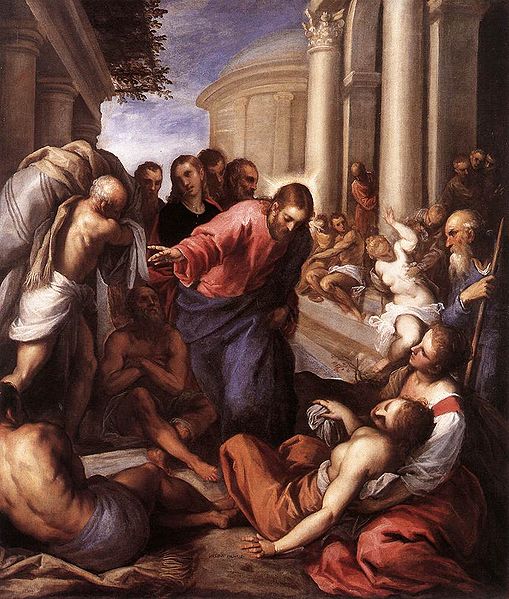
Photo credit: Jesus Healing the Paralytic at the Pool of Bethesda (1592), by Palma il Giovane (1544-1628) [public domain / Wikimedia Commons]

***
alleged biblical contradictions
Not-Your-Pastor’s Tour of Mark’s Gospel
Previous Post

August 13, 2019
Masturbation Remains a Grave Sin (Debate w Steve Hays)
Next Post

August 14, 2019 Masturbation: Thoughts on Why it is as Wrong as it Ever Was
Browse Our Archives
Select a Category & Last Things About Me Anti-Catholicism Atheism & Agnosticism Baptism and Sacramentalism Bible and Tradition Blessed Virgin Mary Books by Dave Armstrong C. S. Lewis Calvinism & General Protestantism Catholic Apologetics Catholic Apologists Catholic conversion Catholic converts Christmas Church (Ecclesiology) Church History Conversion and Converts Development of Doctrine Eastern Orthodoxy Ecumenism & Christian Unity Eucharist & Liturgy Fathers of the Church French Translations G. K. Chesterton Hell Hell & Satan Hell & Satan & Last Things Heresies & Comparative Religion Holistic Health Inquisition & Crusades & Scandals James White Jews & Judaism & Old Testament John Calvin John Henry Newman Liberal / Modernist Theology Life Issues Literary Resume Lutheranism Mariology Martin Luther Music Orthodoxy Papacy & Infallibility Personal Page Philosophy & Science Political & Ethical & Moral Issues Protestant Persecution & Intolerance Protestantism Purgatory Purgatory & Penance Romantic & Imaginative Theology Saints & Purgatory & Penance Salvation Salvation & Justification Satan & Last Things Sexuality and Gender Issues Spanish Translations Traditionalism vs. Radical Catholic Reactionaries Traducciones al español / tradução para português Trinitarianism & Christology Uncategorized Videos
Select a Month October 2026 September 2026 August 2026 July 2026 June 2026 May 2026 April 2026 March 2026 February 2026 January 2026 December 2025 November 2025 October 2025 September 2025 August 2025 July 2025 June 2025 May 2025 April 2025 March 2025 February 2025 January 2025 December 2024 November 2024 October 2024 September 2024 August 2024 July 2024 June 2024 May 2024 April 2024 March 2024 February 2024 January 2024 December 2023 November 2023 October 2023 September 2023 August 2023 July 2023 June 2023 May 2023 April 2023 March 2023 February 2023 January 2023 December 2022 November 2022 October 2022 September 2022 August 2022 July 2022 June 2022 May 2022 April 2022 March 2022 February 2022 January 2022 December 2021 November 2021 October 2021 September 2021 August 2021 July 2021 June 2021 May 2021 April 2021 March 2021 February 2021 January 2021 December 2020 November 2020 October 2020 September 2020 August 2020 July 2020 June 2020 May 2020 April 2020 March 2020 February 2020 January 2020 December 2019 November 2019 October 2019 September 2019 August 2019 July 2019 June 2019 May 2019 April 2019 March 2019 February 2019 January 2019 December 2018 November 2018 October 2018 September 2018 August 2018 July 2018 June 2018 May 2018 April 2018 March 2018 February 2018 January 2018 December 2017 November 2017 October 2017 September 2017 August 2017 July 2017 June 2017 May 2017 April 2017 March 2017 February 2017 January 2017 December 2016 November 2016 October 2016 September 2016 August 2016 July 2016 June 2016 May 2016 April 2016 March 2016 February 2016 January 2016 December 2015 November 2015 October 2015 September 2015 August 2015 July 2015 June 2015 May 2015 April 2015 March 2015 February 2015 January 2015 December 2014 November 2014 October 2014 September 2014 August 2014 July 2014 June 2014 April 2014 March 2014 February 2014 January 2014 December 2013 November 2013 October 2013 September 2013 August 2013 July 2013 June 2013 April 2013 March 2013 February 2013 January 2013 December 2012 November 2012 October 2012 September 2012 August 2012 July 2012 June 2012 May 2012 April 2012 March 2012 February 2012 January 2012 December 2011 November 2011 October 2011 September 2011 August 2011 July 2011 June 2011 April 2011 March 2011 February 2011 October 2010 September 2010 August 2010 July 2010 April 2010 March 2010 December 2009 October 2009 August 2009 July 2009 June 2009 May 2009 March 2009 February 2009 October 2008 September 2008 April 2008 March 2008 February 2008 January 2008 December 2007 November 2007 October 2007 May 2007 March 2007 February 2007 January 2007 November 2006 October 2006 September 2006 August 2006 July 2006 June 2006 May 2006 April 2006 March 2006 February 2006 October 2005 June 2005 April 2005 February 2005 July 2004 May 2004 April 2004
Follow Us!
TAKE THE
Religious Wisdom Quiz
What was Paul’s profession before becoming an apostle?
Select your answer to see how you score.
Tentmaker Tax Collector Fisherman Carpenter
Books by This Author Books by Dave Armstrong
Related posts from Biblical Evidence for Catholicism

God, Modern Physics, & Dark Energy: An Analogy
Biblical Evidence for Catholicism

General Debate on Christianity with an Atheist
Biblical Evidence for Catholicism

Can Atheists Be Saved? Surprising Biblical Data
Biblical Evidence for Catholicism
Can Atheists Be Saved? YES! (Possibly Some ....
Biblical Evidence for Catholicism
TRENDING AT PATHEOS Catholic

I was strolling through the top floor of the brand new Parthenon...

What Does Gêvâh Mean For Kimberley Guifoyle &...
This week, a lot of the news is focused on Kimberly Guilfoyle....

INNER CIRCLE: Profound Mystery (Of Christ In All...
Ephesians 5:31-32 “For this reason, a man will leave his father and...

Do Not Rejoice When Your Enemy Falls: The...
Turning an execution into a public spectacle is a disturbing expression of...

'The Chosen' S6 Trailer: The Passion Gets Very...
Not many watching 'The Chosen' worry about spoilers, but just because they...

The purpose-driven labor priest
A labor activist reads Rick Warren and it gets me wondering about...
view all Catholic blogs
Ad-Free & Subscriber Log-In Subscription Support
- About Us
- 2026 Calendar
- Videos
- Podcasts
- Library of World Religions
- Faith In Media Tracker
- Advertise With Us
- Write for Us
- Privacy Policy
- Terms of Service
- Do Not Sell My Data
- Contact Us
- Radiant Digital
- Manage Newsletter Subscriptions
- Unsubscribe From Notifications
- Sitemap
Copyright 2008-2026, Patheos. All rights reserved.
Subscription Support Ad-Free & Subscriber Log-In
Follow Patheos