
BuddhistCatholicContemplativeEvangelicalGeneral ChristianHinduJewishLatter-day SaintMuslimNew VisionsProgressive Christian
Beliefs
- Buddhist
- Catholic
- Contemplative
- Evangelical
- General Christian
- Hindu
- Jewish
- Latter-day Saint
- More Voices
- Muslim
- New Visions
- Pagan
- Progressive Christian
Topics
- Religion News
- Food and Religion
- Sports and Religion
- Religious Art
- Religious Music and Entertainment
- Religious Events
- History and Religion
- Style and Religion
- Politics and Religion
- Women in Religion
- Recreation Outdoors and Religion
- Business Finance and Religion
- Careers Workplace and Religion
- Education and Religion
- Family Parenting and Religion
- Health Fitness and Religion
- Home and Religion
- Relationships and Religion
- Technology and Religion
- Travel and Religion
Columnists
- Buddhist Columnists
- Business Finance and Religion Columnists
- Careers Workplace and Religion Columnists
- Catholic Columnists
- Contemplative Columnists
- Education and Religion Columnists
- Evangelists Columnists
- Family Parenting and Religion Columnists
- General Christian Columnists
- Health Fitness and Religion Columnists
- Hindu Columnists
- History and Religion Columnists
- Home and Religion Columnists
- Jewish Columnists
- More Voices Columnists
- Latter Day Columnists
- Muslim Columnists
- New Visions Columnists
- Nonreligious Columnists
- Pagan Columnists
- Politics and Religion Columnists
- Progressive Columnists
- Recreation Outdoors and Religion Columnists
- Relationships and Religion Columnists
- Religion News Columnists
- Religious Art Columnists
- Religious Events Columnists
- Religious Music and Entertainment Columnists
- Sports and Religion Columnists
- Style and Religion Columnists
- Technology and Religion Columnists
- Travel and Religion Columnists
- Women in Religion Columnists
Resource Library
- 2026 Calendar
- Library of World Religions
- The 100 Most Holy Places on Earth
- Patheos Answers
- Podcasts
- Videos
- Faith Leaders Database
- Anglican Episcopalian
- Bahai
- Baptist
- Buddhism
- Christianity
- Confucianism
- Eastern Orthodoxy
- Hinduism
- Holiness and Pentecostal
- ISKCON
- Islam
- Judaism
- Lutheran
- Methodist
- The Church of Jesus Christ of Latter-day Saints
- New Age
- Paganism
- Presbytarian and Reformed
- Protestantism
- Religion Behind the Scenes
- Roman Catholic
- Scientology
- Shia Islam
- Sikhism
- Sufism
- Sunni Islam
- Taoism
- Zen
- See all religions
Research Tools
 Ad-Free & Subscriber Log-In Subscription Support
Ad-Free & Subscriber Log-In Subscription Support
Follow Patheos 

- Trending:
- Forgiveness
- |
- Marriage
- |
- Consciousness
- |
- Death Penalty
- |
- Election
- |
- Halloween

-
About
-
Catholic Apologetics
-
Church History
-
Great Apologists
-
Christian Worldview
-
Protestantism & Misc.
- Home
- Catholic
- History and Religion
- Madison vs. Jesus #8: Holy Eucharist as “Grotesque Magic”?
Madison vs. Jesus #8: Holy Eucharist as “Grotesque Magic”?
Last updated on: August 7, 2019 at 11:40 am by Dave Armstrong
Madison vs. Jesus #8: Holy Eucharist as “Grotesque Magic”? 2019-08-07T11:40:20-04:00 Dave Armstrong
Patheos Explore the world's faith through different perspectives on religion and spirituality! Patheos has the views of the prevalent religions and spiritualities of the world.
This is an installment of my series of replies to an article by Dr. David Madison: a pastor in the Methodist Church for nine years, who has a PhD in Biblical Studies from Boston University. It’s called, “Things We Wish Jesus Hadn’t Said” (Debunking Christianity, 7-21-19). His words will be in blue below. Dr. Madison makes several “generic” digs at Jesus and Christianity, in the written portion (it details a series of 12 podcasts):
A challenge for Christians: If you’re so sure Jesus existed, then you have some explaining to do. A major frustration is that, while believers are indignant at all the talk about Jesus not existing, they don’t know the issues that fuel the skepticism—and are unwilling to inform themselves.
Yes, I’m up to the “challenge.” No problem at all. I’m not threatened or “scared” by this in the slightest. It’s what I do, as an apologist. The question is whether Dr. Madison is up to interacting with counter-critiques? Or will he act like the voluminous anti-theist atheist polemicist Bob Seidensticker?: who directly challenged me in one of his own comboxes to respond to his innumerable attack-pieces against Christianity and the Bible, and then courageously proceeded to utterly ignore my 35 specific critiques of his claims as of this writing. We shall soon see which course Dr. Madison will decide to take. Anyway, he also states in his post and combox:
[S]o many of the words of Jesus are genuinely shocking. These words aren’t proclaimed much from the pulpit, . . . Hence the folks in the pews have absorbed and adored an idealized Jesus. Christian apologists make their livings refiguring so many of the things Jesus supposedly said.
The gospels are riddled with contradictions and bad theology, and Jesus is so frequently depicted as a cult fanatic—because cult fanatics wrote the gospels. We see Jesus only through their theological filters. I just want to grab hold of Christian heads (standing behind them, with a hand on each ear) and force them to look straight ahead, unflinchingly, at the gospels, and then ask “Tell me what you see!” uncoached by apologist specialists, i.e., priests and pastors, who’ve had a lot of practice making bad texts look good. . . . I DO say, “Deal with the really bad stuff in the gospels.” Are you SURE you’ve not make a big mistake endorsing this particular Lord and Savior? That’s the whole point of this series of Flash Podcasts, because a helluva lot of Christians would agree, right away, that these quotes are bad news—if no one told then that they’ve been attributed to Jesus.
Of course, Dr. Madison — good anti-theist atheist that he is — takes the view that we are not at all sure whether Jesus in fact said anything recorded in the Gospels in the first place. I don’t play that game, because there is no end to it. It’s like trying to pin jello to the wall. The atheist always has their convenient out (when refuted in argument about some biblical text) that Jesus never said it anyway [wink wink and sly patronizing grin], and/or that the biblical text in question was simply added later by dishonest ultra-biased Christian partisans and propagandists. It’s a silly and ultimately intellectually dishonest game, and so I always refuse to play it with atheists or anyone else, because there is no way to “win” with such an absurdly stacked, purely subjective deck.
In my defense of biblical texts, I start with the assumption that the manuscripts we have are quite sufficient for us to know what is in the Bible (believe it or not). Going on from there, I simply defend particular [supposedly “difficult”] texts, and note with appropriate argumentation, that “here, the Bible teaches so-and-so,” etc. I deal with the texts as they exist. I don’t get into the endlessly arbitrary, subjective games that atheists and theologically liberal biblical skeptics play with the texts, in their self-serving textual criticism.
Dr. Madison himself (fortunately) grants my outlook in terms of practical “x vs. y” debate purposes: “For the sake of argument, I’m willing to say, okay, Jesus was real and, yes, we have gospels that tell the story.” And in the combox: “So, we can go along with their insistence that he did exist. We’ll play on their field, i.e., the gospels.”
Good! So we shall examine his cherry-picked texts and see whether his interpretations of them can stand up to scrutiny. He is issuing challenges, and I as an apologist will be dishing a bunch of my own right back to him. Two can play this game. I will be dealing honestly with his challenges. Will he return the favor, and engage in serious and substantive dialogue? Again, we’ll soon know what his reaction will be. A true dialogue is of a confident, inquisitive, “nothing to fear and everything to gain” back-and-forth and interactive nature, not merely “ships passing in the night” or what I call “mutual monologue.”
*****
Dr. Madison’s eighth podcast of twelve is entitled: “On John 6:53-57, eating the flesh of Jesus and drinking his blood are the key to eternal life”. Here is the passage:
John 6:53-57 So Jesus said to them, “Truly, truly, I say to you, unless you eat the flesh of the Son of man and drink his blood, you have no life in you; [54] he who eats my flesh and drinks my blood has eternal life, and I will raise him up at the last day. [55] For my flesh is food indeed, and my blood is drink indeed. [56] He who eats my flesh and drinks my blood abides in me, and I in him. [57] As the living Father sent me, and I live because of the Father, so he who eats me will live because of me.
It’s hard to come up with a better example of magical thinking. How in the world could eating flesh and blood, even if it belonged to a God, bestow eternal life? . . . These verses in John’s Gospel are grotesque magic . . . eating a God to live forever is not real world thinking. It’s magical thinking. It’s bad religion; it’s bad theology. . . . What an embarrassment that this text ended up in the New Testament.
Dr. Madison makes two major points about this text. First he argues that it echoes elements in other mystery religions before or during the time of Jesus; therefore, it is immediately suspect, and was simply yet another deceitful technique used by cult propagandists Mark, Luke, and now John (or whoever he thinks put the Gospel that bears his name together), to put onto the lips of Jesus. He sees this as a disproof of the claim that Jesus even said what He did in John 6.
But it’s by no means certain that when an idea has some aspects within it that were previously present elsewhere, that in and of itself, it disproves the later idea. Why would anyone think that? Yet this is common playbook / talking-points of both atheists and dissident theological liberals, when approaching historic Christianity and the Bible. Let me provide three analogies or word-pictures to reveal the blatant fallacy involved here:
Modern astronomy and the theory of gravity both contain ideas which were present in the prior field of astrology; namely: distant bodies have an influence on the earth. Does it follow that, therefore, gravitation is untrue, simply because of this fact? No, of course not. Astrology had hit upon some truths, while also espousing many falsehoods. And in fact, Isaac Newton was neck-deep in the antiquated pseudo-science of alchemy and other occultic beliefs, at the same time he did legitimate, ground-breaking science; and early astronomers like Galileo, Copernicus, and Kepler, were equally enthralled with astrology, even while they made their momentous contributions to modern astronomy and physics. By the way, St. Thomas Aquinas 300-400 years earlier, and St. Augustine 1100-1200 years earlier, both rejected astrology. Historical truth is much more interesting than revisionist historical fiction.
It’s often noted that there is a Deluge account in the Epic of Gilgamesh; therefore, this casts doubt on the story of Noah’s Flood. But why would it? Is it not more plausible to assert that if in fact (for the sake of argument) such a major Flood had occurred, that other cultures besides Hebrew culture would more likely know about it, rather than not? Say for the sake of argument that the Bible had mentioned Halley’s Comet. We now know that it passes by the earth every 76 years. No doubt many cultures have some written record of observing it. But if the Bible had happened to mention it, it would immediately be suspect because non-Hebrews also wrote about it? Clearly not.
Several cultures for centuries used mold in order to help people heal. Later it was discovered that the antibiotic penicillin was derived from mold. Is it therefore to be rejected as a result? Nope. This is shoddy reasoning. The Wikipedia article. “History of penicillin” noted:
Many ancient cultures, including those in Egypt, Greece, and India, independently discovered the useful properties of fungi and plants in treating infection. These treatments often worked because many organisms, including many species of mold, naturally produce antibiotic substances. However, ancient practitioners could not precisely identify or isolate the active components in these organisms.
A similar argument can be made regarding aspirin. The Wikipedia article notes: “A precursor to aspirin found in leaves from the willow tree has been used for its health effects for at least 2,400 years.” My own family has taken white willow bark for many years to treat pain.
In fact, Catholic apologist G. K. Chesterton, in his masterpiece, The Everlasting Man, argued that it is precisely to be expected, and is an argument in favor of Christianity, that there are many precursors to it: especially in the paganism that flourished in the previous 500 years or so. Anglican apologist C. S. Lewis, in his book, The Abolition of Man, has a section at the end (“Illustrations of the Tao”) in which he shows (and rejoices in) many similarities of world religions.
Young Lewis (very much like myself in my teen years) was enthralled with Norse mythology and Wagner’s operas, etc., and was an atheist. He became a theist after a discussion with J. R. R. Tolkien, in which the latter noted that “Christianity was a true myth.” It had never occurred to Lewis that there could be such a thing as a myth that actually happened. I have written about supposed “pagan elements” in Catholicism: which is a charge that anti-Catholic Protestants often make. It’s fascinating to now see an atheist former Methodist minister use the same fallacious tactic:
*
Is Catholicism Half-Pagan, & a Blend of Gospel & Lies?
*
The second argument Dr. Madison makes (if we can even call it that), is that this eucharistic discourse is merely a species of “magic” (and of a grotesque sort at that). What he calls “magic” (and ironically again, this is an old talking-point of anti-Catholic Protestant fundamentalism as well) is simply sacramentalism. Briefly defined, the word means; “use of matter to convey grace.”
*
I don’t intend to write a mini-treatise on sacramentalism in this reply. Readers may consult my articles for that purpose (just as they can read about the exegesis of John 6 and eucharistic theology on that web page of mine: including extensive exegetical arguments in favor of the literal interpretation). Suffice it to say that it is a very common theme or motif in the Bible:
*
Heartfelt Sacramentalism (Not Mere Charms) [1996]Why do Catholics Believe that Sacraments are Necessary? [2002]
Sacraments & the Moral Responsibility of Their Recipients [8-26-06]
Are Relics & Sacraments Mere Magical Charms? [2007]
Dialogue on Sacramentalism, Holy Objects, and Relics [2-26-09]
Bible on Physical Objects as Aids in Worship [4-7-09]
Sacraments: Bible & Church Fathers (vs. Calvin #34) [9-25-09]
The Biblical Understanding of Holy Places and Things [National Catholic Register, 4-11-17]
Biblical Evidence for Sacramentalism [National Catholic Register, 8-29-17]
Obviously, Dr. Madison is not likely at all to be persuaded of a full Catholic eucharistic theology (or any theology at all). He’s a hostile apostate. But I think perhaps he could be made to see at least (and many others can grasp) that it is not mere “grotesque magic.” He asks, “How in the world could eating flesh and blood, even if it belonged to a God, bestow eternal life?” Well, it can because an omnipotent God decreed it to be so, just as the Bible also teaches regeneration and salvation by means of water baptism.
If one thinks that it is weird to eat Jesus’ body (even in the “eucharistic manner” that we believe in, as opposed to literal cannibalism), then maybe an analogy would help. Jesus made it Himself in the passage under consideration. First He stated:
John 6:31 “Our fathers ate the manna in the wilderness; as it is written, ‘He gave them bread from heaven to eat.’ ”
Here Jesus starts to make the analogy between food for physical nutrition and “special food” for spiritual nourishment. He had just miraculously fed the five thousand in the passage preceding this discourse. This is a common technique in the Bible. Likewise, a parallel is made in 1 Peter 3:20-21 between Noah’s Ark saving him and his family from drowning; preserving their physical lives, and being saved spiritually through water of baptism. Then Jesus started saying that He was the bread of life:
John 6:35 . . . “I am the bread of life; he who comes to me shall not hunger, and he who believes in me shall never thirst.”
John 6:48-51 “I am the bread of life. [49] Your fathers ate the manna in the wilderness, and they died. [50] This is the bread which comes down from heaven, that a man may eat of it and not die. [51] I am the living bread which came down from heaven; if any one eats of this bread, he will live for ever . . .”
Then He made it clear that He was not merely speaking metaphorically, but literally about His real, substantial, bodily presence in the Holy Eucharist:
John 6:51b-52 “. . . the bread which I shall give for the life of the world is my flesh.” [52] The Jews then disputed among themselves, saying, “How can this man give us his flesh to eat?” [followed by the text that Dr. Madison cites]
Then Jesus ties it all together, to make sure that no one misses the analogy:
John 6:58 “This is the bread which came down from heaven, not such as the fathers ate and died; he who eats this bread will live for ever.”
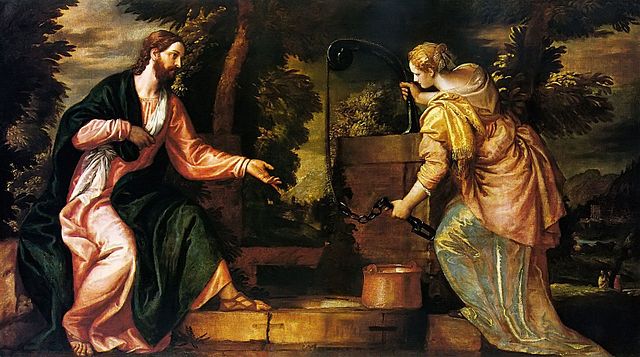
Jesus makes a similar parallel with the woman at the well:
John 4:9-14 The Samaritan woman said to him, “How is it that you, a Jew, ask a drink of me, a woman of Samar’ia?” For Jews have no dealings with Samaritans. [10] Jesus answered her, “If you knew the gift of God, and who it is that is saying to you, `Give me a drink,’ you would have asked him, and he would have given you living water.” [11] The woman said to him, “Sir, you have nothing to draw with, and the well is deep; where do you get that living water? [12] Are you greater than our father Jacob, who gave us the well, and drank from it himself, and his sons, and his cattle?” [13] Jesus said to her, “Every one who drinks of this water will thirst again, [14] but whoever drinks of the water that I shall give him will never thirst; the water that I shall give him will become in him a spring of water welling up to eternal life.”
John 7:37-38 On the last day of the feast, the great day, Jesus stood up and proclaimed, “If any one thirst, let him come to me and drink. [38] He who believes in me, as the scripture has said, `Out of his heart shall flow rivers of living water.'”
Revelation 21:6 . . . To the thirsty I will give from the fountain of the water of life without payment.
This is biblical sacramentalism. It’s nothing unusual at all. It’s what the Bible teaches. Whether one rejects it, is another matter, but the Bible does unmistakably teach it. In this case, it make perfect internal sense: just as physical food gives biological nourishment, eucharistic “food” gives spiritual nourishment and grace.
Sacramentalism exists in the first place because God knew that human beings could relate a lot better to physical, concrete things that conveyed grace, rather than purely abstract grace. And He knew that they could grasp analogies, parables, and parallelism.
***
Photo credit: Jesus and the Samaritan Woman (c. 1585), by Paolo Veronese (1528-1588) and his workshop [public domain / Wikimedia Commons]

***
alleged biblical contradictions
Previous Post

August 6, 2019
Madison vs. Jesus #7: God Prohibits Some Folks' Repentance?
Next Post
August 7, 2019 Madison vs. Jesus #9: Clueless Re Rebellion & Judgment
Browse Our Archives
Select a Category & Last Things About Me Anti-Catholicism Atheism & Agnosticism Baptism and Sacramentalism Bible and Tradition Blessed Virgin Mary Books by Dave Armstrong C. S. Lewis Calvinism & General Protestantism Catholic Apologetics Catholic Apologists Catholic conversion Catholic converts Christmas Church (Ecclesiology) Church History Conversion and Converts Development of Doctrine Eastern Orthodoxy Ecumenism & Christian Unity Eucharist & Liturgy Fathers of the Church French Translations G. K. Chesterton Hell Hell & Satan Hell & Satan & Last Things Heresies & Comparative Religion Holistic Health Inquisition & Crusades & Scandals James White Jews & Judaism & Old Testament John Calvin John Henry Newman Liberal / Modernist Theology Life Issues Literary Resume Lutheranism Mariology Martin Luther Music Orthodoxy Papacy & Infallibility Personal Page Philosophy & Science Political & Ethical & Moral Issues Protestant Persecution & Intolerance Protestantism Purgatory Purgatory & Penance Romantic & Imaginative Theology Saints & Purgatory & Penance Salvation Salvation & Justification Satan & Last Things Sexuality and Gender Issues Spanish Translations Traditionalism vs. Radical Catholic Reactionaries Traducciones al español / tradução para português Trinitarianism & Christology Uncategorized Videos
Select a Month October 2026 September 2026 August 2026 July 2026 June 2026 May 2026 April 2026 March 2026 February 2026 January 2026 December 2025 November 2025 October 2025 September 2025 August 2025 July 2025 June 2025 May 2025 April 2025 March 2025 February 2025 January 2025 December 2024 November 2024 October 2024 September 2024 August 2024 July 2024 June 2024 May 2024 April 2024 March 2024 February 2024 January 2024 December 2023 November 2023 October 2023 September 2023 August 2023 July 2023 June 2023 May 2023 April 2023 March 2023 February 2023 January 2023 December 2022 November 2022 October 2022 September 2022 August 2022 July 2022 June 2022 May 2022 April 2022 March 2022 February 2022 January 2022 December 2021 November 2021 October 2021 September 2021 August 2021 July 2021 June 2021 May 2021 April 2021 March 2021 February 2021 January 2021 December 2020 November 2020 October 2020 September 2020 August 2020 July 2020 June 2020 May 2020 April 2020 March 2020 February 2020 January 2020 December 2019 November 2019 October 2019 September 2019 August 2019 July 2019 June 2019 May 2019 April 2019 March 2019 February 2019 January 2019 December 2018 November 2018 October 2018 September 2018 August 2018 July 2018 June 2018 May 2018 April 2018 March 2018 February 2018 January 2018 December 2017 November 2017 October 2017 September 2017 August 2017 July 2017 June 2017 May 2017 April 2017 March 2017 February 2017 January 2017 December 2016 November 2016 October 2016 September 2016 August 2016 July 2016 June 2016 May 2016 April 2016 March 2016 February 2016 January 2016 December 2015 November 2015 October 2015 September 2015 August 2015 July 2015 June 2015 May 2015 April 2015 March 2015 February 2015 January 2015 December 2014 November 2014 October 2014 September 2014 August 2014 July 2014 June 2014 April 2014 March 2014 February 2014 January 2014 December 2013 November 2013 October 2013 September 2013 August 2013 July 2013 June 2013 April 2013 March 2013 February 2013 January 2013 December 2012 November 2012 October 2012 September 2012 August 2012 July 2012 June 2012 May 2012 April 2012 March 2012 February 2012 January 2012 December 2011 November 2011 October 2011 September 2011 August 2011 July 2011 June 2011 April 2011 March 2011 February 2011 October 2010 September 2010 August 2010 July 2010 April 2010 March 2010 December 2009 October 2009 August 2009 July 2009 June 2009 May 2009 March 2009 February 2009 October 2008 September 2008 April 2008 March 2008 February 2008 January 2008 December 2007 November 2007 October 2007 May 2007 March 2007 February 2007 January 2007 November 2006 October 2006 September 2006 August 2006 July 2006 June 2006 May 2006 April 2006 March 2006 February 2006 October 2005 June 2005 April 2005 February 2005 July 2004 May 2004 April 2004
Follow Us!
TAKE THE
Religious Wisdom Quiz
Who prayed for rain after a long drought and sent his servant to look seven times?
Select your answer to see how you score.
Elijah Isaiah Samuel Hosea
Books by This Author Books by Dave Armstrong
Related posts from Biblical Evidence for Catholicism

A Few "Worst" & "Best" Arguments vs. Protestantism
Biblical Evidence for Catholicism

"Baptism" & Romans 10 (Engwer's Silly Word Games)
Biblical Evidence for Catholicism

50 Biblical Disproofs of "Evident Clearness" of the...
Biblical Evidence for Catholicism

The Mass & Development of Doctrine (vs. Wes...
Biblical Evidence for Catholicism
TRENDING AT PATHEOS Catholic

I was strolling through the top floor of the brand new Parthenon...

What Does Gêvâh Mean For Kimberley Guifoyle &...
This week, a lot of the news is focused on Kimberly Guilfoyle....

INNER CIRCLE: Profound Mystery (Of Christ In All...
Ephesians 5:31-32 “For this reason, a man will leave his father and...

Do Not Rejoice When Your Enemy Falls: The...
Turning an execution into a public spectacle is a disturbing expression of...

'The Chosen' S6 Trailer: The Passion Gets Very...
Not many watching 'The Chosen' worry about spoilers, but just because they...

The purpose-driven labor priest
A labor activist reads Rick Warren and it gets me wondering about...
view all Catholic blogs
Ad-Free & Subscriber Log-In Subscription Support
- About Us
- 2026 Calendar
- Videos
- Podcasts
- Library of World Religions
- Faith In Media Tracker
- Advertise With Us
- Write for Us
- Privacy Policy
- Terms of Service
- Do Not Sell My Data
- Contact Us
- Radiant Digital
- Manage Newsletter Subscriptions
- Unsubscribe From Notifications
- Sitemap
Copyright 2008-2026, Patheos. All rights reserved.
Subscription Support Ad-Free & Subscriber Log-In
Follow Patheos