
BuddhistCatholicContemplativeEvangelicalGeneral ChristianHinduJewishLatter-day SaintMuslimNew VisionsProgressive Christian
Beliefs
- Buddhist
- Catholic
- Contemplative
- Evangelical
- General Christian
- Hindu
- Jewish
- Latter-day Saint
- More Voices
- Muslim
- New Visions
- Pagan
- Progressive Christian
Topics
- Religion News
- Food and Religion
- Sports and Religion
- Religious Art
- Religious Music and Entertainment
- Religious Events
- History and Religion
- Style and Religion
- Politics and Religion
- Women in Religion
- Recreation Outdoors and Religion
- Business Finance and Religion
- Careers Workplace and Religion
- Education and Religion
- Family Parenting and Religion
- Health Fitness and Religion
- Home and Religion
- Relationships and Religion
- Technology and Religion
- Travel and Religion
Columnists
- Buddhist Columnists
- Business Finance and Religion Columnists
- Careers Workplace and Religion Columnists
- Catholic Columnists
- Contemplative Columnists
- Education and Religion Columnists
- Evangelists Columnists
- Family Parenting and Religion Columnists
- General Christian Columnists
- Health Fitness and Religion Columnists
- Hindu Columnists
- History and Religion Columnists
- Home and Religion Columnists
- Jewish Columnists
- More Voices Columnists
- Latter Day Columnists
- Muslim Columnists
- New Visions Columnists
- Nonreligious Columnists
- Pagan Columnists
- Politics and Religion Columnists
- Progressive Columnists
- Recreation Outdoors and Religion Columnists
- Relationships and Religion Columnists
- Religion News Columnists
- Religious Art Columnists
- Religious Events Columnists
- Religious Music and Entertainment Columnists
- Sports and Religion Columnists
- Style and Religion Columnists
- Technology and Religion Columnists
- Travel and Religion Columnists
- Women in Religion Columnists
Resource Library
- 2026 Calendar
- Library of World Religions
- The 100 Most Holy Places on Earth
- Patheos Answers
- Podcasts
- Videos
- Faith Leaders Database
- Anglican Episcopalian
- Bahai
- Baptist
- Buddhism
- Christianity
- Confucianism
- Eastern Orthodoxy
- Hinduism
- Holiness and Pentecostal
- ISKCON
- Islam
- Judaism
- Lutheran
- Methodist
- The Church of Jesus Christ of Latter-day Saints
- New Age
- Paganism
- Presbytarian and Reformed
- Protestantism
- Religion Behind the Scenes
- Roman Catholic
- Scientology
- Shia Islam
- Sikhism
- Sufism
- Sunni Islam
- Taoism
- Zen
- See all religions
Research Tools
 Ad-Free & Subscriber Log-In Subscription Support
Ad-Free & Subscriber Log-In Subscription Support
Follow Patheos 

- Trending:
- Forgiveness
- |
- Marriage
- |
- Consciousness
- |
- Death Penalty
- |
- Election
- |
- Halloween

-
About
-
Catholic Apologetics
-
Church History
-
Great Apologists
-
Christian Worldview
-
Protestantism & Misc.
- Home
- Catholic
- History and Religion
- Madison vs. Jesus #7: God Prohibits Some Folks’ Repentance?
Madison vs. Jesus #7: God Prohibits Some Folks’ Repentance?
Last updated on: August 6, 2019 at 9:53 am by Dave Armstrong
Madison vs. Jesus #7: God Prohibits Some Folks’ Repentance? 2019-08-06T09:53:42-04:00 Dave Armstrong
Patheos Explore the world's faith through different perspectives on religion and spirituality! Patheos has the views of the prevalent religions and spiritualities of the world.
This is an installment of my series of replies to an article by Dr. David Madison: a pastor in the Methodist Church for nine years, who has a PhD in Biblical Studies from Boston University. It’s called, “Things We Wish Jesus Hadn’t Said” (Debunking Christianity, 7-21-19). His words will be in blue below. Dr. Madison makes several “generic” digs at Jesus and Christianity, in the written portion (it details a series of 12 podcasts):
A challenge for Christians: If you’re so sure Jesus existed, then you have some explaining to do. A major frustration is that, while believers are indignant at all the talk about Jesus not existing, they don’t know the issues that fuel the skepticism—and are unwilling to inform themselves.
Yes, I’m up to the “challenge.” No problem at all. I’m not threatened or “scared” by this in the slightest. It’s what I do, as an apologist. The question is whether Dr. Madison is up to interacting with counter-critiques? Or will he act like the voluminous anti-theist atheist polemicist Bob Seidensticker?: who directly challenged me in one of his own comboxes to respond to his innumerable attack-pieces against Christianity and the Bible, and then courageously proceeded to utterly ignore my 35 specific critiques of his claims as of this writing. We shall soon see which course Dr. Madison will decide to take. Anyway, he also states in his post and combox:
[S]o many of the words of Jesus are genuinely shocking. These words aren’t proclaimed much from the pulpit, . . . Hence the folks in the pews have absorbed and adored an idealized Jesus. Christian apologists make their livings refiguring so many of the things Jesus supposedly said.
The gospels are riddled with contradictions and bad theology, and Jesus is so frequently depicted as a cult fanatic—because cult fanatics wrote the gospels. We see Jesus only through their theological filters. I just want to grab hold of Christian heads (standing behind them, with a hand on each ear) and force them to look straight ahead, unflinchingly, at the gospels, and then ask “Tell me what you see!” uncoached by apologist specialists, i.e., priests and pastors, who’ve had a lot of practice making bad texts look good. . . . I DO say, “Deal with the really bad stuff in the gospels.” Are you SURE you’ve not make a big mistake endorsing this particular Lord and Savior? That’s the whole point of this series of Flash Podcasts, because a helluva lot of Christians would agree, right away, that these quotes are bad news—if no one told then that they’ve been attributed to Jesus.
Of course, Dr. Madison — good anti-theist atheist that he is — takes the view that we are not at all sure whether Jesus in fact said anything recorded in the Gospels in the first place. I don’t play that game, because there is no end to it. It’s like trying to pin jello to the wall. The atheist always has their convenient out (when refuted in argument about some biblical text) that Jesus never said it anyway [wink wink and sly patronizing grin], and/or that the biblical text in question was simply added later by dishonest ultra-biased Christian partisans and propagandists. It’s a silly and ultimately intellectually dishonest game, and so I always refuse to play it with atheists or anyone else, because there is no way to “win” with such an absurdly stacked, purely subjective deck.
In my defense of biblical texts, I start with the assumption that the manuscripts we have are quite sufficient for us to know what is in the Bible (believe it or not). Going on from there, I simply defend particular [supposedly “difficult”] texts, and note with appropriate argumentation, that “here, the Bible teaches so-and-so,” etc. I deal with the texts as they exist. I don’t get into the endlessly arbitrary, subjective games that atheists and theologically liberal biblical skeptics play with the texts, in their self-serving textual criticism.
Dr. Madison himself (fortunately) grants my outlook in terms of practical “x vs. y” debate purposes: “For the sake of argument, I’m willing to say, okay, Jesus was real and, yes, we have gospels that tell the story.” And in the combox: “So, we can go along with their insistence that he did exist. We’ll play on their field, i.e., the gospels.”
Good! So we shall examine his cherry-picked texts and see whether his interpretations of them can stand up to scrutiny. He is issuing challenges, and I as an apologist will be dishing a bunch of my own right back to him. Two can play this game. I will be dealing honestly with his challenges. Will he return the favor, and engage in serious and substantive dialogue? Again, we’ll soon know what his reaction will be. A true dialogue is of a confident, inquisitive, “nothing to fear and everything to gain” back-and-forth and interactive nature, not merely “ships passing in the night” or what I call “mutual monologue.”
*****
Dr. Madison’s seventh podcast of twelve is entitled: “On Mark 4:11-12: Jesus taught in parables to keep people from repenting and being forgiven”. Here is the passage:
Mark 4:11-12 (RSV) And he said to them, “To you has been given the secret of the kingdom of God, but for those outside everything is in parables; [12] so that they may indeed see but not perceive, and may indeed hear but not understand; lest they should turn again, and be forgiven.”
Bizarre Jesus quote . . . Jesus teaches in parables so that people won’t turn and be forgiven. . . . It clearly doesn’t make sense at all. Is Jesus serious? Parables are meant to fool people, to keep them in the dark?
Mark 4:11-12 is a common scriptural / Hebraic way of expressing God’s judgment and His providence (while not denying that ultimately men decide their own eternal fates, by either accepting or rejecting God’s grace). Romans 1 explains it:
Romans 1:18-25 For the wrath of God is revealed from heaven against all ungodliness and wickedness of men who by their wickedness suppress the truth. [19] For what can be known about God is plain to them, because God has shown it to them. [20] Ever since the creation of the world his invisible nature, namely, his eternal power and deity, has been clearly perceived in the things that have been made. So they are without excuse; [21] for although they knew God they did not honor him as God or give thanks to him, but they became futile in their thinking and their senseless minds were darkened. [22] Claiming to be wise, they became fools, [23] and exchanged the glory of the immortal God for images resembling mortal man or birds or animals or reptiles. [24] Therefore God gave them up in the lusts of their hearts to impurity, to the dishonoring of their bodies among themselves, [25] because they exchanged the truth about God for a lie and worshiped and served the creature rather than the Creator, who is blessed for ever! Amen.
Note that the onus lies upon the people who “suppress the truth” and are engaged in “all ungodliness and wickedness” (1:18). They choose in their own free will to disobey God, then the text says that “God gave them up in the lusts of their hearts to impurity” (1:24). In other words, He didn’t cause their rebellion; He only allowed them in their free choices, to rebel.
The same dynamic is seen in the juxtaposition between Pharaoh freely hardening his heart, which is then applied to God (in a limited sense) doing it (which means that He allowed it, in His providence; He didn’t ordain it). I explain this at length, in two papers.
A fourth similar example occurs in the book of Job. Satan comes to God and challenges Him to allow him to torment Job. God responds, “Behold, he is in your power; only spare his life” (2:6; cf. 1:12). So it is clear that Satan is behind the direct persecution of Job. But later, the text refers to “all the evil that the LORD had brought upon him” (42:11); that is (properly interpreted, with knowledge of the multitude of Hebrew literary devices), allowed in His providence. Then it is reported (now literally) that God “restored the fortunes of Job, . . . and the LORD gave Job twice as much as he had before” (42:10) and “blessed the latter days of Job more than his beginning” (42:12).
2 Thessalonians (written by St. Paul, as was Romans) is a fifth example, and it expresses precisely the same dynamic as we see in Romans 1 and the other three examples above. Men rebel in their wickedness (“they refused to love the truth and so be saved”: 2:10). Then it is stated (as a forceful hyperbolic manifestation of God’s providence and His permissive will) that “God sends upon them a strong delusion, to make them believe what is false, so that all may be condemned who did not believe the truth but had pleasure in unrighteousness” (2:11-12).
It’s not a contradiction. This way of speaking is common in the Bible. When Paul talks about wicked men, he is being literal; but when He talks about God, it is hyperbolic and a form of sarcasm. 2:10 makes it quite clear what caused their damnation: “those who are to perish, because they refused to love the truth.” Even 2:12 again reiterates that man’s rebellion was the cause of the demise of the damned: not because God willed and ordained it from all eternity. The Gospel of John teaches the same thing:
John 12:37-40 Though he had done so many signs before them, yet they did not believe in him; [38] it was that the word spoken by the prophet Isaiah might be fulfilled: “Lord, who has believed our report, and to whom has the arm of the Lord been revealed?” [39] Therefore they could not believe. For Isaiah again said, [40] “He has blinded their eyes and hardened their heart, lest they should see with their eyes and perceive with their heart, and turn for me to heal them.”
Coffman’s Commentaries on the Bible, in its treatment of the Old Testament passage cited in John 12 (Isaiah 6:9-10) states:
What is prophesied in this passage is the judicial hardening of Israel in their rebellion against God. The prophecy is stated in different forms. Here it appears imperatively; but in other places the prophecy is referred to as self-accomplished as in Acts 28:27, or as having occurred passively as in Matthew 13:13-15. Here, as Dummelow pointed out, “The result of Isaiah’s preaching is spoken of as if it were the purpose of it.” . . .
The classical example from the Bible is that of Pharaoh, of whom it is stated ten times that “Pharaoh hardened his heart …” after which it is said that, “God hardened Pharaoh’s heart.” God never hardened anyone’s heart who had not already hardened his own heart many times. Thus it was said of this prophecy that Israel had themselves shut their ears, closed their eyes, and hardened their hearts.
Thus we may say that God hardened Israel, that Israel hardened themselves, and further, that Satan hardened their hearts. “The god of this world has blinded the minds of the unbelieving” (2 Corinthians 4:4). The “blinding” of this passage and the “strong delusion” of 2 Thessalonians 2:11 KJV, and the “working of error” (2 Thessalonians 2:11, ASV) are all designations of exactly the same condition described here as “hardening.”
The key to understanding lies in the parallel passage of Acts 28:27, which the commentary above describes as “self-accomplished” rebellion. This shows the same dynamic as the “hardened hearts” passages. In the overall context of Acts 28, we don’t see the language of God deliberately blinding them, etc. We see their own choices causing these things. Hence, we see references to “others disbelieved” (28:24); then the Isaiah passage is cited, but in a milder fashion, followed by “Let it be known to you then that this salvation of God has been sent to the Gentiles; they will listen” (28:28). In other words, these hearers would not listen. It was their fault; they were rebellious. God didn’t cause that.
Likewise, here is how Jesus put it in Matthew 13:13, 16: “This is why I speak to them in parables, because seeing they do not see, and hearing they do not hear, nor do they understand. . . . their eyes they have closed . . . But blessed are your eyes, for they see, and your ears, for they hear.” If one looks at the larger context of John 12:37-40, one can also see that it is man’s rebellion, not God’s foreordination, that causes the disbelief and wickedness:
John 12:37, 47-48 Though he had done so many signs before them, yet they did not believe in him; . . . [47] [Jesus] If any one hears my sayings and does not keep them, I do not judge him; for I did not come to judge the world but to save the world. [48] He who rejects me and does not receive my sayings has a judge; the word that I have spoken will be his judge on the last day.
***
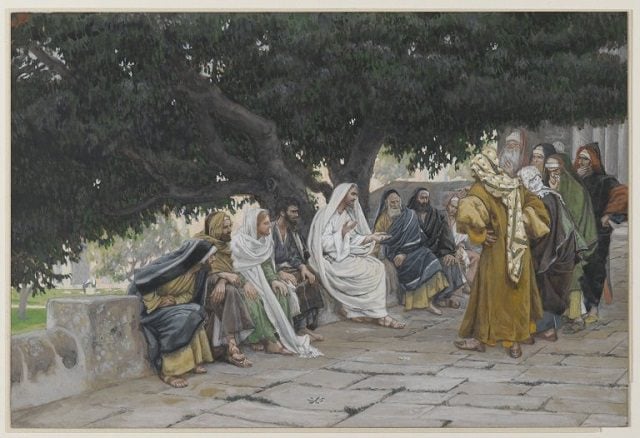
Photo credit: The Pharisees and the Sadducees Come to Tempt Jesus, by James Tissot (1836-1902) [public domain / Wikimedia Commons]

***
alleged biblical contradictions
Previous Post

August 6, 2019
Madison vs. Jesus #6: Narcissistic, Love-Starved God?
Next Post
August 7, 2019 Madison vs. Jesus #8: Holy Eucharist as "Grotesque Magic"?
Browse Our Archives
Select a Category & Last Things About Me Anti-Catholicism Atheism & Agnosticism Baptism and Sacramentalism Bible and Tradition Blessed Virgin Mary Books by Dave Armstrong C. S. Lewis Calvinism & General Protestantism Catholic Apologetics Catholic Apologists Catholic conversion Catholic converts Christmas Church (Ecclesiology) Church History Conversion and Converts Development of Doctrine Eastern Orthodoxy Ecumenism & Christian Unity Eucharist & Liturgy Fathers of the Church French Translations G. K. Chesterton Hell Hell & Satan Hell & Satan & Last Things Heresies & Comparative Religion Holistic Health Inquisition & Crusades & Scandals James White Jews & Judaism & Old Testament John Calvin John Henry Newman Liberal / Modernist Theology Life Issues Literary Resume Lutheranism Mariology Martin Luther Music Orthodoxy Papacy & Infallibility Personal Page Philosophy & Science Political & Ethical & Moral Issues Protestant Persecution & Intolerance Protestantism Purgatory Purgatory & Penance Romantic & Imaginative Theology Saints & Purgatory & Penance Salvation Salvation & Justification Satan & Last Things Sexuality and Gender Issues Spanish Translations Traditionalism vs. Radical Catholic Reactionaries Traducciones al español / tradução para português Trinitarianism & Christology Uncategorized Videos
Select a Month October 2026 September 2026 August 2026 July 2026 June 2026 May 2026 April 2026 March 2026 February 2026 January 2026 December 2025 November 2025 October 2025 September 2025 August 2025 July 2025 June 2025 May 2025 April 2025 March 2025 February 2025 January 2025 December 2024 November 2024 October 2024 September 2024 August 2024 July 2024 June 2024 May 2024 April 2024 March 2024 February 2024 January 2024 December 2023 November 2023 October 2023 September 2023 August 2023 July 2023 June 2023 May 2023 April 2023 March 2023 February 2023 January 2023 December 2022 November 2022 October 2022 September 2022 August 2022 July 2022 June 2022 May 2022 April 2022 March 2022 February 2022 January 2022 December 2021 November 2021 October 2021 September 2021 August 2021 July 2021 June 2021 May 2021 April 2021 March 2021 February 2021 January 2021 December 2020 November 2020 October 2020 September 2020 August 2020 July 2020 June 2020 May 2020 April 2020 March 2020 February 2020 January 2020 December 2019 November 2019 October 2019 September 2019 August 2019 July 2019 June 2019 May 2019 April 2019 March 2019 February 2019 January 2019 December 2018 November 2018 October 2018 September 2018 August 2018 July 2018 June 2018 May 2018 April 2018 March 2018 February 2018 January 2018 December 2017 November 2017 October 2017 September 2017 August 2017 July 2017 June 2017 May 2017 April 2017 March 2017 February 2017 January 2017 December 2016 November 2016 October 2016 September 2016 August 2016 July 2016 June 2016 May 2016 April 2016 March 2016 February 2016 January 2016 December 2015 November 2015 October 2015 September 2015 August 2015 July 2015 June 2015 May 2015 April 2015 March 2015 February 2015 January 2015 December 2014 November 2014 October 2014 September 2014 August 2014 July 2014 June 2014 April 2014 March 2014 February 2014 January 2014 December 2013 November 2013 October 2013 September 2013 August 2013 July 2013 June 2013 April 2013 March 2013 February 2013 January 2013 December 2012 November 2012 October 2012 September 2012 August 2012 July 2012 June 2012 May 2012 April 2012 March 2012 February 2012 January 2012 December 2011 November 2011 October 2011 September 2011 August 2011 July 2011 June 2011 April 2011 March 2011 February 2011 October 2010 September 2010 August 2010 July 2010 April 2010 March 2010 December 2009 October 2009 August 2009 July 2009 June 2009 May 2009 March 2009 February 2009 October 2008 September 2008 April 2008 March 2008 February 2008 January 2008 December 2007 November 2007 October 2007 May 2007 March 2007 February 2007 January 2007 November 2006 October 2006 September 2006 August 2006 July 2006 June 2006 May 2006 April 2006 March 2006 February 2006 October 2005 June 2005 April 2005 February 2005 July 2004 May 2004 April 2004
Follow Us!
TAKE THE
Religious Wisdom Quiz
Who denied Jesus three times before the rooster crowed?
Select your answer to see how you score.
Paul John Peter Judas
Books by This Author Books by Dave Armstrong
Related posts from Biblical Evidence for Catholicism

Bible & Catholicism on Mortal Sin (vs. John...
Biblical Evidence for Catholicism

Dialogue on Eternal Security / Absolute Assurance
Biblical Evidence for Catholicism

"Faith Alone" Dialogue with a Calvinist
Biblical Evidence for Catholicism

Exegesis of 75 NT Faith [Alone?] & Works...
Biblical Evidence for Catholicism
TRENDING AT PATHEOS Catholic

The Sermon on the Mount, Part I: Matthew...
The Sermon on the Mount, Part I (Matthew 4:12-5:12) St. Matthew moves...

What's up from Crossway: Reviewing some of their latest A few weeks...

Janie Learns the Way of the Cross: A...
Teaching children about Jesus' Passion can be challenging. Many parents and educators...

Looking For Good Catholic Writing - October 2026
He alone extends the heavens, and he walks upon the waves of...

In "Irreplaceable," our book on vocation and technology, Trevor Sutton and I...

I was strolling through the top floor of the brand new Parthenon...
view all Catholic blogs
Ad-Free & Subscriber Log-In Subscription Support
- About Us
- 2026 Calendar
- Videos
- Podcasts
- Library of World Religions
- Faith In Media Tracker
- Advertise With Us
- Write for Us
- Privacy Policy
- Terms of Service
- Do Not Sell My Data
- Contact Us
- Radiant Digital
- Manage Newsletter Subscriptions
- Unsubscribe From Notifications
- Sitemap
Copyright 2008-2026, Patheos. All rights reserved.
Subscription Support Ad-Free & Subscriber Log-In
Follow Patheos