
BuddhistCatholicContemplativeEvangelicalGeneral ChristianHinduJewishLatter-day SaintMuslimNew VisionsProgressive Christian
Beliefs
- Buddhist
- Catholic
- Contemplative
- Evangelical
- General Christian
- Hindu
- Jewish
- Latter-day Saint
- More Voices
- Muslim
- New Visions
- Pagan
- Progressive Christian
Topics
- Religion News
- Food and Religion
- Sports and Religion
- Religious Art
- Religious Music and Entertainment
- Religious Events
- History and Religion
- Style and Religion
- Politics and Religion
- Women in Religion
- Recreation Outdoors and Religion
- Business Finance and Religion
- Careers Workplace and Religion
- Education and Religion
- Family Parenting and Religion
- Health Fitness and Religion
- Home and Religion
- Relationships and Religion
- Technology and Religion
- Travel and Religion
Columnists
- Buddhist Columnists
- Business Finance and Religion Columnists
- Careers Workplace and Religion Columnists
- Catholic Columnists
- Contemplative Columnists
- Education and Religion Columnists
- Evangelists Columnists
- Family Parenting and Religion Columnists
- General Christian Columnists
- Health Fitness and Religion Columnists
- Hindu Columnists
- History and Religion Columnists
- Home and Religion Columnists
- Jewish Columnists
- More Voices Columnists
- Latter Day Columnists
- Muslim Columnists
- New Visions Columnists
- Nonreligious Columnists
- Pagan Columnists
- Politics and Religion Columnists
- Progressive Columnists
- Recreation Outdoors and Religion Columnists
- Relationships and Religion Columnists
- Religion News Columnists
- Religious Art Columnists
- Religious Events Columnists
- Religious Music and Entertainment Columnists
- Sports and Religion Columnists
- Style and Religion Columnists
- Technology and Religion Columnists
- Travel and Religion Columnists
- Women in Religion Columnists
Resource Library
- 2026 Calendar
- Library of World Religions
- The 100 Most Holy Places on Earth
- Patheos Answers
- Podcasts
- Videos
- Faith Leaders Database
- Anglican Episcopalian
- Bahai
- Baptist
- Buddhism
- Christianity
- Confucianism
- Eastern Orthodoxy
- Hinduism
- Holiness and Pentecostal
- ISKCON
- Islam
- Judaism
- Lutheran
- Methodist
- The Church of Jesus Christ of Latter-day Saints
- New Age
- Paganism
- Presbytarian and Reformed
- Protestantism
- Religion Behind the Scenes
- Roman Catholic
- Scientology
- Shia Islam
- Sikhism
- Sufism
- Sunni Islam
- Taoism
- Zen
- See all religions
Research Tools
 Ad-Free & Subscriber Log-In Subscription Support
Ad-Free & Subscriber Log-In Subscription Support
Follow Patheos 

- Trending:
- Forgiveness
- |
- Marriage
- |
- Consciousness
- |
- Death Penalty
- |
- Election
- |
- Halloween

-
About
-
Catholic Apologetics
-
Church History
-
Great Apologists
-
Christian Worldview
-
Protestantism & Misc.
- Home
- Catholic
- History and Religion
- Madison vs. Jesus #11: He’s Not the Prince of Peace?
Madison vs. Jesus #11: He’s Not the Prince of Peace?
Last updated on: June 5, 2026 at 11:54 pm by Dave Armstrong
Madison vs. Jesus #11: He’s Not the Prince of Peace? 2026-06-05T23:54:15-04:00 Dave Armstrong
Patheos Explore the world's faith through different perspectives on religion and spirituality! Patheos has the views of the prevalent religions and spiritualities of the world.
This is an installment of my series of replies to an article by Dr. David Madison: a pastor in the Methodist Church for nine years, who has a PhD in Biblical Studies from Boston University. It’s called, “Things We Wish Jesus Hadn’t Said” (Debunking Christianity, 7-21-19). His words will be in blue below. Dr. Madison makes several “generic” digs at Jesus and Christianity, in the written portion (it details a series of 12 podcasts):
A challenge for Christians: If you’re so sure Jesus existed, then you have some explaining to do. A major frustration is that, while believers are indignant at all the talk about Jesus not existing, they don’t know the issues that fuel the skepticism—and are unwilling to inform themselves.
Yes, I’m up to the “challenge.” No problem at all. I’m not threatened or “scared” by this in the slightest. It’s what I do, as an apologist. The question is whether Dr. Madison is up to interacting with counter-critiques? Or will he act like the voluminous anti-theist atheist polemicist Bob Seidensticker?: who directly challenged me in one of his own comboxes to respond to his innumerable attack-pieces against Christianity and the Bible, and then courageously proceeded to utterly ignore my 35 specific critiques of his claims as of this writing. We shall soon see which course Dr. Madison will decide to take. Anyway, he also states in his post and combox:
[S]o many of the words of Jesus are genuinely shocking. These words aren’t proclaimed much from the pulpit, . . . Hence the folks in the pews have absorbed and adored an idealized Jesus. Christian apologists make their livings refiguring so many of the things Jesus supposedly said.
The gospels are riddled with contradictions and bad theology, and Jesus is so frequently depicted as a cult fanatic—because cult fanatics wrote the gospels. We see Jesus only through their theological filters. I just want to grab hold of Christian heads (standing behind them, with a hand on each ear) and force them to look straight ahead, unflinchingly, at the gospels, and then ask “Tell me what you see!” uncoached by apologist specialists, i.e., priests and pastors, who’ve had a lot of practice making bad texts look good. . . . I DO say, “Deal with the really bad stuff in the gospels.” Are you SURE you’ve not make a big mistake endorsing this particular Lord and Savior? That’s the whole point of this series of Flash Podcasts, because a helluva lot of Christians would agree, right away, that these quotes are bad news—if no one told then that they’ve been attributed to Jesus.
Of course, Dr. Madison — good anti-theist atheist that he is — takes the view that we are not at all sure whether Jesus in fact said anything recorded in the Gospels in the first place. I don’t play that game, because there is no end to it. It’s like trying to pin jello to the wall. The atheist always has their convenient out (when refuted in argument about some biblical text) that Jesus never said it anyway [wink wink and sly patronizing grin], and/or that the biblical text in question was simply added later by dishonest ultra-biased Christian partisans and propagandists. It’s a silly and ultimately intellectually dishonest game, and so I always refuse to play it with atheists or anyone else, because there is no way to “win” with such an absurdly stacked, purely subjective deck.
In my defense of biblical texts, I start with the assumption that the manuscripts we have are quite sufficient for us to know what is in the Bible (believe it or not). Going on from there, I simply defend particular [supposedly “difficult”] texts, and note with appropriate argumentation, that “here, the Bible teaches so-and-so,” etc. I deal with the texts as they exist. I don’t get into the endlessly arbitrary, subjective games that atheists and theologically liberal biblical skeptics play with the texts, in their self-serving textual criticism.
Dr. Madison himself (fortunately) grants my outlook in terms of practical “x vs. y” debate purposes: “For the sake of argument, I’m willing to say, okay, Jesus was real and, yes, we have gospels that tell the story.” And in the combox: “So, we can go along with their insistence that he did exist. We’ll play on their field, i.e., the gospels.”
Good! So we shall examine his cherry-picked texts and see whether his interpretations of them can stand up to scrutiny. He is issuing challenges, and I as an apologist will be dishing a bunch of my own right back to him. Two can play this game. I will be dealing honestly with his challenges. Will he return the favor, and engage in serious and substantive dialogue? Again, we’ll soon know what his reaction will be. A true dialogue is of a confident, inquisitive, “nothing to fear and everything to gain” back-and-forth and interactive nature, not merely “ships passing in the night” or what I call “mutual monologue.”
*****
Dr. Madison’s 11th podcast of twelve is entitled: “On Matthew 10:34-39, Jesus came to bring a sword, and to set family members against one another”. Here is the passage:
Matthew 10:34-39 (RSV) “Do not think that I have come to bring peace on earth; I have not come to bring peace, but a sword. [35] For I have come to set a man against his father, and a daughter against her mother, and a daughter-in-law against her mother-in-law; [36] and a man’s foes will be those of his own household. [37] He who loves father or mother more than me is not worthy of me; and he who loves son or daughter more than me is not worthy of me; [38] and he who does not take his cross and follow me is not worthy of me. [39] He who finds his life will lose it, and he who loses his life for my sake will find it.
This quote is among those that really drags Jesus down and disqualifies him as a great moral teacher. . . . Why don’t Christians say, “Maybe we’ve made a mistake, worshiping this guy”? . . . People who love the colossal ego of Jesus as portrayed in John’s Gospel won’t be bothered by the arrogant Jesus on display here in Matthew 10. . . . Can we stop talking about Jesus as the Prince of Peace? And just think of the damage that this text has done in fueling Christian fanaticism. “We’re carrying the sword of Jesus,” said the Crusaders and the persecutors of the Inquisition. . . . C’mon! This is really despicable. There is no way to spin this to make Jesus look like a good guy. . . . Cults preach like this. . . . These words put Jesus firmly in the tradition of cult fanatics, who want undiluted devotion to themselves. . . . This is unhealthy religion, that damages people. It’s bad theology.
Matthew 10:37 provides the key to this whole passage, and in fact, helped to explain the issue dealt with in Podcast #1: Jesus supposedly telling His followers to hate their families. The point is that they are to love Him the most (the absence of which in the Bible is the sin of idolatry). And he informs them that there will be great costs involved in being His disciple (10:38), though these will result in ultimate fulfillment and reward (10:39). Jesus seems to virtually be citing Micah 7:6:
for the son treats the father with contempt, the daughter rises up against her mother, the daughter-in-law against her mother-in-law; a man’s enemies are the men of his own house.
He utilizes a literary device described below and His discourse is partly a prophecy that Christianity was in fact to cause a division in society and in the world ever since: i.e., many people didn’t like it then, just as they don’t today, which is why there is more persecution of Christians now, than at any time in history (according to even a secular magazine like Newsweek).
Sometimes, families are split, and there have been even civil wars over religious matters. Try to be openly, publicly Christian in, for example, Saudi Arabia or Iran today, and see how well things go for you. Why is it that churches are being attacked in alarmingly great numbers all over Europe? According to one article:
Countries like France and Germany have seen a spike in violent vandalism, desecrating cherished churches and Christian symbols in recent months and years.
According to the German news site PI-News, every day in France, two churches are desecrated. They report 1,063 attacks on Christian churches or symbols like crucifixes, icons, and statues in France in 2018, marking a 17 percent increase from the year before.
It’s because there has been opposition to Christianity from the start. Christianity severely critiques the world-system, and the world doesn’t like it one bit. It’s not rocket science, then, to understand what Jesus was expressing here. It’s only the literary genre that is confusing folks like Dr. Madison. What He was driving at is made perfectly clear in the larger context (which Dr. Madison — like virtually all atheist “exegetes” habitually do — completely ignores):
Matthew 24:16-18, 21-25, 28 “Behold, I send you out as sheep in the midst of wolves; so be wise as serpents and innocent as doves. [17] Beware of men; for they will deliver you up to councils, and flog you in their synagogues, [18] and you will be dragged before governors and kings for my sake, to bear testimony before them and the Gentiles. . . . [21] Brother will deliver up brother to death, and the father his child, and children will rise against parents and have them put to death; [22] and you will be hated by all for my name’s sake. But he who endures to the end will be saved. [23] When they persecute you in one town, flee to the next; for truly, I say to you, you will not have gone through all the towns of Israel, before the Son of man comes. [24] “A disciple is not above his teacher, nor a servant above his master; [25] it is enough for the disciple to be like his teacher, and the servant like his master. If they have called the master of the house Be-el’zebul, how much more will they malign those of his household. . . . [28] And do not fear those who kill the body but cannot kill the soul; rather fear him who can destroy both soul and body in hell.”
This is the backdrop, and this explains Jesus’ meaning:
The world has hated Me, and so they will hate you also, as My followers.
This hatred will extend even to families, where non-Christian families may persecute Christians in the family.
If your family hates you, you have to choose between it and your ultimate allegiance to God [and I am God].
Jesus doesn’t desire or will or endorse or sanction any of this, which is Dr. Madison’s central and utterly erroneous point (as is quite obvious, I think, in 24:16-28 above). He is simply stating it in a typically pungent Hebraic / Semitic style. And he is using a literary technique, which has a name: Metonymy (or, Change of Name / Noun).
In my Installment #1, I mentioned Bible scholar E. W. Bullinger, who described and explained “over 200 distinct figures [in the Bible], several of them with from 30 to 40 varieties.” His 1104-page tome is called, Figures of Speech Used in the Bible (London: 1898). It’s available for free, online. Bullinger devotes no less than 75 pages to Metonymy (pp. 538-612) [see the entire section in a nice format online]. He defines it as follows:
The Change of one Noun for another Related Noun.
. . . Metonymy is a figure by which one name or noun is used instead of another, to which it stands in a certain relation.
The change is in the noun, and only in a verb as connected with the action proceeding from it. . . .
Thus it will be seen that Metonymy is not founded on resemblance, but on relation.
When we say that a person writes ” a bad hand,” we do not mean a hand, but we use the noun ” hand ” for the characters which it writes.
Metonymy is of four kinds: viz., of the Cause, of the Effect, of the Subject, and of the Adjunct.
I. Metonymy of the Cause is when the cause is put for the effect: i.e., when the doer is put for the thing done; or, the instrument for that which is effected; or, where the action is put for the effect produced by the action. (p. 538)
Metonymy of the Cause is the kind that occurs in our disputed passage, which Bullinger cites under his examples (p. 548). He comments on Matthew 10:34: “That is to say, the object of His coming was peace, but the effect of it was war.” In other words, Jesus’ technique (rather common in prophetic-type utterance in the Old Testament) was to speak poetically, as if He directly caused or willed what He only directly “caused” by being the object of the displeasure and disagreement of those who would reject Him and His followers. So He says:
I have not come to bring peace, but a sword. For I have come to set a man against his father, and a daughter against her mother . . . He who loves father or mother more than me is not worthy of me.
This is poetic expression, utilizing Metonymy of the Cause, where “the cause is put for the effect”. But His literal meaning may be paraphrased as follows:
I came to bring peace, but the effect is, rather [in some cases], a sword [serious conflict]. The [undesired] result of my coming [in extreme cases] will be a man against his father, and a daughter against her mother . . . [If it tragically gets to this point] He who loves father or mother more than me is not worthy of me [which love would be idolatry].
I’ve seen war movies, where a commander of so many soldiers said to another commander, “I killed 14 of my men.” OI remember being jolted by that when I first heard it. Then, after a moment’s reflection, I “got” it. This is the same sort of non-literal language. Of course, literally, his soldiers were killed by the enemy; they were the cause, not the commander, who did not desire this outcome. But he put it that way because he was trying to express, in his understandable human feeling and compassion: “if I had not sent these men into battle, onto the front lines, they would still be alive [i.e., I ‘killed’ them].”
That is true, but it’s not direct cause. Likewise, Jesus is talking in this same way, saying in effect: “If I had not come and taught what I teach, then we wouldn’t have families being divided as a result.” In that sense only, He caused it, but not directly. Hence, “I bring a sword.” The division is directly caused by those who choose to engage in it, and to persecute folks for following Jesus.
Robert H. Stein wrote a very helpful article entitled, “Jesus’ Use of Figurative Language.” He states:
Jesus evidently prepared his teaching, putting it into literary forms using the metaphorical, exaggerating, impressionistic language of a culture that loved to tell stories. This helped his listeners remember easily what he taught. . . . Jesus thought his hearers were capable of understanding figurative language and he expected them to do so, . . .
He goes on to list (with many examples) many of the literary forms Jesus used: simile, metaphor, poetry, proverb, hyperbole, puns, paradox, a fortiori, use of [Socratic] questioning (I have written about that, myself), irony, synecdoche, personification, paranomasia, and anthropomorphism (that I have also described at length).
Pulpit Commentary, for Matthew 10:35, sagely states: “Christ would leave in his hearers’ minds no room for thinking that he was ignorant of what the immediate result of his coming would be.”
***
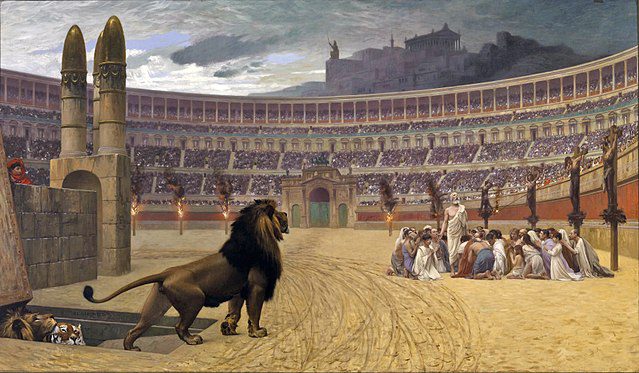
Photo credit: The Christian Martyrs’ Last Prayer, by Jean-Léon Gérôme (1824-1904) [public domain / Wikimedia Commons]

***
alleged biblical contradictions
Previous Post

August 7, 2019
Madison vs. Jesus #10: Universal Answered Prayer & Healing?
Next Post

August 8, 2019 Madison vs. Jesus #12: Discipleship & Jewish Burial Customs
Browse Our Archives
Select a Category & Last Things About Me Anti-Catholicism Atheism & Agnosticism Baptism and Sacramentalism Bible and Tradition Blessed Virgin Mary Books by Dave Armstrong C. S. Lewis Calvinism & General Protestantism Catholic Apologetics Catholic Apologists Catholic conversion Catholic converts Christmas Church (Ecclesiology) Church History Conversion and Converts Development of Doctrine Eastern Orthodoxy Ecumenism & Christian Unity Eucharist & Liturgy Fathers of the Church French Translations G. K. Chesterton Hell Hell & Satan Hell & Satan & Last Things Heresies & Comparative Religion Holistic Health Inquisition & Crusades & Scandals James White Jews & Judaism & Old Testament John Calvin John Henry Newman Liberal / Modernist Theology Life Issues Literary Resume Lutheranism Mariology Martin Luther Music Orthodoxy Papacy & Infallibility Personal Page Philosophy & Science Political & Ethical & Moral Issues Protestant Persecution & Intolerance Protestantism Purgatory Purgatory & Penance Romantic & Imaginative Theology Saints & Purgatory & Penance Salvation Salvation & Justification Satan & Last Things Sexuality and Gender Issues Spanish Translations Traditionalism vs. Radical Catholic Reactionaries Traducciones al español / tradução para português Trinitarianism & Christology Uncategorized Videos
Select a Month October 2026 September 2026 August 2026 July 2026 June 2026 May 2026 April 2026 March 2026 February 2026 January 2026 December 2025 November 2025 October 2025 September 2025 August 2025 July 2025 June 2025 May 2025 April 2025 March 2025 February 2025 January 2025 December 2024 November 2024 October 2024 September 2024 August 2024 July 2024 June 2024 May 2024 April 2024 March 2024 February 2024 January 2024 December 2023 November 2023 October 2023 September 2023 August 2023 July 2023 June 2023 May 2023 April 2023 March 2023 February 2023 January 2023 December 2022 November 2022 October 2022 September 2022 August 2022 July 2022 June 2022 May 2022 April 2022 March 2022 February 2022 January 2022 December 2021 November 2021 October 2021 September 2021 August 2021 July 2021 June 2021 May 2021 April 2021 March 2021 February 2021 January 2021 December 2020 November 2020 October 2020 September 2020 August 2020 July 2020 June 2020 May 2020 April 2020 March 2020 February 2020 January 2020 December 2019 November 2019 October 2019 September 2019 August 2019 July 2019 June 2019 May 2019 April 2019 March 2019 February 2019 January 2019 December 2018 November 2018 October 2018 September 2018 August 2018 July 2018 June 2018 May 2018 April 2018 March 2018 February 2018 January 2018 December 2017 November 2017 October 2017 September 2017 August 2017 July 2017 June 2017 May 2017 April 2017 March 2017 February 2017 January 2017 December 2016 November 2016 October 2016 September 2016 August 2016 July 2016 June 2016 May 2016 April 2016 March 2016 February 2016 January 2016 December 2015 November 2015 October 2015 September 2015 August 2015 July 2015 June 2015 May 2015 April 2015 March 2015 February 2015 January 2015 December 2014 November 2014 October 2014 September 2014 August 2014 July 2014 June 2014 April 2014 March 2014 February 2014 January 2014 December 2013 November 2013 October 2013 September 2013 August 2013 July 2013 June 2013 April 2013 March 2013 February 2013 January 2013 December 2012 November 2012 October 2012 September 2012 August 2012 July 2012 June 2012 May 2012 April 2012 March 2012 February 2012 January 2012 December 2011 November 2011 October 2011 September 2011 August 2011 July 2011 June 2011 April 2011 March 2011 February 2011 October 2010 September 2010 August 2010 July 2010 April 2010 March 2010 December 2009 October 2009 August 2009 July 2009 June 2009 May 2009 March 2009 February 2009 October 2008 September 2008 April 2008 March 2008 February 2008 January 2008 December 2007 November 2007 October 2007 May 2007 March 2007 February 2007 January 2007 November 2006 October 2006 September 2006 August 2006 July 2006 June 2006 May 2006 April 2006 March 2006 February 2006 October 2005 June 2005 April 2005 February 2005 July 2004 May 2004 April 2004
Follow Us!
TAKE THE
Religious Wisdom Quiz
What city did David capture and make the capital of Israel?
Select your answer to see how you score.
Bethlehem Samaria Jerusalem Hebron
Books by This Author Books by Dave Armstrong
Related posts from Biblical Evidence for Catholicism

God, Modern Physics, & Dark Energy: An Analogy
Biblical Evidence for Catholicism

Catholic "Wicked Married Sex"?: 4th Reply to Sean...
Biblical Evidence for Catholicism
2nd Reply to Anglican Sean Luke on Catholicism...
Biblical Evidence for Catholicism

History of Required Celibacy Disproves Catholicism?
Biblical Evidence for Catholicism
TRENDING AT PATHEOS Catholic

I was strolling through the top floor of the brand new Parthenon...

What Does Gêvâh Mean For Kimberley Guifoyle &...
This week, a lot of the news is focused on Kimberly Guilfoyle....

INNER CIRCLE: Profound Mystery (Of Christ In All...
Ephesians 5:31-32 “For this reason, a man will leave his father and...

Do Not Rejoice When Your Enemy Falls: The...
Turning an execution into a public spectacle is a disturbing expression of...

'The Chosen' S6 Trailer: The Passion Gets Very...
Not many watching 'The Chosen' worry about spoilers, but just because they...

The purpose-driven labor priest
A labor activist reads Rick Warren and it gets me wondering about...
view all Catholic blogs
Ad-Free & Subscriber Log-In Subscription Support
- About Us
- 2026 Calendar
- Videos
- Podcasts
- Library of World Religions
- Faith In Media Tracker
- Advertise With Us
- Write for Us
- Privacy Policy
- Terms of Service
- Do Not Sell My Data
- Contact Us
- Radiant Digital
- Manage Newsletter Subscriptions
- Unsubscribe From Notifications
- Sitemap
Copyright 2008-2026, Patheos. All rights reserved.
Subscription Support Ad-Free & Subscriber Log-In
Follow Patheos