
BuddhistCatholicContemplativeEvangelicalGeneral ChristianHinduJewishLatter-day SaintMuslimNew VisionsProgressive Christian
Beliefs
- Buddhist
- Catholic
- Contemplative
- Evangelical
- General Christian
- Hindu
- Jewish
- Latter-day Saint
- More Voices
- Muslim
- New Visions
- Pagan
- Progressive Christian
Topics
- Religion News
- Food and Religion
- Sports and Religion
- Religious Art
- Religious Music and Entertainment
- Religious Events
- History and Religion
- Style and Religion
- Politics and Religion
- Women in Religion
- Recreation Outdoors and Religion
- Business Finance and Religion
- Careers Workplace and Religion
- Education and Religion
- Family Parenting and Religion
- Health Fitness and Religion
- Home and Religion
- Relationships and Religion
- Technology and Religion
- Travel and Religion
Columnists
- Buddhist Columnists
- Business Finance and Religion Columnists
- Careers Workplace and Religion Columnists
- Catholic Columnists
- Contemplative Columnists
- Education and Religion Columnists
- Evangelists Columnists
- Family Parenting and Religion Columnists
- General Christian Columnists
- Health Fitness and Religion Columnists
- Hindu Columnists
- History and Religion Columnists
- Home and Religion Columnists
- Jewish Columnists
- More Voices Columnists
- Latter Day Columnists
- Muslim Columnists
- New Visions Columnists
- Nonreligious Columnists
- Pagan Columnists
- Politics and Religion Columnists
- Progressive Columnists
- Recreation Outdoors and Religion Columnists
- Relationships and Religion Columnists
- Religion News Columnists
- Religious Art Columnists
- Religious Events Columnists
- Religious Music and Entertainment Columnists
- Sports and Religion Columnists
- Style and Religion Columnists
- Technology and Religion Columnists
- Travel and Religion Columnists
- Women in Religion Columnists
Resource Library
- 2026 Calendar
- Library of World Religions
- The 100 Most Holy Places on Earth
- Patheos Answers
- Podcasts
- Videos
- Faith Leaders Database
- Anglican Episcopalian
- Bahai
- Baptist
- Buddhism
- Christianity
- Confucianism
- Eastern Orthodoxy
- Hinduism
- Holiness and Pentecostal
- ISKCON
- Islam
- Judaism
- Lutheran
- Methodist
- The Church of Jesus Christ of Latter-day Saints
- New Age
- Paganism
- Presbytarian and Reformed
- Protestantism
- Religion Behind the Scenes
- Roman Catholic
- Scientology
- Shia Islam
- Sikhism
- Sufism
- Sunni Islam
- Taoism
- Zen
- See all religions
Research Tools
 Ad-Free & Subscriber Log-In Subscription Support
Ad-Free & Subscriber Log-In Subscription Support
Follow Patheos 

- Trending:
- Forgiveness
- |
- Marriage
- |
- Consciousness
- |
- Death Penalty
- |
- Election
- |
- Halloween

-
About
-
Catholic Apologetics
-
Church History
-
Great Apologists
-
Christian Worldview
-
Protestantism & Misc.
- Home
- Catholic
- History and Religion
- Dr. David Madison vs. Jesus #2: Weird & Fictional Mark 16?
Dr. David Madison vs. Jesus #2: Weird & Fictional Mark 16?
Last updated on: August 3, 2019 at 8:35 pm by Dave Armstrong
Dr. David Madison vs. Jesus #2: Weird & Fictional Mark 16? 2019-08-03T20:35:03-04:00 Dave Armstrong
Patheos Explore the world's faith through different perspectives on religion and spirituality! Patheos has the views of the prevalent religions and spiritualities of the world.
This is an installment of my series of replies to an article by Dr. David Madison: a pastor in the Methodist Church for nine years, who has a PhD in Biblical Studies from Boston University. It’s called, “Things We Wish Jesus Hadn’t Said” (Debunking Christianity, 7-21-19). His words will be in blue below. Dr. Madison makes several “generic” digs at Jesus and Christianity, in the written portion (it details a series of 12 podcasts):
A challenge for Christians: If you’re so sure Jesus existed, then you have some explaining to do. A major frustration is that, while believers are indignant at all the talk about Jesus not existing, they don’t know the issues that fuel the skepticism—and are unwilling to inform themselves.
Yes, I’m up to the “challenge.” No problem at all. I’m not threatened or “scared” by this in the slightest. It’s what I do, as an apologist. The question is whether Dr. Madison is up to interacting with counter-critiques? Or will he act like the voluminous anti-theist atheist polemicist Bob Seidensticker?: who directly challenged me in one of his own comboxes to respond to his innumerable attack-pieces against Christianity and the Bible, and then courageously proceeded to utterly ignore my 35 specific critiques of his claims as of this writing. We shall soon see which course Dr. Madison will decide to take. Anyway, he also states in his post and combox:
[S]o many of the words of Jesus are genuinely shocking. These words aren’t proclaimed much from the pulpit, . . . Hence the folks in the pews have absorbed and adored an idealized Jesus. Christian apologists make their livings refiguring so many of the things Jesus supposedly said.
The gospels are riddled with contradictions and bad theology, and Jesus is so frequently depicted as a cult fanatic—because cult fanatics wrote the gospels. We see Jesus only through their theological filters. I just want to grab hold of Christian heads (standing behind them, with a hand on each ear) and force them to look straight ahead, unflinchingly, at the gospels, and then ask “Tell me what you see!” uncoached by apologist specialists, i.e., priests and pastors, who’ve had a lot of practice making bad texts look good. . . . I DO say, “Deal with the really bad stuff in the gospels.” Are you SURE you’ve not make a big mistake endorsing this particular Lord and Savior? That’s the whole point of this series of Flash Podcasts, because a helluva lot of Christians would agree, right away, that these quotes are bad news—if no one told then that they’ve been attributed to Jesus.
Of course, Dr. Madison — good anti-theist atheist that he is — takes the view that we are not at all sure whether Jesus in fact said anything recorded in the Gospels in the first place. I don’t play that game, because there is no end to it. It’s like trying to pin jello to the wall. The atheist always has their convenient out (when refuted in argument about some biblical text) that Jesus never said it anyway [wink wink and sly patronizing grin], and/or that the biblical text in question was simply added later by dishonest ultra-biased Christian partisans and propagandists. It’s a silly and ultimately intellectually dishonest game, and so I always refuse to play it with atheists or anyone else, because there is no way to “win” with such an absurdly stacked, purely subjective deck.
In my defense of biblical texts, I start with the assumption that the manuscripts we have are quite sufficient for us to know what is in the Bible (believe it or not). Going on from there, I simply defend particular [supposedly “difficult”] texts, and note with appropriate argumentation, that “here, the Bible teaches so-and-so,” etc. I deal with the texts as they exist. I don’t get into the endlessly arbitrary, subjective games that atheists and theologically liberal biblical skeptics play with the texts, in their self-serving textual criticism.
Dr. Madison himself (fortunately) grants my outlook in terms of practical “x vs. y” debate purposes: “For the sake of argument, I’m willing to say, okay, Jesus was real and, yes, we have gospels that tell the story.” And in the combox: “So, we can go along with their insistence that he did exist. We’ll play on their field, i.e., the gospels.”
Good! So we shall examine his cherry-picked texts and see whether his interpretations of them can stand up to scrutiny. He is issuing challenges, and I as an apologist will be dishing a bunch of my own right back to him. Two can play this game. I will be dealing honestly with his challenges. Will he return the favor, and engage in serious and substantive dialogue? Again, we’ll soon know what his reaction will be. A true dialogue is of a confident, inquisitive, “nothing to fear and everything to gain” back-and-forth and interactive nature, not merely “ships passing in the night” or what I call “mutual monologue.”
*****
Dr. Madison calls his second podcast, “On Mark 16:16-18, on the five things baptized Christians ought to be able to do”. Here is the passage:
Mark 16:16-18 (RSV) “He who believes and is baptized will be saved; but he who does not believe will be condemned. [17] And these signs will accompany those who believe: in my name they will cast out demons; they will speak in new tongues; [18] they will pick up serpents, and if they drink any deadly thing, it will not hurt them; they will lay their hands on the sick, and they will recover.”
He starts off by making the textual argument that Mark 16:9-20 is a disputed text. And indeed it is, among many Christians. That discussion is too complex and involved to delve into here, for my purposes of rebuttal. Catholics accept the “long ending”, and the many reasons we do are explained in the Catholic Encyclopedia: “Gospel of St. Mark” (section: “State of text and integrity”).
Protestants are divided on the issue, as they are on many issues. But (for what it’s worth) a solid and extensive case for inclusion of 16:9-20 was made by Protestant Dave Miller (“Is Mark 16:9-20 Inspired?,” Apologetics Press, 2005 [link] ).
That said, the gist of this podcast is to contend that the long ending of Mark 16 is strange and “weird” and “bizarre” (especially the bit about serpents) and doesn’t sound like what Jesus would say. He says “someone invented verses 19-20” [I’m pretty sure he meant “9-20”] as a result of “creative imagination”: a piece of “religious fantasy literature.”
The five things Christians are supposed to be able to do are not “good religion”: so we are told. Dr. Madison suggests things like “love your enemies, love your neighbors . . . forgive 70 x 70” as more appropriate utterances for Jesus to express right before His ascension (as “much better religion”). Well, I suppose atheists would have all sorts of advice to Jesus as to what He ought to teach, and how and when. That’s neither here nor there. But Dr. Madison makes this argument as part of his skepticism regarding whether these things were said by Jesus at all. And we shall consider them each in turn.
Dr. Madison opines that “there was a heavy cult flavor to early Christianity, especially that line about, ‘if you do not believe, you will be condemned’: that’s typical cult playbook stuff.” If he is trying to insinuate that Jesus wouldn’t have said that, and it was simply added by overzealous, fanatical, “cultlike” adherents, he’s wrong:
John 5:24 Truly, truly, I say to you, he who hears my word and believes him who sent me, has eternal life; he does not come into judgment, but has passed from death to life.
John 6:40 For this is the will of my Father, that every one who sees the Son and believes in him should have eternal life; and I will raise him up at the last day.
John 10:28 and I give them eternal life, and they shall never perish, and no one shall snatch them out of my hand.
Jesus taught more about hell (see Gospel passages on “fire” and “hell”) than He did about heaven. Hell and condemnation was not invented as fantasy by some wild-eyed scribe who made up Mark 16:9-20.
Dave Miller (see his cited article above) contends that there is nothing in the long ending that is unique and not found elsewhere in Scripture:
Most, if not all, scholars who have examined the subject concede that the truths presented in the verses are historically authentic—even if they reject the genuineness of the verses as being originally part of Mark’s account. The verses contain no teaching of significance that is not taught elsewhere. Christ’s post-resurrection appearance to Mary is verified elsewhere (Luke 8:2; John 20:1-18), as is His appearance to the two disciples on the road to Emmaus (Luke 24:35), and His appearance to the eleven apostles (Luke 24:36-43; John 20:19-23). The “Great Commission” is presented by two of the other three gospel writers (Matthew 28:18-20; Luke 24:46-48), and Luke verifies the ascension twice (Luke 24:51; Acts 1:9). The promise of the signs that were to accompany the apostles’ activities is hinted at by Matthew (28:20), noted by the Hebrews writer (2:3-4), explained in greater detail by John (chapters 14-16; cf. 14:12), and demonstrated by the events of the book of Acts . . .
Here are the five things “baptized Christians ought to be able to do” (right from the passage):
they will cast out demons;
they will speak in new tongues;
they will pick up serpents,
and if they drink any deadly thing, it will not hurt them;
they will lay their hands on the sick, and they will recover.
First of all, note that this is a proverbial-type statement, meaning that it doesn’t follow that every Christian believer “ought” to be able to do any of these things at any time, at will. Proverbs are generalized statements, that allow many exceptions. So Jesus is saying, “these signs will accompany those who believe”; that is, “among Christians [not every single one, for all time] you will see all of this sort of phenomena, or signs.” I’ve written at length about the biblical view of healing, and to some extent, also about the related issue of how not all prayers are answered.
But (this is what many — including the snake-handling fools — don’t get): signs were never to be considered normative among Christians. In fact, Jesus was scathingly critical of those who sought signs for their own sake (e.g., “An evil and adulterous generation seeks for a sign”: Mt 12:39; “Blessed are those who have not seen and yet believe”: Jn 20:29).
That understood, the writer of Hebrews proclaims: “God also bore witness by signs and wonders and various miracles” (2:4). And Jesus said: “Truly, truly, I say to you, he who believes in me will also do the works that I do; and greater works than these will he do, because I go to the Father” (Jn 14:12). Thus, Jesus told His disciples: “Heal the sick, raise the dead, cleanse lepers, cast out demons” (Mt 10:8). Thus, we can find examples of all of the five things above among Christians:
casting out demons (Mk 3:15; 6:13; Lk 9:1; 10:17, 20; Acts 5:16; 8:7; 16:16-18; 19:12)
speaking in tongues (Acts 2:4-11)
contact with serpents, unharmed (Lk 10:19; Acts 28:1-6)
unharmed by poison (Lk 10:19)
healing the sick, including raising the dead (Mk 6:13; Lk 9:1-2; Acts 3:6-9; 5:15-16; 8:7; 9:34-40; 19:12; 28:8)
Conclusion: there is nothing novel or new in Mark 16 that cannot be found elsewhere. It’s completely consistent with Jesus’ teachings and actions, and those of His disciples. That’s why even those Bible scholars who think it is not an authentic biblical text concede that it preserved a portion of authentic tradition, from Jesus. In other words, it was the very opposite of “creative imagination” and “religious fantasy literature.”
Hence, Dr. Madison’s second claim fails.
***
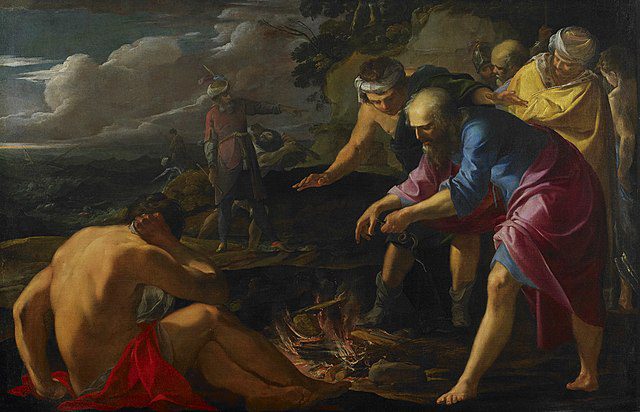
Photo credit: Saint Paul Shipwrecked on Malta (1630) [note the snake on his hand], by Laurent de La Hyre (1606-1656) [public domain / Wikimedia Commons]

***
alleged biblical contradictions
Previous Post

August 2, 2019
Depression and Anxiety: Some Natural Remedies Do Exist!
Next Post

August 3, 2019 Dr. David Madison vs. Jesus #3: Nature & Time of 2nd Coming
Browse Our Archives
Select a Category & Last Things About Me Anti-Catholicism Atheism & Agnosticism Baptism and Sacramentalism Bible and Tradition Blessed Virgin Mary Books by Dave Armstrong C. S. Lewis Calvinism & General Protestantism Catholic Apologetics Catholic Apologists Catholic conversion Catholic converts Christmas Church (Ecclesiology) Church History Conversion and Converts Development of Doctrine Eastern Orthodoxy Ecumenism & Christian Unity Eucharist & Liturgy Fathers of the Church French Translations G. K. Chesterton Hell Hell & Satan Hell & Satan & Last Things Heresies & Comparative Religion Holistic Health Inquisition & Crusades & Scandals James White Jews & Judaism & Old Testament John Calvin John Henry Newman Liberal / Modernist Theology Life Issues Literary Resume Lutheranism Mariology Martin Luther Music Orthodoxy Papacy & Infallibility Personal Page Philosophy & Science Political & Ethical & Moral Issues Protestant Persecution & Intolerance Protestantism Purgatory Purgatory & Penance Romantic & Imaginative Theology Saints & Purgatory & Penance Salvation Salvation & Justification Satan & Last Things Sexuality and Gender Issues Spanish Translations Traditionalism vs. Radical Catholic Reactionaries Traducciones al español / tradução para português Trinitarianism & Christology Uncategorized Videos
Select a Month October 2026 September 2026 August 2026 July 2026 June 2026 May 2026 April 2026 March 2026 February 2026 January 2026 December 2025 November 2025 October 2025 September 2025 August 2025 July 2025 June 2025 May 2025 April 2025 March 2025 February 2025 January 2025 December 2024 November 2024 October 2024 September 2024 August 2024 July 2024 June 2024 May 2024 April 2024 March 2024 February 2024 January 2024 December 2023 November 2023 October 2023 September 2023 August 2023 July 2023 June 2023 May 2023 April 2023 March 2023 February 2023 January 2023 December 2022 November 2022 October 2022 September 2022 August 2022 July 2022 June 2022 May 2022 April 2022 March 2022 February 2022 January 2022 December 2021 November 2021 October 2021 September 2021 August 2021 July 2021 June 2021 May 2021 April 2021 March 2021 February 2021 January 2021 December 2020 November 2020 October 2020 September 2020 August 2020 July 2020 June 2020 May 2020 April 2020 March 2020 February 2020 January 2020 December 2019 November 2019 October 2019 September 2019 August 2019 July 2019 June 2019 May 2019 April 2019 March 2019 February 2019 January 2019 December 2018 November 2018 October 2018 September 2018 August 2018 July 2018 June 2018 May 2018 April 2018 March 2018 February 2018 January 2018 December 2017 November 2017 October 2017 September 2017 August 2017 July 2017 June 2017 May 2017 April 2017 March 2017 February 2017 January 2017 December 2016 November 2016 October 2016 September 2016 August 2016 July 2016 June 2016 May 2016 April 2016 March 2016 February 2016 January 2016 December 2015 November 2015 October 2015 September 2015 August 2015 July 2015 June 2015 May 2015 April 2015 March 2015 February 2015 January 2015 December 2014 November 2014 October 2014 September 2014 August 2014 July 2014 June 2014 April 2014 March 2014 February 2014 January 2014 December 2013 November 2013 October 2013 September 2013 August 2013 July 2013 June 2013 April 2013 March 2013 February 2013 January 2013 December 2012 November 2012 October 2012 September 2012 August 2012 July 2012 June 2012 May 2012 April 2012 March 2012 February 2012 January 2012 December 2011 November 2011 October 2011 September 2011 August 2011 July 2011 June 2011 April 2011 March 2011 February 2011 October 2010 September 2010 August 2010 July 2010 April 2010 March 2010 December 2009 October 2009 August 2009 July 2009 June 2009 May 2009 March 2009 February 2009 October 2008 September 2008 April 2008 March 2008 February 2008 January 2008 December 2007 November 2007 October 2007 May 2007 March 2007 February 2007 January 2007 November 2006 October 2006 September 2006 August 2006 July 2006 June 2006 May 2006 April 2006 March 2006 February 2006 October 2005 June 2005 April 2005 February 2005 July 2004 May 2004 April 2004
Follow Us!
TAKE THE
Religious Wisdom Quiz
True or False: Hebrews teaches that the blood of bulls and goats can take away sins.
Select your answer to see how you score.
FALSE TRUE
Books by This Author Books by Dave Armstrong
Related posts from Biblical Evidence for Catholicism

A Few "Worst" & "Best" Arguments vs. Protestantism
Biblical Evidence for Catholicism

Jerusalem Council vs. James White & Sola Scriptura
Biblical Evidence for Catholicism

Biblical Perspicuity: Absurd Anti-Catholic "Defense"
Biblical Evidence for Catholicism

50 Biblical Disproofs of "Evident Clearness" of the...
Biblical Evidence for Catholicism
TRENDING AT PATHEOS Catholic

57th Dove Awards Honor Dolly Parton, Crown New...
On gospel music’s biggest night, the 57th annual GMA Dove Awards honored...

The First Eucharistic Controversy: Christ’s Real Presence
For Catholics, the Eucharist is the source and summit of the Christian...

What a Stop Sign Can Teach Us About...
How to Make a Decision When You Can't Hear God Main point:...

Archdiocese Hosts Military Marriage Retreat in Germany
RASTATT, Germany — The transient military lifestyle, with its frequent deployments and...

Nearly every morning, I make the drive to Detroit with my high-school-age...

The Real AI Story Is Adoption Without Trust
Artificial intelligence has crossed a political threshold. It is no longer a...
view all Catholic blogs
Ad-Free & Subscriber Log-In Subscription Support
- About Us
- 2026 Calendar
- Videos
- Podcasts
- Library of World Religions
- Faith In Media Tracker
- Advertise With Us
- Write for Us
- Privacy Policy
- Terms of Service
- Do Not Sell My Data
- Contact Us
- Radiant Digital
- Manage Newsletter Subscriptions
- Unsubscribe From Notifications
- Sitemap
Copyright 2008-2026, Patheos. All rights reserved.
Subscription Support Ad-Free & Subscriber Log-In
Follow Patheos