
BuddhistCatholicContemplativeEvangelicalGeneral ChristianHinduJewishLatter-day SaintMuslimNew VisionsProgressive Christian
Beliefs
- Buddhist
- Catholic
- Contemplative
- Evangelical
- General Christian
- Hindu
- Jewish
- Latter-day Saint
- More Voices
- Muslim
- New Visions
- Pagan
- Progressive Christian
Topics
- Religion News
- Food and Religion
- Sports and Religion
- Religious Art
- Religious Music and Entertainment
- Religious Events
- History and Religion
- Style and Religion
- Politics and Religion
- Women in Religion
- Recreation Outdoors and Religion
- Business Finance and Religion
- Careers Workplace and Religion
- Education and Religion
- Family Parenting and Religion
- Health Fitness and Religion
- Home and Religion
- Relationships and Religion
- Technology and Religion
- Travel and Religion
Columnists
- Buddhist Columnists
- Business Finance and Religion Columnists
- Careers Workplace and Religion Columnists
- Catholic Columnists
- Contemplative Columnists
- Education and Religion Columnists
- Evangelists Columnists
- Family Parenting and Religion Columnists
- General Christian Columnists
- Health Fitness and Religion Columnists
- Hindu Columnists
- History and Religion Columnists
- Home and Religion Columnists
- Jewish Columnists
- More Voices Columnists
- Latter Day Columnists
- Muslim Columnists
- New Visions Columnists
- Nonreligious Columnists
- Pagan Columnists
- Politics and Religion Columnists
- Progressive Columnists
- Recreation Outdoors and Religion Columnists
- Relationships and Religion Columnists
- Religion News Columnists
- Religious Art Columnists
- Religious Events Columnists
- Religious Music and Entertainment Columnists
- Sports and Religion Columnists
- Style and Religion Columnists
- Technology and Religion Columnists
- Travel and Religion Columnists
- Women in Religion Columnists
Resource Library
- 2026 Calendar
- Library of World Religions
- The 100 Most Holy Places on Earth
- Patheos Answers
- Podcasts
- Videos
- Faith Leaders Database
- Anglican Episcopalian
- Bahai
- Baptist
- Buddhism
- Christianity
- Confucianism
- Eastern Orthodoxy
- Hinduism
- Holiness and Pentecostal
- ISKCON
- Islam
- Judaism
- Lutheran
- Methodist
- The Church of Jesus Christ of Latter-day Saints
- New Age
- Paganism
- Presbytarian and Reformed
- Protestantism
- Religion Behind the Scenes
- Roman Catholic
- Scientology
- Shia Islam
- Sikhism
- Sufism
- Sunni Islam
- Taoism
- Zen
- See all religions
Research Tools
 Ad-Free & Subscriber Log-In Subscription Support
Ad-Free & Subscriber Log-In Subscription Support
Follow Patheos 

- Trending:
- Forgiveness
- |
- Marriage
- |
- Consciousness
- |
- Death Penalty
- |
- Election
- |
- Halloween

-
About
-
Catholic Apologetics
-
Church History
-
Great Apologists
-
Christian Worldview
-
Protestantism & Misc.
- Home
- Catholic
- History and Religion
- Dr. David Madison vs. Jesus #1: Hating One’s Family?
Dr. David Madison vs. Jesus #1: Hating One’s Family?
Last updated on: June 5, 2026 at 11:54 pm by Dave Armstrong
Dr. David Madison vs. Jesus #1: Hating One’s Family? 2026-06-05T23:54:15-04:00 Dave Armstrong
Patheos Explore the world's faith through different perspectives on religion and spirituality! Patheos has the views of the prevalent religions and spiritualities of the world.
This is an installment of my series of replies to an article by Dr. David Madison: a pastor in the Methodist Church for nine years, who has a PhD in Biblical Studies from Boston University. It’s called, “Things We Wish Jesus Hadn’t Said” (Debunking Christianity, 7-21-19). His words will be in blue below. Dr. Madison makes several “generic” digs at Jesus and Christianity, in the written portion (it details a series of 12 podcasts):
A challenge for Christians: If you’re so sure Jesus existed, then you have some explaining to do. A major frustration is that, while believers are indignant at all the talk about Jesus not existing, they don’t know the issues that fuel the skepticism—and are unwilling to inform themselves.
Yes, I’m up to the “challenge.” No problem at all. I’m not threatened or “scared” by this in the slightest. It’s what I do, as an apologist. The question is whether Dr. Madison is up to interacting with counter-critiques? Or will he act like the voluminous anti-theist atheist polemicist Bob Seidensticker?: who directly challenged me in one of his own comboxes to respond to his innumerable attack-pieces against Christianity and the Bible, and then courageously proceeded to utterly ignore my 35 specific critiques of his claims as of this writing. We shall soon see which course Dr. Madison will decide to take. Anyway, he also states in his post and combox:
[S]o many of the words of Jesus are genuinely shocking. These words aren’t proclaimed much from the pulpit, . . . Hence the folks in the pews have absorbed and adored an idealized Jesus. Christian apologists make their livings refiguring so many of the things Jesus supposedly said.
The gospels are riddled with contradictions and bad theology, and Jesus is so frequently depicted as a cult fanatic—because cult fanatics wrote the gospels. We see Jesus only through their theological filters. I just want to grab hold of Christian heads (standing behind them, with a hand on each ear) and force them to look straight ahead, unflinchingly, at the gospels, and then ask “Tell me what you see!” uncoached by apologist specialists, i.e., priests and pastors, who’ve had a lot of practice making bad texts look good. . . . I DO say, “Deal with the really bad stuff in the gospels.” Are you SURE you’ve not make a big mistake endorsing this particular Lord and Savior? That’s the whole point of this series of Flash Podcasts, because a helluva lot of Christians would agree, right away, that these quotes are bad news—if no one told then that they’ve been attributed to Jesus.
Of course, Dr. Madison — good anti-theist atheist that he is — takes the view that we are not at all sure whether Jesus in fact said anything recorded in the Gospels in the first place. I don’t play that game, because there is no end to it. It’s like trying to pin jello to the wall. The atheist always has their convenient out (when refuted in argument about some biblical text) that Jesus never said it anyway [wink wink and sly patronizing grin], and/or that the biblical text in question was simply added later by dishonest ultra-biased Christian partisans and propagandists. It’s a silly and ultimately intellectually dishonest game, and so I always refuse to play it with atheists or anyone else, because there is no way to “win” with such an absurdly stacked, purely subjective deck.
In my defense of biblical texts, I start with the assumption that the manuscripts we have are quite sufficient for us to know what is in the Bible (believe it or not). Going on from there, I simply defend particular [supposedly “difficult”] texts, and note with appropriate argumentation, that “here, the Bible teaches so-and-so,” etc. I deal with the texts as they exist. I don’t get into the endlessly arbitrary, subjective games that atheists and theologically liberal biblical skeptics play with the texts, in their self-serving textual criticism.
Dr. Madison himself (fortunately) grants my outlook in terms of practical “x vs. y” debate purposes: “For the sake of argument, I’m willing to say, okay, Jesus was real and, yes, we have gospels that tell the story.” And in the combox: “So, we can go along with their insistence that he did exist. We’ll play on their field, i.e., the gospels.”
Good! So we shall examine his cherry-picked texts and see whether his interpretations of them can stand up to scrutiny. He is issuing challenges, and I as an apologist will be dishing a bunch of my own right back to him. Two can play this game. I will be dealing honestly with his challenges. Will he return the favor, and engage in serious and substantive dialogue? Again, we’ll soon know what his reaction will be. A true dialogue is of a confident, inquisitive, “nothing to fear and everything to gain” back-and-forth and interactive nature, not merely “ships passing in the night” or what I call “mutual monologue.”
*****
Luke 14:26 (RSV) If any one comes to me and does not hate his own father and mother and wife and children and brothers and sisters, yes, and even his own life, he cannot be my disciple.
Dr. Madison, in his podcast, calls the text in question a “full body blow” and “embarrassing.” He adds (for no extra charge): “cult leaders . . . have not wanted people who would be swayed by family . . . that was part of his [Luke’s] agenda . . . for him it was standard operating procedure.”
Is that so? How very odd, then, that the same writer, eyes allegedly ablaze with propagandizing purposes and a cultish hatred of normal familial relations, records Jesus healing Peter’s mother-in-law:
Luke 4:38-39 And he arose and left the synagogue, and entered Simon’s house. Now Simon’s mother-in-law was ill with a high fever, and they besought him for her. [39] And he stood over her and rebuked the fever, and it left her; and immediately she rose and served them.
What sense does that make? None . . . If we interpret everything with a stultified, wooden literalism (utterly ignoring the richness of literary forms and genres that every language has: including Hebrew and Greek), then we have the absurdity of Jesus supposedly advocating literal hatred of family members, yet turning around and healing one of same. And Luke the wild-eyed “true believer” — inexplicably, if we accept Dr. Madison’s take — records this! So do Matthew (8:14-15) and Mark (1:29-31).
“Hate” . . . means exactly what it seems to mean . . . This verse has to be at the top of the list of things we wish Jesus hadn’t said. . . .
One would have to know Greek or Aramaic . . . if not, so Dr. Madison opines, it is a “knee jerk reaction” to not interpret literally.
I’m delighted that he actually brought up the question of language and [implied] literary genres. It’s the only indication we have in his podcast, that he is aware of such factors that are crucial in interpretation. But one would fully expect this in one who has a PhD in Biblical Studies. This is what makes it all the more odd and strange that Dr. Madison can’t figure out what is going on in this passage. It’s really not all that complicated.
Bible scholar E. W. Bullinger catalogued “over 200 distinct figures [in the Bible], several of them with from 30 to 40 varieties.” That is a statement from the Introduction to his 1104-page tome, Figures of Speech Used in the Bible (London: 1898). I have this work in my own library (hardcover). It’s also available for free, online. Bullinger continues, in the Introduction:
All language is governed by law; but, in order to increase the power of a word, or the force of an expression, these laws are designedly departed from, and words and sentences are thrown into, and used in, new forms, or figures.
The ancient Greeks reduced these new and peculiar forms to science, and gave names to more than two hundred of them.
The Romans carried forward this science . . .
These manifold forms which words and sentences assume were called by the Greeks Schema and by the Romans, Figura. Both words have the same meaning, viz., a shape or figure. . . .
Applied to words, a figure denotes some form which a word or sentence takes, different from its ordinary and natural form. This is always for the purpose of giving additional force, more life, intensified feeling, and greater emphasis.
Bullinger devotes six pages (423-428) to “Hyperbole; or, Exaggeration”: which he defines as follows:
The figure is so called because the expression adds to the sense so much that it exaggerates it, and enlarges or diminishes it more than is really meant in fact. Or, when more is said than is meant to be literally understood, in order to heighten the sense.
It is the superlative degree applied to verbs and sentences and expressions or descriptions, rather than to mere adjectives. . . .
It was called by the Latins superlatio, a carrying beyond, an exaggerating.
I shall cite some of his more notable and obvious examples (omitting ellipses: “. . .” ):
Gen. ii. 24. — “Therefore shall a man leave his father and his mother, and shall cleave unto his wife.” This does not mean that he is to forsake and no longer to love or care for his parents. So Matt. xix. 5.
Ex. viii. 17. — “All the dust of the land became lice throughout all the land of Egypt”: i.e., wherever in all the land there was dust, it became lice.
I Sam. xxv. 37. — Nabal’s “heart died within him, and he became as a stone”: i.e., he was terribly frightened and collapsed or fainted away.
I Kings i. 40. — “So that the earth rent with the sound of them.” A hyperbolical description of their jumping and leaping for joy.Job xxix. 6. — “The rock poured me out rivers of oil”: i.e., I had abundance of all good things. So chap. xx. 17 and Micah vi. 7.
Isa. xiv. 13, — “I will ascend into heaven”: to express the pride of Lucifer.
Lam. ii. 11.— “My liver is poured upon the earth, etc”: to express the depth of the Prophet’s grief and sorrow at the desolations of Zion.
Luke xiv. 26. — “If any man come to me and hate not his father and mother”: i.e., does not esteem them less than me. So the verb to hate is used (Gen. xxix. 31. Rom. ix. 13). [my bolding]
John iii. 26. — “All men come to him.” Thus his disciples said to John, to show their sense of the many people who followed the Lord.
John xii. 19. — “Behold, the world is gone after him.” The enemies of the Lord thus expressed their indignation at the vast multitudes which followed Him.
Gary Amirault highlights more biblical examples in a similar article:
[T]is verse is a hyperbole, an exaggeration for effect:
“You blind guides! You strain out a gnat but swallow a camel.” (Matt. 23:24, NIV)
It is not too difficult to determine that this is a hyperbole, an exaggeration. Because the English language is full of Bible terms and phraseology, this Hebrew idiom has become part of the English language. Therefore most English speaking people know the real meaning of that phrase: “You pay close attention to little things but neglect the important things.” [Dave: or, “you can’t see the forest for the trees”]
However, here is a hyperbole that the average Bible reader may miss and formulate doctrine from which may end up being harmful to themselves and others.
“Everything is possible for him who believes.” (Mark 9:23b, NIV)
The Bible is full of exaggerations like the one above which are not to be taken literally. Careful attention, comparing scripture with scripture, knowing the Bible and its author thoroughly, making certain not to necessary apply things to ourselves which weren’t meant for us individually and some basics about the original languages are needed to prevent us from misinterpreting various scripture verses like this one. . . .
“If thy right eye offend thee, pluck it out…” Matt. 5:29 (I met a Christian who actually tried to pluck out his right eye because he had a lust problem. This is an example the kind of problem a Bible translation can cause if one is not informed of the various figures of speech found in the Bible.)
The literary device of antithesis, or contrast also seems more specifically applicable to the verse we are considering. Bullinger writes about this in his pages 715-718:
A setting of one Phrase in Contrast with another.
. . . It is a figure by which two thoughts, ideas, or phrases, are set over one against the other, in order to make the contrast more striking, and thus to emphasize it. [footnote: “When this consists of words rather than of sentences, it is called Epanodos, and Antimetabole (q.v.).”]
The two parts so placed are hence called in Greek antitheta, and in Latin opposita and contraposita. . . .
It is called also contentio: i.e., comparison, or contrast. When this contrast is made by affirmatives and negatives, it is called Enantiosis, see below. The Book of Proverbs so abounds in such Antitheses that we have not given any examples from it.
Hence (understanding all this, which Dr. Madison obviously does not), when Jesus says “does not hate his own father and mother and wife and children and brothers and sisters” He is expressing Hebrew hyperbole and/or antithesis to express with extreme exaggeration what He literally means: “does not esteem them less than me.” Thus, the thought of “loving Jesus more than one’s own family” is expressed by the non-literal “hate [one’s family, in order to] be my disciple.”
In fact, Jesus did express what we contend He was stating non-literally in Luke 14:26, in a literal fashion elsewhere (and here we see the important hermeneutical principle of “interpret less clear or obvious passages by more clear related passages”):
Matthew 10:37 He who loves father or mother more than me is not worthy of me; and he who loves son or daughter more than me is not worthy of me;
We see precisely the same parallelism (“hate” = “love relatively more than”) in the poetic literary expression of Genesis:
Genesis 29:30-33 So Jacob went in to Rachel also, and he loved Rachel more than Leah, and served Laban for another seven years. [31] When the LORD saw that Leah was hated, he opened her womb; but Rachel was barren. [32] And Leah conceived and bore a son, and she called his name Reuben; for she said, “Because the LORD has looked upon my affliction; surely now my husband will love me.” [33] She conceived again and bore a son, and said, “Because the LORD has heard that I am hated, he has given me this son also”; and she called his name Simeon.
The apostle Paul expresses largely the same sort of thing in the same way:
Philippians 3:7-8 But whatever gain I had, I counted as loss for the sake of Christ. [8] Indeed I count everything as loss because of the surpassing worth of knowing Christ Jesus my Lord. For his sake I have suffered the loss of all things, and count them as refuse, in order that I may gain Christ
Paul also seemed blissfully unaware of Luke and other early Christian “cultist” supposed fanatical anti-family views, since he casually alluded to apostles like himself and Peter (“Cephas”) having “the right to be accompanied by a wife” (1 Cor 9:5).
I submit that Jesus commented on his own statement in another related sense in this passage:
Matthew 12:47-50 While he was still speaking to the people, behold, his mother and his brothers stood outside, asking to speak to him. [48] But he replied to the man who told him, “Who is my mother, and who are my brothers?” [49] And stretching out his hand toward his disciples, he said, “Here are my mother and my brothers! [50] For whoever does the will of my Father in heaven is my brother, and sister, and mother.”
He’s not rejecting His family. He is enlarging the concept of family to include people like His disciples and indeed, anyone who “does the will of my Father in heaven.” It’s another very typical instance of Hebrew hyperbole or a type of antithesis. But it’s inclusive, not exclusive.
Jesus taught that we are to love (not hate) even our enemies:
Matthew 5:43-44 You have heard that it was said, `You shall love your neighbor and hate your enemy.’ [44] But I say to you, Love your enemies and pray for those who persecute you, (cf. Lk 6:27-35)
Obviously, then, He would not (and did not) teach that we ought to hate our own families. Jesus taught that we should love all people, and that includes families:
Matthew 19:19 Honor your father and mother, and, You shall love your neighbor as yourself.
Matthew 22:37-40 And he said to him, “You shall love the Lord your God with all your heart, and with all your soul, and with all your mind. [38] This is the great and first commandment. [39] And a second is like it, You shall love your neighbor as yourself. [40] On these two commandments depend all the law and the prophets.”
Mark 12:30-31 and you shall love the Lord your God with all your heart, and with all your soul, and with all your mind, and with all your strength.’ [31] The second is this, `You shall love your neighbor as yourself.’ There is no other commandment greater than these.”
Luke 10:27 And he answered, “You shall love the Lord your God with all your heart, and with all your soul, and with all your strength, and with all your mind; and your neighbor as yourself.
John 13:34-35 A new commandment I give to you, that you love one another; even as I have loved you, that you also love one another.[35] By this all men will know that you are my disciples, if you have love for one another.
John 15:17 This I command you, to love one another.
I rest my case. This poses no problem whatsoever for either Christians, or a consistent interpretation of these Bible passages. It’s simply a function of non-literal forms of speaking that were common in Hebrew culture (just as in every other culture and language, to more or less degrees). But Hebrew language was especially rich in figures and non-literal techniques.
And this leads to innumerable misguided readings of Scripture from atheists and other biblical skeptics (even including those with doctorates in biblical studies) who — oddly — don’t grasp this rather elementary consideration, and appear to make no effort to try to understand it. They’re too busy tearing down Holy Scripture and approaching it like how a butcher views a hog.
***
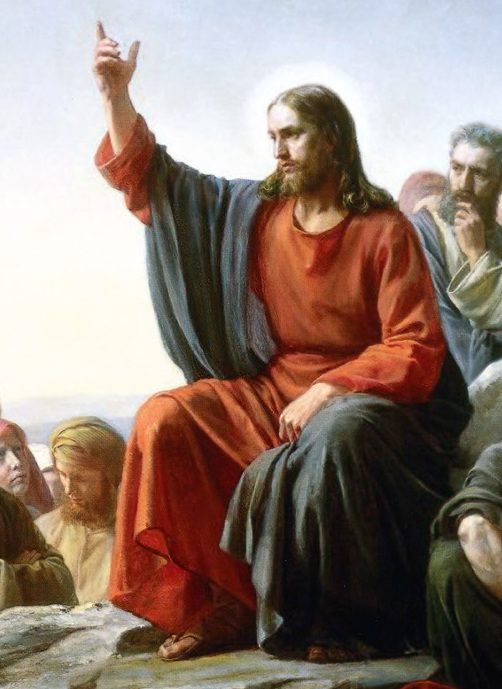
Photo credit: The Sermon on the Mount (1877, portion), by Carl Bloch (1834-1890) [public domain / Wikimedia Commons]

alleged biblical contradictions
Previous Post

August 1, 2019
Jesus: Faith + Works (Not Faith Alone) Leads to Salvation
Next Post

August 2, 2019 Caiaphas' Unjust Accusation of Jesus as a Blasphemer
Browse Our Archives
Select a Category & Last Things About Me Anti-Catholicism Atheism & Agnosticism Baptism and Sacramentalism Bible and Tradition Blessed Virgin Mary Books by Dave Armstrong C. S. Lewis Calvinism & General Protestantism Catholic Apologetics Catholic Apologists Catholic conversion Catholic converts Christmas Church (Ecclesiology) Church History Conversion and Converts Development of Doctrine Eastern Orthodoxy Ecumenism & Christian Unity Eucharist & Liturgy Fathers of the Church French Translations G. K. Chesterton Hell Hell & Satan Hell & Satan & Last Things Heresies & Comparative Religion Holistic Health Inquisition & Crusades & Scandals James White Jews & Judaism & Old Testament John Calvin John Henry Newman Liberal / Modernist Theology Life Issues Literary Resume Lutheranism Mariology Martin Luther Music Orthodoxy Papacy & Infallibility Personal Page Philosophy & Science Political & Ethical & Moral Issues Protestant Persecution & Intolerance Protestantism Purgatory Purgatory & Penance Romantic & Imaginative Theology Saints & Purgatory & Penance Salvation Salvation & Justification Satan & Last Things Sexuality and Gender Issues Spanish Translations Traditionalism vs. Radical Catholic Reactionaries Traducciones al español / tradução para português Trinitarianism & Christology Uncategorized Videos
Select a Month October 2026 September 2026 August 2026 July 2026 June 2026 May 2026 April 2026 March 2026 February 2026 January 2026 December 2025 November 2025 October 2025 September 2025 August 2025 July 2025 June 2025 May 2025 April 2025 March 2025 February 2025 January 2025 December 2024 November 2024 October 2024 September 2024 August 2024 July 2024 June 2024 May 2024 April 2024 March 2024 February 2024 January 2024 December 2023 November 2023 October 2023 September 2023 August 2023 July 2023 June 2023 May 2023 April 2023 March 2023 February 2023 January 2023 December 2022 November 2022 October 2022 September 2022 August 2022 July 2022 June 2022 May 2022 April 2022 March 2022 February 2022 January 2022 December 2021 November 2021 October 2021 September 2021 August 2021 July 2021 June 2021 May 2021 April 2021 March 2021 February 2021 January 2021 December 2020 November 2020 October 2020 September 2020 August 2020 July 2020 June 2020 May 2020 April 2020 March 2020 February 2020 January 2020 December 2019 November 2019 October 2019 September 2019 August 2019 July 2019 June 2019 May 2019 April 2019 March 2019 February 2019 January 2019 December 2018 November 2018 October 2018 September 2018 August 2018 July 2018 June 2018 May 2018 April 2018 March 2018 February 2018 January 2018 December 2017 November 2017 October 2017 September 2017 August 2017 July 2017 June 2017 May 2017 April 2017 March 2017 February 2017 January 2017 December 2016 November 2016 October 2016 September 2016 August 2016 July 2016 June 2016 May 2016 April 2016 March 2016 February 2016 January 2016 December 2015 November 2015 October 2015 September 2015 August 2015 July 2015 June 2015 May 2015 April 2015 March 2015 February 2015 January 2015 December 2014 November 2014 October 2014 September 2014 August 2014 July 2014 June 2014 April 2014 March 2014 February 2014 January 2014 December 2013 November 2013 October 2013 September 2013 August 2013 July 2013 June 2013 April 2013 March 2013 February 2013 January 2013 December 2012 November 2012 October 2012 September 2012 August 2012 July 2012 June 2012 May 2012 April 2012 March 2012 February 2012 January 2012 December 2011 November 2011 October 2011 September 2011 August 2011 July 2011 June 2011 April 2011 March 2011 February 2011 October 2010 September 2010 August 2010 July 2010 April 2010 March 2010 December 2009 October 2009 August 2009 July 2009 June 2009 May 2009 March 2009 February 2009 October 2008 September 2008 April 2008 March 2008 February 2008 January 2008 December 2007 November 2007 October 2007 May 2007 March 2007 February 2007 January 2007 November 2006 October 2006 September 2006 August 2006 July 2006 June 2006 May 2006 April 2006 March 2006 February 2006 October 2005 June 2005 April 2005 February 2005 July 2004 May 2004 April 2004
Follow Us!
TAKE THE
Religious Wisdom Quiz
Where was Paul's hometown?
Select your answer to see how you score.
Damascus Tarsus Antioch Jerusalem
Books by This Author Books by Dave Armstrong
Related posts from Biblical Evidence for Catholicism

A Few "Worst" & "Best" Arguments vs. Protestantism
Biblical Evidence for Catholicism

Jerusalem Council vs. James White & Sola Scriptura
Biblical Evidence for Catholicism

Biblical Perspicuity: Absurd Anti-Catholic "Defense"
Biblical Evidence for Catholicism

50 Biblical Disproofs of "Evident Clearness" of the...
Biblical Evidence for Catholicism
TRENDING AT PATHEOS Catholic

The Sermon on the Mount, Part I: Matthew...
The Sermon on the Mount, Part I (Matthew 4:12-5:12) St. Matthew moves...

What's up from Crossway: Reviewing some of their latest A few weeks...

Janie Learns the Way of the Cross: A...
Teaching children about Jesus' Passion can be challenging. Many parents and educators...

Looking For Good Catholic Writing - October 2026
He alone extends the heavens, and he walks upon the waves of...

In "Irreplaceable," our book on vocation and technology, Trevor Sutton and I...

I was strolling through the top floor of the brand new Parthenon...
view all Catholic blogs
Ad-Free & Subscriber Log-In Subscription Support
- About Us
- 2026 Calendar
- Videos
- Podcasts
- Library of World Religions
- Faith In Media Tracker
- Advertise With Us
- Write for Us
- Privacy Policy
- Terms of Service
- Do Not Sell My Data
- Contact Us
- Radiant Digital
- Manage Newsletter Subscriptions
- Unsubscribe From Notifications
- Sitemap
Copyright 2008-2026, Patheos. All rights reserved.
Subscription Support Ad-Free & Subscriber Log-In
Follow Patheos