
BuddhistCatholicContemplativeEvangelicalGeneral ChristianHinduJewishLatter-day SaintMuslimNew VisionsProgressive Christian
Beliefs
- Buddhist
- Catholic
- Contemplative
- Evangelical
- General Christian
- Hindu
- Jewish
- Latter-day Saint
- More Voices
- Muslim
- New Visions
- Pagan
- Progressive Christian
Topics
- Religion News
- Food and Religion
- Sports and Religion
- Religious Art
- Religious Music and Entertainment
- Religious Events
- History and Religion
- Style and Religion
- Politics and Religion
- Women in Religion
- Recreation Outdoors and Religion
- Business Finance and Religion
- Careers Workplace and Religion
- Education and Religion
- Family Parenting and Religion
- Health Fitness and Religion
- Home and Religion
- Relationships and Religion
- Technology and Religion
- Travel and Religion
Columnists
- Buddhist Columnists
- Business Finance and Religion Columnists
- Careers Workplace and Religion Columnists
- Catholic Columnists
- Contemplative Columnists
- Education and Religion Columnists
- Evangelists Columnists
- Family Parenting and Religion Columnists
- General Christian Columnists
- Health Fitness and Religion Columnists
- Hindu Columnists
- History and Religion Columnists
- Home and Religion Columnists
- Jewish Columnists
- More Voices Columnists
- Latter Day Columnists
- Muslim Columnists
- New Visions Columnists
- Nonreligious Columnists
- Pagan Columnists
- Politics and Religion Columnists
- Progressive Columnists
- Recreation Outdoors and Religion Columnists
- Relationships and Religion Columnists
- Religion News Columnists
- Religious Art Columnists
- Religious Events Columnists
- Religious Music and Entertainment Columnists
- Sports and Religion Columnists
- Style and Religion Columnists
- Technology and Religion Columnists
- Travel and Religion Columnists
- Women in Religion Columnists
Resource Library
- 2026 Calendar
- Library of World Religions
- The 100 Most Holy Places on Earth
- Patheos Answers
- Podcasts
- Videos
- Faith Leaders Database
- Anglican Episcopalian
- Bahai
- Baptist
- Buddhism
- Christianity
- Confucianism
- Eastern Orthodoxy
- Hinduism
- Holiness and Pentecostal
- ISKCON
- Islam
- Judaism
- Lutheran
- Methodist
- The Church of Jesus Christ of Latter-day Saints
- New Age
- Paganism
- Presbytarian and Reformed
- Protestantism
- Religion Behind the Scenes
- Roman Catholic
- Scientology
- Shia Islam
- Sikhism
- Sufism
- Sunni Islam
- Taoism
- Zen
- See all religions
Research Tools
 Ad-Free & Subscriber Log-In Subscription Support
Ad-Free & Subscriber Log-In Subscription Support
Follow Patheos 

- Trending:
- Forgiveness
- |
- Marriage
- |
- Consciousness
- |
- Death Penalty
- |
- Election
- |
- Halloween

-
About
-
Catholic Apologetics
-
Church History
-
Great Apologists
-
Christian Worldview
-
Protestantism & Misc.
- Home
- Catholic
- History and Religion
- David Madison vs. the Gospel of Mark #5: Chapter 4 (Parables)
David Madison vs. the Gospel of Mark #5: Chapter 4 (Parables)
Last updated on: August 17, 2019 at 9:04 pm by Dave Armstrong
David Madison vs. the Gospel of Mark #5: Chapter 4 (Parables) 2019-08-17T21:04:33-04:00 Dave Armstrong
Patheos Explore the world's faith through different perspectives on religion and spirituality! Patheos has the views of the prevalent religions and spiritualities of the world.
This is an installment of my replies to a series of articles on Mark by Dr. David Madison: an atheist who was a Methodist minister for nine years: with a Ph.D. in Biblical Studies from Boston University. His summary article is called, “Not-Your-Pastor’s Tour of Mark’s Gospel: The falsification of Christianity made easy” (Debunking Christianity, 7-17-19). His words will be in blue below.
Dr. Madison has utterly ignored my twelve refutations of his “dirty dozen” podcasts against Jesus, and I fully expect that stony silence to continue. If he wants to be repeatedly critiqued and make no response, that’s his choice (which would challenge Bob Seidensticker as the most intellectually cowardly atheist I know). I will continue on, whatever he decides to do (no skin off my back).
Dr. Madison believes we are not at all sure whether Jesus in fact said anything recorded in the Gospels. The atheist always has a convenient “out” (when refuted in argument about some biblical text) that Jesus never said it anyway and that the text in question was simply made up and added later by unscrupulous and “cultish” Christian propagandists.
I always refuse to play this silly and ultimately intellectually dishonest game, because there is no way to “win” with such a stacked, subjective deck. I start with the assumption (based on many historical evidences) that the manuscripts we have are quite sufficient for us to know what is in the Bible (believe it or not).
Dr. Madison himself — in his anti-Jesus project noted above, granted my outlook, strictly in terms of practical “x vs. y” debate purposes: “For the sake of argument, I’m willing to say, okay, Jesus was real and, yes, we have gospels that tell the story.” And in the combox: “So, we can go along with their insistence that he did exist. We’ll play on their field, i.e., the gospels.” Excellent! Otherwise, there would be no possible discussion at all.
*****
Dr. Madison called this installment: “Please Tell Me Jesus Didn’t Say That: The gospel writer pushed history off the page” (7-27-18)
The Purpose of the Parables
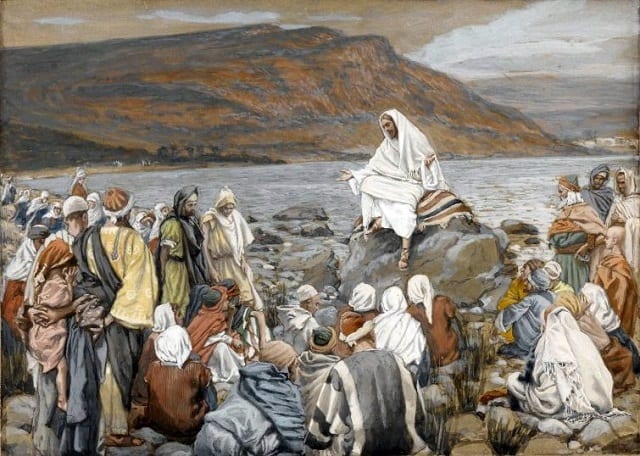
At the opening of Mark 4 we read that Jesus, sitting in a boat, was preaching to a large crowd on the land. In fact, this is the first time that Jesus is depicted telling a parable. It is commonly known as the Parable of the Sower. Jesus points out that some of the seed lands on the path, some in rocky soil, some among thorns—and finally some in good soil, which yields abundant produce. Jesus concludes, “He who has ears to hear, let him hear.”
That’s it?
The folks in the big crowd probably knew what sowers did, and they might have thought, “Gee, what a sloppy guy. Be more careful where you throw the seed! So, what’s your point Jesus?” We’re told in earlier chapters that many people flocked to see Jesus because he healed a lot of people—they wanted to just touch his garments—and he cast out demons. We hear in Mark 1:27 that they raved about his new teaching.
But this parable of the sower could not have failed to disappoint. Why would his listeners not have said, “So what?”
Church folks, who have probably heard dozens of sermons based on this parable—and its explanation a few verses later—nod knowingly. But the crowd that supposedly heard Jesus wasn’t told the explanation. Bizarrely enough, that’s part of Mark’s plot. In vv. 10-12, we read that, when Jesus was alone with the disciplines and other followers, he told them:
“To you has been given the secret [or mystery] of the kingdom of God, but for those outside, everything comes in parables; in order that ‘they may indeed look, but not perceive,
and may indeed listen, but not understand;
so that they may not turn again and be forgiven.’”
Did I read that right? This is even a quote from Isaiah 6:9-10, presumably to give it more clout. Jesus confides to his inside circle that he doesn’t want outsiders to perceive, understand his message and repent. He seems to be referring to the common rabble, those great throngs of people who came out to hear him preach.
But this doesn’t make sense. Jesus doesn’t want them to repent?
This is such a contrast to what we read elsewhere. In Mark 1:38, Jesus says, “Let us go on to the neighboring towns, so that I may proclaim the message there also; for that is what I came out to do.” And in 2:17 Jesus declares, “Those who are well have no need of a physician, but those who are sick; I have come to call not the righteous but sinners.” Why would he then tell those closest to him that he uses parables to keep people in the dark?
Yes, of course, Mark got it wrong, and seems to have overlooked his blunder. Or maybe not. He might have known exactly what he was doing, and didn’t care all that much about consistency. . . .
In verses 33-34 he returns to the promise that knowledge of God’s Kingdom is for the few:
“With many such parables he spoke the word to them, as they were able to hear it; he did not speak to them except in parables, but he explained everything in private to his disciples.” . . .
Let’s just hope that no one succeeds in proving that Jesus didn’t want sinners to repent and be forgiven. That would be a setback for the What-Would-Jesus-Do crowd.
I have already thoroughly disposed of this groundless and clueless objection in my paper, Madison vs. Jesus #7: God Prohibits Some Folks’ Repentance?
Apologists can also deal with the challenge of squaring “he did not speak to them except in parables” with John’s gospel, in which Jesus doesn’t tell any parables at all.
Yeah, I did that in installment #1 of this series, but for convenience’ sake, I’ll paste it here again:
That’s correct. But Jesus does talk (as recorded in the Gospel of John) in many metaphorical or proverbial (non-literal) ways that bear resemblance to the synoptic parables. For example:
John 2:19-21 (RSV) Jesus answered them, “Destroy this temple, and in three days I will raise it up.” [20] The Jews then said, “It has taken forty-six years to build this temple, and will you raise it up in three days?” [21] But he spoke of the temple of his body.
John 3:8 The wind blows where it wills, and you hear the sound of it, but you do not know whence it comes or whither it goes; so it is with every one who is born of the Spirit.
John 4:13-14 Jesus said to her, “Every one who drinks of this water will thirst again, [14] but whoever drinks of the water that I shall give him will never thirst; the water that I shall give him will become in him a spring of water welling up to eternal life.”
John 6:35 Jesus said to them, “I am the bread of life; he who comes to me shall not hunger, and he who believes in me shall never thirst.
John 10:11 I am the good shepherd. The good shepherd lays down his life for the sheep. (see also 10:1-10, 12-18, including Jesus calling Himself “the door” three times)
John 11:12-14 But if any one walks in the night, he stumbles, because the light is not in him.” [11] Thus he spoke, and then he said to them, “Our friend Laz’arus has fallen asleep, but I go to awake him out of sleep.” [12] The disciples said to him, “Lord, if he has fallen asleep, he will recover.” [13] Now Jesus had spoken of his death, but they thought that he meant taking rest in sleep. [14] Then Jesus told them plainly, “Laz’arus is dead;”
Then follows this warning, vv. 24-25:
[Jesus] said to them, “Pay attention to what you hear; the measure you give will be the measure you get, and still more will be given you. For to those who have, more will be given; and from those who have nothing, even what they have will be taken away.”
I’ll leave it to the zealous apologists to make Jesus look good on this one. Mark’s script, trying to keep the Jesus cult intact, sets the tone for countless cult leaders to come: folks were expected to give full commitment to the cult, and they will lose everything if they didn’t.
Dr. Madison employs his usual tarnishing of Christianity as a bizarre, mind-controlling “cult.” “Cult” might even very well be his favorite word in the English language. I’m afraid it’s much simpler than that (no one need resort to arbitrary conspiracy theories and poisoning the well). Jesus is merely saying that if we don’t act upon the grace that God gives us, then we are in danger of losing everything: meaning that we will lose salvation and be damned.
This is the whole point of Christianity: ultimate salvation and going to heaven to be in union with God forever: just as God always intended for His children that He created (because this will give us unimaginable — the highest possible — joy and happiness for all eternity, since we were made for it). But He also didn’t want to create robots with no free will; so that free will is what opens up the possibility of rejection of God, and thus (failing repentance) winding up in hell, separate from Him, by deliberate choice, for all eternity.
Mark continues his theme of the seed being the Kingdom of God. In vv. 26-29 he uses the imagery of seed sprouting and growing, resulting in a good harvest, and in vv. 30-32 the Kingdom of God is compared to a mustard seed that will grow into an enormous bush. He seems to want to assure his followers that their hope for the Kingdom would have a big payoff.
Nonsense. All Jesus is saying here is that evangelism — spreading the Gospel — will bear great fruit. He’s not talking about personal gain (economic or otherwise). What started as a small band of twelve disciples (eventually minus the one betrayer) would grow and grow to the size it is today:
With around 2.3 billion adherents, split into three main branches of Catholic, Protestant, and Eastern Orthodox, Christianity is the world’s largest religion. The Christian share of the world’s population has stood at around 33% for the last hundred years, which means that one in three persons on Earth are Christians. . . . According to a 2015 Pew Research Center study, within the next four decades, Christians will remain the world’s largest religion; and by 2050, the Christian population is expected to exceed 3 billion. (Wikipedia, “Christianity: Demographics”)
How’s that for a true prediction?
***
Photo credit: Jesus Teaches the People by the Sea, by James Tisot (1836-1902) [public domain / Wikimedia Commons]

***
alleged biblical contradictions
Not-Your-Pastor’s Tour of Mark’s Gospel
Previous Post

August 16, 2019
David Madison vs. the Gospel of Mark #4: Chapter 3
Next Post

August 16, 2019 Masturbation: Gravely Disordered According to Catholicism
Browse Our Archives
Select a Category & Last Things About Me Anti-Catholicism Atheism & Agnosticism Baptism and Sacramentalism Bible and Tradition Blessed Virgin Mary Books by Dave Armstrong C. S. Lewis Calvinism & General Protestantism Catholic Apologetics Catholic Apologists Catholic conversion Catholic converts Christmas Church (Ecclesiology) Church History Conversion and Converts Development of Doctrine Eastern Orthodoxy Ecumenism & Christian Unity Eucharist & Liturgy Fathers of the Church French Translations G. K. Chesterton Hell Hell & Satan Hell & Satan & Last Things Heresies & Comparative Religion Holistic Health Inquisition & Crusades & Scandals James White Jews & Judaism & Old Testament John Calvin John Henry Newman Liberal / Modernist Theology Life Issues Literary Resume Lutheranism Mariology Martin Luther Music Orthodoxy Papacy & Infallibility Personal Page Philosophy & Science Political & Ethical & Moral Issues Protestant Persecution & Intolerance Protestantism Purgatory Purgatory & Penance Romantic & Imaginative Theology Saints & Purgatory & Penance Salvation Salvation & Justification Satan & Last Things Sexuality and Gender Issues Spanish Translations Traditionalism vs. Radical Catholic Reactionaries Traducciones al español / tradução para português Trinitarianism & Christology Uncategorized Videos
Select a Month October 2026 September 2026 August 2026 July 2026 June 2026 May 2026 April 2026 March 2026 February 2026 January 2026 December 2025 November 2025 October 2025 September 2025 August 2025 July 2025 June 2025 May 2025 April 2025 March 2025 February 2025 January 2025 December 2024 November 2024 October 2024 September 2024 August 2024 July 2024 June 2024 May 2024 April 2024 March 2024 February 2024 January 2024 December 2023 November 2023 October 2023 September 2023 August 2023 July 2023 June 2023 May 2023 April 2023 March 2023 February 2023 January 2023 December 2022 November 2022 October 2022 September 2022 August 2022 July 2022 June 2022 May 2022 April 2022 March 2022 February 2022 January 2022 December 2021 November 2021 October 2021 September 2021 August 2021 July 2021 June 2021 May 2021 April 2021 March 2021 February 2021 January 2021 December 2020 November 2020 October 2020 September 2020 August 2020 July 2020 June 2020 May 2020 April 2020 March 2020 February 2020 January 2020 December 2019 November 2019 October 2019 September 2019 August 2019 July 2019 June 2019 May 2019 April 2019 March 2019 February 2019 January 2019 December 2018 November 2018 October 2018 September 2018 August 2018 July 2018 June 2018 May 2018 April 2018 March 2018 February 2018 January 2018 December 2017 November 2017 October 2017 September 2017 August 2017 July 2017 June 2017 May 2017 April 2017 March 2017 February 2017 January 2017 December 2016 November 2016 October 2016 September 2016 August 2016 July 2016 June 2016 May 2016 April 2016 March 2016 February 2016 January 2016 December 2015 November 2015 October 2015 September 2015 August 2015 July 2015 June 2015 May 2015 April 2015 March 2015 February 2015 January 2015 December 2014 November 2014 October 2014 September 2014 August 2014 July 2014 June 2014 April 2014 March 2014 February 2014 January 2014 December 2013 November 2013 October 2013 September 2013 August 2013 July 2013 June 2013 April 2013 March 2013 February 2013 January 2013 December 2012 November 2012 October 2012 September 2012 August 2012 July 2012 June 2012 May 2012 April 2012 March 2012 February 2012 January 2012 December 2011 November 2011 October 2011 September 2011 August 2011 July 2011 June 2011 April 2011 March 2011 February 2011 October 2010 September 2010 August 2010 July 2010 April 2010 March 2010 December 2009 October 2009 August 2009 July 2009 June 2009 May 2009 March 2009 February 2009 October 2008 September 2008 April 2008 March 2008 February 2008 January 2008 December 2007 November 2007 October 2007 May 2007 March 2007 February 2007 January 2007 November 2006 October 2006 September 2006 August 2006 July 2006 June 2006 May 2006 April 2006 March 2006 February 2006 October 2005 June 2005 April 2005 February 2005 July 2004 May 2004 April 2004
Follow Us!
TAKE THE
Religious Wisdom Quiz
How many disciples did Jesus have?
Select your answer to see how you score.
Thirty Seven One hundred Twelve
Books by This Author Books by Dave Armstrong
Related posts from Biblical Evidence for Catholicism

God, Modern Physics, & Dark Energy: An Analogy
Biblical Evidence for Catholicism

General Debate on Christianity with an Atheist
Biblical Evidence for Catholicism

Can Atheists Be Saved? Surprising Biblical Data
Biblical Evidence for Catholicism
Can Atheists Be Saved? YES! (Possibly Some ....
Biblical Evidence for Catholicism
TRENDING AT PATHEOS Catholic

In "Irreplaceable," our book on vocation and technology, Trevor Sutton and I...

I was strolling through the top floor of the brand new Parthenon...

What Does Gêvâh Mean For Kimberley Guifoyle &...
This week, a lot of the news is focused on Kimberly Guilfoyle....

INNER CIRCLE: Profound Mystery (Of Christ In All...
Ephesians 5:31-32 “For this reason, a man will leave his father and...

Do Not Rejoice When Your Enemy Falls: The...
Turning an execution into a public spectacle is a disturbing expression of...

'The Chosen' S6 Trailer: The Passion Gets Very...
Not many watching 'The Chosen' worry about spoilers, but just because they...
view all Catholic blogs
Ad-Free & Subscriber Log-In Subscription Support
- About Us
- 2026 Calendar
- Videos
- Podcasts
- Library of World Religions
- Faith In Media Tracker
- Advertise With Us
- Write for Us
- Privacy Policy
- Terms of Service
- Do Not Sell My Data
- Contact Us
- Radiant Digital
- Manage Newsletter Subscriptions
- Unsubscribe From Notifications
- Sitemap
Copyright 2008-2026, Patheos. All rights reserved.
Subscription Support Ad-Free & Subscriber Log-In
Follow Patheos