
BuddhistCatholicContemplativeEvangelicalGeneral ChristianHinduJewishLatter-day SaintMuslimNew VisionsProgressive Christian
Beliefs
- Buddhist
- Catholic
- Contemplative
- Evangelical
- General Christian
- Hindu
- Jewish
- Latter-day Saint
- More Voices
- Muslim
- New Visions
- Pagan
- Progressive Christian
Topics
- Religion News
- Food and Religion
- Sports and Religion
- Religious Art
- Religious Music and Entertainment
- Religious Events
- History and Religion
- Style and Religion
- Politics and Religion
- Women in Religion
- Recreation Outdoors and Religion
- Business Finance and Religion
- Careers Workplace and Religion
- Education and Religion
- Family Parenting and Religion
- Health Fitness and Religion
- Home and Religion
- Relationships and Religion
- Technology and Religion
- Travel and Religion
Columnists
- Buddhist Columnists
- Business Finance and Religion Columnists
- Careers Workplace and Religion Columnists
- Catholic Columnists
- Contemplative Columnists
- Education and Religion Columnists
- Evangelists Columnists
- Family Parenting and Religion Columnists
- General Christian Columnists
- Health Fitness and Religion Columnists
- Hindu Columnists
- History and Religion Columnists
- Home and Religion Columnists
- Jewish Columnists
- More Voices Columnists
- Latter Day Columnists
- Muslim Columnists
- New Visions Columnists
- Nonreligious Columnists
- Pagan Columnists
- Politics and Religion Columnists
- Progressive Columnists
- Recreation Outdoors and Religion Columnists
- Relationships and Religion Columnists
- Religion News Columnists
- Religious Art Columnists
- Religious Events Columnists
- Religious Music and Entertainment Columnists
- Sports and Religion Columnists
- Style and Religion Columnists
- Technology and Religion Columnists
- Travel and Religion Columnists
- Women in Religion Columnists
Resource Library
- 2026 Calendar
- Library of World Religions
- The 100 Most Holy Places on Earth
- Patheos Answers
- Podcasts
- Videos
- Faith Leaders Database
- Anglican Episcopalian
- Bahai
- Baptist
- Buddhism
- Christianity
- Confucianism
- Eastern Orthodoxy
- Hinduism
- Holiness and Pentecostal
- ISKCON
- Islam
- Judaism
- Lutheran
- Methodist
- The Church of Jesus Christ of Latter-day Saints
- New Age
- Paganism
- Presbytarian and Reformed
- Protestantism
- Religion Behind the Scenes
- Roman Catholic
- Scientology
- Shia Islam
- Sikhism
- Sufism
- Sunni Islam
- Taoism
- Zen
- See all religions
Research Tools
 Ad-Free & Subscriber Log-In Subscription Support
Ad-Free & Subscriber Log-In Subscription Support
Follow Patheos 

- Trending:
- Forgiveness
- |
- Marriage
- |
- Consciousness
- |
- Death Penalty
- |
- Election
- |
- Halloween

-
About
-
Catholic Apologetics
-
Church History
-
Great Apologists
-
Christian Worldview
-
Protestantism & Misc.
- Home
- Catholic
- History and Religion
- David Madison vs. the Gospel of Mark #3: Chapter 2
David Madison vs. the Gospel of Mark #3: Chapter 2
Last updated on: August 26, 2019 at 2:54 pm by Dave Armstrong
David Madison vs. the Gospel of Mark #3: Chapter 2 2019-08-26T14:54:21-04:00 Dave Armstrong
Patheos Explore the world's faith through different perspectives on religion and spirituality! Patheos has the views of the prevalent religions and spiritualities of the world.
Archaeological Support / Sin, Illness, Healing, & Faith / “Word” & “Gospel”
This is an installment of my replies to a series of articles on Mark by Dr. David Madison: an atheist who was a Methodist minister for nine years: with a Ph.D. in Biblical Studies from Boston University. His summary article is called, “Not-Your-Pastor’s Tour of Mark’s Gospel: The falsification of Christianity made easy” (Debunking Christianity, 7-17-19). His words will be in blue below.
Dr. Madison has utterly ignored my twelve refutations of his “dirty dozen” podcasts against Jesus, and I fully expect that stony silence to continue. If he wants to be repeatedly critiqued and make no response, that’s his choice (which would challenge Bob Seidensticker as the most intellectually cowardly atheist I know). I will continue on, whatever he decides to do (no skin off my back).
Dr. Madison believes we are not at all sure whether Jesus in fact said anything recorded in the Gospels. The atheist always has a convenient “out” (when refuted in argument about some biblical text) that Jesus never said it anyway and that the text in question was simply made up and added later by unscrupulous and “cultish” Christian propagandists.
I always refuse to play this silly and ultimately intellectually dishonest game, because there is no way to “win” with such a stacked, subjective deck. I start with the assumption (based on many historical evidences) that the manuscripts we have are quite sufficient for us to know what is in the Bible (believe it or not).
Dr. Madison himself — in his anti-Jesus project noted above, granted my outlook, strictly in terms of practical “x vs. y” debate purposes: “For the sake of argument, I’m willing to say, okay, Jesus was real and, yes, we have gospels that tell the story.” And in the combox: “So, we can go along with their insistence that he did exist. We’ll play on their field, i.e., the gospels.” Excellent! Otherwise, there would be no possible discussion at all.
*****
Dr. Madison called this installment: “A Charming Bible Story… and Its Bad Theology: another installment of the fantasy novel” (3-23-18).
It’s no surprise that Jesus was impressed, seeing a man being lowered through the ceiling: “When Jesus saw their faith, he said to the paralytic, ‘Son, your sins are forgiven.’”
The religious bureaucrats who heard this were shocked: “Now some of the scribes were sitting there, questioning in their hearts, “Why does this fellow speak in this way? It is blasphemy! Who can forgive sins but God alone?” But Jesus would have none of it:
“Why do you raise such questions in your hearts? Which is easier, to say to the paralytic, ‘Your sins are forgiven,’ or to say, ‘Stand up and take your mat and walk’? But so that you may know that the Son of Man has authority on earth to forgive sins”—he said to the paralytic— ‘I say to you, stand up, take your mat and go to your home.’”
Have you been paying attention? If this were anybody else, we would say, “Such a blowhard”—claiming to heal someone to prove he had authority to forgive sins. But that’s a minor point. The implication of this story is that physical affliction is a consequence of sin, and that, once sin is forgiven, the body can be repaired. While we’re charmed by the image of a paralytic being lowered through the roof to reach Jesus, we shouldn’t suspend critical thinking, even though this is a beloved Bible story (well, especially because it is). It would be good to know where this story came from. Those who believe Mark reports “true stories”—i.e., that the gospels are history—never seem to wonder what Mark’s sources were.
To the latter question: presumably from the robust oral tradition of early Christianity: energized by abundant eyewitness testimony. I showed in my previous installment that the tidbit about a sick man being lowered through the roof is supported by archaeology. This was after Dr. Madison ludicrously exclaimed that there was “no way—none at all—to determine if there is any history at all in his [Mark’s] narratives.”
Here’s a little helpful tip to those of you interested in either apologetics or logic and debate in general: don’t assert sweeping universal negatives. It will come back to haunt and embarrass you every time. All I had to do to knock this down was find one example of the Gospel of Mark being supported by secular archaeology and historiography. I found six in one article (in about three minutes of Google searching); and so Dr. Madison’s wild statement was refuted.
As to sin being the reason the man was sick, Jesus refutes this notion elsewhere:
John 9:1-3 (RSV) As he passed by, he saw a man blind from his birth. [2] And his disciples asked him, “Rabbi, who sinned, this man or his parents, that he was born blind?” [3] Jesus answered, “It was not that this man sinned, or his parents, but that the works of God might be made manifest in him.
Luke 13:1-5 There were some present at that very time who told him of the Galileans whose blood Pilate had mingled with their sacrifices. [2] And he answered them, “Do you think that these Galileans were worse sinners than all the other Galileans, because they suffered thus? [3] I tell you, No; but unless you repent you will all likewise perish. [4] Or those eighteen upon whom the tower in Silo’am fell and killed them, do you think that they were worse offenders than all the others who dwelt in Jerusalem? [5] I tell you, No; but unless you repent you will all likewise perish.”
This sort of worthless speculation and thinking was disposed of in the book of Job, many centuries earlier. God describes Job: “there is none like him on the earth, a blameless and upright man, who fears God and turns away from evil” (1:8; cf. 2:3). Yet the entire book is about his extreme sufferings. Obviously, the teaching and “moral” of that book is not that he suffered because of his sins, but rather, in a state of extraordinary holiness. I deal with these sorts of issues regarding healing, in-depth, in my paper, Is It Always God’s Will to Heal?: Biblical Refutation of “Hyperfaith” / “Name-It-Claim-It” Teaching.
One thing we do know is that the thinking reflected here—let’s face it, this is bad theology—has caused a lot of damage. It has seeped into Christian thinking that suffering is one of the ways that God punishes us. How much anguish have people suffered—on top of the pain of illness—because they’re sure that God is getting even with them? Double this anguish if people think that God is hurting others as well, to get even.
Yes, this is false theology (I completely agree), but it’s not the theology of Jesus or the Bible. Dr. Madison states that “The implication of this story is that physical affliction is a consequence of sin” but this doesn’t follow at all. Jesus didn’t say that (and stated the contrary at least twice, as just shown). He simply said to the man, “My son, your sins are forgiven” (Mk 2:5b). He never said that his sins had caused his paralysis. In fact, the immediate context explains why He said that: because He “saw their faith” (2:5a; cf. Mt 9:2; Lk 5:20).
In other words, saying he was forgiven was due to Jesus’ knowledge and observation that he and his friends were faithful: which state brings about forgiveness and absolution (which has nothing to do with his physical condition). This ties into other similar sayings of Jesus when He healed. He is recorded in the Gospels saying no less than six times: “your faith has made you well” (Mt 9:22; Mk 5:34; 10:52; Lk 8:48; 17:19; 18:42).
So yes, it was cool that a disabled man was lowered through the roof to meet Jesus; yes, it was cool that Jesus healed him (or so the story goes). But linking his paralysis with unknown, undisclosed sins was not cool at all.
If that had actually occurred, I would agree, but of course it did not, as just shown. It’s simply another “Madison myth”: one of a great many that I will be exposing and refuting as I proceed through this long (and tedious) series.
We find one of the most famous sayings of Jesus in the next episode in Mark 2. Jesus recruited the tax collector Levi to follow him, then went to his house, where he was in the company of “sinners and tax collectors.” When religious bureaucrats again raised their eyebrows, Jesus replied, “Those who are well have no need of a physician, but those who are sick; I have come to call not the righteous but sinners.” (v. 17) And, rightly so, this is one of the feel-good saying of Jesus.
I appreciate Dr. Madison’s approbation of Jesus. What would we do without it?
But Mark keeps the message vague. At the outset of the chapter, with all those people crammed into Jesus’ house, we read “…he was speaking the word to them.” (v. 2) And now, in the Levi episode, Jesus says that be had come to “call” on certain people. What was “the word,” and what was Jesus calling people to?
The “word” or “word of God” is equivalent in the New Testament to the Gospel and also “true apostolic tradition” (including Old Testament inspired revelation; the Ten Commandments and other tenets of the moral law): the salvation message of God’s free gift of grace, mercy, and salvation through acceptance of Christ’s work on our behalf. Jesus clarifies much of this in chapter 7:
Mark 7:5-13 And the Pharisees and the scribes asked him, “Why do your disciples not live according to the tradition of the elders, but eat with hands defiled?” [6] And he said to them, “Well did Isaiah prophesy of you hypocrites, as it is written, `This people honors me with their lips, but their heart is far from me; [7] in vain do they worship me, teaching as doctrines the precepts of men.’ [8] You leave the commandment of God, and hold fast the tradition of men.” [9] And he said to them, “You have a fine way of rejecting the commandment of God, in order to keep your tradition! [10] For Moses said, `Honor your father and your mother’; and, `He who speaks evil of father or mother, let him surely die’; [11] but you say, `If a man tells his father or his mother, What you would have gained from me is Corban’ (that is, given to God) — [12] then you no longer permit him to do anything for his father or mother, [13] thus making void the word of God through your tradition which you hand on. And many such things you do.” (cf. Mk 4:14-20, 33: eight usages of “the word”)
“The gospel” also appears in Mark eight times (1:1, 14-15; 8:35; 10:29; 13:10; 14:9; 16:15). It’s simply the summation of Jesus’ message, seen throughout the book.
Read the gospel of Mark carefully—and what’s missing? There is little focus at all on ethical teaching. Jesus’ primary message in Mark is the soon-to-arrive Kingdom of God…which never arrived.
I thoroughly dealt with this charge about the kingdom never arriving in the last installment.
So, bottom line: “the word” was probably not moral teaching; Jesus was calling people to commit to his delusion.
It was the gospel, etc., as just explained.
The Son of Man didn’t descended [sic] through the clouds, as was so enthusiastically promised and predicted as well by the apostle Paul. This is one of the big New Testament failures that the church has had to finesse.
Sheer nonsense. These false charges have been dealt in another one of my numerous refutations of Dr. Madison.
Somehow, the idea that abstaining from food, as a way to get right with God, has gained traction in multiple religious traditions.
Fasting and abstinence was long established part of the Jewish religion: continued on into Christianity (especially during Lent). It’s not complicated: the idea is heroic renunciation of good (in and of themselves) physical things in order to concentrate more intensely on spiritual things.
We read in Mark 2:18 that the disciples of John the Baptist fasted—no surprise there, since he was known for his asceticism; but the Pharisees also saw fasting as an essential component of piety. Asked why his disciples didn’t go along with the practice, at least for the present:
“Jesus said to them, ‘The wedding guests cannot fast while the bridegroom is with them, can they? As long as they have the bridegroom with them, they cannot fast. The days will come when the bridegroom is taken away from them, and then they will fast on that day.’”
There is a time for everything under the sun (Ecc 3:1-8).
With this Jesus script, Mark introduces a theme that will be developed later, especially in Matthew 25:1-13, i.e., the Parable of the Ten Virgins. There, Jesus displays a nasty streak in his role as the bridegroom. This motif is part of Mark’s message about the coming Kingdom of God.
I fail to see what is “nasty” about the parable. The moral is that we must be wise with the gifts and graces that God has given us. If not, we may be lost in the end (“the door was shut”: 25:10). The choice is ours. It’s no more “nasty” for God to judge disobedience to His laws (and for Jesus, Who is God, to teach this in His parables) than it is for earthly judges to judge disobeying of legislative laws. It’s just silly to insinuate otherwise.
In the final episode of Mark 2 we find another famous Jesus pronouncement: “And he said to them, ‘The sabbath was made for man, not man for the sabbath.’” (v.27) In this scene Jesus had been criticized because his disciples had been plucking grain on the Sabbath, which amounted to doing work. Hey, kudos to Mark/Jesus for this bold statement. This is a progressive outlook, after all, i.e., religious rules are made for the benefit of people, who are not created to conform to divine edict.
But here’s an interesting twist: when Matthew and Luke copied this story, they deleted verse 27…just skipped right over it! Seems they preferred a less radical Jesus. (…so you see, all four gospel writers make Jesus say what they want him to say). But all three synoptic authors included Jesus’ claim in verse 28: “…the son of man is lord even of the sabbath.”
If three people set out to write the same story, they will all include some common details and also have some exclusive to their story which aren’t in the others. This is a no-brainer and a non-starter. The essence of what was being talked about is present in all three accounts. No need to get conspiratorial. But then, what would “atheist exegesis” [choke / cough] be without this sort of inane foolishness?
The same people who habitually (almost by nature) complain and lie about the evangelists and other Bible writers (including Jesus) supposedly lying constantly and conspiring all over the place, constantly do precisely that in their own polemics. This is but one of innumerable unproven, arbitrary examples in Dr. Madison’s ongoing sophistry. How ironic and sad, huh?
***
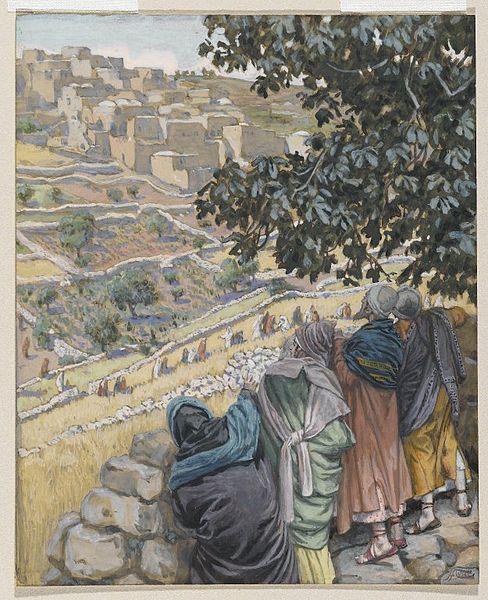
Photo credit: The Disciples Eat Wheat on the Sabbath, by James Tissot (1836-1902) [public domain / Wikimedia Commons]

***
alleged biblical contradictions
Not-Your-Pastor’s Tour of Mark’s Gospel
Previous Post

August 15, 2019
Mary's Bodily Assumption: Eleven Related Bible Passages
Next Post

August 16, 2019 David Madison vs. the Gospel of Mark #4: Chapter 3
Browse Our Archives
Select a Category & Last Things About Me Anti-Catholicism Atheism & Agnosticism Baptism and Sacramentalism Bible and Tradition Blessed Virgin Mary Books by Dave Armstrong C. S. Lewis Calvinism & General Protestantism Catholic Apologetics Catholic Apologists Catholic conversion Catholic converts Christmas Church (Ecclesiology) Church History Conversion and Converts Development of Doctrine Eastern Orthodoxy Ecumenism & Christian Unity Eucharist & Liturgy Fathers of the Church French Translations G. K. Chesterton Hell Hell & Satan Hell & Satan & Last Things Heresies & Comparative Religion Holistic Health Inquisition & Crusades & Scandals James White Jews & Judaism & Old Testament John Calvin John Henry Newman Liberal / Modernist Theology Life Issues Literary Resume Lutheranism Mariology Martin Luther Music Orthodoxy Papacy & Infallibility Personal Page Philosophy & Science Political & Ethical & Moral Issues Protestant Persecution & Intolerance Protestantism Purgatory Purgatory & Penance Romantic & Imaginative Theology Saints & Purgatory & Penance Salvation Salvation & Justification Satan & Last Things Sexuality and Gender Issues Spanish Translations Traditionalism vs. Radical Catholic Reactionaries Traducciones al español / tradução para português Trinitarianism & Christology Uncategorized Videos
Select a Month October 2026 September 2026 August 2026 July 2026 June 2026 May 2026 April 2026 March 2026 February 2026 January 2026 December 2025 November 2025 October 2025 September 2025 August 2025 July 2025 June 2025 May 2025 April 2025 March 2025 February 2025 January 2025 December 2024 November 2024 October 2024 September 2024 August 2024 July 2024 June 2024 May 2024 April 2024 March 2024 February 2024 January 2024 December 2023 November 2023 October 2023 September 2023 August 2023 July 2023 June 2023 May 2023 April 2023 March 2023 February 2023 January 2023 December 2022 November 2022 October 2022 September 2022 August 2022 July 2022 June 2022 May 2022 April 2022 March 2022 February 2022 January 2022 December 2021 November 2021 October 2021 September 2021 August 2021 July 2021 June 2021 May 2021 April 2021 March 2021 February 2021 January 2021 December 2020 November 2020 October 2020 September 2020 August 2020 July 2020 June 2020 May 2020 April 2020 March 2020 February 2020 January 2020 December 2019 November 2019 October 2019 September 2019 August 2019 July 2019 June 2019 May 2019 April 2019 March 2019 February 2019 January 2019 December 2018 November 2018 October 2018 September 2018 August 2018 July 2018 June 2018 May 2018 April 2018 March 2018 February 2018 January 2018 December 2017 November 2017 October 2017 September 2017 August 2017 July 2017 June 2017 May 2017 April 2017 March 2017 February 2017 January 2017 December 2016 November 2016 October 2016 September 2016 August 2016 July 2016 June 2016 May 2016 April 2016 March 2016 February 2016 January 2016 December 2015 November 2015 October 2015 September 2015 August 2015 July 2015 June 2015 May 2015 April 2015 March 2015 February 2015 January 2015 December 2014 November 2014 October 2014 September 2014 August 2014 July 2014 June 2014 April 2014 March 2014 February 2014 January 2014 December 2013 November 2013 October 2013 September 2013 August 2013 July 2013 June 2013 April 2013 March 2013 February 2013 January 2013 December 2012 November 2012 October 2012 September 2012 August 2012 July 2012 June 2012 May 2012 April 2012 March 2012 February 2012 January 2012 December 2011 November 2011 October 2011 September 2011 August 2011 July 2011 June 2011 April 2011 March 2011 February 2011 October 2010 September 2010 August 2010 July 2010 April 2010 March 2010 December 2009 October 2009 August 2009 July 2009 June 2009 May 2009 March 2009 February 2009 October 2008 September 2008 April 2008 March 2008 February 2008 January 2008 December 2007 November 2007 October 2007 May 2007 March 2007 February 2007 January 2007 November 2006 October 2006 September 2006 August 2006 July 2006 June 2006 May 2006 April 2006 March 2006 February 2006 October 2005 June 2005 April 2005 February 2005 July 2004 May 2004 April 2004
Follow Us!
TAKE THE
Religious Wisdom Quiz
Where was Paul's hometown?
Select your answer to see how you score.
Damascus Tarsus Antioch Jerusalem
Books by This Author Books by Dave Armstrong
Related posts from Biblical Evidence for Catholicism

God, Modern Physics, & Dark Energy: An Analogy
Biblical Evidence for Catholicism

General Debate on Christianity with an Atheist
Biblical Evidence for Catholicism

Can Atheists Be Saved? Surprising Biblical Data
Biblical Evidence for Catholicism
Can Atheists Be Saved? YES! (Possibly Some ....
Biblical Evidence for Catholicism
TRENDING AT PATHEOS Catholic

The Sermon on the Mount, Part I: Matthew...
The Sermon on the Mount, Part I (Matthew 4:12-5:12) St. Matthew moves...

What's up from Crossway: Reviewing some of their latest A few weeks...

Janie Learns the Way of the Cross: A...
Teaching children about Jesus' Passion can be challenging. Many parents and educators...

Looking For Good Catholic Writing - October 2026
He alone extends the heavens, and he walks upon the waves of...

In "Irreplaceable," our book on vocation and technology, Trevor Sutton and I...

I was strolling through the top floor of the brand new Parthenon...
view all Catholic blogs
Ad-Free & Subscriber Log-In Subscription Support
- About Us
- 2026 Calendar
- Videos
- Podcasts
- Library of World Religions
- Faith In Media Tracker
- Advertise With Us
- Write for Us
- Privacy Policy
- Terms of Service
- Do Not Sell My Data
- Contact Us
- Radiant Digital
- Manage Newsletter Subscriptions
- Unsubscribe From Notifications
- Sitemap
Copyright 2008-2026, Patheos. All rights reserved.
Subscription Support Ad-Free & Subscriber Log-In
Follow Patheos