
BuddhistCatholicContemplativeEvangelicalGeneral ChristianHinduJewishLatter-day SaintMuslimNew VisionsProgressive Christian
Beliefs
- Buddhist
- Catholic
- Contemplative
- Evangelical
- General Christian
- Hindu
- Jewish
- Latter-day Saint
- More Voices
- Muslim
- New Visions
- Pagan
- Progressive Christian
Topics
- Religion News
- Food and Religion
- Sports and Religion
- Religious Art
- Religious Music and Entertainment
- Religious Events
- History and Religion
- Style and Religion
- Politics and Religion
- Women in Religion
- Recreation Outdoors and Religion
- Business Finance and Religion
- Careers Workplace and Religion
- Education and Religion
- Family Parenting and Religion
- Health Fitness and Religion
- Home and Religion
- Relationships and Religion
- Technology and Religion
- Travel and Religion
Columnists
- Buddhist Columnists
- Business Finance and Religion Columnists
- Careers Workplace and Religion Columnists
- Catholic Columnists
- Contemplative Columnists
- Education and Religion Columnists
- Evangelists Columnists
- Family Parenting and Religion Columnists
- General Christian Columnists
- Health Fitness and Religion Columnists
- Hindu Columnists
- History and Religion Columnists
- Home and Religion Columnists
- Jewish Columnists
- More Voices Columnists
- Latter Day Columnists
- Muslim Columnists
- New Visions Columnists
- Nonreligious Columnists
- Pagan Columnists
- Politics and Religion Columnists
- Progressive Columnists
- Recreation Outdoors and Religion Columnists
- Relationships and Religion Columnists
- Religion News Columnists
- Religious Art Columnists
- Religious Events Columnists
- Religious Music and Entertainment Columnists
- Sports and Religion Columnists
- Style and Religion Columnists
- Technology and Religion Columnists
- Travel and Religion Columnists
- Women in Religion Columnists
Resource Library
- 2026 Calendar
- Library of World Religions
- The 100 Most Holy Places on Earth
- Patheos Answers
- Podcasts
- Videos
- Faith Leaders Database
- Anglican Episcopalian
- Bahai
- Baptist
- Buddhism
- Christianity
- Confucianism
- Eastern Orthodoxy
- Hinduism
- Holiness and Pentecostal
- ISKCON
- Islam
- Judaism
- Lutheran
- Methodist
- The Church of Jesus Christ of Latter-day Saints
- New Age
- Paganism
- Presbytarian and Reformed
- Protestantism
- Religion Behind the Scenes
- Roman Catholic
- Scientology
- Shia Islam
- Sikhism
- Sufism
- Sunni Islam
- Taoism
- Zen
- See all religions
Research Tools
 Ad-Free & Subscriber Log-In Subscription Support
Ad-Free & Subscriber Log-In Subscription Support
Follow Patheos 

- Trending:
- Forgiveness
- |
- Marriage
- |
- Consciousness
- |
- Death Penalty
- |
- Election
- |
- Halloween

-
About
-
Catholic Apologetics
-
Church History
-
Great Apologists
-
Christian Worldview
-
Protestantism & Misc.
- Home
- Catholic
- History and Religion
- David Madison vs. the Gospel of Mark #10: Chapter 11
David Madison vs. the Gospel of Mark #10: Chapter 11
Last updated on: March 19, 2022 at 1:14 pm by Dave Armstrong
David Madison vs. the Gospel of Mark #10: Chapter 11 2022-03-19T13:14:35-04:00 Dave Armstrong
Patheos Explore the world's faith through different perspectives on religion and spirituality! Patheos has the views of the prevalent religions and spiritualities of the world.
Two Donkeys? / Fig Tree / Moneychangers
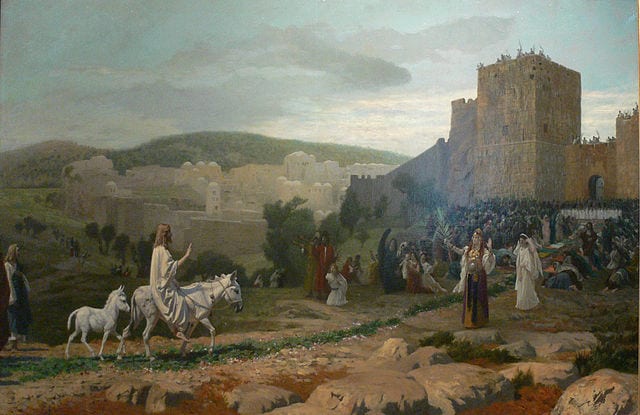
This is an installment of my replies to a series of articles on Mark by Dr. David Madison: an atheist who was a Methodist minister for nine years: with a Ph.D. in Biblical Studies from Boston University. His summary article is called, “Not-Your-Pastor’s Tour of Mark’s Gospel: The falsification of Christianity made easy” (Debunking Christianity, 7-17-19). His words will be in blue below.
Dr. Madison has utterly ignored my twelve refutations of his “dirty dozen” podcasts against Jesus, and I fully expect that stony silence to continue. If he wants to be repeatedly critiqued and make no response, that’s his choice (which would challenge Bob Seidensticker as the most intellectually cowardly atheist I know). I will continue on, whatever he decides to do (no skin off my back).
Dr. Madison believes we are not at all sure whether Jesus in fact said anything recorded in the Gospels. The atheist always has a convenient “out” (when refuted in argument about some biblical text) that Jesus never said it anyway and that the text in question was simply made up and added later by unscrupulous and “cultish” Christian propagandists.
I always refuse to play this silly and ultimately intellectually dishonest game, because there is no way to “win” with such a stacked, subjective deck. I start with the assumption (based on many historical evidences) that the manuscripts we have are quite sufficient for us to know what is in the Bible (believe it or not).
Dr. Madison himself — in his anti-Jesus project noted above, granted my outlook, strictly in terms of practical “x vs. y” debate purposes: “For the sake of argument, I’m willing to say, okay, Jesus was real and, yes, we have gospels that tell the story.” And in the combox: “So, we can go along with their insistence that he did exist. We’ll play on their field, i.e., the gospels.” Excellent! Otherwise, there would be no possible discussion at all.
*****
Dr. Madison called this installment: “The Day Jesus Cursed a Fig Tree: …and followed the deed with bad theology” (1-25-19)
The theological agenda of the gospel authors included Jesus as a fulfillment of scripture—everybody knows that, right?—so they frequently quoted OT texts out of context.
Dr. Madison doesn’t, alas, tell us how he thinks Matthew cited Zechariah 9:9 out of context, so there is nothing here to refute. It’s simply one of his gratuitous and groundless swipes at Jesus and the Gospel writer.
Matthew failed to grasp the technique of the parallelism in Hebrew poetry (line 1: say something; line 2, say the same thing using a different word), and reports that Jesus rode on two animals, a donkey and a colt. (Matthew 21:7) Yes, Matthew could be that goofy . . .
Matthew does not report that Jesus rode on two animals. He wrote: “they brought the ass and the colt, and put their garments on them, and he sat thereon” (Mt 21:7, RSV). He can hardly have sat on (let alone ride) two animals at once. Does Dr. Madison think Matthew was trying to present Jesus as a circus stunt rider? How silly are we gonna get? There must be some other sensible meaning. But then, what does “them” mean in this verse? And why two animals? It does seem strange at first glance. Apologist Eric Lyons, in a comprehensive article on this very issue of the colt and the ass, writes:
Mark recorded that Jesus told the two disciples that they would find “a colt tied, on which no one has sat” (11:2). . . .
Mark, Luke, and John did not say that only one donkey was obtained for Jesus, or that only one donkey traveled up to Jerusalem with Jesus. The writers simply mentioned one donkey (the colt). They never denied that another donkey (the mother of the colt) was present. . . .
[W]hen Matthew’s gospel is taken into account, the elusive female donkey of Zechariah 9:9 is brought to light. Both the foal and the female donkey were brought to Christ at Mount Olivet, and both made the trip to Jerusalem. Since the colt never had been ridden, or even sat upon (as stated by Mark and Luke), its dependence upon its mother is very understandable (as implied by Matthew). The journey to Jerusalem, with multitudes of people in front of and behind Jesus and the donkeys (Matthew 21:8-9), obviously would have been much easier for the colt if the mother donkey were led nearby down the same road. . . .
Greek scholar A.T. Robertson believed that the second “them” (Greek αυτων) refers to the garments that the disciples laid on the donkeys, and not to the donkeys themselves. In commenting on Matthew 21:7 he stated: “The garments thrown on the animals were the outer garments (himatia), Jesus ‘took his seat’ (epekathisen) upon the garments” (1930, [Word Pictures in the New Testament], 1:167).
Two Bible translations, whose purpose is to provide an exceptionally literal rendering of the Greek biblical text: Amplified Bible and Wuest Expanded Translation, concur with this interpretation:
They brought the donkey and the colt and laid their coats upon them, and He seated Himself on them [the clothing].
And they placed upon them their outer garments. And He took His seat upon them [the garments].
New American Standard Bible also brings out this more specific meaning:
and brought the donkey and the colt, and laid on them their garments, on which He sat.
“On the following day, when they came from Bethany, he was hungry. Seeing in the distance a fig tree in leaf, he went to see whether perhaps he would find anything on it. When he came to it, he found nothing but leaves, for it was not the season for figs. He said to it, ‘May no one ever eat fruit from you again.’ And his disciples heard it.”
D. E. Nineham, in his 1963 commentary, noted: “This story is one of the most difficult in the Gospels, for it approximates more closely than any other episode in Mark to the type of ‘unreasonable’ miracle characteristic of the non-canonical Gospel literature.” (p. 298) C. F. D. Moule, in his 1965 commentary: “It is very odd that Jesus should condemn a fig-tree for having no fruit when it was not even the season for fruit.” (p. 89)
Apologist Kyle Butt offers a plausible explanation:
One prominent question naturally arises from a straightforward reading of the text. Why would Jesus curse a fig tree that did not have figs on it, especially since the text says that “it was not the season for figs”? In response to this puzzling question, skeptical minds have let themselves run wild with accusations regarding the passage. . . .
When Jesus approached the fig tree, the text indicates that the tree had plenty of leaves. R.K. Harrison, writing in the International Standard Bible Encyclopedia, explains that various kinds of figs grew in Palestine during the first century. One very important aspect of fig growth has to do with the relationship between the leaf and the fruit. Harrison notes that the tiny figs, known to the Arabs as taksh, “appear simultaneously in the leaf axils” (1982, 2:302) This taksh is edible and “is often gathered for sale in the markets” (2:302). Furthermore, the text notes: “When the young leaves are appearing in spring, every fertile fig will have some taksh on it…. But if a tree with leaves has no fruit, it will be barren for the entire season” (2:301-302).
Thus, when Jesus approached the leafy fig tree, He had every reason to suspect that something edible would be on it. However, after inspecting the tree, Mark records that “He found nothing but leaves.” No taksh were budding as they should have been if the tree was going to produce edible figs that year. The tree appeared to be fruitful, but it only had outward signs of bearing fruit (leaves) and in truth offered nothing of value to weary travelers. . . .
[I]n a general sense, Jesus often insisted that trees which do not bear good fruit will be cut down (Matthew 7:19; Luke 13:6-9). The fig tree did not bear fruit, was useless, and deserved to be destroyed: the spiritual application being that any human who does not bear fruit for God will also be destroyed for his or her failure to produce.
Jesus did not throw a temper tantrum and curse the fig tree even though it was incapable of producing fruit. He cursed the tree because it should have been growing fruit since it had the outward signs of productivity. Jesus’ calculated timing underscored the spiritual truth that barren spiritual trees eventually run out of time. As for personal application, we should all diligently strive to ensure that we are not the barren fig tree.
Upon arriving at the Temple (v.15): “And he entered the temple and began to drive out those who were selling and those who were buying in the temple, and he overturned the tables of the money changers and the seats of those who sold doves.”
What provoked Jesus to do this? Why was he upset about money-changers and dove-sellers? Jesus himself had once told a man he’d healed to “offer for your cleansing what Moses commanded,” meaning the sacrifice of a bird (according to Leviticus 14). The Temple existed for this form of devotion.
Cambridge Bible for Schools and Colleges provides an answer:
the tables of the moneychangers] The Greek word signifies those who took a small coin (Hebr. Kolbon, Grk. κόλλυβος, perhaps a Phœnician word) as a fee for exchanging the money of the worshippers, who were required to pay in Hebrew coin. This exaction of the fee was itself unlawful (Lightfoot). And probably other dishonest practices were rife.
Encyclopedia Judaica (“Money Changers”) confirms that this interest-taking was contrary to Jewish Law:
In the period of the Second Temple vast numbers of Jews streamed to Palestine and Jerusalem “out or every nation under heaven” (Acts 2:5), taking with them considerable sums of money in foreign currencies. This is referred to in the famous instance of Jesus’ driving the money changers out of the Temple (Matt. 21:12). Not only did these foreign coins have to be changed but also ordinary deposits were often handed over to the Temple authorities for safe deposit in the Temple treasury (Jos., Wars 6:281–2). Thus Jerusalem became a sort of central bourse and exchange mart, and the Temple vaults served as “safe deposits” in which every type of coin was represented (TJ, Ma’as. Sh. 1:2, 52d, and parallels). The business of money exchange was carried out by the shulḥani (“exchange banker”), who would change foreign coins into local currency and vice versa (Tosef., Shek. 2:13; Matt. 21:12). People coming from distant countries would bring their money in large denominations rather than in cumbersome small coins. The provision of small change was a further function of the shulḥani (cf. Sif. Deut., 306; Ma’as Sh., 2:9). For both of these kinds of transactions the shulḥani charged a small fee (agio), called in rabbinic literature a kolbon (a word of doubtful etymology but perhaps from the Greek κόλλυβος “small coin”; TJ, Shek. 1:6, 46b). This premium seems to have varied from 4 percent to 8 percent (Shek. 1:6, et al.). The shulḥani served also as a banker, and would receive money on deposit for investment and pay out an interest at a fixed rate (Matt. 25:27), although this was contrary to Jewish law (see below; *Moneylending ). . . .
The activity of the Jewish banker, shulḥani, was of a closely defined nature, as his transactions had to be in accordance with the biblical prohibition against taking interest (ribit).
John Lightfoot’s commentary on Matthew 21:12 adds more relevant information:
[Overthrew the tables of the moneychangers.] Who those moneychangers were, may be learned very well from the Talmud, and Maimonides in the treatise Shekalim:– . . .
At that time when they paid pence for the half shekel, a kolbon [or the fee that was paid to the moneychanger] was half a mea, that is, the twelfth part of a penny, and never less. But the kolbons were not like the half shekel; but the exchangers laid them by themselves till the holy treasury were paid out of them.” You see what these moneychangers were, and whence they had their name. You see that Christ did not overturn the chests in which the holy money was laid up, but the tables on which they trafficked for this unholy gain.
Note that Jesus specifically concentrated on two groups: the moneychangers and those who sold doves. This was mentioned in the current account from Mark (above), and in the parallel stories (Mt 21:12-13; Jn 2:13-16). His anger at the moneychangers has just been explained. They were unlawfully extracting interest, which would hurt the poor the most. Why did He go after the dove sellers? It’s a similar reason. The Experimental Theology blog explains:
As most know, the preferred sacrifice to be offered at the temple was a lamb. But a provision is made in the Levitical code for the poor:
Leviticus 5.7 Anyone who cannot afford a lamb is to bring two doves or two young pigeons to the Lord as a penalty for their sin—one for a sin offering and the other for a burnt offering.
By going after the dove sellers we see Jesus directly attacking the group who were having economic dealings with the poor. When the poor would go to the temple they would head for the dove sellers.
The point being, while we know that Jesus was upset about economic exploitation going on in the temple, his focus on the dove sellers sharpens the message and priorities. . . . Jesus’s anger is stirred at the way the poor are being treated and economically exploited.
Hence, He described this scenario with these people who exploited the poor, a “den of robbers” or “den of thieves.” Dr. Madison asked why Jesus was upset. I have provided an answer, through these excellent commentaries. Now Dr. Madison knows more than he did (so do I).
He blends wording from Isaiah 56:7 and Jeremiah 7:11, which have no relevance whatever to this incident—but Mark knew that he could get away with it.
• In Isaiah 56, the prophet looks forward to the day when all nations will bend the knee to his own god, Yahweh, and in that sense only will the temple be a house of prayer for all nations, i.e., when they have converted. Nor is this verse (7) a denunciation of the gory business of the temple; the text reads: “…their burnt offerings and their sacrifices will be accepted on my altar; for my house shall be called a house of prayer for all peoples.”
All Jesus cited was “My house shall be called a house of prayer” (Mk 11:17), which is from Isaiah 56:7. The point is that this is its central purpose: a place of worship and praise and prayer and ritual sacrifice: not of collection of unlawful interest and exploiting the poor, contrary to the Jewish Law. That’s all Jesus was saying.
It doesn’t follow (as with partial analogies) that every jot and tittle of a prophecy must be applicable to the situation about which it is cited. New Testament citation of the Old Testament is a long and complex subject in and of itself (see one article that gets into that). The same Isaiah 56:7 refers to “my house of prayer” (God speaking) before it says it will be called the same.
• In Jeremiah 7:11, the prophet blasts the wickedness of the people of Israel, and no amount of worship at the temple can cancel that reality. Thus the temple is a sham: “ Has this house, which is called by my name, become a den of robbers in your sight?” Den of robbers seems to have been an allusion to the sin that annulls the value of worship, not to the practice of selling animals and exchanging currency.
Here is the passage and some context as well:
Jeremiah 7:9-11 Will you steal, murder, commit adultery, swear falsely, burn incense to Ba’al, and go after other gods that you have not known, [10] and then come and stand before me in this house, which is called by my name, and say, `We are delivered!’ — only to go on doing all these abominations? [11] Has this house, which is called by my name, become a den of robbers in your eyes? Behold, I myself have seen it, says the LORD.
The moneychangers and sellers of doves were stealing by extracting unlawful interest and excessive prices for items sold to the poor (the birds). 7:6 also states: “do not oppress the alien, the fatherless or the widow”. So the passage is exactly applicable. The passage in its larger context lists a bunch of sins: two of which applied to the temple situation in Jesus’ time (stealing and exploitation of the less fortunate), and so He cited it accordingly. Yet Dr. Madison claimed that both passages “have no relevance whatever to this incident.” Poppycock!
***
Photo credit: Entry of the Christ in Jerusalem (1897), by Jean-Léon Gérôme (1824-1904) [public domain / Wikimedia Commons]

***
alleged biblical contradictions
Not-Your-Pastor’s Tour of Mark’s Gospel
Previous Post
August 20, 2019
David Madison vs. the Gospel of Mark #9: Chapter 10
Next Post
August 20, 2019 Isaiah Foretells the Gospel & the Suffering Messiah
Browse Our Archives
Select a Category & Last Things About Me Anti-Catholicism Atheism & Agnosticism Baptism and Sacramentalism Bible and Tradition Blessed Virgin Mary Books by Dave Armstrong C. S. Lewis Calvinism & General Protestantism Catholic Apologetics Catholic Apologists Catholic conversion Catholic converts Christmas Church (Ecclesiology) Church History Conversion and Converts Development of Doctrine Eastern Orthodoxy Ecumenism & Christian Unity Eucharist & Liturgy Fathers of the Church French Translations G. K. Chesterton Hell Hell & Satan Hell & Satan & Last Things Heresies & Comparative Religion Holistic Health Inquisition & Crusades & Scandals James White Jews & Judaism & Old Testament John Calvin John Henry Newman Liberal / Modernist Theology Life Issues Literary Resume Lutheranism Mariology Martin Luther Music Orthodoxy Papacy & Infallibility Personal Page Philosophy & Science Political & Ethical & Moral Issues Protestant Persecution & Intolerance Protestantism Purgatory Purgatory & Penance Romantic & Imaginative Theology Saints & Purgatory & Penance Salvation Salvation & Justification Satan & Last Things Sexuality and Gender Issues Spanish Translations Traditionalism vs. Radical Catholic Reactionaries Traducciones al español / tradução para português Trinitarianism & Christology Uncategorized Videos
Select a Month October 2026 September 2026 August 2026 July 2026 June 2026 May 2026 April 2026 March 2026 February 2026 January 2026 December 2025 November 2025 October 2025 September 2025 August 2025 July 2025 June 2025 May 2025 April 2025 March 2025 February 2025 January 2025 December 2024 November 2024 October 2024 September 2024 August 2024 July 2024 June 2024 May 2024 April 2024 March 2024 February 2024 January 2024 December 2023 November 2023 October 2023 September 2023 August 2023 July 2023 June 2023 May 2023 April 2023 March 2023 February 2023 January 2023 December 2022 November 2022 October 2022 September 2022 August 2022 July 2022 June 2022 May 2022 April 2022 March 2022 February 2022 January 2022 December 2021 November 2021 October 2021 September 2021 August 2021 July 2021 June 2021 May 2021 April 2021 March 2021 February 2021 January 2021 December 2020 November 2020 October 2020 September 2020 August 2020 July 2020 June 2020 May 2020 April 2020 March 2020 February 2020 January 2020 December 2019 November 2019 October 2019 September 2019 August 2019 July 2019 June 2019 May 2019 April 2019 March 2019 February 2019 January 2019 December 2018 November 2018 October 2018 September 2018 August 2018 July 2018 June 2018 May 2018 April 2018 March 2018 February 2018 January 2018 December 2017 November 2017 October 2017 September 2017 August 2017 July 2017 June 2017 May 2017 April 2017 March 2017 February 2017 January 2017 December 2016 November 2016 October 2016 September 2016 August 2016 July 2016 June 2016 May 2016 April 2016 March 2016 February 2016 January 2016 December 2015 November 2015 October 2015 September 2015 August 2015 July 2015 June 2015 May 2015 April 2015 March 2015 February 2015 January 2015 December 2014 November 2014 October 2014 September 2014 August 2014 July 2014 June 2014 April 2014 March 2014 February 2014 January 2014 December 2013 November 2013 October 2013 September 2013 August 2013 July 2013 June 2013 April 2013 March 2013 February 2013 January 2013 December 2012 November 2012 October 2012 September 2012 August 2012 July 2012 June 2012 May 2012 April 2012 March 2012 February 2012 January 2012 December 2011 November 2011 October 2011 September 2011 August 2011 July 2011 June 2011 April 2011 March 2011 February 2011 October 2010 September 2010 August 2010 July 2010 April 2010 March 2010 December 2009 October 2009 August 2009 July 2009 June 2009 May 2009 March 2009 February 2009 October 2008 September 2008 April 2008 March 2008 February 2008 January 2008 December 2007 November 2007 October 2007 May 2007 March 2007 February 2007 January 2007 November 2006 October 2006 September 2006 August 2006 July 2006 June 2006 May 2006 April 2006 March 2006 February 2006 October 2005 June 2005 April 2005 February 2005 July 2004 May 2004 April 2004
Follow Us!
TAKE THE
Religious Wisdom Quiz
Who lived in Ur of the Chaldeans before God called him?
Select your answer to see how you score.
Jacob Abram Isaac Lot
Books by This Author Books by Dave Armstrong
Related posts from Biblical Evidence for Catholicism

God, Modern Physics, & Dark Energy: An Analogy
Biblical Evidence for Catholicism
Jesus Proved He Was God in Six Ways...
Biblical Evidence for Catholicism

General Debate on Christianity with an Atheist
Biblical Evidence for Catholicism

Can Atheists Be Saved? Surprising Biblical Data
Biblical Evidence for Catholicism
TRENDING AT PATHEOS Catholic

In "Irreplaceable," our book on vocation and technology, Trevor Sutton and I...

I was strolling through the top floor of the brand new Parthenon...

What Does Gêvâh Mean For Kimberley Guifoyle &...
This week, a lot of the news is focused on Kimberly Guilfoyle....

INNER CIRCLE: Profound Mystery (Of Christ In All...
Ephesians 5:31-32 “For this reason, a man will leave his father and...

Do Not Rejoice When Your Enemy Falls: The...
Turning an execution into a public spectacle is a disturbing expression of...

'The Chosen' S6 Trailer: The Passion Gets Very...
Not many watching 'The Chosen' worry about spoilers, but just because they...
view all Catholic blogs
Ad-Free & Subscriber Log-In Subscription Support
- About Us
- 2026 Calendar
- Videos
- Podcasts
- Library of World Religions
- Faith In Media Tracker
- Advertise With Us
- Write for Us
- Privacy Policy
- Terms of Service
- Do Not Sell My Data
- Contact Us
- Radiant Digital
- Manage Newsletter Subscriptions
- Unsubscribe From Notifications
- Sitemap
Copyright 2008-2026, Patheos. All rights reserved.
Subscription Support Ad-Free & Subscriber Log-In
Follow Patheos