
BuddhistCatholicContemplativeEvangelicalGeneral ChristianHinduJewishLatter-day SaintMuslimNew VisionsProgressive Christian
Beliefs
- Buddhist
- Catholic
- Contemplative
- Evangelical
- General Christian
- Hindu
- Jewish
- Latter-day Saint
- More Voices
- Muslim
- New Visions
- Pagan
- Progressive Christian
Topics
- Religion News
- Food and Religion
- Sports and Religion
- Religious Art
- Religious Music and Entertainment
- Religious Events
- History and Religion
- Style and Religion
- Politics and Religion
- Women in Religion
- Recreation Outdoors and Religion
- Business Finance and Religion
- Careers Workplace and Religion
- Education and Religion
- Family Parenting and Religion
- Health Fitness and Religion
- Home and Religion
- Relationships and Religion
- Technology and Religion
- Travel and Religion
Columnists
- Buddhist Columnists
- Business Finance and Religion Columnists
- Careers Workplace and Religion Columnists
- Catholic Columnists
- Contemplative Columnists
- Education and Religion Columnists
- Evangelists Columnists
- Family Parenting and Religion Columnists
- General Christian Columnists
- Health Fitness and Religion Columnists
- Hindu Columnists
- History and Religion Columnists
- Home and Religion Columnists
- Jewish Columnists
- More Voices Columnists
- Latter Day Columnists
- Muslim Columnists
- New Visions Columnists
- Nonreligious Columnists
- Pagan Columnists
- Politics and Religion Columnists
- Progressive Columnists
- Recreation Outdoors and Religion Columnists
- Relationships and Religion Columnists
- Religion News Columnists
- Religious Art Columnists
- Religious Events Columnists
- Religious Music and Entertainment Columnists
- Sports and Religion Columnists
- Style and Religion Columnists
- Technology and Religion Columnists
- Travel and Religion Columnists
- Women in Religion Columnists
Resource Library
- 2026 Calendar
- Library of World Religions
- The 100 Most Holy Places on Earth
- Patheos Answers
- Podcasts
- Videos
- Faith Leaders Database
- Anglican Episcopalian
- Bahai
- Baptist
- Buddhism
- Christianity
- Confucianism
- Eastern Orthodoxy
- Hinduism
- Holiness and Pentecostal
- ISKCON
- Islam
- Judaism
- Lutheran
- Methodist
- The Church of Jesus Christ of Latter-day Saints
- New Age
- Paganism
- Presbytarian and Reformed
- Protestantism
- Religion Behind the Scenes
- Roman Catholic
- Scientology
- Shia Islam
- Sikhism
- Sufism
- Sunni Islam
- Taoism
- Zen
- See all religions
Research Tools
 Ad-Free & Subscriber Log-In Subscription Support
Ad-Free & Subscriber Log-In Subscription Support
Follow Patheos 

- Trending:
- Forgiveness
- |
- Marriage
- |
- Consciousness
- |
- Death Penalty
- |
- Election
- |
- Halloween

-
About
-
Catholic Apologetics
-
Church History
-
Great Apologists
-
Christian Worldview
-
Protestantism & Misc.
- Home
- Catholic
- History and Religion
- David Madison vs. Paul and Romans #9: Chapter 9
David Madison vs. Paul and Romans #9: Chapter 9
Last updated on: June 5, 2026 at 11:54 pm by Dave Armstrong
David Madison vs. Paul and Romans #9: Chapter 9 2026-06-05T23:54:35-04:00 Dave Armstrong
Patheos Explore the world's faith through different perspectives on religion and spirituality! Patheos has the views of the prevalent religions and spiritualities of the world.
“Hardening Hearts” and Hebrew “Block Logic”
This is an installment of my replies to a series of articles on the epistle to the Romans (written by St. Paul) by Dr. David Madison: an atheist who was a Methodist minister for nine years: with a Ph.D. in Biblical Studies from Boston University. His summary article is called, “Bad Bible Theology: Paul’s Letter to the Romans: Let me count the ways…that Paul got it wrong” (2-26-18). He devotes a paper to each chapter. Unless he repeats himself (a bad habit of his) or descends to sheer biblical skepticism (which I have less than no interest in), I will reply to all.
The introduction is basically a catalogue of rank insults, where he calls St. Paul “a crank” and a “delusional cult fanatic” and “the prototype for Christian crazies” and “an obsessive-compulsive mediocre thinker and bad theologian” and “an embarrassment.” He adds: “how can anyone take this guy seriously?” That about covers the “content” there. Bears poop in the woods, brats throw fits, squirrels walk telephone lines, and the prevalent anti-theist brand of atheists insult Christians. Ho hum. What else is new?
Thus far, I have counter-replied to 33 of Dr. Madison’s critiques, without hearing one peep back from him as of yet (29 days’ total time, starting on 8-1-19). This certainly doesn’t suggest to me that he is very confident in his opinions. I know he’s still alive and kicking, because I’ve seen him write other posts during this same period (example one / two / three).
Dr. Madison’s words will be in blue below.
*****
Dr. Madison calls his critique of Romans chapter 9, “How Did the Great Christian Swindle Begin?: It followed an old script…and added its own spin” (8-4-17).
Paul hits some familiar sour notes. Nothing can be allowed to minimize God—especially not anything a person could do; God calls all the shots, vv. 16-18:
“So it depends not on human will or exertion, but on God who shows mercy. For the scripture says to Pharaoh, ‘I have raised you up for the very purpose of showing my power in you, so that my name may be proclaimed in all the earth.’ So then he has mercy on whomever he chooses, and he hardens the heart of whomever he chooses.” So God has mercy on whomever he chooses, and he hardens the heart of whomever he chooses.
Say what? God gets the credit for making people hard-hearted? Kinda puts at least one hole in the free will argument. This reminds us of Paul’s bludgeon theology found in Romans 1; three times there he says that God “gave people up” to their lusts, degraded passions and debased minds (vv. 24, 26 & 28). Also check out his chilling list of people “who deserve to die” in vv. 29-31.
I’ve dealt with this “hardening” motif many times. It’s far more complex than Dr. Madison makes out. In a nutshell, it means (all relevant passages examined together) that people choose in their free will to rebel against God and to sin, and God allows it. It’s one of innumerable examples of biblical non-literal expression:
God “Hardening Hearts”: How Do We Interpret That?
Reply to a Calvinist: Hardening of Pharaoh’s Heart
Madison vs. Jesus #7: God Prohibits Some Folks’ Repentance?
Paul anticipates that people might object to this view of God, but he offers a typical putdown, v. 20: “But who indeed are you, a human being, to argue with God? Will what is molded say to the one who molds it, ‘Why have you made me like this?’” Moreover, he is convinced that God has made some people for destruction as a way to show off his wrath, v. 22: “What if God, desiring to show his wrath and to make known his power, has endured with much patience the objects of wrath that are made for destruction.”
But wait, it gets worse, v. 23: “…and what if he has done so in order to make known the riches of his glory for the objects of mercy, which he has prepared beforehand for glory—“ God shows wrath is order to make a nice contrast with his mercy! Then Paul boasts that he and his followers are “the objects of mercy,” part of the in-crowd, v. 24: “ …including us whom he has called, not from the Jews only but also from the Gentiles?” And he quotes Hosea to drive home the point that his crowd “shall be called the children of the living God.”
It’s a difficult chapter to understand, and Calvinists have famously and wrongly used it to bolster their false theology of double predestination, but there is a perfectly acceptable and plausible non-Calvinist interpretation of it, as I have written about: Romans 9: Plausible Non-Calvinist Interpretation. Here’s an excerpt, from Marvin Wilson’s Our Father Abraham:
[C]oncepts were expressed in self-contained units or blocks of thought. These blocks did not necessarily fit together in any obviously rational or harmonious pattern, particularly when one block represented the human perspective on truth and the other represented the divine. This way of thinking created a propensity for paradox, antimony, or apparent contradiction, as one block stood in tension — and often illogical relation — to the other. Hence, polarity of thought or dialectic often characterized block logic.” Examples of this in practice are the alternate hardening of Pharaoh’s heart by God, or by Pharaoh himself; and the reference to loving Jacob while hating Esau — both of which, significantly, are referred to often by Calvinist writers.
Consideration of certain forms of block logic may give one the impression that divine sovereignty and human responsibility were incompatible. The Hebrews, however, sense no violation of their freedom as they accomplish God’s purposes.” The back and forth between human freedom and divine sovereignty is a function of block logic and the Hebrew mindset. Writers like Palmer who proudly declare that they believe what they read in spite of what they see as an apparent absurdity are ultimately viewing the Scriptures, wrongly, through their own Western lens in which they assume that all that they read is all that there is.
Most of the rest of this critique is repetition of Dr. Madison’s tired, oh-so-familiar-by-now themes that I have already dealt with, so I’ll pass.
***
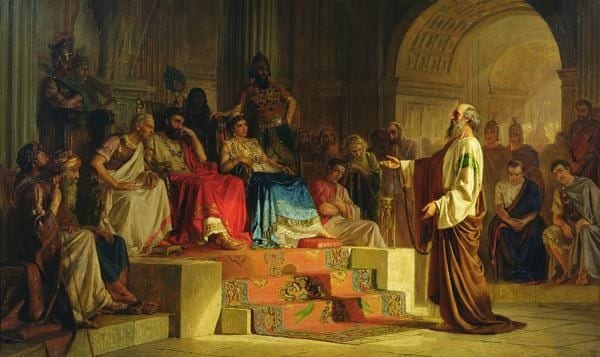
Photo credit: Trial of the Apostle Paul (1875), by Nikolai Bodarevsky (1850-1921). It shows Paul before Herod Agrippa II flanked by his sister Berenice and Roman procurator Porcius Festus [public domain / Wikimedia Commons]

***
alleged biblical contradictions
Bad Bible Theology: Paul’s Letter to the Romans
Previous Post
August 29, 2019
Did Jesus Believe That Homosexual Acts Were Immoral?
Next Post
August 30, 2019 David Madison vs. Paul and Romans #10: Chapter 10
Browse Our Archives
Select a Category & Last Things About Me Anti-Catholicism Atheism & Agnosticism Baptism and Sacramentalism Bible and Tradition Blessed Virgin Mary Books by Dave Armstrong C. S. Lewis Calvinism & General Protestantism Catholic Apologetics Catholic Apologists Catholic conversion Catholic converts Christmas Church (Ecclesiology) Church History Conversion and Converts Development of Doctrine Eastern Orthodoxy Ecumenism & Christian Unity Eucharist & Liturgy Fathers of the Church French Translations G. K. Chesterton Hell Hell & Satan Hell & Satan & Last Things Heresies & Comparative Religion Holistic Health Inquisition & Crusades & Scandals James White Jews & Judaism & Old Testament John Calvin John Henry Newman Liberal / Modernist Theology Life Issues Literary Resume Lutheranism Mariology Martin Luther Music Orthodoxy Papacy & Infallibility Personal Page Philosophy & Science Political & Ethical & Moral Issues Protestant Persecution & Intolerance Protestantism Purgatory Purgatory & Penance Romantic & Imaginative Theology Saints & Purgatory & Penance Salvation Salvation & Justification Satan & Last Things Sexuality and Gender Issues Spanish Translations Traditionalism vs. Radical Catholic Reactionaries Traducciones al español / tradução para português Trinitarianism & Christology Uncategorized Videos
Select a Month October 2026 September 2026 August 2026 July 2026 June 2026 May 2026 April 2026 March 2026 February 2026 January 2026 December 2025 November 2025 October 2025 September 2025 August 2025 July 2025 June 2025 May 2025 April 2025 March 2025 February 2025 January 2025 December 2024 November 2024 October 2024 September 2024 August 2024 July 2024 June 2024 May 2024 April 2024 March 2024 February 2024 January 2024 December 2023 November 2023 October 2023 September 2023 August 2023 July 2023 June 2023 May 2023 April 2023 March 2023 February 2023 January 2023 December 2022 November 2022 October 2022 September 2022 August 2022 July 2022 June 2022 May 2022 April 2022 March 2022 February 2022 January 2022 December 2021 November 2021 October 2021 September 2021 August 2021 July 2021 June 2021 May 2021 April 2021 March 2021 February 2021 January 2021 December 2020 November 2020 October 2020 September 2020 August 2020 July 2020 June 2020 May 2020 April 2020 March 2020 February 2020 January 2020 December 2019 November 2019 October 2019 September 2019 August 2019 July 2019 June 2019 May 2019 April 2019 March 2019 February 2019 January 2019 December 2018 November 2018 October 2018 September 2018 August 2018 July 2018 June 2018 May 2018 April 2018 March 2018 February 2018 January 2018 December 2017 November 2017 October 2017 September 2017 August 2017 July 2017 June 2017 May 2017 April 2017 March 2017 February 2017 January 2017 December 2016 November 2016 October 2016 September 2016 August 2016 July 2016 June 2016 May 2016 April 2016 March 2016 February 2016 January 2016 December 2015 November 2015 October 2015 September 2015 August 2015 July 2015 June 2015 May 2015 April 2015 March 2015 February 2015 January 2015 December 2014 November 2014 October 2014 September 2014 August 2014 July 2014 June 2014 April 2014 March 2014 February 2014 January 2014 December 2013 November 2013 October 2013 September 2013 August 2013 July 2013 June 2013 April 2013 March 2013 February 2013 January 2013 December 2012 November 2012 October 2012 September 2012 August 2012 July 2012 June 2012 May 2012 April 2012 March 2012 February 2012 January 2012 December 2011 November 2011 October 2011 September 2011 August 2011 July 2011 June 2011 April 2011 March 2011 February 2011 October 2010 September 2010 August 2010 July 2010 April 2010 March 2010 December 2009 October 2009 August 2009 July 2009 June 2009 May 2009 March 2009 February 2009 October 2008 September 2008 April 2008 March 2008 February 2008 January 2008 December 2007 November 2007 October 2007 May 2007 March 2007 February 2007 January 2007 November 2006 October 2006 September 2006 August 2006 July 2006 June 2006 May 2006 April 2006 March 2006 February 2006 October 2005 June 2005 April 2005 February 2005 July 2004 May 2004 April 2004
Follow Us!
TAKE THE
Religious Wisdom Quiz
I am twelve stones taken from a riverbed and set up as a memorial to a miraculous crossing. What am I?
Select your answer to see how you score.
Altar stones The memorial stones The Stones of remembrance Bethel
Books by This Author Books by Dave Armstrong
Related posts from Biblical Evidence for Catholicism

God, Modern Physics, & Dark Energy: An Analogy
Biblical Evidence for Catholicism

General Debate on Christianity with an Atheist
Biblical Evidence for Catholicism

Can Atheists Be Saved? Surprising Biblical Data
Biblical Evidence for Catholicism
Can Atheists Be Saved? YES! (Possibly Some ....
Biblical Evidence for Catholicism
TRENDING AT PATHEOS Catholic

The Sermon on the Mount, Part I: Matthew...
The Sermon on the Mount, Part I (Matthew 4:12-5:12) St. Matthew moves...

What's up from Crossway: Reviewing some of their latest A few weeks...

Janie Learns the Way of the Cross: A...
Teaching children about Jesus' Passion can be challenging. Many parents and educators...

Looking For Good Catholic Writing - October 2026
He alone extends the heavens, and he walks upon the waves of...

In "Irreplaceable," our book on vocation and technology, Trevor Sutton and I...

I was strolling through the top floor of the brand new Parthenon...
view all Catholic blogs
Ad-Free & Subscriber Log-In Subscription Support
- About Us
- 2026 Calendar
- Videos
- Podcasts
- Library of World Religions
- Faith In Media Tracker
- Advertise With Us
- Write for Us
- Privacy Policy
- Terms of Service
- Do Not Sell My Data
- Contact Us
- Radiant Digital
- Manage Newsletter Subscriptions
- Unsubscribe From Notifications
- Sitemap
Copyright 2008-2026, Patheos. All rights reserved.
Subscription Support Ad-Free & Subscriber Log-In
Follow Patheos