
BuddhistCatholicContemplativeEvangelicalGeneral ChristianHinduJewishLatter-day SaintMuslimNew VisionsProgressive Christian
Beliefs
- Buddhist
- Catholic
- Contemplative
- Evangelical
- General Christian
- Hindu
- Jewish
- Latter-day Saint
- More Voices
- Muslim
- New Visions
- Pagan
- Progressive Christian
Topics
- Religion News
- Food and Religion
- Sports and Religion
- Religious Art
- Religious Music and Entertainment
- Religious Events
- History and Religion
- Style and Religion
- Politics and Religion
- Women in Religion
- Recreation Outdoors and Religion
- Business Finance and Religion
- Careers Workplace and Religion
- Education and Religion
- Family Parenting and Religion
- Health Fitness and Religion
- Home and Religion
- Relationships and Religion
- Technology and Religion
- Travel and Religion
Columnists
- Buddhist Columnists
- Business Finance and Religion Columnists
- Careers Workplace and Religion Columnists
- Catholic Columnists
- Contemplative Columnists
- Education and Religion Columnists
- Evangelists Columnists
- Family Parenting and Religion Columnists
- General Christian Columnists
- Health Fitness and Religion Columnists
- Hindu Columnists
- History and Religion Columnists
- Home and Religion Columnists
- Jewish Columnists
- More Voices Columnists
- Latter Day Columnists
- Muslim Columnists
- New Visions Columnists
- Nonreligious Columnists
- Pagan Columnists
- Politics and Religion Columnists
- Progressive Columnists
- Recreation Outdoors and Religion Columnists
- Relationships and Religion Columnists
- Religion News Columnists
- Religious Art Columnists
- Religious Events Columnists
- Religious Music and Entertainment Columnists
- Sports and Religion Columnists
- Style and Religion Columnists
- Technology and Religion Columnists
- Travel and Religion Columnists
- Women in Religion Columnists
Resource Library
- 2026 Calendar
- Library of World Religions
- The 100 Most Holy Places on Earth
- Patheos Answers
- Podcasts
- Videos
- Faith Leaders Database
- Anglican Episcopalian
- Bahai
- Baptist
- Buddhism
- Christianity
- Confucianism
- Eastern Orthodoxy
- Hinduism
- Holiness and Pentecostal
- ISKCON
- Islam
- Judaism
- Lutheran
- Methodist
- The Church of Jesus Christ of Latter-day Saints
- New Age
- Paganism
- Presbytarian and Reformed
- Protestantism
- Religion Behind the Scenes
- Roman Catholic
- Scientology
- Shia Islam
- Sikhism
- Sufism
- Sunni Islam
- Taoism
- Zen
- See all religions
Research Tools
 Ad-Free & Subscriber Log-In Subscription Support
Ad-Free & Subscriber Log-In Subscription Support
Follow Patheos 

- Trending:
- Forgiveness
- |
- Marriage
- |
- Consciousness
- |
- Death Penalty
- |
- Election
- |
- Halloween

-
About
-
Catholic Apologetics
-
Church History
-
Great Apologists
-
Christian Worldview
-
Protestantism & Misc.
- Home
- Catholic
- History and Religion
- David Madison vs. Paul and Romans #7: Chapter 7
David Madison vs. Paul and Romans #7: Chapter 7
Last updated on: August 29, 2019 at 9:47 am by Dave Armstrong
David Madison vs. Paul and Romans #7: Chapter 7 2019-08-29T09:47:48-04:00 Dave Armstrong
Patheos Explore the world's faith through different perspectives on religion and spirituality! Patheos has the views of the prevalent religions and spiritualities of the world.
Stock Atheist Insults / Flesh vs. Spirit / Did Paul Wallow in “Personal Torment”?
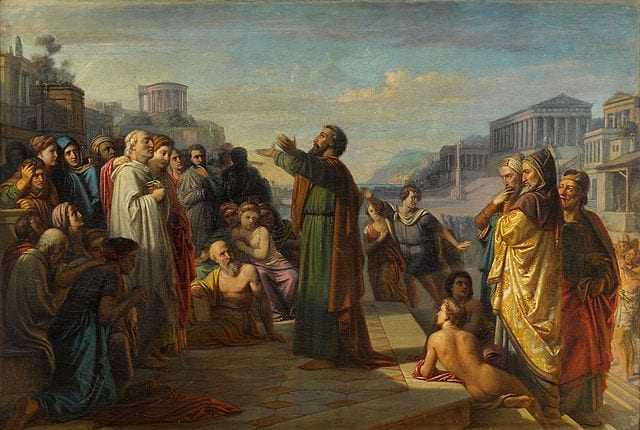
This is an installment of my replies to a series of articles on the epistle to the Romans (written by St. Paul) by Dr. David Madison: an atheist who was a Methodist minister for nine years: with a Ph.D. in Biblical Studies from Boston University. His summary article is called, “Bad Bible Theology: Paul’s Letter to the Romans: Let me count the ways…that Paul got it wrong” (2-26-18). He devotes a paper to each chapter. Unless he repeats himself (a bad habit of his) or descends to sheer biblical skepticism (which I have less than no interest in), I will reply to all.
The introduction is basically a catalogue of rank insults, where he calls St. Paul “a crank” and a “delusional cult fanatic” and “the prototype for Christian crazies” and “an obsessive-compulsive mediocre thinker and bad theologian” and “an embarrassment.” He adds: “how can anyone take this guy seriously?” That about covers the “content” there. Bears poop in the woods, brats throw fits, squirrels walk telephone lines, and the prevalent anti-theist brand of atheists insult Christians. Ho hum. What else is new?
Thus far, I have counter-replied to 31 of Dr. Madison’s critiques, from three different series, without hearing one peep back from him as of yet (28 days’ total time, starting on 8-1-19). This certainly doesn’t suggest to me that he is very confident in his opinions. I know he’s still alive and kicking, because I’ve seen him write other posts during this same period (example one / two / three).
Dr. Madison’s words will be in blue below.
*****
Dr. Madison calls his critique of Romans chapter 7, “Gosh, Why Is THAT in the Bible?: One big chunk of the New Testament can go in the trash” (4-21-17).
No, there is no such thing as a Holy Man who is privy to God’s thoughts . . .
Really? No saints, no prophets, no apostles, and no Jesus Who is God, no fathers and doctors of the Church? What a despairing view.
As any layperson who has plowed through the whole Bible will testify, there seems to be a lot that doesn’t need to be there, that shouldn’t be there. The common sense reaction, “How in the world is this the Word of God?” applies to literally thousands of texts—although many folks wouldn’t say so out loud.
So I guess we need a wise guy like Dr. Madison to decide what makes the cut in the Bible, rather than holy people (whose existence he has just denied) and the Church of God deciding such mundane things for us.
Just how bad can some scripture be? . . . in terms of pathetic human babbling—resulting in pathetic theobabble—it would be pretty hard to beat Romans 7. In fact my distaste for Paul goes back to my teenage years; Bible geek though I was, I dreaded reading his clunky letters. Then in 1992 I came across British scholar A.N. Wilson’s perfect description of Paul: “To say that he was self-contradictory is an understatement. He was a man who was fighting himself and quarreling with himself all the time; and he managed to project the warfare in his own breast on to the Cosmos itself” (Jesus, p. 23).
That explains quite a bit. Dr. Madison ran across this slop in 1992: as arrogant and assuming as his own endless trashings of the Bible, and it apparently set him on the course that ended in atheistic despair. We are what we eat. As Paul wisely stated:
2 Timothy 4:3-4 For the time is coming when people will not endure sound teaching, but having itching ears they will accumulate for themselves teachers to suit their own likings, [4] and will turn away from listening to the truth and wander into myths.
Dr. Madison found Wilson, Carrier, and others to satisfy his itching ears, and he has regurgitated their irrational pablum ever since (looks like).
So would this be your first choice for a guy to write scripture? No. His personal torment did not result in insights about God.
Yes (were it for me to select). I absolutely love St. Paul and his personality and style. He’s on my short list (with Jesus, Mary, St. Augustine, St. Therese, St. Teresa of Avila, and Cardinal Newman) of people to go talk to, when I (Lord willing) get to heaven. I guess that makes me a nutty fanatic, too, huh? So be it. The so-called “smart people” insulted Paul from the beginning. In Athens, this is what some of the pointy-heads said about him: “Some also of the Epicurean and Stoic philosophers met him. And some said, ‘What would this babbler say?'” (Acts 17:18a). The more things change, the more they stay the same.
Writing Theology from the Therapist Couch
Paul felt that sin was a cosmic force, and—much like an aggressive cancer—invades people to their very core:
Exactly right. It’s called original sin and concupiscence (propensity to sin). It’s the easiest Christian and biblical doctrine to defend, as it is self-evident by observing any and all people.
“For we know that the law is spiritual; but I am of the flesh, sold into slavery under sin. I do not understand my own actions. For I do not do what I want, but I do the very thing I hate. Now if I do what I do not want, I agree that the law is good. But in fact it is no longer I that do it, but sin that dwells within me. For I know that nothing good dwells within me, that is, in my flesh. I can will what is right, but I cannot do it. For I do not do the good I want, but the evil I do not want is what I do. Now if I do what I do not want, it is no longer I that do it, but sin that dwells within me.” (7:14-20)
He had super-sized internalized low self-esteem. Today we would advise therapy and even meds is some cases.
Nonsense. Christians draw a stark distinction between the flesh (which means that part of fallen humanity that wars against God, and is separate from the Holy Spirit and grace; not literal flesh) and the spirit: a common rhetorical dichotomy in Paul: especially in Romans 8 and Galatians 5. Paul is highlighting the flesh and its fruits in this chapter, just as he will highlight (in deliberate contradistinction) the triumphant Spirit in chapter 8.
It’s a dramatic build-up, so to speak. He is saying here that we can’t win this battle with our flesh and sinful desires, by ourselves (the heresy of Pelagianism or works-salvation). We need God’s enabling grace and power (which he details in the next chapter).
This is not low self-esteem; this is the reality of very flawed and frail human beings. But those who deny sin have to redefine and rationalize this sort of statement away. The way Dr. Madison does it is to classify St. Paul as a mentally ill nut and fanatic, in need of medication for his malady, rather than admit that he himself ever suffers from what Paul describes here.
I think it is far more “mentally ill” and abnormal (not to mention prideful) to deny that we have any sin or struggles with sin, than to openly admit the obvious.
But he was sure that the Cosmos had provided a fix for his anguish. “Who will rescue me from this body of death? Thanks be to God through Jesus Christ our Lord!” This is personal theism with a vengeance; Paul had horrible forebodings about a wrathful God aware of his inability to defeat sin. However, he had discovered, through his hallucinations, the magical solution: believe in the resurrection of Jesus. Verse 7: “Brothers, you have died to the law through the body of Christ, so that you may belong to another, to him who has been raised from the dead in order that we may bear fruit for God.” But did this really work for Paul? He’s complaining a lot in these verses about the on-going battle: “Wretched man that I am!”
Yes, it did work, for him and for Christians generally. See Romans 8 and Paul’s entire corpus. We can be sure that if Paul didn’t write this chapter about human frailty, then atheists like Dr, Madison would be saying that he is merely “pie-in-the-sky” and a juvenile fantasist divorced from reality of human struggles and sufferings and existential angst. But if he does write it, we get this condescending, patronizing tripe. If he didn’t express this aspect of the Christian life, then the cry no doubt would be that all Christians are self-righteous and “holier-than-thou”: folks who deny that they have any problems, who live in self-delusion. We just can’t win.
Now it’ll be fun to see what Dr. Madison does with Romans 8. Perhaps he will say that is unreality and pie-in-the-sky “magic.” When Paul appears too “happy” then atheists will say he is nuts (excessive religious “enthusiasm” etc.), but if it looks like he is too sad, he is a nut. See how it works? It’s Jekyll and Hyde. Paul is two-faced. We Christians are madmen no matter what we believe or express. We can never be right.
Bear in mind that this outburst is made in a letter to a church he’s never visited.
So what? We’re to believe that every pen pal relationship of people who never met is invalid?
From Galatians 2 we know that he didn’t get along with Peter . . .
From Galatians 2 what we know is that he rebuked Peter one time for behavioral hypocrisy. Big deal. The Bible says that “faithful are the wounds of a friend” and “rebuke a wise man and he will love you.” That proves nothing about any supposed ongoing difficulty. I’ve rebuked my children scores of times. Does it follow that I don’t “get along” with them? No!: not logically, and not in actual fact.
For one who thinks himself so wise (able to judge, mock, and dismiss the Bible and holy persons at the drop of a hat), Dr. Madison seems exceedingly naive and unrealistic about human relationships (in drawing such a ridiculous conclusion).
His theology may have appealed to simple-minded converts, but how was he perceived personally? Who knows—when the scroll was received, some of them may have rolled their eyes: “Oh no, not another letter from that insufferable dingbat.”
This is what passes for “rational argument” in Dr. Madison’s eyes . . .
Forgive me for resorting to a cliché, but the theology spun from Paul’s tortured brain reminds me of Macbeth’s bitter lament about life; the only words that don’t apply to Paul—darn it—are “then is heard no more.”
Life’s but a walking shadow, a poor player
That struts and frets his hour upon the stage
And then is heard no more: it is a tale
Told by an idiot, full of sound and fury,
Signifying nothing.
How melodramatic. This is self-refuting so I need not give it any further attention.
***
Photo credit: Paul in Athens, on Mars Hill, Anonymous (19th century German) [public domain / Wikimedia Commons]

***
alleged biblical contradictions
Bad Bible Theology: Paul’s Letter to the Romans
Previous Post

August 28, 2019
David Madison vs. Paul and Romans #6: Chapter 6
Next Post
August 29, 2019 David Madison vs. Paul and Romans #8: Chapter 8
Browse Our Archives
Select a Category & Last Things About Me Anti-Catholicism Atheism & Agnosticism Baptism and Sacramentalism Bible and Tradition Blessed Virgin Mary Books by Dave Armstrong C. S. Lewis Calvinism & General Protestantism Catholic Apologetics Catholic Apologists Catholic conversion Catholic converts Christmas Church (Ecclesiology) Church History Conversion and Converts Development of Doctrine Eastern Orthodoxy Ecumenism & Christian Unity Eucharist & Liturgy Fathers of the Church French Translations G. K. Chesterton Hell Hell & Satan Hell & Satan & Last Things Heresies & Comparative Religion Holistic Health Inquisition & Crusades & Scandals James White Jews & Judaism & Old Testament John Calvin John Henry Newman Liberal / Modernist Theology Life Issues Literary Resume Lutheranism Mariology Martin Luther Music Orthodoxy Papacy & Infallibility Personal Page Philosophy & Science Political & Ethical & Moral Issues Protestant Persecution & Intolerance Protestantism Purgatory Purgatory & Penance Romantic & Imaginative Theology Saints & Purgatory & Penance Salvation Salvation & Justification Satan & Last Things Sexuality and Gender Issues Spanish Translations Traditionalism vs. Radical Catholic Reactionaries Traducciones al español / tradução para português Trinitarianism & Christology Uncategorized Videos
Select a Month October 2026 September 2026 August 2026 July 2026 June 2026 May 2026 April 2026 March 2026 February 2026 January 2026 December 2025 November 2025 October 2025 September 2025 August 2025 July 2025 June 2025 May 2025 April 2025 March 2025 February 2025 January 2025 December 2024 November 2024 October 2024 September 2024 August 2024 July 2024 June 2024 May 2024 April 2024 March 2024 February 2024 January 2024 December 2023 November 2023 October 2023 September 2023 August 2023 July 2023 June 2023 May 2023 April 2023 March 2023 February 2023 January 2023 December 2022 November 2022 October 2022 September 2022 August 2022 July 2022 June 2022 May 2022 April 2022 March 2022 February 2022 January 2022 December 2021 November 2021 October 2021 September 2021 August 2021 July 2021 June 2021 May 2021 April 2021 March 2021 February 2021 January 2021 December 2020 November 2020 October 2020 September 2020 August 2020 July 2020 June 2020 May 2020 April 2020 March 2020 February 2020 January 2020 December 2019 November 2019 October 2019 September 2019 August 2019 July 2019 June 2019 May 2019 April 2019 March 2019 February 2019 January 2019 December 2018 November 2018 October 2018 September 2018 August 2018 July 2018 June 2018 May 2018 April 2018 March 2018 February 2018 January 2018 December 2017 November 2017 October 2017 September 2017 August 2017 July 2017 June 2017 May 2017 April 2017 March 2017 February 2017 January 2017 December 2016 November 2016 October 2016 September 2016 August 2016 July 2016 June 2016 May 2016 April 2016 March 2016 February 2016 January 2016 December 2015 November 2015 October 2015 September 2015 August 2015 July 2015 June 2015 May 2015 April 2015 March 2015 February 2015 January 2015 December 2014 November 2014 October 2014 September 2014 August 2014 July 2014 June 2014 April 2014 March 2014 February 2014 January 2014 December 2013 November 2013 October 2013 September 2013 August 2013 July 2013 June 2013 April 2013 March 2013 February 2013 January 2013 December 2012 November 2012 October 2012 September 2012 August 2012 July 2012 June 2012 May 2012 April 2012 March 2012 February 2012 January 2012 December 2011 November 2011 October 2011 September 2011 August 2011 July 2011 June 2011 April 2011 March 2011 February 2011 October 2010 September 2010 August 2010 July 2010 April 2010 March 2010 December 2009 October 2009 August 2009 July 2009 June 2009 May 2009 March 2009 February 2009 October 2008 September 2008 April 2008 March 2008 February 2008 January 2008 December 2007 November 2007 October 2007 May 2007 March 2007 February 2007 January 2007 November 2006 October 2006 September 2006 August 2006 July 2006 June 2006 May 2006 April 2006 March 2006 February 2006 October 2005 June 2005 April 2005 February 2005 July 2004 May 2004 April 2004
Follow Us!
TAKE THE
Religious Wisdom Quiz
Which book of the Bible contains the most direct prophecies about the Messiah?
Select your answer to see how you score.
Micah Isaiah Zechariah Psalms
Books by This Author Books by Dave Armstrong
Related posts from Biblical Evidence for Catholicism

God, Modern Physics, & Dark Energy: An Analogy
Biblical Evidence for Catholicism

General Debate on Christianity with an Atheist
Biblical Evidence for Catholicism

Can Atheists Be Saved? Surprising Biblical Data
Biblical Evidence for Catholicism
Can Atheists Be Saved? YES! (Possibly Some ....
Biblical Evidence for Catholicism
TRENDING AT PATHEOS Catholic

The Sermon on the Mount, Part I: Matthew...
The Sermon on the Mount, Part I (Matthew 4:12-5:12) St. Matthew moves...

What's up from Crossway: Reviewing some of their latest A few weeks...

Janie Learns the Way of the Cross: A...
Teaching children about Jesus' Passion can be challenging. Many parents and educators...

Looking For Good Catholic Writing - October 2026
He alone extends the heavens, and he walks upon the waves of...

In "Irreplaceable," our book on vocation and technology, Trevor Sutton and I...

I was strolling through the top floor of the brand new Parthenon...
view all Catholic blogs
Ad-Free & Subscriber Log-In Subscription Support
- About Us
- 2026 Calendar
- Videos
- Podcasts
- Library of World Religions
- Faith In Media Tracker
- Advertise With Us
- Write for Us
- Privacy Policy
- Terms of Service
- Do Not Sell My Data
- Contact Us
- Radiant Digital
- Manage Newsletter Subscriptions
- Unsubscribe From Notifications
- Sitemap
Copyright 2008-2026, Patheos. All rights reserved.
Subscription Support Ad-Free & Subscriber Log-In
Follow Patheos