
BuddhistCatholicContemplativeEvangelicalGeneral ChristianHinduJewishLatter-day SaintMuslimNew VisionsProgressive Christian
Beliefs
- Buddhist
- Catholic
- Contemplative
- Evangelical
- General Christian
- Hindu
- Jewish
- Latter-day Saint
- More Voices
- Muslim
- New Visions
- Pagan
- Progressive Christian
Topics
- Religion News
- Food and Religion
- Sports and Religion
- Religious Art
- Religious Music and Entertainment
- Religious Events
- History and Religion
- Style and Religion
- Politics and Religion
- Women in Religion
- Recreation Outdoors and Religion
- Business Finance and Religion
- Careers Workplace and Religion
- Education and Religion
- Family Parenting and Religion
- Health Fitness and Religion
- Home and Religion
- Relationships and Religion
- Technology and Religion
- Travel and Religion
Columnists
- Buddhist Columnists
- Business Finance and Religion Columnists
- Careers Workplace and Religion Columnists
- Catholic Columnists
- Contemplative Columnists
- Education and Religion Columnists
- Evangelists Columnists
- Family Parenting and Religion Columnists
- General Christian Columnists
- Health Fitness and Religion Columnists
- Hindu Columnists
- History and Religion Columnists
- Home and Religion Columnists
- Jewish Columnists
- More Voices Columnists
- Latter Day Columnists
- Muslim Columnists
- New Visions Columnists
- Nonreligious Columnists
- Pagan Columnists
- Politics and Religion Columnists
- Progressive Columnists
- Recreation Outdoors and Religion Columnists
- Relationships and Religion Columnists
- Religion News Columnists
- Religious Art Columnists
- Religious Events Columnists
- Religious Music and Entertainment Columnists
- Sports and Religion Columnists
- Style and Religion Columnists
- Technology and Religion Columnists
- Travel and Religion Columnists
- Women in Religion Columnists
Resource Library
- 2026 Calendar
- Library of World Religions
- The 100 Most Holy Places on Earth
- Patheos Answers
- Podcasts
- Videos
- Faith Leaders Database
- Anglican Episcopalian
- Bahai
- Baptist
- Buddhism
- Christianity
- Confucianism
- Eastern Orthodoxy
- Hinduism
- Holiness and Pentecostal
- ISKCON
- Islam
- Judaism
- Lutheran
- Methodist
- The Church of Jesus Christ of Latter-day Saints
- New Age
- Paganism
- Presbytarian and Reformed
- Protestantism
- Religion Behind the Scenes
- Roman Catholic
- Scientology
- Shia Islam
- Sikhism
- Sufism
- Sunni Islam
- Taoism
- Zen
- See all religions
Research Tools
 Ad-Free & Subscriber Log-In Subscription Support
Ad-Free & Subscriber Log-In Subscription Support
Follow Patheos 

- Trending:
- Forgiveness
- |
- Marriage
- |
- Consciousness
- |
- Death Penalty
- |
- Election
- |
- Halloween

-
About
-
Catholic Apologetics
-
Church History
-
Great Apologists
-
Christian Worldview
-
Protestantism & Misc.
- Home
- Catholic
- History and Religion
- David Madison: Synoptics vs. John Re Jesus’ Will & Passion?
David Madison: Synoptics vs. John Re Jesus’ Will & Passion?
Last updated on: August 22, 2019 at 10:03 am by Dave Armstrong
David Madison: Synoptics vs. John Re Jesus’ Will & Passion? 2019-08-22T10:03:08-04:00 Dave Armstrong
Patheos Explore the world's faith through different perspectives on religion and spirituality! Patheos has the views of the prevalent religions and spiritualities of the world.
Dr. David Madison is an atheist who was a Methodist minister for nine years: with a Ph.D. in Biblical Studies from Boston University. He believes we are not at all sure whether Jesus in fact said anything recorded in the Gospels. The atheist always has a convenient “out” (when refuted in argument about some biblical text) that Jesus never said it anyway and that the text in question was simply made up and added later by unscrupulous and “cultish” Christian propagandists.
I always refuse to play this silly and ultimately intellectually dishonest game, because there is no way to “win” with such a stacked, subjective deck. I start with the assumption (based on many historical evidences) that the manuscripts we have are quite sufficient for us to know what is in the Bible (believe it or not).
Dr. Madison himself — in his anti-Jesus project noted above, granted my outlook, strictly in terms of practical “x vs. y” debate purposes: “For the sake of argument, I’m willing to say, okay, Jesus was real and, yes, we have gospels that tell the story.” And in the combox: “So, we can go along with their insistence that he did exist. We’ll play on their field, i.e., the gospels.” Excellent! Otherwise, there would be no possible discussion at all.
His words below will be in blue.
*****
He wrote an article called, ” ‘This Howling Conflict between Mark and John’: Yet so many Christians don’t seem to have a clue” (10-26-18).
Even if there wasn’t a Beloved Disciple, there is a Beloved Gospel—and that would be John, in which Jesus has a superhuman commanding presence. Well, as seen through the eyes of adoring faith. For those who aren’t so adoring, that ‘commanding presence’ looks more like bragging, insufferable egregious egotism. Which is what can happen—as in John’s case—when the author isn’t even trying to depict a real human. . . . Mark was schooled in Greek tragedy . . . and constructed his Jesus story accordingly, i.e., he made Jesus a real human who agonized over his fate; Mark assumed that even the Son of God could do that.
But John would have none of it; a human Jesus was out of the question. As an exercise to shock Christians out of faith-complacency, I suggest that they read Mark and John back-to-back. It should jump out at them, . . . If they aren’t puzzled—if they aren’t alarmed—then they’re not paying attention. Someone is lying about their Jesus. . . .
John . . . doesn’t even mention—as do Matthew, Mark, and Luke—that Jesus was distraught [during the time when His Passion was imminent], . . .
Really? Not human, and not distraught?:
John 11:32-33, 38 (RSV) Then Mary, when she came where Jesus was and saw him, fell at his feet, saying to him, “Lord, if you had been here, my brother would not have died.” [33] When Jesus saw her weeping, and the Jews who came with her also weeping, he was deeply moved in spirit and troubled; . . . [38] Then Jesus, deeply moved again, came to the tomb; . . .
John 12:27 “Now is my soul troubled. And what shall I say? `Father, save me from this hour’? No, for this purpose I have come to this hour.”
John 13:21 When Jesus had thus spoken, he was troubled in spirit, and testified, “Truly, truly, I say to you, one of you will betray me.”
Dr. Madison cites Louis A. Ruprecht, Jr.:
• “The Synoptic story of Gethsemane raised two critical questions that are nearly impossible to answer. First, if Jesus was alone when he prayed, then how can anyone know exactly what he said? Second, if Jesus was on such intimate terms with God, then how can their wills be so dramatically out of sync at the very end of the story? John’s evangel cuts the complicated Gordian knot of such questions with a very simple answer: Jesus didn’t pray that way.” (p. 74)
• “If the Synoptic story of Gethsemane is a story about praying in the face of temptation prior to betrayal, then John’s is no longer the same story at all.” (p. 74) . . .
• “…John had to erase the dramatic episode that Mark located in Gethsemane—a powerful story about prayer and temptation, about the sheer humanity of Jesus’s doubts and the awful depth of his suffering. Mark’s tragedy hinges on the fact that we are witnesses to the collision between two wills, a tragic struggle for self-definition in which we are invited to participate and to recognize as our own. John simply cannot tell a story like that because his theology cannot allow for a collision of wills between Father and Son or for a divided picture of Jesus.” (p. 76) Remember these key words: his theology cannot allow. . . .
Ruprecht makes it starkly clear that Mark and John thought very differently about Jesus. . . .
• “… we modern people must work very carefully, with more finally developed historical habits, to be able to feel the shock that John’s evangel might have created in an ancient Christian audience that knew and admired Mark’s version. The power of Marks performance has something to do with Jesus’s passionate humanity, something to do with compassion in the face of unimaginable suffering, and it has everything to do with tragedy. John turned all this upside down by writing an anti-tragic evangel in which Jesus’s humanity is muted and all compassion, much like the wavering disciples, has fled.” (p. 101) . . .
“Gethsemane admits a level not just of humanity, but of actual doubt, and that Luther finds completely unacceptable in the Savior of humankind.” (p. 174) . . .
Unbeknown to most of the folks in the pews, the New Testament is a minefield of conflicting, contradictory theologies—as well as portraits of Jesus that cannot be reconciled. Oblivious to all this, they show up to worship. It’s comforting to hear nice verses read from the Good Book on Sunday morning. So there was a howling conflict between Mark and John? That would be too much information.
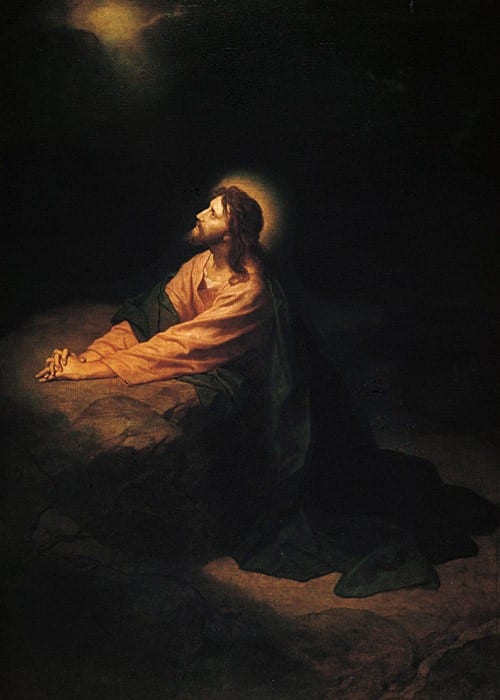
There is no supposed “collision of wills between Father and Son” in the Synoptic Gospels. Jesus made it clear (as recorded in those three Gospels) that His will was fully in line with the Father’s will that He suffer and die for the sake of all men. There is no hint that He disagrees with that or that he “doubts”; only that He is agonized over what is to come (as any human being would be):
Matthew 26:36-42 Then Jesus went with them to a place called Gethsem’ane, and he said to his disciples, “Sit here, while I go yonder and pray.” [37] And taking with him Peter and the two sons of Zeb’edee, he began to be sorrowful and troubled. [38] Then he said to them, “My soul is very sorrowful, even to death; remain here, and watch with me.” [39] And going a little farther he fell on his face and prayed, “My Father, if it be possible, let this cup pass from me; nevertheless, not as I will, but as thou wilt.” [40] And he came to the disciples and found them sleeping; and he said to Peter, “So, could you not watch with me one hour? [41] Watch and pray that you may not enter into temptation; the spirit indeed is willing, but the flesh is weak.” [42] Again, for the second time, he went away and prayed, “My Father, if this cannot pass unless I drink it, thy will be done.”
Mark 14:32-36 And they went to a place which was called Gethsem’ane; and he said to his disciples, “Sit here, while I pray.” [33] And he took with him Peter and James and John, and began to be greatly distressed and troubled. [34] And he said to them, “My soul is very sorrowful, even to death; remain here, and watch.” [35] And going a little farther, he fell on the ground and prayed that, if it were possible, the hour might pass from him. [36] And he said, “Abba, Father, all things are possible to thee; remove this cup from me; yet not what I will, but what thou wilt.”
Luke 22:39-42 And he came out, and went, as was his custom, to the Mount of Olives [where Gethsem’ane is located]; and the disciples followed him. [40] And when he came to the place he said to them, “Pray that you may not enter into temptation.” [41] And he withdrew from them about a stone’s throw, and knelt down and prayed, [42] “Father, if thou art willing, remove this cup from me; nevertheless not my will, but thine, be done.”
Likewise, the unity of the wills of Jesus and God the Father was also expressed by Jesus in John’s Gospel: “And he who sent me is with me; he has not left me alone, for I always do what is pleasing to him” (Jn 8:29); “Now is my soul troubled. And what shall I say? `Father, save me from this hour’? No, for this purpose I have come to this hour” (Jn 12:27); “I lay down my life, that I may take it again. [18] No one takes it from me, but I lay it down of my own accord. I have power to lay it down, and I have power to take it again; this charge I have received from my Father” (Jn 10:17-18)
Moreover, Jesus shows no inclination whatsoever to not willingly suffer and die for the purpose of redemption, and indeed, rather casually predicted what was to come, over and over: as seen in all four Gospels:
Matthew 16:21 From that time Jesus began to show his disciples that he must go to Jerusalem and suffer many things from the elders and chief priests and scribes, and be killed, and on the third day be raised.
Matthew 17:22-23 As they were gathering in Galilee, Jesus said to them, “The Son of man is to be delivered into the hands of men, [23] and they will kill him, and he will be raised on the third day.” And they were greatly distressed.
Matthew 20:17-19 And as Jesus was going up to Jerusalem, he took the twelve disciples aside, and on the way he said to them, [18] “Behold, we are going up to Jerusalem; and the Son of man will be delivered to the chief priests and scribes, and they will condemn him to death, [19] and deliver him to the Gentiles to be mocked and scourged and crucified, and he will be raised on the third day.”
Matthew 26:1-2 When Jesus had finished all these sayings, he said to his disciples, [2] “You know that after two days the Passover is coming, and the Son of man will be delivered up to be crucified.”
Matthew 26:31-32 Then Jesus said to them, “You will all fall away because of me this night; for it is written, `I will strike the shepherd, and the sheep of the flock will be scattered.’ [32] But after I am raised up, I will go before you to Galilee.”
Mark 8:31 And he began to teach them that the Son of man must suffer many things, and be rejected by the elders and the chief priests and the scribes, and be killed, and after three days rise again.
Mark 9:31 for he was teaching his disciples, saying to them, “The Son of man will be delivered into the hands of men, and they will kill him; and when he is killed, after three days he will rise.”
Mark 10:32-34 And they were on the road, going up to Jerusalem, and Jesus was walking ahead of them; and they were amazed, and those who followed were afraid. And taking the twelve again, he began to tell them what was to happen to him, [33] saying, “Behold, we are going up to Jerusalem; and the Son of man will be delivered to the chief priests and the scribes, and they will condemn him to death, and deliver him to the Gentiles; [34] and they will mock him, and spit upon him, and scourge him, and kill him; and after three days he will rise.”
Mark 12:1-11 And he began to speak to them in parables. “A man planted a vineyard, and set a hedge around it, and dug a pit for the wine press, and built a tower, and let it out to tenants, and went into another country. [2] When the time came, he sent a servant to the tenants, to get from them some of the fruit of the vineyard. [3] And they took him and beat him, and sent him away empty-handed. [4] Again he sent to them another servant, and they wounded him in the head, and treated him shamefully. [5] And he sent another, and him they killed; and so with many others, some they beat and some they killed. [6] He had still one other, a beloved son; finally he sent him to them, saying, `They will respect my son.’ [7] But those tenants said to one another, `This is the heir; come, let us kill him, and the inheritance will be ours.’ [8] And they took him and killed him, and cast him out of the vineyard. [9] What will the owner of the vineyard do? He will come and destroy the tenants, and give the vineyard to others. [10] Have you not read this scripture: `The very stone which the builders rejected has become the head of the corner; [11] this was the Lord’s doing, and it is marvelous in our eyes’?”
Luke 9:22 . . . “The Son of man must suffer many things, and be rejected by the elders and chief priests and scribes, and be killed, and on the third day be raised.”
Luke 9:44 “Let these words sink into your ears; for the Son of man is to be delivered into the hands of men.”
Luke 18:31-33 And taking the twelve, he said to them, “Behold, we are going up to Jerusalem, and everything that is written of the Son of man by the prophets will be accomplished. [32] For he will be delivered to the Gentiles, and will be mocked and shamefully treated and spit upon; [33] they will scourge him and kill him, and on the third day he will rise.”
John 2:19-21 Jesus answered them, “Destroy this temple, and in three days I will raise it up.” [20] The Jews then said, “It has taken forty-six years to build this temple, and will you raise it up in three days?” [21] But he spoke of the temple of his body.
John 3:14 And as Moses lifted up the serpent in the wilderness, so must the Son of man be lifted up,
John 8:28 So Jesus said, “When you have lifted up the Son of man, then you will know that I am he, . . .
John 10:15, 17-18 . . . I lay down my life for the sheep. . . . [17] For this reason the Father loves me, because I lay down my life, that I may take it again. [18] No one takes it from me, but I lay it down of my own accord. I have power to lay it down, and I have power to take it again; this charge I have received from my Father.”
John 12:23-24 And Jesus answered them, “The hour has come for the Son of man to be glorified. [24] Truly, truly, I say to you, unless a grain of wheat falls into the earth and dies, it remains alone; but if it dies, it bears much fruit.
John 12:31-33 “Now is the judgment of this world, now shall the ruler of this world be cast out; [32] and I, when I am lifted up from the earth, will draw all men to myself.” [33] He said this to show by what death he was to die.
John 13:1 Now before the feast of the Passover, when Jesus knew that his hour had come to depart out of this world to the Father, having loved his own who were in the world, he loved them to the end. (cf. 14:18-19, 27-29)
John 16:5 But now I am going to him who sent me; . . . (cf. 16:7, 16-22, 28; 17:13)
There is no imagined “difference” or “contradiction” in these respects (or any other) between Mark and John, or Matthew and Luke, and John. It’s simply one of many “Madison myths.”
***
Photo credit: Christ in Gethsemane (1886), by Heinrich Hofmann (1824-1911) [public domain / Wikimedia Commons]

***
alleged biblical contradictions
Gospel of John vs. Gospel of Mark
Previous Post

August 22, 2019
David Madison vs. Paul and Romans #1: Chapter 1
Next Post

August 26, 2019 David Madison vs. Paul and Romans #2: Chapter 2
Browse Our Archives
Select a Category & Last Things About Me Anti-Catholicism Atheism & Agnosticism Baptism and Sacramentalism Bible and Tradition Blessed Virgin Mary Books by Dave Armstrong C. S. Lewis Calvinism & General Protestantism Catholic Apologetics Catholic Apologists Catholic conversion Catholic converts Christmas Church (Ecclesiology) Church History Conversion and Converts Development of Doctrine Eastern Orthodoxy Ecumenism & Christian Unity Eucharist & Liturgy Fathers of the Church French Translations G. K. Chesterton Hell Hell & Satan Hell & Satan & Last Things Heresies & Comparative Religion Holistic Health Inquisition & Crusades & Scandals James White Jews & Judaism & Old Testament John Calvin John Henry Newman Liberal / Modernist Theology Life Issues Literary Resume Lutheranism Mariology Martin Luther Music Orthodoxy Papacy & Infallibility Personal Page Philosophy & Science Political & Ethical & Moral Issues Protestant Persecution & Intolerance Protestantism Purgatory Purgatory & Penance Romantic & Imaginative Theology Saints & Purgatory & Penance Salvation Salvation & Justification Satan & Last Things Sexuality and Gender Issues Spanish Translations Traditionalism vs. Radical Catholic Reactionaries Traducciones al español / tradução para português Trinitarianism & Christology Uncategorized Videos
Select a Month October 2026 September 2026 August 2026 July 2026 June 2026 May 2026 April 2026 March 2026 February 2026 January 2026 December 2025 November 2025 October 2025 September 2025 August 2025 July 2025 June 2025 May 2025 April 2025 March 2025 February 2025 January 2025 December 2024 November 2024 October 2024 September 2024 August 2024 July 2024 June 2024 May 2024 April 2024 March 2024 February 2024 January 2024 December 2023 November 2023 October 2023 September 2023 August 2023 July 2023 June 2023 May 2023 April 2023 March 2023 February 2023 January 2023 December 2022 November 2022 October 2022 September 2022 August 2022 July 2022 June 2022 May 2022 April 2022 March 2022 February 2022 January 2022 December 2021 November 2021 October 2021 September 2021 August 2021 July 2021 June 2021 May 2021 April 2021 March 2021 February 2021 January 2021 December 2020 November 2020 October 2020 September 2020 August 2020 July 2020 June 2020 May 2020 April 2020 March 2020 February 2020 January 2020 December 2019 November 2019 October 2019 September 2019 August 2019 July 2019 June 2019 May 2019 April 2019 March 2019 February 2019 January 2019 December 2018 November 2018 October 2018 September 2018 August 2018 July 2018 June 2018 May 2018 April 2018 March 2018 February 2018 January 2018 December 2017 November 2017 October 2017 September 2017 August 2017 July 2017 June 2017 May 2017 April 2017 March 2017 February 2017 January 2017 December 2016 November 2016 October 2016 September 2016 August 2016 July 2016 June 2016 May 2016 April 2016 March 2016 February 2016 January 2016 December 2015 November 2015 October 2015 September 2015 August 2015 July 2015 June 2015 May 2015 April 2015 March 2015 February 2015 January 2015 December 2014 November 2014 October 2014 September 2014 August 2014 July 2014 June 2014 April 2014 March 2014 February 2014 January 2014 December 2013 November 2013 October 2013 September 2013 August 2013 July 2013 June 2013 April 2013 March 2013 February 2013 January 2013 December 2012 November 2012 October 2012 September 2012 August 2012 July 2012 June 2012 May 2012 April 2012 March 2012 February 2012 January 2012 December 2011 November 2011 October 2011 September 2011 August 2011 July 2011 June 2011 April 2011 March 2011 February 2011 October 2010 September 2010 August 2010 July 2010 April 2010 March 2010 December 2009 October 2009 August 2009 July 2009 June 2009 May 2009 March 2009 February 2009 October 2008 September 2008 April 2008 March 2008 February 2008 January 2008 December 2007 November 2007 October 2007 May 2007 March 2007 February 2007 January 2007 November 2006 October 2006 September 2006 August 2006 July 2006 June 2006 May 2006 April 2006 March 2006 February 2006 October 2005 June 2005 April 2005 February 2005 July 2004 May 2004 April 2004
Follow Us!
TAKE THE
Religious Wisdom Quiz
Which book of the Bible contains the most direct prophecies about the Messiah?
Select your answer to see how you score.
Micah Isaiah Zechariah Psalms
Books by This Author Books by Dave Armstrong
Related posts from Biblical Evidence for Catholicism

A Few "Worst" & "Best" Arguments vs. Protestantism
Biblical Evidence for Catholicism

Jerusalem Council vs. James White & Sola Scriptura
Biblical Evidence for Catholicism

Biblical Perspicuity: Absurd Anti-Catholic "Defense"
Biblical Evidence for Catholicism

50 Biblical Disproofs of "Evident Clearness" of the...
Biblical Evidence for Catholicism
TRENDING AT PATHEOS Catholic

The Sermon on the Mount, Part I: Matthew...
The Sermon on the Mount, Part I (Matthew 4:12-5:12) St. Matthew moves...

What's up from Crossway: Reviewing some of their latest A few weeks...

Janie Learns the Way of the Cross: A...
Teaching children about Jesus' Passion can be challenging. Many parents and educators...

Looking For Good Catholic Writing - October 2026
He alone extends the heavens, and he walks upon the waves of...

In "Irreplaceable," our book on vocation and technology, Trevor Sutton and I...

I was strolling through the top floor of the brand new Parthenon...
view all Catholic blogs
Ad-Free & Subscriber Log-In Subscription Support
- About Us
- 2026 Calendar
- Videos
- Podcasts
- Library of World Religions
- Faith In Media Tracker
- Advertise With Us
- Write for Us
- Privacy Policy
- Terms of Service
- Do Not Sell My Data
- Contact Us
- Radiant Digital
- Manage Newsletter Subscriptions
- Unsubscribe From Notifications
- Sitemap
Copyright 2008-2026, Patheos. All rights reserved.
Subscription Support Ad-Free & Subscriber Log-In
Follow Patheos