
BuddhistCatholicContemplativeEvangelicalGeneral ChristianHinduJewishLatter-day SaintMuslimNew VisionsProgressive Christian
Beliefs
- Buddhist
- Catholic
- Contemplative
- Evangelical
- General Christian
- Hindu
- Jewish
- Latter-day Saint
- More Voices
- Muslim
- New Visions
- Pagan
- Progressive Christian
Topics
- Religion News
- Food and Religion
- Sports and Religion
- Religious Art
- Religious Music and Entertainment
- Religious Events
- History and Religion
- Style and Religion
- Politics and Religion
- Women in Religion
- Recreation Outdoors and Religion
- Business Finance and Religion
- Careers Workplace and Religion
- Education and Religion
- Family Parenting and Religion
- Health Fitness and Religion
- Home and Religion
- Relationships and Religion
- Technology and Religion
- Travel and Religion
Columnists
- Buddhist Columnists
- Business Finance and Religion Columnists
- Careers Workplace and Religion Columnists
- Catholic Columnists
- Contemplative Columnists
- Education and Religion Columnists
- Evangelists Columnists
- Family Parenting and Religion Columnists
- General Christian Columnists
- Health Fitness and Religion Columnists
- Hindu Columnists
- History and Religion Columnists
- Home and Religion Columnists
- Jewish Columnists
- More Voices Columnists
- Latter Day Columnists
- Muslim Columnists
- New Visions Columnists
- Nonreligious Columnists
- Pagan Columnists
- Politics and Religion Columnists
- Progressive Columnists
- Recreation Outdoors and Religion Columnists
- Relationships and Religion Columnists
- Religion News Columnists
- Religious Art Columnists
- Religious Events Columnists
- Religious Music and Entertainment Columnists
- Sports and Religion Columnists
- Style and Religion Columnists
- Technology and Religion Columnists
- Travel and Religion Columnists
- Women in Religion Columnists
Resource Library
- 2026 Calendar
- Library of World Religions
- The 100 Most Holy Places on Earth
- Patheos Answers
- Podcasts
- Videos
- Faith Leaders Database
- Anglican Episcopalian
- Bahai
- Baptist
- Buddhism
- Christianity
- Confucianism
- Eastern Orthodoxy
- Hinduism
- Holiness and Pentecostal
- ISKCON
- Islam
- Judaism
- Lutheran
- Methodist
- The Church of Jesus Christ of Latter-day Saints
- New Age
- Paganism
- Presbytarian and Reformed
- Protestantism
- Religion Behind the Scenes
- Roman Catholic
- Scientology
- Shia Islam
- Sikhism
- Sufism
- Sunni Islam
- Taoism
- Zen
- See all religions
Research Tools
 Ad-Free & Subscriber Log-In Subscription Support
Ad-Free & Subscriber Log-In Subscription Support
Follow Patheos 

- Trending:
- Forgiveness
- |
- Marriage
- |
- Consciousness
- |
- Death Penalty
- |
- Election
- |
- Halloween

-
About
-
Catholic Apologetics
-
Church History
-
Great Apologists
-
Christian Worldview
-
Protestantism & Misc.
- Home
- Catholic
- History and Religion
- Vs. Pasqualucci Re Vatican II #9: DH & Religious Liberty
Vs. Pasqualucci Re Vatican II #9: DH & Religious Liberty
Last updated on: July 23, 2019 at 11:22 am by Dave Armstrong
Vs. Pasqualucci Re Vatican II #9: DH & Religious Liberty 2019-07-23T11:22:29-04:00 Dave Armstrong
Patheos Explore the world's faith through different perspectives on religion and spirituality! Patheos has the views of the prevalent religions and spiritualities of the world.
[see the Master List of all twelve installments]
Paolo Pasqualucci (signer of three of the endless reactionary-dominated “corrections” of Pope Francis), a Catholic and retired professor of philosophy of the law at the University of Perugia, Italy, wrote “‘Points of Rupture’ of the Second Vatican Council with the Tradition of the Church – A Synopsis” (4-13-18), hosted by the infamous reactionary site, One Peter Five. It’s an adaptation of the introduction to his book Unam Sanctam – A Study on Doctrinal Deviations in the Catholic Church of the 21st Century.
Pope Benedict XVI, writing as Cardinal Ratzinger, stated that the authority of Vatican II was identical to that of the Council of Trent:
It must be stated that Vatican II is upheld by the same authority as Vatican I and the Council of Trent, namely, the Pope and the College of Bishops in communion with him, and that also with regard to its contents, Vatican II is in the strictest continuity with both previous councils and incorporates their texts word for word in decisive points . . .
Whoever accepts Vatican II, as it has clearly expressed and understood itself, at the same time accepts the whole binding tradition of the Catholic Church, particularly also the two previous councils . . . It is likewise impossible to decide in favor of Trent and Vatican I but against Vatican II. Whoever denies Vatican II denies the authority that upholds the other two councils and thereby detaches them from their foundation. And this applies to the so-called ‘traditionalism,’ also in its extreme forms. Every partisan choice destroys the whole (the very history of the Church) which can exist only as an indivisible unity.
To defend the true tradition of the Church today means to defend the Council. It is our fault if we have at times provided a pretext (to the ‘right’ and ‘left’ alike) to view Vatican II as a ‘break’ and an abandonment of the tradition. There is, instead, a continuity that allows neither a return to the past nor a flight forward, neither anachronistic longings nor unjustified impatience. We must remain faithful to the today of the Church, not the yesterday or tomorrow. And this today of the Church is the documents of Vatican II, without reservations that amputate them and without arbitrariness that distorts them . . .
I see no future for a position that, out of principle, stubbornly renounces Vatican II. In fact in itself it is an illogical position. The point of departure for this tendency is, in fact, the strictest fidelity to the teaching particularly of Pius IX and Pius X and, still more fundamentally, of Vatican I and its definition of papal primacy. But why only popes up to Pius XII and not beyond? Is perhaps obedience to the Holy See divisible according to years or according to the nearness of a teaching to one’s own already-established convictions? (The Ratzinger Report, San Francisco: Ignatius, 1985, 28-29, 31)
For further basic information about the sublime authority of ecumenical councils and Vatican II in particular, see:
Conciliar Infallibility: Summary from Church Documents [6-5-98]
The Bible on Papal & Church Infallibility [5-16-06]
Authority and Infallibility of Councils (vs. Calvin #26) [8-25-09]
The Analogy of an Infallible Bible to an Infallible Church [11-6-05; rev. 7-25-15; published at National Catholic Register: 6-16-17]
“Reply to Calvin” #2: Infallible Church Authority [3-3-17]
“On Adhesion to the Second Vatican Council” (Msgr. Fernando Ocariz Braña, the current Prelate of Opus Dei, L’Osservatore Romano, 12-2-11; reprinted at Catholic Culture) [includes discussion of VCII supposedly being “only” a “pastoral council”]
Pope Benedict on “the hermeneutic of reform, of renewal within continuity” (12-22-05)
The words of Paolo Pasqualucci, from his article, noted above, will be in blue:
*****
11. In the Decree On Religious Liberty Dignitatis Humanae (DH), a concept of “religious liberty” is affirmed which does not seem to distinguish itself from the secular concept of the same, which is the fruit of the idea of tolerance, the origins of which are in Deism and the Enlightenment. Such a concept appears not to conform to the doctrine of the Church and is a harbinger of indifferentism and agnosticism.
My friend and fellow Catholic apologist Tim Staples thoroughly disposes of this in an excellent article, “Religious Liberty” (Catholic Answers, 1-9-15):
Our Lord himself removed all doubt concerning man’s freedom when he revealed that as God from all eternity he willed to gather “Jerusalem” as his own, but they refused him:
Jerusalem, Jerusalem, killing the prophets and stoning those who are sent to you! How often I would have gathered your children together as a hen gathers her brood under her wings, and you would not (Matt. 23:37)! . . .
The claim is made that . . . the Council contradict[s] earlier Magisterial teachings of the Church that condemn “religious freedom,” and so, must be considered heretical.
And one can certainly see how a surface reading of Magisterial statements . . . could be so construed . . . Pope Leo XIII, in his Encyclical Letter, Libertas, 42, June 20, 1888, is also used to this end:
From what has been said it follows that it is quite unlawful to demand, to defend, or to grant unconditional freedom of thought, of speech, or writing, or of worship, as if these were so many rights given by nature to man. For, if nature had really granted them, it would be lawful to refuse obedience to God, and there would be no restraint on human liberty. It likewise follows that freedom in these things may be tolerated wherever there is just cause, but only with such moderation as will prevent its degenerating into license and excess. And, where such liberties are in use, men should employ them in doing good, and should estimate them as the Church does; for liberty is to be regarded as legitimate in so far only as it affords greater facility for doing good, but no farther.
Two points in Response
1. These declarations of the Holy See [Dave: he had also cited Pope Gregory XVI’s Encyclical Letter, Mirari Vos, from 1832] condemn an absolute religious freedom that casts off all constraints of Natural Law and Church authority. This is essentially different from what DH is speaking about. Notice, DH 2 includes key phrases like, ”within due limits,” and “provided that just public order be observed,” to emphasize limitations on religious liberty. There is not even a hint of its approval of what Pope Gregory XVI called “indifferentism,” or what Pope Leo XIII called “unconditional freedom…”
2. The Council Fathers were careful to define what the Church means by “religious freedom” in the context of DH.
This Vatican Council declares that the human person has a right to religious freedom. This freedom means that all men are to be immune from coercion on the part of individuals or of social groups and of any human power…
By “religious freedom,” the Council meant men “are to be immune from coercion.” This is absolutely consonant with Catholic teaching.
And notice as well the Council spoke of the evil of coercion by human power. This in no way means man is not bound by God’s law, or by divine authority. That was not even a consideration here. In other words, Vatican II is not presenting a “right to error,” or a “right to blaspheme.” It is presenting a negative right—a right to not being coerced.
And this is not to say God, or any divine authority, coerces either when it comes to man responding to God’s gracious invitation to come to him. God has given man freedom to either choose him or reject him, as I said above. But it is to emphasize the context of DH. The fathers of the Council were responding to the problem of earthly despots or any political authority that would attempt to coerce with regard to matters religious.
Fr. Brian W. Harrison has also again done excellent work in refuting this objection to Dignitatis Humanae, in his tour de force article, “Dignitatis Humanae: a Non-Contradictory Doctroinal Development” (Living Tradition; Roman Theological Forum, March 2011). I shall cite it at length (I won’t indent: everything below are his words; footnotes incorporated in green):
***
As is well known, the perception that the doctrine enshrined in these magisterial documents, and indeed, in the Church’s universal and ordinary magisterium since the patristic era, is irreconcilable with that of DH has been a major factor in the SSPX’s continued resistance to Vatican Council II. . . .
I. First of all, certain important hermeneutical distinctions need to be kept in mind:
(a) between Church doctrine (teaching proposed as true for all times and places) and Church law or prudential policy judgments (adaptable according to different historical/cultural circumstances).
(b) between a Vatican II Declaration such as DH and more authoritative conciliar documents, such as Dogmatic Constitutions. Conciliar declarations (of which there are two others, Nostra Aetate and Gravissimum Educationis, on inter-religious dialogue and Catholic education respectively) are not meant to be read as if they proposed universal, timeless and unchangeable doctrine from start to finish. All three of them begin with a few basic general doctrinal principles of this sort, and then go on to lay down practical norms and other comments that the Church considers appropriate as present-day applications of, and reflections on, those principles.
(c) between affirming a right to do X and affirming a right to immunity from coercion in doing X. In a purely juridical or legal document setting out only what is and is not to be prohibited and punished by human positive law, this distinction would be inapplicable, even meaningless. But in a theological, doctrinal document such as DH, which in the first place considers moral rights and duties, and only secondarily their implications for human law codes, the distinction is crucial. DH carefully specifies that what it affirms as the natural right to religious freedom is only the second kind of right. A theological affirmation that there is a human right to do X simply means that X is itself a kind of action which is objectively morally upright and justifiable – one that does not, as such, deserve censure or disapproval from either God or man. But to affirm a right to immunity from human coercion in doing X – that is, a right not to be prevented by human authority from doing X – does not necessarily imply that X is objectively good behavior. It is simply a reflection of the important distinction between sin and crime; that is, it recognizes the limited jurisdiction of government when it comes to penalizing the errant behavior of citizens. St. Thomas recognized long ago that it is not the function of human law (civil authority) to outlaw and punish any and every kind of sin.3
[Cf. Summa Theologiae, Ia IIae, Q. 96, a. 2.]
And he answered negatively the question as to whether Muslim or Jewish parents could justly be prevented by Catholic governments from teaching their children their respective non-Christian religions. (In practice, of course, such prevention would mean removing these children from their parents’ custody altogether.) Aquinas said this would be unjust, because the right of a father over his family in this case prevails against the alleged right of government to intervene in favor of the true religion.4
[Cf. Summa Theologiae, IIa, IIae, Q. 10, a. 12.]
Does that mean St. Thomas is saying or implying that there exists a “right to teach one’s children false doctrine” – doctrine contrary to the revealed truths such as the Incarnation and Trinity? Not at all. There is only a right not to be prevented by government from doing so.
[. . .]
(d) Finally, we need to avoid the fallacy of assuming that if we say a government should tolerate a certain activity, we are implying or presupposing that it has a right, in justice, to repress that same activity if it wishes to do so. Again, in a purely juridical document, that right might perhaps be implied. But not in theological discourse, in which the first of the above propositions by no means entails the second. In the context of such discourse, saying that a ruler tolerates activity A simply means that, while disapproving of A, he decides not to repress it even though he disposes of enough physical force (police or military), and perhaps the permission of his country’s existing positive law, to do so. Whether or not he would also have the right (in the sense of the moral authority) to repress A is a distinct question. In some cases he would, in others he wouldn’t. So critics of Vatican II are setting up a false dichotomy when – as often happens – they claim to discern an implicit contradiction between DH’s language of “rights” in civil society for those practising various different religions and the traditional papal language that spoke of mere civil “tolerance” for non-Catholic religious activity. The distinction made in (c) above also needs to be kept in mind here. It follows from all this that the respective concepts of having a right not to be prevented by the State from carrying out religious activity A (which is the language of DH), and of being tolerated by the State in carrying out A (the language of the pre-conciliar magisterium) are not at all logically incompatible. And precisely because they are compatible, it would not be oxymoronic to combine the conciliar and pre-conciliar ways of speaking in one expression, affirming that persons can sometimes have a natural “right to be tolerated” by government in carrying out A.
II. Note also that, according to DH 1, the religious freedom affirmed in this document leaves “intact”, or “whole and entire” (Latin integram) the “traditional Catholic doctrine concerning the moral duty of individuals and societies toward the true religion and the one Church of Christ”. Now, the word “societies” here certainly includes civil or political communities as such. This was clarified in words that were personally approved and mandated by Pope Paul VI, and then read out by the relator (official spokesman for the drafting committee) to the assembled Fathers who were about to vote on this final draft of DH. The relator told them that this and other last-minute additions to the text were a response to the concerns expressed by some Fathers about apparent doctrinal inconsistency between the declaration they were being asked to approve and “ecclesiastical documents up till the time of the Supreme Pontiff Leo XIII”, especially the “insistence” of these documents on “the moral duty of public authority (potestas publica) toward the true religion”. The relator then pointed out to the Fathers that the revised text, by virtue of the final amendments to articles 1 and 3, “recalls [this duty] more clearly”. As a result, he said, “it is manifest that this part of the doctrine has not been overlooked”.5
[“. . . ex quo patet hanc doctrinae partem non praetermitti” (Acta Synodalia, IV, VI, 719).]
Therefore, any interpretation of DH that has it contradict the doctrine of previous popes cannot reflect the mind of the Church as to the true meaning of the Declaration.
III. Keeping in mind the preceding hermeneutical criteria, we can now set out very briefly a case for non-contradiction. Two of the three doctrinal propositions of DH in its key paragraph (article 2, paragraph 1) are not usually contested by the declaration’s traditionalist critics. These brethren are troubled little, if at all, by the Council’s vindication of immunity from human coercion for non-Catholics in their private religious activity, or by its assertion that no one is to be coerced into acting against their conscience in religious matters. What troubles these critics in DH #2 is its teaching that, “within due limits”, no one may be prevented from acting publicly in accord with their conscience in religious matters. This assertion, they claim, is unorthodox and irreconcilable with previous papal teaching, in spite of its recognition that the right to such freedom for public activity is not unlimited.
Now, taking into account the elaboration of those “due limits” which we find in article 7 of the Declaration, this controverted teaching of DH can be synthesized as the following proposition:
P: It is unjust for human authority (Catholic or non-Catholic) to prevent people from publicly acting in accord with their conscience in religious matters, unless such action violates legal norms, based on the objective moral order, that are necessary for safeguarding: (a) the rights of all citizens; (b) public peace; and (c) public morality. (These three factors are said to make up collectively “the basic component of the common good”, otherwise termed “a just public order”. It is important to be aware that DH defines “public order” in terms of these three.)
Now, if indeed P contradicts traditional Catholic doctrine in the way critics of Vatican II claim it does (i.e., by allowing too much civil freedom in religious matters) then the pertinent traditional doctrine would have to have been the following:
P1 It is sometimes just for human authority (Catholic or non-Catholic) to prevent people from publicly acting in accord with their conscience in religious matters even when such activity does not violate any of the three general norms (a), (b) and (c), specified in P.
But P1 was not in fact the Church’s traditional doctrine. It cannot be found – in those words or others implying the same thing – in the pre-conciliar magisterium, ordinary or extraordinary. For the popes of earlier times who sometimes exhorted Catholic rulers to repress all public manifestations of non-Catholic religions would certainly have answered affirmatively, had they been asked whether such manifestations violated one or more of the three norms set out in proposition P above. (We will return to this point below.) Ergo, DH does not contradict the Church’s traditional doctrine.
[. . .]
The Catechism of the Catholic Church, which can be seen as giving us an authentic commentary on the meaning of DH, reinforces this by asserting, with a footnote reference to Leo XIII’s encyclical Libertas, that “[t]he right to religious liberty is neither a moral license to adhere to error, nor a supposed right to error” (#2109).
[. . .]
Indeed, other approved traditional theologians (e.g., Suárez, Von Ketteler, and even Pope Gregory the Great) foreshadowed Vatican II to some extent by saying that Catholic civil authorities are obliged by the requirements of justice(not merely of prudence) to tolerate the worship of at least unbaptized monotheists – mainly Jews and Muslims – carried out in synagogues, mosques, or other places of public worship.6
[According to such theologians, neither civil nor ecclesiastical Christian authorities have any jurisdiction over the unbaptized in their religious activities, as long as these do not include practices contrary to what is knowable by reason and natural law, such as idolatry and polytheism. The Jews were considered ‘off limits’ for Christian authorities for an additional reason, namely, that their providential continued existence as a distinct religious community left them as living witnesses – independent of, and even hostile to, the Church herself – to her own historical origins and to the historical truth of both Old and New Testaments.]
[. . .]
Vatican II’s position is not so liberal as to deny that under certain past circumstances, the public manifestation of erroneous religious ideas and practices could have been, as such, a justly punishable threat to the common good of society (that is, it would jeopardize the rights of other citizens, and/or public peace, and/or public morality).
In short, the pre-conciliar and conciliar doctrines respectively are not so ‘absolute’ as to exclude and contradict each other. The perennial common thread in the Church’s doctrine, from ancient times until now, has been that, on the one hand, those persons outside the Church, especially those presumed to be invincibly ignorant of the truth of Catholicism, have a right to some degree of civil religious freedom (e.g., at the very least, non-Christians should never be coerced into baptism and Church membership, and should enjoy civil freedom to teach their religion privately to their own children), but that on the other hand, the State also has the right to impose some limitations on the spread of harmful and dangerous ideas in the interests of the common good of society. So there are two poles here, ‘positive’ and ‘negative’, that need to be kept in equilibrium: respect for erring consciences (toleration) and the need to prevent the spread of the most dangerous propaganda.
The difference between old and new has basically been a gradually changing emphasis in the Church’s position. Traditionally she emphasized more the ‘negative’ end of the spectrum – the State’s right to repress error; and from the mid-20th century on, she emphasizes more the human person’s right to immunity from coercion. Changes of emphasis, however – even to the extent of making the rule what was once the exception – are not contradictions. What we have here, rather, are changing prudential judgments as to where to find the right balance between necessary freedom and just restraint.
***
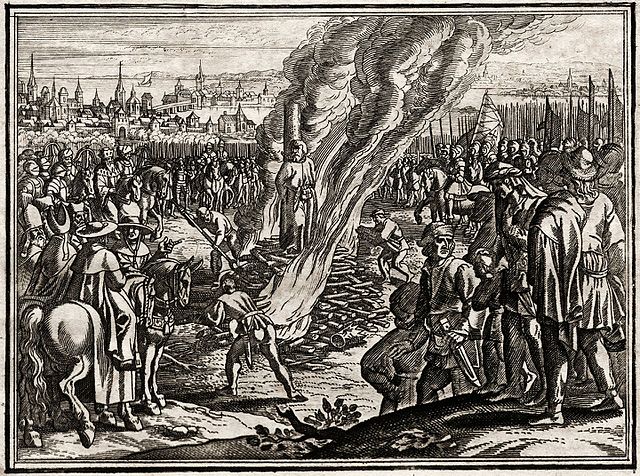
Photo credit: Burning of Jan Hus at the stake, from Matthäus Merian (1593-1650), Historische Chronica…, Frankfurt am Main 1630 [public domain / Wikimedia Commons]

***
Traditionalism vs. Radical Catholic Reactionaries
Radical Catholic Reactionaries
Previous Post
July 18, 2019
Vs. Pasqualucci Re Vatican II #8: Lumen Gentium & Collegiality
Next Post

July 19, 2019 Vs. Pasqualucci Re Vatican II #10: "Pastoral" Council Only?
Browse Our Archives
Select a Category & Last Things About Me Anti-Catholicism Atheism & Agnosticism Baptism and Sacramentalism Bible and Tradition Blessed Virgin Mary Books by Dave Armstrong C. S. Lewis Calvinism & General Protestantism Catholic Apologetics Catholic Apologists Catholic conversion Catholic converts Christmas Church (Ecclesiology) Church History Conversion and Converts Development of Doctrine Eastern Orthodoxy Ecumenism & Christian Unity Eucharist & Liturgy Fathers of the Church French Translations G. K. Chesterton Hell Hell & Satan Hell & Satan & Last Things Heresies & Comparative Religion Holistic Health Inquisition & Crusades & Scandals James White Jews & Judaism & Old Testament John Calvin John Henry Newman Liberal / Modernist Theology Life Issues Literary Resume Lutheranism Mariology Martin Luther Music Orthodoxy Papacy & Infallibility Personal Page Philosophy & Science Political & Ethical & Moral Issues Protestant Persecution & Intolerance Protestantism Purgatory Purgatory & Penance Romantic & Imaginative Theology Saints & Purgatory & Penance Salvation Salvation & Justification Satan & Last Things Sexuality and Gender Issues Spanish Translations Traditionalism vs. Radical Catholic Reactionaries Traducciones al español / tradução para português Trinitarianism & Christology Uncategorized Videos
Select a Month October 2026 September 2026 August 2026 July 2026 June 2026 May 2026 April 2026 March 2026 February 2026 January 2026 December 2025 November 2025 October 2025 September 2025 August 2025 July 2025 June 2025 May 2025 April 2025 March 2025 February 2025 January 2025 December 2024 November 2024 October 2024 September 2024 August 2024 July 2024 June 2024 May 2024 April 2024 March 2024 February 2024 January 2024 December 2023 November 2023 October 2023 September 2023 August 2023 July 2023 June 2023 May 2023 April 2023 March 2023 February 2023 January 2023 December 2022 November 2022 October 2022 September 2022 August 2022 July 2022 June 2022 May 2022 April 2022 March 2022 February 2022 January 2022 December 2021 November 2021 October 2021 September 2021 August 2021 July 2021 June 2021 May 2021 April 2021 March 2021 February 2021 January 2021 December 2020 November 2020 October 2020 September 2020 August 2020 July 2020 June 2020 May 2020 April 2020 March 2020 February 2020 January 2020 December 2019 November 2019 October 2019 September 2019 August 2019 July 2019 June 2019 May 2019 April 2019 March 2019 February 2019 January 2019 December 2018 November 2018 October 2018 September 2018 August 2018 July 2018 June 2018 May 2018 April 2018 March 2018 February 2018 January 2018 December 2017 November 2017 October 2017 September 2017 August 2017 July 2017 June 2017 May 2017 April 2017 March 2017 February 2017 January 2017 December 2016 November 2016 October 2016 September 2016 August 2016 July 2016 June 2016 May 2016 April 2016 March 2016 February 2016 January 2016 December 2015 November 2015 October 2015 September 2015 August 2015 July 2015 June 2015 May 2015 April 2015 March 2015 February 2015 January 2015 December 2014 November 2014 October 2014 September 2014 August 2014 July 2014 June 2014 April 2014 March 2014 February 2014 January 2014 December 2013 November 2013 October 2013 September 2013 August 2013 July 2013 June 2013 April 2013 March 2013 February 2013 January 2013 December 2012 November 2012 October 2012 September 2012 August 2012 July 2012 June 2012 May 2012 April 2012 March 2012 February 2012 January 2012 December 2011 November 2011 October 2011 September 2011 August 2011 July 2011 June 2011 April 2011 March 2011 February 2011 October 2010 September 2010 August 2010 July 2010 April 2010 March 2010 December 2009 October 2009 August 2009 July 2009 June 2009 May 2009 March 2009 February 2009 October 2008 September 2008 April 2008 March 2008 February 2008 January 2008 December 2007 November 2007 October 2007 May 2007 March 2007 February 2007 January 2007 November 2006 October 2006 September 2006 August 2006 July 2006 June 2006 May 2006 April 2006 March 2006 February 2006 October 2005 June 2005 April 2005 February 2005 July 2004 May 2004 April 2004
Follow Us!
TAKE THE
Religious Wisdom Quiz
Who denied Jesus three times before the rooster crowed?
Select your answer to see how you score.
Paul John Peter Judas
Books by This Author Books by Dave Armstrong
Related posts from Biblical Evidence for Catholicism

Jesus Founded the [Catholic] Church. If Not Him,...
Biblical Evidence for Catholicism

Jerusalem Council vs. James White & Sola Scriptura
Biblical Evidence for Catholicism
Marian Devotion is NOT Idolatry! (vs. Sean Luke)
Biblical Evidence for Catholicism
Worshiping God Through Images: Seven Bible Proofs
Biblical Evidence for Catholicism
TRENDING AT PATHEOS Catholic

The Sermon on the Mount, Part I: Matthew...
The Sermon on the Mount, Part I (Matthew 4:12-5:12) St. Matthew moves...

What's up from Crossway: Reviewing some of their latest A few weeks...

Janie Learns the Way of the Cross: A...
Teaching children about Jesus' Passion can be challenging. Many parents and educators...

Looking For Good Catholic Writing - October 2026
He alone extends the heavens, and he walks upon the waves of...

In "Irreplaceable," our book on vocation and technology, Trevor Sutton and I...

I was strolling through the top floor of the brand new Parthenon...
view all Catholic blogs
Ad-Free & Subscriber Log-In Subscription Support
- About Us
- 2026 Calendar
- Videos
- Podcasts
- Library of World Religions
- Faith In Media Tracker
- Advertise With Us
- Write for Us
- Privacy Policy
- Terms of Service
- Do Not Sell My Data
- Contact Us
- Radiant Digital
- Manage Newsletter Subscriptions
- Unsubscribe From Notifications
- Sitemap
Copyright 2008-2026, Patheos. All rights reserved.
Subscription Support Ad-Free & Subscriber Log-In
Follow Patheos