
BuddhistCatholicContemplativeEvangelicalGeneral ChristianHinduJewishLatter-day SaintMuslimNew VisionsProgressive Christian
Beliefs
- Buddhist
- Catholic
- Contemplative
- Evangelical
- General Christian
- Hindu
- Jewish
- Latter-day Saint
- More Voices
- Muslim
- New Visions
- Pagan
- Progressive Christian
Topics
- Religion News
- Food and Religion
- Sports and Religion
- Religious Art
- Religious Music and Entertainment
- Religious Events
- History and Religion
- Style and Religion
- Politics and Religion
- Women in Religion
- Recreation Outdoors and Religion
- Business Finance and Religion
- Careers Workplace and Religion
- Education and Religion
- Family Parenting and Religion
- Health Fitness and Religion
- Home and Religion
- Relationships and Religion
- Technology and Religion
- Travel and Religion
Columnists
- Buddhist Columnists
- Business Finance and Religion Columnists
- Careers Workplace and Religion Columnists
- Catholic Columnists
- Contemplative Columnists
- Education and Religion Columnists
- Evangelists Columnists
- Family Parenting and Religion Columnists
- General Christian Columnists
- Health Fitness and Religion Columnists
- Hindu Columnists
- History and Religion Columnists
- Home and Religion Columnists
- Jewish Columnists
- More Voices Columnists
- Latter Day Columnists
- Muslim Columnists
- New Visions Columnists
- Nonreligious Columnists
- Pagan Columnists
- Politics and Religion Columnists
- Progressive Columnists
- Recreation Outdoors and Religion Columnists
- Relationships and Religion Columnists
- Religion News Columnists
- Religious Art Columnists
- Religious Events Columnists
- Religious Music and Entertainment Columnists
- Sports and Religion Columnists
- Style and Religion Columnists
- Technology and Religion Columnists
- Travel and Religion Columnists
- Women in Religion Columnists
Resource Library
- 2026 Calendar
- Library of World Religions
- The 100 Most Holy Places on Earth
- Patheos Answers
- Podcasts
- Videos
- Faith Leaders Database
- Anglican Episcopalian
- Bahai
- Baptist
- Buddhism
- Christianity
- Confucianism
- Eastern Orthodoxy
- Hinduism
- Holiness and Pentecostal
- ISKCON
- Islam
- Judaism
- Lutheran
- Methodist
- The Church of Jesus Christ of Latter-day Saints
- New Age
- Paganism
- Presbytarian and Reformed
- Protestantism
- Religion Behind the Scenes
- Roman Catholic
- Scientology
- Shia Islam
- Sikhism
- Sufism
- Sunni Islam
- Taoism
- Zen
- See all religions
Research Tools
 Ad-Free & Subscriber Log-In Subscription Support
Ad-Free & Subscriber Log-In Subscription Support
Follow Patheos 

- Trending:
- Forgiveness
- |
- Marriage
- |
- Consciousness
- |
- Death Penalty
- |
- Election
- |
- Halloween

-
About
-
Catholic Apologetics
-
Church History
-
Great Apologists
-
Christian Worldview
-
Protestantism & Misc.
- Home
- Catholic
- History and Religion
- Vs. Pasqualucci Re Vatican II #8: Lumen Gentium & Collegiality
Vs. Pasqualucci Re Vatican II #8: Lumen Gentium & Collegiality
Last updated on: June 6, 2026 at 12:39 am by Dave Armstrong
Vs. Pasqualucci Re Vatican II #8: Lumen Gentium & Collegiality 2026-06-06T00:39:52-04:00 Dave Armstrong
Patheos Explore the world's faith through different perspectives on religion and spirituality! Patheos has the views of the prevalent religions and spiritualities of the world.
[see the Master List of all twelve installments]
Paolo Pasqualucci (signer of three of the endless reactionary-dominated “corrections” of Pope Francis), a Catholic and retired professor of philosophy of the law at the University of Perugia, Italy, wrote “‘Points of Rupture’ of the Second Vatican Council with the Tradition of the Church – A Synopsis” (4-13-18), hosted by the infamous reactionary site, One Peter Five. It’s an adaptation of the introduction to his book Unam Sanctam – A Study on Doctrinal Deviations in the Catholic Church of the 21st Century.
Pope Benedict XVI, writing as Cardinal Ratzinger, stated that the authority of Vatican II was identical to that of the Council of Trent:
It must be stated that Vatican II is upheld by the same authority as Vatican I and the Council of Trent, namely, the Pope and the College of Bishops in communion with him, and that also with regard to its contents, Vatican II is in the strictest continuity with both previous councils and incorporates their texts word for word in decisive points . . .
Whoever accepts Vatican II, as it has clearly expressed and understood itself, at the same time accepts the whole binding tradition of the Catholic Church, particularly also the two previous councils . . . It is likewise impossible to decide in favor of Trent and Vatican I but against Vatican II. Whoever denies Vatican II denies the authority that upholds the other two councils and thereby detaches them from their foundation. And this applies to the so-called ‘traditionalism,’ also in its extreme forms. Every partisan choice destroys the whole (the very history of the Church) which can exist only as an indivisible unity.
To defend the true tradition of the Church today means to defend the Council. It is our fault if we have at times provided a pretext (to the ‘right’ and ‘left’ alike) to view Vatican II as a ‘break’ and an abandonment of the tradition. There is, instead, a continuity that allows neither a return to the past nor a flight forward, neither anachronistic longings nor unjustified impatience. We must remain faithful to the today of the Church, not the yesterday or tomorrow. And this today of the Church is the documents of Vatican II, without reservations that amputate them and without arbitrariness that distorts them . . .
I see no future for a position that, out of principle, stubbornly renounces Vatican II. In fact in itself it is an illogical position. The point of departure for this tendency is, in fact, the strictest fidelity to the teaching particularly of Pius IX and Pius X and, still more fundamentally, of Vatican I and its definition of papal primacy. But why only popes up to Pius XII and not beyond? Is perhaps obedience to the Holy See divisible according to years or according to the nearness of a teaching to one’s own already-established convictions? (The Ratzinger Report, San Francisco: Ignatius, 1985, 28-29, 31)
For further basic information about the sublime authority of ecumenical councils and Vatican II in particular, see:
Conciliar Infallibility: Summary from Church Documents [6-5-98]
The Bible on Papal & Church Infallibility [5-16-06]
Authority and Infallibility of Councils (vs. Calvin #26) [8-25-09]
The Analogy of an Infallible Bible to an Infallible Church [11-6-05; rev. 7-25-15; published at National Catholic Register: 6-16-17]
“Reply to Calvin” #2: Infallible Church Authority [3-3-17]
“On Adhesion to the Second Vatican Council” (Msgr. Fernando Ocariz Braña, the current Prelate of Opus Dei, L’Osservatore Romano, 12-2-11; reprinted at Catholic Culture) [includes discussion of VCII supposedly being “only” a “pastoral council”]
Pope Benedict on “the hermeneutic of reform, of renewal within continuity” (12-22-05)
The words of Paolo Pasqualucci, from his article, noted above, will be in blue:
*****
10. The new definition of episcopal collegiality in LG 22 does not seem reconcilable with the Tradition of the Church and undermines the right understanding of the Primacy of the Roman Pontiff. In fact it establishes something unheard of – two subjects of the supreme power of jurisdiction over the entire Church (the Pope by himself and also the College of Bishops with the Pope) and two differing exercises of the same jurisdiction (of the Pope by himself and of the College by itself with the authorization of the Pope): “The order of bishops, which succeeds to the college of apostles … is also the subject of supreme and full power over the universal Church, provided we understand this body together with its head the Roman Pontiff and never without this head. This power can be exercised only with the consent of the Roman Pontiff” (LG 22.2).
Here is the entire section 22 of Lumen Gentium, with footnotes incorporated in green (and my bolding):
- Just as in the Gospel, the Lord so disposing, St. Peter and the other apostles constitute one apostolic college, so in a similar way the Roman Pontiff, the successor of Peter, and the bishops, the successors of the apostles, are joined together. Indeed, the very ancient practice whereby bishops duly established in all parts of the world were in communion with one another and with the Bishop of Rome in a bond of unity, charity and peace, (23*)
[Cfr. Eusebius, Hist. ecl., V, 24, 10: GCS II, 1, p. 49S; cd. Bardy, Sources Chr. II, p. 69 Dionysius, apud Eusebium, ib. VII 5, 2: GCS 11, 2, p. 638 s.; Bardy, II, p. 168 s.]
and also the councils assembled together, (24*)
[Cfr. de antiquis Conciliis, Eusebius, Hist. Eccl. V, 23-24: GCS 11, 1, p. 488 ss.; Bardy, 11, p. 66 ss. et. passim. Conc. Nicaenum. Can. S: Conc. Oec. Decr. p. 7.]
in which more profound issues were settled in common, (25*)
[Tertullianus, de Iciunio, 13: PL 2, 972 B; CSFL 20, p. 292, lin. 13-16.]
the opinion of the many having been prudently considered, (26*)
[S. Cyprianus, Epist. 56, 3: Hartel, 111 B, p. 650; Bayard, p.154.]
both of these factors are already an indication of the collegiate character and aspect of the Episcopal order; and the ecumenical councils held in the course of centuries are also manifest proof of that same character. And it is intimated also in the practice, introduced in ancient times, of summoning several bishops to take part in the elevation of the newly elected to the ministry of the high priesthood. Hence, one is constituted a member of the Episcopal body in virtue of sacramental consecration and hierarchical communion with the head and members of the body.
But the college or body of bishops has no authority unless it is understood together with the Roman Pontiff, the successor of Peter as its head. The pope’s power of primacy over all, both pastors and faithful, remains whole and intact. In virtue of his office, that is as Vicar of Christ and pastor of the whole Church, the Roman Pontiff has full, supreme and universal power over the Church. And he is always free to exercise this power. The order of bishops, which succeeds to the college of apostles and gives this apostolic body continued existence, is also the subject of supreme and full power over the universal Church, provided we understand this body together with its head the Roman Pontiff and never without this head. (27*)
[Cfr. Relatio officialis Zinelli, in Conc. Vat. I: Mansi S2,1 109 C.]
This power can be exercised only with the consent of the Roman Pontiff. For our Lord placed Simon alone as the rock and the bearer of the keys of the Church, (156)
[Cf. Mt. 16.18-19.]
and made him shepherd of the whole flock; (157)
[Cf. Jn. 21:15 ff.]
it is evident, however, that the power of binding and loosing, which was given to Peter, (158)
[Mt. 16:19.]
was granted also to the college of apostles, joined with their head. (159) (28*)
[Mt. 18:18, 28:16-20.]
[Cfr. Conc. Vat. 1, Schema Const. dogm. 11, de Ecclesia Christi, c. 4: Mansi S3, 310. Cfr. Relatio Kleutgen de Schemate reformato: Mansi S3, 321 B – 322 B et declaratio Zinelli: Mansi 52 1110 A. Vide etiam S. Leonem M. Scrm. 4, 3: PL 54, 151 A.]
This college, insofar as it is composed of many, expresses the variety and universality of the People of God, but insofar as it is assembled under one head, it expresses the unity of the flock of Christ. In it, the bishops, faithfully recognizing the primacy and pre-eminence of their head, exercise their own authority for the good of their own faithful, and indeed of the whole Church, the Holy Spirit supporting its organic structure and harmony with moderation. The supreme power in the universal Church, which this college enjoys, is exercised in a solemn way in an ecumenical council. A council is never ecumenical unless it is confirmed or at least accepted as such by the successor of Peter; and it is prerogative of the Roman Pontiff to convoke these councils, to preside over them and to confirm them. (29*)
[Cfr. Cod. Iur. Can., c. 227.]
This same collegiate power can be exercised together with the pope by the bishops living in all parts of the world, provided that the head of the college calls them to collegiate action, or at least approves of or freely accepts the united action of the scattered bishops, so that it is thereby made a collegiate act.
It’s much ado about nothing yet again . . . True, the doctrine has been more highly developed, but nothing heterodox or untrue has been added to the prior understanding. Conciliarism: the notion that ecumenical councils were supreme and higher in authority than popes, was a medieval heresy, that have dealt with at length three times (one / two / three).
Vatican II collegiality, on the other hand, is simply historic Catholic ecclesiology: ecumenical councils ratified and accepted or partially condemned by popes (popes having the final say). That’s how it has always been. Papal infallibility was, of course, already firmly and forever clarified and defined at Vatican I in 1870. See my related papers (and one book):
Pope Silvester and the Council of Nicaea (vs. James White) [August 1997]
Conciliar Infallibility: Summary from Church Documents [6-5-98]
Infallibility, Councils, and Levels of Church Authority: Explanation of the Subtleties of Church Teaching and Debate with Several Radical Catholic Reactionaries [7-30-99; terminology updated, and a few minor changes made on 7-31-18]
The Analogy of an Infallible Bible to an Infallible Church [11-6-05; rev. 7-25-15; published at National Catholic Register: 6-16-17]
The Bible on Papal & Church Infallibility [5-16-06]
Infallibility: Dialogue with a Traditional Anglican [10-6-08]
Papal Participation in the First Seven Ecumenical Councils [4-22-09]
Popes & Early Ecumenical Councils (vs. Calvin #16) [6-15-09]
Authority and Infallibility of Councils (vs. Calvin #26) [8-25-09]
Books by Dave Armstrong: Biblical Proofs for an Infallible Church and Papacy [2012]
“Reply to Calvin” #2: Infallible Church Authority [3-3-17]
Of particular relevance to this discussion is my paper, The Papacy and the Aid of Conciliarity (or, Collegiality) (How Popes Routinely Consult Bishops, Priests, and Laity Prior to Momentous Decrees). This shows how collegiality (either formal or informal) had already been taking place in practice, long before Vatican II. I cite it at length:
Servant of God Fr. John A. Hardon, S. J. my mentor, wrote some interesting things about collegiality in his book, The Catholic Catechism (Garden City, New York: Doubleday & Co., 1975, 219-221):
*[A] new dimension has entered the picture in the past century, or rather an always present dimension received new emphasis and raises some new, even startling, implications for the future. Collegiality must now be seen as an aspect of apostolicity. It is the Church’s apostolicity seen from the standpoint of her social or collective, hence collegial, character.
. . . the apostles were not only called individually . . . they were also a collegial community . . .
We see them acting as a body during the novena of waiting for the spirit after Christ’s Ascension, when, on Peter’s initiative, they chose Matthias to replace Judas. We see them doing the same at the council in Jerusalem to settle the thorny problem of whether Christian converts had to follow the Jewish laws. . . .
For more than sixteen centuries, these forms of collegiality-in-practice were commonplace in the Church, yet the doctrine itself was only partially realized until the mid twentieth century and formalized under John XXIII and Paul VI. Several reasons may account for this, but one contributing factor was the dawn of the communications age . . .
I would like to note the historical fact of input to the pope in the matters of the two dogmatic definitions of the Immaculate Conception of the Blessed Virgin Mary (1854) and her Bodily Assumption (or Dormition, as the East refers to it, in 1950). In no way were these merely “top-down” (some would say, arbitrary) decrees.
The two popes (Blessed Pope Pius IX and Ven. Pope Pius XII) took into consideration the desires of not only bishops, but also priests and laypeople (sensus fidelium). Thus, in the widest sense of the term, these proclamations may be regarded as collegial in nature (though I’m sure our Eastern friends would note that the East was inadequately represented in the “polling”). Catholic theologian Alan Schreck observed:
In the hundred years before Pope Pius’ declaration, the popes had received petitions from 113 cardinals, 250 bishops, 32,000 priests and religious brothers, 50,000 religious women, and 8 million lay people, all requesting that the Assumption be recognized officially as a Catholic teaching. Apparently, the pope discerned that the Holy Spirit was speaking through the people of God on this matter. (Catholic and Christian, Ann Arbor, Michigan: Servant Books, 1984, 180)
Likewise in an article in the Catholic apologetics magazine This Rock (“Assumptions About Mary”, May/June 1992, 12-18; quote from p. 18), T. L. Frazier noted of the bishops consulted by Ven. Pope Pius XII:
*[O]nly 22 replied negatively. Of the 22, only six doubted that the Assumption was a divinely revealed truth, the rest feeling that the time was not yet appropriate for such a definition.
Blessed Pope Pius IX, in his Apostolic Constitution Ineffabilis Deus, (8 December 1854) in which he defined ex cathedra the dogma of the Immaculate Conception, noted the sought-after (overwhelming) consensus of the bishops:
Although we knew the mind of the bishops from the petitions which we had received from them, namely, that the Immaculate Conception of the Blessed Virgin be finally defined, nevertheless, on February 2, 1849, we sent an Encyclical Letter from Gaeta to all our venerable brethren, the bishops of the Catholic world, that they should offer prayers to God and then tell us in writing what the piety and devotion of their faithful was in regard to the Immaculate Conception of the Mother of God. We likewise inquired what the bishops themselves thought about defining this doctrine and what their wishes were in regard to making known with all possible solemnity our supreme judgment.
We were certainly filled with the greatest consolation when the replies of our venerable brethren came to us. For, replying to us with a most enthusiastic joy, exultation and zeal, they not only again confirmed their own singular piety toward the Immaculate Conception of the most Blessed Virgin, and that of the secular and religious clergy and of the faithful, but with one voice they even entreated us to define our supreme judgment and authority the Immaculate Conception of the Virgin. In the meantime we were indeed filled with no less joy when, after a diligent examination, our venerable brethren, the cardinals of the special congregation and the theologians chosen by us as counselors (whom we mentioned above), asked with the same enthusiasm and fervor for the definition of the Immaculate Conception of the Mother of God.
Consequently, following the examples of our predecessors, and desiring to proceed in the traditional manner, we announced and held a consistory, in which we addressed our brethren, the cardinals of the Holy Roman Church. It was the greatest spiritual joy for us when we heard them ask us to promulgate the dogmatic definition of the Immaculate Conception of the Virgin Mother of God.
Therefore, having full trust in the Lord that the opportune time had come for defining the Immaculate Conception of the Blessed Virgin Mary, Mother of God, which Holy Scripture, venerable Tradition, the constant mind of the Church, the desire of Catholic bishops and the faithful, and the memorable Acts and Constitutions of our predecessors, wonderfully illustrate and proclaim, and having most diligently considered all things, as we poured forth to God ceaseless and fervent prayers, we concluded that we should no longer delay in decreeing and defining by our supreme authority the Immaculate Conception of the Blessed Virgin. (from the posting on EWTN; footnote numbers excised).
After consulting theologians Bl. Pope Pius IX had consulted 603 bishops and 546 (91%) had responded affirmatively. Four or five thought it couldn’t be defined, 24 were “inopportunists” (i.e., believed that the time was not right, independently of the truth of the doctrine), and ten wanted a more indirect definition. . . .
[T]he dogmatic proclamation of the infallibility of the pope was itself a conciliar decree; not a papal decree.
Blessed Pope Pius IX could have made the decree himself, just as he had proclaimed the dogma of the Immaculate Conception 16 years earlier. And even if he had done so, it would have been in deep consultation with bishops and priests, as was the case with the dogmatic, ex cathedra decree that he did make (as shown in my previous reply). But he didn’t do so. It was the council that did it. . . .
Church historian Latourette gives us some numbers to ponder:
On the preliminary vote of the question of approval of the declaration of infallibility, 451, or three-fourths, were in favour; 88, between a sixth and a seventh, were flatly opposed; and 62, slightly more than a tenth, approved with reservations. Ninety-one bishops abstained from voting. (Ibid., 282)
By my math, that is 692 bishops. 65% were totally in favour. If we add “approval with reservations,” the total “yay” vote is 513 out of 692, or 74%. Those “flatly opposed” were only 13% of the whole. This is the “voice of the bishops” and the “Mind of the Church”.
*
Pope St. Paul VI again decisively intervened, for the sake of those who were concerned that the wording in this document watered-down the authority of the pope (I don’t see it myself — see my bolded excepts in the section under consideration, above –, but some did, and “better safe than sorry”). A nota paevia, or Preliminary Note of Explanation was added to the end, and if there was any doubt on the matter, there certainly was none left after these clarifications (all bolding my own):
The College, which does not exist without the head, is said “to exist also as the subject of supreme and full power in the universal Church.” This must be admitted of necessity so that the fullness of power belonging to the Roman Pontiff is not called into question. For the College, always and of necessity, includes its head, because in the college he preserves unhindered his function as Christ’s Vicar and as Pastor of the universal Church. In other words, it is not a distinction between the Roman Pontiff and the bishops taken collectively, but a distinction between the Roman Pontiff taken separately and the Roman Pontiff together with the bishops. Since the Supreme Pontiff is head of the College, he alone is able to perform certain actions which are not at all within the competence of the bishops, e.g., convoking the College and directing it, approving norms of action, etc. Cf. Modus 81. It is up to the judgment of the Supreme Pontiff, to whose care Christ’s whole flock has been entrusted, to determine, according to the needs of the Church as they change over the course of centuries, the way in which this care may best be exercised—whether in a personal or a collegial way. The Roman Pontiff, taking account of the Church’s welfare, proceeds according to his own discretion in arranging, promoting and approving the exercise of collegial activity.
As Supreme Pastor of the Church, the Supreme Pontiff can always exercise his power at will, as his very office demands. Though it is always in existence, the College is not as a result permanently engaged in strictly collegial activity; the Church’s Tradition makes this clear. In other words, the College is not always “fully active [in actu pleno]”; rather, it acts as a college in the strict sense only from time to time and only with the consent of its head. The phrase “with the consent of its head” is used to avoid the idea of dependence on some kind of outsider; the term “consent” suggests rather communion between the head and the members, and implies the need for an act which belongs properly to the competence of the head. This is explicitly affirmed in n. 22, 12, and is explained at the end of that section. The word “only” takes in all cases. It is evident from this that the norms approved by the supreme authority must always be observed. Cf. Modus 84.
It is clear throughout that it is a question of the bishops acting in conjunction with their head, never of the bishops acting independently of the Pope. In the latter instance, without the action of the head, the bishops are not able to act as a College: this is clear from the concept of “College.” This hierarchical communion of all the bishops with the Supreme Pontiff is certainly firmly established in Tradition.
So we see the successor of St. Peter, the Supreme Pontiff and Head of the Catholic Church, acting again as Peter did: guiding and making sure that everything was correct and orthodox. Why there would be any doubt as to the teaching here, and its harmony with sacred tradition, is the profound mystery. How much clearer can words be? Where is the so-called “ambiguity” in this instance? It’s as if reactionary critics are looking all over the sky on a clear summer day at high noon, unable to find the sun.
2 Timothy 4:3-4 (RSV) For the time is coming when people will not endure sound teaching, but having itching ears they will accumulate for themselves teachers to suit their own likings, [4] and will turn away from listening to the truth and wander into myths.
***
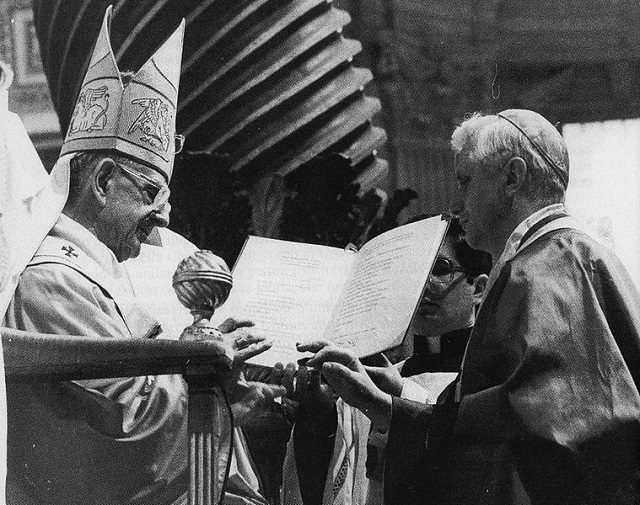
Photo credit: Pope St. Paul VI makes Fr. Joseph Ratzinger a Cardinal: 27 June 1977 [public domain / Wikimedia Commons]

***
Traditionalism vs. Radical Catholic Reactionaries
Radical Catholic Reactionaries
Previous Post
July 17, 2019
Vs. Pasqualucci Re Vatican II #7: Dei Verbum & Tradition
Next Post

July 18, 2019 Vs. Pasqualucci Re Vatican II #9: DH & Religious Liberty
Browse Our Archives
Select a Category & Last Things About Me Anti-Catholicism Atheism & Agnosticism Baptism and Sacramentalism Bible and Tradition Blessed Virgin Mary Books by Dave Armstrong C. S. Lewis Calvinism & General Protestantism Catholic Apologetics Catholic Apologists Catholic conversion Catholic converts Christmas Church (Ecclesiology) Church History Conversion and Converts Development of Doctrine Eastern Orthodoxy Ecumenism & Christian Unity Eucharist & Liturgy Fathers of the Church French Translations G. K. Chesterton Hell Hell & Satan Hell & Satan & Last Things Heresies & Comparative Religion Holistic Health Inquisition & Crusades & Scandals James White Jews & Judaism & Old Testament John Calvin John Henry Newman Liberal / Modernist Theology Life Issues Literary Resume Lutheranism Mariology Martin Luther Music Orthodoxy Papacy & Infallibility Personal Page Philosophy & Science Political & Ethical & Moral Issues Protestant Persecution & Intolerance Protestantism Purgatory Purgatory & Penance Romantic & Imaginative Theology Saints & Purgatory & Penance Salvation Salvation & Justification Satan & Last Things Sexuality and Gender Issues Spanish Translations Traditionalism vs. Radical Catholic Reactionaries Traducciones al español / tradução para português Trinitarianism & Christology Uncategorized Videos
Select a Month October 2026 September 2026 August 2026 July 2026 June 2026 May 2026 April 2026 March 2026 February 2026 January 2026 December 2025 November 2025 October 2025 September 2025 August 2025 July 2025 June 2025 May 2025 April 2025 March 2025 February 2025 January 2025 December 2024 November 2024 October 2024 September 2024 August 2024 July 2024 June 2024 May 2024 April 2024 March 2024 February 2024 January 2024 December 2023 November 2023 October 2023 September 2023 August 2023 July 2023 June 2023 May 2023 April 2023 March 2023 February 2023 January 2023 December 2022 November 2022 October 2022 September 2022 August 2022 July 2022 June 2022 May 2022 April 2022 March 2022 February 2022 January 2022 December 2021 November 2021 October 2021 September 2021 August 2021 July 2021 June 2021 May 2021 April 2021 March 2021 February 2021 January 2021 December 2020 November 2020 October 2020 September 2020 August 2020 July 2020 June 2020 May 2020 April 2020 March 2020 February 2020 January 2020 December 2019 November 2019 October 2019 September 2019 August 2019 July 2019 June 2019 May 2019 April 2019 March 2019 February 2019 January 2019 December 2018 November 2018 October 2018 September 2018 August 2018 July 2018 June 2018 May 2018 April 2018 March 2018 February 2018 January 2018 December 2017 November 2017 October 2017 September 2017 August 2017 July 2017 June 2017 May 2017 April 2017 March 2017 February 2017 January 2017 December 2016 November 2016 October 2016 September 2016 August 2016 July 2016 June 2016 May 2016 April 2016 March 2016 February 2016 January 2016 December 2015 November 2015 October 2015 September 2015 August 2015 July 2015 June 2015 May 2015 April 2015 March 2015 February 2015 January 2015 December 2014 November 2014 October 2014 September 2014 August 2014 July 2014 June 2014 April 2014 March 2014 February 2014 January 2014 December 2013 November 2013 October 2013 September 2013 August 2013 July 2013 June 2013 April 2013 March 2013 February 2013 January 2013 December 2012 November 2012 October 2012 September 2012 August 2012 July 2012 June 2012 May 2012 April 2012 March 2012 February 2012 January 2012 December 2011 November 2011 October 2011 September 2011 August 2011 July 2011 June 2011 April 2011 March 2011 February 2011 October 2010 September 2010 August 2010 July 2010 April 2010 March 2010 December 2009 October 2009 August 2009 July 2009 June 2009 May 2009 March 2009 February 2009 October 2008 September 2008 April 2008 March 2008 February 2008 January 2008 December 2007 November 2007 October 2007 May 2007 March 2007 February 2007 January 2007 November 2006 October 2006 September 2006 August 2006 July 2006 June 2006 May 2006 April 2006 March 2006 February 2006 October 2005 June 2005 April 2005 February 2005 July 2004 May 2004 April 2004
Follow Us!
TAKE THE
Religious Wisdom Quiz
What famous cathedral is in Paris, known for its flying buttresses and rose windows?
Select your answer to see how you score.
Notre Dame St. Paul's St. Peter's Canterbury
Books by This Author Books by Dave Armstrong
Related posts from Biblical Evidence for Catholicism

Jesus Founded the [Catholic] Church. If Not Him,...
Biblical Evidence for Catholicism

Jerusalem Council vs. James White & Sola Scriptura
Biblical Evidence for Catholicism

Apostolic Succession: 40 Biblical Arguments
Biblical Evidence for Catholicism

350 Bible Passages vs. Sola Scriptura
Biblical Evidence for Catholicism
TRENDING AT PATHEOS Catholic

In "Irreplaceable," our book on vocation and technology, Trevor Sutton and I...

I was strolling through the top floor of the brand new Parthenon...

What Does Gêvâh Mean For Kimberley Guifoyle &...
This week, a lot of the news is focused on Kimberly Guilfoyle....

INNER CIRCLE: Profound Mystery (Of Christ In All...
Ephesians 5:31-32 “For this reason, a man will leave his father and...

Do Not Rejoice When Your Enemy Falls: The...
Turning an execution into a public spectacle is a disturbing expression of...

'The Chosen' S6 Trailer: The Passion Gets Very...
Not many watching 'The Chosen' worry about spoilers, but just because they...
view all Catholic blogs
Ad-Free & Subscriber Log-In Subscription Support
- About Us
- 2026 Calendar
- Videos
- Podcasts
- Library of World Religions
- Faith In Media Tracker
- Advertise With Us
- Write for Us
- Privacy Policy
- Terms of Service
- Do Not Sell My Data
- Contact Us
- Radiant Digital
- Manage Newsletter Subscriptions
- Unsubscribe From Notifications
- Sitemap
Copyright 2008-2026, Patheos. All rights reserved.
Subscription Support Ad-Free & Subscriber Log-In
Follow Patheos