
BuddhistCatholicContemplativeEvangelicalGeneral ChristianHinduJewishLatter-day SaintMuslimNew VisionsProgressive Christian
Beliefs
- Buddhist
- Catholic
- Contemplative
- Evangelical
- General Christian
- Hindu
- Jewish
- Latter-day Saint
- More Voices
- Muslim
- New Visions
- Pagan
- Progressive Christian
Topics
- Religion News
- Food and Religion
- Sports and Religion
- Religious Art
- Religious Music and Entertainment
- Religious Events
- History and Religion
- Style and Religion
- Politics and Religion
- Women in Religion
- Recreation Outdoors and Religion
- Business Finance and Religion
- Careers Workplace and Religion
- Education and Religion
- Family Parenting and Religion
- Health Fitness and Religion
- Home and Religion
- Relationships and Religion
- Technology and Religion
- Travel and Religion
Columnists
- Buddhist Columnists
- Business Finance and Religion Columnists
- Careers Workplace and Religion Columnists
- Catholic Columnists
- Contemplative Columnists
- Education and Religion Columnists
- Evangelists Columnists
- Family Parenting and Religion Columnists
- General Christian Columnists
- Health Fitness and Religion Columnists
- Hindu Columnists
- History and Religion Columnists
- Home and Religion Columnists
- Jewish Columnists
- More Voices Columnists
- Latter Day Columnists
- Muslim Columnists
- New Visions Columnists
- Nonreligious Columnists
- Pagan Columnists
- Politics and Religion Columnists
- Progressive Columnists
- Recreation Outdoors and Religion Columnists
- Relationships and Religion Columnists
- Religion News Columnists
- Religious Art Columnists
- Religious Events Columnists
- Religious Music and Entertainment Columnists
- Sports and Religion Columnists
- Style and Religion Columnists
- Technology and Religion Columnists
- Travel and Religion Columnists
- Women in Religion Columnists
Resource Library
- 2026 Calendar
- Library of World Religions
- The 100 Most Holy Places on Earth
- Patheos Answers
- Podcasts
- Videos
- Faith Leaders Database
- Anglican Episcopalian
- Bahai
- Baptist
- Buddhism
- Christianity
- Confucianism
- Eastern Orthodoxy
- Hinduism
- Holiness and Pentecostal
- ISKCON
- Islam
- Judaism
- Lutheran
- Methodist
- The Church of Jesus Christ of Latter-day Saints
- New Age
- Paganism
- Presbytarian and Reformed
- Protestantism
- Religion Behind the Scenes
- Roman Catholic
- Scientology
- Shia Islam
- Sikhism
- Sufism
- Sunni Islam
- Taoism
- Zen
- See all religions
Research Tools
 Ad-Free & Subscriber Log-In Subscription Support
Ad-Free & Subscriber Log-In Subscription Support
Follow Patheos 

- Trending:
- Forgiveness
- |
- Marriage
- |
- Consciousness
- |
- Death Penalty
- |
- Election
- |
- Halloween

-
About
-
Catholic Apologetics
-
Church History
-
Great Apologists
-
Christian Worldview
-
Protestantism & Misc.
- Home
- Catholic
- History and Religion
- Vs. Pasqualucci Re Vatican II #1: Gaudium et Spes (Incarnation)
Vs. Pasqualucci Re Vatican II #1: Gaudium et Spes (Incarnation)
Last updated on: July 23, 2019 at 11:17 am by Dave Armstrong
Vs. Pasqualucci Re Vatican II #1: Gaudium et Spes (Incarnation) 2019-07-23T11:17:48-04:00 Dave Armstrong
Patheos Explore the world's faith through different perspectives on religion and spirituality! Patheos has the views of the prevalent religions and spiritualities of the world.
[see the Master List of all twelve installments]
Paolo Pasqualucci (signer of three of the endless reactionary-dominated “corrections” of Pope Francis), a Catholic and retired professor of philosophy of the law at the University of Perugia, Italy, wrote “‘Points of Rupture’ of the Second Vatican Council with the Tradition of the Church – A Synopsis” (4-13-18), hosted by the infamous reactionary site, One Peter Five. It’s an adaptation of the introduction to his book Unam Sanctam – A Study on Doctrinal Deviations in the Catholic Church of the 21st Century.
Pope Benedict XVI, writing as Cardinal Ratzinger, stated that the authority of Vatican II was identical to that of the Council of Trent:
It must be stated that Vatican II is upheld by the same authority as Vatican I and the Council of Trent, namely, the Pope and the College of Bishops in communion with him, and that also with regard to its contents, Vatican II is in the strictest continuity with both previous councils and incorporates their texts word for word in decisive points . . .
Whoever accepts Vatican II, as it has clearly expressed and understood itself, at the same time accepts the whole binding tradition of the Catholic Church, particularly also the two previous councils . . . It is likewise impossible to decide in favor of Trent and Vatican I but against Vatican II. Whoever denies Vatican II denies the authority that upholds the other two councils and thereby detaches them from their foundation. And this applies to the so-called ‘traditionalism,’ also in its extreme forms. Every partisan choice destroys the whole (the very history of the Church) which can exist only as an indivisible unity.
To defend the true tradition of the Church today means to defend the Council. It is our fault if we have at times provided a pretext (to the ‘right’ and ‘left’ alike) to view Vatican II as a ‘break’ and an abandonment of the tradition. There is, instead, a continuity that allows neither a return to the past nor a flight forward, neither anachronistic longings nor unjustified impatience. We must remain faithful to the today of the Church, not the yesterday or tomorrow. And this today of the Church is the documents of Vatican II, without reservations that amputate them and without arbitrariness that distorts them . . .
I see no future for a position that, out of principle, stubbornly renounces Vatican II. In fact in itself it is an illogical position. The point of departure for this tendency is, in fact, the strictest fidelity to the teaching particularly of Pius IX and Pius X and, still more fundamentally, of Vatican I and its definition of papal primacy. But why only popes up to Pius XII and not beyond? Is perhaps obedience to the Holy See divisible according to years or according to the nearness of a teaching to one’s own already-established convictions? (The Ratzinger Report, San Francisco: Ignatius, 1985, 28-29, 31)
For further basic information about the sublime authority of ecumenical councils and Vatican II in particular, see:
Conciliar Infallibility: Summary from Church Documents [6-5-98]
The Bible on Papal & Church Infallibility [5-16-06]
Authority and Infallibility of Councils (vs. Calvin #26) [8-25-09]
The Analogy of an Infallible Bible to an Infallible Church [11-6-05; rev. 7-25-15; published at National Catholic Register: 6-16-17]
“Reply to Calvin” #2: Infallible Church Authority [3-3-17]
“On Adhesion to the Second Vatican Council” (Msgr. Fernando Ocariz Braña, the current Prelate of Opus Dei, L’Osservatore Romano, 12-2-11; reprinted at Catholic Culture) [includes discussion of VCII supposedly being “only” a “pastoral council”]
Pope Benedict on “the hermeneutic of reform, of renewal within continuity” (12-22-05)
The words of Paolo Pasqualucci, from his article, noted above, will be in blue:
*****
1. It appears that the actual meaning attributed to the Pastoral Constitution Gaudium et Spes On the Church In the Modern World (GS) does not conform to the Tradition of the Church; it seems on the whole to be permeated with the spirit of the so-called “new Enlightenment.”
This is too vague and offers no particular argument or critique, so I can’t reply.
2. GS 22.2 affirms that by His Incarnation the Son of God “has united Himself in some fashion with every man,” an extraordinary affirmation, which seems to extend the Incarnation to each one of us, thereby divinizing man.
Dr. Pasqualucci appears to be unfamiliar with theosis or deification or divinization. What these words (synonyms) mean is summarized in the Catechism of the Catholic Church:
460 The Word became flesh to make us “partakers of the divine nature“:78 “For this is why the Word became man, and the Son of God became the Son of man: so that man, by entering into communion with the Word and thus receiving divine sonship, might become a son of God.”79 “For the Son of God became man so that we might become God.”80 “The only-begotten Son of God, wanting to make us sharers in his divinity, assumed our nature, so that he, made man, might make men gods.”81
Footnotes:
78 2 Pt 1:4.
79 St. Irenaeus, Adv. haeres. 3, 19, 1: PG 7/1, 939.
80 St. Athanasius, De inc. 54, 3: PG 25, 192B.
81 St. Thomas Aquinas, Opusc. 57, 1-4.
Here are the first three references in the footnotes:
2 Peter 1:4 (RSV) . . . you may escape from the corruption that is in the world because of passion, and become partakers of the divine nature.
- But again, those who assert that He was simply a mere man, begotten by Joseph, remaining in the bondage of the old disobedience, are in a state of death having been not as yet joined to the Word of God the Father, nor receiving liberty through the Son, as He does Himself declare: If the Son shall make you free, you shall be free indeed.John 8:36 But, being ignorant of Him who from the Virgin is Emmanuel, they are deprived of His gift, which is eternal life; Romans 6:23 and not receiving the incorruptible Word, they remain in mortal flesh, and are debtors to death, not obtaining the antidote of life. To whom the Word says, mentioning His own gift of grace: I said, You are all the sons of the Highest, and gods; but you shall die like men. He speaks undoubtedly these words to those who have not received the gift of adoption, but who despise the incarnation of the pure generation of the Word of God, defraud human nature of promotion into God, and prove themselves ungrateful to the Word of God, who became flesh for them. For it was for this end that the Word of God was made man, and He who was the Son of God became the Son of man, that man, having been taken into the Word, and receiving the adoption, might become the son of God. For by no other means could we have attained to incorruptibility and immortality, unless we had been united to incorruptibility and immortality. But how could we be joined to incorruptibility and immortality, unless, first, incorruptibility and immortality had become that which we also are, so that the corruptible might be swallowed up by incorruptibility, and the mortal by immortality, that we might receive the adoption of sons? (St. Irenaeus, Against Heresies, III, 19:1)
For He was made man that we might be made God; and He manifested Himself by a body that we might receive the idea of the unseen Father; and He endured the insolence of men that we might inherit immortality. (St. Athanasius, On the Incarnation 54:3, PG 25:192B)
St. Thomas Aquinas stated:
Moreover, He has a particular agreement with human nature, since the Word is a concept of the eternal Wisdom, from Whom all man’s wisdom is derived. And hence man is perfected in wisdom (which is his proper perfection, as he is rational) by participating the Word of God, as the disciple is instructed by receiving the word of his master. Hence it is said (Sirach 1:5): “The Word of God on high is the fountain of wisdom.” And hence for the consummate perfection of man it was fitting that the very Word of God should be personally united to human nature. (ST III, q. 3. a. 8)
One of the reasons for the incarnation, according to St. Thomas, is for “the full participation of the Divinity, which is the true bliss of man and end of human life; and this is bestowed upon us by Christ’s humanity; for Augustine says in a sermon (xiii de Temp): ‘God was made man, that man might be made God‘ ” (ST III, q. 1 a. 2). St. Thomas also wrote:
Now the gift of grace surpasses every capability of created nature, since it is nothing short of a partaking of the Divine Nature, which exceeds every other nature. And thus it is impossible that any creature should cause grace. For it is as necessary that God alone should deify, bestowing a partaking of the Divine Nature by a participated likeness, as it is impossible that anything save fire should enkindle. (Summa Theologica, First Part of the Second Part, Q. 112: The Cause of Grace, Art. 1: Whether God Alone is the Cause of Grace)
That can hardly be anti-traditional and a “rupture” can it?: seeing that it is based on the Bible, St. Irenaeus, St. Augustine, St. Athanasius, and St. Thomas Aquinas. What more does one require? For more on the basics of theosis, see my papers:
Theosis and the Exalted Virgin Mary [7-11-04]
“In Him” An Expression of the Oneness of Theosis? [3-13-14]
Here now is the disputed section of Gaudium et Spes:
[section 22, 2nd paragraph] He Who is “the image of the invisible God” (Col. 1:15), (21) is Himself the perfect man. To the sons of Adam He restores the divine likeness which had been disfigured from the first sin onward. Since human nature as He assumed it was not annulled, (22) by that very fact it has been raised up to a divine dignity in our respect too. For by His incarnation the Son of God has united Himself in some fashion with every man. He worked with human hands, He thought with a human mind, acted by human choice (23) and loved with a human heart. Born of the Virgin Mary, He has truly been made one of us, like us in all things except sin. (24)
Footnotes:
Cf. 2 Cor. 4:4.
Cf. Second Council of Constantinople, canon 7: “The divine Word was not changed into a human nature, nor was a human nature absorbed by the Word.” Denzinger 219 (428); Cf. also Third Council of Constantinople: “For just as His most holy and immaculate human nature, though deified, was not destroyed (theotheisa ouk anerethe), but rather remained in its proper state and mode of being”: Denzinger 291 (556); Cf. Council of Chalcedon:” to be acknowledged in two natures, without confusion change, division, or separation.” Denzinger 148 (302).
Cf. Third Council of Constantinople: “and so His human will, though deified, is not destroyed”: Denzinger 291 (556).
Cf. Heb. 4:15.
I think it’s quite clear that the intended meaning here is in line with what has been presented above from Holy Tradition and the Bible. If “every man” is the “gripe within a gripe” then that is easily explained as referring to universal atonement. This is made clear in paragraph 5:
For, since Christ died for all men, (32: “Cf. Rom. 8:32.”) and since the ultimate vocation of man is in fact one, and divine, we ought to believe that the Holy Spirit in a manner known only to God offers to every man the possibility of being associated with this paschal mystery.
Holy Scripture itself often refers to “all men” or “the world,” etc., with regard to salvation, but we know (all relevant texts considered) that it is referring to universal atonement (i.e., a universal possibility or offer of salvation by His free grace), and not universalism (all people are saved):
Wisdom 16:12 For neither herb nor poultice cured them, but it was thy word, O Lord, which heals all men.
Luke 3:6 and all flesh shall see the salvation of God.
John 3:17 For God sent the Son into the world, not to condemn the world, but that the world might be saved through him. (cf. 4:42; 6:33; 6:51; 8:12; 9:5; 12:47; 2 Cor 5:19; 1 Jn 4:14)
John 12:32 and I, when I am lifted up from the earth, will draw all men to myself.
Romans 5:18 Then as one man’s trespass led to condemnation for all men, so one man’s act of righteousness leads to acquittal and life for all men.
Ephesians 3:9 and to make all men see what is the plan of the mystery hidden for ages in God who created all things; (cf. 1:9-10)
1 Timothy 2:3-6 . . . God our Savior, [4] who desires all men to be saved and to come to the knowledge of the truth. [5] For there is one God, and there is one mediator between God and men, the man Christ Jesus, [6] who gave himself as a ransom for all, the testimony to which was borne at the proper time.
1 Timothy 4:10 For to this end we toil and strive, because we have our hope set on the living God, who is the Savior of all men, especially of those who believe.
Titus 2:11 For the grace of God has appeared for the salvation of all men,
2 Peter 3:9 The Lord is not slow about his promise as some count slowness, but is forbearing toward you, not wishing that any should perish, but that all should reach repentance.
Hence, the objection vanishes.
***
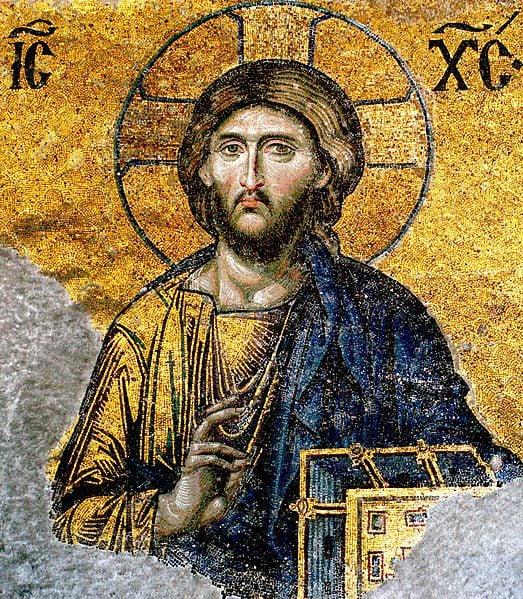
Photo credit: Edal Anton Lefterov (3-31-06): Jesus Christ – detail from Deesis mosaic (13th c.), Hagia Sophia, Istanbul [Wikimedia Commons / Creative Commons Attribution-Share Alike 3.0 Unported license]

Traditionalism vs. Radical Catholic Reactionaries
Radical Catholic Reactionaries
Previous Post

July 10, 2019
Wickedness of Christian Division & Anti-Protestantism
Next Post
July 11, 2019 Vs. Pasqualucci Re Vatican II #2: Unitatis Redintegratio (Salvation)
Browse Our Archives
Select a Category & Last Things About Me Anti-Catholicism Atheism & Agnosticism Baptism and Sacramentalism Bible and Tradition Blessed Virgin Mary Books by Dave Armstrong C. S. Lewis Calvinism & General Protestantism Catholic Apologetics Catholic Apologists Catholic conversion Catholic converts Christmas Church (Ecclesiology) Church History Conversion and Converts Development of Doctrine Eastern Orthodoxy Ecumenism & Christian Unity Eucharist & Liturgy Fathers of the Church French Translations G. K. Chesterton Hell Hell & Satan Hell & Satan & Last Things Heresies & Comparative Religion Holistic Health Inquisition & Crusades & Scandals James White Jews & Judaism & Old Testament John Calvin John Henry Newman Liberal / Modernist Theology Life Issues Literary Resume Lutheranism Mariology Martin Luther Music Orthodoxy Papacy & Infallibility Personal Page Philosophy & Science Political & Ethical & Moral Issues Protestant Persecution & Intolerance Protestantism Purgatory Purgatory & Penance Romantic & Imaginative Theology Saints & Purgatory & Penance Salvation Salvation & Justification Satan & Last Things Sexuality and Gender Issues Spanish Translations Traditionalism vs. Radical Catholic Reactionaries Traducciones al español / tradução para português Trinitarianism & Christology Uncategorized Videos
Select a Month October 2026 September 2026 August 2026 July 2026 June 2026 May 2026 April 2026 March 2026 February 2026 January 2026 December 2025 November 2025 October 2025 September 2025 August 2025 July 2025 June 2025 May 2025 April 2025 March 2025 February 2025 January 2025 December 2024 November 2024 October 2024 September 2024 August 2024 July 2024 June 2024 May 2024 April 2024 March 2024 February 2024 January 2024 December 2023 November 2023 October 2023 September 2023 August 2023 July 2023 June 2023 May 2023 April 2023 March 2023 February 2023 January 2023 December 2022 November 2022 October 2022 September 2022 August 2022 July 2022 June 2022 May 2022 April 2022 March 2022 February 2022 January 2022 December 2021 November 2021 October 2021 September 2021 August 2021 July 2021 June 2021 May 2021 April 2021 March 2021 February 2021 January 2021 December 2020 November 2020 October 2020 September 2020 August 2020 July 2020 June 2020 May 2020 April 2020 March 2020 February 2020 January 2020 December 2019 November 2019 October 2019 September 2019 August 2019 July 2019 June 2019 May 2019 April 2019 March 2019 February 2019 January 2019 December 2018 November 2018 October 2018 September 2018 August 2018 July 2018 June 2018 May 2018 April 2018 March 2018 February 2018 January 2018 December 2017 November 2017 October 2017 September 2017 August 2017 July 2017 June 2017 May 2017 April 2017 March 2017 February 2017 January 2017 December 2016 November 2016 October 2016 September 2016 August 2016 July 2016 June 2016 May 2016 April 2016 March 2016 February 2016 January 2016 December 2015 November 2015 October 2015 September 2015 August 2015 July 2015 June 2015 May 2015 April 2015 March 2015 February 2015 January 2015 December 2014 November 2014 October 2014 September 2014 August 2014 July 2014 June 2014 April 2014 March 2014 February 2014 January 2014 December 2013 November 2013 October 2013 September 2013 August 2013 July 2013 June 2013 April 2013 March 2013 February 2013 January 2013 December 2012 November 2012 October 2012 September 2012 August 2012 July 2012 June 2012 May 2012 April 2012 March 2012 February 2012 January 2012 December 2011 November 2011 October 2011 September 2011 August 2011 July 2011 June 2011 April 2011 March 2011 February 2011 October 2010 September 2010 August 2010 July 2010 April 2010 March 2010 December 2009 October 2009 August 2009 July 2009 June 2009 May 2009 March 2009 February 2009 October 2008 September 2008 April 2008 March 2008 February 2008 January 2008 December 2007 November 2007 October 2007 May 2007 March 2007 February 2007 January 2007 November 2006 October 2006 September 2006 August 2006 July 2006 June 2006 May 2006 April 2006 March 2006 February 2006 October 2005 June 2005 April 2005 February 2005 July 2004 May 2004 April 2004
Follow Us!
TAKE THE
Religious Wisdom Quiz
What does the Bible say about greed?
Select your answer to see how you score.
It leads to ruin It is always wise It is best It helps you win
Books by This Author Books by Dave Armstrong
Related posts from Biblical Evidence for Catholicism

Bible & Catholicism on Mortal Sin (vs. John...
Biblical Evidence for Catholicism

Dialogue on Eternal Security / Absolute Assurance
Biblical Evidence for Catholicism

Jesus Founded the [Catholic] Church. If Not Him,...
Biblical Evidence for Catholicism

"Faith Alone" Dialogue with a Calvinist
Biblical Evidence for Catholicism
TRENDING AT PATHEOS Catholic

Janie Learns the Way of the Cross: A...
Teaching children about Jesus' Passion can be challenging. Many parents and educators...

Looking For Good Catholic Writing - October 2026
He alone extends the heavens, and he walks upon the waves of...

In "Irreplaceable," our book on vocation and technology, Trevor Sutton and I...

I was strolling through the top floor of the brand new Parthenon...

What Does Gêvâh Mean For Kimberley Guifoyle &...
This week, a lot of the news is focused on Kimberly Guilfoyle....

INNER CIRCLE: Profound Mystery (Of Christ In All...
Ephesians 5:31-32 “For this reason, a man will leave his father and...
view all Catholic blogs
Ad-Free & Subscriber Log-In Subscription Support
- About Us
- 2026 Calendar
- Videos
- Podcasts
- Library of World Religions
- Faith In Media Tracker
- Advertise With Us
- Write for Us
- Privacy Policy
- Terms of Service
- Do Not Sell My Data
- Contact Us
- Radiant Digital
- Manage Newsletter Subscriptions
- Unsubscribe From Notifications
- Sitemap
Copyright 2008-2026, Patheos. All rights reserved.
Subscription Support Ad-Free & Subscriber Log-In
Follow Patheos